

What do you think?

La Comédie Humaine #78
The Recruit
An 1831 short story, Le Réquisitionnaire takes place in November 1793 and features Madame de Dey, a danger seeking aristocrat, whose one love is for her son, the sole heir of the family. Already widowed at the time of the Terror, she has retired from Court and settled in Carentan, where she is apparently the most popular person in town. However, rumours run wild when Madame de Dey's evenings are cancelled twice in a row.
26 pages, Paperback
First published January 1, 1831
About the author
Honoré de Balzac
10.2k books4,556 followersFrench writer Honoré de Balzac (born Honoré Balzac), a founder of the realist school of fiction, portrayed the panorama of society in a body of works, known collectively as
La comédie humaine
.
Honoré de Balzac authored 19th-century novels and plays. After the fall of Napoléon in 1815, his magnum opus, a sequence of almost a hundred novels and plays, entitled, presents life in the years.
Due to keen observation of fine detail and unfiltered representation, European literature regards Balzac. He features renowned multifaceted, even complex, morally ambiguous, full lesser characters. Character well imbues inanimate objects; the city of Paris, a backdrop, takes on many qualities. He influenced many famous authors, including the novelists Marcel Proust, Émile Zola, Charles John Huffam Dickens, Gustave Flaubert, Henry James, and Jack Kerouac as well as important philosophers, such as Friedrich Engels. Many works of Balzac, made into films, continue to inspire.
An enthusiastic reader and independent thinker as a child, Balzac adapted with trouble to the teaching style of his grammar. His willful nature caused trouble throughout his life and frustrated his ambitions to succeed in the world of business. Balzac finished, and people then apprenticed him as a legal clerk, but after wearying of banal routine, he turned his back on law. He attempted a publisher, printer, businessman, critic, and politician before and during his career. He failed in these efforts From his own experience, he reflects life difficulties and includes scenes.
Possibly due to his intense schedule and from health problems, Balzac suffered throughout his life. Financial and personal drama often strained his relationship with his family, and he lost more than one friend over critical reviews. In 1850, he married Ewelina Hańska, his longtime paramour; five months later, he passed away.
Honoré de Balzac authored 19th-century novels and plays. After the fall of Napoléon in 1815, his magnum opus, a sequence of almost a hundred novels and plays, entitled, presents life in the years.
Due to keen observation of fine detail and unfiltered representation, European literature regards Balzac. He features renowned multifaceted, even complex, morally ambiguous, full lesser characters. Character well imbues inanimate objects; the city of Paris, a backdrop, takes on many qualities. He influenced many famous authors, including the novelists Marcel Proust, Émile Zola, Charles John Huffam Dickens, Gustave Flaubert, Henry James, and Jack Kerouac as well as important philosophers, such as Friedrich Engels. Many works of Balzac, made into films, continue to inspire.
An enthusiastic reader and independent thinker as a child, Balzac adapted with trouble to the teaching style of his grammar. His willful nature caused trouble throughout his life and frustrated his ambitions to succeed in the world of business. Balzac finished, and people then apprenticed him as a legal clerk, but after wearying of banal routine, he turned his back on law. He attempted a publisher, printer, businessman, critic, and politician before and during his career. He failed in these efforts From his own experience, he reflects life difficulties and includes scenes.
Possibly due to his intense schedule and from health problems, Balzac suffered throughout his life. Financial and personal drama often strained his relationship with his family, and he lost more than one friend over critical reviews. In 1850, he married Ewelina Hańska, his longtime paramour; five months later, he passed away.
Ratings & Reviews
Friends & Following
Create a free account to discover what your friends think of this book!
Community Reviews
Displaying 1 - 29 of 29 reviews

October 28, 2019
Στα 1831, ο Balzac είναι 32 ετών. Συνεχίζει να εξασφαλίζει τα προς το ζην γράφοντας, συχνά με βιασύνη και προχειρότητα, διηγήματα για λογαριασμό διάφορων περιοδικών, και το μυθιστόρημά του με τίτλο "La peau de chagrin" (Το μαγικό δέρμα) έχει ήδη εκδοθεί (την ίδια χρονιά, 1931) σημειώνοντας μια σχετική επιτυχία, από τον εκδότη C. Gosselin, με τον οποίο ο Balzac καυγαδίζει για οικονομικούς λόγους:
"Θα αρκεστώ στις εφημερίδες που τη στιγμή αυτή μου προσφέρουν περισσότερα χρήματα απ' όσα είχα ποτέ ελπίσει" γράφει ο συγγραφέας σε μια επιστολή του προς τον εκδότη του.
Πράγματι τα εισοδήματά του από τα περιοδικά αλλά και η επιτυχία του "Μαγικού δέρματος" αρκούν για να του εξασφαλίσουν πλέον μια πιο άνετη ζωή. Φρόντισε να αγοράσει άλογα και άμαξα με δικό του μονόγραμμα και οικόσημο, υπέγραψε ένα νέο μισθωτήριο για το σπίτι που είχε νοικιάσει στα 1828 (το επονομαζόμενο la Folie Beaujon), στη Rue Cassini, και πλέον διαθέτει πέντε δωμάτια τα οποία διακοσμεί πλουσιοπάροχα και προβαίνει σε γενικές ανακαινίσεις που περιλαμβάνουν ένα αμαξοστάσιο, κάβα και στάβλο. Έχει επίσης υπηρέτη με λιβρέα και παραγγέλνει στον ράφτη του τρεις άσπρες ρόμπες για να μπορεί να αισθάνεται ζεστά και άνετα τις ώρες που εργάζεται. Οι επαφές του με τα παριζιάνικα κοσμικά σαλόνια αυξάνονται. Το ίδιο και τα χρέη του φυσικά, καθώς με όλες αυτές τις υπερβολές καταλήγει να ζει πάνω από τις δυνατότητές του.
Το σπίτι του Balzac:
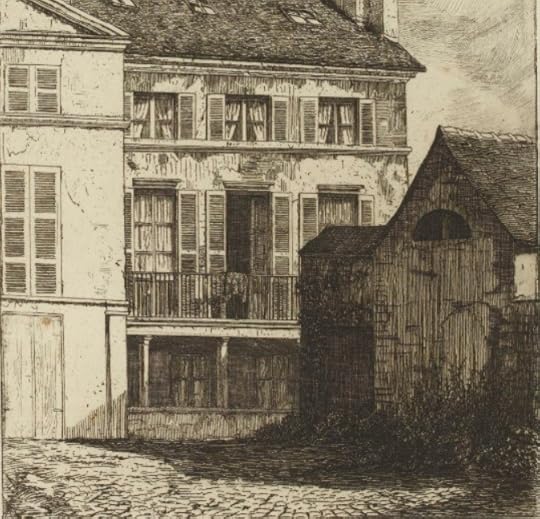
Πηγή: https://gallica.bnf.fr/ark:/12148/btv...
Στις 20 Σεπτεμβρίου 1831 κυκλοφορεί ξανά από τον Gosselin (παρά τις απειλές του για το αντίθετο) το τρίτομο έργο με γενικό τίτλο: Romans et contes philosophiques (Φιλοσοφικά διηγήματα και μυθιστορήματα). Ο πρώτος τόμος περιλαμβάνει το "Μαγικό δέρμα", ο δεύτερος τόμος συνεχίζει με το υπόλοιπο του "Μαγικού δέρματος" (Suite et fin de La peau de chagrin) και τα: Sarrasine, La comédie du diable, El Verdugo. Ο τρίτος τόμος περιλαμβάνει τα διηγήματα: L'enfant maudit, L'élixir de longue vie, Les proscrits, Le chef-d'oeuvre inconnu, Le réquisitionnaire, Étude de femme, Les deux rêves, Jésus-Christ en Flandre, L'église.
Το διήγημα "Le réquisitionnaire" (κληρωτός, στρατολογημένος, επίστρατος) είναι εκ πρώτη όψεως μια σύντομη και πρόχειρη έως αδιάφορη ιστορία που δημοσιεύτηκε αρχικά στις 27 Φεβρουαρίου 1831 στην "Επιθεώρηση των Παρισίων" (Revue de Paris).
Η Madame de Dey... είναι μια πλούσια γυναίκα 38 ετών, η οποία λίγο μετά το ξέσπασμα της Γαλλικής Επανάστασης εγκατέλειψε το Παρίσι και επέστρεψε στο Carendan της Νορμανδίας για να διαχειριστεί την προσωπική της περιουσία. Η υπόθεση του έργου εκτυλίσσεται κατά το Νοέμβριο του 1793, δηλαδή την εποχή της Γαλλικής Τρομοκρατίας (La Terreur). Η Madame de Dey... διατηρεί ένα κοσμικό σαλόνι και φροντίζει να έχει καλές σχέσεις με όλους τους σημαντικούς εκπροσώπους της τοπικής κοινωνίας. Κάποιοι συμπεριφέρονται ως υποψήφιοι μνηστήρες αλλά εκείνη, ούσα μικροπαντρεμένη και χήρα πλέον, είναι ολόψυχα αφοσιωμένη, με μια παθολογική αγάπη που θυμίζει ερωτικό πάθος, στο νεαρό της γιο, έναν υπολοχαγό των δραγόνων, ο οποίος δεν ζει μαζί της, καθώς έχει ακολουθήσει τους άλλους ευγενείς στην εξορία (Émigré).
Όταν ξαφνικά η ηρωίδα παύει να δεξιώνεται στο σαλόνι της και κλείνεται στο σπίτι της με την πρόφαση κάποια μυστηριώδους ασθένειας, όλη η πόλη αναστατώνεται και το κουτσομπολιό δίνει και παίρνει. Είναι πραγματικά άρρωστη; Μήπως κρύβεται με τη συντροφιά κάποιου εραστή; Ή μήπως οργανώνει κάποια συνωμοσία ενάντια στο καθεστώς;
Ο αδελφός του δημάρχου, ένας έντιμος, ηλικιωμένος έμπορος καταφέρνει να κερδίσει την εμπιστοσύνη της και μαθαίνει την αλήθεια:
Όλη η ιστορία εκτυλίσσεται γύρω από αυτό ακριβώς το γεγονός και την αγωνία της ηρωίδας που ανοίγει ξανά το σαλόνι της και είναι υποχρεωμένη να διατηρήσει τα προσχήματα ώστε να καθησυχάσει τις υποψίες την ίδια ώρα που ένας
Αυτό που έχει το μεγαλύτερο ενδιαφέρον είναι το τέλος της ιστορίας. Το οποίο είναι αρκετά προβλέψιμο, ωστόσο εξηγεί τον λόγο που ο Balzac ενέταξε το συγκεκριμένο έργο του στα φιλοσοφικά διηγήματα:
Ο Balzac, εξαιτίας της μητέρας του, είχε μεγάλο ενδιαφέρον για φαινόμενα όπως ο μεσμερισμός (ύπνωση) και η μαντεία μέσω διαμέσων (μέντιουμ, χαρτομάντεις κτλ). Πίστευε στην τηλεπάθεια και θεωρούσε πως δύο άνθρωποι που μοιράζονται βαθύτατα αισθήματα αγάπης έχουν τη δύναμη να επικοινωνούν νοερά.
Ακριβώς αυτού του είδους οι αντιλήψεις αποτελούν τον πυρήνα του φιλοσοφικού συστήματος του Balzac, οποίος βλέπει τους συγγραφείς και τους ποιητές ως διάμεσους που αποκαλύπτουν την πραγματικότητα στους συνανθρώπους τους. Στην Εισαγωγή της πρώτης έκδοσης του μαγικού δέρματος αναφέρει:
"Outre ces deux conditions essentielles au talent, il se passe chez les poètes ou chez les écrivains réellement philosophes, un phénomène moral, inexplicable, inouï, dont la science peut difficilement rendre compte. C'est une sorte de secondevue qui leur permet de deviner la vérité dans toutes les situations possibles ; ou, mieux encore, je ne sais quelle puissance qui les transporte là où ils doivent, où ils veulent être".
"Παράλληλα με αυτές τις δύο σημαντικές για το ταλέντο προϋποθέσεις, στους ποιητές και στους συγγραφείς οι οποίοι είναι πραγματικοί φιλόσοφοι, συντελείται ένα ηθικό ανεξήγητο και πρωτάκουστο φαινόμενο, το οποίο η επιστήμη αδυνατεί να εξηγήσει. Πρόκειται για ένα είδος ενόρασης (διαίσθησης) που τους επιτρέπει να μαντεύουν την αλήθεια σε κάθε δυνατή περίσταση ή ακόμα σωστότερα μια απροσδιόριστη δύναμη που τους μεταφέρει εκεί όπου πρέπει, εκεί όπου θέλουν να βρίσκονται" (Βλέπε επίσης Nadine Satiat, Μπαλζάκ. Ή η μανία της γραφής, σελ. 197, μετάφραση Ευγενία Τσελέντη)
Με αφήνει άφωνη η διαπίστωση πως όπως και ο Zola, έτσι και ο Balzac στηρίζει το έργο του σε ψευδοεπιστημονικές υποθέσεις, το αποτέλεσμα ωστόσο που προκύπτει είναι σωστό, αν και η θεωρητική τους βάση είναι λανθασμένη!
Γιατί και πώς συμβαίνει αυτό, αναρωτιέμαι. Και καταλήγω πως η μέθοδος και των δύο στηρίζεται στη λεπτομερή παρατήρηση, στην πιστή καταγραφή και απεικόνιση της πραγματικότητας η οποία τους παρέχει το απαραίτητο υλικό ώστε να δημιουργήσουν τα έργα τους. Από τη ψυχολογία των ηρώων τους, ως τα ήθη και τις συνήθειες της κάθε εποχής, πετυχαίνουν να συνθέσουν μικρογραφίες του κόσμου τις οποίες διασώζουν μέσα από το έργο τους.
Ο δε Balzac, χωρίς κανένα μέτρο, εξαιτίας του άστατου χαρακτήρα του, βυθίζεται σε αυτούς τους μικροκόσμους και βιώνει τα όσα γράφει σε σημείο εξουθένωσης.
"Θα αρκεστώ στις εφημερίδες που τη στιγμή αυτή μου προσφέρουν περισσότερα χρήματα απ' όσα είχα ποτέ ελπίσει" γράφει ο συγγραφέας σε μια επιστολή του προς τον εκδότη του.
Πράγματι τα εισοδήματά του από τα περιοδικά αλλά και η επιτυχία του "Μαγικού δέρματος" αρκούν για να του εξασφαλίσουν πλέον μια πιο άνετη ζωή. Φρόντισε να αγοράσει άλογα και άμαξα με δικό του μονόγραμμα και οικόσημο, υπέγραψε ένα νέο μισθωτήριο για το σπίτι που είχε νοικιάσει στα 1828 (το επονομαζόμενο la Folie Beaujon), στη Rue Cassini, και πλέον διαθέτει πέντε δωμάτια τα οποία διακοσμεί πλουσιοπάροχα και προβαίνει σε γενικές ανακαινίσεις που περιλαμβάνουν ένα αμαξοστάσιο, κάβα και στάβλο. Έχει επίσης υπηρέτη με λιβρέα και παραγγέλνει στον ράφτη του τρεις άσπρες ρόμπες για να μπορεί να αισθάνεται ζεστά και άνετα τις ώρες που εργάζεται. Οι επαφές του με τα παριζιάνικα κοσμικά σαλόνια αυξάνονται. Το ίδιο και τα χρέη του φυσικά, καθώς με όλες αυτές τις υπερβολές καταλήγει να ζει πάνω από τις δυνατότητές του.
Το σπίτι του Balzac:
Πηγή: https://gallica.bnf.fr/ark:/12148/btv...
Στις 20 Σεπτεμβρίου 1831 κυκλοφορεί ξανά από τον Gosselin (παρά τις απειλές του για το αντίθετο) το τρίτομο έργο με γενικό τίτλο: Romans et contes philosophiques (Φιλοσοφικά διηγήματα και μυθιστορήματα). Ο πρώτος τόμος περιλαμβάνει το "Μαγικό δέρμα", ο δεύτερος τόμος συνεχίζει με το υπόλοιπο του "Μαγικού δέρματος" (Suite et fin de La peau de chagrin) και τα: Sarrasine, La comédie du diable, El Verdugo. Ο τρίτος τόμος περιλαμβάνει τα διηγήματα: L'enfant maudit, L'élixir de longue vie, Les proscrits, Le chef-d'oeuvre inconnu, Le réquisitionnaire, Étude de femme, Les deux rêves, Jésus-Christ en Flandre, L'église.
Το διήγημα "Le réquisitionnaire" (κληρωτός, στρατολογημένος, επίστρατος) είναι εκ πρώτη όψεως μια σύντομη και πρόχειρη έως αδιάφορη ιστορία που δημοσιεύτηκε αρχικά στις 27 Φεβρουαρίου 1831 στην "Επιθεώρηση των Παρισίων" (Revue de Paris).
Η Madame de Dey... είναι μια πλούσια γυναίκα 38 ετών, η οποία λίγο μετά το ξέσπασμα της Γαλλικής Επανάστασης εγκατέλειψε το Παρίσι και επέστρεψε στο Carendan της Νορμανδίας για να διαχειριστεί την προσωπική της περιουσία. Η υπόθεση του έργου εκτυλίσσεται κατά το Νοέμβριο του 1793, δηλαδή την εποχή της Γαλλικής Τρομοκρατίας (La Terreur). Η Madame de Dey... διατηρεί ένα κοσμικό σαλόνι και φροντίζει να έχει καλές σχέσεις με όλους τους σημαντικούς εκπροσώπους της τοπικής κοινωνίας. Κάποιοι συμπεριφέρονται ως υποψήφιοι μνηστήρες αλλά εκείνη, ούσα μικροπαντρεμένη και χήρα πλέον, είναι ολόψυχα αφοσιωμένη, με μια παθολογική αγάπη που θυμίζει ερωτικό πάθος, στο νεαρό της γιο, έναν υπολοχαγό των δραγόνων, ο οποίος δεν ζει μαζί της, καθώς έχει ακολουθήσει τους άλλους ευγενείς στην εξορία (Émigré).
Όταν ξαφνικά η ηρωίδα παύει να δεξιώνεται στο σαλόνι της και κλείνεται στο σπίτι της με την πρόφαση κάποια μυστηριώδους ασθένειας, όλη η πόλη αναστατώνεται και το κουτσομπολιό δίνει και παίρνει. Είναι πραγματικά άρρωστη; Μήπως κρύβεται με τη συντροφιά κάποιου εραστή; Ή μήπως οργανώνει κάποια συνωμοσία ενάντια στο καθεστώς;
Ο αδελφός του δημάρχου, ένας έντιμος, ηλικιωμένος έμπορος καταφέρνει να κερδίσει την εμπιστοσύνη της και μαθαίνει την αλήθεια:
Όλη η ιστορία εκτυλίσσεται γύρω από αυτό ακριβώς το γεγονός και την αγωνία της ηρωίδας που ανοίγει ξανά το σαλόνι της και είναι υποχρεωμένη να διατηρήσει τα προσχήματα ώστε να καθησυχάσει τις υποψίες την ίδια ώρα που ένας
Αυτό που έχει το μεγαλύτερο ενδιαφέρον είναι το τέλος της ιστορίας. Το οποίο είναι αρκετά προβλέψιμο, ωστόσο εξηγεί τον λόγο που ο Balzac ενέταξε το συγκεκριμένο έργο του στα φιλοσοφικά διηγήματα:
Ο Balzac, εξαιτίας της μητέρας του, είχε μεγάλο ενδιαφέρον για φαινόμενα όπως ο μεσμερισμός (ύπνωση) και η μαντεία μέσω διαμέσων (μέντιουμ, χαρτομάντεις κτλ). Πίστευε στην τηλεπάθεια και θεωρούσε πως δύο άνθρωποι που μοιράζονται βαθύτατα αισθήματα αγάπης έχουν τη δύναμη να επικοινωνούν νοερά.
Ακριβώς αυτού του είδους οι αντιλήψεις αποτελούν τον πυρήνα του φιλοσοφικού συστήματος του Balzac, οποίος βλέπει τους συγγραφείς και τους ποιητές ως διάμεσους που αποκαλύπτουν την πραγματικότητα στους συνανθρώπους τους. Στην Εισαγωγή της πρώτης έκδοσης του μαγικού δέρματος αναφέρει:
"Outre ces deux conditions essentielles au talent, il se passe chez les poètes ou chez les écrivains réellement philosophes, un phénomène moral, inexplicable, inouï, dont la science peut difficilement rendre compte. C'est une sorte de secondevue qui leur permet de deviner la vérité dans toutes les situations possibles ; ou, mieux encore, je ne sais quelle puissance qui les transporte là où ils doivent, où ils veulent être".
"Παράλληλα με αυτές τις δύο σημαντικές για το ταλέντο προϋποθέσεις, στους ποιητές και στους συγγραφείς οι οποίοι είναι πραγματικοί φιλόσοφοι, συντελείται ένα ηθικό ανεξήγητο και πρωτάκουστο φαινόμενο, το οποίο η επιστήμη αδυνατεί να εξηγήσει. Πρόκειται για ένα είδος ενόρασης (διαίσθησης) που τους επιτρέπει να μαντεύουν την αλήθεια σε κάθε δυνατή περίσταση ή ακόμα σωστότερα μια απροσδιόριστη δύναμη που τους μεταφέρει εκεί όπου πρέπει, εκεί όπου θέλουν να βρίσκονται" (Βλέπε επίσης Nadine Satiat, Μπαλζάκ. Ή η μανία της γραφής, σελ. 197, μετάφραση Ευγενία Τσελέντη)
Με αφήνει άφωνη η διαπίστωση πως όπως και ο Zola, έτσι και ο Balzac στηρίζει το έργο του σε ψευδοεπιστημονικές υποθέσεις, το αποτέλεσμα ωστόσο που προκύπτει είναι σωστό, αν και η θεωρητική τους βάση είναι λανθασμένη!
Γιατί και πώς συμβαίνει αυτό, αναρωτιέμαι. Και καταλήγω πως η μέθοδος και των δύο στηρίζεται στη λεπτομερή παρατήρηση, στην πιστή καταγραφή και απεικόνιση της πραγματικότητας η οποία τους παρέχει το απαραίτητο υλικό ώστε να δημιουργήσουν τα έργα τους. Από τη ψυχολογία των ηρώων τους, ως τα ήθη και τις συνήθειες της κάθε εποχής, πετυχαίνουν να συνθέσουν μικρογραφίες του κόσμου τις οποίες διασώζουν μέσα από το έργο τους.
Ο δε Balzac, χωρίς κανένα μέτρο, εξαιτίας του άστατου χαρακτήρα του, βυθίζεται σε αυτούς τους μικροκόσμους και βιώνει τα όσα γράφει σε σημείο εξουθένωσης.

August 30, 2018
My reading set in the various periods of the French Revolution came to fruition in this. It is another set in 1793 during the Reign of Terror. The aristocracy, rather than going to the guillotine, emigrated. These emigres had their property confiscated. I understood the references to the Chouans and to the Vendeans. I recognized that priests could be imprisoned just for serving Mass.
All of this just to read of the love of a mother for her son and the risks she was willing to take for him. It is a story told only as Balzac could tell it. Still, it is just a very short story, a very strong 3-stars, but too short to become four.
All of this just to read of the love of a mother for her son and the risks she was willing to take for him. It is a story told only as Balzac could tell it. Still, it is just a very short story, a very strong 3-stars, but too short to become four.

February 9, 2022
A beautiful sad story as only Balzac can do it.

November 7, 2020
Set in 1783, Balzac tells a story of a mother and son, conditions for recruits and descriptions of life during the revolutionary period in France- full of disruption and uncertainty. I listened to it on audiobook and would be interested in more of Balzac’s La Comedie Humaine.

January 6, 2021
It is November 1793 and Madame de Dey, a widow whose only beloved son emigrated with other royalists, lives in Carentan, a small town. There are laws for the arrest of emigres on their return, and Madame de Dey, with natural charm, holds parties and makes friends with people from all ranks of society as a form of protection for her son should he return. One day she fails to hold dinners for two days. Speculations abound, and upon questioning by the mayor’s brother, she reveals that her son returned to France to join a battle, and has sent a message that he will come to her house in disguise. The mayor’s brother supports her, and advises her to hold her normal dinner on the third day to deflect suspicions. Madame de Dey carries herself with courage and composure during the dinner, while anxiously awaiting her son’s arrrival. The public prosecutor, who could arrest her son, realises the truth, but unexpectedly also lends his support. Finally, after the dinner, a recruit, whom we have been led to suspect is her son, arrives at her house, sent to lodge by the mayor. But it is not her son, but a stranger! That night, Madame de Dey dies, at the same moment her son is shot in a battle.
This short story is set during the Vendée uprising, the best-known counter-revolutionary movement of the French Revolution. Peasants and farmers, appalled by the revolutionary government, were joined by royalist nobles in a large uprising that was eventually put down by the Republican government. The Vendée royalists were also joined by Chouan rebels, as depicted in Balzac’s earlier novel The Chouans. Madame de Dey is one of the Vendée royalist rebels, and is killed in the uprising.
Balzac illustrates the effects of this historical event on regular people, through the example of a single lady. Madame de Dey is an ordinary woman struggling for the future of her son. When she is widowed, her love for her son and her determination to protect him prevents her from going into despair, and she instead shows extraordinary courage in manoeuvring herself into a position of society where she can best benefit her son even while separated from him. Showing kindness to people from all ranks of society, and humbling herself while elevating others, can be tiring and frustrating, but Madame de Dey does so with charm and an appearance of self-possession, driven by love and hope.
And it almost works. The mayor, the mayor’s brother and the prosecutor, all men with the power to make Madame de Dey’s life miserable, close an eye each when they discover that her son is returning, and secretly help her. Others are willing, almost eager, to accept any reasons that may pardon her. As each helping hand is extended to Madame de Dey, and as the recruit approaches Madame de Dey’s house, our hope and expectation of celebration increase.
It is a shock to realise that the recruit is not, as the mayor supposed, Madame de Dey’s son, and then a few paragraphs later to find out that he has been killed. Madame de Dey almost supernaturally senses her loss and dies too. We see the overwhelming power of war. Despite the extreme measures that people go to to protect themselves and their loved ones, they are powerless to overturn the devastating effects of war that kills and destroys remorselessly.
Balzac’s style is, as always, hyperbolic and melodramatic. There isn’t much character development and Madame de Dey is almost too perfect. Nevertheless I enjoyed and was moved by the story and its message. In the great historical backdrop of the French Revolution, Madame de Dey’s story could easily have been real.
This short story is set during the Vendée uprising, the best-known counter-revolutionary movement of the French Revolution. Peasants and farmers, appalled by the revolutionary government, were joined by royalist nobles in a large uprising that was eventually put down by the Republican government. The Vendée royalists were also joined by Chouan rebels, as depicted in Balzac’s earlier novel The Chouans. Madame de Dey is one of the Vendée royalist rebels, and is killed in the uprising.
Balzac illustrates the effects of this historical event on regular people, through the example of a single lady. Madame de Dey is an ordinary woman struggling for the future of her son. When she is widowed, her love for her son and her determination to protect him prevents her from going into despair, and she instead shows extraordinary courage in manoeuvring herself into a position of society where she can best benefit her son even while separated from him. Showing kindness to people from all ranks of society, and humbling herself while elevating others, can be tiring and frustrating, but Madame de Dey does so with charm and an appearance of self-possession, driven by love and hope.
And it almost works. The mayor, the mayor’s brother and the prosecutor, all men with the power to make Madame de Dey’s life miserable, close an eye each when they discover that her son is returning, and secretly help her. Others are willing, almost eager, to accept any reasons that may pardon her. As each helping hand is extended to Madame de Dey, and as the recruit approaches Madame de Dey’s house, our hope and expectation of celebration increase.
It is a shock to realise that the recruit is not, as the mayor supposed, Madame de Dey’s son, and then a few paragraphs later to find out that he has been killed. Madame de Dey almost supernaturally senses her loss and dies too. We see the overwhelming power of war. Despite the extreme measures that people go to to protect themselves and their loved ones, they are powerless to overturn the devastating effects of war that kills and destroys remorselessly.
Balzac’s style is, as always, hyperbolic and melodramatic. There isn’t much character development and Madame de Dey is almost too perfect. Nevertheless I enjoyed and was moved by the story and its message. In the great historical backdrop of the French Revolution, Madame de Dey’s story could easily have been real.
This entire review has been hidden because of spoilers.

June 12, 2010
This isn't a review, it's just a brief summary from my reading journal. There are spoilers throughout.
I didn't enjoy this short story as much as others I have read such as An Episode under the Terror. It's the story of an aristocrat, Mme de Dey who has survived the French Revolution thus far, and flees to her summer place in Normandy because it's safer there. She takes care not to live a life of luxury but makes sure that the locals are treated generously. Still, they become suspicious when they notice preparations for a feast and there's some deft footwork to evade their notice - because she's really expecting a visit from her son, who'd fled to England and has now returned to take part in an uprising.
But she dies, and it turns out that he also dies in battle at the very same time.
I didn't enjoy this short story as much as others I have read such as An Episode under the Terror. It's the story of an aristocrat, Mme de Dey who has survived the French Revolution thus far, and flees to her summer place in Normandy because it's safer there. She takes care not to live a life of luxury but makes sure that the locals are treated generously. Still, they become suspicious when they notice preparations for a feast and there's some deft footwork to evade their notice - because she's really expecting a visit from her son, who'd fled to England and has now returned to take part in an uprising.
But she dies, and it turns out that he also dies in battle at the very same time.
This entire review has been hidden because of spoilers.
April 21, 2020
Really short, with rather a melodramatic end, but the picture of small town gossip is brilliant. I do like Balzac's attention to details of scene.

July 24, 2024
L’amour maternel pendant la terreur, magnifié par les mots de Balzac

April 10, 2022
Balances "The Recruit" is another heartbreaking story of a mother's love for her son.
I did not read this edition but from a Delphi collection of his works that included the below synopsis.
"AN 1831 SHORT story, Le Réquisitionnaire takes place in November 1793 and features Madame de Dey, a danger seeking aristocrat, whose one love is for her son, the sole heir of the family. Already widowed at the time of the Terror, she has retired from Court and settled in Carentan, where she is apparently the most popular person in town. However, rumours run wild when Madame de Dey’s evenings are cancelled twice in a row."
Highlight (Yellow) | Location 177835
On an evening in the month of November, 1793, the principal persons of Carentan were assembled in the salon of Madame de Dey, where they met daily. Several circumstances which would never have attracted
Highlight (Yellow) | Location 177837
attention in a large town, though they greatly preoccupied the little one, gave to this habitual rendezvous an unusual interest. For the two preceding evenings Madame de Dey had closed her doors to the little company, on the ground that she was ill. Such an event would, in ordinary times, have produced as much effect as the closing of the theatres in Paris; life under those circumstances seems merely incomplete. But in 1793, Madame de Dey’s action was likely to have fatal results. The slightest departure from a usual custom became, almost invariably for the nobles, a matter of life or death.
❌❌❌❌❌❌❌❌❌❌❌❌❌❌❌❌❌❌❌❌❌❌❌❌❌❌❌❌❌❌❌❌❌❌❌❌❌❌❌❌spoiler alert ❌❌❌❌
Madame de Dey has stayed in France risking her life for the sake of her noble son's future. He has left the country to escape death. Madame de Dey walks a fine line between keeping 4 suitors at bey but canceling her salon for a couple days has the town talking. She tells an old man about her son in France and trying to escape prison. He will be home in three days or dead. She is told she must keep her salon open but to remain calm. When a recruit who is thought to be her son comes, at first she thinks he is her son and the prosecutor tells her before the young man comes that he will say her house is clear, but she can no longer wait in her house and waits outside. She is found dead the next day the same time her son is shot far away.
Highlight (Yellow) | Location 177844
Madame de Dey, widow of a lieutenant-general, chevalier of the Orders, had left the court at the time of the emigration. Possessing a good deal of property in the neighborhood of Carentan, she took refuge in that town hoping that the influence of the Terror would be little felt there. This expectation, based on a knowledge of the region, was well-founded. The Revolution committed but few ravages in Lower Normandy. Though Madame de Dey
Highlight (Yellow) | Location 177847
had known none but the nobles of her own caste when she visited her property in former years, she now felt it advisable to open her house to the principle bourgeois of the town, and to the new governmental authorities; trying to make them pleased at obtaining her society, without arousing either hatred or jealousy.
Highlight (Yellow) | Location 177862
Her soul, naturally noble, but strengthened by cruel trials, was far indeed from the common run, and men did justice to it. Such a soul necessarily required a lofty passion; and the affections of Madame de Dey were concentrated on a single sentiment, — that of motherhood. The happiness and pleasure of which her married life was deprived, she found in the passionate
Highlight (Yellow) | Location 177865
love she bore her son. She loved him not only with the pure and deep devotion of a mother, but with the coquetry of a mistress, and the jealousy of a wife. She was miserable away from him, uneasy at his absence, could never see him enough, and loved only through him and for him. To make men understand the strength of this feeling, it suffices to add that the son was not only the sole child of Madame de Dey, but also her last relation, the only being in the world to whom the fears and
Highlight (Yellow) | Location 177868
hopes and joys of her life could be naturally attached.
Highlight (Yellow) | Location 177871
She had brought up this son with the utmost difficulty, and with infinite pains, which rendered the youth still dearer to her; a score of times the doctors had
Highlight (Yellow) | Location 177872
predicted his death, but, confident in her own presentiments, her own unfailing hope, she had the happiness of seeing him come safely through the perils of childhood, with a constitution that was ever improving, in spite of the warnings of the Faculty.
Highlight (Yellow) | Location 177876
Her son adored her; their souls understood each other with fraternal sympathy. If they had not been bound by nature’s ties, they would instinctively have felt for each other that friendship of man to man, which is so rarely
to be met in this life. Appointed sub-lieutenant of dragoons, at the age of eighteen, the young Comte de Dey had obeyed the point of honor of the period by following the princes of the blood in their emigration.
Highlight (Yellow) | Location 177879
Thus Madame de Dey, noble, rich, and the mother of an emigre, could not be unaware of the dangers of her cruel situation. Having no other desire than to preserve a fortune for her son, she renounced the happiness of emigrating with him; and when she read the vigorous laws by virtue of which the Republic daily confiscated the property of emigres, she congratulated herself on that act of courage; was she not guarding the property of her son at the peril of her life?
Highlight (Yellow) | Location 177884
With this secret comfort in her mind, she was ready to make all the concessions required by those evil days, and without sacrificing either her dignity as a woman, or her aristocratic beliefs, she conciliated the good-will of those about her.
Highlight (Yellow) | Location 177890
The first four of these personages, being bachelors, courted her with the hope of marriage, furthering their cause by either letting her see the evils they could do her, or those from which they could protect her. The public prosecutor, previously an attorney at Caen, and the manager of the countess’s affairs, tried to inspire her with love by an appearance of generosity and devotion; a dangerous attempt for her. He was the most to be feared
Highlight (Yellow) | Location 177893
among her suitors. He alone knew the exact condition of the property of his former client. His passion was increased by cupidity, and his cause was backed by enormous power, the power of life and death throughout the district. This man, still young, showed so much apparent nobleness and generosity in his proceedings that Madame de Dey had not yet been able to judge him.
Highlight (Yellow) | Location 177899
In spite of these difficulties, the countess had maintained her independence very cleverly until the day when, by an inexplicable imprudence, she closed her doors to her
Highlight (Yellow) | Location 177900
usual evening visitors. Madame de Dey inspired so genuine and deep an interest, that the persons who called upon her that evening expressed extreme anxiety on being told that she was unable to receive them. Then, with that frank curiosity which appears in provincial manners, they inquired what misfortune, grief, or illness afflicted her. In reply to these questions, an old housekeeper named Brigitte informed them that her mistress had shut herself up in her room and would see no one, not even the servants of the house.
Highlight (Yellow) | Location 177908
The next day, conjectures became suspicions. As life is all aboveboard in a little town, the women were the first to learn that Brigitte had made larger purchases than usual in the market. This fact could not be disputed: Brigitte had been seen there, very early in the morning; and, extraordinary event!
Highlight (Yellow) | Location 177918
The public prosecutor imagined a whole drama to result in the return by night of Madame de Dey’s son, the emigre. The mayor was convinced that a priest who refused the oath had arrived from La Vendee and asked for asylum; but the day being Friday, the purchase of a hare embarrassed the good mayor not a little. The judge of the district court held firmly to the theory of a Chouan leader or a body of Vendeans hotly pursued. Others were
Highlight (Yellow) | Location 177921
convinced that the person thus harbored was a noble escaped from the Paris prisons. In short, they all suspected the countess of being guilty of one of those generosities, which the laws of the day called crimes, and punished on the scaffold. The public prosecutor remarked in a low voice that it would be best to say no more, but to do their best to save the poor woman from the abyss toward which she was hurrying. “If you talk about this affair,” he said, “I shall be obliged to take notice of it, and search her house, and then — ” He said no more, but all present understood what he meant.
Highlight (Yellow) | Location 177930
The singular expression on the countess’s face strengthened this conjecture. Much moved at the thought of such devotion, for all men are flattered by the sacrifices a woman makes for one of them, the old man told the countess of the rumors that were floating about the
Highlight (Yellow) | Location 177932
town, and the dangers to which she was exposing herself. “For,” he said in conclusion, “though some of the authorities will readily pardon a heroism which protects a priest, none of them will spare you if they discover that you are sacrificing yourself to the interests of your heart.” At these words Madame de Dey looked at the old man with a wild and bewildered air, that made him shudder. “Come,” she said, taking him by the hand and leading him into
Highlight (Yellow) | Location 177936
her bedroom. After assuring herself that they were quite alone, she drew from her bosom a soiled and crumpled letter. “Read that,” she said, making a violent effort to say the words.
Highlight (Yellow) | Location 177940
“I am here to share your crime,” replied the good man, simply. She quivered. For the first time in that little town, her soul sympathized with that of another. The old man now understood both the hopes and the fears of the poor
woman. The letter was from her son. He had returned to France to share in Granville’s expedition, and was taken prisoner. The letter was written from his cell, but it told her to hope. He did not doubt his means of escape, and he named to her three days, on one of which he expected
Highlight (Yellow) | Location 177944
to be with her in disguise. But in case he did not reach Carentan by the third day, she might know some fatal difficulty had occurred, and the letter contained his last wishes and a sad farewell. The paper trembled in the old man’s hand. “This is the third day,” cried the countess, rising and walking hurriedly up and down. “You have been very imprudent,” said the merchant. “Why send Brigitte to buy those provisions?” “But he may arrive half- dead with hunger, exhausted, and — ”
Highlight (Yellow) | Location 177949
“I am sure of my brother the mayor,” said the old man. “I will see him at once, and put him in your interests.” After talking with the mayor, the shrewd old man made visits on various pretexts to the principal families of Carentan, to all of whom he mentioned that Madame de Dey, in spite of her illness, would receive her friends that evening. Matching his own craft against those wily Norman minds, he replied to the questions put to him on the nature
Highlight (Yellow) | Location 177952
of Madame de Dey’s illness in a manner that hoodwinked the community. He related to a gouty old dame, that Madame de Dey had almost died of a sudden attack of gout in the stomach, but had been relieved by a remedy which the famous doctor, Tronchin, had once recommended to her, —
Highlight (Yellow) | Location 177974
“I am suffocating, my poor Brigitte,” she cried, wiping the tears that gushed from her eyes, now brilliant with fever, anxiety, and impatience. “He does not come,” she moaned, looking round the room prepared for her son. “Here alone I can breathe, I can live! A few minutes more and he must be here; for I know he is living. I am certain of it, my heart says so. Don’t you hear something, Brigitte? I would
Highlight (Yellow) | Location 177978
give the rest of my life to know at this moment whether he were still in prison, or out in the free country. Oh! I wish I could stop thinking —
Highlight (Yellow) | Location 177998
When drafts for the army were first instituted, there was little or no discipline. The requirements of the moment did not allow the Republic to equip
Highlight (Yellow) | Location 177999
its soldiers immediately, and it was not an unusual thing to see the roads covered with recruits, who were still wearing citizen’s dress. These young men either preceded or lagged behind their respective battalions, according to their power of enduring the fatigues of a long march. The young man of whom we are now speaking, was much in advance of a column of recruits, known to be on its way from Cherbourg, which the mayor of Carentan was awaiting hourly, in order to give them their
Highlight (Yellow) | Location 178002
billets for the night.
Highlight (Yellow) | Location 178010
The young man was good-looking, and belonged, evidently, to a distinguished family. His air and manner were those of the nobility. The intelligence of a good education was in his face. “What is your name?” asked the mayor, giving him a shrewd and meaning look. “Julien Jussieu.”
Highlight (Yellow) | Location 178017
“I know where to send you. Here,” he added, giving him his billet, “take this and go to that house, ‘Citizen Jussieu.’” So saying, the mayor held out to the recruit a billet, on which the address of Madame de Dey’s house was written. The young man read it with an air of curiosity. “He knows he hasn’t far to go,” thought the mayor as the recruit left the house. “That’s a bold fellow! God guide him! He seemed to have his answers ready. But he’d have been lost if any one but I had questioned him and demanded to see his papers.”
Highlight (Yellow) | Location 178030
“Ah! madame,” cried the prosecutor, changing his tone and seating himself beside her, “at this moment, for want of a word between us, you and I may be risking our heads on the scaffold. I have too long observed your character, your soul, your manners, to share the error into which you have persuaded your friends this evening. You are, I cannot doubt, expecting your son.” The countess made a gesture of denial; but she had turned pale, the
Highlight (Yellow) | Location 178034
muscles of her face contracted from the effort that she made to exhibit firmness, and the implacable eye of the public prosecutor lost none of her movements. “Well, receive him,” continued the functionary of the Revolution, “but do not keep him under your roof later than seven o’clock in the morning. To-morrow, at eight, I shall be at your door with a denunciation.”
Highlight (Yellow) | Location 178038
“I will prove,” he continued in a kindly voice, “the falsity of the denunciation, by making a careful search of the premises; and the nature of my report will protect you in future from all suspicions. I will speak of your patriotic gifts, your civic virtues, and that will save you.”
Highlight (Yellow) | Location 178047
“Who has come?” asked the prosecutor. “A recruit, whom the mayor has sent to lodge here,” replied Brigitte, showing the billet. “True,” said the prosecutor, reading the paper. “We expect a detachment to-night.” And he went away. The countess had too much need at this moment to believe in the sincerity of her former attorney, to distrust his promise. She mounted the stairs rapidly, though her strength seemed failing her; then she opened the door, saw her son, and fell into his arms half dead, — “Oh! my child! my child!” she cried, sobbing, and covering him with kisses in a sort of frenzy. “Madame!” said an unknown man. “Ah! it is not he!” she cried, recoiling in terror, and standing erect before the recruit, at whom she gazed with a haggard eye.
Highlight (Yellow) | Location 178054
“Holy Father! what a likeness!” said Brigitte. There was silence for a moment. The recruit himself shuddered at the aspect of Madame de Dey. “Ah! monsieur,” she said, leaning on Brigitte’s husband, who had entered the room, and feeling to its fullest extent an agony the fear of which had already nearly killed her. “Monsieur, I cannot stay with you longer. Allow my people to attend upon you.”
Highlight (Yellow) | Location 178062
At that moment the recruit made a noise in the room above by sitting down to his supper. “I cannot stay here!” cried Madame de Dey. “I will go into the greenhouse; there I can hear what happens outside during the night.” She still floated between the fear of having lost her son and the hope of his suddenly appearing. The night was horribly silent. There was one dreadful moment for the countess, when the battalion of recruits passed through the town, and went to their several billets.
Highlight (Yellow) | Location 178066
Every step, every sound, was a hope, — and a lost hope. After that the stillness continued. Towards morning the countess was obliged to return to her room. Brigitte, who watched her movements, was uneasy when she did not reappear, and entering the room she found her dead.
Highlight (Yellow) | Location 178070
The death of the countess had a far more solemn cause; it resulted, no doubt, from an awful vision. At the exact hour when Madame de Dey died at Carentan, her son was shot in the Morbihan. That tragic fact may be added to many recorded observations on sympathies that are known to ignore the laws of space: records which men of solitude are collecting with far-seeing curiosity, and which will some day serve as the basis of a new science for which, up to the present time, a man of genius has been lacking.
Highlight (Yellow) | Location 233726
DEY (Comtesse de), born about 1755. Widow of a lieutenant-general retired to Carentan, department of the Manche, where she died suddenly in November, 1793, through a shock to her maternal sensibilities. The Conscript.
I did not read this edition but from a Delphi collection of his works that included the below synopsis.
"AN 1831 SHORT story, Le Réquisitionnaire takes place in November 1793 and features Madame de Dey, a danger seeking aristocrat, whose one love is for her son, the sole heir of the family. Already widowed at the time of the Terror, she has retired from Court and settled in Carentan, where she is apparently the most popular person in town. However, rumours run wild when Madame de Dey’s evenings are cancelled twice in a row."
Highlight (Yellow) | Location 177835
On an evening in the month of November, 1793, the principal persons of Carentan were assembled in the salon of Madame de Dey, where they met daily. Several circumstances which would never have attracted
Highlight (Yellow) | Location 177837
attention in a large town, though they greatly preoccupied the little one, gave to this habitual rendezvous an unusual interest. For the two preceding evenings Madame de Dey had closed her doors to the little company, on the ground that she was ill. Such an event would, in ordinary times, have produced as much effect as the closing of the theatres in Paris; life under those circumstances seems merely incomplete. But in 1793, Madame de Dey’s action was likely to have fatal results. The slightest departure from a usual custom became, almost invariably for the nobles, a matter of life or death.
❌❌❌❌❌❌❌❌❌❌❌❌❌❌❌❌❌❌❌❌❌❌❌❌❌❌❌❌❌❌❌❌❌❌❌❌❌❌❌❌spoiler alert ❌❌❌❌
Madame de Dey has stayed in France risking her life for the sake of her noble son's future. He has left the country to escape death. Madame de Dey walks a fine line between keeping 4 suitors at bey but canceling her salon for a couple days has the town talking. She tells an old man about her son in France and trying to escape prison. He will be home in three days or dead. She is told she must keep her salon open but to remain calm. When a recruit who is thought to be her son comes, at first she thinks he is her son and the prosecutor tells her before the young man comes that he will say her house is clear, but she can no longer wait in her house and waits outside. She is found dead the next day the same time her son is shot far away.
Highlight (Yellow) | Location 177844
Madame de Dey, widow of a lieutenant-general, chevalier of the Orders, had left the court at the time of the emigration. Possessing a good deal of property in the neighborhood of Carentan, she took refuge in that town hoping that the influence of the Terror would be little felt there. This expectation, based on a knowledge of the region, was well-founded. The Revolution committed but few ravages in Lower Normandy. Though Madame de Dey
Highlight (Yellow) | Location 177847
had known none but the nobles of her own caste when she visited her property in former years, she now felt it advisable to open her house to the principle bourgeois of the town, and to the new governmental authorities; trying to make them pleased at obtaining her society, without arousing either hatred or jealousy.
Highlight (Yellow) | Location 177862
Her soul, naturally noble, but strengthened by cruel trials, was far indeed from the common run, and men did justice to it. Such a soul necessarily required a lofty passion; and the affections of Madame de Dey were concentrated on a single sentiment, — that of motherhood. The happiness and pleasure of which her married life was deprived, she found in the passionate
Highlight (Yellow) | Location 177865
love she bore her son. She loved him not only with the pure and deep devotion of a mother, but with the coquetry of a mistress, and the jealousy of a wife. She was miserable away from him, uneasy at his absence, could never see him enough, and loved only through him and for him. To make men understand the strength of this feeling, it suffices to add that the son was not only the sole child of Madame de Dey, but also her last relation, the only being in the world to whom the fears and
Highlight (Yellow) | Location 177868
hopes and joys of her life could be naturally attached.
Highlight (Yellow) | Location 177871
She had brought up this son with the utmost difficulty, and with infinite pains, which rendered the youth still dearer to her; a score of times the doctors had
Highlight (Yellow) | Location 177872
predicted his death, but, confident in her own presentiments, her own unfailing hope, she had the happiness of seeing him come safely through the perils of childhood, with a constitution that was ever improving, in spite of the warnings of the Faculty.
Highlight (Yellow) | Location 177876
Her son adored her; their souls understood each other with fraternal sympathy. If they had not been bound by nature’s ties, they would instinctively have felt for each other that friendship of man to man, which is so rarely
to be met in this life. Appointed sub-lieutenant of dragoons, at the age of eighteen, the young Comte de Dey had obeyed the point of honor of the period by following the princes of the blood in their emigration.
Highlight (Yellow) | Location 177879
Thus Madame de Dey, noble, rich, and the mother of an emigre, could not be unaware of the dangers of her cruel situation. Having no other desire than to preserve a fortune for her son, she renounced the happiness of emigrating with him; and when she read the vigorous laws by virtue of which the Republic daily confiscated the property of emigres, she congratulated herself on that act of courage; was she not guarding the property of her son at the peril of her life?
Highlight (Yellow) | Location 177884
With this secret comfort in her mind, she was ready to make all the concessions required by those evil days, and without sacrificing either her dignity as a woman, or her aristocratic beliefs, she conciliated the good-will of those about her.
Highlight (Yellow) | Location 177890
The first four of these personages, being bachelors, courted her with the hope of marriage, furthering their cause by either letting her see the evils they could do her, or those from which they could protect her. The public prosecutor, previously an attorney at Caen, and the manager of the countess’s affairs, tried to inspire her with love by an appearance of generosity and devotion; a dangerous attempt for her. He was the most to be feared
Highlight (Yellow) | Location 177893
among her suitors. He alone knew the exact condition of the property of his former client. His passion was increased by cupidity, and his cause was backed by enormous power, the power of life and death throughout the district. This man, still young, showed so much apparent nobleness and generosity in his proceedings that Madame de Dey had not yet been able to judge him.
Highlight (Yellow) | Location 177899
In spite of these difficulties, the countess had maintained her independence very cleverly until the day when, by an inexplicable imprudence, she closed her doors to her
Highlight (Yellow) | Location 177900
usual evening visitors. Madame de Dey inspired so genuine and deep an interest, that the persons who called upon her that evening expressed extreme anxiety on being told that she was unable to receive them. Then, with that frank curiosity which appears in provincial manners, they inquired what misfortune, grief, or illness afflicted her. In reply to these questions, an old housekeeper named Brigitte informed them that her mistress had shut herself up in her room and would see no one, not even the servants of the house.
Highlight (Yellow) | Location 177908
The next day, conjectures became suspicions. As life is all aboveboard in a little town, the women were the first to learn that Brigitte had made larger purchases than usual in the market. This fact could not be disputed: Brigitte had been seen there, very early in the morning; and, extraordinary event!
Highlight (Yellow) | Location 177918
The public prosecutor imagined a whole drama to result in the return by night of Madame de Dey’s son, the emigre. The mayor was convinced that a priest who refused the oath had arrived from La Vendee and asked for asylum; but the day being Friday, the purchase of a hare embarrassed the good mayor not a little. The judge of the district court held firmly to the theory of a Chouan leader or a body of Vendeans hotly pursued. Others were
Highlight (Yellow) | Location 177921
convinced that the person thus harbored was a noble escaped from the Paris prisons. In short, they all suspected the countess of being guilty of one of those generosities, which the laws of the day called crimes, and punished on the scaffold. The public prosecutor remarked in a low voice that it would be best to say no more, but to do their best to save the poor woman from the abyss toward which she was hurrying. “If you talk about this affair,” he said, “I shall be obliged to take notice of it, and search her house, and then — ” He said no more, but all present understood what he meant.
Highlight (Yellow) | Location 177930
The singular expression on the countess’s face strengthened this conjecture. Much moved at the thought of such devotion, for all men are flattered by the sacrifices a woman makes for one of them, the old man told the countess of the rumors that were floating about the
Highlight (Yellow) | Location 177932
town, and the dangers to which she was exposing herself. “For,” he said in conclusion, “though some of the authorities will readily pardon a heroism which protects a priest, none of them will spare you if they discover that you are sacrificing yourself to the interests of your heart.” At these words Madame de Dey looked at the old man with a wild and bewildered air, that made him shudder. “Come,” she said, taking him by the hand and leading him into
Highlight (Yellow) | Location 177936
her bedroom. After assuring herself that they were quite alone, she drew from her bosom a soiled and crumpled letter. “Read that,” she said, making a violent effort to say the words.
Highlight (Yellow) | Location 177940
“I am here to share your crime,” replied the good man, simply. She quivered. For the first time in that little town, her soul sympathized with that of another. The old man now understood both the hopes and the fears of the poor
woman. The letter was from her son. He had returned to France to share in Granville’s expedition, and was taken prisoner. The letter was written from his cell, but it told her to hope. He did not doubt his means of escape, and he named to her three days, on one of which he expected
Highlight (Yellow) | Location 177944
to be with her in disguise. But in case he did not reach Carentan by the third day, she might know some fatal difficulty had occurred, and the letter contained his last wishes and a sad farewell. The paper trembled in the old man’s hand. “This is the third day,” cried the countess, rising and walking hurriedly up and down. “You have been very imprudent,” said the merchant. “Why send Brigitte to buy those provisions?” “But he may arrive half- dead with hunger, exhausted, and — ”
Highlight (Yellow) | Location 177949
“I am sure of my brother the mayor,” said the old man. “I will see him at once, and put him in your interests.” After talking with the mayor, the shrewd old man made visits on various pretexts to the principal families of Carentan, to all of whom he mentioned that Madame de Dey, in spite of her illness, would receive her friends that evening. Matching his own craft against those wily Norman minds, he replied to the questions put to him on the nature
Highlight (Yellow) | Location 177952
of Madame de Dey’s illness in a manner that hoodwinked the community. He related to a gouty old dame, that Madame de Dey had almost died of a sudden attack of gout in the stomach, but had been relieved by a remedy which the famous doctor, Tronchin, had once recommended to her, —
Highlight (Yellow) | Location 177974
“I am suffocating, my poor Brigitte,” she cried, wiping the tears that gushed from her eyes, now brilliant with fever, anxiety, and impatience. “He does not come,” she moaned, looking round the room prepared for her son. “Here alone I can breathe, I can live! A few minutes more and he must be here; for I know he is living. I am certain of it, my heart says so. Don’t you hear something, Brigitte? I would
Highlight (Yellow) | Location 177978
give the rest of my life to know at this moment whether he were still in prison, or out in the free country. Oh! I wish I could stop thinking —
Highlight (Yellow) | Location 177998
When drafts for the army were first instituted, there was little or no discipline. The requirements of the moment did not allow the Republic to equip
Highlight (Yellow) | Location 177999
its soldiers immediately, and it was not an unusual thing to see the roads covered with recruits, who were still wearing citizen’s dress. These young men either preceded or lagged behind their respective battalions, according to their power of enduring the fatigues of a long march. The young man of whom we are now speaking, was much in advance of a column of recruits, known to be on its way from Cherbourg, which the mayor of Carentan was awaiting hourly, in order to give them their
Highlight (Yellow) | Location 178002
billets for the night.
Highlight (Yellow) | Location 178010
The young man was good-looking, and belonged, evidently, to a distinguished family. His air and manner were those of the nobility. The intelligence of a good education was in his face. “What is your name?” asked the mayor, giving him a shrewd and meaning look. “Julien Jussieu.”
Highlight (Yellow) | Location 178017
“I know where to send you. Here,” he added, giving him his billet, “take this and go to that house, ‘Citizen Jussieu.’” So saying, the mayor held out to the recruit a billet, on which the address of Madame de Dey’s house was written. The young man read it with an air of curiosity. “He knows he hasn’t far to go,” thought the mayor as the recruit left the house. “That’s a bold fellow! God guide him! He seemed to have his answers ready. But he’d have been lost if any one but I had questioned him and demanded to see his papers.”
Highlight (Yellow) | Location 178030
“Ah! madame,” cried the prosecutor, changing his tone and seating himself beside her, “at this moment, for want of a word between us, you and I may be risking our heads on the scaffold. I have too long observed your character, your soul, your manners, to share the error into which you have persuaded your friends this evening. You are, I cannot doubt, expecting your son.” The countess made a gesture of denial; but she had turned pale, the
Highlight (Yellow) | Location 178034
muscles of her face contracted from the effort that she made to exhibit firmness, and the implacable eye of the public prosecutor lost none of her movements. “Well, receive him,” continued the functionary of the Revolution, “but do not keep him under your roof later than seven o’clock in the morning. To-morrow, at eight, I shall be at your door with a denunciation.”
Highlight (Yellow) | Location 178038
“I will prove,” he continued in a kindly voice, “the falsity of the denunciation, by making a careful search of the premises; and the nature of my report will protect you in future from all suspicions. I will speak of your patriotic gifts, your civic virtues, and that will save you.”
Highlight (Yellow) | Location 178047
“Who has come?” asked the prosecutor. “A recruit, whom the mayor has sent to lodge here,” replied Brigitte, showing the billet. “True,” said the prosecutor, reading the paper. “We expect a detachment to-night.” And he went away. The countess had too much need at this moment to believe in the sincerity of her former attorney, to distrust his promise. She mounted the stairs rapidly, though her strength seemed failing her; then she opened the door, saw her son, and fell into his arms half dead, — “Oh! my child! my child!” she cried, sobbing, and covering him with kisses in a sort of frenzy. “Madame!” said an unknown man. “Ah! it is not he!” she cried, recoiling in terror, and standing erect before the recruit, at whom she gazed with a haggard eye.
Highlight (Yellow) | Location 178054
“Holy Father! what a likeness!” said Brigitte. There was silence for a moment. The recruit himself shuddered at the aspect of Madame de Dey. “Ah! monsieur,” she said, leaning on Brigitte’s husband, who had entered the room, and feeling to its fullest extent an agony the fear of which had already nearly killed her. “Monsieur, I cannot stay with you longer. Allow my people to attend upon you.”
Highlight (Yellow) | Location 178062
At that moment the recruit made a noise in the room above by sitting down to his supper. “I cannot stay here!” cried Madame de Dey. “I will go into the greenhouse; there I can hear what happens outside during the night.” She still floated between the fear of having lost her son and the hope of his suddenly appearing. The night was horribly silent. There was one dreadful moment for the countess, when the battalion of recruits passed through the town, and went to their several billets.
Highlight (Yellow) | Location 178066
Every step, every sound, was a hope, — and a lost hope. After that the stillness continued. Towards morning the countess was obliged to return to her room. Brigitte, who watched her movements, was uneasy when she did not reappear, and entering the room she found her dead.
Highlight (Yellow) | Location 178070
The death of the countess had a far more solemn cause; it resulted, no doubt, from an awful vision. At the exact hour when Madame de Dey died at Carentan, her son was shot in the Morbihan. That tragic fact may be added to many recorded observations on sympathies that are known to ignore the laws of space: records which men of solitude are collecting with far-seeing curiosity, and which will some day serve as the basis of a new science for which, up to the present time, a man of genius has been lacking.
Highlight (Yellow) | Location 233726
DEY (Comtesse de), born about 1755. Widow of a lieutenant-general retired to Carentan, department of the Manche, where she died suddenly in November, 1793, through a shock to her maternal sensibilities. The Conscript.

June 21, 2025
The Recruit by Honore de Balzac – the glorious author of Pere Goriot https://realini.blogspot.com/2021/10/... one of the Top 100 Books of All Time
9 out of 10
I have two macaws, which you can see on my Facebook page, the blog – the link is up there, though that one is for a written note, and the boys are visible in the videos that can be found on the same spot, if anybody is interested – and one of them is called…Balzac, while the other was named Puccini, with the hope that they will talk and sing
However, I call and shout at Balzac every day, and that is because of the admiration for the fabulous author – his La Comedie Humaine https://realini.blogspot.com/2019/04/... is a massive chef d’oeuvre, with thousands of pages to delight, enchant the readers, for months
Alas, it is not always with respect that I say Balzac, but this is because my bird is mischievous, to say the least, whenever he sees a shadow, a sparrow, he starts screaming like there is no tomorrow, and these animals communicate across miles of jungle, so you can see how my brain is suffering frequent commotions…
Come to think of it, it is not my fault that this note (and the others) is not relevant, inspired, and it looks like it will meander off topic, so you should leave this page, it is all because of the circumstances, I always write with these fellows in the background, and now, Puccini is agitated, going to take a swim, in the cage
They are free to get out, the door is open, in fact, we would normally be out in the garden, where there is a big aviary, only it rained a lot today, the sun has just come out, but there is a wind, the place is in shadow by now, and besides, ‘I am a river to my people’ https://realini.blogspot.com/2017/07/...
The last is a line from Lawrence of Arabia, one of the best five movies ever made, and it is said by Anthony Quinn, who is a sheik in the film, and Lawrence aka majestic Peter O’Toole is asking about Aqaba, using a ruse to entice the leader to come along with his troops, and thus ‘I am a river to my people’
Which is meant to indicate munificence, magnanimity, when the fact was that the interests were more complex, it was also a desire for gold, money, to take loot, but dignity, honor is foremost, and I use that to boast that I am also generous, and I stay indoors, with all that sunshine, to satisfy the ‘readers’, anxious to see what I say about The Recruit
When not trying to be funny, I know that this is futile, and it is in the standard closing, where the quote about the mountains that have knocked each other and produced a lousy mouse is inserted, because all this scribbling does not really get out more than just a silly game, an exercise for the mind, for writing helps
The tale of The Recruit takes place in 1793, thus we are in the period after the beginning of The French Revolution of 1789, with all the fabulous benefits and changes, progress, liberty, equality and fraternity, the famous slogan, but unfortunately, it was not all Wine and Roses https://realini.blogspot.com/2017/08/...
On the contrary, there was a bloodbath, the king, queen, nobles have been executed, beheaded in fact, and innocent people suffered a terrible fate, based on suspicion, the excessive zeal, heinous character of many revolutionaries, the chaos, revenge, Danton is himself a victim of that mass revolt, the lust for violence
Robespierre https://realini.blogspot.com/2015/04/... is the hero and leader for some time, and there is an effort to fight back…this is where The Recruit comes into the picture, Madame de Dey lives in Normandy, and she is very worried, nay, desperate to save her only son
He is taking part in the royalist campaign to eject the hoi polloi, and restore the monarchy – as we know, a convulsive period would follow, Napoleon would first lead the revolutionary army, but then got trapped in the complex that has his name (supposedly, the ones that are short, or feel underprivileged would try to over compensate)
The opposite of that would be The Harding Effect, no, sorry, not the opposite, but related to tall people – they do not feel the need to push it, or not as a rule, it relates to how others see them – explained in the psychology classic Blink, The Power of Thinking Without Thinking https://realini.blogspot.com/2013/05/...
The Recruit is in fact not the son expected by his mother, Madame de Dey receives a message from the royalist, informing her that he had been captured, but expects to be home soon, and she tries to do the best she can for his anticipated arrival, getting a rabbit, in those awful circumstances, with all the Regime of Terror
She will use a lie, backed by the doctor, who also has royalist inclinations, saying that she was ill, and the skin of the animal can be used as a cure – that is what the physician recommended, allegedly, I mean he does say it helps, but he is just going along with nonsense, there is no scientific basis for that – the prosecutor is suspicious though
Nonetheless, the end is tragic – you have had a spoiler alert, and indeed, I do not expect a crowd to be reaching this far, most likely, there is no one to read this – and the mother is elated briefly, thinking the son has come, but it is just a Recruit, she dies that night, and the young man is shot dead, at about the same time…
Now for my standard closing of the note with a question, and invitation – maybe you have a good idea on how we could make more than a million dollars with this http://realini.blogspot.com/2022/02/u... – as it is, this is a unique technique, which we could promote, sell, open the Oscars show with or something and then make lots of money together, if you have the how, I have the product, I just do not know how to get the befits from it, other than the exercise per se
There is also the small matter of working for AT&T – this huge company asked me to be its Representative for Romania and Bulgaria, on the Calling Card side, which meant sailing into the Black Sea wo meet the US Navy ships, travelling to Sofia, a lot of activity, using my mother’s two bedrooms flat as office and warehouse, all for the grand total of $250, raised after a lot of persuasion to the staggering $400…with retirement ahead, there are no benefits, nothing…it is a longer story, but if you can help get the mastodont to pay some dues, or have an idea how it can happen, let me know
As for my role in the Revolution that killed Ceausescu, a smaller Mao, there it is http://realini.blogspot.com/2022/03/r...
Some favorite quotes from To The Hermitage and other works
‘Fiction is infinitely preferable to real life...As long as you avoid the books of Kafka or Beckett, the everlasting plot of fiction has fewer futile experiences than the careless plot of reality...Fiction's people are fuller, deeper, cleverer, more moving than those in real life…Its actions are more intricate, illuminating, noble, profound…There are many more dramas, climaxes, romantic fulfillment, twists, turns, gratified resolutions…Unlike reality, all of this you can experience without leaving the house or even getting out of bed…What's more, books are a form of intelligent human greatness, as stories are a higher order of sense…As random life is to destiny, so stories are to great authors, who provided us with some of the highest pleasures and the most wonderful mystifications we can find…Few stories are greater than Anna Karenina, that wise epic by an often foolish author…’
‚Parturiunt montes, nascetur ridiculus mus’
“From Monty Python - The Meaning of Life...Well, it's nothing very special...Try and be nice to people, avoid eating fat, read a good book every now and then, get some walking in, and try and live together in peace and harmony with people of all creeds and nations.”
9 out of 10
I have two macaws, which you can see on my Facebook page, the blog – the link is up there, though that one is for a written note, and the boys are visible in the videos that can be found on the same spot, if anybody is interested – and one of them is called…Balzac, while the other was named Puccini, with the hope that they will talk and sing
However, I call and shout at Balzac every day, and that is because of the admiration for the fabulous author – his La Comedie Humaine https://realini.blogspot.com/2019/04/... is a massive chef d’oeuvre, with thousands of pages to delight, enchant the readers, for months
Alas, it is not always with respect that I say Balzac, but this is because my bird is mischievous, to say the least, whenever he sees a shadow, a sparrow, he starts screaming like there is no tomorrow, and these animals communicate across miles of jungle, so you can see how my brain is suffering frequent commotions…
Come to think of it, it is not my fault that this note (and the others) is not relevant, inspired, and it looks like it will meander off topic, so you should leave this page, it is all because of the circumstances, I always write with these fellows in the background, and now, Puccini is agitated, going to take a swim, in the cage
They are free to get out, the door is open, in fact, we would normally be out in the garden, where there is a big aviary, only it rained a lot today, the sun has just come out, but there is a wind, the place is in shadow by now, and besides, ‘I am a river to my people’ https://realini.blogspot.com/2017/07/...
The last is a line from Lawrence of Arabia, one of the best five movies ever made, and it is said by Anthony Quinn, who is a sheik in the film, and Lawrence aka majestic Peter O’Toole is asking about Aqaba, using a ruse to entice the leader to come along with his troops, and thus ‘I am a river to my people’
Which is meant to indicate munificence, magnanimity, when the fact was that the interests were more complex, it was also a desire for gold, money, to take loot, but dignity, honor is foremost, and I use that to boast that I am also generous, and I stay indoors, with all that sunshine, to satisfy the ‘readers’, anxious to see what I say about The Recruit
When not trying to be funny, I know that this is futile, and it is in the standard closing, where the quote about the mountains that have knocked each other and produced a lousy mouse is inserted, because all this scribbling does not really get out more than just a silly game, an exercise for the mind, for writing helps
The tale of The Recruit takes place in 1793, thus we are in the period after the beginning of The French Revolution of 1789, with all the fabulous benefits and changes, progress, liberty, equality and fraternity, the famous slogan, but unfortunately, it was not all Wine and Roses https://realini.blogspot.com/2017/08/...
On the contrary, there was a bloodbath, the king, queen, nobles have been executed, beheaded in fact, and innocent people suffered a terrible fate, based on suspicion, the excessive zeal, heinous character of many revolutionaries, the chaos, revenge, Danton is himself a victim of that mass revolt, the lust for violence
Robespierre https://realini.blogspot.com/2015/04/... is the hero and leader for some time, and there is an effort to fight back…this is where The Recruit comes into the picture, Madame de Dey lives in Normandy, and she is very worried, nay, desperate to save her only son
He is taking part in the royalist campaign to eject the hoi polloi, and restore the monarchy – as we know, a convulsive period would follow, Napoleon would first lead the revolutionary army, but then got trapped in the complex that has his name (supposedly, the ones that are short, or feel underprivileged would try to over compensate)
The opposite of that would be The Harding Effect, no, sorry, not the opposite, but related to tall people – they do not feel the need to push it, or not as a rule, it relates to how others see them – explained in the psychology classic Blink, The Power of Thinking Without Thinking https://realini.blogspot.com/2013/05/...
The Recruit is in fact not the son expected by his mother, Madame de Dey receives a message from the royalist, informing her that he had been captured, but expects to be home soon, and she tries to do the best she can for his anticipated arrival, getting a rabbit, in those awful circumstances, with all the Regime of Terror
She will use a lie, backed by the doctor, who also has royalist inclinations, saying that she was ill, and the skin of the animal can be used as a cure – that is what the physician recommended, allegedly, I mean he does say it helps, but he is just going along with nonsense, there is no scientific basis for that – the prosecutor is suspicious though
Nonetheless, the end is tragic – you have had a spoiler alert, and indeed, I do not expect a crowd to be reaching this far, most likely, there is no one to read this – and the mother is elated briefly, thinking the son has come, but it is just a Recruit, she dies that night, and the young man is shot dead, at about the same time…
Now for my standard closing of the note with a question, and invitation – maybe you have a good idea on how we could make more than a million dollars with this http://realini.blogspot.com/2022/02/u... – as it is, this is a unique technique, which we could promote, sell, open the Oscars show with or something and then make lots of money together, if you have the how, I have the product, I just do not know how to get the befits from it, other than the exercise per se
There is also the small matter of working for AT&T – this huge company asked me to be its Representative for Romania and Bulgaria, on the Calling Card side, which meant sailing into the Black Sea wo meet the US Navy ships, travelling to Sofia, a lot of activity, using my mother’s two bedrooms flat as office and warehouse, all for the grand total of $250, raised after a lot of persuasion to the staggering $400…with retirement ahead, there are no benefits, nothing…it is a longer story, but if you can help get the mastodont to pay some dues, or have an idea how it can happen, let me know
As for my role in the Revolution that killed Ceausescu, a smaller Mao, there it is http://realini.blogspot.com/2022/03/r...
Some favorite quotes from To The Hermitage and other works
‘Fiction is infinitely preferable to real life...As long as you avoid the books of Kafka or Beckett, the everlasting plot of fiction has fewer futile experiences than the careless plot of reality...Fiction's people are fuller, deeper, cleverer, more moving than those in real life…Its actions are more intricate, illuminating, noble, profound…There are many more dramas, climaxes, romantic fulfillment, twists, turns, gratified resolutions…Unlike reality, all of this you can experience without leaving the house or even getting out of bed…What's more, books are a form of intelligent human greatness, as stories are a higher order of sense…As random life is to destiny, so stories are to great authors, who provided us with some of the highest pleasures and the most wonderful mystifications we can find…Few stories are greater than Anna Karenina, that wise epic by an often foolish author…’
‚Parturiunt montes, nascetur ridiculus mus’
“From Monty Python - The Meaning of Life...Well, it's nothing very special...Try and be nice to people, avoid eating fat, read a good book every now and then, get some walking in, and try and live together in peace and harmony with people of all creeds and nations.”

May 8, 2018
Set in the Revolutionary Period, 1793, this story has similarities to Les Chouans, even with explicit mention of the Chouans. But it also has something of Père Goriot about it, a story about an aristocratic woman -- Madame de Dey -- who invests all of her love and energy into the well-being of her son, and it is imbued with the mysticism of Emmanuel Swedenborg (a Balzac favorite), not unlike such stories in the Human Comedy as Louis Lambert. The more I read Balzac, the more I recognize patterns in the web that is La Comédie humaine, with its interconnected themes and characters.
While we get hints of Balzac the storyteller/novelist and Balzac the mystic here, it is Balzac the historian that shines through most clearly in the lines of this short story, with its descriptions of life in the Revolutionary Period and of the conditions for recruits. It was, Balzac believed, as a historian that he would be most remembered, a man who is wider than he is deep (to paraphrase Balzac himself), who, as Friedrich Engels writes, can teach us more about the conditions of life than many statisticians, economists and historians put together.
"The Recruit" is the story of one woman and her son, but it is also the story of many in that period, when everyone believed that "the Revolution would be ended on the morrow . . . [a] conviction [that] was the ruin of very many [royalists]." It is a story of hope and dashed hopes and a story that while set in Carentan in 1793 could ring true at any time and in any place when everyday life is disrupted and uncertainty reigns.
While we get hints of Balzac the storyteller/novelist and Balzac the mystic here, it is Balzac the historian that shines through most clearly in the lines of this short story, with its descriptions of life in the Revolutionary Period and of the conditions for recruits. It was, Balzac believed, as a historian that he would be most remembered, a man who is wider than he is deep (to paraphrase Balzac himself), who, as Friedrich Engels writes, can teach us more about the conditions of life than many statisticians, economists and historians put together.
"The Recruit" is the story of one woman and her son, but it is also the story of many in that period, when everyone believed that "the Revolution would be ended on the morrow . . . [a] conviction [that] was the ruin of very many [royalists]." It is a story of hope and dashed hopes and a story that while set in Carentan in 1793 could ring true at any time and in any place when everyday life is disrupted and uncertainty reigns.

December 30, 2012
(The Human Comedy #05/98)
Another short Balzac story that's ok, but of very little consequence (and rather sacharine too). An aristocrat in mid-1790s France hears that her beloved son is coming home from overseas and is desperately worried that he's going to be caught an executed. she gets herself agitated and hears a soldier's been billetted in her large house - when she gets to the room, she discovers it isn't him ... and dies (at just the same moment that he's been shot hundreds of miles away while crossing the border). Silly, sentimental hogwash. It's difficult to believe that stories like this came from the same pen that wrote Father Goriot.
Another short Balzac story that's ok, but of very little consequence (and rather sacharine too). An aristocrat in mid-1790s France hears that her beloved son is coming home from overseas and is desperately worried that he's going to be caught an executed. she gets herself agitated and hears a soldier's been billetted in her large house - when she gets to the room, she discovers it isn't him ... and dies (at just the same moment that he's been shot hundreds of miles away while crossing the border). Silly, sentimental hogwash. It's difficult to believe that stories like this came from the same pen that wrote Father Goriot.

June 30, 2022
It’s November 1793, the teeing of terror is at its peak. Madame de Dey is a widow in her late 30s. Her husband was much older than she. He had loyally and dutifully served as a General in the army of the previous king. Madame had quitter Paris and moved to her country estate, hoping to avoid proscription. She is dreadfully fearful that her twenty year old son could escape capture and execution and join his mother at said estate. This story is another gem by Balzac, 3 stars.
June 4, 2026
Short, effective and emotionally devastating. I re-read the last few pages because it happens quickly but it is quite a punch to the gut to receive the ending for our characters. There is little plot and most of the suspense and action is contained to one night but the imagery and descriptions used to describe Madame de Dey’s ordeal of emotions waiting for her son is enough to sympathize greatly for her character.

July 29, 2021
A very slight tale of the Terror (1793) as a provincial noblewoman navigates life in Carentan (Balzac’s Norman town) while also fearing for her emigre son. The chief interest is in the politics of social life among the town’s elite who orbit around Mme de Day. When she withdraws from society and her servant buys a lot of food there’s gossip which becomes political.

April 5, 2018
Short Story. During the French revolution, an aristocratic woman desperately hopes in the return of her son from the royalist army. The story focuses on the mother's pain of not knowing her son's whereabouts. It was too short a story to really get into it. Characters were too uni-dimensional.

March 26, 2026
Spotify audiobook (36 minutes)
I enjoyed this suprisingly lot! First one that I've listened or read by Balzac and I'm interested to immerse myself more into his work! The story was believable and kept my attention nicely. A sad story though.
I enjoyed this suprisingly lot! First one that I've listened or read by Balzac and I'm interested to immerse myself more into his work! The story was believable and kept my attention nicely. A sad story though.
September 20, 2021
I just find it so hard to read a book where a description of a woman is an entire page of remarks about her figure, followed by her relations to men. The book had no particular virtues to rescue it from its vices

August 2, 2026
Quoique la narration soit concise et bcp insinuante et les personnages ne soient pas toujours assez developpées, la protagoniste pose des nombreuses questions et le texte offre une problématique serieuse sur la Guerre.

September 27, 2019
Not his best short story.

January 16, 2020
Short and somewhere macabre story set during the Terror. Not bad but not quite as good as *An Episode during the Terror.*

December 16, 2022
4 stars
July 6, 2023
Merveilleuse et triste nouvelle où tout est dit par le génial Balzac.



March 7, 2012
L'histoire de ce roman se passe en 1793. Madame de Dey est une femme très respectée dans son coin de pays. Elle l'est autant des des royalistes que des républicain. Ayant perdu son mari il y a quelques années, il n'y a de place dans son coeur uniquement pour son fils. Du jour au lendemain, elle se coupe de monde. Dans un petit village comme celui où elle vit, cette situation ne passe pas inaperçue. La raison c'est qu'elle a reçu une lettre de son fils lui disant que s'il n'est pas là d'ici trois jours c'est qu'il aura été fusillé.
Une grande partie de ce livre est sur l'attende de Madame de Dey. Tout comme elle, on se demande ce qui arrivera à son fils. C'est un très bon court roman qui nous tient en haleine du début à la fin. Pour la fin, elle est typique des autres romans de Balzac.
Une grande partie de ce livre est sur l'attende de Madame de Dey. Tout comme elle, on se demande ce qui arrivera à son fils. C'est un très bon court roman qui nous tient en haleine du début à la fin. Pour la fin, elle est typique des autres romans de Balzac.

November 30, 2019
Histoire courte d'une femme Madame de Dey, qui attend désespérément le retour de son fils insurgé contre les révolutionnaires. Celui-ci n'en reviendra pas et la mère meurt à Carantan au moment où son fils est fusillé dans le Morbihan. Balzac a le soin des détails. L'attente devient aussi insupportable que cette femme est prisonnière de son statut social, et qu'elle ne peut échapper aux rapaces de la populace.

September 10, 2011
Fairly ho hum not one of his best

April 20, 2019
Publicado em 1831 faz parte de Estudos Filosóficos.
A ação se passa no conturbado período pós revolução francesa no contexto da Vendeia onde a população se dividia entre realistas e republicanos.
A sra. Dey, viúva de um militar, tinha como maior bem na vida um filho único e querido, emigrado, portanto era o conscrito. Até que resolve visitar a mãe, mesmo sob perigo de vida.
Histórico de leitura
12/04/2019
"Numa noite do mês de novembro de 1793, os principais personagens de Carentan achavam-se no salão da sra. de Dey, em cuja casa a assembleia se reunia todos os dias."
A ação se passa no conturbado período pós revolução francesa no contexto da Vendeia onde a população se dividia entre realistas e republicanos.
A sra. Dey, viúva de um militar, tinha como maior bem na vida um filho único e querido, emigrado, portanto era o conscrito. Até que resolve visitar a mãe, mesmo sob perigo de vida.
Histórico de leitura
12/04/2019
"Numa noite do mês de novembro de 1793, os principais personagens de Carentan achavam-se no salão da sra. de Dey, em cuja casa a assembleia se reunia todos os dias."
Displaying 1 - 29 of 29 reviews