

What do you think?

Splendide-Hôtel
Arthur Rimbaud's invented "Splendide-Hotel," "built in the chaos of ice and of the polar night," provides the occasion for Sorrentino's imaginative meditation on letters and language. Each chapter serves as an opportunity for the author to expand on thoughts and images suggested by a letter of the alphabet, as well as to reflect upon the workings of the imagination, particularly in the art of William Carlos Williams and Arthur Rimbaud. Reminiscent of the philosophical treatise/poem "On Being Blue" by William H. Glass, "Splendide-Hotel" is a Grand Hotel of the mind, splendidly conceived.
64 pages, Paperback
First published January 1, 1973
About the author
Gilbert Sorrentino
46 books138 followersGilbert Sorrentino was one of the founders (1956, together with Hubert Selby Jr.) and the editor (1956-1960) of the literary magazine Neon, the editor for Kulchur (1961-1963), and an editor at Grove Press (1965-1970). Selby's Last Exit to Brooklyn (1964) and The Autobiography of Malcolm X are among his editorial projects. Later he took up positions at Sarah Lawrence College, Columbia University, the University of Scranton and the New School for Social Research in New York and then was a professor of English at Stanford University (1982-1999). The novelists Jeffrey Eugenides and Nicole Krauss were among his students, and his son, Christopher Sorrentino, is the author of the novels Sound on Sound and Trance.
Mulligan Stew is considered Sorrentino's masterpiece.
Obituary from The Guardian
Interview 2006
Mulligan Stew is considered Sorrentino's masterpiece.
Obituary from The Guardian
Interview 2006
Ratings & Reviews
Friends & Following
Create a free account to discover what your friends think of this book!
Community Reviews
Displaying 1 - 16 of 16 reviews

June 19, 2026
“And Hotel Splendid was built in the chaos of ice and of the polar night.” Arthur Rimbaud After the Flood
And who may stay at a hotel like this?
Gilbert Sorrentino populated the hotel with the letters… In alphabetical order…
We all need letters… Pupils, teachers, students, poets, writers, academics can’t do without them…
The poetry and spirits of poets also reside within those walls…
The novella is a contemplation on creativity and the constant renewal of everything that exists…
Without the alphabet neither civilization nor culture are possible.
And who may stay at a hotel like this?
Gilbert Sorrentino populated the hotel with the letters… In alphabetical order…
Then there are those who rhyme dialogue, subsidized assassins of the precise. The inane, the poets in constant residence. They demand of the poem that it adjust their very lives, they die fragmented at parties, turn out bands of students armed against ignorance with error.
We all need letters… Pupils, teachers, students, poets, writers, academics can’t do without them…
The poetry and spirits of poets also reside within those walls…
The novella is a contemplation on creativity and the constant renewal of everything that exists…
Outside, the black polar night, a chaos of glaciers. In the ballroom, a false orchestra plays false music to which all are dancing. In a small suite somewhere in the rear of the great hotel, the poet has abandoned his egoistic mumblings and writes a manifesto that all may understand.
Without the alphabet neither civilization nor culture are possible.

July 30, 2012
4.5 stars. Why can’t we give half stars? Dearjesuschristgodinheavenyawehalmighty please deliver me from the cruel oppression of the whole number rating system. Amen.
Gilbert Sorrentino, in an essay on the poetry of Marianne Moore, castigates her verse for deliberately avoiding an exploration of the American experience; that is, that she eschews the American experience for what she wishes to believe is the American experience, and hides in “safe poems” behind the mask of the Eccentric Aunt. Because she fears to scratch past that first layer. Because beneath that first layer is an America that is rotten, desperate, cruel, and depleted. Because under the skin America’s heart is in a state of total decay and collapse and corruption, and we shouldn’t use our arts to hide that fact. It’s the most obvious aspect of our lives here. Our arts need to needle right into that fact. Rimbaud is much more a poet to Sorrentino’s liking than Miss Moore. Rimbaud, who wonders whether a garden of roses is worth even one dropping from a seagull. This is all paraphrase. I’m working from memory. Apologies for all errors.
Sorrentino certainly couldn’t be accused of running away from the venality of this American life- his writing plunges right in. Even in this slim masterpiece, inspired by Rimbaud’s famous hotel built in the opening pages of the Illuminations (the hotel raised in the polar night après le déluge), as well as the poem “Voyelles” (where the vowels are attributed colors and characteristic associations), Sorrentino keeps it local and acerbic. And how else but with the alphabet to confront the dying language? So each grapheme gets a page, or two, or three, A to Z, for Sorrentino to wind associations from Rimbaud to General Aupick to William Carlos Williams to Delaware heifers to the paint flecks on small town churches to Heroin with the big H to baseball to fishing to war-waging politicians to Green the peaceful color and Yellow the color of love to black biting flies to brown cannibalistic rats to the importance of art to the failings of art to the wasted streets of Bel Aire, Indiana (does such a town even exist? it doesn’t matter) and on and on...
You want an American who writes without illusions and with full awareness of the inevitable artifice yet extreme importance of the creative mind and its works? Read Sorrentino. This one ain’t a bad place to start.
“It is all the sea, endlessly moving, endlessly the same.”
Gilbert Sorrentino, in an essay on the poetry of Marianne Moore, castigates her verse for deliberately avoiding an exploration of the American experience; that is, that she eschews the American experience for what she wishes to believe is the American experience, and hides in “safe poems” behind the mask of the Eccentric Aunt. Because she fears to scratch past that first layer. Because beneath that first layer is an America that is rotten, desperate, cruel, and depleted. Because under the skin America’s heart is in a state of total decay and collapse and corruption, and we shouldn’t use our arts to hide that fact. It’s the most obvious aspect of our lives here. Our arts need to needle right into that fact. Rimbaud is much more a poet to Sorrentino’s liking than Miss Moore. Rimbaud, who wonders whether a garden of roses is worth even one dropping from a seagull. This is all paraphrase. I’m working from memory. Apologies for all errors.
Sorrentino certainly couldn’t be accused of running away from the venality of this American life- his writing plunges right in. Even in this slim masterpiece, inspired by Rimbaud’s famous hotel built in the opening pages of the Illuminations (the hotel raised in the polar night après le déluge), as well as the poem “Voyelles” (where the vowels are attributed colors and characteristic associations), Sorrentino keeps it local and acerbic. And how else but with the alphabet to confront the dying language? So each grapheme gets a page, or two, or three, A to Z, for Sorrentino to wind associations from Rimbaud to General Aupick to William Carlos Williams to Delaware heifers to the paint flecks on small town churches to Heroin with the big H to baseball to fishing to war-waging politicians to Green the peaceful color and Yellow the color of love to black biting flies to brown cannibalistic rats to the importance of art to the failings of art to the wasted streets of Bel Aire, Indiana (does such a town even exist? it doesn’t matter) and on and on...
You want an American who writes without illusions and with full awareness of the inevitable artifice yet extreme importance of the creative mind and its works? Read Sorrentino. This one ain’t a bad place to start.
“It is all the sea, endlessly moving, endlessly the same.”


June 15, 2012
More Effort Required
Something is happening, but I don't know what it is, do I, Mr Jones?
I was hoping to find Lou Reed, but I got Bachmann Turner Overdrive.
Either the author needed to put more effort into this work, or I did, or both.
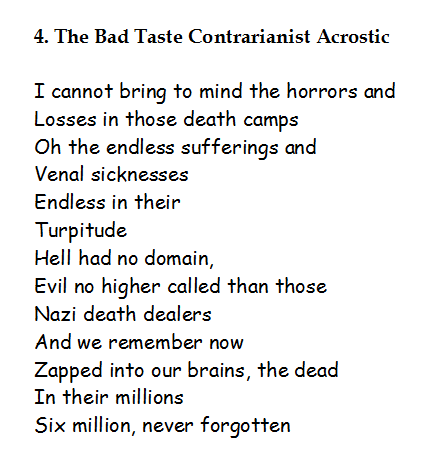
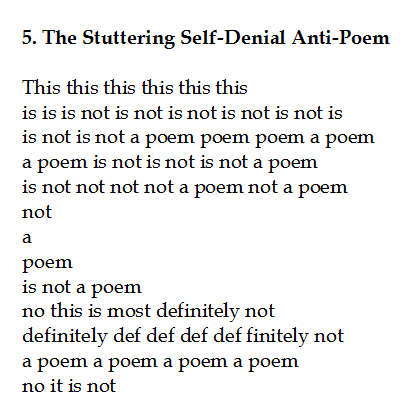
At the bottom of this review are some great words that aspired towards something ineffable , but ultimately, for me, they too often struggled to become great sentences or meditations or fiction.
Sometimes a word alone is not enough to spell it out.
In No Strange Land
[by Francis Thompson]
"O world invisible, we view thee,
O world intangible, we touch thee,
O world unknowable, we know thee,
Inapprehensible, we clutch thee!
...
The angels keep their ancient places--
Turn but a stone and start a wing!
'Tis ye, 'tis your estrangèd faces,
That miss the many-splendored thing."
http://www.poemhunter.com/poem/in-no-...
Up on Your High Horse Again
[For a Jazz Addict]
What is bebop
Without the hype?
Have you seen Bird
Or Lady Day?
Where is the Prez?
Somebody spot
Him a tenner,
Lest the young
Don't get the smack
That we deserve.
The Smack is Back! (On the Scales)
Every
Addict
Deserves
A
Good
Smack.
(A List Built Amid) The Chaos of Ice, Bees and Seas
Art Alcohol Aristotle Asleep Arthur
Beauty Beer Black Book Betty Boop Baseball Baudelaire Boat Bitterness Blue Bore Barefoot Bee Business
Criticism Certainty Conceal Catholic Church Chevrolet Coke Color Chablis Clipboard Cocker Career
Debasement Desire Direction Descend Dresden Drunk Decadence Depravity Drugs Dust Death Decay Deluge
Eyes Everything Elegance Eros
Fly Flower Force False Food Fraternity Fruit salad Fillmore East Fanciful Forever
Glazed Gray Genius General God Godard Gift Green
Hide Heroin Home Hotel Hot Hefty Hydrogen Hell Hamburger Heiress Homosexual Hatred Honeymoon
Idea Issue I Invent Imagination Immortal Imperialism Impotent Innocent Illumination Ice
Jesus Jersey City
Kitsch Kink King Koufax
Language List Lingerie Lenin Liberation Lust
Manipulation Metaphor Mediocrity Mask Monarch Marx Masculine Moral
Numb No Nabokov
Orange Oyster
Poem Prez Power Politics People Protestant Pencil Pope Painter Photograph Professor Prince Peace
Queen
Rolling Stone(s) Rimbaud Repression Ray
Song Scorecard Soul Splendide St Thomas Style Servant Structure Sea
Trumpet Thunder Tyranny Tavern
Underwear Udder
Vignette Victory Voice Verlaine Violet Van
Williams Waiter Window World Wall
XXXX
Youth Yellow
ZZZZ
Something is happening, but I don't know what it is, do I, Mr Jones?
I was hoping to find Lou Reed, but I got Bachmann Turner Overdrive.
Either the author needed to put more effort into this work, or I did, or both.
At the bottom of this review are some great words that aspired towards something ineffable , but ultimately, for me, they too often struggled to become great sentences or meditations or fiction.
Sometimes a word alone is not enough to spell it out.
In No Strange Land
[by Francis Thompson]
"O world invisible, we view thee,
O world intangible, we touch thee,
O world unknowable, we know thee,
Inapprehensible, we clutch thee!
...
The angels keep their ancient places--
Turn but a stone and start a wing!
'Tis ye, 'tis your estrangèd faces,
That miss the many-splendored thing."
http://www.poemhunter.com/poem/in-no-...
Up on Your High Horse Again
[For a Jazz Addict]
What is bebop
Without the hype?
Have you seen Bird
Or Lady Day?
Where is the Prez?
Somebody spot
Him a tenner,
Lest the young
Don't get the smack
That we deserve.
The Smack is Back! (On the Scales)
Every
Addict
Deserves
A
Good
Smack.
(A List Built Amid) The Chaos of Ice, Bees and Seas
Art Alcohol Aristotle Asleep Arthur
Beauty Beer Black Book Betty Boop Baseball Baudelaire Boat Bitterness Blue Bore Barefoot Bee Business
Criticism Certainty Conceal Catholic Church Chevrolet Coke Color Chablis Clipboard Cocker Career
Debasement Desire Direction Descend Dresden Drunk Decadence Depravity Drugs Dust Death Decay Deluge
Eyes Everything Elegance Eros
Fly Flower Force False Food Fraternity Fruit salad Fillmore East Fanciful Forever
Glazed Gray Genius General God Godard Gift Green
Hide Heroin Home Hotel Hot Hefty Hydrogen Hell Hamburger Heiress Homosexual Hatred Honeymoon
Idea Issue I Invent Imagination Immortal Imperialism Impotent Innocent Illumination Ice
Jesus Jersey City
Kitsch Kink King Koufax
Language List Lingerie Lenin Liberation Lust
Manipulation Metaphor Mediocrity Mask Monarch Marx Masculine Moral
Numb No Nabokov
Orange Oyster
Poem Prez Power Politics People Protestant Pencil Pope Painter Photograph Professor Prince Peace
Queen
Rolling Stone(s) Rimbaud Repression Ray
Song Scorecard Soul Splendide St Thomas Style Servant Structure Sea
Trumpet Thunder Tyranny Tavern
Underwear Udder
Vignette Victory Voice Verlaine Violet Van
Williams Waiter Window World Wall
XXXX
Youth Yellow
ZZZZ

March 7, 2013
Splendide-Hôtel defies the quick classification. It celebrates Symbolism, knitting lace flourishes between Rimbaud and William Carlos Williams. It settles some scores, that means you, Wallace Stevens. Splendide-Hôtel
reveals and revels; baseball and jazz are placed on an alter. Sorrentino's project is a series of case studies, each devoted to a letter of the alphabet. The focus initially appears random but the associations become gradually associated and focuses until thematically the work becomes a wonderful palindrome. When the majesty of such is realized, one is tempted to rent one's clothing in anguish, why not more?
reveals and revels; baseball and jazz are placed on an alter. Sorrentino's project is a series of case studies, each devoted to a letter of the alphabet. The focus initially appears random but the associations become gradually associated and focuses until thematically the work becomes a wonderful palindrome. When the majesty of such is realized, one is tempted to rent one's clothing in anguish, why not more?

Read
August 21, 2021A kind of compressed Mulligan Stew but less microcosm than vague SparkNotes. Elements are there, such as the propensity for lists, the metafiction of the author, etc., but with little to none of the passion and delight to be found in the heartier recipe of the Stew. As the author admits, the construction is loose. Ostensibly located at a hotel mentioned in a Rimbaud work, each section of this brief book is a—again, ostensibly—meditation on a letter from the alphabet. I had intimations of William Gass’ On Being Blue only to see it mentioned in the marketing material. Yes, both works start with a thesis that is quickly abandoned if there ever was one in the first place. On Being Blue isn’t about blue as much as this book isn’t about the alphabet. One fun moment was seeing Leopold Bloom’s cucker Blazes Boylan mentioned in a list of games. There are also names that are featured more prominently in Mulligan Stew, making me wonder if they were added in for this new edition (new being 1984 as opposed to the first edition being 1973, originally 6 years before the publication of the Stew). What names? That of the character Antony Lamont (in a hotel guest list) and, earlier, his novel Rayon Violet.
I’d only recommend this little volume to Sorrentino completionists or those who are curious about the first book of fiction Dalkey Archive ever published.
I’d only recommend this little volume to Sorrentino completionists or those who are curious about the first book of fiction Dalkey Archive ever published.

January 27, 2025
Less a novel than an extended essay, this short book is a series of ruminations on each letter of the alphabet, loosely connected under the pretense that all described action is occurring within the Splendide-Hôtel. In other words, it’s an excuse for Sorrentino to wax poetic on whatever associations he has for any given letter, sometimes obvious (i.e. Z = sleep) and other times vague enough as to feel barely connected to the theme. I was initially disappointed at this thin conceit for a book, but my disappointment didn’t last long since this author is such a master that it’s a pleasure to read him in any capacity, and if you can vibe with the nebulousness of this thing, it’s a nice little gem.

September 21, 2007
HÔTEL SPLENDID & SPLENDIDE-HÔTEL take their title from the first poem of rimbaud’s ILLUMINATIONS (”And the Hôtel-Splendide was built in the chaos of ice and polar night.”)
HÔTEL SPLENDID is one of marie redonnet’s trilogy of death — the others are FOREVER VALLEY and ROSE MELLIE ROSE. i haven’t read the last, but like FOREVER VALLEY, HÔTEL SPLENDID is a thin book packed with modern anxiety in an oddly proto-modern setting. this time we’re in a rustic hotel set amidst a sucking, sulfuric swamp. less effective for me i think than FOREVER VALLEY (possibly because the hotel is a more familiar device and thus more in danger of being used as a cliche) HÔTEL SPLENDID was still impressive by its accumulative feeling of anxiety. its main character’s desperate attempt to keep up the rotting, leaking building as well as attend to her sisters ailments and hostilities, was perfect allegory for the burden of all our constant anxieties: bourgeois real estate phobias, hypochondria and contagion paranoia, and the melancholy in seeing the flesh’s various evidence of its encroaching age.
redonnet’s work is particularly virtuosic with time. time contracts and leaps in her writing. within a paragraph, between sentences, we can oddly jump weeks and then linger for pages on a single incident only to pass through a night in a phrase’s brief flourish. the effect is somewhat like reading an irregular diary — quickpenned and intense during moments of drama but languishing for long trials or spurted into with a feverish insight. and yet also her writing undercuts this diary-like inconsistency with its repeating, inescapable and unchanging obsessions. maybe a better comparison than diary is the fever dream, which moves forward in jumpcuts and then traps you in over-hot, looping nightmare scenes.
sorrentino’s SPLENDIDE-HÔTEL is a beautiful artwork of prose, constructed with just the slightest bits of conceit and image: the idea of rimbaud’s hotel and an alphabet primer (and maybe doc williams’ wheel barrow). from these he plays riffs on his favorite themes: the necessary artifice of literary work, our ceaseless acts of corruption, a paradoxically unsentimental nostalgia for mid-century america. i always thought SPLENDIDE-HÔTEL was ever-so-slightly marred by its occasional interluding poem which, even in his parodic modes, necessarily fall short in comparison to his dazzling sentences. nonetheless sorrentino delivers some of his best work here. the paragraphs are a wonder of shifting and connected precise perceptions; he’s enormously funny — a pitch black humor; and the sentences that have that old world panache so one can’t help but think: they don’t make them like that anymore…
here’s a bit:
"B-b-b-b-b. The sound an idiot makes. I remember Jo-Jo, ah, a perfect idiot name. A Mongoloid, shuffling down the street on the arm of his grey and faded Irish mother, punching himself in the face. Yet we all stand now as idiots in the face of the mass devastation of feeling that abounds. A culture that can give no sustenance, and yet the remedies are for still more 'useful skills.' Useful skills, and the heart dies, the imagination crippled so that mere boys are become mass murderers or drift blindly into a sterile adulthood. The young, the young! In a stupendous rage of nonbelief–faced with a spurious culture, the art that can give life sullied or made unavailable. What art there is is cheap and false, dedicated to a quick assay of the superficial. Don’t believe for a moment that art is a decoration or an emblem. It is what life there is left, though ill-used, ill-used. The young crying for nourishment, and they are given the cynical products of the most fickle market. “Look at what passes for the new,” the poet says. Put a handle on it and sell it, cotton candy: to be gone in a moment and leave no memory other than the memory of sickening sweetness" (p. 9).
HÔTEL SPLENDID is one of marie redonnet’s trilogy of death — the others are FOREVER VALLEY and ROSE MELLIE ROSE. i haven’t read the last, but like FOREVER VALLEY, HÔTEL SPLENDID is a thin book packed with modern anxiety in an oddly proto-modern setting. this time we’re in a rustic hotel set amidst a sucking, sulfuric swamp. less effective for me i think than FOREVER VALLEY (possibly because the hotel is a more familiar device and thus more in danger of being used as a cliche) HÔTEL SPLENDID was still impressive by its accumulative feeling of anxiety. its main character’s desperate attempt to keep up the rotting, leaking building as well as attend to her sisters ailments and hostilities, was perfect allegory for the burden of all our constant anxieties: bourgeois real estate phobias, hypochondria and contagion paranoia, and the melancholy in seeing the flesh’s various evidence of its encroaching age.
redonnet’s work is particularly virtuosic with time. time contracts and leaps in her writing. within a paragraph, between sentences, we can oddly jump weeks and then linger for pages on a single incident only to pass through a night in a phrase’s brief flourish. the effect is somewhat like reading an irregular diary — quickpenned and intense during moments of drama but languishing for long trials or spurted into with a feverish insight. and yet also her writing undercuts this diary-like inconsistency with its repeating, inescapable and unchanging obsessions. maybe a better comparison than diary is the fever dream, which moves forward in jumpcuts and then traps you in over-hot, looping nightmare scenes.
sorrentino’s SPLENDIDE-HÔTEL is a beautiful artwork of prose, constructed with just the slightest bits of conceit and image: the idea of rimbaud’s hotel and an alphabet primer (and maybe doc williams’ wheel barrow). from these he plays riffs on his favorite themes: the necessary artifice of literary work, our ceaseless acts of corruption, a paradoxically unsentimental nostalgia for mid-century america. i always thought SPLENDIDE-HÔTEL was ever-so-slightly marred by its occasional interluding poem which, even in his parodic modes, necessarily fall short in comparison to his dazzling sentences. nonetheless sorrentino delivers some of his best work here. the paragraphs are a wonder of shifting and connected precise perceptions; he’s enormously funny — a pitch black humor; and the sentences that have that old world panache so one can’t help but think: they don’t make them like that anymore…
here’s a bit:
"B-b-b-b-b. The sound an idiot makes. I remember Jo-Jo, ah, a perfect idiot name. A Mongoloid, shuffling down the street on the arm of his grey and faded Irish mother, punching himself in the face. Yet we all stand now as idiots in the face of the mass devastation of feeling that abounds. A culture that can give no sustenance, and yet the remedies are for still more 'useful skills.' Useful skills, and the heart dies, the imagination crippled so that mere boys are become mass murderers or drift blindly into a sterile adulthood. The young, the young! In a stupendous rage of nonbelief–faced with a spurious culture, the art that can give life sullied or made unavailable. What art there is is cheap and false, dedicated to a quick assay of the superficial. Don’t believe for a moment that art is a decoration or an emblem. It is what life there is left, though ill-used, ill-used. The young crying for nourishment, and they are given the cynical products of the most fickle market. “Look at what passes for the new,” the poet says. Put a handle on it and sell it, cotton candy: to be gone in a moment and leave no memory other than the memory of sickening sweetness" (p. 9).

August 6, 2025
Too much cleverness and not enough heart; often amusing, occasionally interesting, but nothing to write home about. Disappointing, as the other Sorrentino novels (three of them) I've read were all excellent; thus I was hoping for some profundity here but it feels like a throwaway, a bit of a lark, something perhaps better left in a forgotten desk drawer.

December 28, 2018
Having now read three of Gilbert Sorrentino's novels I take stock of a writer who would appear to come at each project as a craftsman ready to adapt himself to a fresh undertaking. Though these books do have commonalities (as in the works of Donald Barthelme, for example, I note an occasional tendency to maniacally list), in each case Sorrentino appears to gamely rise to greet the call issued by each singular work in its germinal haecceity. Sorrentino, of course, wrote poetry and essays in addition to novels, and in SPLENDIDE HÔTEL the three modes very demonstrably operate in tandem. This extremely idiosyncratic novel could be said to present us with a series of interrelated essays whose way of conducting business, a business related to the industrious corralling of slippery insights, is fundamentally the poet's. In short: it is a poet's novel of essays, and you may well choose to declare this conceit of conflation either postmodern or modernist without my personally feeling compelled to fault you on either score. What kind of truths are poetic truths? What species of revelation the poet's? It is all right there in the doing, of course, but not only are we welcome to proffer a little analysis, Sorrentino dabbles a bit here himself. “I agree," he writes, "with all who wish to leave something behind that has the flash of the smallest truth. It is, I admit, sadly, sadly, so much of my life’s concern. That minuscule flash, that occasion, has more value than the most staggering evasion by explanation of the real.” What is this word "flash" here, with all it entails, if not the business in question, or, mixing the metaphor, the gold for which the poet vocationally pans? Sorrentino also says he believes in “the obfuscation of the celebration of God’s mysteries.” Ah, to be sure. Flashes of the profoundest ephemeral insight wound up in obfuscation and mystification. That right there is the poet's spiritual, moral, intellectual, and sensual relationship with life on life's terms. There are basically two primary conceptual bases for SPLENDIDE HÔTEL. Firstly, the novel is broken into sections named sequentially for each letter of the alphabet (with one provisional quasi-break with the schema), each section meditating associatively on matters tangentially related to its enabling letter. This is very much done as in certain children's books. A is for ... etc. In this case A is for flies and their blackness. Z, no reader of cartoons will be surprised to discover, belongs to the sleeper. Etc. H is for heroin, narcotic of death-like respite. Naturellement. We know, of course, that I is the only letter that is also an independent first person pronoun, of which Sorrentino strikingly declares "it is a streak of spat blood, deep red, purple on the sidewalk.” Etc. This alphabetic gambit, as noted by Robert Creely in his Afterword, is a way of establishing a form while at the same time foregrounding the form's arbitrary character. A way of being wise and playful, it hardly constitutes the meat of the the book's matter. The book's second conceptual basis is very much where we find the meat, and it is more or less announced by the title. The Splendide-Hôtel is an invention of Arthur Rimbaud's. It just so happens to be a very special invention. Obviously it is two words joined by hyphen. Yes, certainly that. It is also something that is almost a metaphor, almost an idea, almost an image, but very certainly something stratified within poetry itself. It makes for a very nice metaphor (metaphor as poetry-thing) because it is stratified for something like ever in the field of poetry and is also, you know, a hotel, a place where we can reside, maybe over and over, returning bodily or in memory, looking at ourselves as visitors among visitors. Sorrentino repeatedly comes back to Rimbaud in the book, and Rimbaud clearly constitutes for him the most hallowed of literary saints. While both Baudelaire and Lautréamont figure importantly here, the other major saint is William Carlos Williams. While the saints here are poet saints, I should probably also mention the special significance of Sheila Henry, held in high esteem for her novel THE ORANGE DRESS, relating as it apparently does to the letter R, itself from the Phoenician symbol representing a tiny pennant, a pennant Sorrentino would like to imagine to be orange, orange being his favourite colour. And incidentally: the ship that "monarch of colors" Arthur Rimbaud sailed to Java in 1876 was called THE PRINCE OR ORANGE. You are probably getting the idea. If Sorrentino testifies to the majesty of certain saints in the manifested corridors and rooms of whom we can continue to productively laze, he also identifies a somewhat surprising archnemesis in the form of Wallace Stevens, a man who just so happens to be the American poet whose poetry I personally most revere. Sorrentino's amusing excoriation of Stevens takes place in section T, T standing quite prettily in this context for thunder. Sorrentino laments Stevens' prodigious level of cultural immersion along with his evidently excessively well-appointed personage. He laments what he calls the man's lack of personal style, suggesting Stevens to be a kind of mendaciously gifted copycat. What he most laments, however, is that Stevens fails to hear "the bell of rose-colored fire tolling in the clouds." The rose-colored fire in the clouds appears in a previous section of the book. Not exactly metaphor, not exactly idea, not exactly image, it is purely poetry, representing elegantly the aforementioned meat of the matter. What can I say? I love the poetry of Wallace Stevens but I also very much love section T of SPLENDIDE HÔTEL. The back cover of the Dalkey edition compares the novel to William H. Gass's book length essay ON BEING BLUE. You will note that ON BEING BLUE appeared two years after SPLENDIDE HÔTEL. It also happens to be a book of absolutely exquisite threads of rhetoric (poetic, sure). Sorrentino has not come to SPLENDIDE HÔTEL, or been called forth by it, to flex rhetoric. He is here as a flitting sentient thing with wings, though of all the colours, not merely the black fly A. This is a very short book. There can be no harm in dallying in this particular hotel. You will want to take in all its many features and accoutrements. Its is plural and many, anchored by the alphabet, beholden to poetry. You will very much want to read Sorrentino on the individual's negligible love datum. You absolutely must read about the two Xs on the windows of the honeymooners. One marvelous things about Splendide-Hôtel is that they are extremely lax regarding when you check in and out.

August 14, 2015
Splendide-Hôtel is a series of meditations, organized into chapters by letters of the alphabet. The content of some chapters establishes a clear relationship to the corresponding letter (i.e. A is the shape of a fly; V is a symbol of victory), while others invoke no direct relationship to the letter in question.
Sorrentino exudes craft - sentences, phrases, and lists flow in steady motion from one page to the next - and the narrative exists as merely a wisp of a thread. The chapters are loosely connected by bits and pieces of that refer to William Carlos Williams and Arthur Rimbaud, two writers with whom I am only tangentially familiar.
Splendide-Hôtel reminded me of reading Richard Brautigan (indeed, on p. 47, Sorrentino criticizes pseudo- intellectual President Wallace Stevens, declaring "I am sick of his trout fishing...") - the work is American in its narrator's slight removal from society, open criticism of politics, and weariness towards the advertising age. While life in the 20th century United States should live up to its marketed ideal that things feel free, easy, and accessible, the artist and intellectual is waiting for the other shoe to drop. The feeling is like standing on the edge of a cliff - the breeze is exhilarating, but if it picks up a bit more, it may knock you into the abyss.
Sorrentino exudes craft - sentences, phrases, and lists flow in steady motion from one page to the next - and the narrative exists as merely a wisp of a thread. The chapters are loosely connected by bits and pieces of that refer to William Carlos Williams and Arthur Rimbaud, two writers with whom I am only tangentially familiar.
Splendide-Hôtel reminded me of reading Richard Brautigan (indeed, on p. 47, Sorrentino criticizes pseudo- intellectual President Wallace Stevens, declaring "I am sick of his trout fishing...") - the work is American in its narrator's slight removal from society, open criticism of politics, and weariness towards the advertising age. While life in the 20th century United States should live up to its marketed ideal that things feel free, easy, and accessible, the artist and intellectual is waiting for the other shoe to drop. The feeling is like standing on the edge of a cliff - the breeze is exhilarating, but if it picks up a bit more, it may knock you into the abyss.
January 14, 2019
I didn't totally connect with this abecedarian collection of short essays and meditations by Sorrentino. I like his work-- I think Imaginary Qualities is a masterpiece and feel nearly as stongly about Steelworks, and love what parts of Mulligan Stew I read before I put it aside. This was good, and has some of the same elements, including a fascination with WCW, but it didn't quite work for me, in part because I think I don't know Rimbaud well enough to follow the conceit, and partly because this came off as a little too fire-breathing to me, about what an artist is and does. Maybe I like Sorrentino better when he's writing fiction because he plays in that space between the speaker and the writer, that it's that ironic distance that gives him (or maybe me, if I've been misreading him all these years) to room to really excel.
Still, there are individual sections here that I really like, and this is another spur to go back and read more Rimbaud.
Still, there are individual sections here that I really like, and this is another spur to go back and read more Rimbaud.

August 11, 2026
Where the oulipian and symbolism and poetry in the “American grain” come together—. This is gonna make me sound ridiculous but (o well!) an idea that sounds great to me. As I’ve thought the distance between the oulipo and symbolist poetry are not as far in final product as they are in concept and guiding principles (limitation being the launching pad for the eternal in oulipo and, I don’t know, the eternal being the launching pad for words in symbolist work? Or rather bureaucratic vs. what we think of when we think of poetry…they end up in similar places…nb: Stevens was a vice president of a life insurance company. Instinct and genius and work and an accountant suit drinking absinthe and hitting a hookah). Well, alas—it’s still exciting to ME ( ie my ideas are exciting to me). Baseball, WCW, Rimbaud by way of Abish? Count me in!
Ok. That was prologue. Here’s the review: “sort of boring. I expected to like it more…”
Ok. That was prologue. Here’s the review: “sort of boring. I expected to like it more…”

November 2, 2018
An exquisite exploration / homage to the work of Arthur Rimbaud. Poetry, prose, prose poetry. Walk through the alphabet with Sorrentino; you won't regret it.

December 30, 2015
Arthur Rimbaud's invented "Splendide-Hotel", "built in the chaos of ice and of the polar night," provides the platform for Gilbert Sorrentino's collection of musings on writing, language, creativity and art. Like a child’s reading primer each chapter begins with a letter of the alphabet. Sometimes a piece begins as a simple commentary on the implications of the shape of the letter; sometimes with a question; sometimes as the beginning of a letter; always with a sense of literary adventure and an exploration of imagination. With Splendide-Hotel Gilbert Sorrentino is becoming my favorite unknown writer.

April 24, 2010
the President - who cannot admit that the heart dies in pieces
-Gilbert Sorrentino, Splendide-Hotel
-Gilbert Sorrentino, Splendide-Hotel
Displaying 1 - 16 of 16 reviews