Kinslayer. Soul reaver. Sorcerer. Thief. And last emperor of a cruel, decadent race. Elric of Melniboné is all of these–and more. His life is sustained by drugs and magic–and energy sucked from the victims of his vampiric black sword, Stormbringer, a weapon feared by men and gods alike. Denied the oblivion he seeks, poised between a tragic past he cannot escape and a terrifying future he is doomed to bring about, Elric is a hero like no other.
Del Rey is proud to present the fifth installment in its definitive collection featuring the immortal creation of Michael Moorcock, named Grand Master by the Science Fiction and Fantasy Writers of America. Highlights include an epic novel of Elric’s early years, The Fortress of the Pearl; the script of the graphic novel The Making of a Sorcerer; a previously unpublished proposal for a new series; and Hugo Award—winning author Neil Gaiman’s moving fictional tribute to Elric, the short story “One Life, Furnished in Early Moorcock.”
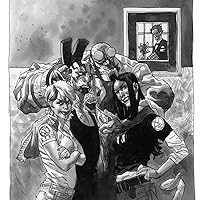
Gorgeously illustrated by Michael Wm. Kaluta, In the Dream Realms is a dream come true for sword-and-sorcery fans.
Michael John Moorcock is an English writer primarily of science fiction and fantasy who has also published a number of literary novels.
Moorcock has mentioned The Gods of Mars by Edgar Rice Burroughs, The Apple Cart by George Bernard Shaw and The Constable of St. Nicholas by Edward Lester Arnold as the first three books which captured his imagination. He became editor of Tarzan Adventures in 1956, at the age of sixteen, and later moved on to edit Sexton Blake Library. As editor of the controversial British science fiction magazine New Worlds, from May 1964 until March 1971 and then again from 1976 to 1996, Moorcock fostered the development of the science fiction "New Wave" in the UK and indirectly in the United States. His serialization of Norman Spinrad's Bug Jack Barron was notorious for causing British MPs to condemn in Parliament the Arts Council's funding of the magazine.
During this time, he occasionally wrote under the pseudonym of "James Colvin," a "house pseudonym" used by other critics on New Worlds. A spoof obituary of Colvin appeared in New Worlds #197 (January 1970), written by "William Barclay" (another Moorcock pseudonym). Moorcock, indeed, makes much use of the initials "JC", and not entirely coincidentally these are also the initials of Jesus Christ, the subject of his 1967 Nebula award-winning novella Behold the Man, which tells the story of Karl Glogauer, a time-traveller who takes on the role of Christ. They are also the initials of various "Eternal Champion" Moorcock characters such as Jerry Cornelius, Jerry Cornell and Jherek Carnelian. In more recent years, Moorcock has taken to using "Warwick Colvin, Jr." as yet another pseudonym, particularly in his Second Ether fiction.
"We have an enemy," said Oone. Her face was grim and she clenched her hands to her sides, clearly taking a grip on herself. "We have been indentified already. The Fortress of the Pearl does not merely defend. She attacks."
"You know these riders? You have seen them before."
She shook her head. "I know their kind, that's all."
"And we've no means of avoiding them?"
"Very few." She was frowning to herself again, considering some problem she was not prepared to discuss. Then she seemed to dismiss it and taking his arm led him under the twin cascades of cool gold into a further cavern which this time suddenly filled with a gentle green glow, as if they walked beneath a canopy of leaves in autumn sunlight. And Elric was reminded of Old Melnibone, at the height of her power, when his people were proud enough to take the whole world for granted. When entire nations had been remoulded for their passing pleasure. As they emerged into a further cavern, so vast he did not at first realize they were still underground, he saw the spires and minarets of a city, glowing with the same warm green, which was as beautiful as his own beloved Imrryr, the Dreaming City, which he had explored throughout his boyhood.
"It is like Imrryr and yet it is not like Imrryr at all," he said in surprise.
"No," she said, "it is like London. It is like Tanelorn. It is like Ras-Paloom-Atai." And she did not speak sarcastically. She spoke as if she really did believe the city resembled those other cities, only one of which Elric recognized.
"But you have seen it before. What is it called?"
"It has no name," she said. "It has all names. It is called whatever you desire to call it." And she turned away, as if resting herself, before she led him onwards down the road past the city.
"Should we not visit it? There may be people there who can help us find our way."
Oone gestured. "And there may be those who would hamper us. It is now clear, Prince Elric, that our mission is suspected and that certain forces could well have the intention of stopping us at any cost."
"You think the Sorcerer Adventurers have followed us?"
"Or preceded us. Leaving at least something of themselves here." She was peering cautiously towards the city.
"It seems such a peaceful place," said Elric. The more he looked at the city the more he was impressed by the architecture, all of the same greenish stone but varying from yellow to blue. There were vast buttresses and curving bridges between one tower and another; there were spires as delicate as cobwebs yet so tall they almost disappeared into the roofs of the cavern. It seemed to reflect some part of him which he could not at once recall. He longed to go there. He grew resentful of Oone's guidance, though he had sworn to follow it, and began to believe that she herself was lost, that she was not better suited to discover their goal than was he.
"We must continue," she said. She was speaking more urgently now.
"I know I would find something within that city which would make Irrmyr great again. And in her greatness I could lead her to dominate the world. But this time, instead of bringing cruelty and terror, we could bring beauty and good will."
"You are more prone to illusion than I thought, Prince Elric," said Oone.
He turned on her angrily. "What's wrong with such ambitions?"
"They are unrealistic. As unreal as that city."
"The city looks solid enough to me."
"Solid? Aye, in its way. Once you enter its gate it will embrace you as thoroughly as any long-lost lover! Come then, sir. Come!" She seemed seize by an equally poor temper and strode on up an obsidian road which twisted along the hill towards the city.
Startled by her sudden change, Elric followed. But now his own anger was dissipating. "I'll abide, madam, by your judgement. I am sorry..."
She was not listening to him. Moment by moment the city came closer until soon they were overshadowed by it, looking up at walls and domes and towers whose size was so tremendous it was almost impossible to guess at their true extent.
"There's a gate," she said. "There! Go through and I'll say farewell. I'll try to save the child myself and you can give yourself up to lost beliefs and so lose the beliefs you currently hold!"
And now Elric looked closer at the walls, which were like jade, and he saw dark shapes within the walls and he saw that the dark shapes were the figures of men, women and children. He gasped as he stepped forward to peer at them, observing living faces, eyes which were undying, lips frozen in expressions of terror, of anguish, of misery. They were like so many flies in amber.
"That's the unchanging past, Prince Elric," said Oone. "That's the fate of those who seek to reclaim their lost beliefs without first experiencing the search for new ones. This city has another name. Dreamthieves call it the City of Inventive Cowardice. You would not understand the twists of logic which brought so many to this pass! Which made them force those they loved to share their fate. Would you stay with them, Prince Elric, and nurse your lost beliefs?"
The albino turned away with a shudder. "But if they could see what had happened to earlier travelers, why did they continue into the city?"
"They blinded themselves to the obvious. That is the great triumph of mindless need over intelligence and the human spirit."
Includes The Fortress of the Pearl, Moorcock's first Elric novel after a lengthy hiatus (actually, at the time it was published, maybe only the third true Elric novel, after Stormbringer and Elric of Melniboné -- the other Elric books were fix-up collections of short stories & novellas), the script to the comic book series Elric: The Making of a Sorcerer, and various other bits & bobs -- some essays, one more Elric story (one that I hadn't actually read before, although it's just a few pages long), and Neil Gaiman's "One Life Furnished in Early Moorcock", from a 1994 collection of other authors' takes on the Doomed Albino Prince.
I'm a bit torn -- on the one hand, Michael Moorcock in the 1990s & after is clearly a better, more accomplished writer than was Michael Moorcock circa the 1960s & 1970s; on the other hand, I have to admit I prefer the earlier stories, with their gigantic mirths and melancholies and their throbbing, unearthly colours. Still, if you've read the original books and you want more Elric, this is the place to be.
(The Fortress of the Pearl slots in between Elric of Melniboné and The Sailor on the Seas of Fate; Elric visits a desert city, is enmeshed in its intrigues and, through no desire of his own, is sent on a quest through the realms of dream in company with the dreamthief Oone; and for much of the story, he's separated from his sword Stormbringer, which really is the Garfunkel to his Simon.)
The fascinating 5th volume of this collection features more stories of Michael Moorcock's most famous character, Elric, this time in various dream-related adventures. It contains "The Fortress of the Pearl" (which I had read before) and the adapted script for a rather lengthy graphic novel telling of how Elric learned sorcery using his people's "dream couches" to experience vast stretches of past time in just minutes or hours. This collection also has a story NOT by Moorcock - Neil Gaiman's "One Life, Furnished In Early Moorcock" (which I had read before in collections of Gaiman's work). A very interesting collection, indeed! Moorcock is, as of this writing, the last living and active author from the "Appendix N" of Gary Gygax, and an author that helped shape all subsequent fantasy and sword-and-sorcery fiction, the anti-Tolkien, anti-Howard, anti-establishment fantasist. Very cool.
The primary work in this collection is "The Fortress of Pearl." I loved the exploration of Elric before the sack of Melnibone, his idealism not yet crushed. The idea of the Dream Thieves, yet another group able to travel the multiverse, is interesting. OTOH, it is in some ways the most formulaic or conventional of the Elric stories (commissioned or bribed into a quest for a mcguffin, travel through strange realms, lots of confrontations along the way).
As the Elric saga nears its close, volume 5 is mostly focused on character development: the two primary novels both focus on broadening the semi-vampiric mercenary emperor from a brooding Byronic type to a figure torn between his human and inhuman sides. Adding Arabic and Native American influences to the pan-mythic D&D world of the Elric multiverse, these may not be the greatest novels in the Elric canon, but they do some of the best world-building.
The other items contained are related to the Elric character and/or Moorcock (his history, influence, insights, etc), but not all are necessarily stories, per se. This volume contains a smattering of illustrations throughout the work. Perhaps it is the presence of said illustrations that contribute to minor issues of formatting in the book. There are several occurrences where the flow of text, specifically with dialogue, indicate a paragraph break that is not present. It can be distracting when a portion of conversation, including a back and forth exchange between characters, is all part of the same body of text, rather than offset in a separate line.
“The Fortress of the Pearl” is a novel-length story and remarkable for several reasons. Firstly, the bulk of the story features Elric without his alter ego: while on the dream quest, Elric forgoes the company of Stormbringer. As always, the opportunities for character growth/development presented without the hellblade prove rich and intriguing. Usually, the sword is the catalyst/agent of change in those situations and the albino reacts to the events. Witnessing some of the decisions the anti-hero makes without Stormbringer present, the reader is able to more fully appreciate two things: how much influence the sword truly exerts on Elric and how much of Elric's fate is actually in his own hands. No doubt the souldrinker is responsible for much of the strife in the life of it's wielder. However, Elric has a history of making poor decisions completely of his own free will. He knows this, as evidenced by this remark he makes to his companion on the dream quest: “Fate is cruel, Oone. It would be better if it provided us with one unaltering path. Instead it forces us to make choices, never to know if those choices were for the best.” Perhaps the sword's most important function is not providing Elric the strength he needs to survive, but rather being the scapegoat of the albino's conscience. It is a refreshing change of pace to watch Elric hobble through the journey without his moral crutch.
Two other things stand out. First, the introduction of dreamthieves into Elric's world provide yet another portal by which the multi-verse may be accessed, appreciated and perhaps understood. The idea that a dream can be stolen is fascinating enough; that said dream is treated as a commodity to be traded or sold for who knows what other goods or services is simply mind-blowing. Lastly, the story itself is an experience of the fantastic variety. Moorcock makes incredible use of imagery, stream of conscience storytelling and emotional motivation to provide the reader moments of genuine wonder. For example: “Oh, it is a lie!” Lady Sough almost shouted, pointing to where, swimming directly towards them, came a child. But the boy's skin was metallic, of glaring silver, and his silver eyes were begging them for help. Then the child grinned, reached to pull off its own head, and submerged.” Incredible.
One of the aforementioned “other items” was the text sketch of a graphic novel (“Elric: The Making of a Sorcerer”). That sketch depicted some of Elric's ordeals on the fabled dream couches, where Melnibonean's trained in the sorcerous arts undergo a significant portion of their magical instruction. This sketch proved to be the most interesting piece in the volume. Not only did it provide a glimpse of what must be learned to master the art of magic, but it also provides substantial insight about the conflict between Elric and Yrkoon; it offered a clever subversion of our own history and how Melnibone came to influence it (or would come to influence it?); and the existence of such a tale demonstrates the sheer pervasiveness of the signature character, regardless of specific genre or medium.
TLDR: “Fortress” is a good story, if not a conventional Elric tale. The text sketch of the graphic novel adds some great meat to the history and culture of Melnibone (as well as background detail for Elric and some of those close to him). Forward and short story by Neil Gamen also do not hurt. This volume is a worthwhile addition for anyone this far into the series.
This edition contains The fortress of the pearl, published separately, and a text sketch of a graphic novel about the training of Elric through dream quests as a young man. There are also a few other bits, notably a short autobiography by Neil Gaiman. I imagine it is such a struggle to put collections together for Moorcock since he has written so much. This edition was good as thematically the stories revolve around Elric and the ability to have adventures through dreams that affect this reality. Also the contrast in formats with a novel and a novel length text sketch of a graphic novel. Those interested in Elric will find the familiar as well as the novel, and for a collected work you can't really expect more.
İnci Kalesi hikayesi oldukça güzel ve sürükleyici bir hikaye. Ama Dük Elric kitabında olduğu gibi bu kitabın da yarısı okuması pek de keyifli olmayan çizgi roman senaryosu saçmalığına ayrılmış.
İnci kalesi dışındaki diğer bölümler hiç okunmasa da olur niteliğinde. Özellikle Neil Gaiman yazdığı kısa hikaye çok kötüydü.
I liked it. I liked basically every character besides Elric. I read a review somewhere that called Elric a whiny drama queen and yeah, I feel that's accurate. The magic was cool, the traveling through a dream was really cool and I loved the world building and magic rules there, and I liked the inclusion of the comic script at the end. So, I liked it, but I don't think I'll read any others in the series.
I got this to read The Fortress of the Pearl, and that was a fine Elric novella. There are other stories as well, though the prose for the Graphic novel just didn't work, in an ebook. If you can get the Pearl book by itself, just do that. A Portrait in Ivory is in this as well, but is a tiny, minor Elric story.
It had been so long since I read The fortrese of the Pearl that it seemed like a new story. Everything else was new to me. The only story that was weak was the last one by Gaiman. Overall, though, it's a great book.
Still going strong. The Fortress of the Pearl was great, as was the script for the DC comics. The dream couches are very interesting to me. They remind me of the current push for VR for some reason. As it turns out, I really enjoy authors who have done a lot of psychedelics.