

What do you think?
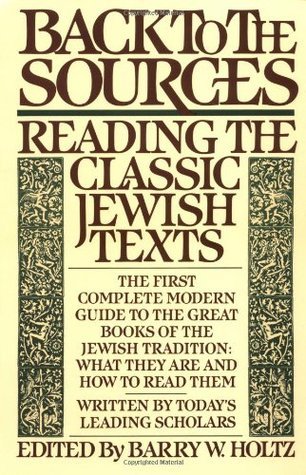
Back to the Sources: Reading the Classic Jewish Texts
Essays analyze the major traditional texts of Judaism from literary, historical, philosophical, and religious points of view.
448 pages, Paperback
First published January 1, 1984
Ratings & Reviews
Friends & Following
Create a free account to discover what your friends think of this book!
Community Reviews
Displaying 1 - 21 of 21 reviews

August 30, 2018
A brilliant introduction into Jewish written culture, once you've had some other introduction.
If you have no idea what Talmud is, I wouldn't recommend starting with this book - but I definitely recommend coming back to this book, once you have some - maybe very basic - knowledge about the topic. I personally read this book alongside "Jews, God and History" by Max Dimont and "Introduction Au Talmud" by Adin Steinsaltz, which helped a lot, and I'm sure there are many others like this.
"Back to the Sources" is a collection of essays on different areas of Jewish textual tradition, written by different authors.
1. Bible.
a) "Biblical Narrative" by J. Rosenberg. Analysis of narrative techniques used in the Bible. I especially loved the analysis of how the end of the Garden Story mirrors its beginning, in this way shedding positive light on the expulsion form the Garden.
b) "Biblical Law" by E. L. Greenstein. An essay about the laws derived (or outwardly stated) in the Bible: on murder, the regulations of slavery etc. I feel the author was a little too positive towards them, demonstrating several times the superiority of Biblical law over Hamurapi codex.
c) "Biblical Poetry" by M. H. Lichtenstein. Minute analysis of some of the verses from the Bible, and mentioning of general principles. I don't feel like I learned a lot about Jewish textual culture from this, but rather that I've learned something about poetry.
2. "Talmud" by R. Goldenberg. Really vibrant overview of Talmudic thought, not trying to show its whole scope (again, I advise to read some other introduction before), but rather attempting to "give a taste" of Talmudic arguments, quoting one and providing comments about it, which is actually a very talmudic way to introduce Talmud.
fun fact: Since the discussions in Talmud end unresolved, how should a person live according to the implicit law? The amoraim (rabbis of 230-500 a.d., authors of Gemarah - a part of Talmud) devised some rules about which rules to follow, in the form of: "If Rabbi A differs with Rabbi B, follow Rabbi A." or "If Rabbi C differs with one colleague follow Rabbi C anyway, but not if he differs with all his colleagues."
3. "Midrash" bu B. W. Holtz. Just as Talmud is concerned with commentaries on Oral Torah, Midrash is a type of literature that comments (explains, discusses, devises laws, adds stories) the Written Torah. Among other things, this chapter provides interesting discussion about whether God is to blame for Cain's murder of Abel.
4. "Medieval Bible Commentaries" by E. L. Greenstein. I loved this chapter! It's clear, concise and even humorous at times. It presents two approaches of commenting Biblical text: derash is homiletical approach, dvelving deep into the text in search for an answer or revelation, assuming that there's nothing unneccessary in the Written Torah and everything is meaningful. Peshat is a contextual approach, that started in the Middle Ages, and that takes historical conditions, linguistic pecularities and other contextual things into account when analysing Biblical text. For example, there's no distinction between the words "hear" and "give-ear" according to the peshat method, but according to derash, Moses said "give-ear, O heaven" because he was actually in heaven when he spoke the Torah, and said "And let the land hear", because it was far from him at the moment.
5. "Medieval Jewish Philosophy" by N. M. Samuelson. The lives of the philosophers almost steal the show here. For instance, according to legend, an Arab horseman killed Judah Halevi with a spear as he was singing his "Ode to Zion" at the gates of the Holy City.
Fun fact: Maimonides didn't want to violate rabbinic dictum not to enquire about metaphysics and cosmology, so he sort-of deviced a technique how to study "things that are too marvelous for you" without violating rabbinical law. He also purposefully put the discussions on "too marvelous things" in the middle of his book, so that unqualified reader would get bored sooner than he reaches them.
6. "Kabbalistic Texts" by L. Fine. Again, one of my favorite chapters in this book. It concentrated very much on the Zohar, provides wonderfully clear explanation of sefirotic symbolism and extracts from Zohar. I liked how rabbis in Zohar just walk around chatting to each other about Torah, and very often start weeping from joy, when one of them provides an especially beautiful explanation.
I felt that the author appreciates the complex worldview of kabbalah, but the tone is a little bit tongue-in-cheek, which I liked very much.
7. "Teachings of the Hasidic Masters" by A. Green. In contrast to the previous chapter, I also enjoyed the seriousness with which Hasidism is treated in this chapter. I feel that hasidism is sometimes treated as "too pop" to deserve serious academic attention. And I didn't even know they had such a complex and beautiful homilies (derashot)!
Some quotes of Likkutim Yekarim
some textual analysis on why there is no comma between "Moses Moses" in Exodus, but there is one between "Jacob, Jacob" in Genesis: "Moses has no pause, for he is one, both above and below; he is so removed from matter that even when dealing with corporeal things <...> he is entirely turned upward"
more hassidic advice: "Know that each word is a comolete form. You must say it with all your strenght, or else it will be like one lacking a limb"
and also about crying: "Crying is very bad. It is in joy that a person is supposed to serve God. Only tears that flow from joy and attachment to God are beneficial."
8. "Prayer and the Prayerbook" by A. Mintz.It's a chapter on the structure of the Jewish prayer, and I'm already quite tired from writing, and you're probably praying this review would be over, so I'm gonna stop there.
A great book and thank you Lara for lending it to me!
If you have no idea what Talmud is, I wouldn't recommend starting with this book - but I definitely recommend coming back to this book, once you have some - maybe very basic - knowledge about the topic. I personally read this book alongside "Jews, God and History" by Max Dimont and "Introduction Au Talmud" by Adin Steinsaltz, which helped a lot, and I'm sure there are many others like this.
"Back to the Sources" is a collection of essays on different areas of Jewish textual tradition, written by different authors.
1. Bible.
a) "Biblical Narrative" by J. Rosenberg. Analysis of narrative techniques used in the Bible. I especially loved the analysis of how the end of the Garden Story mirrors its beginning, in this way shedding positive light on the expulsion form the Garden.
b) "Biblical Law" by E. L. Greenstein. An essay about the laws derived (or outwardly stated) in the Bible: on murder, the regulations of slavery etc. I feel the author was a little too positive towards them, demonstrating several times the superiority of Biblical law over Hamurapi codex.
c) "Biblical Poetry" by M. H. Lichtenstein. Minute analysis of some of the verses from the Bible, and mentioning of general principles. I don't feel like I learned a lot about Jewish textual culture from this, but rather that I've learned something about poetry.
2. "Talmud" by R. Goldenberg. Really vibrant overview of Talmudic thought, not trying to show its whole scope (again, I advise to read some other introduction before), but rather attempting to "give a taste" of Talmudic arguments, quoting one and providing comments about it, which is actually a very talmudic way to introduce Talmud.
fun fact: Since the discussions in Talmud end unresolved, how should a person live according to the implicit law? The amoraim (rabbis of 230-500 a.d., authors of Gemarah - a part of Talmud) devised some rules about which rules to follow, in the form of: "If Rabbi A differs with Rabbi B, follow Rabbi A." or "If Rabbi C differs with one colleague follow Rabbi C anyway, but not if he differs with all his colleagues."
3. "Midrash" bu B. W. Holtz. Just as Talmud is concerned with commentaries on Oral Torah, Midrash is a type of literature that comments (explains, discusses, devises laws, adds stories) the Written Torah. Among other things, this chapter provides interesting discussion about whether God is to blame for Cain's murder of Abel.
4. "Medieval Bible Commentaries" by E. L. Greenstein. I loved this chapter! It's clear, concise and even humorous at times. It presents two approaches of commenting Biblical text: derash is homiletical approach, dvelving deep into the text in search for an answer or revelation, assuming that there's nothing unneccessary in the Written Torah and everything is meaningful. Peshat is a contextual approach, that started in the Middle Ages, and that takes historical conditions, linguistic pecularities and other contextual things into account when analysing Biblical text. For example, there's no distinction between the words "hear" and "give-ear" according to the peshat method, but according to derash, Moses said "give-ear, O heaven" because he was actually in heaven when he spoke the Torah, and said "And let the land hear", because it was far from him at the moment.
5. "Medieval Jewish Philosophy" by N. M. Samuelson. The lives of the philosophers almost steal the show here. For instance, according to legend, an Arab horseman killed Judah Halevi with a spear as he was singing his "Ode to Zion" at the gates of the Holy City.
Fun fact: Maimonides didn't want to violate rabbinic dictum not to enquire about metaphysics and cosmology, so he sort-of deviced a technique how to study "things that are too marvelous for you" without violating rabbinical law. He also purposefully put the discussions on "too marvelous things" in the middle of his book, so that unqualified reader would get bored sooner than he reaches them.
6. "Kabbalistic Texts" by L. Fine. Again, one of my favorite chapters in this book. It concentrated very much on the Zohar, provides wonderfully clear explanation of sefirotic symbolism and extracts from Zohar. I liked how rabbis in Zohar just walk around chatting to each other about Torah, and very often start weeping from joy, when one of them provides an especially beautiful explanation.
I felt that the author appreciates the complex worldview of kabbalah, but the tone is a little bit tongue-in-cheek, which I liked very much.
7. "Teachings of the Hasidic Masters" by A. Green. In contrast to the previous chapter, I also enjoyed the seriousness with which Hasidism is treated in this chapter. I feel that hasidism is sometimes treated as "too pop" to deserve serious academic attention. And I didn't even know they had such a complex and beautiful homilies (derashot)!
Some quotes of Likkutim Yekarim
some textual analysis on why there is no comma between "Moses Moses" in Exodus, but there is one between "Jacob, Jacob" in Genesis: "Moses has no pause, for he is one, both above and below; he is so removed from matter that even when dealing with corporeal things <...> he is entirely turned upward"
more hassidic advice: "Know that each word is a comolete form. You must say it with all your strenght, or else it will be like one lacking a limb"
and also about crying: "Crying is very bad. It is in joy that a person is supposed to serve God. Only tears that flow from joy and attachment to God are beneficial."
8. "Prayer and the Prayerbook" by A. Mintz.It's a chapter on the structure of the Jewish prayer, and I'm already quite tired from writing, and you're probably praying this review would be over, so I'm gonna stop there.
A great book and thank you Lara for lending it to me!

July 31, 2012
A collection of slightly scholarly essays on the history, roles, structure and uses of the classic texts of Judaism: the Tanach (one each on narrative,law and poetry), Talmud, Midrash, the Medieval Bible Commentaries, Medieval Jewish Philosophy, Kabbalistic texts, the teachings of the Hasidic Masters, and the prayerbook (Siddur). I found each of these chapters to be a small gem of a lesson on the texts with a readable and accessible style that should suit almost any reader interested in the canonical works of Judaism. Each essay concludes with a helpful bibliography section with suggested further readings on each text. An excellent introduction to the life and story of Judaism and the Jews through the story of their books.

January 14, 2014
This is an excellent resource of Jewish texts, covering eight areas of study. This includes the Bible, the Talmud, various texts of the Midrash, commentaries, philosophy, the Kabbalah, the mystic teachings of the Hasidic masters and the Prayerbook. This book is a good place to start ones study of any one of these areas.

July 17, 2026
As a Christian, the Jews are a confusingly close-yet-alien relative. We're alternately exasperated by them and indebted to them, and we often both attack and defend them. I've repeatedly defended the Old Testament against gnostic attacks, yet I've also highlighted the shared weakness of Jewish-Muslim conceptions of a disembodied God. It's like how Lutherans love to make fun of Catholics, but if any other protestants do the same thing, we defend them (as if we have the exclusive right to insult them). Perhaps the most confusing thing for us Christians is discerning what we would consider "true" Jewish religion (i.e. before Christ) and what are comparatively modern accretions (often indirectly in response to Christ, i.e. much of Rabbinic Judaism).
The only things I really knew about Judaism were more self-serving cliches than actual robust knowledge, such as "they made the laws easy enough so that they could keep all of them." But in an important sense, what good is a law (to a community) if no one can keep it? Plus, the way they explained fences of smaller laws around the bigger ones was actually genius, not legalistic; instead of letting people flirt with serious sins (as we too often do in Christianity under "Christian Freedom"), why not adhere to manmade sub-rules to prevent yourself from even approaching the more serious laws?
Yes, some (most?) of the nitpicking in the Talmud comes off as excessive and lawyer-like, but the more general ideas and practices explained in this book are very edifying. For example, let's return to the Talmud. For some strange reason, antisemites have latched on to these extremely dense and huge legal texts as their primary source for "proving" how "evil" the Jews are. But the first problem is that there's two different versions of the Talmud, the Babylonian and the Jerusalem. So when they say "the Talmud", they're not even knowledgable enough to say which Talmud they're supposedly talking about. Furthermore, they treat the Talmud as if it's scripture, which it's not. This book (Back to the Sources) explained the Jewish conception of a written and oral Torah, of which the Talmud would be a part of the latter, but it would be nonsensical to treat every sentence of the Talmud as scripture, since the point of the Talmud is a giant discussion among scholars across the ages about various points of law not detailed in the written Torah. Thus, even if someone finds something unsettling in there, and even if it isn't ripped out of context, you still can't even get mad at it since rarely do they come to neat conclusions about the matters they're discussing; rather, they show the range of possible (not even "acceptable"!) interpretations.
It's people's profound ignorance about the form of the Talmud (i.e. that there's a central text with concentric texts wrapping around that text, commenting on each other, digressing, and generally swirling around a problem) that precludes them from making any intelligent statements about the content (which sometimes is hypothetical, sometimes is straw-manning their opponents, sometimes is what they're actually arguing for, etc.). Frankly, I wish we Christians had our own Talmud, thematically organizing the writings of the Church Fathers on various topics, since as it stands now it's easy to get the wrong idea and think that we can "do religion" on our own (*cough* all of protestantism *cough*).
Furthermore, the idea of a written and oral Torah helps to challenge simplistic Protestant ideas of the Bible and biblical interpretation, as the heavily abbreviated nature of most of scripture is evident even on a superficial reading. The question is what do we do with these gaps: do we fervently hold on to them as holy (as most protestants do), or do we build off of them and use them as inspiration, as the Jews do? For their mystical writings, the Zohar especially, seek to do just that, in a way that they see as respecting the text but which most protestants would see as little more than fan fiction. But we Christians would do well to better understand how the Jews see their own scripture, since we also claim it as our own.
One of the very interesting dilemmas in both the Old and New testaments is how much repetition there is, from the two recordings of the Law of Moses, to the four Gospels. Do we see the repetition as inherently meaningful? Or is it the result of overly cautious and conservative scribes who didn't know which to prefer, and who instead included both, so as to not risk losing anything? Also, as this text brings up, how much were texts "spruced up" or otherwise made flowery/consistent/coherent by later editors (i.e. what happened during the shift from the spoken original in history to the written-down version we hold today)? Just like with the Talmudic discussions, we don't have many clear answers, and that's fine; the Bible, like any great text, by definition doesn't give quick, easy answers to most questions, which is one of the main reasons we still read it today.
It's also interesting to note how in my own thinking I've become more tolerant of esoteric readings of texts like the Bible, since I see more and more how getting stuck on the literal, exoteric level can cheapen the text and miss the larger point. It's this willingness to go on digressions and other tangents that feels so relatable to my own review-writing. Rarely do I go head-on at a text and summarize it then give my own thoughts. I prefer to give anecdotes, to explore where the text inspired me, rather than autistically sticking at the surface. To do so is to miss the joy of relational interactions with media. To view texts as merely repositories of information is to kill them and prevent any true knowledge or wisdom. It's only by the indirect route that you can ever reach your destination; going as the crow flies guarantees getting caught in brambles or falling off of cliffs.
Given all of this, it's fascinating how the Jews have deified texts even more than protestants have; unlike protestants who deaden a text by assuming it's some stock-rigid thing with no flexibility or life, the Jews wisely live in relation with it, like how we pray to the Living God and live in relation with him. Because their temple was destroyed in the first century, Jews have had to find some way to stay religious on the move, and the answer has usually been to focus even more on the texts, and to write down the oral traditions into texts. At several points, the author of this book mentioned that "The Talmud is a book put together by people who saw intellectual activity as sanctifying." Even in my most pretentious moments, I don't think I can abide by that, however; theory is empty without praxis, just as orthodoxy is worthless without orthopraxy. It's only half of the equation to be stuck in the books; the other half is to share what you've learned and to actually act differently as a result. But then again, this approach is understandable given how dangerous it has been for Jews to "act" in the larger world for most of their history. If you hide in your house and pour over texts, the only thing that can kill you is someone burning your house down. If you go out and try to live in public, you're much more vulnerable...
But then again, returning to filling in the gaps (as Jews do in the Midrash), is that not betraying an anxiety of needing to know unnecessary things? For example, we don't know what Abraham was thinking on his way up the mountain, and I'd argue that that's a good thing; we don't need to know exactly what he (or Cain or many other people) were thinking as they did what they did, because the story is much more pregnant with the gaps left open, rather than with them all stuffed full. When not stuffing gaps, the Midrashic texts also apparently allowed rabbis to explore more radical or unspeakable ideas by floating them as hypotheticals, which is a nice release valve. But sometimes the more narrative Midrashim get to be totally inventive and basically serve as a new mythology, which, when combined with the previous sentence, seems to put into question the notion of the oral Torah being something in the mind of God back on Sinai. But then again, maybe that's my Christian biases coming out again...
Whatever the truth is, I find the Jewish longing for an embodied God quite interesting, especially as apparently described in the Kabbalah; it's almost like to better understand God and our relational with him and everything else, we have to return to the marriage metaphors in scripture (which arguably prefigure Christ quite explicitly). In the case of the Kabbalah, it's very interesting how the Zohar's author had to use indirection to stay safe (claiming he was translating an older work); but that there wasn't the blowback he expected, and instead many people have accepted the work. Of the various Jewish mystical speculations, perhaps my favorite is the magnifying of our good and bad deeds as adding to the unity or disunity of the divine life. It's easy to dive so deep into theology and learning that you cease acting or threaten to become a disembodied mind, but this Kabbalic move magnifies the importance of every moral decision, rather than minimizing it.
Let's conclude with how this text speaks about the Law and Love: By using the term love, the text implies that these truths can be fulfilled less through cognitive affirmation than through relationship. Thus, when they claim earlier that "man was created wholly for the purpose of working at Torah," far from a dead end, that's the starting point, the excavation of a moral gap into which we're compelled to explore in the wider world, a beginning without end.
The only things I really knew about Judaism were more self-serving cliches than actual robust knowledge, such as "they made the laws easy enough so that they could keep all of them." But in an important sense, what good is a law (to a community) if no one can keep it? Plus, the way they explained fences of smaller laws around the bigger ones was actually genius, not legalistic; instead of letting people flirt with serious sins (as we too often do in Christianity under "Christian Freedom"), why not adhere to manmade sub-rules to prevent yourself from even approaching the more serious laws?
Yes, some (most?) of the nitpicking in the Talmud comes off as excessive and lawyer-like, but the more general ideas and practices explained in this book are very edifying. For example, let's return to the Talmud. For some strange reason, antisemites have latched on to these extremely dense and huge legal texts as their primary source for "proving" how "evil" the Jews are. But the first problem is that there's two different versions of the Talmud, the Babylonian and the Jerusalem. So when they say "the Talmud", they're not even knowledgable enough to say which Talmud they're supposedly talking about. Furthermore, they treat the Talmud as if it's scripture, which it's not. This book (Back to the Sources) explained the Jewish conception of a written and oral Torah, of which the Talmud would be a part of the latter, but it would be nonsensical to treat every sentence of the Talmud as scripture, since the point of the Talmud is a giant discussion among scholars across the ages about various points of law not detailed in the written Torah. Thus, even if someone finds something unsettling in there, and even if it isn't ripped out of context, you still can't even get mad at it since rarely do they come to neat conclusions about the matters they're discussing; rather, they show the range of possible (not even "acceptable"!) interpretations.
It's people's profound ignorance about the form of the Talmud (i.e. that there's a central text with concentric texts wrapping around that text, commenting on each other, digressing, and generally swirling around a problem) that precludes them from making any intelligent statements about the content (which sometimes is hypothetical, sometimes is straw-manning their opponents, sometimes is what they're actually arguing for, etc.). Frankly, I wish we Christians had our own Talmud, thematically organizing the writings of the Church Fathers on various topics, since as it stands now it's easy to get the wrong idea and think that we can "do religion" on our own (*cough* all of protestantism *cough*).
Furthermore, the idea of a written and oral Torah helps to challenge simplistic Protestant ideas of the Bible and biblical interpretation, as the heavily abbreviated nature of most of scripture is evident even on a superficial reading. The question is what do we do with these gaps: do we fervently hold on to them as holy (as most protestants do), or do we build off of them and use them as inspiration, as the Jews do? For their mystical writings, the Zohar especially, seek to do just that, in a way that they see as respecting the text but which most protestants would see as little more than fan fiction. But we Christians would do well to better understand how the Jews see their own scripture, since we also claim it as our own.
One of the very interesting dilemmas in both the Old and New testaments is how much repetition there is, from the two recordings of the Law of Moses, to the four Gospels. Do we see the repetition as inherently meaningful? Or is it the result of overly cautious and conservative scribes who didn't know which to prefer, and who instead included both, so as to not risk losing anything? Also, as this text brings up, how much were texts "spruced up" or otherwise made flowery/consistent/coherent by later editors (i.e. what happened during the shift from the spoken original in history to the written-down version we hold today)? Just like with the Talmudic discussions, we don't have many clear answers, and that's fine; the Bible, like any great text, by definition doesn't give quick, easy answers to most questions, which is one of the main reasons we still read it today.
It's also interesting to note how in my own thinking I've become more tolerant of esoteric readings of texts like the Bible, since I see more and more how getting stuck on the literal, exoteric level can cheapen the text and miss the larger point. It's this willingness to go on digressions and other tangents that feels so relatable to my own review-writing. Rarely do I go head-on at a text and summarize it then give my own thoughts. I prefer to give anecdotes, to explore where the text inspired me, rather than autistically sticking at the surface. To do so is to miss the joy of relational interactions with media. To view texts as merely repositories of information is to kill them and prevent any true knowledge or wisdom. It's only by the indirect route that you can ever reach your destination; going as the crow flies guarantees getting caught in brambles or falling off of cliffs.
Given all of this, it's fascinating how the Jews have deified texts even more than protestants have; unlike protestants who deaden a text by assuming it's some stock-rigid thing with no flexibility or life, the Jews wisely live in relation with it, like how we pray to the Living God and live in relation with him. Because their temple was destroyed in the first century, Jews have had to find some way to stay religious on the move, and the answer has usually been to focus even more on the texts, and to write down the oral traditions into texts. At several points, the author of this book mentioned that "The Talmud is a book put together by people who saw intellectual activity as sanctifying." Even in my most pretentious moments, I don't think I can abide by that, however; theory is empty without praxis, just as orthodoxy is worthless without orthopraxy. It's only half of the equation to be stuck in the books; the other half is to share what you've learned and to actually act differently as a result. But then again, this approach is understandable given how dangerous it has been for Jews to "act" in the larger world for most of their history. If you hide in your house and pour over texts, the only thing that can kill you is someone burning your house down. If you go out and try to live in public, you're much more vulnerable...
But then again, returning to filling in the gaps (as Jews do in the Midrash), is that not betraying an anxiety of needing to know unnecessary things? For example, we don't know what Abraham was thinking on his way up the mountain, and I'd argue that that's a good thing; we don't need to know exactly what he (or Cain or many other people) were thinking as they did what they did, because the story is much more pregnant with the gaps left open, rather than with them all stuffed full. When not stuffing gaps, the Midrashic texts also apparently allowed rabbis to explore more radical or unspeakable ideas by floating them as hypotheticals, which is a nice release valve. But sometimes the more narrative Midrashim get to be totally inventive and basically serve as a new mythology, which, when combined with the previous sentence, seems to put into question the notion of the oral Torah being something in the mind of God back on Sinai. But then again, maybe that's my Christian biases coming out again...
Whatever the truth is, I find the Jewish longing for an embodied God quite interesting, especially as apparently described in the Kabbalah; it's almost like to better understand God and our relational with him and everything else, we have to return to the marriage metaphors in scripture (which arguably prefigure Christ quite explicitly). In the case of the Kabbalah, it's very interesting how the Zohar's author had to use indirection to stay safe (claiming he was translating an older work); but that there wasn't the blowback he expected, and instead many people have accepted the work. Of the various Jewish mystical speculations, perhaps my favorite is the magnifying of our good and bad deeds as adding to the unity or disunity of the divine life. It's easy to dive so deep into theology and learning that you cease acting or threaten to become a disembodied mind, but this Kabbalic move magnifies the importance of every moral decision, rather than minimizing it.
Let's conclude with how this text speaks about the Law and Love: By using the term love, the text implies that these truths can be fulfilled less through cognitive affirmation than through relationship. Thus, when they claim earlier that "man was created wholly for the purpose of working at Torah," far from a dead end, that's the starting point, the excavation of a moral gap into which we're compelled to explore in the wider world, a beginning without end.

August 1, 2017
Best quote: "In What Else Will He Lie Down?" Exodus 22:26
I was looking for policy implications of Biblical study, and could not resist this book. I merely skimmed this book, so feel free to take this review with a grain of salt.
p. 21 very nice distinction between Caritas vs. Tzdaka as roots for Charity vs. Tzdaka (translated poorly as charity).
p. 69 interesting translation of hit'alallti as dealt mischeiveously
Nice idea of Torah as merging Justice and Law, vs Hamurabi's code of law because he (the king) was Just.
p 97 One of my favorite passages: Do not mistreat teh slave, and send him free with good food and wine.
ha ha!! Funny: Page 99: "The Torah's laws mean what the rabbis' traditions ... say they mean."
p. 100
Creditors return pledge by nightfall to teach ALL ppl: as a "modest utopia" -but doable!
Nice: Biblical law's "moral tack" vs simple economic justice builds empathy. from verse (cute: "Yiddish-like question" !! :-) maybe! :
"In What Else Will He Lie Down?" Exodus 22:26
I was looking for policy implications of Biblical study, and could not resist this book. I merely skimmed this book, so feel free to take this review with a grain of salt.
p. 21 very nice distinction between Caritas vs. Tzdaka as roots for Charity vs. Tzdaka (translated poorly as charity).
p. 69 interesting translation of hit'alallti as dealt mischeiveously
Nice idea of Torah as merging Justice and Law, vs Hamurabi's code of law because he (the king) was Just.
p 97 One of my favorite passages: Do not mistreat teh slave, and send him free with good food and wine.
ha ha!! Funny: Page 99: "The Torah's laws mean what the rabbis' traditions ... say they mean."
p. 100
Creditors return pledge by nightfall to teach ALL ppl: as a "modest utopia" -but doable!
Nice: Biblical law's "moral tack" vs simple economic justice builds empathy. from verse (cute: "Yiddish-like question" !! :-) maybe! :
"In What Else Will He Lie Down?" Exodus 22:26

December 31, 2008
I learned alot from this book that I didn't know before. I highly recommend this book if you're interested in Jewish history or thought . . .

Read
January 26, 2009It inroduces the reader to the most comprehensive study of the traditional Jewish Texts. A history of Judaism.

September 14, 2018
Capítulo 1 acerca de la narrativa bíblica, de Ioel Rosenberg.
Fascinante capítulo que analiza principalmente "el pecado original" a nivel narrativo, destacando su estructura, juegos de palabras ambiguas propias del hebreo bíblico en diferentes pasajes.
Acabo de terminar también el capítulo 3 acerca del Midrash en el que se explica este tipo de luteratura dando ejemplos claros de los diferentes tipos de Midrashim y de los compendios. Hacia el final del cápítulo se expone un estado del arte sobre la literatura midráshica en el que se incluye a A.J. Heschel, Glatnz, y Bialik entre otros.
Fascinante capítulo que analiza principalmente "el pecado original" a nivel narrativo, destacando su estructura, juegos de palabras ambiguas propias del hebreo bíblico en diferentes pasajes.
Acabo de terminar también el capítulo 3 acerca del Midrash en el que se explica este tipo de luteratura dando ejemplos claros de los diferentes tipos de Midrashim y de los compendios. Hacia el final del cápítulo se expone un estado del arte sobre la literatura midráshica en el que se incluye a A.J. Heschel, Glatnz, y Bialik entre otros.
August 22, 2008
En otrolig bok som guidar dig igenom ALL religiös judisk litteratur från de senaste 2500 åren!
Tanach (bibeln), Talmud, Midrash, kommentarer, medeltida filosofiska verk, kabbalistiska verk, chassidiska verk och Siddur (bönboken).
Varje kapitel är skriven på ett lättillgängligt sätt med bokrekommendationer för fortsatta studier. Ett måste för alla som är intresserade!
Tanach (bibeln), Talmud, Midrash, kommentarer, medeltida filosofiska verk, kabbalistiska verk, chassidiska verk och Siddur (bönboken).
Varje kapitel är skriven på ett lättillgängligt sätt med bokrekommendationer för fortsatta studier. Ett måste för alla som är intresserade!

Read
September 14, 2009Back To The Sources: Reading the Classic Jewish Texts by Barry W. Holtz (1986)
August 10, 2010
Like all my Jewish reference books, I keep referring to this. It is a unique book.

June 15, 2015
Great reading
A colation of ideas and opinions. The last chapter is particularly well written. Several recommendations follow. A must buy book.
A colation of ideas and opinions. The last chapter is particularly well written. Several recommendations follow. A must buy book.

January 27, 2016
I studied this book with friends many years ago. It is an excellent source book and a great study guide.

January 8, 2025
Can't blame this valuable anthology for coming out four decades ago. I consulted it nearly as long back for a first foray, grad school, pre-net, into key texts and overviews of scholarship, when few such guides were out there at all for newcomers lacking insider knowledge, academic connections, or rabbinical advice. Holtz' introduction reminds us how rooted Jewish thought is in the book, and how the lack of "originality" as the Torah encompasses all that's been discussed since the Mosaic theophany doesn't detract from interpretation, study, and enthusiastic responses to the Law, but invigorates it endlessly. Rather than belief per se, practice, disputation, and elaboration perpetuate.
But the chapters vary wildly in quality. Joel Rosenberg's Biblical Narrative is fine; Edward Greenstein's offering on the Law, by perhaps inevitable contrast, less engaging. Murray Lichtenstein's poetry does reveal a lot of the wordplay, inversion, allusion, and "insider" cross-references which elude those lacking the ability to discern biblical Hebrew. Robert Goldenberg's Talmud comes out pretty well; Barry Holtz's own contribution on Midrash so-so. However, Norbert Samuelson's entry on Medieval philosophy captures the excitement of that era's revisions of Rabbinical learning well. Samuelson succeeds against odds, given modern prejudice, in showing how the Middle Ages had to confront the Christian challenge and adapt an Islamic turn to analyses.
Lawrence Fine's Kabbalah and Arthur Green's Hasidic explorations prefer to stick to extended case studies, like professors in seminars, rather than span the variety of texts available, as did many of their previous peers in this collection. Alan Moore's prayerbook survey suffices. What's left out, as Holtz warns from the start, are fiction, historiography, or cultural critiques. Given the unavoidable dated-ness of the references for further reading, still, it sums up the state of the field as of 1984.
But the chapters vary wildly in quality. Joel Rosenberg's Biblical Narrative is fine; Edward Greenstein's offering on the Law, by perhaps inevitable contrast, less engaging. Murray Lichtenstein's poetry does reveal a lot of the wordplay, inversion, allusion, and "insider" cross-references which elude those lacking the ability to discern biblical Hebrew. Robert Goldenberg's Talmud comes out pretty well; Barry Holtz's own contribution on Midrash so-so. However, Norbert Samuelson's entry on Medieval philosophy captures the excitement of that era's revisions of Rabbinical learning well. Samuelson succeeds against odds, given modern prejudice, in showing how the Middle Ages had to confront the Christian challenge and adapt an Islamic turn to analyses.
Lawrence Fine's Kabbalah and Arthur Green's Hasidic explorations prefer to stick to extended case studies, like professors in seminars, rather than span the variety of texts available, as did many of their previous peers in this collection. Alan Moore's prayerbook survey suffices. What's left out, as Holtz warns from the start, are fiction, historiography, or cultural critiques. Given the unavoidable dated-ness of the references for further reading, still, it sums up the state of the field as of 1984.

December 14, 2020
A really excellent book- the only drawback is that it's from 1986 and hasn't been updated at all- the 2006 paperback edition would have been a good opportunity to update the bibliography for each chapter at least. But that said, this is an enormously informative, interesting, clear book on a wide range of texts. Each chapter gives both general background and some close analysis of a few of the texts themselves, which is a fantastic way to approach the topic. On the biblical end of things, it was interesting to me to see how much space and effort was expended on the literary vs the legal- it seems that people are fascinated by the former and rather indifferent to the latter. Just a scholarly trend? Of course, the legal recurs with the Talmud, but still, the Biblical legal texts have their own context and significance, surely. A separate chapter on the mishnah would also have been useful.
The only thing the book doesn't do that I would have liked is set these writings a bit more in context with the cultures around the Jews at various times (only the medieval philosophy chapter does this a little). But I suppose one can't ask one book to do everything.
The only thing the book doesn't do that I would have liked is set these writings a bit more in context with the cultures around the Jews at various times (only the medieval philosophy chapter does this a little). But I suppose one can't ask one book to do everything.

May 22, 2021
Not for beginners.
Each chapter covers a different aspect of Judaic texts and treats them as literature (as opposed to the approach of treating them historically). I probably wouldn't recommend for someone who is just interested in one subject in Jewish religious literature, like Hassidic homilies, as each chapter compares its subject to the other chapters to build upon its teaching. You get a good overview of each theoretical movement but not necessarily a lot of historical context -- you should know that stuff already. At the end of each chapter there are a few pages entitled "Where To Go From Here" that can set you on a path of deeper understanding, and the recommendations are very thoughtful even when admitting there is a dearth of excellent writing on a subject.
All in all, reading this book in 10 days made me feel like I was in grad school, having to spend every minute and cancel every superfluous plan in order to get through a chapter/subject a day. This was not necessarily a bad thing, but it definitely pounded my brain into shape.
Each chapter covers a different aspect of Judaic texts and treats them as literature (as opposed to the approach of treating them historically). I probably wouldn't recommend for someone who is just interested in one subject in Jewish religious literature, like Hassidic homilies, as each chapter compares its subject to the other chapters to build upon its teaching. You get a good overview of each theoretical movement but not necessarily a lot of historical context -- you should know that stuff already. At the end of each chapter there are a few pages entitled "Where To Go From Here" that can set you on a path of deeper understanding, and the recommendations are very thoughtful even when admitting there is a dearth of excellent writing on a subject.
All in all, reading this book in 10 days made me feel like I was in grad school, having to spend every minute and cancel every superfluous plan in order to get through a chapter/subject a day. This was not necessarily a bad thing, but it definitely pounded my brain into shape.
April 5, 2023
I recognize that this book has given me the most comprehensive understanding of the Tulmud through diagrams and explanation, and helped explain Midrashim to me as well. I do have to say that sometimes reading through the book was difficult due to its density. The quotes throughout give such amazing examples of the text we are looking at so its hard to criticize this too much. Very helpful guide to Jewish texts.

Read
May 11, 2025Clearly written series of chapters on the major Jewish texts/schools: Torah, Talmud, medieval Bible commentary, medieval philosophy, etc.
Probably best read chapter by chapter as an intro when studying the relevant literature rather than cover to cover.
Suggestions for further reading at the end of each chapter are a good idea although now somewhat outdated (book is from 1980 tbf)
Probably best read chapter by chapter as an intro when studying the relevant literature rather than cover to cover.
Suggestions for further reading at the end of each chapter are a good idea although now somewhat outdated (book is from 1980 tbf)

December 10, 2019
This book is an amazing read and gives great insight into Jewish literature. Christians and Jews alike should at least have a working knowledge of these ancient writings.

October 26, 2022
An excellent overview of Jewish texts.

Read
November 5, 2022Pretty foundational introduction to the Jewish texts (which is a lot more than just the “Old Testament”). Really enjoyed some of these essays, wish I had read it sooner!
Displaying 1 - 21 of 21 reviews