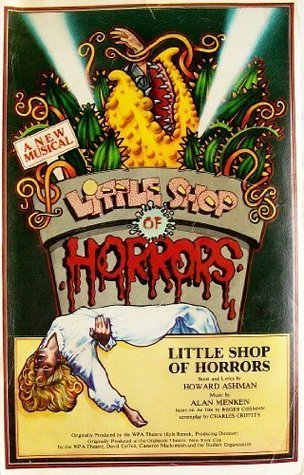
Little Shop of Horrors is a rock musical, by composer Alan Menken and writer Howard Ashman, about a hapless florist shop worker (Seymour) who nurtures a plant (Audrey II) and discovers that it's bloodthirsty and highly intelligent, forcing him to kill to feed it. The musical is based on the low-budget 1960 black comedy film The Little Shop of Horrors, directed by Roger Corman. The music, composed by Menken in the style of early 1960s rock and roll, doo-wop and early Motown, includes several well-known tunes, including the title song, "Skid Row (Downtown)", "Somewhere That's Green", and "Suddenly, Seymour". Author's Little Shop of Horrors satirizes many science fiction, "B" movies, musical comedy itself, and even the Faust legend. There will, therefore, be a temptation to play it for camp and low comedy. This is a great and potentially fatal mistake. The script keeps its tongue firmly in cheek, so the actors should not. Instead, they should play with simplicity, honesty, and sweetness-- even when events are at their most outlandish. The show's individual "style" will evolve naturally from the words themselves and an approach to acting and singing them that is almost child-like in its sincerity and intensity. By way of example, AUDREY poses like Fay Wray from time to time. But she does this because she's in genuine fear and happens to see the world as her private "B" movie--not because she's "commenting" to the audience on the stillness of her situation. Having directed the original New York production of LITTLE SHOP myself, and subsequently having seen it in many versions and even many languages, I can vouch for the fact that when LITTLE SHOP is at its most honest, it is also at its funniest and most enjoyable. -- Howard Ashman
This will complete my challenge for reading a play script. Since I’m handling props for an upcoming show, I figured I’d kill two birds with one stone. I’ve seen this play before a couple of times, so this was a fairly quick read. I still prefer the movie ending, but it’s a weird, wacky play with a lot of fun songs and memorable characters. The most known character, of course, is Audrey II, a carnivorous plant not just content with Miracle-Gro. No, Audrey II’s tastes are more sanguinary. At any rate, I was reading it from a props perspective, and it makes me appreciate how much is needed for a musical such as this.
December 5 -I had never seen the movie, but was adopted into the Little Shop of Horrors Tech crew for the Batesville Community Theater's show and read through it and I think it's a great story. It's not only funny and fun to watch, but I think it has a good message. As weird as this sounds, I think it alludes to the Bible a little bit because the plant represents evil and corruption and sin and as he fed it, it grew bigger and much more out of control to the point where it ate Seymore, Audrey, Mushnik, and Orin, not to mention had little tiny plants sent all across the world. The finale's chorus is "DON'T FEED THE PLANTS" and talks about even if it offers fame and success, "DON'T FEED THE PLANTS". Biblically, we are told to not live in a lifestyle of sin and to not keep adding to our temptations because if we do we get a calloused heart and end up with this huge mess. To me, the plant and sin were too similar to express.
This entire review has been hidden because of spoilers.
One of my school friends loved this show, but I never got into it because the title and my vague idea of it didn't appeal to me (it was about some manly, singing giant plant?). BUT now I'm glad I never read more about it, because then the plot and ending were a total surprise when I watched the 2019 Pasadena Playhouse version with George Salazar and M. J. Rodriguez. I liked the apparent changes from the original, too: a modern setting, a female-sung Audrey II, and POC leads. Aside from a few added lines here and there that contributed more to the characters and story, the original script was mostly the same. Salazar was a very sweet and endearing Seymour, with excellent comedic timing (and the dramatic moments were heart-wrenching!). Story-wise, my favorite aspect of the show was the thoughtful, deeper themes available--like how the plant doesn't speak to anyone but Seymour or grow for most of the show, which allowed for interesting implications about Seymour's psychological state; like if him growing up as a poor orphan with not much affection in his life made him somehow crack and imagine the plant speaking to him. I love Seymour and the human Audrey's romance, and how perfect they are for each other after the lives of suffering they've had. Overall, it was cool to finally read/watch this popular sci-fi musical!
This was Wild. I knew a couple of things about it just from having general knowledge of musicals, but honestly I don't think anything could have actually prepared me. I had a great time with this. It was fun, shocking, a little random, and kind of sad at times. The style of music was not my favorite thing ever, but I thought it fit really nicely into the style of the story. I would be very interested to see this one live.
It’s a fun and great play and I’m super happy to be apart of it. We are doing it this year for our winter musical and it’s fun to be apart of. Just whatever you do don’t feed the plant 🩸
I love this musical! Audrey and Seymour's romance is the most tragic love story since Romeo and Juliet. There's no better way to express true love than having yourself fed to a man eating plant in hopes that it will in some way keep you in your lover's presence. If that doesn't bring a tear to your eye I don't want to know you because you must be a dentist!
From reading this book I learned about how greed can warp people's morals. The plant's potential monetary value changes Seymour and the ripple effect has an impact on everyone's values. When Seymour is first introduced in the story, he is portrayed as a nerdy, goofy guy. He only has one thing on his agenda, getting Audrey to like him. At this point in the story Seymour wouldn’t hurt, let alone kill, anyone. In the song ‘Git it!’ Seymour expresses his disdain towards the idea when he says to the plant “I don’t know anyone who deserves to get chopped up and fed to a hungry plant!” The turning point for Seymour is again in the song ‘Git it!’ The plant has placed the idea in Seymour's head that he can justify the deaths of some people in order to feed the plant and make it grow bigger. So once Seymour witnesses Orin assault Audrey, the song changes into a duet, representing the alignment in their mindset. This is a complete switch from his initial standpoint, demonstrating how our morals can be molded by greed. In this way I think that Audrey Two (the name Seymour gives the plant) represents greed, as it shapes Seymour in the same way that greed could.
Not only is Seymour changed by his greed, but the surrounding characters are impacted by it as well. As a result, he becomes successful. Then this success is what attracts the other characters with their new perspective on Seymour. The most notable example of this being Mr Mushnik. As outlined in ‘Mushnik & Sons, Mr Mushnik decides that he cannot lose Seymour, otherwise he will lose all of his wealth. This can be demonstrated when Mr Mushnik says to Seymour “I used to think you left a stench, but now I see that you’re a mensch!” This phrase is directed at Seymour during the song, but he is speaking more to the plant than Seymour. In the beginning of the story Mr Mushnik is sceptical that the plant could attract any real business, so this line fits better when directed to the plant. After all, he doesn’t care about Seymour at all, but what he could bring to the table.
It has been explored how greed can shape your morals and how the book demonstrates this. How Seymour's attitude at the beginning of the story vastly contrasts his actions and demonstrates the changes in morals. How Mr Mushnik's opinion on Seymour is fueled by his ambitions. These two examples show the theme of the story, ambition vs morality. As you give in further to one side, the other is neglected. This same message is relevant today, as we can see it in many industries debating ethics vs profit. As the ethics get worse, it enables the increase in profit. But the thing driving this system is the greed of humanity, keeping us in this exchange, where the rich get richer and the poor get poorer.
This entire review has been hidden because of spoilers.
I read this because I’m currently in a drive-in production of it at my high school. It is so hilarious and simultaneously mildly frightening, in the most absurd way. It toys a lot with the fact that it is supposed to take place in the 60s, but will be seen by a more modern audience. One line that does this is when Audrey sings “We’ll snuggle watching Lucy on our big, enormous, 12 inch screen.” I’ve seen the movie a couple of times, but I most definitely prefer the play’s ending, largely because I think it leaves you on a much more closed ending. Sure, it’s not the ending that you want, but I like it all the same. I definitely recommend that if you’re reading through this musical, you pull up the soundtrack and listen along when you get to the songs. Personally, I prefer the soundtrack with Johnathan Groff and Tammy Blanchard. I hope that one day I get to see this musical on stage.
Also, I feel like this post reads like a discussion board post for a college class haha. Sorry about that. Anyways if you get a chance to read this or see a production of it, definitely do it.
I’ve always loved this movie and got the honor of being an ASM for a production of this show. Because shows I partake in are very personal I don’t rate them, but I love and recommend this show and the movie. This should be appropriate for all ages. (Content warning: domestic abuse)
Does this count if I basically read the play every single day, sometimes twice a day, for three weeks straight via the captions I op’ed for the show? Unsure. Regardless, I could give you a word perfect performance on the spot.
So I can’t find the DC comic I actually read on here so I’ll just rate this instead. I rewatched the movie and it’s my second favorite musical. The comic adaptation was just as amazing.
I love this show and I love Menken and Ashman. Ashman's humor shines through so much, even in his little introductory notes, and his work with Menken is consistently rich and wonderful. This is definitely a shorter libretto than other musicals, but it is incredibly effective and I'm glad Little Shop has grown into the theatre legend that it is.
TL;DR: "Mid-twenties and perhaps balding a little" is such a funny introduction to a protagonist.
unfortunately don’t love this show. there is too much murder and greed and not enough hope or redemption for me 💔 music is pretty solid tho!! always love menken and ashman!!
July 2006 review: One of my favorite movies, favorite stage shows and favorite performing experiences, Alan Menken and Howard Ashman (the writing team who would later single-handedly launch the Disney Renaissance) hit gold here with their good-hearted sci-fi spoof. Riffing on Roger Corman's z-list film so effectively that it has entirely replaced it in popular culture, the story of Seymour, Audrey, Dr. Scrivello and the foul-mouthed talking plant is one of the masterpieces of sci-fi comedy, as well as a stage and screen legend.
February 2018 review: Twelve years later, my opinion has not changed. Whether you're doing the large or small version of this show, it just "works." The seemingly broad humor has so many moments of incisive nuance, and even as it never takes itself too seriously, the show is full of so much heart that you can't help but feel for these tragic, absurd characters even as you laugh at them.