At the age of 21, Nicoletta travels to Rome to find her mother, Olga, who abandoned her long ago. Nicoletta finds her at Casetta dell'Orso, a charming little restaurant owned by Olga's husband. The staff of bespectacled gentlemen welcomes Nicoletta warmly, but Olga's reception is not so pleasant. Olga has never told her husband that she ever had children--and he must never know.
In exchange for Nicoletta's playing "the daughter of an old friend," Olga offers Nicoletta a place to live and an apprenticeship at the restaurant. Nicoletta fits in well among the unique personalities at Casetta dell'Orso. She gets along particularly well with the kindly headwaiter, Claudio, a divorced man who, after years, has still never taken off his wedding ring. As Nicoletta's feelings for Claudio become complicated, she finds a sympathetic ear in Olga, leading the estranged pair to form a friendship neither expected. But as they grow closer, the pressure exerted by the secret they share becomes too much to bear.
Natsume Ono (Japanese name: オノ・ナツメ) made her professional debut in 2003 with the webcomic La Quinta Camera. Her subsequent works not simple, Ristorante Paradiso, and Gente (a continuation of Ristorante Paradiso) met with both critical and popular acclaim. In 2009 Ristorante Paradiso was adapted into a TV anime series. Her current series House of Five Leaves (Saraiya Goyou), also adapted into a TV anime series in 2010, is running in IKKI magazine.
I didn't get on all that well with this one. It wasn't terrible, but I'm not quite sure how it's got so much critical acclaim.
The story setup intrigued me: a girl is abandoned by her mother as a child because her mother falls in love with a man that doesn't want to date women with children. Once she's grown into a young women, the girl decides to go and confront her mother (and the man that she is still with), with the truth. Throw in the backdrop of an Italian restaurant staffed incongruously with only older bespectacled men, and you've at least got a good hook for people like me who are after something a bit off-the-wall in their comics entertainment.
The main problem I had with the comic tho was the writing. Things just seemed to happen because that's what the author wanted to write, rather than the characters actually causing things to happen because of who they were. One example: at the start, the daughter thinks to herself that she doesn't understand the appeal of the all-older-bespectacled-male waiting staff at the restaurant, but the very next time she sees one of the staff she immediately starts to think how sexy he is.
The author could have written it as if the daughter's mind changed over time, or even that there was something specific about the man that suddenly caught her attention, but in fact she just seemed to contradict herself entirely in the space of just a couple of pages at the start of the book.
There also really isn't much of an emotional impact anywhere in the book around the daughter and the mother's relationship, which is a missed trick in my opinion, given the plot.
The artwork is probably going to be marmite to a lot of people: you'd love it or hate it. Its drawn with nib pens in quite a scratchy, quick style. Personally there are moments where I think the artwork is quite beautifully balanced, but most of the time its quite ugly to me. It's reminiscent of the kind of pen illustrations you might get in a magazine about wine (which is actually pretty fitting, considering the Italian restaurant backdrop), but I'm not really a fan of that style of illustration unfortunately.
All of the supposedly sexy male staff at the restaurant were drawn looking pretty similar, so at points they were very hard to tell apart from each other. The choice to give everyone elongated, spindly bodies and hands was probably 100% conscious on the part of the creator, but again, I'm just not a fan of that style of art (it screams 'I'm out of proportion!' to me :S )
So I would say flip through a few pages of this book if you can before buying and take a look at the art - if you love the art then you'll probably forgive the story a bit. But if you're a fan of enigmatic tall older men with glasses, you should probably just go straight out and buy this anyway ;)
This may seem like a harsh review but I didn't like this manga at all.
The manga follows Nicoletta, who, at 21 years old, travels to Rome to confront her mother who had abandoned her to marry a restauranteur. When Nicoletta arrives at the restaurant, she is immediately mesmerized by all the handsome elderly gentlemen that the restaurant employs and is particularly enamored by one of the servers, Claudio (who honestly reminds me of Michael Caine).
There were a few reasons why I didn't like this manga: - the dialogue was weak - little to no character development - no chemistry between any of the characters - I didn't particularly like the artwork - Nicoletta's feelings towards Claudio came from nowhere, and she came onto him hard (and in a very inappropriate way that's borderline creepy. I get the sense that Claudio has no idea how to deal with her without hurting her feelings) - very little and very slow development in the relationship between Nicoletta and her mother
This didn’t touch me at all, creepy story poorly told and drawn. I picked it up from the library because it was a right to left graphic novel and in English and so I thought that would be good for my brain! However the story didn’t grip me, the characters weren’t deeply unfolded and the drawings, pace and box flow didn’t do anything for me. Why was a gorgeous young woman so attracted to an older sorry arsed man still in love with his ex??? Premise didn’t even make sense. And the whole mother won’t acknowledge me story also bit specious. Sorry, I wanted to like it more than I did!
This entire review has been hidden because of spoilers.
La premisa con esta historia es no tener muchas expectativas, disfrutarla como es, aunque posiblemente te pueda llegar a dejar indiferente.
Ciertamente llegue a esta historia por el único motivo de que otra de las obras de la autora tuvo un anime, ACCA: 13-Territory Inspection Dept., que visual y musicalmente me dejó enamorada y aunque la historia tiene algunos giros particulares logró su cometido de entretenerme. Por lo que siendo Ristorante Paradiso su única obra publicada en español, no quería dejar pasar la oportunidad de poder leerla. Lo que sí, es que teniendo el estilo que tiene, muy probablemente, sin ser demasiado pesimista, sea la única obra de esta mangaka que sea traducida al español (espero estar equivocada)
Con un ritmo pausado, lento, poco a poco te va envolviendo, haciéndote participe de esta pequeña etapa en la que se desenvuelve la protagonista, esperando que algo suceda, pero que al final solo se queda en una trama que avanza sin dar una conclusión cerrada.
Nicoletta, un día llega a un reconocido restaurante, con un objetivo personal en mente, y aunque en un principio está determinada a conseguirlo, el ir conociendo y conviviendo con todos los trabajadores del restaurante, poco a poco va cambiando su perspectiva.
Me gusta el crecimiento que va dando mientras está en el restaurante, pero hay algo que al principio tal vez en apariencia no termina de encajar del todo, no sé si sea su cambio repentino, que por el hecho de no querer estar sola, de aprovechar su libertad y estadía en la ciudad y de convertir esto en uno más de sus objetivos, decide lanzarse de frente a conquistar a alguien que ha llamado su atención, lo que la vuelve obstinada por lograr que el dicho caballero se fije en ella, como si fuese un capricho, lo que provoca ciertas situaciones inesperadas y que rompe un poco con el ritmo de la historia pero que al final deja esa actitud hasta cierto punto infantil para luego convertirse en un personaje más maduro, dando como consecuencia más situaciones que no hacen más que reafirmar el cambio en ella. Así que lo que empieza como algo que se siente un punto y aparte en la trama, termina por convertirse en un factor que genera un cambio positivo en la protagonista.
La historia resulta bonita pero desear que haya una conclusión cerrada y no tenerla, puede ser un poco decepcionante, pero a cambio el epílogo logra reconfortarnos con una especie de conclusión para todos los personajes, dejándote un buen sabor de boca.
Una trama con un ritmo que no a todos pudiera resultar atractiva, con un estilo de dibujo demasiado particular pero característico de la autora, que da como resultado una historia bonita, que no va más allá del relato temporal de la vida de la protagonista, un momento de su vida que le dará muchos cambios que la harán crecer y replantearse varias cosas, dando como resultado un crecimiento personal que no muchas veces solemos encontrar en este tipo de historias.
Al final he disfrutado de esta historia y me deja con la curiosidad de poder leer más obras de Natsume Ono.
I completed Gente ages ago but somehow never actually read Ristorante Paradiso oops. I did watch the anime, which was how I found out about Ono Natsume in the first place.
There's this type of delicate and refined old man that exists only in fiction (or maybe they do exist irl but like, I say this in a 'we haven't seen everything in the deepest parts of the ocean' kind of way), but Ono Natsume has created this ideal for me okay. Like Nicoletta, I was totally taken in by Claudio, who has bottom energies is kind and thoughtful and has a nice smile. 「こっちから迫って困らせてみたいタイプよね」That is, the type you want to come on to and embarrass. Obviously there are other men and they all have their different charms, but we focus on Claudio here because he's the one Nicoletta takes a shine to.
Which is not to say RisPara is about a girl who moves to Rome to find love. The reason Nicoletta goes to Rome and Ristorante Paradiso in particular is because she wants to get back at her mum for abandoning her when she was a kid in order to get married again. Half of the focus is about Nicoletta and Claudio's budding relationship, but another half is about a daughter finding a connection with her estranged mother--no matter how reluctant both of them are about it.
This kind of story can honestly only be written by a woman 😅 I love that type of relationship Nicoletta and Olga have... there's a lot of resentment from Nicoletta of course, seeing her mother so happy and carefree while Nicoletta was left behind in the countryside with her grandparents. But they way they reconnect as women and how similar they are and the way they think is kinda fascinating for me. 'As a mother, I want you to pursue a relationship with someone your age, but as a woman I want you to go for it.' They have an unorthodox relationship of course, but that's what makes the story special. Yes, even though I really like Claudio.
Can I just say how good Ono Natsume's pacing and panelling though? The reveal in Olga's party in particular... when she gives Claudio time to pat Nicoletta's head, and we pan out so we don't see Nicoletta's face when she starts to cry... that honestly made me tear up myself. It's that moment when we're trying to act normal, but then we remember all the past resentment, and we kinda like our mother after all, and also being accepted so publicly. There's just so many emotions there and the way we just have silence and the panel where Nicoletta puts her hands on her eyes 😔👌
This is so long. Let's stop.
This entire review has been hidden because of spoilers.
La petite jeune Nicoletta 21 ans a un crush sur le maître d'hôtel du resto, un vieux croûton presbyte divorcé, encore amoureux de son ex. Comme d'hab' on romantise des histoires pedo, ça ne choque personne l'écart d'âge, c'est même tout a fait banalisé, au lieu de passer le message aux jeunes femmes de ne pas s'enticher des vieux (même très gentils) ?? Le resto est complet tous les soirs car des femmes viennent baver sur le personnel (100% vieux croûtons presbytes). C'est donc selon mon analyse comme un club de gogo-danceurs / une maison close / un bar a hôtes mais personne ne veut l'admettre mais moi je vous le dis franchement 🧐 (sans sexe ofc)
* Je suis déçue du traitement simpliste de la relation mère-fille : abandon à 6 ans, elles se retrouvent 15 ans plus tard, elles font comme si de rien était, pas de bouleversements, pas de complexité ???
* C'est impossible de reconnaître les différents hommes car ils ont tous la même tête, ils sont identiques ??
* Je m'interroge sur un potentiel défaut de traduction car les dialogues sont banals/naïfs à l'excès ? Dans l'ensemble se dégage de cette œuvre un manque de profondeur tant dans les dialogues, que dans l'intrigue. On a même pas de descriptions des plats délicieux alors qu'on est dans un resto où la cuisine est censée être une tuerie. Ne donne pas envie de s'intéresser a la série Gente pour approfondir. Je n'aurais pas été étonnée de le trouver a Noz pour 1€99 mais moi c'est Pauline qui me l'a donné pour s'en débarrasser.
Point positif : les expressions faciales, c'est très mignon et comique. En décalé par rapport à leur âge et supposée maturité que personne n'a, même ceux qui se prennent pour des sages.
Me gusto mucho el anime y probé con el manga en que se baso la animación, el manga esta bien pero se nota que los realizadores del anime se metieron de lleno con la ambientación, música y demás, para lograr una historia entrañable (es una versiona mas nostálgica y romántica que el material original). Aunque la protagonista se enamora de alguien muchísimo mayor que ella, se siente que en el manga eso viene de la carencia del vinculo afectivo con sus padres, sobre todo aquí se enfocan en Olga, su madre, que la dejo por irse con el hombre del que se enamoro perdidamente, sin medir las consecuencias que vendrían para ella después.
This has such a cool premise. There are some good scenes, but as a whole it doesn't work for me. Instead of the restaurant and its staff, the focus of the story should've been on the mother daughter relationship. It doesn't help that Claudio and Nicoletta have no chemistry together.
Amores pequeños y desamores aún más pequeños en el marco del rutinario devenir de un restaurante italiano. Una madre y una hija. Su desencuentro. Y su encuentro. Y una alianza que no acaba de caer donde debiera...
Pongamos que decimos que una de las grandes virtudes del manga, aun de los mangas del montón como éste, es tratar esos temas ordinarios y sin aparente importancia, pero tan importantes a veces, que ningún otro cómic se atreve a tocar nunca.
It's supposed to be a prequel for a series, but it made me want to stop halfway through the thing, not even looking at the next books. The drawing style was really janky and the romance was confusing and uncomfortable. The only thing I sorta liked was the mom's character, but she was annoying as well. I feel like we started at zero and came nowhere. Nothing really developed past the first chapter except for the mom. I can't say I recommend reading this manga.
There is nothing really wrong with this book.... but nothing right either. It's boring. Just so so boring. There is no romantic tension between Claudio and Nicolette at all, so it just drags.
Having first discovered Natsume Ono’s manga Ristorante Paradiso thanks to the Anime Adaptation which David Production produced, I was very interested in reading the original manga. To see the differences between the two productions, but also to enjoy the original story that the mangaka published in the magazines. And what I read really pleased me.
The story of a ristorante set in the center of Rome, at a street corner so small that none of the tourist masses will bombard the employees there. Though the food and service there — such as gorgeous waiters in their fifties/sixties all wearing spectacles — makes it quite a coveted place to enjoy a night meal. Giving its owners —Lorenzo Giorno and his wife Olga — a joyful business alongside their winery. Though everything might crumble down for the woman as her daughter Nicoletta, now 21 years old, has come back into her life and is ready to reveal to her husband the truth. That his wife is a divorcee and has, from that former marriage, a child which she has abandoned — something that Olga wouldn’t want him to know as back when they were dating; he told her that he refused to marry a divorcee with children. Before this ominous revelation that she had been married before which could destroy her marriage, Olga confronts her daughter to make sure no such thing happens; succeeding in a way, but not enough as Nicoletta settles down in Rome and slowly succumbs to the charm of this Ristorante; working alongside its waiters as an apprentice cook and falling in love with Claudio, the Head Stewart.
Now unlike the anime, the series stands in one volume and much of the narrative of the episodes stands in either a couple of pages or half a chapter as Ristorante Paradiso is written through 6 chapters. In sum, this is a good read to do either in a one-hour sitting; though for those who’d want to discover the story more slowly, they can take the time to read everything one chapter each day.
As of the story, I really enjoyed the characters and their backstories, though let’s take note that not all of them get the chance to be further studied as in the manga. This is why Natsume Ono also published the Series Gente. As an attempt to explore the characters, their personalities and the life climate in the Ristorante. For in this volume, the focus is more on Nicoletta, Olga, Lorenzo, his brother whose name I will not reveal to not break spoilers, and Claudio’s relationship with his ex-wife. So for those who enjoyed in the anime series other characters than those 6 individuals, they should also consider the Gente series as they will get a wider painting of the Casetta dell’Orso culture. A beautiful painting rendered through a neo-realistic portrayal of life, like in Luchino Visconti and Ettore Da Scolla’s movies.
As for the artwork, the pencil work delighted me. Through the very detailed panels that presented the story as if we were seeing a film to the very good use of Screen tones, Natsume Ono presents herself as a skilled artist.
In sum, this series, just like the movie Cinema Paradiso did with small/local cinemas, is a beautiful love letter to the small restaurants set around cities such as Rome. And for those who want to prove to others that mangas are more than action/fantasy/sports-driven stories, Ristorante Paradiso is a great way to encourage older audiences in discovering the Japanese medium of mangas.
Nicoletta comes to Rome, determined to get a little revenge on the mother who abandoned her when she was small. Olga is married to the owner of a quaint little restaurant in the heart of Rome, and Nicoletta shows up unannounced. Only to be intrigued by the waitstaff, all of whom are suave, bespectacled gentlemen over fifty. And most especially by kind Claudio. Despite a significant age difference, Nicoletta is in danger of falling in love.
A charming blend of restrained romance and family drama, with mother-daughter moments providing most of the character development. There's less in this single volume than was in the anime, but I suspect the adapters borrowed from the three-volume sequel, Gente, which I'm diving into next!
[Read for Scallywagathon '18 for the challenge "Book that starts with 'R'"]
The thing I really love about Natsume Ono titles is how she builds a nice collected world and just fills it with realistic but also very colorful and different characters with realistic personalities. All with a simple, sketchy art style that I'm in LOVE with.
This was lovely and peaceful. Surprisingly I was more invested into development of relationship between mother and daughter than in romance. The romance is on pre-relationship stage during the entire book but it was cute, I liked Nicoletta and Claudio scenes together.
The art was pretty but a bit rough? I had trouble figuring out who’s who because many characters have similar designs.
I really liked the tone and the ideas behind the characters, but the story was a little too thin and there were a few too many characters to keep track of without enough space for their development. I'm curious whether I'll like Gente better, since that's a collection of smaller stories focusing on each character. It makes sense that Ono would shift focus and do that with this concept.
So really this is probably more deserving of a three, but I have some personal bias for the themes and a huge soft spot for the (superior) anime, which helped me feel better during a tough time and remains very close to my heart. So four stars it is.
I enjoyed this book. I watched the anime first and wanted to read the manga as well. I liked the storytelling and art style. Natsume Ono has an unique style and I felt it was executed well in this story.
Interesting read!! I love stories that slowly introduce you to individual members of an ensemble. Also really enjoyed the restaurant setting. Main character wasn't super my favourite though and I found some of the men in the restaurant to be a little dull.
En el amor no existen reglas. Siempre es fortuito, extraño, arrollador. No importa cuánto nos preparemos o cuanto lo neguemos, pues cuando nos alcanza es como un rayo que nos atraviesa; no sólo es inevitable y destruye aquello que éramos hasta entonces, sino que además nunca podemos saber cuándo ocurrirá. Si es que alguna vez ocurre.
Aunque Natsume Ono es prácticamente desconocida en nuestro país cosecha un importante éxito crítico tanto en EEUU como en Japón. También en buena parte de Europa. A ello contribuye un dibujo de ecos manga, pero más estilizado al redundar en la línea clara, donde todo se juega en una composición de viñetas que no teme al espacio en blanco. No existe diferencia alguna entre dibujo y diseño. Una viñeta en blanco o un espacio más prominente entre viñetas puede dar a entender tanto como la sucesión de dibujos, remitiendo a las formas más elegantes del género. Ono siempre sabe dónde colocar la cámara para retratar con exactitud la sensación que quiere transmitir, pero lo hace tanto con el dibujo como con el viñetado o su distribución; tanto con la imagen como la composición o el montaje. Elementos estos últimos que no pocas veces descuidan dibujantes muy bien considerados en Occidente.
Su única pega es narrativa. Al ceñirse hacia cierta linealidad donde los flashback van sólo en relación al descubrimiento inmediato, consigue retratar de forma certera el tempo propio del slice of life, pero también pierde la oportunidad de ir más allá. De no sólo ser un excelente slice of life, sino un manga perfecto. Algo que se hace evidente en lo desaprovechada que se siente la relación entre el dueño del restaurante y Gigi.
Pero, ¿de qué restaurante estamos hablando? Del Ristorante Paradiso. Un restaurante donde todos los empleados son hombres con gafas para vista cansada. Auténticos caballeros. Y allí aparecerá Nicoletta, hija del dueño del restaurante, para aclarar con su madre su disgusto por haber sido abandonada durante quince años. Al menos hasta que decide hacerle el favor de no delatarla por el momento de que es su hija en parte por un cierto amor soterrado y en parte porque Claudio, el jefe de camareros que le lleva más de veinte años, ha conseguido despertar su curiosidad. O tal vez algo más.
Aquí el conflicto se dilucida en si Nicoletta revelará el secreto de su madre, que tiene una hija, mientras que su relación con Claudio o las revelaciones de los demás miembros del restaurante alimentan, de forma extraordinaria, la forma de ver el mundo de Nicoletta. Cada pequeño paso nos hace comprender mejor cómo o porqué hace cada uno de los involucrados lo que hace y, con nosotros, también aprende Nicoletta, que descubre que, aunque sea difícil de comprender, cada persona está dispuesta a llegar hasta diferentes lugares por amor. No todos haríamos lo mismo en la misma situación.
De ahí que la única pega que podamos sacarle sea ínfima. Su modo de narrar es perfecto, no tiene debilidades o incoherencias —mas al contrario, es uno de los slice of life más inteligentes que pueden leerse no sólo en el manga, sino en la literatura en general—, por lo cual la queja va más bien sobre su trascendencia. Sobre la posibilidad de, dando mayor peso hacia ciertos elementos de tensión (la culpa que siente Gigi, el carácter agrio de Luciano), pudiera explorarse con mayor profundidad el contexto. Pero entonces hubiera necesitado más de un tomo. Y Ristorante Paradiso, tal y como es, ya es casi perfecto.
Partiendo de esa idea, sólo nos cabe esperar que en el futuro podamos leer más obras de Natsume Ono. Y con un poco de suerte, que logre la popularidad que se merece. A fin de cuentas, no todos los días podemos leer una historia tan excepcional que parece, como el amor, demasiado real como para reducirse a la mera pasión.
Imagine a quaint little restaurant located on the charming streets of Rome. Inside the tables are occupied to maximmum capacity and appetizing Italian food are catered by handsomely mature bespectacled gentlemen. This is the kind of restaurant Nicoletta waltz into in Ristorante Paradiso.
When in Rome… This manga is a nice slice-of-life romance about a young woman named Nicoletta who travels to Rome in order to confront the man her mother remarried. As a young child, Nicoletta’s mother her left to be raised by her grandparents with this as her reason: “There’s a man I’m destined to be with. But he’ll never marry a divorced woman”. (This is not really a spoiler because this is explained within the first few pages). Now at age 21, Nicoletta travels to Rome to confront her mother’s husband, which is why she finds herself outside of Casetta dell’Orso and where our story begins.
Like mother, like daughter. Nicoletta’s relationship with her mother is interesting to say the least. After basically being abandoned as a child, it’s easy to understand Nicoletta’s resentment towards their mother. Due to some circumstances, Nicoletta doesn’t outright say she is he mother’s child and instead plays the “daughter of a friend” role. I appreciate that this story isn’t all about hating her estranged mother, but instead mother and daughter trying to rekindle their lost relationship.
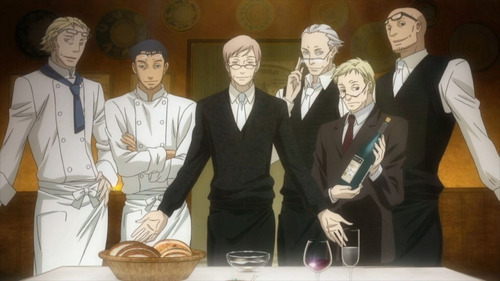
“Most of our guest are here for the waiters. Our customers share a particular weakness for handsome gentlemen.”
Left to Right: Furio, Teo, Claudio, Luciano , Gigi and Vito
Ladies, eat your heart out! The story is set primarily in the ever popular restaurant, Casetta dell’Orso. This restuarant is popular for two reasons: 1) The food. 2) The staff. Now I think one of the selling points of Ristorante Paradiso is definitely the abundance of charming bespectacled gentlemen. While I wouldn’t call this story a reverse harem (all the guys don’t fall for the female protagonist), the readers could easily pick out a favorite if they wanted to. I would say that Ristorante Paradiso is the Ouran High School Host Club equivalent for older woman. What’s nice about this manga is that we do get some insight on all the characters (some more than others). Everyone has a personality and story behind them fleshing out their character.
City of love. Now, I know that Paris is typically the city of love, but after reading this manga I think it would be nice to fall in love in Rome. Nicoletta falls in love in the insta-love kind of way, but being a short romance prequel manga to the series I didn’t really mind. Like her mother, Nicoletta feels with her heart, but she also doesn’t act rashly on it. She is constantly trying to understand if what she is feeling is simply an attraction or real love. To me, when Nicoletta acted for the sake of “love” she did it in a way that was confident and reflects how sure she is of her feelings. I really admired her personality because of it.
Would I recommend it?
I loved the anime and love being able to carry the manga with me to read whenever. So yes, I recommend it. This is a nice light read if you want to stray from the typical shōjo romance manga out there.
This is one of the properties where scanlations/fansubs did it for me. I totally understand that not every reader of scanlations goes on to buy the books that become available, even if they have liked them. Not even I have that money for every long-running series.
But I remember the time where I couldn't get an impression of a property and only had to rely on reviews in a magazine (not even multiple ones, because there was only one anime magazine and no manga one). I bought much more cautiously and was quite slow to start buying again if I got burned during the buying and watching/reading of a series.
The drawing style of this one-shot is not at all my taste. But I had seen some chapters as scanlations and the storyline was intriguing and then I watched the fansubbed anime series (which I would buy in a heartbeat if they licensed it) which did the admirable trick of staying close to the design but making the people much more attractive.
I love the quietness of the story: abandoned 21-year-old daughter confronts mother, falls in love with the people at the restaurant the mother's current husband owns. You get the sense of directionless resentment and then the opening of Nicoletta's heart and her first big love. The fact that all the guys at the restaurant are middle-aged and older gentlemen works because Nicoletta realises how much she is like her mom in her obsession with Santo Claudio Paradiso, going directly after him, almost ignoring any obstacle - she even molests him physically right when he helps her out with an umbrella to her door the first time.
With no space wasted we find out why Claudio is so vague and why he is no longer together with his ex-wife whom he continued to love, why Olga, Nicoletta's mother, left her and now is sorry for it, why her current husband Lorenzo didn't want a woman who had a child from a previous marriage (there's actually a believable reason in his and his brother's Gigi story); that you can love without having to destroy someone else's love; that you need to develop dedication and patience if you really want something; that you don't need to make the mistakes of your parents.
All this in a lovely Italian setting around food and good wine. From what I infer some bits in the anime series were probably gotten from the Gente prequel series and the series had way more time to slowly develop the characters and their interaction and background, but even this one off really works. Like a dolce to savour after a satisfying meal.
I genuinely don't remember how this ended up on my queue outside of potentially the unique (albeit kinda bad) art style, the premise/setting, and/or the GILF café. It's not often you see a manga or anime set in modern Italy, especially one with the aforementioned GILF café, but that's as far as it goes.