Jump to ratings and reviews
Rate this book

Subliminal Seduction

Rate this book
Book by Key, Wilson Bryan

Mass Market Paperback

First published January 1, 1973

24 people are currently reading
1411 people want to read

About the author

Wilson Bryan Key

6 books26 followers

Ratings & Reviews

What do you think?
Rate this book

Friends & Following

Create a free account to discover what your friends think of this book!

Community Reviews

5 stars
74 (25%)
4 stars
90 (30%)
3 stars
85 (29%)
2 stars
22 (7%)
1 star
20 (6%)
Displaying 1 - 30 of 45 reviews
Profile Image for Don LaVange.
207 reviews15 followers
July 30, 2007
In fact, this book seduced me when I first read it. I was seeing subliminal messages everywhere. I think I completely bought it all until one day, looking out of a plane window my brain, now trained to see these subversively scribed messages of sexuality, imagined the word "sex" in the clouds below me.

"Ok. Now I get it", I thought to myself.
Profile Image for Michael.
982 reviews174 followers
October 4, 2015
There’s a great mystery about this book. It isn’t the mystery of why the Illuminati allowed it to be published when it gives away all their secrets. It’s not the mystery of who’s really controlling the messages that are secretly beamed to consumers. Nor is it the mystery of what techniques you can use to protect yourself from their thought-control.

The mystery is why a serious media researcher like Marshall McLuhan would allow his name to be associated with this crap. More than that, in his introduction to the book, McLuhan repeatedly praises the author as a genius who has made an important contribution to our understanding of advertising. He retained his personal copyright on the Intro, incidentally, so he could have pulled it at any time (maybe the moment where Key was supporting the Fundamentalist assault against reason by testifying in the famous Judas Priest suicide case would have been a good point?). But, for some reason, he allowed his reputation to be tarnished by this book, and I will never see him in the same way again.

I have stared at the illustrations in this book for hours, trying to find the evidence Key claims “proves” that subliminal images are used in magazine advertisements, and all I see are blurry smudges that don’t prove a thing. Even in cases where he has magnified the image until the grains from the photograph are clearly visible (is he claiming that we all carry around unconscious microscopes behind our eyes?), it still doesn’t look like he says it does. Apparently, I am immune from his particular form of hypnotism, because at one time there were thousands of Americans who DID see those images, just as he told them to.

There is an interesting section in this book, in which he offers up an anti-feminist analysis of the messages contained in Playboy, Vogue, and Cosmopolitan, but any validity that argument may have had in the 70s would be negated by the changes in publishing since that time. Basically, the value of this book is as an example of how nobody goes broke by underestimating the intelligence of the American people, or even its leading intellectuals.
Profile Image for Zadignose.
308 reviews179 followers
read-genre-ghetto
July 10, 2025
Total pseudo-scientific bunk, and probably dangerous in that it's persuasive if you approach it without skepticism. It will contribute to your tendency towards paranoia if you have such a tendency. But now that I've been reading Freud again, I understand that there's a precedent for speculative musings being presented as proven theory.

Of course, there's also the possibility that some advertising executives gave credence to the same things this author did, and thus there may have been some actual experiments with techniques such as described in the book. And also, of course we all know sex sells. But unfortunately the author takes some semi-credible ideas and goes off the deep-end with them. And he forgets that blunt and crude often trumps subtle and subliminal in advertising.

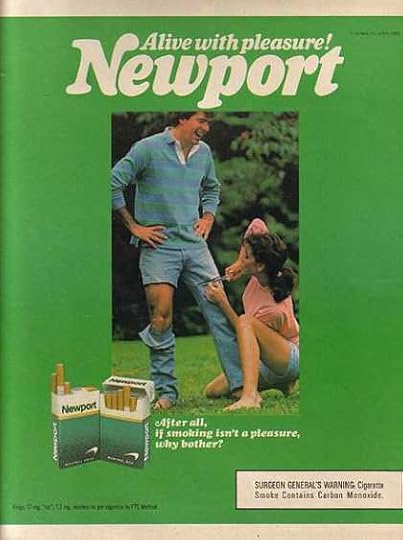
Still, I was always creeped out by 1980s Newport Cigarette ads. And I still am:


"Please don't take my dick away. Or my cigarettes. You castrating bitch."
Profile Image for Charles.
Author 41 books289 followers
February 16, 2009
Another book that it's hard to judge how to rate. For accuracy as to what subliminal presentation can accomplish, it far overstates the case and the need for concern.

On the other hand, there is little doubt that advertisers are manipulating us constantly. They're just using supraliminal effects rather than subliminal.

There is some interesting reading in the book but be cautious about believing what you're reading.
Profile Image for Marc.
Author 2 books9 followers
April 7, 2013
I read this book years ago when it first came out. A friend had taken a course in college with the author and he told me about it. I didn't put it down until I finished it-and bought my own copy. Many of the examples are dated and technology today has changed the landscape. But the take-home message remains the same. We are constantly being manipulated by ad copy writers; Political ads especially.
Profile Image for Michael David.
Author 3 books90 followers
December 26, 2019
I had absolutely no idea about this book and its author until one of my close friends posted its picture as a joke. Piqued, I eventually bought this book and sought to read it. It took me some time, because most of its extant copies are expensive, and I didn't want to spend a fortune on a curio.

While it's undeniably dated, it does contain a few salient points. Sadly, however, most of the book's content is outdated and irrelevant. Among the few relevant points in Key's book are his comments on psychology, however, have aged well. In page 34, he writes:

"As oral gratification is a basic human response to rejection threats, the rejection theme is a persistent and successful technique used in the merchandising of cigarettes, cigars, pipe tobacco, and food."


This was definitely applicable to the quintessential Marlboro ad: if you smoked Marlboro, you would be a man, even if you looked nowhere like the Marlboro man. Nowadays, a lot of people run to food as a provider of transient enjoyment: it's easier to stuff one's mouth with food than it is to act in the face of rejection. It's so much easier to sit than it is to exercise.

Second, Key's assessment of television as medium remains accurate, even today.

Aside from the domination of time, perhaps the most devastating part of the TV legacy is the destruction of communication among family members.


I had a hard time understanding this back when I was younger, but my father forced us to share dinner together, and only allowed us to watch the television during weekends. I'm sure that his exhortation towards reading and his training led me to become a more intelligent person. Further, our family remains close-knit because we talked about our own personal issues together.

When we were younger, he did not believe in the television as a consistent medium of education. Key comments:

Education requires subtle nuances of both teacher and audience reaction, human interpretations and discourse, multisensory experiences, unique individual responses and interpretations. (p. 67)


Key was even a bit of a Nostradamus when he wrote that:

... television serves America as the greatest pacifier of them all - a total substitute for thumbsucking and toying with one's genitals. The TV machine regulates time, channelizes or unifies perceptual experience, and establishes an entire range of desirable human expectations, value systems, identities, relationships, and perspectives towards the entire world.


I believe that among the signs of intelligence is the ability to hold two opposing thoughts in one's head, and assess them rationally. The television provides people with ready-made answers that lets them relax in its glow; the same can be said with the dynamic medium of the Internet.

If we replaced "TV machine" with "Facebook," the sentence still makes sense. The people who appear most in our feed are those who essentially agree with us, because we either block or ignore the people who disagree with us. Carr's The Shallows: What the Internet Is Doing to Our Brains has already proved that the Internet is decreasing our ability to concentrate and comprehend - and we still have TV!

This was a great insight by Key.

However, most of the book is mired down in inane appearances of SEX. Although he made legitimate points in assessing one Gilbey's Gin advertisement, his presumptions about letters appearing out of nowhere seem laughable nowadays. His warning, however, to try and look over things closely, is also being ignored due to the massive popularity of the Internet.

The masses love to be hypnotized: distraction is their anodyne. This is where Key succeeds. But the book mostly fails.
Profile Image for Nick.
82 reviews
July 2, 2021
The methods of admen and marketing are explored and exposed in a very detailed and articulate description. Written in 1973, this needs little revision and even somewhat predicted the echo chambers of political media we have today. This book's accusatory tone toward the industries of media and advertising is refreshing and feels as though the reader is being deprogrammed and trained to recognize and reject trickery. A full glimpse of modern society with its carefully led masses to collectively desire specific brands, activities, and views.
Profile Image for Maxwell Bauman.
Author 29 books33 followers
August 28, 2017
This book explores x-rated subliminal techniques used in advertising. I first heard about this book mentioned in the Kubrick documentary "Room 237." I pretty much inhaled this book. It starts off by emphasizing that you need to relax (and in so many words, not be an prude) to see the hidden layers in ads. Then it gives examples from alcohol and cigarette sales, to Vogue and Cosmo (which are apparently really into castration imagery). This is a fascinating read for anyone who wants to take a step back and see how advertisers are getting down and dirty.
After reading this, I've been able to see the copious amounts of filth thrown at the masses at an astounding rate. I've seen it in commercials for bottled water, and seafood, and hotels, and all these things that seem innocent enough, but actually have super kinky message. My friends all think I'm nuts when I point out these taboo images, but they've closed themselves to the reality of what's being bombarded at them. But I can see the truth! The filthy, perverted, deviant truth, and I love it.
Profile Image for Boni Aditya.
378 reviews890 followers
December 9, 2017
Loved this book - This is the book that sparked my interest in Psychology and various ways in which it is used in our products everyday. To exploit, in multiple ways like negotiation, manipulation, seduction, persuasion and many other ways in which mental tactics are developed over the years and perfected to capture human attention and eventually get them to say YES and open their purses and say "TAKE MY MONEY"
Profile Image for Carlo Fortunato.
11 reviews3 followers
April 20, 2021
I read it in high school and enjoyed it. It's fun. Later, when I spent five years in Advertising Print Production, I realized it was BS. They don't do that. It doesn't even occur to them. There's no evidence that it would work, and it would cost considerable time and production money, so why would you?
Profile Image for Dori Sabourin.
1,252 reviews6 followers
September 13, 2018
This book explains how advertisers can use pictures or images as a mass hypnosis to influence consumers to purchase their products. It brings to mind, the question what other avenues can be and have been influenced by these enticements.
92 reviews
February 1, 2025
Certainly the concept of subliminal persuasion is an interesting one. I recall hearing about this book and the concepts presented within as a youth growing up in the '70s. We have learned much since this book was published and it invalidates almost every claim made in it. Wilson Bryan Key makes the claim that he could have written this book as a series of papers - but that he didn't so that he could present his findings as a whole so that the public could be informed of the manipulation that they are apparently ender from advertisers. Of course, academic papers would include such useful things as actual data, references and the like - none of which are provided in this book. Knowing as well that some of the studies mentioned in the text never happened (such as the subliminal movie theatre experiment) also made me question the validity of almost every statement made by Key. Along with some of outrageous interpretations of advertisements made by Key there is the question of mechanism... Sure maybe there may be symbolism in that print ad for Absolute vodka but, if I am not aware that the bull is a symbol of virility, how would that impel me to purchase that particular brand the next time I am at the liquor store? If I subliminally perceive that the word 'SEX' is engraved into the surface of RITZ cracker, why would that make me choose RITZ? Surely if these attempts at subliminal persuasion are as pervasive as Key claims other crackers are trying to entice me as well! In the end we have a book in which I feel like 90% (or more) of the content is made up - it's not real - one can argue for Key's interpretation but someone else could easily weave a completely different interpretation. I also found it quite annoying that the illustrations (at least in the paper back version I read) were too small to really see anything (perhaps deliberately so?). The most entertaining part of this book is looking for the hidden images Key is talking about (kind of a perverted 'where's Waldo' exercise) but in most cases it is almost impossible to distinguish the tiny details he is describing.

In the final analysis, even though I was skeptical from the very beginning, I expected to at least be entertained by the persuasions described. Instead, it was an exercise in frustration.
Profile Image for Java Davis.
Author 6 books49 followers
August 12, 2017
Subliminal Seduction was a popular advertising concept in the 70s, but although this book was fun to read, subliminal advertising was debunked decades ago.
Profile Image for Suzy.
41 reviews4 followers
Read
August 27, 2019
I read this a long time ago, and loved it. I need to reread it again. Many decades have passed since I read this, but it always sticks with me.
Profile Image for Clayton Rumley.
Author 1 book2 followers
October 11, 2023
Read this as a teen back in the 90's and it made me look at advertisements in a whole new light.
Profile Image for Margaret.
491 reviews
February 22, 2025
WOW. This was one of the most frightening books I’ve ever read. I’d put it in the same category as “Helter Skelter”. Both kept me up at night.
Profile Image for Alex.
152 reviews2 followers
April 28, 2016
I'll admit I was skeptical when I started the book, and now, I remain skeptical, at least to some degree. There is however some great intrigue to be had in reading this. Professor Key explores the idea that the media, at the unconscious level (a topic I previously explored through discussion on Jung's writing, a seminal writer in this area), exploits the human psyche to sell its goods.

Professor Key submits that there are subliminal symbols essentially everywhere. Sex's woven into curtains even, at one point. I can't agree this to be accurate. Equally I cannot agree to schizophrenia is induced by the ability to consciously perceive subliminal artefacts - the evidence is yet to be presented in support of this case by any expert in this area.

As for phallic shadows under elbows of women, or cigarettes (a symbol of male virility) pointing at Ashtrays (a symbol of female sexuality) or images spliced into Ads which seem to show some form of sex, yea, I can agree that exists. Equally I can agree that the media knows it audience ever so well. The picture of the girl in Playboy holding the magazines topless in a motherly position was somewhat interestingly explored from a Freudian perspective in the sense that she is nursing the playboy readings (whom for the purpose of argument are concluded to be people with mother issues who need a little reassurance when they buy the magazine to strip away the guilt of photographic self-administered sexual indulgence).

I also had the opportunity to watch Professor Key's lectures on YouTube. This was also rather interesting and I would recommend viewing these videos if you like the book. He might come across as slightly delusional - I too believe he lies at the fringe of sanity, but if you took some of the more reasonable submissions (he considers being reasonable a methodology by which people are exploited, but ignore that sentiment for this review) you can begin your own analysis of advertisements in the open world.

By way of example - there is currently a Coke advertisement campaign, the tag line for which is 'taste the feel'. One rather prominent picture of this campaign is a woman wearing red lipstick (Keys considers this to be a sexual symbol but the sensuality of touch is perhaps a slightly more reasonable symbol to read) drinking from a bottle of Coke/Diet Coke. Her lips are pursed/slightly open and at one corner the lipstick has ever so slightly rubbed away, demonstrating that she is mid drink rather than taking the first sip (the bottle appears largely full so that's unusual and may or may not suggest an 'affair' with a previous bottle of coke). The whole picture emits this unusual little demonstrating of sensuality and its hard to really understand on first glance why. I think I've only scraped it, but that's my view of partly what Keys would at least think if he were alive today. That isn't to say I take this view of the ad.

So yea would recommend!
Profile Image for mkfs.
333 reviews29 followers
October 16, 2015
Read this back in '92 or thereabouts. Utter, as they say, bollocks.

Oh sure, some advertising creatives may have tried to sneak something in somewhere, and during the 50s there were sufficient attempts at inserting frames into motion pictures that laws were enacted against this sort of thing.

But a) the techniques do not actually work, and b) the evidence that Wilson Key finds are as imaginary as the lyrics found by playing rock LPs backwards (using the ol' belt twist) during the great satanic cult scare of the early 80s.

See, here's the thing. There is no magic decoder in the subconsious mind that the conscious mind does not have access to. If the conscious mind cannot discern hidden lyrics because they are sung backwards, or hidden images that are stylized beyond recognition or hidden in a lot of visual noise, then the subconscious mind can't do it either.

Interestingly, the conscious mind's incredible ability to perceive words and images when surrounded by high-visual noise is being actively studied in attempts to differentiate between human and computer-driven users (e.g. in the "captcha" arms race).
Author 9 books2 followers
May 26, 2016
Goddamn brilliant. Written long before the internet, it really makes you consider just how much we are subconsciously stimulated. This has certainly always been something I have been interested in as a writer, an artist, or whatever the hell I am; looking to communicate and appeal to people through different levels of image, sound and language: a goal that is not in the least unique. At any rate, I recommend it, but you do need a cursory understanding of psychology, aesthetics, sexuality, (all things which everyone understands subconsciously. We are endowed with the ability to discern and analyze these things as humans, but seldom do we.) It's really one of those reads that hits home the idea that ignorance is not stupidity, but rather 'one's capacity to ignore,' and I'm not just talking about the symbols, but rather the disinterest in figuring out what these massive corporations and their admen do to fill their coffers.
Profile Image for Donald.
Author 14 books96 followers
October 12, 2007
I first became aware of the use of subliminal suggestion in advertising when a friend pointed out the imbedded messages in the ice cubes of all those liquor ads in magazines. Wilson Bryan Key wrote a series of books on this subject, starting with "Subliminal Seduction." I was fascinated at his detailed analysis of various advertisements, and never grew tired of seeing the word "sex" camouflaged in those ice cubes. For those interested in checking out this topic, a good starting point is to took at a five-dollar bill. Stare intently into Lincoln's beard, and you will eventually make out the word "sex" there. For those who think that corporations have any altruistic motives at all, "Subliminal Seduction" is a must-read. It's an important book about a very important subject.
Profile Image for Mark Austin.
601 reviews5 followers
May 14, 2016
★ - Most books with this rating I never finish and so don't make this list. This one I probably started speed-reading to get it over with.
★★ - Average. Wasn't terrible, but not a lot to recommend it. Probably skimmed parts of it.
★★★ - Decent. A few good ideas, well-written passages, interesting characters, or the like.
★★★★ - Good. This one had parts that inspired me, impressed me, made me laugh out loud, made me think - it got positive reactions and most of the rest of it was pretty decent too.
★★★★★ - Amazing. This is the best I've read of its genre, the ones I hold on to so I can re-read them and/or loan them out to people looking for a great book. The best of these change the way I look at the world and operate within it.
2,142 reviews28 followers
February 5, 2016
This book is not only worth reading but should be made compulsory, so people get some idea of the manipulation they are subjected to in and by various forms of media and advertisements. In fact news media is not exactly immune either - only perhaps more subtle.

There might be books later and even more extensive on the subject, but this one is really a good one. In a slightly off context, Naomi Wolf's Beauty Myth connects to it - and quite thouroughly well, too.
Profile Image for Nikki.
3 reviews
October 2, 2007
one of the best 70s books i've ever read. WB Key was what randy shiltz is to the AIDS investigation and bob woodward is to watergate. "media sexploitation" is of course far more sophisticated, if not ruthless, today. but this seminal work should be required reading to all humanities/comm arts freshmen.
Profile Image for Andrew.
366 reviews12 followers
February 1, 2008
Is it a fun read? Abso-freakin-lutely. Do I believe a word of it? Nah. But one kind of needs to experiment with fringe ideas at some point in one's life, and Key is as fringe as they come, not to mention, highly entertaining. And Key's brand of fringe is a lot healthier than, say, 911 conspiracy bullshit.
Profile Image for John.
182 reviews40 followers
January 19, 2012
This was written in 1974. I read it soon after it was published. In those ads of the day I could see all kinds of stuff. Do I believe his premise? HELL YES.

Todays ads may not be as blatant but they do sell status and use touch points to get the message across. I think Madison Avenue has only become slicker. Just watch that little milf handle her HandyMan Mop
Profile Image for Joseph Johnston.
1 review
May 10, 2013
I read this stuff as a young grad student ... and when our University brought Key in as a special speaker (and I was in the audience), I hit him over and over again as a total crank 'scientist'. Although my attacks were greeted with many groans in the audience, in the following days many scientific stars on the University staff stood squarely behind me in denouncing this pseudo-scientific fraud!
Profile Image for David.
1,443 reviews40 followers
September 20, 2015
Read this when I was in public relations and was on my way to teaching public relations and advertising at Kent State University. "Subliminal advertising" was a hot hypothesis at the moment, and this book was one of the reasons why. The author tried hard, but I was not convinced. Students wanted to believe, however. The topic always was good for at least one day of classroom discussion.
Profile Image for LINDA.
168 reviews7 followers
November 5, 2007
I read this book for a report that I was writing about advertising in my Senior English Class. It was very informative, and the special section in the middle with color photos of advertisements that used subliminal methods was of particular interest!
Profile Image for Dan  Ray.
784 reviews3 followers
February 16, 2017
Paranoid, poorly researched and supported. OR THAT'S WHAT THEY WANT YOU TO THINK!!! No, really, they only want you to think that because you'd have to be crazy to see that much sexual imagery in ice cubes.
Displaying 1 - 30 of 45 reviews

Can't find what you're looking for?

Get help and learn more about the design.