Once upon a time . . . Those words conjure up the aura of timeless children's stories, the kind of tales told in our comprehensive line of Children's Classics. Accompanied with exquisite illustrations specially commissioned for this line, each book is a hardcover, elegant little treasure with a deluxe four-color bronzed jacket. At $6.95, they are an affordable answer for first-class gift giving and collecting. And to make them even more attractive to your customers, we offer a variety of assortment and display options.
I am currently reading through the short stories by the Danish author Hans Christian Andersen, and intermittently reviewing a few. So far I had not found a single one I liked, and a couple of them I disliked intensely. This one however, entitled, The Nightingale, was a delight. It captured my imagination. It is captivating, whimsical and completely charming.
The Nightingale was originally published as "Nattergalen" in 1843. Both the critics and the public liked this story, and it made its author even more successful. The story has been adapted and rewritten many times, including as a television drama and an animated film, but also unusually as a musical play, an opera called "Le Rossignol" by Stravinsky, followed by a ballet from his original score, with sets by Henri Matisse, and choreography by Léonide Massine.
Hans Christian Andersen always wrote using a very colloquial and informal style, which is one reason why the critics did not like him (and also a reason why I would dearly have loved to like everything he wrote!) This one begins,
"You know that in China the Emperor is Chinese, and all the people there are Chinese too. This story happened there a long time ago, which is all the more reason I should tell it to you now, before it is forgotten."
It's the equivalent of "Are you sitting comfortably? Then I'll begin" ... a chatty question, making a child feel as if they are the only one listening. You feel as if Hans Christian Andersen is sitting right there beside you, and you give him your complete attention.
The storyteller goes on to describe the Emperor's beautiful garden, admired by all who lived there. But what was most admired by everybody, was without question the nightingale,
"who sang so sweetly that even the fisherman, with all his cares, would stop to listen ... 'It does my heart good to hear it,' he said"
And all who heard the nightingale paused awhile, and said, 'That's the best of all.'
Eventually the Emperor got to hear about the bird with the marvellous voice, famed for singing so sweetly in his garden. He sent various servants to find the bird, and the nightingale agreed to come to court and sing for the Emperor. The Emperor was so moved by the beauty of the nightingale's song, that he broke down and wept.
Even the Emperor of Japan got to hear about the wonderful nightingale, and sent a gift of an beautiful jewelled artificial bird. It was a mechanical bird, which sang the same song over and over again. The Emperor of China and his people liked it just as much - in fact even better - than the live nightingale, who sang in her natural way. They liked to be able to learn the song of the artificial bird. 'She keeps perfect time' said the music master. 'She knows the rules' ... The storyteller commented wryly,
"This was the thirty-fourth time they had heard the very same tune; but it was a very complicated one so they didn't notice."
Meanwhile the real living nightingale flew away, unnoticed, back to the green of the forest.
The Emperor invited lots of guests to hear his new bird, but eventually the mechanism broke. A watchmaker said regretfully that it was almost worn out, and that there was no fixing it. It could only be played a few more times. So the mechanical bird was allowed to sing just once a year.
For five years the whole empire sorrowed over the loss of the nightingale's song, even though the music master insisted that the artificial bird was singing as well as ever. The Emperor himself was now very ill and close to death. Things were looking so hopeless, that a new Emperor had been chosen in readiness.
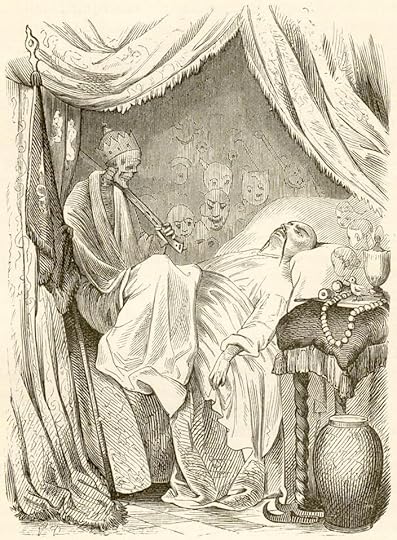
Lying on his bed, the Emperor looked up and could see,
Vilhelm Pedersen
"Death, wearing the Emperor's gold crown and holding in one hand the imperial sword and in the other the imperial banner."
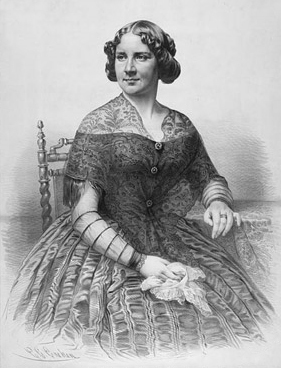
The Nightingale was almost certainly inspired by the author's passion for the opera singer, Jenny Lind, later called "The Swedish nightingale",
Hans Christian Andersen had met her three years earlier in 1840, and fallen in love with her. Jenny Lind however, preferred to think of him as her brother. This tale is generally considered to be a tribute to her. In his 1847 autobiography, Hans Christian Andersen wrote,
"Through Jenny Lind I first became sensible of the holiness of Art. Through her I learned that one must forget one's self in the service of the Supreme. No books, no men, have had a more ennobling influence upon me as a poet than Jenny Lind".
Hans Christian Andersen's story was actually responsible for Jenny Lind's nickname of "The Swedish Nightingale", well before she became internationally famous. Ironically, the nightingale story became a reality for Jenny Lind, when she herself fell in love with the Polish composer Frederick Chopin, who suffered and later died from tuberculosis. Chopin wrote that he "felt better" when she sang for him. Jenny Lind raised funds for a tuberculosis hospital in London, and after his death devoted the rest of her life to enshrining Chopin's legacy.
As well as his imagination being fired by his love for Jenny Lind, Hans Christian Andersen may have been inspired by Johns Keats' poem, "Ode to a Nightingale" of 1819, which Keats wrote just after his brother's death from tuberculosis. The poem mentions both a nightingale and an Emperor,
"Thou was not born for death, immortal Bird! No hungry generations tread thee down The Voice I hear this passing night was heard In ancient days by emperor and clown".
Keats was himself to die from tuberculosis two years later.
As well as the writing style of this story having a lovely intimate feel, the story also has a lot of humour. Hans Christian Andersen pokes fun at the servants who are so pompous, and at the ladies who try to gargle in their throats to imitate the nightingale's song, among other things. It is descriptive, imaginative, original and very whimsical. Apparently Oscar Wilde admired Hans Christian Andersen's stories, and this one clearly influenced some of Oscar Wilde's own fairy stories for children.
The story deals with both nature and Art. The natural world's artistry is far lovelier than an artificial substitute, and as time moves on, and we make more and more technological advances - sometimes at the expense of nature - this tale becomes yet more meaningful and poignant. But for all that, Hans Christian Andersen has written a beautiful, optimistic tale about life. It is a rare joy to read a story with such a positive slant by this author.
On now to "The Ugly Duckling". And I like that one too!
پادشاه چین، توی کتاب سفرنامه نویس ها می خونه: همه چیز چین قشنگه، اما بلبل های چین از همه قشنگ ترن. و میگه: این بلبل ها کجا بودن که من تا حالا ازشون خبر نداشتم؟ و دستور میده توی کل چین بگردن و بلبل پیدا کنن. از توی جنگل ها یه بلبل پیدا می کنن و میارن پیش شاه. بلبل که می خونه، شاه از شدت تحریک احساسات، به گریه می افته. پس دستور میده برای بلبل یه قفس طلایی بسازن، جامه های فاخر طلا بهش بپوشونن، بیست تا ندیمه همیشه همراهی ش کنن، همیشه توی بهترین اتاق قصر نگه دارنش و توی همه ی مجالس و محافل، درست کنار امپراتور بذارنش. همه ی این ها، اما یه روز که بلبل فرصت پیدا می کنه، فوری می پره و از قصر فرار می کنه. امپراتور غمگین میشه. اما یه شب (بعد از یه ماجرای مفصل) بلبل میاد لب پنجره و باز براش می خونه. امپراتور غرق شادی میشه، و میگه: پس چرا از پیش من رفتی؟ من که همه چیز برات مهیا کرده بودم؟ اگه باز بیای پیشم، بیشترش رو هم بهت میدم. بلبل میگه: درسته، اما همه ی چیزهایی که تو برام مهیا کرده بودی، برای من مثل قفس بود. من نمی خوام تو بهم ثروت و جاه و مقام بدی، بزرگ ترین دستمزدی که من از تو گرفتم، همون اشکی بود که روز اول با آوازم ریختی. برای هنرمند همین مهمه که روی دیگران تأثیر بذاره. از این به بعد، من هر شب میام پشت پنجره ت میشینم و برات می خونم.
This book is about an emperor who lives in the palace and never see the outside world. One day when he heard the hardener told him that there was nightingale who sing very nicely, he order his servant to search for the nightingale. They finally find the bird and the bird sing to the king everyday. One day the Japanese emperor came and gave him a wire nightingale, he like it so much he forget about the real one. When the wire nightingale broke he was sad and sick, so the real nightingale came back and sing for him make him better. He beg the nightingale to stay but the bird wants to be free so he flew away. The king plant a tree to remember the nightingale and later the tree grew and grew and the nightingale made a nest there. This is a very good book to teach people the moral of not to abandone what we have and be appreciated.
The Nightingale by Hans Christian Andersen is about an Emperor and his beautiful garden, admired by all who lived there. But everyone admired the Nightingale and it's songs the most. However, the Emperor had yet to hear the beautiful Nightingale's songs so he sends servants to go find the bird. Once found and heard, the Emperor cried from the wonderful song. The Emperor of Japan sent a gift of a mechanical Nightingale to the Emperor of China. ***SPOILER*** They were so mesmerized by the new bird that they didn't even notice when the real Nightingale flew back home. The Emperor had many guests over to hear the mechanical birds complicated song but then it broke! The empire lived without the songs for five years. Then, the Emperor became very ill, close to death. When death came to visit the Emperor, the real Nightingale showed up as well. It sang until Death had given up all his treasures to hear more. The Emperor was so grateful for the Nightingale and they made a plan to have the bird visit every once in awhile as a treat.
I liked this version of The Nightingale rather than the other fractured versions I have read. It captured the true whimsicalness of the true story. I also liked the illustrations in this one the best because they were full of detail accompanied with vibrant colors. The first time I read it, I just looked at the pictures and then the second time, I read it along with the text. Surprisingly, I liked just looking at the pictures more than with the text because it allowed me to create a storyline in my own head. I also really liked the language because it was pretty informal and colloquial so it felt more like a conversation.
I loved this story so much! It has an important moral of learning to value natural beauty above mechanized dazzle, which I feel like children should know about because these days guys seem more attracted to girls with a lot of make-up on and girls feel like they need to put on a lot of make-up to impress girls, but that isn't true. Therefore, this story helps children realize that natural beauty is more important to people rather than all this make-up. This is a great book and I would highly recommend that teachers have this in their classroom since it teaches such a great moral to children even if they aren't at the stage of dazzling their self up to attract the opposite sex.
This is my favorite story of Hans Christian Andersen. Defenetly my number one. The story was simply beautiful and it had a wonderful message that we should all apply to our daily lives.
This story tells of a bird that has the most beautiful song in the whole kingdom. One day, the emperor hears of this bird and ask for it to sing for him. The bird happily agrees and sings for the emperor. The emperor decides to cage the bird and have him sing for him day and night, only letting him out to fly when he is attached to a sort of leash. Still, the emperor is unhappy because of the bird's bland color. They have a much more colorful bird built that replaces that nightingale.
The mechanical bird breaks down many years later and is unable to sing as it used to. Then one day the emperor becomes very ill, and he is close to death. The nightingale hears of this and comes to the emperors window and sings to him. This lifts him from his illness and everyone is surprised to find the emperor in good health. After he recovers, the bird tells him that he will come to his window and sing to him about his people, only if he agrees to never lock the bird up again, and the emperor agrees.
It's a touching story about the bird forgiving the emperor even though he may have treated him badly in the past. The bird still blesses him even though there is nothing in return for the bird.
11/2023 reread: I recall not liking this one too much when I was a child, but now it is one of my favorite Andersen tales. The same things struck me as before, but this time I notice even more the humorous digs at the shallowness and pretension of court etiquette.
*** 12/2022 reread: There is something so cozy and comforting about the way this one is written. "Forests with tall trees and deep lakes." Such a simple yet powerful description! The story seems to be partly about forgiveness--the nightingale returns to sing for the sick emperor even though he replaced the real bird with a fake--and partly about authenticity and the downside of forced gratification. The fake bird never comes close to the real one, and although the people want to enjoy the nightingale's song whenever and however much they want, understandably, they sacrifice quality to achieve this gratification. The part where the emperor lies in bed with Death on his chest and seeing the faces of his good and bad deeds was very imaginative and interesting, especially since people on their death beds do tend to look back on everything they've done, seeing it with more clarity than before.
It is a fairytale about appreciating what you have, and what is real, instead of being duped by materialism. The emperor of China hears about a nightingale in his garden, and when it later sings for him, it is trapped. Eventually, it manages to escape from its prison, and is hence exiled by the emperor.
Spoilers alert!
Then, an artificial nightingale is singing in the palace, but the people used to the real nightingale hear the difference. Later, the emperor is falling ill, and the real nightingale turns up and saves the day. The emperor redeems himself only because of the nightingale. He realizes the worth of a living being. A real nightingale is alive, an artificial nightingale is not. The fairytale is beautiful and have an important message.
Fiona Black retells a Hans Christian Andersen - why? Who knows I mean why don't they just publish the Andersen version or is it now of favour because of some reason? Anyway it is a pretty decent story but I just wonder why it needs to be 'retold' by this biddy.
I really enjoyed this book- it is one that I have been meaning to read for a long time and I am so glad that I have read it - it is a charming story and definately one that I would recommend - 4 stars and one I would most definately recommend.
This fairy tale book is about a beautiful bird called a nightingale that lives in China. The emperor of China read that the loveliest of all things in China was the voice of the nightingale. So the emperor demanded that he hear this wonderful voice and told his people to find him the nightingale. Once they found the nightingale she sang such a beautiful song that it made everyone so happy that the emperor demanded that it stay in a cage in the palace. One day the Japanese emperor sent a bird that was decorated with jewels and that sang a song just like the nightingale. The real nightingale was able to fly away when the people were playing with the jeweled nightingale. The emperor became very upset banned the bird from ever coming back to his palace. After a year the whole country of China was able to sing the song of the jeweled nightingale and they soon missed the real nightingale. When the emperor was very sick the real nightingale came back and sang a song for the emperor to help him get better. The emperor asked if he could stay, but the nightingale said she would come back and sing ever once in awhile because many more people need to hear the sound of her voice as well.
Teaching ideas
1) The classroom teacher can work with the music teacher to develop a song that the nightingale would sing. The students should be allowed to sing and play musical instruments to form a beautiful song.
2) After reading this book have the students work together as a class to show the different sides the emperor shows before and after he get sick. The teacher can introduce similarities and difference by examining the emperor’s life.
I could not find the edition I read with Lisbeth Zwerger as the illustrator so I am using this edition to write my review.
I was not a huge fan of this traditional picture book. I loved the story, but it is laid out extremely poorly. It tells the story of the Ancient Chinese Emperor looking for the beautiful Nightingale, whose songs brings tears to the eyes of all who hear it. However, this Nightingale has competition with a fact beautiful replica of the original, but in the end the Emperor with a little help from the Nightingale realizes that the original is the best. I enjoyed the story, however it also has flaws with different added information. This added information does not help the story move along at all. The illustrations are absolutely atrocious and very poorly done. This story deserves a extremely better illustration to show the reader how beautiful the garden, diamond nightingale and Ancient China really was. Also there is too much text on each page that would discourage kids from reading the book. In order to become a great retelling of this story I think that it should be done with better illustrations and more spacing of text. I would not recommend this for my students because of the length and poor illustrations. However, I think this story should be learned as it is a traditional tale. If a better version is attained I'm sure they would love this story. If I had to recommend this for a class, it would be 2nd to 3rd grade.
"The Nightingale," by Hans Christian Anderson, was my second easy to read traditional book. This is an excellent book, because it addresses authentic beauty, life lessons, and appearances. The lessons that it addresses are traditional lessons that every child should both read about and learn. The book brings the reader to the land of China and the demands of the Chinese emperor. When he heard about a beautiful nightingale, the emperor demanded that the bird be brought to the palace. Many were surprised that the bird, who looked so dull, could sing such beautiful songs. When a beautiful, fake bird comes to the palace, the competition is unmatched and the real bird flies away. When the emperor lies dying, his old friend pays him a visit and a precious gift. The life lessons of freedom, authentic beauty, and appearances addressed in this book are certainly worthwhile lessons that every child should read about and discuss. Classrooms are a prime place for this.
At a very young age I read The Nightingale and The Snow Queen, and they entangled themselves in my feelings and thoughts. For some time when I was quite small I could not remember reading them at all - they just worked as memories, but memories that gave me a strange sensation. This wasn't just a fairy tale, this was far more fascinating than Aesop or a Greek myth - there was what Tolkien called 'eucatastrophe', a moment of reconciliation and triumph in the midst of terrible sorrow.
Eventually I came across them enough to know they were stories, not memories - but the old, odd sensation still steals over me when I read them. Having those stories ingrained in me is something I will be eternally grateful for. Not only is The Nightingale beautiful, but its truth is fundamentally sound, and one all children should encounter in our age of illusions and idols.
This is a fairytale-retelling book about a king who wants a nightingale in his court, but once he has it, forgets its value and then replaces the bird with a clock one. It isn’t until the clock is broken, and the king falls ill, so much so that people get ready to replace him that the nightingale comes back. The King then gets better and learns about the value of what he has, when he has it. This book is definitely different from most books that are normally associated with Hans Christian Anderson, mostly because of the Chinese theme that it holds throughout the book. It is interesting though, I just am not sure how interested a child might be, especially younger ones. The pictures are well drawn with adamant amount of details and a lot of rich colors are used as well, but definitely not the normal Hans Christian Anderson book.
This story seems to me to hew very closely to what I remember of the original Nightingale by Andersen... but then, I don't have it directly in front of me to compare. Regardless, the only big change I see is moving the setting to Morocco instead of China (which is just as well, China was only chosen as a shorthand for "far away and mysterious", and who doesn't know all about China by now?) and having a "Fixer-of-all-Things" instead of a clockmaker.
The illustrations are colorful and lovely, and the story is as touching as always, with the classic Andersen theme of valuing the real above the fake.
This story is a touching story that teaches to appreciate and value what you have. For young readers, the ending may not leave them with a happy feeling. The story does a great job, however, of incorporating a moral lesson without making it so obvious that the students will be disinterested with it. For readers who are mature enough to be patient with this plot and handle the somewhat sad ending, this story is a great choice.
This plain little nightingale sang the most beautiful songs that even the king requested to meet the bird. The king replicates the bird with a mchanical bird and soon forgets about the beautiful sounding nightingale.