

What do you think?

Cambridge Opera Handbooks
Richard Strauss: Salome
This full-length study of Salome is the first in English since Lawrence Gilman's introductory guide of 1907. The handbook presents an informative collection of historical, critical and analytical studies of one of Strauss's most familiar operas. Classic essays by Mario Praz and Richard Ellmann cover the literary background. How Strauss adopted Wilde's play for his libretto is discussed by Roland Tenschert in a fascinating essay which has been updated by Derrick Puffett. In three central analytical chapters, Derrick Puffett considers Salome in relation to Wagnerian music drama, Tethys Carpenter examines its tonal and dramatic structure, and Craig Ayrey analyses the final monologue. The last part of the book moves from analysis to criticism, with a review by John Williamson of the opera's critical reception and an interpretative essay by Robin Holloway. The book also contains a synopsis, bibliography, and discography; Strauss's little-known scenario for the 'Dance of the Seven Veils' is reprinted as an appendix.
- GenresMusic
211 pages, Paperback
First published January 1, 1989
Ratings & Reviews
Friends & Following
Create a free account to discover what your friends think of this book!
Community Reviews
Displaying 1 - 1 of 1 review

May 7, 2019
In summary this book contains much food for thought for fans of the opera, a lot of which applies equally to Wilde's original play. Five stars even though I found much to disagree with; very few books, especially relatively short ones like this, have provided me with so much mental stimulation. The chapters on the music (5, 6, and 7) can be heavy going, at least for the non-musician, for their technical detail.

Chapter 1 Mario Praz: “Salome in Literary Tradition” Praz starts not with Wilde, not even with the New Testament, but with two paintings by Moreau.
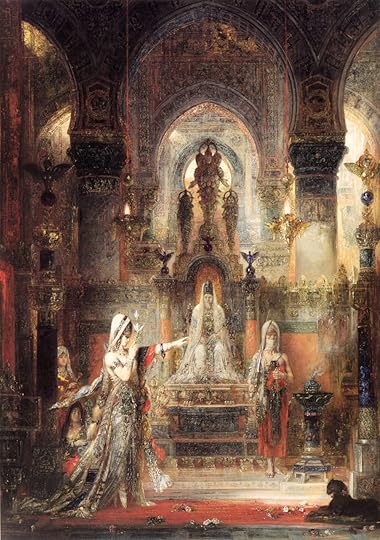
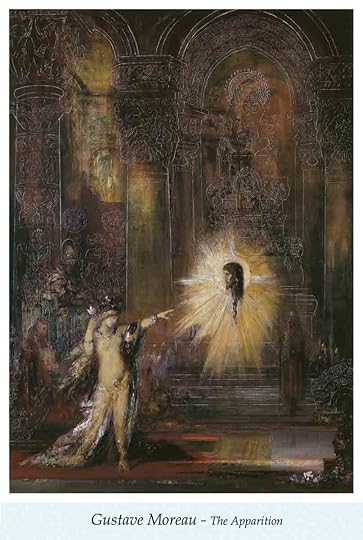
Apparently Huysmans puts these in the possession of his character das Esseintes, and Praz sees A rebours as a an influence in Wilde’s play, which readers of The Picture of Dorian Gray will not be inclined to doubt, but finds the idea of Salome’s “monstrous passion” coming from neither Huysmans nor Flaubert (on the other hand, Robin Holloway, in a later chapter, finds Wilde’s play “a virtual plagiarisation” of Hérodias).
Praz finds the source of the “monstrous passion”, first in Heine’s long poem, “Atta Troll” (which sounds pretty interesting in itself) where the passion for the severed head of the Baptist is attributed to a revenant Herodias, and then in Jules Laforgue where the passion is transferred to Salome in a quoted passage that begins in decadent details of jewels and sumptuous materials and ends with a campy passage on galvanic “post decapitation experiments”.
Chapter 2 Richard Ellmann: “Overtures to Wilde’s Salomé” Sees Salomé as a symbolic confrontation of Wilde’s two artistic mentors John Ruskin (Jokanaan) and Walter Pater (Salomé). This biographical reading seems barely relevant to Strauss’ work and probably doesn’t belong in this book, though the editor refers to the Ruskin / Pater duality once or twice in subsequent chapters.
Chapter 3 Roland Tenschert, Derrick Puffett: “Strauss as Librettist” Interesting details about Strauss’ changes to the play, describing cut scenes and providing numerous instances of changed word order, almost always with a view to musicality and clarity of projection.
Chapter 5 Derrick Puffett: “Salome as music drama”
Leitmotifs Puffett discusses Strauss’ musico-dramatic approach by analyzing several of the opera’s leitmotifs. The motivic analysis itself is sound and the method, new to me, of using tabular summaries to track the sorts of variations used is an interesting way of showing the “life story” of a musical phrase, though some brief descriptive context in the table rather than mere Figure / Bar numbers would be helpful. Puffett cites Carl Dahlhaus (writing on Wagner but, if anything, even more applicable to Strauss)
Puffett does argue with Dahlhaus’ contention that leitmotifs
Symphonic poem or music drama? Puffett is less successful at convincing me in some of his secondary arguments. I’ve longed been persuaded that Salome can be heard as “a symphonic poem with voice parts added”, but Puffett will have none of it. Or almost none; late in the essay he talks about
Pictures in music Another point of contention: Puffett says Salome contains “innumerable examples of pictorial description”. He cites several such as “the tambourine that sounds at every reference to the dance” and the accompaniment of Herod’s “wie ein betrunkenes Weib, das durch Wolken taumelt”. I’d argue that this music requires the words to provoke those pictures; a drunken woman would be an unlikely association to rise spontaneously from the purely instrumental passage (of course I could never in a million years have detected the baby’s bath in Sinfonia Domestica without very specific prompting). I would claim, on the contrary, that there is little purely pictorial music in Salome that could stand as independent representation, like Quixote’s herd of sheep. (OK, I’ll grant Herod’s imaginary wind). Even the “Dance of the Seven Veils” seems only sporadically dance-like compared to something like the dance of Zarathustra. (Even after decades of hearing what Strauss actually wrote, I still recall my original expectation on reading the libretto that the “Dance of the Seven Veils” would be something like Anitra’s Dance with a Bolero-like climactic build-up. But perhaps that would be even more "cheap, mediocre, and vulgar" (see Holloway, below) that what Strauss did produce.) Perhaps what Puffett means is rather general musical depictions responsive to individual speeches, but that is such common practice in Wagner that it hardly seems worth mentioning about a composer following in his footsteps. Moreover, if we take Puffett's claim at face value, it makes an even stronger case for Salome as symphonic poem.
Wagnerian! in its fashion Finally a minor point. After delivering an analysis derived from Wagnerian practice, Puffett closes his essay by pointing out the un-Wagner like nature of Salome in themes, orchestration, and subject matter. He rather sees it as anticipating “Expressionism” and Wozzeck. I’d agree with that for the most part. As a young listener steeped in the Ring, I wanted Salome to be much more Wagner-like than it was, but its style did remind me very much of the quirky, rapid Alberich-Mime exchange in Siegfried.
Excursus: Judaism in music I’m afraid that mention of Wagner here brings me to another issue not raised in this book. Though in his incidental references Puffett avoids the topic, books devoted to Wagner and his works inevitably raise and often dwell extensively on Wagner’s anti-Semitism, and there is a minor branch of music criticism, active since the composer’s lifetime (as witnessed in Cosima’s diaries), that seeks to find this prejudice embodied in the operas, Robert W. Gutman’s ideas on Parsifal being among the most harmful and specious. Unlike any of the works of Wagner, Salome contains characters explicitly identified as “Jews” and their argumentative ensemble presents a kind of musical caricature (there’s a not dissimilar treatment in Mussorgsky’s “Samuel Goldenberg and Schmuyle” movement in Pictures at an Exhibition, but there, at least, there is a suggestion of dual portraiture of named characters). If this quintet were attributed to Wagner it would long ago have become infamous as “a pogrom in music” or some similar epithet, yet I have never read any criticism of Strauss on this point – additionally amazing considering that the composer thrived under the Third Reich (though admittedly under the Wilhelmine empire and Weimar Republic as well, and there is no evidence at all of his sharing Nazi racial ideology). Though Wilde’s text provides a starting point for this scene, as Chapter 3 of the present volume shows Strauss was far from a passive receptor of Wilde’s play: he cut and re-worded numerous passages to suit his conception of the work he wanted to compose.
Chapter 7 Craig Ayrey: “Salome’s final monologue” Ayrey provides a detailed breakdown of the monologue into 11 sections, which reveals its symmetrical character. It does not “redeem” Salome in a Wagnerian sense with a “perverted Liebestod” but does redeem Salome by capping an uneven work with a masterfully constructed finale.
A divagation on Salome and kitsch in the visual arts
I’ve always associated the word kitsch with the visual arts: painting, sculpture, or decorative items, and long before I’d reached Chapter 9 I started thinking about the subject of Salome and kitsch in those terms.
Kitsch as aesthetic challenge I’ve had a longtime fascination with artists whose work approaches the status of kitsch. The Pre-Raphaelites are probably preeminent in this area, having produced, along with a few masterpieces and many more-or-less successful works of art, a number of works which would qualify as kitsch. But the challenge is also for the viewer, once the work exists, to tell whether it qualifies as kitsch, and for this one has to have faith in one’s own taste. The challenge is, if one has artistically minded acquaintances, to be able to make a credible defense of art which is generally automatically anathematized among the sophisticated – though “sophisticated” often means someone who has dismissed whole oeuvres and entire schools of painting based on the opinions of critics rather than their own critical thought.
Salome=kitsch As a subject of art, “Salome” seems almost definitional of kitsch. The juxtaposition of an attractive naked or partially clad young woman with the gruesome image of a severed head produces a combination of unsubtle eroticism with blatant horror that turns out to be, perhaps surprisingly, ridiculous. Add on the elevated overtones of “Biblical illustration” and one gets a sickly combination of prurience with sadism (or masochism) and piety that marks three of the main appetites to which kitsch appeals.
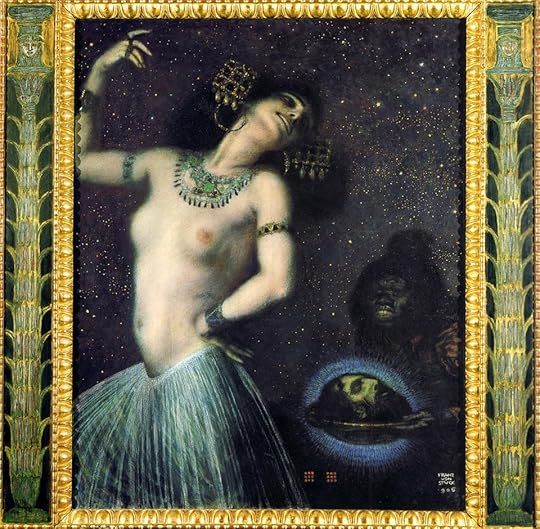
Beardsley manages to avoid the realm of kitsch, in part because of his tendency toward abstract pattern (in the second image Salome resembles an elaborate piece of origami at least as much as a human form), but also by separating the nudity and decapitation into separate images.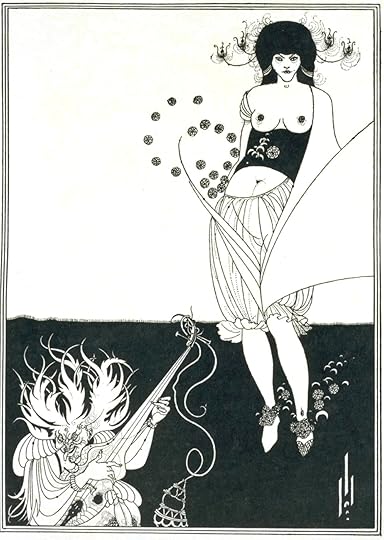
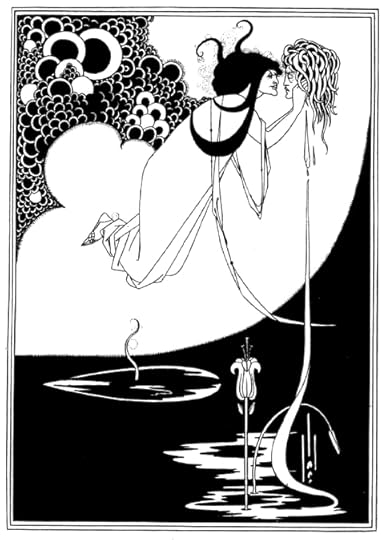
The kind of exercise in taste I mentioned above can be undertaken to explain why the two paintings by Moreau reproduced in the discussion of Chapter 1 are not kitsch - unless, of course, they are.
Personal Many years ago I used to paint and would occasionally paint pictures for friends at their request. A friend who was a fan of this opera asked for a picture of Salome. I instinctively went for the paradoxical option of avoiding kitsch by embracing it and produced an image of a waif-like Salome in the “Big Eyes” Margaret Keane style, holding a silver platter with the head of Jochanaan, rendered in the same wide-eyed style.
A Tasteful Salome I know of at least one image of Salome that features neither bare breasts nor a severed head, that by Regnault. But it turns out that the whole “Salome” interpretation was an afterthought once the painter had already painted his model, adding the title and the iconography of basin and knife afterward. The Metropolitan website cites Regnault writing

Chapter 9 Robin Holloway: “Salome: art or kitsch?” Of course, Holloway’s essay deals with Richard Strauss and Salome, not visual art. So what does musical kitsch consist of? By way of definition Holloway offers three examples - Butterfly; Die tote Stadt; Troilus and Cressida - with no further comment except to contrast them with “classic art in whatever mode” represented by Orfeo; Figaro; Tristan; Ballo; Wozzeck.
Perhaps looking at the parts of Salome which earn his plaudits and brickbats will clarify the issue. He thinks “the motive in fourths … that suggests the spiritual status of the Baptist and his irreducible integrity,” a “superb theme whose beginning is worthy of Bruckner at his most primeval.” Unsurprisingly pretty much the entire last part of the opera following the Dance also earns the highest praise. For “bad music, the choice is embarrassingly wide.” Holloway shows a particular dislike for the expressions of religious feeling: the “Er ist ein heil'ger Mann” motif, Jochanaan’s jeremiads, and, especially, the duet of the Nazarenes. The first of these came in for disdain earlier in the “Critical Reception” chapter (8) where it was described as “Mendelssohnian” (Ernest Bloch) and “shallow as an operetta” (Heinrich Schenker). And, finally, the Dance of the Seven Veils, “cheap, mediocre, and vulgar music”, but nevertheless “exactly what’s wanted” not
Salome stands as a specific instance for the works of Richard Strauss in general. Holloway wants to position him as something other than one of “the great composers” but above “whichever purgatory punishes triumphant banality.”
Chapter 1 Mario Praz: “Salome in Literary Tradition” Praz starts not with Wilde, not even with the New Testament, but with two paintings by Moreau.
Apparently Huysmans puts these in the possession of his character das Esseintes, and Praz sees A rebours as a an influence in Wilde’s play, which readers of The Picture of Dorian Gray will not be inclined to doubt, but finds the idea of Salome’s “monstrous passion” coming from neither Huysmans nor Flaubert (on the other hand, Robin Holloway, in a later chapter, finds Wilde’s play “a virtual plagiarisation” of Hérodias).
Praz finds the source of the “monstrous passion”, first in Heine’s long poem, “Atta Troll” (which sounds pretty interesting in itself) where the passion for the severed head of the Baptist is attributed to a revenant Herodias, and then in Jules Laforgue where the passion is transferred to Salome in a quoted passage that begins in decadent details of jewels and sumptuous materials and ends with a campy passage on galvanic “post decapitation experiments”.
Chapter 2 Richard Ellmann: “Overtures to Wilde’s Salomé” Sees Salomé as a symbolic confrontation of Wilde’s two artistic mentors John Ruskin (Jokanaan) and Walter Pater (Salomé). This biographical reading seems barely relevant to Strauss’ work and probably doesn’t belong in this book, though the editor refers to the Ruskin / Pater duality once or twice in subsequent chapters.
Chapter 3 Roland Tenschert, Derrick Puffett: “Strauss as Librettist” Interesting details about Strauss’ changes to the play, describing cut scenes and providing numerous instances of changed word order, almost always with a view to musicality and clarity of projection.
Chapter 5 Derrick Puffett: “Salome as music drama”
Leitmotifs Puffett discusses Strauss’ musico-dramatic approach by analyzing several of the opera’s leitmotifs. The motivic analysis itself is sound and the method, new to me, of using tabular summaries to track the sorts of variations used is an interesting way of showing the “life story” of a musical phrase, though some brief descriptive context in the table rather than mere Figure / Bar numbers would be helpful. Puffett cites Carl Dahlhaus (writing on Wagner but, if anything, even more applicable to Strauss)
The idea of a leitmotif … as a fixed, recurrent, musical formula … is simplistic to the point of falsity. Unchanged recurrence is the exception rather than the rule …This becomes obvious after one gains any familiarity Wagner’s works and should by now be a truism it is unnecessary to state; the fact that it is still a point that needs to be made is evidence of the simplistic, unsymphonic listening endemic to opera.
Puffett does argue with Dahlhaus’ contention that leitmotifs
are all different impressions of the same material, and all principally equal in status …It is basic to Puffett’s analysis that motifs have “definitive” forms and that the significance of their variations can depend on an auditory memory of this form. He makes a good case for this though to be honest it doesn’t take much to convince me on this point, which seems intuitive from listening to symphonic music.
Symphonic poem or music drama? Puffett is less successful at convincing me in some of his secondary arguments. I’ve longed been persuaded that Salome can be heard as “a symphonic poem with voice parts added”, but Puffett will have none of it. Or almost none; late in the essay he talks about
Strauss’s progressive conception of the leitmotive, which … derives from the ‘narrative’ type of thematic transformation developed in earlier, purely orchestral works … In this respect, and in this respect only, Strauss’s operas may legitimately be compared to symphonic poems.Since the leitmotifs and their deployment are so basic to Puffett’s definition of “music drama”, this seems a rather broad area of exception. The distinction seems to lie in his idea that “the music is there to serve the drama” and, though he doesn’t say so specifically, this means the music drama avoids fixed forms such as rondo or theme and variations. But then what is the form of Also sprach Zarathustra?
Pictures in music Another point of contention: Puffett says Salome contains “innumerable examples of pictorial description”. He cites several such as “the tambourine that sounds at every reference to the dance” and the accompaniment of Herod’s “wie ein betrunkenes Weib, das durch Wolken taumelt”. I’d argue that this music requires the words to provoke those pictures; a drunken woman would be an unlikely association to rise spontaneously from the purely instrumental passage (of course I could never in a million years have detected the baby’s bath in Sinfonia Domestica without very specific prompting). I would claim, on the contrary, that there is little purely pictorial music in Salome that could stand as independent representation, like Quixote’s herd of sheep. (OK, I’ll grant Herod’s imaginary wind). Even the “Dance of the Seven Veils” seems only sporadically dance-like compared to something like the dance of Zarathustra. (Even after decades of hearing what Strauss actually wrote, I still recall my original expectation on reading the libretto that the “Dance of the Seven Veils” would be something like Anitra’s Dance with a Bolero-like climactic build-up. But perhaps that would be even more "cheap, mediocre, and vulgar" (see Holloway, below) that what Strauss did produce.) Perhaps what Puffett means is rather general musical depictions responsive to individual speeches, but that is such common practice in Wagner that it hardly seems worth mentioning about a composer following in his footsteps. Moreover, if we take Puffett's claim at face value, it makes an even stronger case for Salome as symphonic poem.
Wagnerian! in its fashion Finally a minor point. After delivering an analysis derived from Wagnerian practice, Puffett closes his essay by pointing out the un-Wagner like nature of Salome in themes, orchestration, and subject matter. He rather sees it as anticipating “Expressionism” and Wozzeck. I’d agree with that for the most part. As a young listener steeped in the Ring, I wanted Salome to be much more Wagner-like than it was, but its style did remind me very much of the quirky, rapid Alberich-Mime exchange in Siegfried.
Excursus: Judaism in music I’m afraid that mention of Wagner here brings me to another issue not raised in this book. Though in his incidental references Puffett avoids the topic, books devoted to Wagner and his works inevitably raise and often dwell extensively on Wagner’s anti-Semitism, and there is a minor branch of music criticism, active since the composer’s lifetime (as witnessed in Cosima’s diaries), that seeks to find this prejudice embodied in the operas, Robert W. Gutman’s ideas on Parsifal being among the most harmful and specious. Unlike any of the works of Wagner, Salome contains characters explicitly identified as “Jews” and their argumentative ensemble presents a kind of musical caricature (there’s a not dissimilar treatment in Mussorgsky’s “Samuel Goldenberg and Schmuyle” movement in Pictures at an Exhibition, but there, at least, there is a suggestion of dual portraiture of named characters). If this quintet were attributed to Wagner it would long ago have become infamous as “a pogrom in music” or some similar epithet, yet I have never read any criticism of Strauss on this point – additionally amazing considering that the composer thrived under the Third Reich (though admittedly under the Wilhelmine empire and Weimar Republic as well, and there is no evidence at all of his sharing Nazi racial ideology). Though Wilde’s text provides a starting point for this scene, as Chapter 3 of the present volume shows Strauss was far from a passive receptor of Wilde’s play: he cut and re-worded numerous passages to suit his conception of the work he wanted to compose.
Chapter 7 Craig Ayrey: “Salome’s final monologue” Ayrey provides a detailed breakdown of the monologue into 11 sections, which reveals its symmetrical character. It does not “redeem” Salome in a Wagnerian sense with a “perverted Liebestod” but does redeem Salome by capping an uneven work with a masterfully constructed finale.
A divagation on Salome and kitsch in the visual arts
I’ve always associated the word kitsch with the visual arts: painting, sculpture, or decorative items, and long before I’d reached Chapter 9 I started thinking about the subject of Salome and kitsch in those terms.
Kitsch as aesthetic challenge I’ve had a longtime fascination with artists whose work approaches the status of kitsch. The Pre-Raphaelites are probably preeminent in this area, having produced, along with a few masterpieces and many more-or-less successful works of art, a number of works which would qualify as kitsch. But the challenge is also for the viewer, once the work exists, to tell whether it qualifies as kitsch, and for this one has to have faith in one’s own taste. The challenge is, if one has artistically minded acquaintances, to be able to make a credible defense of art which is generally automatically anathematized among the sophisticated – though “sophisticated” often means someone who has dismissed whole oeuvres and entire schools of painting based on the opinions of critics rather than their own critical thought.
Salome=kitsch As a subject of art, “Salome” seems almost definitional of kitsch. The juxtaposition of an attractive naked or partially clad young woman with the gruesome image of a severed head produces a combination of unsubtle eroticism with blatant horror that turns out to be, perhaps surprisingly, ridiculous. Add on the elevated overtones of “Biblical illustration” and one gets a sickly combination of prurience with sadism (or masochism) and piety that marks three of the main appetites to which kitsch appeals.
Beardsley manages to avoid the realm of kitsch, in part because of his tendency toward abstract pattern (in the second image Salome resembles an elaborate piece of origami at least as much as a human form), but also by separating the nudity and decapitation into separate images.
The kind of exercise in taste I mentioned above can be undertaken to explain why the two paintings by Moreau reproduced in the discussion of Chapter 1 are not kitsch - unless, of course, they are.
Personal Many years ago I used to paint and would occasionally paint pictures for friends at their request. A friend who was a fan of this opera asked for a picture of Salome. I instinctively went for the paradoxical option of avoiding kitsch by embracing it and produced an image of a waif-like Salome in the “Big Eyes” Margaret Keane style, holding a silver platter with the head of Jochanaan, rendered in the same wide-eyed style.
A Tasteful Salome I know of at least one image of Salome that features neither bare breasts nor a severed head, that by Regnault. But it turns out that the whole “Salome” interpretation was an afterthought once the painter had already painted his model, adding the title and the iconography of basin and knife afterward. The Metropolitan website cites Regnault writing
je tiens, en rentrant à Rome, à terminer immédiatement ma petite femme au fond jaune (Hérodiade, l'esclave favorite, la poetassa de Cordoba) le nom ne fait rien à l'affaireAlas for the artist, le nom does make a great deal of difference; what would be an accomplished, if not particularly distinguished painting of a woman in academic style is rendered banal and psychologically obtuse by purporting to portray an infamous historical figure.
Chapter 9 Robin Holloway: “Salome: art or kitsch?” Of course, Holloway’s essay deals with Richard Strauss and Salome, not visual art. So what does musical kitsch consist of? By way of definition Holloway offers three examples - Butterfly; Die tote Stadt; Troilus and Cressida - with no further comment except to contrast them with “classic art in whatever mode” represented by Orfeo; Figaro; Tristan; Ballo; Wozzeck.
Perhaps looking at the parts of Salome which earn his plaudits and brickbats will clarify the issue. He thinks “the motive in fourths … that suggests the spiritual status of the Baptist and his irreducible integrity,” a “superb theme whose beginning is worthy of Bruckner at his most primeval.” Unsurprisingly pretty much the entire last part of the opera following the Dance also earns the highest praise. For “bad music, the choice is embarrassingly wide.” Holloway shows a particular dislike for the expressions of religious feeling: the “Er ist ein heil'ger Mann” motif, Jochanaan’s jeremiads, and, especially, the duet of the Nazarenes. The first of these came in for disdain earlier in the “Critical Reception” chapter (8) where it was described as “Mendelssohnian” (Ernest Bloch) and “shallow as an operetta” (Heinrich Schenker). And, finally, the Dance of the Seven Veils, “cheap, mediocre, and vulgar music”, but nevertheless “exactly what’s wanted” not
the perfumed garden and calls-to-erection of the Poème d’extase, the ultra-elegance of amorous soft porn à la Daphnis et Chloé, the small print of sensuality refined and spiritualized à la Jeux?In sum, much of Salome is “Commercial, meretricious, and shallow! But, evidently, something, like sugar, that we want and even need.”
Salome stands as a specific instance for the works of Richard Strauss in general. Holloway wants to position him as something other than one of “the great composers” but above “whichever purgatory punishes triumphant banality.”
Only if we forget the damaging absurdity of taking Salome and Die Frau ohne Schatten to be Wagnerian, and Der Rosenkavalier to be Mozartian(!), can Strauss come into his own, a category apart. His denigrators, equally, are missing something unique and extraordinarily interesting.True to the rather idiosyncratic nature of this essay, that parenthetical exclamation point gets the following endnote:
Overheard during the supper-interval at a Glyndborne Rosenkavalier (answering the question ‘Who wrote the music?’): ‘It’s Mozart, dear; you can tell by the costumes.’I think the bottom line that Holloway never quite reaches is that Strauss is that relatively rare figure in classical music: the middlebrow artist, a skilled but ultimately superficial craftsman. Few composers put themselves so obviously into their art: Heldenleben, Sinfonia Domestica, Intermezzo; but what we have in these and works such as Don Juan and Don Quixote (the list could possibly continue to embrace the entire oeuvre), where there is some projection of the creator unto his characters, is not self-revelation, self-examination, or self-expression, but rather a type of musical “selfie” either in costume or in propria persona, of Strauss, the bourgeois as artist.
Displaying 1 - 1 of 1 review