In her best-selling Agincourt, Juliet Barker gave us the definitive narrative of Henry V’s extraordinary victory over the French. Now, in Conquest, she tells the equally remarkable, but largely forgotten, story of the dramatic years when England ruled France at the point of a sword.
Henry V’s second invasion of France in 1417 launched a campaign that would put the crown of France on an English head. Buoyed by victory, his conquest looked unstoppable. By the time of his premature death in 1422, almost all of northern France was in his hands. The Valois heir to the throne had been disinherited and it was Henry’s infant son who became the first English king of France.
Only the miraculous appearance of a visionary peasant girl – Joan of Arc – would halt the English advance. Yet despite her victories, her influence was short-lived: Henry VI had his coronation in Paris six months after her death and his kingdom endured for another twenty years. When he came of age he was not the leader his father had been. It was the dauphin, whom Joan had crowned Charles VII, who would finally drive the English out of France.
Conquest brings to life these stirring times – the epic battles and sieges, plots and betrayals – through a kaleidoscope of characters from John Talbot, the ‘English Achilles’, and John, duke of Bedford, regent of France, to brutal mercenaries, opportunistic freebooters, resourceful spies and tragic lovers torn apart by the conflict.
Supremely evocative and readable, Conquest is narrative history at its most colourful and compelling – the true story of those who fought for an English kingdom of France.
Juliet R. V. Barker (born 1958) is a British historian, specialising in the Middle Ages and literary biography. She is the author of a number of well-regarded works on the Brontës, William Wordsworth, and medieval tournaments. From 1983 to 1989 she was the curator and librarian of the Brontë Parsonage Museum.
Barker was educated at Bradford Girls' Grammar School and St Anne's College, Oxford, where she gained her doctorate in medieval history. In 1999 she was awarded an honorary Doctorate of Letters by the University of Bradford. She is a Fellow of the Royal Society of Literature.
It has been a while since I read an in-depth history of the so called 100 Year war. With this book I picked a rather good one, a specific history of the 30 year period that the English throne had land under its control. Author Juliet Barker has got away with something I am normally not keen on and that is in-depth opinion of the events. I tend to prefer my own thoughts based on the event narrative presented. But she has given me food for thought. No bad thing I suppose.
For me the English claim on the French throne became spurious as I read more on the subject. When a teen living in England my school history lessons were of the glory of Agincourt et al but as I got older and read deeper it was just another historical pursuit of power over others, others being the people and the wealth that goes with ownership of foreign lands. Henry V’s grandfather married a Frenchwomen and from there cadet branches fought inane wars over the house of Capet’s fall. Seriously? Very seriously did Henry V and his kingdom take that claim. The cost was enormous in lives, wealth and prestige. The final fall of the English kingdom in France in fact caused massive upheaval in England itself and the deaths of some folk in very high places. In the end England held only Calais and then because its financial importance to the mercantile class was more important than that of “the wider English economy” to quote the author.
In my school history lessons we were also taught about the greatness of Joan of Arc. Barker’s chapters on Joan make her out to be a useful fool and tool. I suppose an English writer on the 100 year war would say that but to be fair Barker is not backwards in coming forward criticising the English when required. Hence my feelings that this tome has a bit of balance in its opinion and analysis. Be that as it may it would make interesting reading to get a French perspective.
Barker also gives detail as to the cost of these adventures, how much money was raised for each campaign by taxation to actually pay for the wars and also the massive loans from wealthy clergy and aristocracy. Some serious wealth was wasted and with that the lives of many peasants lost fighting for those spurious monarchical claims. The army was in essence hired via contracts, generally for a year. When funds ran out they tended to go home. Those that couldn’t? They lived off the land in a foreign country and made havoc. With a bunch of thieving drunken foreigners rampaging around the country side and creating mayhem the locals were never going to do anything than support their own in their quest to take back what was in fact their own. The shock of the English authorities on this matter was surprising to me to say the least.
Lastly my opinion is that the character to come out triumphant from this book was the French king Charles VII. He had to put up with an insane father who sold his rights out to Henry V, his realpolitik acumen was superb in bringing the Duke of Burgundy back into the fold and with that turning his military into a professional army made him victorious in the end. Oh and yes and lifting not a finger to assist Joan of Arc was a propaganda triumph that should be noted in history.
If one reads this book they will get a two very good plate sections, a couple of useful maps and family trees. The end-notes are OK without being great, the bibliography is very good and there is a good chronology of events.
Recommended to anyone with an interest in the subject.
My principal attraction to Conquest , a narrative political and military history of the later part of the Hundred years war between England and France, was reading more about Joan of Arc, or Jehanne d’Arc as she is here, a fascinating person of whom more below.
Like her earlier work Agincourt Barker draws on the wealth of detail available from the accounting records – we have the order to pluck six wing feathers from every goose in twenty counties and send them to the tower of London (p3), the elaborate temporary bridge constructed in England, taken apart, shipped to France, and then put back together again by all the king’s men and all the king’s horses below Rouen to allow Henry V to effectively besiege the city (p21). This was a technique that worked excellently well in Agincourt when we can follow each arrow through the single campaign of 1415. Here Barker has to reign herself in because she covers a much longer time span - from 1417 to the 1450s. Even so this is a difficult topic to deal with.
Barker, having jumped in a human way, from writing about the Bronte sisters, to Henry V’s campaigns in France says in her preface that one of her aspirations in writing the book was memoralisation, that the lives caught up in this conflict deserve to be remembered (pxiii). Yet it is curious then to see what is presented to us as a memorial – the ridiculous desire to conquer Normandy and to hold it as part of the Kingdom of France (there were only hundreds of years of experience of how problematic this could be), the naïve hope for a dual kingdom, the bizarre Dauphin distinctly uninspiring, and that the person most to be feared in politics after your uncle is your brother (don't expect any kindness from a cousin either).
In another way what is memorialised is that there is nothing new under the sun. The language of surge, terrorism, war crimes, and the impossibility of backing out of wars that seem to have no end other than the faint hope of compete defeat - the spent cost fallacy I suppose playing its part - are contemporary. In talking about the past, Barker is showing us our present.
Barker takes a narrative approach in what is intended to be an approachable popular history that requires little prior knowledge, the problem is that the nature of the warfare overwhelms us with detail as bands of soldiers seize and then as rapidly lose fortresses across Northern France. There is treachery, bribery, cunning stratagems of every kind - sneaking your soldiers into an enemy castle disguised as prisoners, breaking in to a city through a culvert, wearing false badges to get past the gatehouse, hiding soldiers in barrels and loading them into carts, distracting a guardsman by dropping a penny, and many more, including, on a regular but very slow basis, dragging up the immense artillery pieces of the era to fire at the walls for weeks on end. Nor are there necessarily clear front lines, or definite sides.
In theory the French territories captured by the English were meant to pay for themselves. In practice they were a war-zone and the money that was extracted from Normandy in particular was never sufficient. Nor could the royal finances of England readily supply money, which was instead lent by the Bishop of Winchester, apparently a portrait by Jan van Eyck believed to have been of Cardinal Albergati is actually of our Bishop of Winchester - Henry Beaufort.
If Henry V's reasoning behind warring in France - beyond the hope that his longbow marriage with Charles VI's daughter might somehow cause everyone to forget about the regime that Charles' son the future Charles VII was successfully establishing south of the Loire remains unclear then something that comes through with complete clarity is how the Wars of the Roses flowed out of the policy disagreements, jostling for power, and war footing of this period.
All in all this reminded me of Prestwich's The Three Edwards: War and State in England 1272-1377, war was what kings specialised in. If they were not directing the aggressive capacities of their political systems outwards (Edward I, Edward III, Henry V) then they ran the risk that fighting would break out in their own kingdom (Edward II, Henry VI ).
Anyway, what this all meant was that down to about 1450 there were legally two kings of France, Charles VII and his nephew Henry VI. This was not so unusual for the times, after all there were generally two Popes (and occasionally three) in Europe at that time. However it was the kind of knotty legal issue that in the middle ages was generally felt to be best resolved through war and trial by battle.
Barker's book largely follows the English point of view except for the sudden outbreak of Joan of Arc. This is a problem in that the Dauphin and later Charles VII is in a way the central figure of the entire story. The murder of the Burgundian Duke, John the Fearless, by the Dauphin's men while he was kneeling before the Dauphin in a private meeting to discuss peace between them - a crime which somehow the Dauphin was largely able to wiggle out of being held responsible for - forced Burgundy into alliance with England. While the conflict was closed with the establishment of a French army by Charles VII, as opposed to the system of contracting captains to bring soldiers to war for set sums of money which both sides had been using , and then deploying that army to rapidly conquer Normandy.
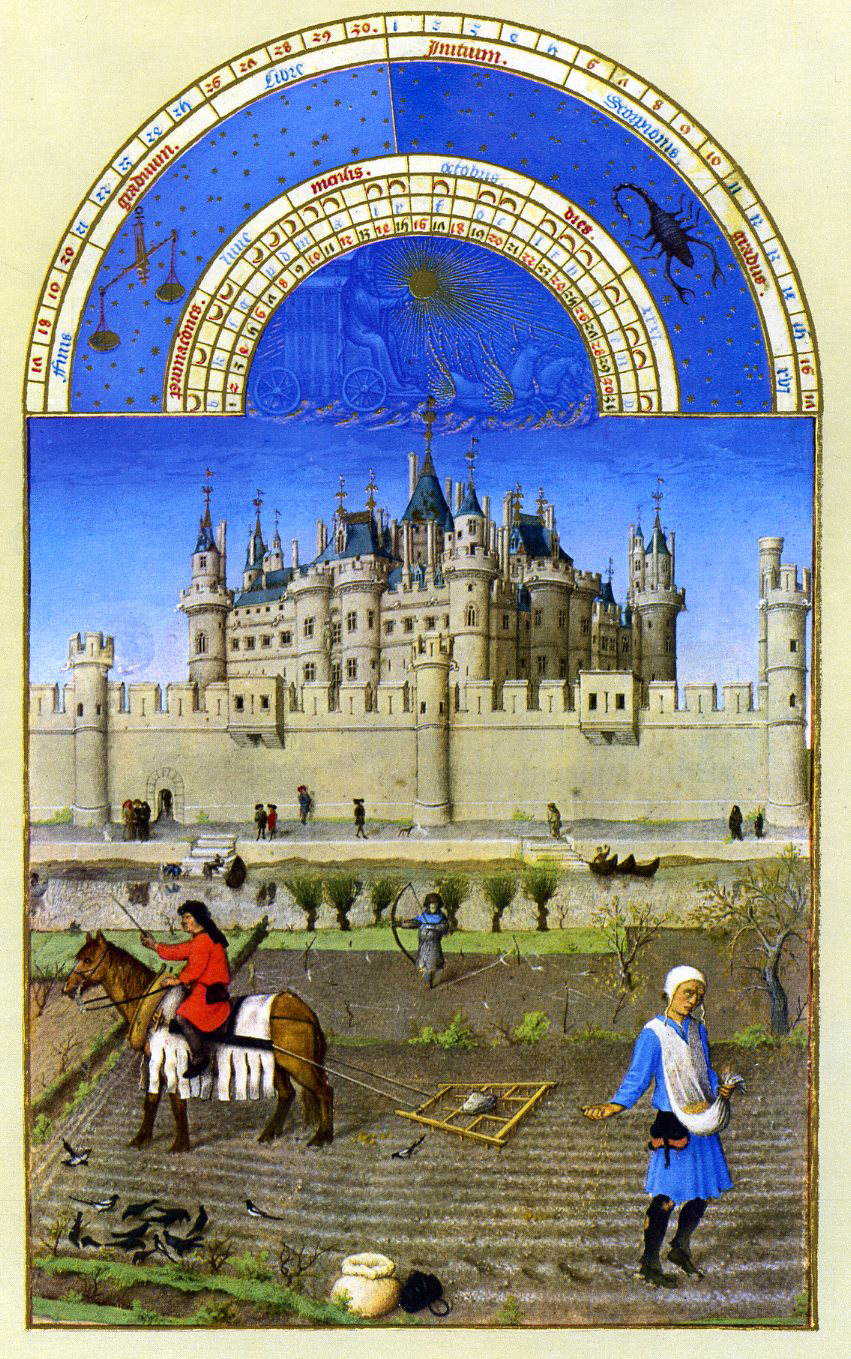
Something that Barker does as an aside is to use illuminations from Les Tres Riches Heures of the Duke of Berry as illustrations in this book and in the annotations to point out the unexpected signs of war in those beautiful pictures, for example the scarecrow in October.
The author writes of the possibility of an objective analysis of Joan, this isn't really the book to provide that, though what Barker does make clear is how almost all the voices recorded in her trial 1431 and then later in the nullification that trial in 1456 had vested interests one way or the other in her fate and reputation. By 1456 Joan was entirely dead and she could be safely used by Charles VII and his supporters as a figure of unity and the voice of destiny. While she was alive she was a difficult and controversial figure who did not want to sit around the Royal Court doing as she was told. Unlike the Dauphin her instinct was to take the fight to the English. Joan is interesting to me because the lives and thoughts of peasants and particularly of peasant women are lost to us, inexplicably perhaps she had a conception of France, she was prepared to go to war for it , and she saw her own virginity as an integral part in the struggle for Charles VII. Then again perhaps it may just be the disturbing memory of the performance of Die Jungfrau von Orleans that draws my attention to her.
Ms. Barker has delivered a very readable account of the last 35 yrs or so of the 100 Years War between France and England. She tells the story of Henry V’s successful invasion and conquest of Northern France starting 2 years after his great victory at Agincourt.
She tells the tale of English military and political power that easily defeats the French in 1417-19 culminating in the French King naming Henry his Heir, the slow slipping away of that military power, culminating with the easy reconquest of Northern France in 1449-50.
Along the way she does tell that story of Joan of Arc. In telling the story Ms. Barker does down play her military importance. While the English/Burgundian siege of Orleans was lifted, not much else changed in her lifetime.
She also makes plain the problems and divisions in the English command during the long minority of Henry VI. The infighting between members of the Royal family made the job of the Regent of France (the Duke of Bedford, Henry V’s brother) much more difficult that it had to be. The English/Burgundian siege of Orleans is an example of this. It was undertaken without Bedford’s approval and according to Ms. Barker made little strategic sense.
The story after 1435 is basically one of English incompetence. While they basically maintained a stalemate on battlefield, in the Peace negotiations they were badly out negotiated. One by one Charles was able to strip away England’s French allies making the English defeat almost inevitable.
When Henry VI came of age, he just made matters worse. His desire for peace led to many bad decisions, including giving away the county of Maine for what was little more than a hope and breathing space for Charles to prepare for his invasion of Normandy. Her discussions of the English inability to prepare for Charles’ inevitable invasion in spite of many warnings from people on the ground in Normandy are enlightening when compared to other intelligence failures in history.
In telling the story, the author tells anecdotes that make the story more human. One that I liked was after a French victory in 1430 near Dijon, one of the fleeing Burgundian soldiers hides in a tree and gets stuck and dies. His body is not found until 1672 when the tree is cut down. Another interesting anecdote is during the truce after the Treaty of Tours in 1444; Henry VI sent English troops that had been fighting the French in Normandy to fight for Charles VII in Alsace.
All in all a very good, readable, enlightening and entertaining book on an era of history that I knew little about.
This is what happens in France after the English King Henry V dies and leaves an infant son (Henry VI, who also became disputed King of France two months afterwards on the death of his maternal Grandfather French King Charles VI) and what is essentially a committee in charge of both England and his newly acquired French possessions. What could possibly go wrong? A no frills, business-like book that covers the last bit (1417-1450) of the so-called Hundred Years War between France and England. Politics, warfare, begging for money to pay the military, taxes, treaties made and broken, bandits, and not-so-happy peasants. I hadn't realised quite how short Joan of Arc's military career was. The middle bogged down a bit in all the offenses, counter-offenses and just general mayhem and slaughter. The book could have used more maps, but a very useful timeline was included.
A broad and readable history of the latter stages of the Hundred Years’ War.
Barker covers how France suffered almost total defeat in the war, only to rise again, how the prince was disinherited and apparently left completely helpless, only to turn the tide with Joan of Arc’s help, and how the weak king grew ever more desperate for peace. The story of how France reconquered Normandy and Gascony from the English is well told, as are the connections between the English and French nobility. She ably describes how Henry VI led England following Henry V’s death, and how his youth, inexperience and incompetence forced the country to be run by a committee (although Henry VI was more farsighted than Henry V) Joan of Arc appears, of course, but Barker concludes that her lasting impact may be unknowable, and she ably shows how Joan was manipulated by the French, then left to fend for herself. She often comes off as reckless, and not exactly chivalrous. Barker doesn’t, however, really try to figure out who she was.
Barker also does a good job describing the logistics of the war, how fortifications worked, and the effect of gunpowder weapons. She also notes how rare large-scale pitched battles were; sometimes one side did win a crushing victory, but it often didn’t have lasting consequences and usually had to be followed up. Barker ably brings the story and its people to life. The narrative is clear and engaging if a bit workmanlike and unfocused, and it drags a bit in the latter half. Sometimes it reads like a pile of facts that Barker just wanted to stick somewhere, even if they don’t help move the story along. She gives good explanations of how the campaigns were funded, sometimes without a clear picture of how bloody or destructive they were. Needless to say, a lot of the detail seems excessive. More maps would have helped.
A colorful, well-researched and well-written work.
This is a comprehensive, and sometimes exhausting, history of what Barker terms the “English Kingdom of France”, beginning with Henry V’s lightning conquests of 1417, capturing all of Normandy, and Paris itself, and ending with the surrender of the final English garrison in Normandy in 1450. Though many English Kings had held lands in France, and had also laid claim to the French crown for the last century, this was a unique period of the Hundred Years War. Thanks to England’s stunning victories and the political savvy of their King, and with the aid of an alliance with the Duchy of Burgundy, Henry was able to force the French king, the feeble Charles VI, to legally name him as heir to the throne of France, an inheritance that would eventually be made good by his son, the much maligned (and rightly so) Henry VI, who became the first, last and only King of England to also be crowned and anointed as King of France in the cathedral of Reims.
In more practical terms, this is the history of a war that dragged on without pause, apart from the brief Truce of Tours in the late 1440’s, for over 30 years. Though Barker does delve into other aspects, such as English immigration into Normandy, intermarriage, administration, and other so on, the almost-continuous fighting tends to take precedence. And that’s this book’s biggest detriment. The war was one of siege and counter-siege, and was a very see-sawing affair, and so it often simply becomes a list of towns and castles captured by the English, or retaken by the French. Though that is hardly Barker’s fault, and her scholarship is impressive, it was pretty dry reading for long stretches, confusing and hard to follow even with the aid of a map.
What was far more entertaining to me was the wealth of anecdotes Barker slips into the story, fascinating little details that really bring the period to life. There are far too many to mention, but one of the best is the story of a certain siege south of Paris. Henry V attempted to undermine the walls, but the French commander retaliated with a countermine. According to the laws of chivalry, when a countermine met a mine, the attackers were obliged to either abandon their efforts completely and begin anew, or to send men-at-arms to fight one on one duels in these narrow tunnels beneath the ground. This particular mine was very large, so a full scale joust took place, with Henry V himself riding against the French commander. Say what you will about Harry Fives, the kid had some swagger in him.
The other strength of the book is the attention Barker gives to the leading figures of the period. I was able to learn a lot about men like the Dukes of Bedford and Gloucester, Henry V’s two younger brothers who both took leading roles in ruling the English conquests, or John Talbot, the English captain the French feared the most, but my absolute favourite “character” had to be Etienne de Vignolles, otherwise known by his nickname of ‘La Hire’, which either meant ‘Hedgehog’ (for his prickly disposition) or ‘The Wrath of God’ (because he was a freaking stone cold badass) One of the few Frenchmen to have regular success in the field during the early years of the English conquest and occupation, La Hire was not a nobleman, but rose to become one of France’s leading generals through a combination of talent, cunning, luck, and near suicidal bravery. Staunchly loyal to the Dauphin, and later a devoted follower of Joan of Arc, La Hire won the crucial Battle of Patay which cleared the way for his lord to finally be crowned in Reims and retake Paris, which was perhaps the tipping point in the long war. He’s bizarrely remembered today as the face of the Jack of Hearts in decks of playing cards. Barker also provides a grounded, and fairly critical look at Joan of Arc, which, while I found it to be a little too dismissive of Joan’s accomplishments, was a compelling and somewhat convincing argument.
A very detailed look at a period of history that is often glossed over, or reduced to a few famous incidents. It’s worth slogging through the sometimes repetitive military campaigns for the rest of it.
Recently having finished The Maid and the Queen: The Secret History of Joan of Arc I wanted to know more of this period. There is clearly good scholarship here, but as a general reader, it was the wrong book for me.
The early parts about Henry V's conquest and Joan of Arc's intervention were the best. They were interesting to read and added perspective on both and on their respective roles in history. This may be just my impression because I have background for both, and my preference is always biography.
While the subsequent chapters had highs and lows, most of it was too encyclopedic to digest. Being unfamiliar with many of the players, I did a lot of index checking. There is a lot on battles and sieges, details on individuals who fought them, details on supplies that may or may not have arrived, weaponry, diplomacy or lack of diplomacy, prisoners taken, people uprooted, and how some people were killed. For some stretches it was like reading a reference book on the destruction of lives and livelihoods.
The book has good tools to help the general reader. Every time I checked a map or the index, I found what I was looking for, which is not always the case in similar works. The genealogy chart was clear and helpful. The Epilogue provided a good summary of the impact of this loss on England, and why Calais was held for another 100 years.
Let's call this a strong 3.5 stars -- it starts off in style (probably the best concise overview of the British in late medieval France that I've read), but after dealing with Joan of Arc, it starts to gets lost in too much battle description...and then feels as if it peters out. Doesn't quite go the distance, but it's on fire at the start.
I have not read Barker's book about Agincourt; however, I know the Agincourt campaign well enough that I can skip it. This book, though...
This book lays out the case that the loss of English France was not a series of thunderbolts, but rather a grinding loss that hit a tipping point, and that it was eminently preventable at a number of occasions. It's a great "but for a nail" story, rather than being the story of a handful of big names. Jehanne d'Arc shows up, but Barker makes a very strong case for her being unique mainly in hindsight, especially since toward the end of her military career, even to the contemporary French she had lost much of her luster and her support. So, too, do the kings of England and France, and the Duke of Burgundy, but most of the war prosecuted between them is carried out by far less well-known names. Over and over, Barker shows that there was a real possibility of an Anglo-French nation, such that even after the English lost everything but Calais, there were English in France who took the oath to Charles, because they had made a home for themselves there. She humanizes the conflict rather than tying it to Great Men, and in doing so makes it much more relatable.
A word of warning - readers should be prepared to check the index frequently - when you talk about how the war impacted so many people and places, there are plenty of people and places to track.
This book left me a bit overwhelmed. There is a vast amount of detail but I found myself lost amongst the research. The book covers the 100 Years War after the battle of Agincourt until the eventual French victory. While Joan of Arc is included, she is primarily a secondary figure in the book and I was left wanting more about her. I came away from the book realizing that Henry VI was the opposite of his father and his weakness brought the end of the "English Kingdom of France" as well as led to The War of the Roses.
There aren’t a lot of books in English that focus on the end of the Hundred Years War. I suppose there has generally been little interest in revisiting the collapse of English rule in France when there are more glorious times to focus on. Most histories tend to skip forward abruptly after the arrival of Joan of Arc directly to the end of the war, skipping over many important developments in the process. Thankfully there are a few historians that have decided to make a closer study of the period from 1417-1453. Conquest by Juliet Barker focuses just on the war in Normandy, covering the period from Henry V’s conquests starting in 1417 until the collapse of English rule in the Duchy and it’s total reconquest by the French monarchy in 1450. It is well researched and is a much-needed study of this period, but I have mixed feelings on the book as a whole.
Let’s start with the good stuff. Conquest is very thoroughly researched. Barker has made an extensive study of the period and provides an in-depth and detailed narrative of both the major and minor events across over three decades of Anglo-French history. If you wanted a thorough breakdown of what happened – how did the English take control of Normandy and several of its neighbouring counties and then lose it all – Conquest absolutely delivers on that. It was very useful in helping me clarify the timeline on several key events and in identifying some of the less famous figures involved in both conquests of Normandy.
It's also well written – the narrative is clear and easy to follow. While I’m not new to this subject and therefore not necessarily the best judge, I still think that most people could pick up this book and follow it without needing much background in the Hundred Years War as a whole. Having that background is always better and I wouldn’t recommend this as a first book on the subject, but if you already have a copy, you could read it without having that broader context. Writing narrative history is challenging, especially narratives with as many moving parts as the Hundred Years War, so Barker must be praised for how well she manages it. The narrower focus on Normandy helps, there’s no effort to include events in Gascony, which reduces the cognitive load in terms of participants and events.
All that having been said, I would have some reservations about recommending Conquest to general readers. The first and, to me personally anyway, most frustrating issue with the book is the very English nationalist perspective that runs throughout the narrative. This may be the most nationalist history of the Hundred Years War I’ve yet read. What’s particularly odd is that the book is still thoroughly researched and many of the core facts are presented in an even-handed manner, it’s just the interpretation that has a strong English bias. This can create odd moments of cognitive dissonance where the interpretation seems to be strongly at odds with the evidence presented by the same book. Let me use an example.
One of Barker’s more interesting points is the way she shows how the Treaty of Troyes, far from securing a long-term peace actually undermined any effort to resolve the Hundred Years War in its later years. For those who may not know, the Treaty of Troyes was signed in 1420 and in it the future Charles VII, then Dauphin or crown prince of France, was disinherited and Henry V was made King Charles VI’s heir in his place. The treaty also cemented the alliance between the Duke of Burgundy and the English and outlined several principles restricting peace negotiations with the disinherited Dauphin. Famously, Henry V died before Charles VI and passed the claim to the inheritance of the French throne to his son Henry VI. What Barker does an excellent job of showing is how the terms of the Treaty of Troyes, along with the later crowning of Henry VI as King of France in Paris – an act orchestrated by Henry’s brother the Duke of Bedford in his capacity as regent but largely in line with Henry’s original wishes – completely undermined any attempt to make peace in the 1430s and 1440s. The English regency, and then later Henry VI when he came of age, couldn’t make peace without conceding that the terms of the Treaty of Troyes were illegitimate. These acts had locked in their claim to the title of King of France and that claim had been used to justify all the conquest and war that had followed – to make peace with the Dauphin would be to declare all those actions illegal and immoral. This created significant stumbling blocks in peace negotiations and created an environment where the only real option was war, a war the English eventually lost.
All of that analysis is fascinating and provides a great perspective on what is often seen as Henry V’s greatest diplomatic triumph. However, Barker also doesn’t take the logical next step and question whether Troyes really was all that good of a treaty. Was it a diplomatic coup achieved by Henry V in his prime or was it an ill-conceived power grab that burdened his kingdom and his son and would eventually lead to social collapse and Civil War? Much of the evidence in the book seems to argue the latter but Barker cannot help but argue an aggressively pro-Henry V line in which he can have done no wrong. The failures are all in how the successors failed to overcome the flaws in the Treaty of Troyes, not in Henry’s original plan.
A similar problem can be seen in how Barker wants to blame both sides for the breaking of the Truce of Tours and the resumption of the war in 1449. The evidence as documented in the book is damning for the English and shows a French monarchy presented with the perfect opportunity to win the war and choosing to take it. The need to paint the English in a good light at times results in criticising the French for making sound decisions that benefit them because they don’t fit the author’s seemingly arbitrary concept of what was or was not chivalrous. This serves to undercut the book and made it a frustrating read.
Conquest also suffers from many of the issues that I have with narrative history more generally. Narrative history can be very engaging and it’s a useful type of history to have, but it can also be done in a fashion that is far too narrow. I found Conquest to be long in narrative and short in broader analysis. It did a lot to tell me what happened but didn’t do nearly enough to tell me why it happened. This to me is the flaw in narrow narrative history. Answering the why is an important part of historical analysis and I just didn’t feel there was enough of it in Conquest. I could have done with a little less in terms of detailed descriptions of minor border skirmishes and instead some explanation of what these border skirmishes meant and what they tell us more broadly about Anglo-French conflict during this period.
My other criticisms are much more minor. I appreciate that Barker is just focusing on Normandy and that the book is long enough as is, but it really would have benefited from providing some context for what was going on in Gascony as well. French campaigns in Gascony only appear in the narrative very rarely, and the end of the book pretty strongly implies that the war ended in 1450 with the fall of Cherbourg – completely ignoring the fact that fighting in Gascony continued until 1453. It’s not a damning flaw, but it is somewhat misleading particularly if you’re not already familiar with the subject.
I also have mixed feelings about her analysis of the financing of the war. This is more an issue of presentation rather than research. Barker has clearly done a lot of work researching how much the various campaigns cost and presents very detailed information on it throughout the book. What I think is missing is context and, in a few places, analysis. I couldn’t help but contrast this with Jonathan Sumption’s Trial by Battle (see my review here: https://www.stuartellisgorman.com/blo...). I think Sumption did a much better job at contextualising the immense financial burden of the campaigns of the 1340s. Barker presents you with the evidence showing how expensive campaigning was and the increasing difficulties the English faced in meeting those demands but she never seems to take a moment to explain that these costs were unsustainable. I think this feeds back a bit into the nationalist perspective of the book – to admit that the English couldn’t afford to wage the war would be to admit that the war was unwinnable, something she cannot bring herself to do. As a result, it feels like a layer of analysis is missing from the book. The research has been done and readers can draw their own conclusion, but it would have benefited from a more explicit exploration of the topic.
Overall, while Juliet Barker’s Conquest is a very valuable history covering an important part of the Hundred Years War that doesn’t receive enough attention, I’m not sure if I would recommend it to most readers. Only die hard Hundred Years War enthusiasts or those with a special interest in the war during the fifteenth century should really read it. For most readers I would recommend A.J. Pollard’s John Talbot and the War in France instead (my review here: https://www.stuartellisgorman.com/blo...).
I just read the recently released US version. This book picks up where Ms. Barker's previous book ended: Agincourt. This remarkable story tells of the years after the famous Battle of Agincourt up until the English were expelled from all of France except Calais. This story was personal for me in that, in this story I learn of the death of one of my wife's ancestors at the Battle of Bauge in France Sir Gilbert de Umfreville. This was a battle that had the benefit of the alliance with the Scottish forces. Gilbert's family were norman-english from generations of conflicts between the Scots and the English in Northumberland - and interestingly dies at the Scots hands in France. Very richly detailed with many references. For example, Ms. Barker details the many expenses involved in the more than fifty years of conflict in France. I would highly recommend this book for anyone interested in the history of this time.
15th c. England and France...such a thrilling period in history. The book was very well researched. Unfortunately, it does not hold up as well stylistically when compared to Barker's earlier work on Agincourt. The book quickly devolved into a series of dry paragraphs with dates, names and places. Familiarity with medieval Normandy and other parts of NW France in order to follow all of the back and forth is helpful. All is not lost, however, because there were several highlights, namely the events surrounding Eleanor Cobham's arrest and conviction, which I thought was well done (who doesn't love a story that involves "The Witch of Eye!?") and the struggles of York to hold it all together in Normandy without meaningful support from the King.
I loved this book. Juliet Barker describes the horrible truths of the human and literal costs of the Hundred years War brilliantly and doesn't spare on the details. It was fantastically informative and surprisingly objective. A majority of books concerning events considered politically or ethnically charged, such as the Hundred Years War, tend to be very biased in favour of one faction. Conquest, however, remains impartial throughout the book. While it does focus primarily on the achievements of the English during this time period, the actions of the French are also documented with a strong sense of objectivity.
I would definitely recommend this book to anyone interested in the Hundred Years War.
I realized I knew surprisingly little about the 100 years war. While I sometimes found myself lost in all of the new-to-me detail, it was overall an interesting narrative.
Having read this book several times its complimentarity with more recent tales of the period is good. Jonathan Sumption, the judge and more recently Lauren Johnson have written distinctive and colourful accounts. But Barker's account is very specific in that it takes the whole warfare in or out of context that covers that latter half of the Hundred Years War. This is generally thought to have begun because Richard II, the pacifist boy-king, wanted to avoid conflict with France. His love of his queens and courtships was too much however for the nobility. Their belief that a king must be a chivalric warrior was total, and uncompromising John of Gaunt was succeeded by his more famous son and grandson, but the family were steeped in that military tradition; fighting abroad was absolutely necessary, and it was after Henry V's untimely death that the real business of government had to be conducted through a coalition of courtly interests that revolved around the king. For the first and last time from 1431 to 1453 Henry VI was the only monarch who called himself King of England and France. Warfare was endemic in the regions controlled by the Lancastrians: Normandy, Maine, Anjou, Poitou and Gascony, and sometimes in Picardy too. Barker collates all these stories together in an interesting narrative that tries to adhere to the most recent chronological sequence: this has been oft-disputed by historians over the centuries leaving many dates dispelled as simply wronged. Such categorical assumptions can only be optimistic rather than definitive. It was when the book was first published a much lesser known period than the homeric reputation of Agincourt's victors. Yet in many ways the book shows how Jean d'Arc played a fundamental part in dividing the allies, mobilising french supporters, compelling allegiance to the Fleur de Lys and dauphin, and undermining English pretensions to legitimacy. There is no doubt though that Charles VII who determined to get back his kingdom after his mad father's death, was under the influences of two duchies of Burgundy and Brittany, whom England frantically sought to hold to commercial priorities. Furthermore the french nobility, often arrogant and self-serving played into their opponents in Paris at least until 1435. Barker uses the whole range of sources in both French and English telling every tale, weaving every encounter on a bridge, at a castle, among the garrison towns. In the end, the English were soundly beaten in battle: outnumbered, bankrupt, towns were bribed by the enemy to open the gates to invading french knights. The streets were littered with atrocities that helped to dispel the myths about chivalry but also helping to form a new interpretation on how the laws of war might be applied. It was during the occupation that the first President of Parlement was appointed by the Regent: the distinct difference between the English/Low Countries way of town government and French autocracy was telling to the rising bourgeoisie. But in the end the French people had to feel patriotic to be drawn away from collegial ideas about a better way to rule. Kings crushed opposition by force, but professional armies created a structured way of approaching logistical problems: better training and equipment and a hierarchy to boot brought the High Renaissance into apolitical relief set against stirring events in England. This is a readable and thoroughly well explained book that sets the scene for the period; a history based on factual research set out in a prose form. It remains useful to casual readers and scholars alike.
This entire review has been hidden because of spoilers.
This is an excellent and engaging follow-up to Juliet Barker's equally good account of the Agincourt campaign. In this book, she continues the story from the declaration of Henry V as heir to the throne of Charles VI of France, and following Henry’s death through the next fifty years or so until the total collapse of the English kingdom of France. I am ashamed to say that, apart from Joan of Arc, it is a story that I knew very little about.
Henry V exits the stage very early in this narrative, but even had he survived and been crowned King of France, it is difficult to see how English rule of that vast nation could have endured. Barker is clear that the projection of English power in France beyond Normandy was ultimately dependent on the alliance with Burgundy. One way of looking at this latter phase of the Hundred Years' War is as a power struggle between two rival French factions, the Burgundians and the Armagnacs, with the Dauphin (and eventual Charles VII) and the young Henry VI as pawns in that wider struggle. The reality was undoubtedly more complex, but what is indisputable is that once the support of a significant French faction was withdrawn, English power in France collapsed very quickly. It is hard to see how even the influence of a warrior king like Henry V could have done more than delay that inevitable outcome.
There are many memorable and compelling characters in Barker’s narrative, but two stood out for me in particular. One is Bedford, Henry V’s brother, and regent in France for the infant Henry VI. Loyal, capable and dedicated to the idea of English rule in France, his eventual death was a significant blow to the stability of the two-kingdoms project. There were many capable English military commanders in this period, but Bedford towers above them for his vision and his political nous. On the French side, La Hire (Étienne de Vignolles) really captured my imagination. He is the archetype of the grizzled and swashbuckling medieval military commander as he besieged, captured, lost and retook castles, villages and towns with bewildering speed. He was also a close comrade of the famous Maid of Orleans, and Barker does a fine job of getting to the heart of Joan’s story. She recognises how remarkable it is for an illiterate peasant girl to rise to such a position of influence, while also pointing out Joan’s naivety as both a politician and a military commander, and how convenient her emergence was for the Dauphin in progressing his aim of reclaiming the throne.
In the end, the English kingdom of France collapsed just as quickly as it rose, and the English shifted their focus to civil war, regicide and dynastic strife. France had taken huge steps away from being a splintered feudal society towards being a more centralised nation-state. English and French identity as two separate nations was finally solidified, and, for all their brilliance, the dreams of Edward III and Henry V to rule over a united kingdom of England and France had failed.
“Conquest: The English Kingdom of France 1417-1450” by Juliet Barker is a chronological telling of the English invasion and defence of northern France heralding the end of the Hundred Years War. The invasion followed Henry V’s claim to the French crown, the victory at Agincourt and France divided by warring factions. With a thorough understanding of the period and an appealing writing style, the author has managed to bring the 15th century to live. However, I do agree with most of the reviewers here, that this is not as good as Barker’s “Agincourt: The King, the Campaign, the Battle”.
With the risk of repeating what has been said here already, covering a complex story that runs over 30 years in 500 pages has resulted in an overload of information and a story that peters out. In addition, the detail is overwhelming in some places, yet sparse in others. Finally, the endless list of characters, place names and long forgotten fights is not supported by portraits, good maps, or an appendix. It makes for a tough read at times and therefore requires perseverance.
And yet, “Conquest” is a good read. This is the world where the Duke of Bedford, John Talbot, Jeanne d’Arc, the English kings Henry V and VI and the French kings Charles VI and VII take centre stage against the backdrop of English imperial overstretch and a resurgent France. This is a story of infighting at courts, international politics, military leadership, shifting loyalties, as well as daring raids, betrayal to capture fortresses, river blockades, roving bands of ex-soldiers and miracles. My conclusion must be that ambitions, dilemmas, and choices in the 15th century do not vary greatly from the 21st century.
Finally, as the book has an Anglo-centric view, I can recommend “The Burgundians: A Vanished Empire” by Bart van Loo for their view of the events. All in all, “Conquest” is a worthwhile but tough read. A good summary of or introduction to the Hundred Years War and Late Medieval times in Europe that I can recommend to all interested these topics.
There were so many side stories of powerful women within this historical narrative. Whether it was the captain's wife whose name has been lost to history, or a powerful noble woman inserting her influence, Juliet Barker does a fabulous job ensuring women are put back into the story. Right where they belong.
It is clear that Juliet Barker is an expert on the relations of England and France, their respective cultures, and The Hundred Years War. There is an abundance of contemporary sources as well as an in-depth reference guide. A researcher’s dream.
Ultimately I gave this read a 3 of 5 stars, though I enjoyed it and learned plenty, the narrative was fairly dry and required me to put it down often to absorb information. I struggled at times to pick it back up even though this period of French/English history is disgustingly delightful. I often found myself wanting more of the historian’s voice. (Which is my own bias, of course.)
Historical note: It was Isabella, duchess of Burgundy who was a 'stirrer of the peace' at the talks in Calais in 1439, not the duchess of Bedford. (References, The Hundred Years War: England and France at War c.1300-c.1450, Christopher Allmand, Cambridge University press 1988, DOCUMENTS RELATING TO THE ANGLO-FRENCH NEGOTIATIONS OF 1439 edited by C. T. ALLMAND, M.A., D.Phil., F.R.Hist.S., and 'The Anglo-French Negotiations, I 439’ BULLETIN OF THE INSTITUTE OF HISTORICAL RESEARCH Vol. XL No. 101, by C. T. ALLMAND, M.A., D.Phil., F.R.Hist.S., May 1967)
A good, solid companion to Barker’s Agincourt. The book picks up right where the other leaves off. But while the first is really about conquest, this one could have been titled how to lose a kingdom without even trying. Not that there weren’t some who did try, but the death of Henry V, and then the eventual ineffective rule of his son, almost guaranteed the loss.
A book about the Hundred Years War could have been a dry rendition of each battle, but Barker makes it very readable. And she seems to have learned from the first book, because, while there is still a listing of men and equipment, it’s not quite as detailed. Highly recommended.
This book is very well researched and sets out the main events in a chronological manner. But, it was not the book I was really hoping for. The coverage of Joan of Arc felt a little thin, and overall while the meticulous research could be seen on every page, it was difficult to read because it was not particularly entertaining to read. It does provide a good overview of the events of the the hundred years war, and provides invaluable background for those trying to understand the historic enmity between England and France, and also the problems for the English monarchy going forward. That said, I am unlikely to be tempted to buy another book by the same author.
For the English it's a long, sad story of bureaucratic negligence and backstabbing. For the French it's a long, valiant story of resistance and victory. And right in the middle one of the most lauded and rather enigmatic characters in history, Joan of Arc. Even in her own day no one quite knew what to do with her. As best she can Barker places her in her own times and focuses on the political side of her actions. It was a good history of those years of conflict. It focuses almost completely on the events in France so it does help to have a little knowledge of the people and events happening in England at the time.
Even to people who know a fair bit about medieval history, they’d struggle to tell you more about the Hundred Years War than Agincourt and Joan of Arc.
But after Agincourt, there were four more decades of conflict, in which England seized northern France and ruled it at the point of a sword. English rule lasted two decades after Joan of Arc was burnt at the stake for heresy. This book sets out the less well known story of what the author calls ‘The English Kingdom of France,’ how it ultimately came to naught, and set in motion the Wars of the Roses.
Pour qui s’intéresse au sujet, ce livre est remarquable. Je n’y connaissais rien et ai beaucoup appris tant sur les ressorts de la guerre (humains, diplomatiques, financiers…) que sur les détails tactiques des batailles et des campagnes. Et puis, quelle horreur que la guerre et celle de 100 ans qui ne sert qu’aujourd’hui à nous rappeler la valeur de la paix.
I had a hard time with parts of this book. Some of it was great and informative but other parts were like reading diary entries of date after date of battles, alliances, etc. maybe I wasn’t ready for another nonfiction book. She knows her stuff.
A good, readable narrative history of the last part of the Hundred Years War. Will help you keep Henry VI's uncles straight! Good knowledge of French geography is a near necessity, or keep the map bookmarked and check it 500 times every chapter.
I learned a lot about the occupation of parts of France by the British - never really read about this period before. Facinating. And scary how well they did under a couple great leaders, and how quickly it all fell apart under bad leadership.
One of my favourite books on this period, and a formulative one. Read as an undergrad, and has had a considerable influence on my historical knowledge and interest.