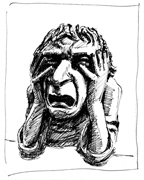
A novel of confusion and paranoia, love and doubt, fear and hysteria: unsettling, unhinged, provocative and bestially funny, ‘Animals’ is for human beings everywhere.
Keith Ridgway's third novel is a psychological menagerie of confusion, paranoia, searching and love. Narrated by an illustrator who can no longer draw, it tells of the sudden and inexplicable collapse of a private life, and the subsequent stubborn search for a place from which to take stock. We are surrounded here – by unsafe or haunted buildings, by artists and capitalists who flirt with terror, by writers and actresses and the deals they have made with unreality, and by the artificial, utterly constructed, scripted city in which we have agreed to live out a version of living. But there are cracks in the facade, and there are stirrings under the floorboards, and there are animals everywhere you look, if only you'd dare to look for them.
Unsettling, unhinged, provocative and richly funny, ‘Animals’ is for human beings everywhere.
His sixth novel, Dooneen, is published by Fitzcarraldo Editions, and by New Directions in June 2026.
His previous books include A Shock, which won the 2021 James Tait Black Memorial Prize for Fiction, and was shortlisted for the Goldsmith’s Prize; Hawthorn & Child; and Animals. His first novel The Long Falling was filmed by Martin Provost as Où Va La Nuit in 2011.
He has been awarded the Prix Fémina Étranger and Premier Roman Étranger, the O Henry award, and the Rooney Prize for Irish Literature.
Animals is a surreal portrait of a man in the midst of a meltdown, lost in a shifting, primal, terrifying version of London in which menacing dogs lurk on street corners, exotic creatures congregate in darkened parks, and sighting the corpse of a mouse triggers an existential crisis. I've mentioned this a few different places now, but this book has a great first page, one that really sets the tone for the rest of the story. It (meaning both the first page and the book) is playful, willfully weird and often properly funny; challenging yet as compulsive as the finest genre fiction. Ridgway is fantastic at folding together the reader's assumptions and the narrator's unreliability and creating a story from the tension in the space between the two. Hilarious and disgusting, incisive and absurd, Animals is a uniquely memorable (if somewhat difficult to describe) novel and one of the best I've read this year.
Ridgway damn near forfeits his thin reputation with a tedious creative-writing exercise at the outset: a nineteen-page encounter with a dead mouse and the narrator's attempt to poke it. Very serious and devoid of laughs, this chapter nearly forced me to chuck the book, but I slogged on, driven by the fact that this dead mouse was obviously the last verifiable element of reality in the book.
'Animals' is one of those alternately absorbing and infuriating "what-the-feck-is-going-on" novels like Hunger, The Third Policeman, or Other People, where banal reality is plunged into dread on a regular basis, and you come to the last page with no resolution to anything. It's the author's game here, and woe betide you, the mere reader, to try to "unpack" or unveil anything put before you.
So here we have a narrator whose very gender seems a mystery until about page 105 (though his partner K remains genderless throughout), a cartoonist freaked by a dead mouse who soon visits a friend, goes for a swim, shows up at his flat -- all incidents punctuated by disaster or an event of sheer dread. Even the appearance of a lone dog becomes a sort of nightmare, and I have to say that Ridgway expertly reports these moments, they're still with me now.
Things get odder, and the narrator makes no bones of his unreliability by constantly reporting his indecision about what really happened, what he really saw and did. As the nightmare becomes all-encompassing toward the end -- was there a murder? a real trip inside a wealthy actress's home? what's with that Australia-shaped stain? -- we're forced to step inside a solipsist's brain and just groove on the nasty, maybe pick up some reality clues, until... everything ends abruptly.
Many of the reviews paint this novel as the self-reporting of mental illness, the "sudden and inexplicable collapse of a private life" says the cover blurb. But on the other hand, we have two fully named characters who may provide some sort of key to everything: David, who created a pointless elaborate universe within which to someday create fiction narratives; and Rachel, a "conceptual artist" who starts rumors (fake kidnappings and such) while documenting the results. Surely they are not just a couple funny inventions to spice up the novel? Toward the end, our narrator ends up in Rachel's apartment, with Rachel nowhere to be seen... or is she there too? Is this novel actually her own work? An elaborate repudiation of David? Wait, is she murdered? Too? Well these questions may be risky, but they might yield more fruitful answers than the "descent into madness" theory. Give it a shot yourself, but be warned that this novel is not nearly as funny or absorbing as Ridgway's reputation suggests.
A man sees a dead mouse in a gutter. He finds it strangely moving; a signifier of something meaningful, but he can't work out why or what. We follow his stream of consciousness through a number of unusual experiences and interactions; a friend who tells him about a haunted office building, a meeting with a famous actress and a terrifying incident in a swimming pool, amongst others. And every so often he catches sight of a sinister black dog, quite possibly only visible to him.... But how much of this is a construct of his own mind and how much of it is real? This is a remarkable book, by turns hilarious, shocking and ultimately both disconcerting and sad. It reminded me of a couple of other books that I've read and enjoyed, particularly Ishiguro's The Unconsoled and Christopher Priest's The Affirmation. The mental collapse of the protagonist is realised brilliantly, and the text becomes more dense and confusing as he loses his grip, particularly in the final couple of chapters. That's not to say that it was a difficult read - I actually found it to be very accessible and, for a novel with no real 'plot', a real page-turner. Highly recommended.
The book is unlike anything I’ve ever read. A few chapters into the book, it becomes evident that the narrator is experiencing a mental breakdown. We’re taken along for the ride, the delusion and paranoia are vivid and keep getting worse as we progress into the book.
The author takes snapshots of the machinations of the human consciousness, describing in detail even mundane details like what it feels like to dive into a swimming pool. You’d expect him to be done with it in a sentence or two, but he stretches it to few paragraphs, accurately capturing the mind and its response to the action.
He’s in a perpetual loop of confusion and paranoia, ruminating about the events that transpired, of which we are not given reliably full and complete details. So when he starts dreading that he has killed his partner, you believe it as a possibility because only that kind of an act can provoke this kind of anguish in a person.
The slugs chapter was very funny.
There’s also a chapter where the author dissects capitalism and terrorism, which seem forced but there’s some good tidbits in there.
Overall, it was an okayish read, I’m returning it to the bookstore coz it isn’t worth keeping in my bookshelf for good.
This started off quite funny, but got decidedly less funny over time. A disturbing and quirky trip through a disturbed person's mind, but very, very well done. If you like it weird, this might work for you.
3.5 stars. This could have been a 5 star ... This story of a sensitive soul who begins to slip from reality after sharing a moment with a dead mouse and having a loopy falling out with his boyfriend was quite moving, and an extraordinary piece of writing. If it had remained at this personal, intimate level, it would have been a profound illustration of the fragility of self, sanity and love. But a couple of megalomaniacs are inserted into the drama --perhaps to make the suffering protagonist look more sane by comparison. I understood why they were there, but for me, they seemed sensationalist, and spoiled the intimacy and credibility of the book.
I gave up on this one. Although the peculiar lack of any realistic psychological motivation for the events in the story was intriguing at first, it fast became a predictable device that seemed to have no point and the coy way in which the writer insistently doesn't identify the gender of the narrator or his partner is a bit lame.
Interesting, odd book. Ends quite abruptly. But I did like the story. What the hell was actually going on I have no idea!! But I liked it. Was K a man or a woman? What the hell happened?? It has made me want to read more of Ridgeway's work.