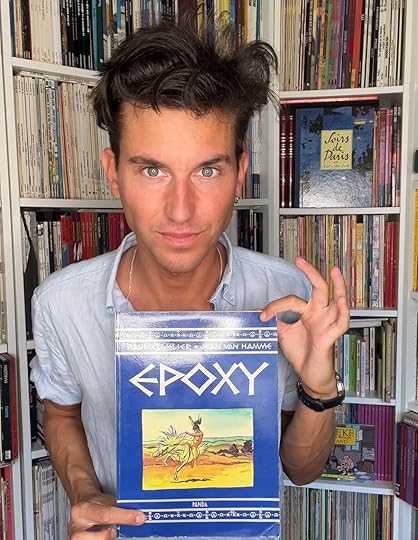
L’histoire débute au large de la Grèce, avec l’innocente promenade en voilier d’une jeune fille ravissante. Mais après avoir été percutée par un yacht, elle va se trouver plongée – au propre comme au figuré – dans un maelström d’aventures inattendues – mais pas franchement désagréables, il faut bien le reconnaître. La voilà propulsée dans une sorte d’univers parallèle situé, comme le lui explique Hermès, "infiniment plus loin de ton monde que tu ne pourrais l’être dans le temps ou dans l’espace".
Jean Van Hamme, is a Belgian novelist and comic book writer. He has written scripts for a number of Belgian/French comic series, including Histoire sans héros, Thorgal, XIII, Blake and Mortimer, Lady S and Largo Winch.
Writer Jean Van Hamme would contact artist Paul Culvier. And Culvier would ask for "a story lauding the eroticism of nude women." This would become Epoxy and the story would be released in 1968, in the beginning of May, worthy of the spirit of May '68. This is quite an adventure. In a time when the judeo-christian sexual dogmas where being questioned, this is not simply a story of debauchery, where characters behave "badly". The young girl here does not simply want to be a "bad girl" so that she can "go everywhere" nor does she settle for hell, so that she can "have fun". It is the very notions of sin, of good and bad, put in the traditional ways, that Jean Van Hamme has challenged. The lead character is caught, unwillingly (we can try to guess, but it's just a guess, by the zeitgeist - in the narrative, it's by the whims of the gods) in something greater than her life. And she is put through tremendous trials. She has to live up to the events. Van Hamme uses greek mythology with hummour, not as a strict helenist. He does not seem to be an apologist of any pre-christian eden, which would contradict his character quest. She soon finds that the gods are selfish and unreliable, they are not trustworthy at all. The lesson is not to replace one idol for another. There is, obsiously, exploitation in these pages. This is a story about the eroticism of a nude woman. Like with many cases, we have to wonder: is the "political" content used as pretext for presenting nude women or are the nude women used as pretext for presenting the "political" content? Maybe that question is in itself always problematic because in books, specially around May '68, nudity is always political. Or is it?
Oh, che porcheria!! Scritto qualche anno dopo Barbarella, che io non ho mai letto e che - se dovesse somigliare a questo - non leggerò tanto presto.
Una ragazza moderna sembra essere vittima di un cattivone che la fa precipitare nella Grecia classica, dove incontra tutti gli dei ed eroi possibili ed immaginabili.
La tipa è sempre nuda e trova un sacco di compagni con cui divertirsi durante il suo viaggio. E anche qualcuno che si diverte con lei senza che lei lo voglia. Quel che importa è mostrare un sacco di corpi nudi in pose piccanti.
C'è anche Afrodite ma, caspita, sembra una prostituta di cinquant'anni con un trucco troppo pesante. Alla faccia della dea della bellezza.
I may add a fifth star depending on how I feel about it when I next see it on my shelves.
Narrative: **** The first screenplay by such a legendary writer who was apparently still an "executive of a multinational". (BobFish- can you verify?)
It's a wonderful journey through mythological Greece and includes appearances by a massive number of characters that are well known to all who enjoy that pantheon!
Art: ***** The backgrounds and especially all anatomy are fantastically rendered. His only weakness seems to be anything at a distance but it goes unnoticed.
Cuvelier leaves out phalluses, vulvas and even pubic hair despite nearly everybody being nude at all times- he often leaves the skin blank when he doesn't place something in front of a crotch. It was so funny seeing Priapus' hairy hind from behind as his member was being exhibited!
The coloring is VERY poor to the point that it may be better in black & white.
Great early comic by Jean Van Hamme, drawn by the impeccable Paul Cuvelier. Sexy swinging sixties long-legged ladies with a dash of mythology, what do you want more ?
Το σενάριο είναι αφαιρετικό και έχει κάποια θέματα στη ροή μιας και είναι ξεκάθαρο πως δεν ήταν αυτός ο σκοπός τους. Δεν τους ενδιέφερε η ποιητικότητα και υιοθετούν μια αφήγηση της μορφής "έγινε αυτό, και μετά εκείνο, και πήγε εκεί, και της έκαναν αυτό κλπ". Πα μαλ, δεδομένων των συνθηκών, της εποχής που γράφτηκε και του σκεπτικού πίσω από την δημιουργία, δεν έχω παραπάνω απαιτήσεις. Για όσους αναρωτηθούν, όχι δεν είναι τσόντα και ούτε ως τέτοια πρέπει να αντιμετωπίζεται μόνο και μόνο γιατί έχει γυμνό. Να τσεκαριστεί για την ιστορικότητα του αν μη τι άλλο.