Zero stars. That's right. Zero of them. This is the worst book I've ever read. It was appallingly bad. Again, it was the worst book I have ever read.
Here's my longer review of it:
Writing by Numbers:
Mark Danielewski’s Only Revolutions
The age-old love-struck teenaged social pariah theme gets a new spin in Only Revolutions, Mark Z. Danielewski’s latest meretricious undertaking. Told by two sixteen-year-olds, Hailey and Sam, the book begins from both ends, “allowing” the reader to flip it over every eight pages, alternating between characters. Danielewski claims to have conceived of the format after having separately written Sam’s and Hailey’s stories, though this is difficult to believe considering the two tales are hardly distinct. Nor do their voices differ; solipsistic Sam asserts, “I am astounding,” egocentric Hailey declares, “I am astonishing,” and aside from such slight dictional variances, the book essentially repeats itself each time it is flipped.
A strong sense of rhythm and an ability to generate momentum are evident immediately as Sam and Hailey race about in a polynymic car, fornicating, eating HONEY and defecating, all the while extolling themselves to the point of absurdity. The car, however, remains undescribed, their driving is aimless, the shitting grandiose and, to say the least, excessive. Further, puerile phrases like chillin, no biggie, bouncing gazongas, and phat props, plus apocopic colloquialisms dis, sitch, and sesh are unengaging and detrimental to the notion of timelessness, a supposed major theme of the novel. All seems consequently quite desultory, the constant book-turning serving no purpose but to prohibit the momentum from really taking off. And while a mollified pace eventually makes room for conflict, even this seems forced: the two try desperately to get married, a social convention such outsiders would surely eschew. Somehow they succeed, and later each holds the other in his/her arms, all vitality inexplicably drained therefrom. The entire narrative is devoid of any setting and context, unless one is inclined to read the so-called history margins, a running compendium of cryptic non-sequiturs obtained largely via fan submission to the author’s web forum. These exist as a separate text alongside the story proper, serving only, really, to distract. Though they do, according to the author, evoke the look of a road. Neat.
While he may lack linguistic maturity, Danielewski excels in graphical flourish and gimmick. Giant Ulyssesesque initials commence both characters’ halves, although, despite several critics’ claims, this is as Joycean as the novel gets. Drop caps indicate the breaks at which the book is meant to be turned over; these follow a rigid pattern of two, three, or five lines in height. Black dots in page corners act as cinematic cigarette burns, harbingers of each expositionally insignificant five-line cap. Type shrinks from 20 to 12 points over the narrative course, a visual representation of Hailey and Sam’s collective quietus. On Sam’s side, fauna is set in bold and fades puzzlingly to gray; Hailey’s repeats the trick with flora. Page numbers revolve around each other in flip-book fashion and the pronoun US is set always in narcissistic capitals, reading as an initialism like a note sung off-key. Though none of this adds anything to the reader’s experience, Danielewski clearly believes an overdeveloped structure can supersede content. Typefaces are numerous, have apposite names—Life, Perpetua, Tempo, Myriad, Spectrum, Univers—and are listed “in order of arrival” as if playing an active role. Within the text though, proper characters clash with Sam and Hailey only visually, via their small-capped monikers, and not through any sort of literal development. Indeed the only memorable one of the bunch is THE CREEP, and only because his handle appears throughout in arbitrary purple ink.
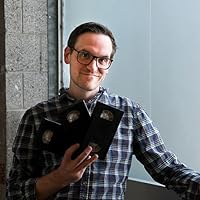
The paperback edition makes small improvements. An appropriate, if obvious, road adorns each cover, replacing the marginally relevant pupils of the hardback. Gone is the further incongruous case, a photocollage of dead birds, insects and plants, and while the eliminated double-ribbon means the reader will have to supply her own bookmarks, these are easy enough to come by. The cryptic endsheets, an apparent concordance set in reverse and arranged in an odd pattern of various overlapping ovals, remain only in part, suggesting dispensability. Rest assured, though, fans; each O and zero are still set in either green (in Sam’s portion) or gold (in Hailey’s). The text itself remains unchanged.
Though specious, House of Leaves, Danielewski’s experimental debut novel, showed ambition. Here, however, he forgoes sentiment for numerical allusion, filling each of his 360 pages with 36 lines and exactly 180 words but not a trace of genuine emotion. Perhaps he’s hoping this paucity of substance will be missed for the constant book-flipping. Indeed, as Hailey claims 67.8% of the way through her half of the novel, “If you can’t fix it, give it a spin.”