Jump to ratings and reviews
Rate this book

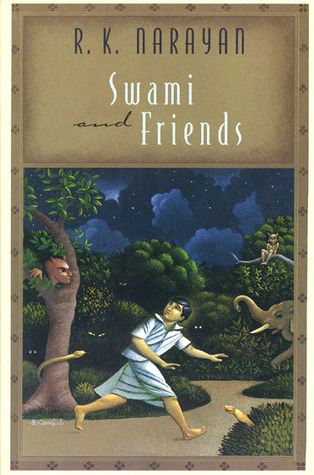
Swami and Friends

Rate this book
"There are writers—Tolstoy and Henry James to name two—whom we hold in awe, writers—Turgenev and Chekhov—for whom we feel a personal affection, other writers whom we respect—Conrad for example—but who hold us at a long arm's length with their 'courtly foreign grace.' Narayan (whom I don't hesitate to name in such a context) more than any of them wakes in me a spring of gratitude, for he has offered me a second home. Without him I could never have known what it is like to be Indian."—Graham Greene

Offering rare insight into the complexities of Indian middle-class society, R. K. Narayan traces life in the fictional town of Malgudi. The Dark Room is a searching look at a difficult marriage and a woman who eventually rebels against the demands of being a good and obedient wife. In Mr. Sampath, a newspaper man tries to keep his paper afloat in the face of social and economic changes sweeping India. Narayan writes of youth and young adulthood in the semiautobiographical Swami and Friends and The Bachelor of Arts. Although the ordinary tensions of maturing are heightened by the particular circumstances of pre-partition India, Narayan provides a universal vision of childhood, early love and grief.

"The experience of reading one of his novels is . . . comparable to one's first reaction to the great Russian the fresh realization of the common humanity of all peoples, underlain by a simultaneous sense of strangeness—like one's own reflection seen in a green twilight."—Margaret Parton, New York Herald Tribune

"The novels of R.K. Narayan are the best I have read in any language for a long time. . . . His work gives the conviction that it is possible to capture in English, a language not born of India, the distinctive characteristics of Indian family life."—Amit Roy, Daily Telegraph

190 pages, Paperback

First published January 1, 1935

591 people are currently reading
13434 people want to read

About the author

R.K. Narayan

143 books1,930 followers
R. K. Narayan is among the best known and most widely read Indian novelists who wrote in English.

R.K. Narayan was born in Madras, South India, in 1906, and educated there and at Maharaja's College in Mysore. His first novel, Swami and Friends and its successor, The Bachelor of Arts, are both set in the enchanting fictional territory of Malgudi and are only two out of the twelve novels he based there. In 1958 Narayan's work The Guide won him the National Prize of the Indian Literary Academy, his country's highest literary honor.

In addition to his novels, Narayan has authored five collections of short stories, including A Horse and Two Goats, Malguidi Days, and Under the Banyan Tree, two travel books, two volumes of essays, a volume of memoirs, and the re-told legends Gods, Demons and Others, The Ramayana, and the Mahabharata. In 1980 he was awarded the A.C. Benson Medal by the Royal Society of Literature and in 1982 he was made an Honorary Member of the American Academy and Institute of Arts and Letters.

Most of Narayan's work, starting with his first novel Swami and Friends (1935), captures many Indian traits while retaining a unique identity of its own. He was sometimes compared to the American writer William Faulkner, whose novels were also grounded in a compassionate humanism and celebrated the humour and energy of ordinary life.

Narayan who lived till age of ninety-four, died in 2001. He wrote for more than fifty years, and published until he was eighty seven. He wrote fourteen novels, five volumes of short stories, a number of travelogues and collections of non-fiction, condensed versions of Indian epics in English, and the memoir My Days.

-Wikipedia & Amazon.co.uk

Ratings & Reviews

What do you think?
Rate this book

Friends & Following

Create a free account to discover what your friends think of this book!

Community Reviews

5 stars
6,004 (44%)
4 stars
5,213 (38%)
3 stars
1,927 (14%)
2 stars
328 (2%)
1 star
142 (1%)
Displaying 1 - 30 of 620 reviews
Profile Image for Swati Tanu.
Author 1 book617 followers
November 16, 2025
The book's core theme is childhood. The author has done an excellent job of highlighting how children are influenced by their environment and community. Readers enjoy the amusing approach to human dual nature.

Swami's relationships with his parents, teachers, friends, and grandma are depicted in a charming manner by the author. The seamless portrayal of a variety of emotions such as innocence, love, hurry, naughtiness, envy, and optimism is also adorable.

This is one of those "children's fiction" books that will bring joy to adults as well. This book's ending isn't exactly what you'd expect from a happy ending. Some may find the ending unsatisfying, but I believe that is the objective, and that youngsters who read this novel will have a more accurate image of the world they live in. I believe it is critical to demonstrate to children that not every tale has a good conclusion, and this is one of them.

You might like to wander through a few artistic journals — they’re full of sparks and surprises.
Profile Image for Lars Guthrie.
546 reviews192 followers
January 11, 2010
I would never have known about Narayan had not the parent of a child with whom I worked introduced me with a Christmas present of the Everyman's Library Edition of the four 'Malgugi' novels. Another lucky reward of my job. The first of these novels, 'Swami' is the story of a ten-year-old boy in a small town in southern India, just as Gandhi's independence movement is gaining traction.

Narayan's effortless prose is deceptively free of judgment, even style--a clean and spare narration that looks way easier than it is. It reminds me of actors who play "themselves" successfully, like Cary Grant or John Wayne, or "natural" sounding singers like Sinatra. When you stop being aware of the craftsmanship, you know you are in the presence of a master craftsman.

Narayan perfectly captures the thinking of a child caught up in events beyond his understanding. Swami is torn between the excitement of a revolutionary movement that is about rejecting the old order, and his idolization of the charming son of a representative of that order, a police official in the British colonial system.

It's a beautiful little book. Highly recommended.
Profile Image for Amit.
151 reviews43 followers
October 20, 2023
4.25 ⭐

Absolutely loved it!!!!

GENRE - FICTION - KIDS CLASSIC, COMEDY.

This book reminded me of my School days and all the monkey tricks I would do with my friends. Long before when there was a time when there would be no mobile phones and computers around we would rely on friends and family to pass our time and connect, I wish those time come back and there be no Smartphones and computers.

This book is about a boy named Swaminathan (Swami) who belongs to a fictional town of Malgudi in India and his relationship with his father and 3 good friends.The book is well written and there is a good mix of comedy, drama and action in it.A must read for all those who love reading novels about children.

Thank you 😊
95 reviews43 followers
October 12, 2011
Swami and friends has got such an innocence that they will make you smile, remind you of the 'big problems' you had to face when you were a child and all those ridiculous things you did.

For example, I used to write letters exactly like this one

"I am studying here because my father came here. My mother is also
here. All of us are here. And we will be only here. I am doing well. I hope
you are doing well. It is very hot here. I had fever for three days and drank
medicine. I hope I will read well and pass the examination. Is Swami and
Mani doing well! It is very hot here. I am playing cricket now. I can't write
more."

Definitely it is a feel good book and might help you to keep the last bit of innocence left in you.
Profile Image for Daren.
1,567 reviews4,571 followers
May 20, 2022
This is Narayan's first book, and therefore the first of his famous Malgudi books.

It is a clever book, in its own way - mainly because it gets into the head of a ten year-old boy, living in a small Indian village. Narayan has really nailed this - the things that are important to a ten year-old, the confusion of a ten year-old, the innocent, lack of understanding that a ten year-old has in the ways of the adult world. It also picks up on the simplicity of relationships - the transition of childhood friendships, the relationship with a father - who is a complex mixture of unfair disciplinarian and hero, the relationship with a doting, but confused grandmother, the relationship with other adults - teachers, headmasters, doctors. In summary, the issues that ten year-olds are troubled with.

It is a short book, it is easy to read, and it is compelling reading - hard to put down.
Each chapter brings a new dynamic or a new situation to be navigated - a new boy at school, a surprise baby brother!, school exams, school holidays, a political protest and a riot, changing schools, the cricket club and a big game.

4 stars.
Profile Image for Reading_ Tamishly.
5,302 reviews3,461 followers
December 22, 2020
*top 10 disappointing reads of 2019*
So glad I am finally done with this beloved children's classic!
I loved the writing style. But somehow I couldn't enjoy this read as much as I had anticipated.

Without a doubt, the author did show his best trying to represent the characters that's relevant to those times. This book was first published in 1935. I appreciate the heavy influence in the writing of all the things that were relevant then. The political upheaval and the unrest; the struggle of the common men and the strive to get educated and in sync with the surroundings that came as a result of the British rule during those days.

I liked the first half of the book much, much more than the second half. The characters were developed in a way I felt that the adult characters were represented fairly well while I have got issues with the child characters. I seriously doubt their age. And they are totally unlikable specially that of the main character, Swaminathan aka Swami. I would say he is pretty inconsiderate and manipulative at times. Mani, one of his best friends, is a big bully and always looking for ways to pick up a fight. Then there's this kid Rajam, an egoistic kid just because his father is a police superintendent. None of these kids are cute or charming or has that childlike nature in them. They are rude most of the times. They are rather manipulative and selfish. All these issues are portrayed as somewhat alright in this book which I believe made this book rather unenjoyable.

The writing, the sequence of events and character portrayal are flawless in the first half of the book. The second half of the book is a bit messed up. It looks like the author wanted to include so many things about politics, the education system, friendship, school life, cricket, emotions and craziness all at once! But as many as such things were there, the ending was abrupt and a bit underwhelming. And the nature of these kids remain questionable. And I think the overflow of emotions from Swami is a bit out of place as compared to that of Rajam's and Mani's. And yes, these characters are all over the place without much impact.

I really wanted to love this book. But meh... This is the first time that I am not overwhelmed by everything in a book by my fav author.

Looking forward to the next read.

***Main issues why this is a 3 star read for me:
🔹Lack of character personality and mispresentation
🔹Lack of sense in the sequence of events in the later half of the book
🔹An underwhelming ending
Profile Image for Ian Laird.
479 reviews96 followers
July 14, 2025
I first read Swami and Friends in 2005, and have re-read it to kick off a little review project

Narayan Project - No. 1 of 26*

This is a beautiful book about childhood, specifically boyhood, told by a master story teller about to begin his long and fruitful creative life.

Famously, Swami and Friends is the work which got RK Narayan his start, when a friend in London showed the manuscript to Graham Greene, leading to its publication, after the friend ignored RKN’s instruction to throw the work into the Thames.

I’m also confident this is the first appearance of the imaginary town of Malgudi, based on Mysore, which appears pretty well developed, featuring a substantial river, the Sarayu, flowing by, the classy residential precinct Lawley Extension (where Swami’s new friend Rajam lives), Ellaman Street and so forth: the elements appearing here would reappear in most of Narayan’s stories hereafter.

Ten year old WS Swaminathan (Swami) is a First Form student at the Albert Mission School. The story starts off smartly, in action and thematically- Swami is off to school, apprehensive about his ‘fire-eyed’ teacher, Vedanayagam and ‘the headmaster with the long thin cane’ (p1). He is soon in a scripture class with Mr Ebenezar, a Christian fanatic, who rubbishes Hindus and erupts when Swami puts some thoughtful questions to him about Jesus, provoking Mr Ebenezar to try to wrench off the boy’s left ear. This ill-treatment prompts Swami’s father, a lawyer, to write to the school threatening to withdraw the boy in light of these non-Christian practices.

This all happens in the first five pages. RK Narayan never mucks around. The themes introduced here are ones which the author pursued throughout his writing life – the importance of good education, the need for understanding and tolerance of religious diversity, the relationship between father and son, and the relationship between student and teacher, especially between student and headmaster. This is particularly meaningful in Narayan’s case as his father was a headmaster: for some of Narayan’s schooling his dad was the headmaster (RK Narayan was an indifferent student).

We soon meet Swami’s friends: Mani the mighty, Somu the monitor, Sankar the smart one and Samuel ‘the pea’, and begin to see how their relationships work. This equilibrium is disturbed by the arrival of Rajam, son of the new Police Superintendent, and wealthier and better spoken (in English) than Swami and his friends.

Swami is dazzled by Rajam, and a group of three becomes established; a new alignment, between Swami, Mani and Rajam, which ultimately leads to the establishment of their own cricket team, which provides the impetus for the latter part of the story.

Even though the stories of Swami’s life at school are episodic they represent a remarkably coherent depiction of a small boy’s life at a critical time.

Narayan manages to capture the fears, aspirations and delights of childhood. He goes to the heart of Swami’s relationships with his friends, his teachers, his headmasters and his family – father, mother, granny and newly arrived baby brother. Swami oscillates wildly, from exhilaration at new discoveries and new friends to fear and apprehension at what might befall him.

Swami’s relationship with his father is really important. Swami is proud of his father, but he is sometimes fearful and thinks father can be unfairly restrictive. Father has laid down some ground rules for Swami prior to the examinations. Swami ruminates:
Staying home in the evenings was extremely irksome. He sighed at the thought of the sandbanks of the Sarayu and Mani’s company. But his father had forbidden him to go out till the examinations were over. He often felt he should tell his father what he thought of him. But somehow when one came near doing it, one failed. He would have to endure it after all for only one week … The thought that he would have to put up with his travails only for a week at worst gave him fresh energy. (p55)
Narayan captures the pluck and defiance in the boy, but also how hard it is for a son to actually stand up to his father. He also appreciates the gulf in world views between parent and child. Take fractions for example: Swami is a dreamer and easily distracted. But even when he tries hard he has trouble understanding a question about the price of mangoes:
Swami then gazed and gazed at this sum, and every time he read it, it seemed to acquire a new meaning. He had the feeling of having stepped into a fearful maze... His mouth began to water at the thought of mangoes. (p86)
He wonders about the setting of the price, the quality of the mangoes and the character of their purveyors and finally asks his father:
‘Father, will you tell me if the mangoes were ripe?’ Father regarded him for a while and smothering a smile remarked: ‘Do the sum first. I will tell you whether the fruits were ripe or not, afterwards.’ (p87)
There follows an agony for the boy as he tries to work out the problem with his father more or less patiently waiting: ‘You seem to be an extraordinary idiot. Now read the sum. Come on.’ (p87). Swami keeps wrestling with the problem and side tracks himself with irrelevant distractions including the thought that if father wanted to know the price of mangoes so badly, he should go to the market himself. With more help from his dad he eventually gets it right but immediately bursts into tears.

I was reminded, rather painfully on both counts, of driving my own father to distraction at my complete failure to grasp simple (to him) mathematical concepts and a very similar reaction for me when trying to do the same with my son.

Like many small boys Swami is often unsure of himself and looks for assurance from his peers. At the examination Swami writes one line in answer to a moral question about a Brahmin and a tiger, but quickly claims more when he learns of his friends’ wordier efforts.
‘I too wrote about that length, about half a page,’ lied Swaminathan as a salve to his conscience, and believed it for a moment. (p63)
RK Narayan was the subject of criticism from some quarters for provincialism and a perceived failure to address and acknowledge the political and social climate, in particular the rising discontent represented by the growing nationalist movement ‘Quit India’.

Having read all of Narayan’s works it is true to say they are anchored in the daily goings on of ordinary people living their lives in provincial India, South India at that, but to say he was politically naïve or unaware is simply wrong. Apart from the obvious works where political awareness and consciousness is apparent for example, Waiting for the Mahatma and The Painter of Signs (and even Mr. Sampath--the Printer of Malgudi), Narayan’s political and especially social acuity is present in all his work, including the present one.

In Swami and Friends I was surprised, having first read it a decade ago, and retaining a clear memory of Swami’s character, but less of the events of the story, coming across his quite serious involvement in the protests arising out of the boycotting of Lancashire and Manchester cloth. It was a response to the impact of British woven cloth on the domestic product and the brutal tactics of some colonial manufacturers who, it has been said, cut off the thumbs of some Indian weavers (whether this actually occurred has been disputed and remains the subject of debate to the present day).

Swami gets caught up in a riot and has lathi-bearing policemen bearing down on him. He and his school friends take the opportunity to vandalise their school, breaking the headmaster’s windows, and another school nearby.

This is serious peril and Narayan does not make light of it, although he takes pains to say the policeman reaching Swami, tapped him lightly on the head with his lathi.

The major driver for Swami and his friends is then formation of a cricket team to play a challenge match. This represents the highpoint of his friendship with Rajam and Mani in particular. They organise themselves in an efficient manner, if not an entirely realistic one, especially their approach to the cricket supply company. They also have a naive belief that the government will help them with gear.

The climax of the book is provided by the match itself and Swami’s part in it - which is to miss it entirely. Typical Narayan touch.

School parade drill prevents him from getting to cricket practice and Swami ends up in front of the headmaster for skipping drill: Swami had done so because he believed a doctor who told Swami he would tee it up with the school. When he is hauled up before the headmaster, Swami realises the doctor has deceived him and was not treating him seriously (so he learns a valuable lesson about adults). As he is about to be punished, Swami grabs the headmaster’s cane and runs away, and gets lost overnight in the forest, thereby missing the match.

His family reacts in different ways, Granny fretting and his mother sobbing, but father’s reaction is poignant, at first cheerfully aggressive, then concerned at whether his behaviour had caused Swami to flee, and then real concern, as he goes searching:
He walked rather briskly up Hospital Road, but had turned back after staring at the tall iron gates of the hospital. He told himself that it was unnecessary to enter the hospital, but in fact he knew that he lacked the courage. That very window in which a soft dim light appeared might have behind it the cot containing Swaminathan all pulped and bandaged. [He continues his search reaching the river]…if the body of his son, sodden and bloated, should be stuck up among the reeds, and rocking gently on the ripples…He shut his eyes and prayed: ‘Oh, God, help me.’ (p158)
After he is found Swami is fussed over by father’s friends. When they leave:
Father went out with one of his friends. Before going he said, ‘Swami, I hope I hope I will not have to look for you when I come back.’ Swami was hurt by this remark. He felt it to be cruel and inconsiderate. (p173)
Sensitive boy.

It’s hard being a father, I have a nine year old and the more I learn, the less I know. Why is the boy so sensitive? Well, he’s not at all unlike Swami – an ocean and a century apart yet not so different when it comes down to it.

Then there’s David Copperfield…

A note about Coffee and tiffin
There are several references in the book to Swami enjoying coffee, which surprised me – the boy is ten after all. This is following his rescue:
Mother had meanwhile disappeared into the kitchen and now came out with a tumbler of hot coffee with plenty of sugar in it, and some steaming tiffin in a plate. Swaminathan, quickly and with great relish, disposed of both. (p174)
I have been saying to my young bloke that he can’t have coffee til he’s much older than his nine years, but I do want him to read the book, so I’ll have to risk further pressure from him for coffee and his idea of tiffin.

* The Narayan Project is my undertaking to review all the great man’s work: 14 novels, six volumes of short stories, three works on Indian mythology, plus his memoirs My Days and My Dateless Diary: An American Journey and finally, a volume of essays A Writer's Nightmare: Selected Essays originally published in The Hindu between 1958-1988. 26 volumes in all. To be posted during 2016 and 2017.
Profile Image for Annette mathews.
70 reviews67 followers
May 5, 2015
I have heard many things about R.K Narayan . I am ashamed to say that I have not read a single book of his till now, him being such a renowned writer not to mention the fact that he was an Indian. I saw his books at a book fair recently.At first , I was hesitant to buy his books ,but then my dad compelled me ,So I ended up buying two of his books .
Better late than never.
The story is about Swami,Mani and Rajam who were foes at first but then went on to become great friends .What I like most in this novel is that I could connect with the characters ,be it Swami ,Mani or Rajam. There would have always been a swami/Mani/Rajam in our school days. At times ,I could relate with swami .It was ironic when Mani ,who was at loggerheads with Rajam in the beginning, was with him till the end .
The writing is simple and clear.This story took me back to my childhood days, where I enjoyed life to the fullest, where the biggest problems was scoring low marks. No boss, No responsibility ,free as a bird.
Profile Image for Bigsna.
364 reviews8 followers
July 4, 2013
:-) Simple and sweet. Much enjoyed reading this very classic book that became the popular Malgudi Days on TV.

RK Narayan picks up the tone of Swami and his friends so well. What I found really funny was how all the boys (Swami, Mani and Rajam)take themselves so seriously, when they haven't a clue about most things.
One of the funniest incidents was when the boys decide to form a local cricket club and wonder if the government would charge them a tax for forming the club, as the government seemed to charge a tax for everything in the world. Its so funny how they mull ver this point for so long and with absolute seriousness.
And when they are past this discussion, they decide to order equipment for their club, this is the letter they send to the supplier:

Dear Sir,
Please send to our team two junior willard bats, six balls, wickets and other things quick. It is very urgent. We shall send you money afterwards. Dont fear. Please be urgent.
Regards

In their world, it seems only they exist.

The central character Swami is quite a selfish chap and I was nodding my head a couple times wishing I could give him a lesson or two. He gets into trouble most times because of this - but then I'm thinking most boys 6 or 7 years old cant be expected to think much beyond themselves. :)
Profile Image for Padmaja.
174 reviews1 follower
August 27, 2018
Finished it last night in a single sitting as I wasn't able to sleep 😅 reading this reminded me of my childhood and my heart craved for the innocence of those times. I absolutely love Swami's character since childhood.
Profile Image for Smiley .
776 reviews18 followers
August 30, 2011
In fact, I enjoyed reading all of the 19 Chapters in the first Narayan novel since I'd never read him before. It's one of the novels published in the Everyman's Library series and I couldn't help admiring him as well as his writing style, narrative and sense of humour to the extent that I could visualize how the rural Indians lived in the remote country nearly similar to my rural Thailand some 55 years ago.
I'm sorry I don't have the Everyman's Library hardcover nearby, therefore, I can't write my review in more detail in the meantime (I'd definitely write a more in-depth one whenever I can find the copy). In short, find this novel to read and you'd love Narayan as one of the pioneering Indian writers in the 20th century.

All right, I've just found the hardcover in question.

Some reasons why I'd like to encourage my Goodreads friends to read this novel:

1) Each chapter is reasonably pleasurable for new comers, not too short or too long,

2) Lots of dialogs, various types of discourse related to their contexts. Therefore, it's relatively convenient for you to grasp or understand the story as it develops. I think I prefer reading dialogs rather than lengthy narratives till we feel sleepy, drowsy due to the notorious effect of 'stream of consciousness', and

3) an exemplary scene of discourse (Chapter 14):
... He (the headmaster) rubbed his eyes, raised his eyebrows three times, yawned, and asked in a voice thick with sleep, 'Have you fellows no class?' He fumbled for his spectacles and put them on. Now the picture was complete -- wizened face and dingy spectacles calculated to strike terror into the hearts of Swaminathans. He asked again, 'To what class do you fellows belong? Have you no class?'
'I don't belong to your school,' Rajam said defiantly.
'Ah, then which heaven do you drop from?'
Rajam said, 'I am the captain of the M. M. C. and have come to see you on business.'
'What is that?'
'This is my friend W. S. Swaminathan of Second C studying in your school...'
'I am honoured to meet you,' said the headmaster turning to Swaminathan. Rajan felt at that moment that he had found out where the Board High School got its reputation from.
'I am the captain of the M. C. C.'
'Equally honoured...'
'He is in my team. He is a good bowler...'
'Are you?' said the headmaster, turning to Swaminathan.
'May I come to the point?' Rajam asked.
'Do, do,' said the headmaster, 'for heaven's sake, do.'... (pp. 107-8)

I think this is enough as an introduction to the famous R. K. Narayan. One more point, he's the novelist honoured by Graham Greene as follows:
"... Narayan (whom I don't hesitate to name in such a context) more than any of them wakes in me a spring of gratitude, for he has offered me a second home. Without him I could never have known what it is like to be Indian." (back cover, Everyman's Library)

I'm sorry it's a bit lengthy but, as for me, I can't help being amused due to the headmaster's sense of humour and as we're children some 55 years ago (that is, in my generation then), with fond memories we still recall such kindness from our headmasters, teachers, parents, etc. when we timidly approached them and asked them for a possible favour.
Profile Image for Prabhjot Kaur.
1,133 reviews217 followers
November 6, 2020
It's always a delight to visit the fictional town of India, Malgudi. R.K. Narayan has created such an amazing world and I can never get enough of it. Swami and Friends is based in pre-partition India when it was still under the British Raaj.

This talks about all the issues surrounding those times and some issues are still present in present day India. Issues such as political unrest, importance of education and respecting different religions. This book is about Swami, Mani and Rajam and how they became friends. We still see these characters in our schools today and I can't believe this was written more than eighty years ago.

I liked the writing. It was simple and easy to read. Even though I didn't really like any of the characters I enjoyed the book.

3.5 stars
Profile Image for S.Ach.
686 reviews208 followers
October 27, 2023
When I had first read this book some 20 years back, I dismissed it considering it too simplistic.

Now, once again when I read it, I loved it, because of its simplicity.

As they say, when you grow older, you appreciate simpler stuff more. This is the proof.

As Tagore once said, “It is very simple to be happy, but it is very difficult to be simple.”

The beautiful way that Narayan had captured the raw innocence of 10 year old kids in a small town of pre-Independent India, is quite endearing and moving.
It will be difficult to find a reader, who hadn't got transported back to his/her school days, while reading this book.
Lovely!

P.S. Also, the amazing TV adoption of the book by Shankar Nag and the tune of Malgudi Intro constantly played in my mind while I was reading it. Tà nà nà tànà tànà nà. Tà nà nà tànà nànà nà.
Profile Image for Luke.
1,626 reviews1,192 followers
March 29, 2020
3.5/5

For some time, there's been a niggling in the back of my mind that every so often jabs me with the realization that I've been rather complacent with my replenishment of Indian literature in my personal collection. A brief overview shows a compendium of writings by Indian women, a couple of postcolonial feminist nonfiction treatises, some biographies, scattered single or double works by a handful of authors, and a work so diasporic in nature that I'm not sure whether it bears mentioning, with little beyond some age old memoirs and a single work by my beloved Roy to signal at any active planning of further purchases on my part. It seems, with a case such as India, I cannot rely as much on my instinct for old/translated works, what with contemporary Anglo being the most prominent representative at most book sales. Even here, while I was glad to be able to finally get around to Narayan through incorporating in a reading challenge, I do not feel any urge to pursue more of his bibliography, save for the rather dry appeal of his having successfully worked his way into various literary canons of my particular language and country. More than this being a work which falls a little more towards the younger aspect of humanity in its attempt to bridge the generations is the fact that, ultimately, this is a story that I've heard before, with the colonial rule and the lack of women and the cricket and the controversial uprisings against everything British. Now, I certainly haven't come even close to experiencing the story in every way that it can be possibly told, but while Narayan's evocation of youthful experiences was at first charming, it didn't sustain itself enough over even its brief number of pages for my cynical gaze. A shame, but an honest personal response nonetheless, and that's the best I can do at times.

I've very little interest in thematically choosing my reading based on whatever contemporaneous events are swirling around me. Thanks to my obsessive book hoarding habits that look less and less ridiculous as quarantine procedures go on, I'm hardly lacking for at least one work that would fit the times, but while my appetite for newly composed nonfiction has grown by leaps and bounds as I've aged, I've always been far more of an escapist than anything else. So, when the world started struggling and my life started adjusting in the wake of it, I turned to a setting on the other side of the world and nearly a century into the past: one, because it's a member of my current bevy of challenge reads; two, because it's been on my shelves forever; and three, because it was the sort of cheery youthfulness that I thought would be good for my state of mind. It certainly was good in that respect, but I was never a little Indian boy, or a little boy for that matter, and I was always half distracted wondering where all the little girls were in this landscape of schools, tennis courts, and the fierce summer heat, where Christians get in trouble for being religious bigots and the cart man is the biggest hero of them all. Entertaining with all its youthful rapscallions, to be sure, but not a varied enough picture of Malgudi's world for me not to be a little dismissive of the next dreaded brush with the teacher's authority or the next work of magnanimity performed by the police chief's son. Highly relevant to a younger form of myself, I'm sure, but it's rather too late for that, and I am not of the temperament for which this work manages to survive the gap between child and adult.

So. Another venerated name in classical literature (somewhat) beyond the Anglo pale of things under my belt, but not one I plan on perusing unless a particularly beautiful edition of unread work(s) crosses my path (I'm superficial like that). I likely left this work too long for it to appeal now, but I was already twenty when I first added it, and considering how frequently (and, honestly, in most instances pathetically) Anglo children's literature finds its way into the best and brightest lists, this was a chance to return the favor. It was good enough that I wouldn't mind recommending it to younger folks (although one scene involving the main character child whacking another younger one over the head was rather off-putting, to say the least), especially those who are already being warped by their US surroundings against the country from which their ancestors hail. For me, I'm better off going forward with my plan to revisit some favorites of my childhood, which, depending on how long my area's shelter in place order lasts, may happen sooner rather than later with books I had originally checked out as children's services reference material that, now, can't be returned for some time. The sooner I can return them, though, the better, as I want to embark on my Indian literature replenishment plan sooner rather than later, and I'm not yet desperate enough to resort to ordering online.
Profile Image for Preetam Chatterjee.
6,736 reviews355 followers
July 29, 2024
This novel consists of a sequence of incidents in the life of a schoolboy (Swaminathan) who disgusts his school intensely for its masters and the routine to which he must submit, but who at the same time enjoys his school-life because of the friends he makes there. Swaminathan or Swami and his friends are students of a mission school preparing boys for the college in Malgudi where English is the lone medium of instruction.

In this situation, these students become committed to the English game of cricket; and their special form of the quest, which dictates their school-life, is a comic one because they aim at establishing on the lawns of Malgudi an M.C.C. which they hope would rival its English original. In other words, these boys fall under the enchantment of a game which is actually the national game of England; and they fall under its spell because they are being taught various subjects at school through the medium of the English language Here we observe the cultural separation in the lives of the Indians of the early thirties of the last century, when this novel was scripted. In some respects, Swami and Friends is the most entertaining of Narayan’s novels.

As one reads it, one becomes sentimental almost, for one has been at some point in their childhood, one of these boys.

Bunyan wrote: "There are many things which make our fancy chuckle while our heart doth ache" Shakespeare wrote: "Life is a mingled yarn of woe and weal." We can see a rainbow through the tears in our eyes. Life is a comedy to those who think, a tragedy to those who feel. R. K. Narayan, like Shakespeare, Dickens and Lamb, does both, thinks as well as feels.

We find the blending of humour and pathos in Swami and Friends. Let us analyse few situations from the nove:

(1) Swami provokes humour when he says to the doctor, the Drill Master and the Board Highschool Head Master that he is suffering from delirium. But later delirium becomes an object of grief when Swami suffers from the most dreadful delirium in the Mempi Forest.

(2) The formation of the Malgudi Cricket Club fills Rajam and his friends with enthusiasm and happiness but ultimately it is the M.CC that brings pathos in the life of Swami. Had M.C.C. not been formed Swami would not have missed the drill practice would not have been caned and would not have lost his friend Rajam. So there is both humour and pathos in the formation of the M.C.C.

(3) The mango sum solution affair is most hilarious. Swami's father asks him to attempt a sum about mangoes. Swami gazes and gazes at the sum, it seems to acquire a new meaning. He has the feeling of having stepped into a fearful maze. His mouth begins to water at the thought of mangoes. He wonders what made Rama fix fifteen annas for ten mangoes. He then asks his father to tell him if the mangoes are ripe. Father tells him to do the sum first and know afterwards whether the mangoes are ripe. Swami wants to know from his father whether Rama is selling ripe mangoes or not. He thinks that it will be scandalous to expect fifteen annas for the unripe mangoes. When his father presses him for the answer, he marvels what the urgency is for the answer. If there is urgency then why does father not go to the market and ask the mango seller about the price. All this is sidesplitting comedy but concurrently there is despair, even though slight. Swami's father takes delight in tormenting him and says that he has half a mind to thrash him and twists his ears. The longer Swami hesitates the more violant the twist is. "Swaminathan announced at the end of half an hour's agony that Krishna must pay six annas, and burst into tears. The hilarity of the comedy ultimately ends into tears. So here there is the blending of humour and pathos.

A must read, simply for its Indianness and simplicity of prose.
Profile Image for Amalie .
783 reviews207 followers
June 6, 2023
Without a doubt, R K Narayan is one of the most famous Indian writers and a great storyteller. His stories are gently humorous. Swami and Friends is one of his first published novels based on R. K. Narayan’s experiences as a village school teacher. There is absolutely nothing boring about this novel and is one of my favourite stories about children.

Swami/Swaminathan is a ten-year-old boy in a small town in southern India called ‘Malgudi’ (The fictitious southern Indian town which is the setting for a large number of Narayan’s works.) just as Gandhi's independence movement is gaining traction. Swami pretty much Mark Twain’s Tom Sawyer, may be even more precocious and mischievous. He hates school, loves to play all the time (his greatest passion is the Malgudi Cricket Club which he founds together with his friends), snuggles beside his grandma every night, frequently gets punished by his father etc. He also has a gang of friends where he is the ‘ringleader’ of all the mischievous works. Swami and his best friend Mani live for their school vacations.

While continuing his mischievous works, Swami manages to get thrown out of his school, participates or rather gets caught in Anti-British protests, runs away from home swearing he will never come back, has to face the terrible tiger all by himself, etc. This is a must-read book. Highly recommended.
Profile Image for Vikas Singh.
Author 4 books335 followers
August 6, 2019
This is the first book by R.K. Narayan. Graham Greene who helped getting it published called it "A book in ten thousand". Narayan introduces the quaint little town of Malgudi. He beautifully captures the trails and tribulations of a young child and his small dreams and joys. We get to see a very authoritarian society out to stiff out children's natural learning and growing up process. A great read and a great insight into Indian way of life in small town back in 30's.
Profile Image for Smitha Murthy.
Author 2 books417 followers
May 10, 2020
I needed something ‘light’, and unlike my friend who picks up gory murders as light reading, I turned to the much-loved world of one of India’s most beloved novelists, RK Narayan.

These whimsical tales of a lost childhood were just what I needed. Swami’s capers made me smile and chuckle and forget the world around me a little bit.

A classic children’s treasure.
Profile Image for Raghav Bhatia.
327 reviews100 followers
October 27, 2021
There's magic in this story. Not the bombastic, whoa-inducing kind of magic; rather the quiet kind of magic that one finds in food made by a mother's hand, or in the music of monsoon rain. I don't know whether this is well-written or not, but I suppose that I barely noticed the writing at all is a mark of fine craft.
Profile Image for Sookie.
1,325 reviews89 followers
July 11, 2019
I was quite close to swami's age when malgudi days aired on TV. The faces on the show were familiar and the stories had a comforting feel to them. Where I am from, swami is a school staple. We see life in a small town where there is a strong British presence in schools and in government offices . Narayan writes about life in such small town where people have now lived for years in a system that looks complacent but the omnipresent head of foreign rule is ever present. Amidst all this we see swami and his friends get into trouble, have fun and just be children as long as the world allows them.

Its always a pleasure to come back to these stories as they always hit me in the ribs with sheer nostalgia.
Profile Image for Kavita.
846 reviews459 followers
May 21, 2024
How absolutely delightful! Narayan weaves a gorgeous landscape of a South Indian village in which Swaminathan and his friends go to school. It bursts forth with the joys and trials of childhood and left me feeling nostalgic. The cast of characters is huge and is a lot of fun.

The story revolves around Swami, the son of a lawyer, who studies in Albert Mission School. His best friends are Somu (the monitor), Sankar (the smart one), Samuel (the Pea), and Mani (the violent bully). When a rich police superintendent's son, Rajam, joins the school, Swami tries very hard to befriend him, which annoys the others very much. Mani tries to bully Rajam but when he is able to hold his own against the bully, the two become friends, and the trio of Swami, Rajam, and Mani is formed, relegating the others to the sidelines. Dude knew how to make 'useful' friends even at ten years old!

In the background is also the freedom movement. With Rajam's dad being a police superintendent and Swami being from a normal family, some feathers are bound to get ruffled. Not to mention a spat with the mission school!

There are some brutal truths of school life. For example, when Somu fails his class, he is not promoted and is 'automatically excluded' from the friend group. Or when, at the end, Rajam moves away and is never heard from again. These add to the nostalgia of the time, when every single moment is to be enjoyed, never knowing what might change.

It's a very simple book, but nevertheless gorgeous. It remains one of my favourite books of all time.❤️
Profile Image for adya.
217 reviews45 followers
July 24, 2021
R.K. Narayan rather strikes me as the Ruskin Bond of the south. The incredible homely quality of both the authors' writings makes for very comforting books!
Really enjoyed this glimpse into the small town life in Malgudi (although I do prefer Malgudi Adventures to any other book of Narayan's).
The M.C.C. and its portrayal of children in colonial India in the 1930s was super funny!

Side note- Very amusing to see that fathers teaching their kids mathematics is the same now as was then! Also I wish getting just 90% was lauded even now 😩
Profile Image for Surabhi.
38 reviews36 followers
March 24, 2012
Swami and Friends is the first of a trilogy of novels written by RK Narayan, a celebrated English novelist from India. The novel, which is also Narayan's first, is set in pre-independence days in India, in a fictional town - Malgudi, which has almost become a real place in India today, due to the wide recognition and popularity of Narayan's many novels. His novels are known for their 'deftly etched characters, his uniquely stylized language and his wry sense of humor'.


Swami and Friends is the story of a 10-year-old boy, growing up during this particular time, his innocence, wonder, mischief and growing pains. He is a student at Albert Mission School, a school established by the British which gives importance to Christianity, English literature and education. His life is dramatically changed when Rajam - a symbol of colonial super power - joins the school and he and Rajan become friends.

The central theme of the novel is growing up of young Swami. He is a spontaneous, impulsive, mischievous and yet a very innocent child. His character is a child in the fullest sense of the world. Through Swami's eyes the reader gets to peak in to the pre-independence days in South India. The life portrayed in the novel is accurate in its description of the colonial days - the uprisings, the rebellions, the contempt and the reverence the natives had for their subjugator, together with varied elements that have become one, such as cricket and education.
The novel, first intended for a very young audience, later expanded into a universal one, for its simple narrative and depiction of colonial India. Today in India it is recommended as a textbook or a reference book. One of the most glaring facts about the novel is the similarity of children through out the world, and how they have not changed since the time the novel was written. Children are all mischievous, impulsive and innocent like Swami. They all play and enjoy just like Swami, and try to circumvent doing homework by ingenious excuses and methods. Like Swami most children - even today- attend schools that do not nourish their heritage and culture, throughout the world including the US.


The criticism of the educational system and the lack of faith in it is a common theme of Narayan. It runs throughout this trilogy Swami and Friends, The Bachelor of Arts and The English Teacher. Narayan's own father who was a principal did not think much of the system as Narayan and his many fictional characters, such as Swami, Chandran, Krishna, Sriram and a host of others. But the educational system comes under grave criticism in this trilogy, and discussed at length in The English Teacher. (Read The English Teacher web page in this site.) It is not that Narayan thought that education was useless, but rather that the school and education system founded by the British was irrelevant. He was maybe among the second generation of persons who received a formal education in India during the time, and saw how his grandparents and many other of his countrymen surviving, thriving and living as good human beings, perhaps even better than the 'educated folk,' without any education.


Profile Image for Zoeb.
198 reviews62 followers
March 23, 2018
Legend has it that 'Swami And Friends' was one of the four books of R.K Narayan that Graham Greene had a lion's share in publishing to the Western world. Had it not been for Greene, we, as a collective human race, would have been deprived of the extraordinary beauty of simplicity and sincerity in prose and literature.

One of the things that makes these wonderful Swami tales stand so tall above their peers of adventures of other intrepid boy heroes is its winsome believability, the sheer serenity of its emotions and the graceful yet insistent poetry of its storytelling. We see Swami grow up in small-town India, circa 1930s; the place is Narayan's now-iconoclast Malgudi, teeming with earthly beauty and populated with charming and crooked characters and we see him and his lovably real classmates and close friends Rajam, Mani, Sankar, Somu and Samuel The Pea in adventures and misadventures that are free of contrived mechanitions. They are utterly warm, relatable and even more the enchanting as they will rope in the children and even remind wistfully and delightfully the adults of their own innocence.

From classroom rivalries to tyrannical teachers, from moody fathers to sleepy grandmothers, from tricky questions in examinations to a cricket club trying to make it big in the world, Swami's adventures are nothing if not entertaining and elegant, Narayan filling up these intimate moments with such a wide-eyed and vivid perspective that would almost belong to a child. Then again, his penchant for humour is endearing, from the way Swami fusses over his examination answers to Mani's thick-headed understanding of things to even the grown-ups and their bemused and whimsical observations about this crowd.

I find it not surprising at all that Greene loved this so much that he went ahead and published it in England and gushed with praise about this writer, heralding him to the world. This is indeed an unforgettable marvel to treasure.
Profile Image for Rebecca.
330 reviews180 followers
March 30, 2018
So homely, so amusing.. And a bit sad towards the end. R K. N. weaves the story such that I almost believed I was in Malgudi.. Now off to rekindle some nostalgia by watching the DD series on you tube
Profile Image for Fiza Pathan.
Author 40 books363 followers
May 20, 2022
I can never get bored of reading 'Swami & Friends' by R.K.Narayan, the Grand old man of Malgudi. Swami & his friends will always remain close to my heart along with their many adventures & misadventures. The wit of this novel is a treat to dip into. R.K.Narayan truly shows us a very comical perspective of a child growing up in pre-Independence India with a brillian example of lucid prose. This happens to be R.K.Narayan's first novel & finest masterpiece according to me. The stories are highly character centric, a prelude to the other more intricate & equally entertaining novels of Narayn in later years. The relationship shared between Swaminathan & his family are highly relatable to the Indian reader even now during the 21st century. The parallels between Swami's & Narayan's own life & views about education & school-life are highly worth taking note of. Somu, Sankar, the Pea, Mani, Rajam & Swami adventures galore, these characters will remain in my tender heart forever more!
Profile Image for Sam.
263 reviews31 followers
December 22, 2019
This book had been in my to-read list for a long, long time and finally, after many years, I got the opportunity to read it and without doubt, it has lived up to its potential! There can never be a book like this one, with simplicity and nostalgia wrapped in every sentence and every incident relating to the innermost core of the heart.

But just reading this book is not sufficient. The television series is a perfect companion after reading R.K Narayan’s books and deserves an award of its own!
Profile Image for Fiza Pathan.
Author 40 books363 followers
October 29, 2012
Malgudi Schooldays was actually published as `Swami & Friends' when R. K. Narayan first wrote the stories of his child character Swaminathan & his adventures. We all love to read most of the time if not, books about our own lives & about people just like us. That's why many school stories & novels are popular. R.K. Narayan, the creator of the character Swami was well aware of this fact & so penned the adventures of a boy in Malgudi.

There is however, a stark difference between the school boy Swami & other foreign & well-loved schoolboy characters. Swami is fully Indian & his story is set before India had won her Independence. However, certain childhood fears & preoccupations we notice are common in both the early 20th century Swami & even todays 21st century kids. E.g., the fear of examinations & rival boys etc. I doubt that the pre-Independence Swami however will ever go out of fashion. This is a character who lives on despite changes in technology...because this character is real & very genuine. All the characters in this book are completely real although technically speaking they are `made up'.

But lets get to the bottom of R.K. Narayan's `Malgudi Schooldays'.

Most of us who love reading already know that the south Indian town mentioned in this book is fictional & does not really exist just the way Narnia does not as well as Camelot. This town where Swami & his friends stay was created by Narayan for the purpose of literature & adventure.

It is here where we are introduced to a boy called Swami (Swaminathan) who is mischievous & has a mind of his own. He like most of the school going children today does his homework at the last minute & incurs the wrath of his teachers as well as his principal (principals) which gets him into a lot of trouble at the home front as well. Like all school going children, he belongs to a group of friends who he associates himself with just the way you associate yourself with the group of friends that you belong to. His two greatest associates are Mani & Rajam the latter who is from an affluent household. Mani on the other hand represents the ruffian of the group who has more brawn than brain but towards the end of the book, becomes diplomatic & quite wise in a way (he makes Swami think that Rajam will write to him to make Swami feel better). Rajam the police superintendent's son on the other hand, enters the plot as a very proud & headstrong character but who never lets his wealth go to his head where his friends are concerned. He is partly generous (he gave Swami a green toy engine from his cupboard) & also is a person to mend broken friendships (it was in his house that all the friends of Swami puts aside their issues & befriend each other once again).

In Swami's family we meet many formidable characters who are immortal not only because of R.K. Narayan but also because, we see such people in our own homes or families. The family of Swami consists of his over indulgent mother (who nags the husband), a strict father & a very forgetful & meek grandmother who gives into whatever Swami says blindly. Swami father runs the show in the family & is often the cause for Swami getting into a lot of trouble.

It is well enough to note that R. K. Narayan himself had a father who was equally strict with the members of his household & an indulgent mother.

The grandmother however, captured my interest the most. The reason for me being interested in the activities of the old grandmother is because of the way she is so important to the main character Swami without him realizing it (well, until his father makes him sleep alone in his office away from the grandmother). He sleeps with the grandmother, the grandmother tells him stories about the great warriors of India & she is the one who gives Swami a listening ear in the whole household. Note that R. K. Narayan also in the first formative years of his life was brought up by his grandmother (mother's mother) who had a great influence in his life. Swami's mother throughout the story keeps herself quite distant from the boy (but cries for him when he gets lost) while Swami's father has a military disposition in the bringing up of his son & never interferes with him. Till the end of the story we see that Swami holds a lot of ill feeling towards his father & his father's behaviour is not at all what one would call, compassionate. There is yet again a similarity between Narayan's own father & the father of Swami.

There is always a bit of a funny bone in Narayan which also shows itself in this work especially during the legendary Satyagraha against the Albert Mission School where Swami takes a substantial part in & breaks the glass of the principals ventilator. He is also told to throw his cap into a bonfire which is first thought to be of foreign make but which in the end turns out to be quite Indian. The whole purpose of Gandhi's Satyagraha is warped here in the story where violence takes place among the protestors & no one knows the difference between Khadi & foreign cloth.

Although we get morals like bravery, friendship, loyalty etc. from the narrative, it's the narrative itself that gives the reader pleasure beyond comparison. It acts like a mirror for youngsters to see their reflection & also gives us a glimpse of the corruption in the education system. Religious fanaticism is brought out through the unstable personage of the teacher Ebenezer but Narayan takes on this topic in his usual elementary manner without really hurting religious sentiment but showing us that religious fanaticism comes not from wisdom but, ignorance.

On the whole, I appreciated this work especially the additions of two stories from the actual `Malgudi Days' which are masterpieces in their own right. Swami is a character who can evoke in us the uncertainties of childhood & its highs & lows.

All in all, a really good read for the weekend.

Fiza Pathan
Profile Image for Manish Purohit.
22 reviews6 followers
September 22, 2013
"Ye Daulat Bhii Le Lo, Ye Shoharat Bhii Le Lo, Bhale Chhiin Lo Mujhase Merii Javaanii, Magar Mujhako Lautaa Do Bachpann Kaa Saavan, Vo Kaagaz Kii Kashtii, Vo Baarish Kaa Paanii..." these magical lines by Sudarshan Faakir beautifully sums up the importance of childhood memories in our lives.

'Swami and Friends' brings out that 'bachpann' in you which is silently hidden in some corner of your heart. There is something especial about this book that separates it from all other creative masterpiece. That persona of innocence and childhood charm which (I'm sure) everyone would have felt during his childhood days comes alive when one is reading this book & it takes you back in those days. Page by Page, incident by incident, chapter by chapter...you re-visit your childhood with the panorama of school days and mischief you played coming before your eyes.

The book is about Swami (a child everyone must have lived his / her childhood with), his whole gang of friends & their adventure in the school. It beautifully captures the perspective of a ten year old boy towards school, adults & stuff around. The life during those days meant juggling around between classes, home work, playing mischief with friends, strolling in sun & making strategies to convince parents for the permission to play. Purity in thoughts & actions, something that even now brings silent smile to the face (Well...it did brought smile to my face when I was writing this). Added to this, the literary zest of R K Narayan really takes you to the magical world of Malgudi (which is essentially a virtual town in southern India) & its slightly eccentric people who are gullible and are still untouched by the winds of change sweeping over India.

This is one of those books falling in the 'children fiction' category, which will provide the same (or infact more) joy to adults too as it makes them remember those forgotten cherished childhood moments. The sweetness and naturalness of the book makes it a must read for all...for the simple reason that we all deserve to feel that innocence & tenderness once again...as somewhere down the line, the thought always comes to each of our mind "Wish I could re-live those moments one more time"

If the above thought have stirred your mind ever. . .Go this is a chance for you to steal some of them!!


Rating: 5/5

Visit the following link to read the detailed review
http://www.musingsofawanderingheart.b...
Displaying 1 - 30 of 620 reviews

Can't find what you're looking for?

Get help and learn more about the design.