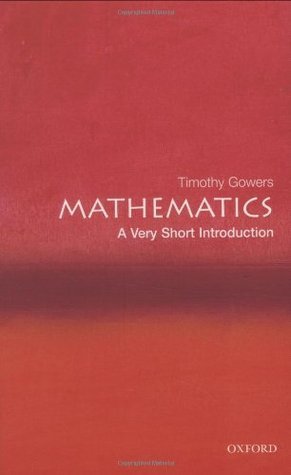
El autor (nada menos que medalla Fields en 1998, ojo al dato) se propone algo a priori imposible: una introducción a «las matemáticas», así en general, en menos de 150 páginas. Y lo resuelve con inteligencia, porque no intenta abarcarlo todo, sino enseñar una forma de pensar. En ocho capítulos nos pasea por modelos, abstracción, demostraciones, límites, dimensiones, geometría y aproximaciones, y en cada uno nos da una lección magistral de lo que significa usar las matemáticas para abordar un problema.
Empieza por los modelos. Para aplicar las matemáticas al mundo real primero hay que simplificarlo: la piedra que lanzas se convierte en un punto sin rozamiento y el gas, en bolitas que rebotan. Un modelo no tiene que ser «verdadero», sino útil. Modelar es sobre todo decidir qué ignorar. Un dado obedece a la física, y aun así lo que funciona es tratarlo como seis caras equiprobables.
El segundo capítulo, sobre números y abstracción, es el corazón del libro. Gowers lo resume en una idea: un objeto matemático es lo que hace. Igual que el rey del ajedrez no se define por su forma sino por cómo se mueve, no importa qué «es» el −1 o la raíz de −1, sino qué reglas cumplen. Con eso explica, por ejemplo, por qué menos por menos da más. No hace falta buscarle un sentido físico: es la única opción compatible con las reglas que ya aceptamos. De paso, el número imaginario i deja de ser misterioso.
En el de demostraciones explica qué separa una prueba de una sospecha. Ejemplo: pones puntos en un círculo y los unes todos con cuerdas. Con 1, 2, 3, 4 y 5 puntos salen 1, 2, 4, 8 y 16 regiones. Con 6 salen 31, no 32.
Luego vienen los límites y el infinito. El infinito es imprescindible y a la vez muy difícil de hacer riguroso, así que los matemáticos, básicamente, lo esquivan. Decir que algo «tiende a» un límite es en realidad una afirmación sobre cosas finitas: para cualquier margen de error, a partir de cierto punto siempre estás dentro. Así cobran sentido los decimales infinitos (0,999… = 1) o el área de una figura curva. El infinito acaba siendo una abreviatura.
En el capítulo de dimensión, gracias a las coordenadas, la cuarta dimensión deja de ser algo que haya que imaginar y pasa a ser una lista de cuatro números. No puedes ver un hipercubo, pero sí contarlo. Tiene 16 vértices, que son todas las listas de cuatro ceros y unos. Y tiene 32 aristas, las que unen vértices que difieren en una sola coordenada. También aparecen los fractales y sus dimensiones fraccionarias.
Personalmente siempre he odiado la geometría, así que fue la parte que menos disfruté. Aun así, reconozco que tiene poco que ver con la del colegio. Parte de los axiomas de Euclides y de los siglos de intentos de deducir el de las paralelas a partir de los demás. Al final se descubre que no se puede, porque existen geometrías coherentes donde ese axioma falla: en la esférica los ángulos de un triángulo suman más de 180° y en la hiperbólica, menos. La idea brillante es cómo se demuestra que algo no se puede demostrar: construyendo un mundo donde se cumplen todos los axiomas salvo ese.
En el capítulo de estimaciones y aproximaciones, Gowers explica que muchas veces encontrar una fórmula exacta sería un milagro, y que el trabajo real consiste en estimar bien. No hay fórmula para el primo número n, pero sabemos que cerca de n, más o menos uno de cada ln(n) números es primo. Y aquí consigue algo admirable: explicar la hipótesis de Riemann como lo que es en el fondo, una afirmación sobre lo precisa que es esa estimación.
Cierra con preguntas frecuentes: si los matemáticos están acabados a los 30, por qué hay tan pocas mujeres matemáticas, si las matemáticas y la música van de la mano… El autor da claramente su opinión personalísima, y se ve cómo intenta no mojarse cuando el tema es peliagudo.
En conjunto, el autor consigue que veas que bajo las matemáticas hay algo profundo, algo que permite hacer cosas que a primera vista parecen imposibles. Que las matemáticas son, en el fondo, «domar el pensamiento» para poder hacer cosas con él. Que no son aritmética. Esto ya lo sabemos muchos, pero me ha encantado cómo Gowers lo hace llegar a su público.
-------------------
The author (a Fields Medal winner in 1998, no less, mind you) sets out to do something that seems impossible from the start: an introduction to “mathematics” in under 150 pages. And he pulls it off cleverly, because he doesn’t try to cover everything. Instead he teaches a way of thinking. Over eight chapters he walks us through models, abstraction, proofs, limits, dimensions, geometry and approximations, and in each one he gives a masterclass in what it means to use mathematics to tackle a problem.
He starts with models. To apply mathematics to the real world you first have to simplify it: the stone you throw becomes a point with no air resistance, and a gas becomes tiny balls bouncing around. A model doesn’t have to be “true”, just useful. What stuck with me is that modelling is mostly about deciding what to ignore. A die obeys the laws of physics, and yet what works is treating it as six equally likely faces.
The second chapter, on numbers and abstraction, is the heart of the book. Gowers sums it up in one idea: a mathematical object is what it does. Just as the king in chess is defined not by its shape but by how it moves, it doesn’t matter what −1 or the square root of −1 “is”, only which rules they obey. This lets him explain, for instance, why a negative times a negative is a positive. There’s no need to look for a physical meaning: it’s the only option consistent with the rules we already accept. Along the way, the number i stops being mysterious.
The chapter on proofs explains what separates a proof from a hunch. My favourite example: put points on a circle and join them all with chords. With 1, 2, 3, 4 and 5 points you get 1, 2, 4, 8 and 16 regions. With 6 you get 31, not 32. It’s the best vaccine against “I see a pattern, so it must be true”.
Next come limits and infinity. Infinity is indispensable and at the same time very hard to make rigorous, so mathematicians basically sidestep it. Saying that something “tends to” a limit is really a statement about finite things: for any margin of error, beyond a certain point you are always within it. That’s how infinite decimals (0.999… = 1) or the area of a curved shape come to make sense. Infinity ends up being a kind of shorthand.
In the chapter on dimension, thanks to coordinates, the fourth dimension stops being something you have to imagine and becomes a list of four numbers. You can’t see a hypercube, but you can count it. It has 16 vertices, which are all the lists of four zeros and ones. And it has 32 edges, the ones joining vertices that differ in a single coordinate. Fractals and their fractional dimensions also make an appearance.
Personally, I’ve always hated geometry, so this was the part I enjoyed least. Even so, I admit it has little to do with the geometry we learnt at school. It starts from Euclid’s axioms and the centuries of attempts to derive the parallel postulate from the others. In the end it turns out this can’t be done, because there are consistent geometries in which that axiom fails: in spherical geometry the angles of a triangle add up to more than 180°, and in hyperbolic geometry to less. The brilliant idea is how you prove that something can’t be proved: by building a world in which all the axioms hold except that one.
In estimates and approximations, Gowers explains that finding an exact formula would often be a miracle, and that the real work lies in estimating well. There is no formula for the nth prime, but we know that near n, roughly one in every ln(n) numbers is prime. And here he achieves something remarkable: explaining the Riemann Hypothesis as what it really is at heart, a statement about how accurate that estimate is.
He closes with some frequently asked questions: are mathematicians past it by 30, why are there so few women mathematicians, do mathematics and music go together… The author clearly gives his own very personal opinion, and you can see him trying to sit on the fence whenever the subject gets thorny.
All in all, the author makes you see that there is something deep underneath mathematics, something that lets you do things that at first glance seem impossible. That mathematics is, at its core, about “taming thought” so you can do things with it. That it isn’t arithmetic. Many of us already know this, but I loved the way Gowers gets it across to his readers.