

What do you think?

Exile trilogy #3
Rigodon
«- Docteur, vite !... vous devez vous douter... toute cette gare ici n'est qu'un piège... tous ces gens des trains sont à liquider... ils sont de trop... vous aussi vous êtes de trop... moi aussi...
- Comment savez-vous ?
- Docteur, je vous expliquerai plus tard... maintenant il faut vous attendre... vite !... ça sera fait cette nuit...
- Pourquoi ?
- Parce qu'ils n'ont plus de places dans les camps... et plus de nourriture... et que dehors ça se sait...»
- Comment savez-vous ?
- Docteur, je vous expliquerai plus tard... maintenant il faut vous attendre... vite !... ça sera fait cette nuit...
- Pourquoi ?
- Parce qu'ils n'ont plus de places dans les camps... et plus de nourriture... et que dehors ça se sait...»
320 pages, Paperback
First published January 1, 1969
About the author
Louis-Ferdinand Céline
156 books2,749 followersLouis-Ferdinand Céline, pen name of Dr. Louis-Ferdinand Destouches, is best known for his works Voyage au bout de la nuit (Journey to the End of the Night), and Mort à crédit (Death on the Installment Plan). His highly innovative writing style using Parisian vernacular, vulgarities, and intentionally peppering ellipses throughout the text was used to evoke the cadence of speech.
Louis-Ferdinand Destouches was raised in Paris, in a flat over the shopping arcade where his mother had a lace store. His parents were poor (father a clerk, mother a seamstress). After an education that included stints in Germany and England, he performed a variety of dead-end jobs before he enlisted in the French cavalry in 1912, two years before the outbreak of the First World War in 1914. While serving on the Western Front he was wounded in the head and suffered serious injuries—a crippled arm and headaches that plagued him all his life—but also winning a medal of honour. Released from military service, he studied medicine and emigrated to the USA where he worked as a staff doctor at the newly build Ford plant in Detroit before returning to France and establishing a medical practice among the Parisian poor. Their experiences are featured prominently in his fiction.
Although he is often cited as one of the most influential and greatest writers of the twentieth century, he is certainly viewed as a controversial figure. After embracing fascism, he published three antisemitic pamphlets, and vacillated between support and denunciation of Hitler. He fled to Germany and Denmark in 1945 where he was imprisoned for a year and declared a national disgrace. He then received amnesty and returned to Paris in 1951.
Kurt Vonnegut, Jr., Henry Miller, William Burroughs, and Charles Bukowski have all cited him as an important influence.
Translated Profiles:
Луи-Фердинанд Селин
Louis-Ferdinand Destouches was raised in Paris, in a flat over the shopping arcade where his mother had a lace store. His parents were poor (father a clerk, mother a seamstress). After an education that included stints in Germany and England, he performed a variety of dead-end jobs before he enlisted in the French cavalry in 1912, two years before the outbreak of the First World War in 1914. While serving on the Western Front he was wounded in the head and suffered serious injuries—a crippled arm and headaches that plagued him all his life—but also winning a medal of honour. Released from military service, he studied medicine and emigrated to the USA where he worked as a staff doctor at the newly build Ford plant in Detroit before returning to France and establishing a medical practice among the Parisian poor. Their experiences are featured prominently in his fiction.
Although he is often cited as one of the most influential and greatest writers of the twentieth century, he is certainly viewed as a controversial figure. After embracing fascism, he published three antisemitic pamphlets, and vacillated between support and denunciation of Hitler. He fled to Germany and Denmark in 1945 where he was imprisoned for a year and declared a national disgrace. He then received amnesty and returned to Paris in 1951.
Kurt Vonnegut, Jr., Henry Miller, William Burroughs, and Charles Bukowski have all cited him as an important influence.
Translated Profiles:
Луи-Фердинанд Селин
Ratings & Reviews
Friends & Following
Create a free account to discover what your friends think of this book!
Community Reviews
Displaying 1 - 30 of 61 reviews

September 13, 2020
برای توصیف کتاب "ریگودون" چیزی مناسبتر از این شعر آقای " الیاس علوی " ندیدم.
خدا کند انگورها برسند
جهان مست شود...
تلوتلو بخورند خیابانها
به شانهی هم بزنند
رئیسجمهورها و گداها
مرزها مست شوند...
و محمدعلی بعد از 17 سال مادرش را ببیند
وآمنه بعد از 17 سال کودکش را لمس کند
خدا کند انگورها برسند
آمو زیباترین پسرانش را بالا بیاورد...
هندوکش دخترانش را آزاد کند ...
برای لحظهای
تفنگها یادشان برود دریدن را...
کاردها یادشان برود
بریدن را
قلمها آتش را
آتشبس بنویسند ...
خدا کند کوهها به هم برسند
دریا چنگ بزند به آسمان
ماهش رابدزدد...
به میخانه شوند پلنگها با آهوها ...
خدا کند مستی به اشیاء سرایت کند...
پنجرهها
دیوارها را بشکنند...
وتو..
تو
تو
همچنانکه یارت را تنگ میبوسی
مرا نیز به یاد بیاوری ...
محبوب من
محبوب دور افتادهی من
با من بزن پیالهای دیگر
به سلامتی باغهای معلق انگور...
به عشق سه نقطهها :))
📍فکت تاریخی:
فیلم جوکر رو احتمال زیاد دیدید. همون که واکین فینیکس بازی کرده و اختلالی داره که در مکان و زمان نامتعارف میخنده. چقدر غم انگیز بود و ادم رو معذب میکرد.
جالبه بدونید آقای سلین _محبوب قلبهای زخم خورده _ در جنگ ضربه ای به سرش میخوره و دچار آسیب مغزی و متعاقبا اختلال Pseudobulbar affect میشه که در اثرش دقیقا همون علائم خندههای غیر قابل کنترل در موقعیتهای تراژیک رو بروز میداده.
و خب ... گفتم شاید براتون جالب باشه و شاید بیاعصابی سلین رو کمی توجیه کنه.
این کتاب رو هدیه گرفتم از دوستی که خیلی میدونه و خیلی بلده درباره کتابها ♡♡
خدا کند انگورها برسند
جهان مست شود...
تلوتلو بخورند خیابانها
به شانهی هم بزنند
رئیسجمهورها و گداها
مرزها مست شوند...
و محمدعلی بعد از 17 سال مادرش را ببیند
وآمنه بعد از 17 سال کودکش را لمس کند
خدا کند انگورها برسند
آمو زیباترین پسرانش را بالا بیاورد...
هندوکش دخترانش را آزاد کند ...
برای لحظهای
تفنگها یادشان برود دریدن را...
کاردها یادشان برود
بریدن را
قلمها آتش را
آتشبس بنویسند ...
خدا کند کوهها به هم برسند
دریا چنگ بزند به آسمان
ماهش رابدزدد...
به میخانه شوند پلنگها با آهوها ...
خدا کند مستی به اشیاء سرایت کند...
پنجرهها
دیوارها را بشکنند...
وتو..
تو
تو
همچنانکه یارت را تنگ میبوسی
مرا نیز به یاد بیاوری ...
محبوب من
محبوب دور افتادهی من
با من بزن پیالهای دیگر
به سلامتی باغهای معلق انگور...
به عشق سه نقطهها :))
📍فکت تاریخی:
فیلم جوکر رو احتمال زیاد دیدید. همون که واکین فینیکس بازی کرده و اختلالی داره که در مکان و زمان نامتعارف میخنده. چقدر غم انگیز بود و ادم رو معذب میکرد.
جالبه بدونید آقای سلین _محبوب قلبهای زخم خورده _ در جنگ ضربه ای به سرش میخوره و دچار آسیب مغزی و متعاقبا اختلال Pseudobulbar affect میشه که در اثرش دقیقا همون علائم خندههای غیر قابل کنترل در موقعیتهای تراژیک رو بروز میداده.
و خب ... گفتم شاید براتون جالب باشه و شاید بیاعصابی سلین رو کمی توجیه کنه.
این کتاب رو هدیه گرفتم از دوستی که خیلی میدونه و خیلی بلده درباره کتابها ♡♡

February 21, 2023
This starts with a harangue when Céline is back in France after World War II. He's being hounded for debts, antisemitic, pro-Nazi writings, etc. Then the narrative flashes back to Céline's flight from Sigmaringen, in south west Germany, near Switzerland, where he had been holed up with officials of the collaborationist Vichy government. He and his wife, Lili — and their cat, Beibert — get on board a train to hell. It's filled with the dead and the near living on their way to Rostock. Why Rostock? Who knows.
Céline's prose is flat, and fragmented, but at the same time vivid and compelling. It draws the reader on. He is a ranter à la Thomas Bernhard, but Bernhard is usually humorless, whereas Céline's humor is black as a fetid corpse.
Céline was supposedly trepanned three times due to action in World War I. He was a decorated war hero. Maybe that turned a switch to his brain, made him more voluble. Maybe not. Many passages here wonder about the same thing; he speaks about his brain creating symphonies for him when he was in prison in Denmark. Then a flying brick to his head in Hanover turns him positively phantasmagoric.
Now though it's off to Rostock, but no, suddenly they're heading to Berlin. Here's a helpful note about chronology. This is the third volume of a trilogy. I've not read the earlier volumes, but will.
"SIGMARINGEN. The order of events in Rigadoon is rather different from that described in the preceding volumes and also from the actual course of events, which is roughly as follows: In July 1944, Céline, whose life had been threatened in France because of his collaboration with the Germans, crossed the German border, intending to go to Denmark. In Baden-Baden his papers were confiscated and for three months he waited in vain for permission to proceed to Denmark. Finally he asked leave to go to Switzerland or return to France. He spent two weeks in Berlin, trying to obtain a visa. After refusing to broadcast Nazi propaganda he was interned for three months at Kressling near Neuruppin in Prussia in a camp of "free thinkers." This would seem to be the setting of North. At this time he tried again to go to Denmark and reached Rostock-Warnemünde, but was unable to cross the border. At this point he decided to join the Vichy refugees in Sigmaringen, where he stayed until March, 1945. It was then, with Sigmaringen as its starting point, that the 21-day odyssey related in Rigadoon began." (p. 268n)
Céline was sort of the French equivalent of Ezra Pound. Though to my knowledge, Pound never addressed his Nazi collaboration in print, as Céline does here. Rather, Pound was committed to an asylum, St. Elizabeth's in DC. Cèline was cleared by a military tribunal in 1951, not sure what rationale was used. Maybe it was just his great fame.
Some may find this difficult to read. Céline opines if fleetingly on mongrelization, Jews, the mentally deficient, the ignoble end of white race, etc. What he doesn't do is either praise the Axis or lambaste the Allies. The French get it in the neck though, and you could argue that in this manner he does criticize the Allies, obliquely. Mostly he's enraged by the critics at home whom he doesn't hesitate to name: Jean Cocteau, dying of rectal cancer, among them.
Céline's prose is flat, and fragmented, but at the same time vivid and compelling. It draws the reader on. He is a ranter à la Thomas Bernhard, but Bernhard is usually humorless, whereas Céline's humor is black as a fetid corpse.
Céline was supposedly trepanned three times due to action in World War I. He was a decorated war hero. Maybe that turned a switch to his brain, made him more voluble. Maybe not. Many passages here wonder about the same thing; he speaks about his brain creating symphonies for him when he was in prison in Denmark. Then a flying brick to his head in Hanover turns him positively phantasmagoric.
Now though it's off to Rostock, but no, suddenly they're heading to Berlin. Here's a helpful note about chronology. This is the third volume of a trilogy. I've not read the earlier volumes, but will.
"SIGMARINGEN. The order of events in Rigadoon is rather different from that described in the preceding volumes and also from the actual course of events, which is roughly as follows: In July 1944, Céline, whose life had been threatened in France because of his collaboration with the Germans, crossed the German border, intending to go to Denmark. In Baden-Baden his papers were confiscated and for three months he waited in vain for permission to proceed to Denmark. Finally he asked leave to go to Switzerland or return to France. He spent two weeks in Berlin, trying to obtain a visa. After refusing to broadcast Nazi propaganda he was interned for three months at Kressling near Neuruppin in Prussia in a camp of "free thinkers." This would seem to be the setting of North. At this time he tried again to go to Denmark and reached Rostock-Warnemünde, but was unable to cross the border. At this point he decided to join the Vichy refugees in Sigmaringen, where he stayed until March, 1945. It was then, with Sigmaringen as its starting point, that the 21-day odyssey related in Rigadoon began." (p. 268n)
Céline was sort of the French equivalent of Ezra Pound. Though to my knowledge, Pound never addressed his Nazi collaboration in print, as Céline does here. Rather, Pound was committed to an asylum, St. Elizabeth's in DC. Cèline was cleared by a military tribunal in 1951, not sure what rationale was used. Maybe it was just his great fame.
Some may find this difficult to read. Céline opines if fleetingly on mongrelization, Jews, the mentally deficient, the ignoble end of white race, etc. What he doesn't do is either praise the Axis or lambaste the Allies. The French get it in the neck though, and you could argue that in this manner he does criticize the Allies, obliquely. Mostly he's enraged by the critics at home whom he doesn't hesitate to name: Jean Cocteau, dying of rectal cancer, among them.

October 17, 2018
Rigodon è l’ultimo libro di Céline ed è una lettura tremendamente ostica per via della narrazione frammentata, per la sua forma scomposta, per il ritmo sincopato, per il groviglio di vicende che si intersecano, per il linguaggio crudo, senza peli sulla lingua. Sono tanti i motivi per cui non lo consiglierei a nessuno, ma è un libro indimenticabile. Alberto Arbasino lo definisce così: «Il vero trionfo di Céline (e della letteratura) è che nessun film di guerra o di orrore riuscirà mai a rappresentare gli orrori della guerra con la terrificante potenza espressiva di questo non-romanzo».
Dite pure che Céline era paranoico, nichilista, disperato, delirante, maledetto, disprezzabile, ambiguo, ecc. ecc… ma – signori miei – che prosa e che senso dell'umorismo! Dite di lui quel che vi pare, ma è uno scrittore vero.
Dite pure che Céline era paranoico, nichilista, disperato, delirante, maledetto, disprezzabile, ambiguo, ecc. ecc… ma – signori miei – che prosa e che senso dell'umorismo! Dite di lui quel che vi pare, ma è uno scrittore vero.

November 28, 2024
France's No.1 renegade writer completes his Exile Trilogy (also his last ever novel) with the darkly rollicking, maddening and ferocious Rigadoon, as Celine's alter ego, wife and cat, flee to find sanctuary with the Nazis in neutral Denmark, taking in a train journey where civilization feels like it's in the death throes of the apocalypse. I swear Celine's alter ego loved his moggy, Bebert, just as much if not more so than his wife, lili. He once even said "I'd take cyanide no problem if it was that or throwing a cat out in the street, even a moth-eaten, mangy, caterwauling pain in the ass! Well, he did dedicate the novel to the animals. Celine's wife Lucette Destouches lived to 107, and had he done too, I'm sure he would have relished the chance to piss off the European lefty elite for another 50 years!

Read
August 15, 2026Endlich, lange gesucht … ein vergilbtes Exemplar von "Rigodon" … dritter Teil der Exil-Trilogie … waren die ersten beiden Teile schon großartig, fast besser als "Reise ans Ende der Nacht" oder "Tod auf Kredit"!
Diesmal kreuz und quer durch's zerbombte Deutschland, Rostock, Berlin, Hamburg, runter bis nach Ulm und wieder rauf, bei Flensburg über die Grenze, dann Kopenhagen … Céline auf Krücken, seine Frau Lili, Kater Bébert in seiner Tasche und La Vigue … auf Zügen, alles schwarz von Ruß … ttscht, ttscht, von einem Bahnhof zum anderen … von vielen nur zwei, drei Gleise übrig … auf offenen Plattformen, in Fischzügen, Leprazügen, eingesperrt in Packwagons … manchmal zu Fuss auf den Gleisen, von einer Schwelle zur anderen … Ruinen, Brände, blaue Flämmchen auf den Trümmerhaufen … die Festungen werfen Bomben ab, wroum! flüssiger Phosphor, alles in Flammen … wozu noch? ist ja schon alles im Arsch … Armageddon … Endzeit …
Stilistisch wie gehabt ... der Text springt einem ins Gesicht … Spratz! … rotzfrech, direkt, chaotisch, ohne Rücksicht auf nichts ... großer Abschluss eines apokalyptischen Triptychons ...
Céline hat das Manuskript am Morgen des 2. Juli 1961 fertiggestellt und ist am Abend desselben Tages verstorben. Mein Review zu "Von einem Schloß zum anderen" passt auch hier. Mehr gibt's nicht zu sagen.
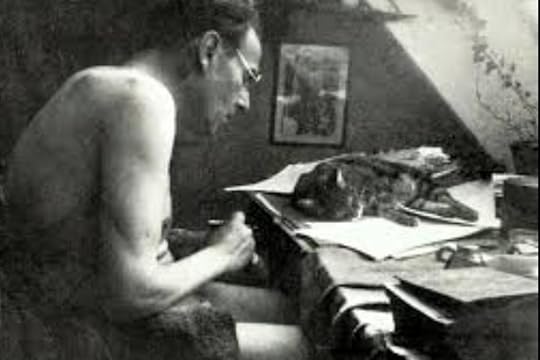
[Céline und Kater Bébert im Exil in Kopenhagen]
Diesmal kreuz und quer durch's zerbombte Deutschland, Rostock, Berlin, Hamburg, runter bis nach Ulm und wieder rauf, bei Flensburg über die Grenze, dann Kopenhagen … Céline auf Krücken, seine Frau Lili, Kater Bébert in seiner Tasche und La Vigue … auf Zügen, alles schwarz von Ruß … ttscht, ttscht, von einem Bahnhof zum anderen … von vielen nur zwei, drei Gleise übrig … auf offenen Plattformen, in Fischzügen, Leprazügen, eingesperrt in Packwagons … manchmal zu Fuss auf den Gleisen, von einer Schwelle zur anderen … Ruinen, Brände, blaue Flämmchen auf den Trümmerhaufen … die Festungen werfen Bomben ab, wroum! flüssiger Phosphor, alles in Flammen … wozu noch? ist ja schon alles im Arsch … Armageddon … Endzeit …
Stilistisch wie gehabt ... der Text springt einem ins Gesicht … Spratz! … rotzfrech, direkt, chaotisch, ohne Rücksicht auf nichts ... großer Abschluss eines apokalyptischen Triptychons ...
Céline hat das Manuskript am Morgen des 2. Juli 1961 fertiggestellt und ist am Abend desselben Tages verstorben. Mein Review zu "Von einem Schloß zum anderen" passt auch hier. Mehr gibt's nicht zu sagen.
[Céline und Kater Bébert im Exil in Kopenhagen]

May 23, 2019
کپشن طولانیِ یک پیرمرد، راستش رو بگم، خیلی جاها دیگه حوصلهی آدم رو سر میبره، از بعضی قسمتهای کتاب این به فکرم میرسید که سلین وقتی پیر شد، دیگه چزی جز غر زدن به جون این و اون نداشت. یعنی بعد مرگ قسطی و سفر به انتهای شب و دسته دلقکها، دیگه چیزی نداشت بگه، یک مشتی غر مونده بود رو دستش...

May 28, 2012
Céline completed this final instalment in his trilogy a day before his death . . . so much for that happy retirement . . . this book (and apparently all of his novels) have a fragmented nouveau roman approach: breaking the text into unpunctuated sentences connected via ellipses . . . like this . . . and this . . . to convey the flow of thoughts and speech . . . and to do away with that bothersome process of having to . . . you know . . . polish really good sentences . . . if only Updike had done this! . . . oh he also uses exclamation points more than is healthy! . . . because Céline was not healthy! . . . he was possibly a crazy man! . . . and this book certainly doesn’t help dispel that notion! . . . I should have started with Journey to the End of the Night . . . but this was a mordantly funny and digressive . . . obviously . . . story of how the author fled to Denmark following the war . . . during which he was a Nazi sympathiser . . . as you do . . . and the more I write like this, the easier it seems to be . . . so I am less convinced Céline was a great artist . . . I suppose I should read Journey first . . . did you know if you space you ellipses . . . the way they do in novels . . . that counts as three separate words on Microsoft Word count!? . . . ooh an interrobang . . . a little tip there for students struggling to make up the word count . . . this review was sponsored by Bob’s Periods . . . dotty since 1987!

May 17, 2021
سلین ،متعهد ترین!
در واقع شاید این اثر رو بشه بازآفرینی دوباره سفر به انتهای شب و مرگ قسطی دانست
فقط حیف از شمال که ترجمه ناقص داره و این سگانه رو خراب کرده.
ریگودون نوعی رمان-زندگینامه هستند. این اثر یک گزارش و یک وقایعنامه است. سلین چندین بار در طی آن اشاره میکند که من در حال گزارش کردن وقایعی هستم که به چشم خودم دیدهام. مدام خوانندگان کتابش را به طور مستقیم خطاب قرار میدهد و میگوید که میداند آنها برای خواندن داستان این کتاب را دستشان گرفتهاند. او اما هیچوقت به دنبال داستان پر از حادثه نبوده و همیشه با تکنیک تکگویی و با راوی اول شخص روایتگر احساسات است؛ همچنان که در اضلاع دیگر تریلوژیاش یعنی «شمال» و «قصر به قصر».
حدستان درست است، من اصلا میل ندارم دلتان را به رحم بیاورم… تا همین الانش چهار کتاب در مورد بدبختیها و مصیبتهایم به شما اختصاص دادهام! باید کمی ملاحظهتان را بکنم… تا حالا شده گهگداری رنج کشیده باشید؟ … یک جورهایی! … هزار بار بدترش را من کشیدهام… اما با متانت بیشتر، فرقش این است! از این بابت شما هیچچیزی را بروز نمیدهید، دریغ از یک آه! نکبتهای بینزاکت! دست از سرم بردارید!
ریگودون، صفحه ۲۸۵
قطعا یکی از سختترین کارها، نوشتن دربارهی «لویی فردینان سلین» است. نویسندهای فرانسوی که پزشک بود و در میان دو جنگ جهانی میزیست. شاید هیچکدام از نویسندگان قرن بیستم مانند سلین هر دو جنگ را ندیده باشند. و البته فقط دیدن که نه، تجربه کرده باشد. سلین از آن نویسندههای بیرون از گود نیست. او وسط تمام ماجراهایی است که نوشته. همین هم خواندن آثارش را خوفناکتر و آزاردهندهتر میکند. آدمِ قبل از سلین خواندن با آدمِ بعد از آن یکی نیست. یک چیزی توی این آدم عوض میشود. آثارش فراموش نمیشود و اگر بشود، به سختی ممکن است! چرا که او در صدد تعریف کردن ماجرا نیست و همانطور که خودش اذعان داشته، بیشتر در پی انتقال حس است. افعال برایش اهمیت ندارد. کتابهایش پر از جملات ناتمام است که با {… } تمام شدهاند.
او را احیاکنندهی زبان فرانسه میدانند. حتی دشمنانش که کم هم نیستند، معترفاند که او یکی از بزرگترین نویسندههای معاصر فرانسه است. او نویسندهای بود که با زبان شفاهی و عامیانه و نامتعارفی مینوشت که خود در رمان مرگ قسطی در توضیح آن میگوید: «تمام تقلایی که میکنم برای این است که به همان زبانی بنویسم که با آن حرف میزنیم. چون که کاغذ، کلام را بد ضبط میکند. همه مسئله این است… رسیدن به عصاره زبان… به نظر من این تنها شیوه بیان حس و عاطفه است. چیزی که من میخواهم، روایتگری نیست، انتقال احساس است.»
او تنهاترین نویسندهی جهان است. حداقل در دوران زنده بودنش که به جز تنها بودن، مطرود و مورد نفرت هم بود. سلین موی دماغ همه بود؛ دست راستیها و دست چپیها. مردمگریز و یا حتی مردمستیز که با هیچ گروهی از در دوستی وارد نمیشد. او چیزهایی را مینویسد که بقیه علاقهای ندارند بدانند یا بخوانند. نویسندهای که در ریگودون، آخرین اثر خود، خودش را اینچنین معرفی میکند: «من، وقایعنگار دلقکهای بزرگم.»
ریگودون یک رمان نیست. همچنان که باقی آثار سلین هم نوعی رمان-زندگینامه هستند. این اثر یک گزارش و یک وقایعنامه است. سلین چندین بار در طی آن اشاره میکند که من در حال گزارش کردن وقایعی هستم که به چشم خودم دیدهام. مدام خوانندگان کتابش را به طور مستقیم خطاب قرار میدهد و میگوید که میداند آنها برای خواندن داستان این کتاب را دستشان گرفتهاند. او اما هیچوقت به دنبال داستان پر از حادثه نبوده و همیشه با تکنیک تکگویی و با راوی اول شخص روایتگر احساسات است. آثارش پرند از واکاوهای عمیق و روانشناسانهی تیپهای شخصیتی مختلف؛ همچنان که در ریگودون و اضلاع دیگر تریلوژیاش یعنی شمال و قصر به قصر.
این سه اثر شخصیتهای ثابتی دارند. خود دکتر سلین، همسرش لیلی، گربهاش بِبِر و بازیگری به نام لوویگان. باقی افراد تیپهای مفلوک و اجساد و زخمیها و آوارگان جنگند که به عنوان سیاهی لشگر حضور دارند. ریگودون، روایتِ سفر سلین با همسفرانش از دلِ آلمانِ ۱۹۴۵ به مقصد دانمارک است. او در یکی از نامههایی که از زندان برای همسرش نوشته است، میگوید که در اصل برای درمان به کپنهاگ سفر میکنند. اما او در آنجا ماندگار میشود و به زندان میافتد. در پاریس او را محاکمه کردهاند و حتی به مرگ محکوم شده. به اتهام همدستی با نازیها که البته از این اتهام تبرئه میشود. حدوداً سه سال در کپنهاگ زندانی بوده و بعد از آن به پاریس برمیگردد. قبل از وارد شدن سلین و همسرش به دانمارک در هجدهم مارس ۱۹۴۵، تمام کتابهای او به دستور وزارت جنگ فرانسه جمع میشوند و حتی ناشر آثار سلین همان سال در پاریس به قتل میرسد.
سلین کسی بود که در جنگ اول جهانی، ۷۵ درصد سلامتیاش را از دست داده بود و به عنوان پزشک در جامعهی ملل آن سالها خدمت کرده بود. فرانسوا ژیبو؛ وکیل و نویسندهی فرانسوی که چندین اثر دربارهی سلین دارد و هم ریگودون را از روی دستنوشتههای سلین به دست چاپ میسپارد و هم نامههای زندان او را ویرایش کرده، در مورد سلین مینویسد: «او خود را قربانی کفاره جهانی میدانست که در آن گروهی مسبب تمام جنایات و گروهی دیگر سالوس و ریاکار بودند.» مهمترین دلیل اتهاماتی که به سلین وارد شد به خاطر جزوهای با عنوان «هیچوپوچ برای یک کشتار» بود که او در آن در ضدیت با قوم یهود، مطالبی نگاشته بود. ژیبو معتقد است: «با بر ملا شدنِ آنچه در آلمان در حال تکوین بود، آن جزوهها چهرهای واقعی و تراژیک یافتند که تا آن زمان نه هیچکس آن را کشف کرده بود و نه پیشتر توجه کرده بود… پس از افتادن پردهها و آشکار شدن فجایعی که اینک بر همگان روشن شده بود، این بهانه واهی که او یکی از زمینهسازان این قتلعامها بوده است، دستاویز جناحی قرار گرفت که هدفشان تنها شکار او بود.»
بههرحال با نویسندهای طرفیم که همه بر علیه او هستند. پیامبرِ افشاگرِ زشتیها و درندهخوییها و دغلبازیها، کسی که بیش از همه از استثمار فقرا توسط اغنیا و بهرهکشی از آنان در عذاب است. آنارشیستی که همزمان مردمستیز و دلسوز آنان بود و جایی در سفر به انتهای شب از خود میپرسد که آیا هنوز توانایی همدردی دارد؟ «من عذاب میکشیدم، عذاب واقعی، برای یک بار هم که شده، برای همه، برای خودم، برای او، برای همه انسانها.»
او از رذل بودن انسانها مینویسد. از دنیایی رو به نزول، از آدمهایی که رذلاند اما درد دارند و رنج میبرند. و در این ایدهها تا جایی پیش میرود که ریگودون را به حیوانات تقدیم میکند. همچنان که بیشتر عمر خود را با همسر مهربانش، گربهاش و چند حیوان و پرندهی دیگری که نگهداری میکرد، سر میکند و در انزوای کامل میمیرد.
ریگودون با توصیف هجوم خبرنگاران و ژورنالیستهایی به خانهی سلین آغاز میشود که در پی سوژهکردن و تمسخر او هستند تا مطبوعات را از مزخرفاتشان سیاه کنند. و سلین تمامی آنها را دست میاندازد. میگویند سلین به سرعت و با علمِ به اینکه به زودی مرگش فرا میرسد، به نوشتن این کتاب مشغول بوده و درست شبِ روزی که همسرش را از اتمام کارش آگاه میکند، از دنیا میرود. او فرصتی برای بازبینی یا بازنویسی اثر نداشته و اثرش هفت سال بعد از مرگ نویسنده در اختیار خوانندگان قرار میگیرد.
کتاب بیانیهای است برای اعلام برائت از تهمتهایی که به او زده بودند. توضیح و تشریح اروپای تکهتکه شده و پردهبرداری از جنایات عریان جنگ است و تنازع رقتانگیز مردم برای بقا. تشریح جزء به جزء فلاکت و آوارگیهایی که سیاستمداران بر سر مردمشان آوردهاند. مردمی که یا توسط متفقین بمباران میشوند یا توسط نازیها منهدم. او از پوچی جنگ میگوید و محشر کبری را توصیف میکند. جهنمی که اروپاییها به جان خودشان انداختهاند و سلین گزارشگر آن نمایش غمانگیز و مضحک است.
آنها در مسیر سفر یا فرارشان از آلمان همهجور آدمی میبینند. اروپاییهای مناطق مختلف این قاره؛ ایتالیاییها و لهستانیها و مجارستانیها و … فرقی ندارد چه کسی دشمن و چه کسی دوست است. حق و باطلی آنجا مشخص نیست. از همه طرف مردم را میکشند. فرقی ندارد چه جور مردمی. جذامیانی که به حال خودشان رها شدهاند تا کسی به فریادشان برسد، کودکان عقبماندهی ذهنی که از پناهگاهها بیرون شدهاند تا به جایی تحویل داده شوند و زنی که آنها را به زور تحویل گرفته، در میانهی راه، آنها را به سلین میسپارد.
سلینی که خود بیمار است و با عصاهایش راه میرود. علاوه بر این در میانهی راه، ساختمانی در اثر انفجاری فرو میریزد و پاره آجری توی سرش میخورد و او را بیهوش میکند. وز وز گوشهای او باز شروع میشود. صدایی که در رمانهای دیگرش هم از آن نوشته؛ یادگاری جنگ اول. پس از آن ضربهی آجر است که سلین گیج و منگ و پریشاناحوال میشود و مدام هذیان میگوید.
ریگودون هذیانوار روایت میشود، چیزی شبیه کابوسی که تمامی ندارد. دکتر سلین همزمان وظیفهی نگهداری از آن بچههای بینوا را دارد که هیچوقت فرصت نمیشود آنها را بشمارد. بعد از آن ضربه است که سلین در لحظات عجیبی خندهاش میگیرد. از تمامی وضعیتی که در آن گرفتارند خندهاش میگیرد و نمیتواند جلوی خندهاش را بگیرد. انگار که این همان خندهی تلخ و طنز جانکاهی است که سلین در این اثر و بقیهی آثارش هم دارد.
خندهای عصبی در زشتترین صحنهها، وضعیتی که تودهای گندیده و گرسنه و زخمی در آن اسیر شرارتها و بازیچهی دولتها هستند. او با آنها همدلی نمیکند. میهنپرستی در این وضعیت جایی ندارد. از مفهوم جنگ تقدسزدائی میکند و به بیان درد جماعتی میپردازد که با آنها همدلی نمیکند. سلین میل به شر در انسان را مسئلهای بیولوژیک میداند که این مسلماً به پزشک بودنش مربوط است. از میل به کشتن و مردن همزمان با میل به زندگی مینویسد. شاید به قول مهدی سحابی، مترجم آثار سلین، او با واقعیت نوعی برخورد بالینی دارد. همان صراحت و خونسردی پزشک وقتی که دندان پوسیده یا زخم را وارسی میکند. و این نوع برخورد ضروری و اجتنابناپذیر است. آثار سلین موسیقیهای گوشخراشند که با صمیمیت و صداقت ساخته میشوند.
علاوه بر این همه، ریگودون شرح پیشبینیهای بدبینانهی سلین هم هست. از نابودی نژاد سفید میگوید. از اروپایی که به دست چینیها خواهد افتاد و سفیدپوستان؛ استثمارگران گذشته، مغلوب نژادهای سرخ و سیاه و زرد خواهند شد. او جنگ بعدی را جنگ نژادها میداند و معتقد است که در نبرد استالینگراد قال تمدن سفید کنده شد. آثار سلین و به ویژه ریگودون پر از مرگ است اما کمی هم بوی زندگی میدهد. حیف که نمیتوانم آن صحنهی عجیب و زیبای آخر کتاب را لو بدهم! همینقدر بگویم که در فصل آخر سلین احساس میکند دیگر کافیست. او در ادبیات از سفر آغاز میکند و با سفر تمام: «چاره را در آن دیدم که از سفر صحبت کنم، چون که یک تاریخ را روایت میکند و هرچه بعد از آن نوشته شده، چیزی جز تقلیدهای تأثرانگیز و چرتوپرتهای آبکی نیست.»
ریگودون (فرانسوی: Rigodon) رمانی که پس از مرگ سلین در سال 1969 منتشر شد. این داستان براساس فرار سلین از فرانسه به دانمارک پس از حمله ی نرماندی است ، پس از آنکه وی با رژیم ویشی همکاری کرده است. ریگودون سومین قسمت از یک سه گانه درباره این تجربیات است. پیش از آن از سلین قصر به قصر را در1957 و شمال را درسال 1960 نوشته است. در واقع ریگودون چیزی بین رمان و خودزندگینامه است. سلین این کتاب را یک روز قبل از مرگ خود در سال 1961 به پایان می رساند و در آن به فاجعه جنگ و پیامدهای آن می پردازد. ریگودون درباره پرواز وی و همسرش از ویشی فرانسه به دانمارک بخاطر فروپاشی رایش سوم است ، زیرا آنها به شکا ناامیدانه به دنبال جلوگیری از مجازات شدنشان به عنوان همکاران حزب نازی هستند. گاهی خنده دار و همیشه عصبانی ، راوی اول شخص ، همراه با همسر و گربه شان، پس از آنکه خود در را در سمت بازنده ی جنگ جهانی دوم می یابند خواننده را با خود در پرواز از پاریس به دانمارک می برند. قطار سواری هایی که رمان را در بر می گیرند پرند از جنون و رحمت ... سلین کاملا آگاهانه باعث می شود وحشت غیرقابل اجتناب و آشوبی بی پایان را حس کنیم.
در واقع شاید این اثر رو بشه بازآفرینی دوباره سفر به انتهای شب و مرگ قسطی دانست
فقط حیف از شمال که ترجمه ناقص داره و این سگانه رو خراب کرده.
ریگودون نوعی رمان-زندگینامه هستند. این اثر یک گزارش و یک وقایعنامه است. سلین چندین بار در طی آن اشاره میکند که من در حال گزارش کردن وقایعی هستم که به چشم خودم دیدهام. مدام خوانندگان کتابش را به طور مستقیم خطاب قرار میدهد و میگوید که میداند آنها برای خواندن داستان این کتاب را دستشان گرفتهاند. او اما هیچوقت به دنبال داستان پر از حادثه نبوده و همیشه با تکنیک تکگویی و با راوی اول شخص روایتگر احساسات است؛ همچنان که در اضلاع دیگر تریلوژیاش یعنی «شمال» و «قصر به قصر».
حدستان درست است، من اصلا میل ندارم دلتان را به رحم بیاورم… تا همین الانش چهار کتاب در مورد بدبختیها و مصیبتهایم به شما اختصاص دادهام! باید کمی ملاحظهتان را بکنم… تا حالا شده گهگداری رنج کشیده باشید؟ … یک جورهایی! … هزار بار بدترش را من کشیدهام… اما با متانت بیشتر، فرقش این است! از این بابت شما هیچچیزی را بروز نمیدهید، دریغ از یک آه! نکبتهای بینزاکت! دست از سرم بردارید!
ریگودون، صفحه ۲۸۵
قطعا یکی از سختترین کارها، نوشتن دربارهی «لویی فردینان سلین» است. نویسندهای فرانسوی که پزشک بود و در میان دو جنگ جهانی میزیست. شاید هیچکدام از نویسندگان قرن بیستم مانند سلین هر دو جنگ را ندیده باشند. و البته فقط دیدن که نه، تجربه کرده باشد. سلین از آن نویسندههای بیرون از گود نیست. او وسط تمام ماجراهایی است که نوشته. همین هم خواندن آثارش را خوفناکتر و آزاردهندهتر میکند. آدمِ قبل از سلین خواندن با آدمِ بعد از آن یکی نیست. یک چیزی توی این آدم عوض میشود. آثارش فراموش نمیشود و اگر بشود، به سختی ممکن است! چرا که او در صدد تعریف کردن ماجرا نیست و همانطور که خودش اذعان داشته، بیشتر در پی انتقال حس است. افعال برایش اهمیت ندارد. کتابهایش پر از جملات ناتمام است که با {… } تمام شدهاند.
او را احیاکنندهی زبان فرانسه میدانند. حتی دشمنانش که کم هم نیستند، معترفاند که او یکی از بزرگترین نویسندههای معاصر فرانسه است. او نویسندهای بود که با زبان شفاهی و عامیانه و نامتعارفی مینوشت که خود در رمان مرگ قسطی در توضیح آن میگوید: «تمام تقلایی که میکنم برای این است که به همان زبانی بنویسم که با آن حرف میزنیم. چون که کاغذ، کلام را بد ضبط میکند. همه مسئله این است… رسیدن به عصاره زبان… به نظر من این تنها شیوه بیان حس و عاطفه است. چیزی که من میخواهم، روایتگری نیست، انتقال احساس است.»
او تنهاترین نویسندهی جهان است. حداقل در دوران زنده بودنش که به جز تنها بودن، مطرود و مورد نفرت هم بود. سلین موی دماغ همه بود؛ دست راستیها و دست چپیها. مردمگریز و یا حتی مردمستیز که با هیچ گروهی از در دوستی وارد نمیشد. او چیزهایی را مینویسد که بقیه علاقهای ندارند بدانند یا بخوانند. نویسندهای که در ریگودون، آخرین اثر خود، خودش را اینچنین معرفی میکند: «من، وقایعنگار دلقکهای بزرگم.»
ریگودون یک رمان نیست. همچنان که باقی آثار سلین هم نوعی رمان-زندگینامه هستند. این اثر یک گزارش و یک وقایعنامه است. سلین چندین بار در طی آن اشاره میکند که من در حال گزارش کردن وقایعی هستم که به چشم خودم دیدهام. مدام خوانندگان کتابش را به طور مستقیم خطاب قرار میدهد و میگوید که میداند آنها برای خواندن داستان این کتاب را دستشان گرفتهاند. او اما هیچوقت به دنبال داستان پر از حادثه نبوده و همیشه با تکنیک تکگویی و با راوی اول شخص روایتگر احساسات است. آثارش پرند از واکاوهای عمیق و روانشناسانهی تیپهای شخصیتی مختلف؛ همچنان که در ریگودون و اضلاع دیگر تریلوژیاش یعنی شمال و قصر به قصر.
این سه اثر شخصیتهای ثابتی دارند. خود دکتر سلین، همسرش لیلی، گربهاش بِبِر و بازیگری به نام لوویگان. باقی افراد تیپهای مفلوک و اجساد و زخمیها و آوارگان جنگند که به عنوان سیاهی لشگر حضور دارند. ریگودون، روایتِ سفر سلین با همسفرانش از دلِ آلمانِ ۱۹۴۵ به مقصد دانمارک است. او در یکی از نامههایی که از زندان برای همسرش نوشته است، میگوید که در اصل برای درمان به کپنهاگ سفر میکنند. اما او در آنجا ماندگار میشود و به زندان میافتد. در پاریس او را محاکمه کردهاند و حتی به مرگ محکوم شده. به اتهام همدستی با نازیها که البته از این اتهام تبرئه میشود. حدوداً سه سال در کپنهاگ زندانی بوده و بعد از آن به پاریس برمیگردد. قبل از وارد شدن سلین و همسرش به دانمارک در هجدهم مارس ۱۹۴۵، تمام کتابهای او به دستور وزارت جنگ فرانسه جمع میشوند و حتی ناشر آثار سلین همان سال در پاریس به قتل میرسد.
سلین کسی بود که در جنگ اول جهانی، ۷۵ درصد سلامتیاش را از دست داده بود و به عنوان پزشک در جامعهی ملل آن سالها خدمت کرده بود. فرانسوا ژیبو؛ وکیل و نویسندهی فرانسوی که چندین اثر دربارهی سلین دارد و هم ریگودون را از روی دستنوشتههای سلین به دست چاپ میسپارد و هم نامههای زندان او را ویرایش کرده، در مورد سلین مینویسد: «او خود را قربانی کفاره جهانی میدانست که در آن گروهی مسبب تمام جنایات و گروهی دیگر سالوس و ریاکار بودند.» مهمترین دلیل اتهاماتی که به سلین وارد شد به خاطر جزوهای با عنوان «هیچوپوچ برای یک کشتار» بود که او در آن در ضدیت با قوم یهود، مطالبی نگاشته بود. ژیبو معتقد است: «با بر ملا شدنِ آنچه در آلمان در حال تکوین بود، آن جزوهها چهرهای واقعی و تراژیک یافتند که تا آن زمان نه هیچکس آن را کشف کرده بود و نه پیشتر توجه کرده بود… پس از افتادن پردهها و آشکار شدن فجایعی که اینک بر همگان روشن شده بود، این بهانه واهی که او یکی از زمینهسازان این قتلعامها بوده است، دستاویز جناحی قرار گرفت که هدفشان تنها شکار او بود.»
بههرحال با نویسندهای طرفیم که همه بر علیه او هستند. پیامبرِ افشاگرِ زشتیها و درندهخوییها و دغلبازیها، کسی که بیش از همه از استثمار فقرا توسط اغنیا و بهرهکشی از آنان در عذاب است. آنارشیستی که همزمان مردمستیز و دلسوز آنان بود و جایی در سفر به انتهای شب از خود میپرسد که آیا هنوز توانایی همدردی دارد؟ «من عذاب میکشیدم، عذاب واقعی، برای یک بار هم که شده، برای همه، برای خودم، برای او، برای همه انسانها.»
او از رذل بودن انسانها مینویسد. از دنیایی رو به نزول، از آدمهایی که رذلاند اما درد دارند و رنج میبرند. و در این ایدهها تا جایی پیش میرود که ریگودون را به حیوانات تقدیم میکند. همچنان که بیشتر عمر خود را با همسر مهربانش، گربهاش و چند حیوان و پرندهی دیگری که نگهداری میکرد، سر میکند و در انزوای کامل میمیرد.
ریگودون با توصیف هجوم خبرنگاران و ژورنالیستهایی به خانهی سلین آغاز میشود که در پی سوژهکردن و تمسخر او هستند تا مطبوعات را از مزخرفاتشان سیاه کنند. و سلین تمامی آنها را دست میاندازد. میگویند سلین به سرعت و با علمِ به اینکه به زودی مرگش فرا میرسد، به نوشتن این کتاب مشغول بوده و درست شبِ روزی که همسرش را از اتمام کارش آگاه میکند، از دنیا میرود. او فرصتی برای بازبینی یا بازنویسی اثر نداشته و اثرش هفت سال بعد از مرگ نویسنده در اختیار خوانندگان قرار میگیرد.
کتاب بیانیهای است برای اعلام برائت از تهمتهایی که به او زده بودند. توضیح و تشریح اروپای تکهتکه شده و پردهبرداری از جنایات عریان جنگ است و تنازع رقتانگیز مردم برای بقا. تشریح جزء به جزء فلاکت و آوارگیهایی که سیاستمداران بر سر مردمشان آوردهاند. مردمی که یا توسط متفقین بمباران میشوند یا توسط نازیها منهدم. او از پوچی جنگ میگوید و محشر کبری را توصیف میکند. جهنمی که اروپاییها به جان خودشان انداختهاند و سلین گزارشگر آن نمایش غمانگیز و مضحک است.
آنها در مسیر سفر یا فرارشان از آلمان همهجور آدمی میبینند. اروپاییهای مناطق مختلف این قاره؛ ایتالیاییها و لهستانیها و مجارستانیها و … فرقی ندارد چه کسی دشمن و چه کسی دوست است. حق و باطلی آنجا مشخص نیست. از همه طرف مردم را میکشند. فرقی ندارد چه جور مردمی. جذامیانی که به حال خودشان رها شدهاند تا کسی به فریادشان برسد، کودکان عقبماندهی ذهنی که از پناهگاهها بیرون شدهاند تا به جایی تحویل داده شوند و زنی که آنها را به زور تحویل گرفته، در میانهی راه، آنها را به سلین میسپارد.
سلینی که خود بیمار است و با عصاهایش راه میرود. علاوه بر این در میانهی راه، ساختمانی در اثر انفجاری فرو میریزد و پاره آجری توی سرش میخورد و او را بیهوش میکند. وز وز گوشهای او باز شروع میشود. صدایی که در رمانهای دیگرش هم از آن نوشته؛ یادگاری جنگ اول. پس از آن ضربهی آجر است که سلین گیج و منگ و پریشاناحوال میشود و مدام هذیان میگوید.
ریگودون هذیانوار روایت میشود، چیزی شبیه کابوسی که تمامی ندارد. دکتر سلین همزمان وظیفهی نگهداری از آن بچههای بینوا را دارد که هیچوقت فرصت نمیشود آنها را بشمارد. بعد از آن ضربه است که سلین در لحظات عجیبی خندهاش میگیرد. از تمامی وضعیتی که در آن گرفتارند خندهاش میگیرد و نمیتواند جلوی خندهاش را بگیرد. انگار که این همان خندهی تلخ و طنز جانکاهی است که سلین در این اثر و بقیهی آثارش هم دارد.
خندهای عصبی در زشتترین صحنهها، وضعیتی که تودهای گندیده و گرسنه و زخمی در آن اسیر شرارتها و بازیچهی دولتها هستند. او با آنها همدلی نمیکند. میهنپرستی در این وضعیت جایی ندارد. از مفهوم جنگ تقدسزدائی میکند و به بیان درد جماعتی میپردازد که با آنها همدلی نمیکند. سلین میل به شر در انسان را مسئلهای بیولوژیک میداند که این مسلماً به پزشک بودنش مربوط است. از میل به کشتن و مردن همزمان با میل به زندگی مینویسد. شاید به قول مهدی سحابی، مترجم آثار سلین، او با واقعیت نوعی برخورد بالینی دارد. همان صراحت و خونسردی پزشک وقتی که دندان پوسیده یا زخم را وارسی میکند. و این نوع برخورد ضروری و اجتنابناپذیر است. آثار سلین موسیقیهای گوشخراشند که با صمیمیت و صداقت ساخته میشوند.
علاوه بر این همه، ریگودون شرح پیشبینیهای بدبینانهی سلین هم هست. از نابودی نژاد سفید میگوید. از اروپایی که به دست چینیها خواهد افتاد و سفیدپوستان؛ استثمارگران گذشته، مغلوب نژادهای سرخ و سیاه و زرد خواهند شد. او جنگ بعدی را جنگ نژادها میداند و معتقد است که در نبرد استالینگراد قال تمدن سفید کنده شد. آثار سلین و به ویژه ریگودون پر از مرگ است اما کمی هم بوی زندگی میدهد. حیف که نمیتوانم آن صحنهی عجیب و زیبای آخر کتاب را لو بدهم! همینقدر بگویم که در فصل آخر سلین احساس میکند دیگر کافیست. او در ادبیات از سفر آغاز میکند و با سفر تمام: «چاره را در آن دیدم که از سفر صحبت کنم، چون که یک تاریخ را روایت میکند و هرچه بعد از آن نوشته شده، چیزی جز تقلیدهای تأثرانگیز و چرتوپرتهای آبکی نیست.»
ریگودون (فرانسوی: Rigodon) رمانی که پس از مرگ سلین در سال 1969 منتشر شد. این داستان براساس فرار سلین از فرانسه به دانمارک پس از حمله ی نرماندی است ، پس از آنکه وی با رژیم ویشی همکاری کرده است. ریگودون سومین قسمت از یک سه گانه درباره این تجربیات است. پیش از آن از سلین قصر به قصر را در1957 و شمال را درسال 1960 نوشته است. در واقع ریگودون چیزی بین رمان و خودزندگینامه است. سلین این کتاب را یک روز قبل از مرگ خود در سال 1961 به پایان می رساند و در آن به فاجعه جنگ و پیامدهای آن می پردازد. ریگودون درباره پرواز وی و همسرش از ویشی فرانسه به دانمارک بخاطر فروپاشی رایش سوم است ، زیرا آنها به شکا ناامیدانه به دنبال جلوگیری از مجازات شدنشان به عنوان همکاران حزب نازی هستند. گاهی خنده دار و همیشه عصبانی ، راوی اول شخص ، همراه با همسر و گربه شان، پس از آنکه خود در را در سمت بازنده ی جنگ جهانی دوم می یابند خواننده را با خود در پرواز از پاریس به دانمارک می برند. قطار سواری هایی که رمان را در بر می گیرند پرند از جنون و رحمت ... سلین کاملا آگاهانه باعث می شود وحشت غیرقابل اجتناب و آشوبی بی پایان را حس کنیم.

February 2, 2013
[In a second read in 2022 (actually, a third read — as I had read this as a youth), these books did not have the same effect on me.]
It is, shockingly, this trilogy of 'flight' -- and not Voyage or even Mort -- that is, in my opinion, Céline's true masterpiece.... just stunning.... and of these, Rigadoon is the greatest of the triad.
It is, shockingly, this trilogy of 'flight' -- and not Voyage or even Mort -- that is, in my opinion, Céline's true masterpiece.... just stunning.... and of these, Rigadoon is the greatest of the triad.

April 10, 2021
آخرین اثر عالیجناب... پیرمرد میداند به آخر خط رسیده... و کتاب را از تمام غرهای باقیمانده اش پر کرده... سلین درباره ی سفرش از فرانسه به دانمارک نوشته... در این سفر زنش و گربه اش را به خود همراه کرده... پیرمرد مدام غر میزند... مینالد... خاطرات پراکنده تعریف میکند... از موضوع دور میشود... برمیگردد... آشفته است... خسته... اما ادامه میدهد... تا جون داره میره... شما رو هم با خودش میکشونه... مثل همه ی کسایی که تو این کتاب دنبالش راه می افتن اما وسط راه به هر دلیلی دکتر رو ول میکنن و میرن دنبال کار خودشون... اما شما این کارو نمیکنید... هرچقدرم بعضی جاها از پیرمرد خسته بشین و کسلتون کنه باز هم مثل یه گربه ی دست آموز دنبالش راه می افتین و اونو تنها نمیذارین... نه... شما از اون کسایی نیستین که بتونین دکتر دتوش پیر رو تنها بذارین... اونم شما رو ول نمیکنه... مثل ون بچه هایی که نصف کتاب دنیالش خودش میکشونه تا برسونتشون به یه جای امن و هرچند بی توجهه بهشون اما بازم هواشون رو داره... هوای مشا رو هم داره... خیلی سعی میکنه که چیزی رو که میخواین بشنوید رو بهتون بگه... اما خاطرات و سختی های یه عمر رو بدون منحرف شدن نمیشه تحمل کرد... پس از همه چی میگه و با اون دوتا عصا و پای لنگش پیش رفتن سخته... ولی همیشه در حال پیش روی... زنده باد عالیجناب سلین...
کتاب اگه با نثر سلین آشنا نباشید شاید اذیتتون کنه، اما با تمام پریشان گوییش کتاب شیرینیه، و باید نبض کتاب بیاد توی دستتون تا بتونید ازش لذت ببرید... از سلین پیر غرغرو
ترجمه بدی نداره، بعضی جاها ممکنه گیجتون کنه که نمیشه گفت به خاطر نثر سلینه یا اینکه مترجم نتونسته از پس متن و انتقال مفهوم بر بیاد... کلی ایراد ویرایشی هم توی کتاب پیدا میشه که... چه میشه ناشرای ما هم مثل ناشرایی که با سلین کار میکردن فقط دنبال پولن و خواننده رو زیاد به جاییشون نمیگیرن
کتاب اگه با نثر سلین آشنا نباشید شاید اذیتتون کنه، اما با تمام پریشان گوییش کتاب شیرینیه، و باید نبض کتاب بیاد توی دستتون تا بتونید ازش لذت ببرید... از سلین پیر غرغرو
ترجمه بدی نداره، بعضی جاها ممکنه گیجتون کنه که نمیشه گفت به خاطر نثر سلینه یا اینکه مترجم نتونسته از پس متن و انتقال مفهوم بر بیاد... کلی ایراد ویرایشی هم توی کتاب پیدا میشه که... چه میشه ناشرای ما هم مثل ناشرایی که با سلین کار میکردن فقط دنبال پولن و خواننده رو زیاد به جاییشون نمیگیرن

October 6, 2017
Un Céline qui fait date ! Parmi les livres les plus impressionnistes que j'aie lus !
September 23, 2025
I grabbed this because its been on my shelf forever, sitting along another by this author (Death on the Installment Plan) and I’m making some effort to read all my many titles in my lifetime. The only reason I bought this many decades ago is because the French speaking Jack Kerouac adored this author, and I was deeply into the beat writers as a young man in the 1980s. My good friend, who recently deceased, back in the day, concerned with my penchant for “dark” novels exhorted me to be more positive upon seeing the “Death…” title on my (then) limited bookshelves. I miss that friend and reading this now reminds me of him and my personal history that will largely disappear from the earth when my brain is no more or addled beyond recollection.
This book reminds me, yet again, of how I live in such a bubble (for people of means, as Steve Pinker says, this is the best time in history to be alive) that it is nearly impossible to comprehend the horrors of the two great wars in Europe in the first quarter of the nineteenth century, and the pessimistic dread it brought. I know it can happen again, and most assuredly will, but it is all too convenient to bury that thought. The author claims originality, the first to accurately provide a first hand, non-embellished account, of the hell of living in Germany toward the end of the second world war, when most of the cities were a burning pile of rubble, and the people wandering, forever damaged, through this hellscape. Reading a bit of the man’s history, this is largely autobiographical, written 20 years after the actual experience, where he journeyed from Germany to Denmark, encountering frequent bombings as the doctor, his wife and their cat survive by the skin of their teeth in what seems a post-apocalyptic journey through hell.
This account seems hopelessly depressing, but Celine is quite hilarious as he vilifies nearly everyone with biting sarcasm and unvarnished criticism. He’s writing as an old man, and this book was his final one, supposedly finished just days before he passes away in 1969. By then he is claiming his style was largely copied by his competitors, the French “existentialists”, and wallows in self pity that he will be forgotten, and his many enemies have led to his imprisonment and largely destroyed his reputation. But he believes in himself, and his arrogance drives him to shamelessly self-promote, especially his first novel (Journey to the End of the Night) which was widely regarded in its time (this was another autobiographical novel of his travails in the first world war, in which he was severely injured and received a medal of honor). The character in Rigadoon is himself, a physician, older now, seeing the horrors of war played out yet again, but this time he’s a largely disabled with “two canes”, navigating the rubble, tragedies and gross indignities of poverty, to say nothing of a virulent despairing sense of the indignity of being on the wrong side of history. His body is wearing down, yet he captures honestly what it was like to be alive and endure in such horrific conditions. Yet somehow he finds humor, perhaps because it is after the fact. This is what makes the book so remarkable, and it held my interest throughout.
One cannot speak of this author without acknowledging his antisemitic tendencies (though a Frenchman, he wrote pamphlets and sided with the Nazis during the war). He really doesn’t defend this, other than to indicate that history is written by the victors (and one point claiming that Hitler would be celebrated had he won the war, and he came very close). He heaps hatred on socialists and, of course, communists, and decries the “mongrelization” of the white race. It saddens me to consider this idea is still around, nearly a hundred years later, and the “western” culture ideals so grossly contorted. It seems a flaw in our DNA, and the honesty with with this author writes about his beliefs is still important to understand. For some reason “blacks” and “hellows” are the villians to this author, which must mean Africans and Chinese, which surprises me as I thought the fascist government of the Nazis was more concerned with ideology more than the ancient “blood and soil” racism.
p. 144 give us a glimpse of the indescribable horror of a recently bombed city our pilgrims encounter, and the unusual style of writing: “Our last rags and knapsacks had disappeared in the smash up! the cabin! seven hand trucks under the torrents of bricks, two three house fronts and forged dash iron balconies!... oh, moonlight! you'll never see such settings and tragedies in the movies!... much less on the stage! they tell us that Hollywood is dead!... they can say that again! how can the movies deliver after what's happened for real!... which is why I personally can't even look at a photograph! to translate is to betray! Right! to reproduce, to photograph, is to putrefy! instantly! anything that existed makes you sick to look at!”
p. 161, here our aging author’s vitriol boils over, as he rages on his contemporaries: “Our French today, so anemic, so strict and finicky, academic sized almost to death, they'd call me worse names than they do now I don't give a **** it's the end they've hunted me enough, robbed me, locked me up, plagiarized me….”.
p. 169, again he excoriates his contemporaries in literature, showing his flair for artful bile: “I see them every day in the paper, photographed back, front, and profile, so pleased with themselves, moldy flesh, dewlaps, sagging temporals, ripe for vivisection…. so pleased to be getting so much attention, celebrities as admired as the kidnapper of greasy street or superstar brilliant team… formidable governors of something or other period flamboyant Marshalls of blarney… I’d put them all on the slab… let them exhibit their pineals, pancreases, prostates, show us what a disemboweled big mouth looks like inside his true self, his essential nature…”
p. 178, more flamboyant narcissism, perhaps grandly delustional: “What's more, I'll make the rest of them unreadable! … every last one of them!... wilted impotence! rotten with prizes in manifestos!... I can lay my plans in all security, the epic belongs to me!... I am literature's favorite child! Anyone who doesn't imitate me is through”
p. 236, the professional envy continues in increasingly colorful tones: “Ever since journey it's been a scramble. Who could steal more from me, plagiarize more, stuff himself fuller… the whole stinking horde! since 1933, it seems to me, I've been feasting them all, they're at the table, at my table, and always asking for more… and more! They guzzle and swill and they never, never admit it.”
p. 237, here’s an example of how the author appeals directly to us, the reader, apologizing for one his many digressions: “I'm cutting loose again, I'm going to lose you, but I've got a feeling that maybe I'll never finish this book, it's all very well writing a chronicle of exploits that were important 20-30 years ago… but what about the things of today?... everybody in my age group is gone except for a few relics who've lost track, who quibble scribble and shoot the shit from one dribbling rag to the next…”
A final quote from an editor of the aging Celine, illustrating his controversial place in history (note Pleiaden = alien): “Your case is hideous indeed, a semi-living Pleiadian, virtually unknown, except for your abominable past.” Yet here I am reviewing his book many decades hence.
I was surprised to find a receipt buried in this slender paperbook from when I had ordered it from Waldenbooks on 10 Jan 1987 while living in Louisville KY. This proves it has been carted around to Michigan, Illinois and Missouri, finally finding its way into my hands (and now etched in my brain). The pages are yellowing, becoming fragile, and beginning to self-destruct, and not through handling – apparently 38 years is about the natural lifetime of books of this quality (like tombstones, which I’ve noticed are largely illegible after about 100 years). Likely I’m the first and last to read this particular volume. It is a Penguin Book with a forward by Kurt Vonnegut. According to the liner notes, it inspired Gunter Grass, William Burroughs and Norman Mailer. It is truly experimental, in the way it engages the reader directly, as when the author apologizes directly to the reader for repeatedly for digressing and repeating himself over and over. He’s like an elderly gent who can’t get to the point as he pontificates excessively and extricates himself from numerous rabbit holes as he attempts to accurately record the many memories crisscrossing a fevered brain. But he does this with humor and the direct style is appealing. His style is to use “3 dots” to separate his often incomplete sentences, but it is enduringly readable, notwithstanding the many cultural references. One must bear in mind these anecdotes are written in French, and apparently a “low” or slangish form of the language – so the translator had a difficult job making this generally interesting to an English-speaking and non-Francophile readership. But it works, the humor and style are entirely unique and fascinating.
This book reminds me, yet again, of how I live in such a bubble (for people of means, as Steve Pinker says, this is the best time in history to be alive) that it is nearly impossible to comprehend the horrors of the two great wars in Europe in the first quarter of the nineteenth century, and the pessimistic dread it brought. I know it can happen again, and most assuredly will, but it is all too convenient to bury that thought. The author claims originality, the first to accurately provide a first hand, non-embellished account, of the hell of living in Germany toward the end of the second world war, when most of the cities were a burning pile of rubble, and the people wandering, forever damaged, through this hellscape. Reading a bit of the man’s history, this is largely autobiographical, written 20 years after the actual experience, where he journeyed from Germany to Denmark, encountering frequent bombings as the doctor, his wife and their cat survive by the skin of their teeth in what seems a post-apocalyptic journey through hell.
This account seems hopelessly depressing, but Celine is quite hilarious as he vilifies nearly everyone with biting sarcasm and unvarnished criticism. He’s writing as an old man, and this book was his final one, supposedly finished just days before he passes away in 1969. By then he is claiming his style was largely copied by his competitors, the French “existentialists”, and wallows in self pity that he will be forgotten, and his many enemies have led to his imprisonment and largely destroyed his reputation. But he believes in himself, and his arrogance drives him to shamelessly self-promote, especially his first novel (Journey to the End of the Night) which was widely regarded in its time (this was another autobiographical novel of his travails in the first world war, in which he was severely injured and received a medal of honor). The character in Rigadoon is himself, a physician, older now, seeing the horrors of war played out yet again, but this time he’s a largely disabled with “two canes”, navigating the rubble, tragedies and gross indignities of poverty, to say nothing of a virulent despairing sense of the indignity of being on the wrong side of history. His body is wearing down, yet he captures honestly what it was like to be alive and endure in such horrific conditions. Yet somehow he finds humor, perhaps because it is after the fact. This is what makes the book so remarkable, and it held my interest throughout.
One cannot speak of this author without acknowledging his antisemitic tendencies (though a Frenchman, he wrote pamphlets and sided with the Nazis during the war). He really doesn’t defend this, other than to indicate that history is written by the victors (and one point claiming that Hitler would be celebrated had he won the war, and he came very close). He heaps hatred on socialists and, of course, communists, and decries the “mongrelization” of the white race. It saddens me to consider this idea is still around, nearly a hundred years later, and the “western” culture ideals so grossly contorted. It seems a flaw in our DNA, and the honesty with with this author writes about his beliefs is still important to understand. For some reason “blacks” and “hellows” are the villians to this author, which must mean Africans and Chinese, which surprises me as I thought the fascist government of the Nazis was more concerned with ideology more than the ancient “blood and soil” racism.
p. 144 give us a glimpse of the indescribable horror of a recently bombed city our pilgrims encounter, and the unusual style of writing: “Our last rags and knapsacks had disappeared in the smash up! the cabin! seven hand trucks under the torrents of bricks, two three house fronts and forged dash iron balconies!... oh, moonlight! you'll never see such settings and tragedies in the movies!... much less on the stage! they tell us that Hollywood is dead!... they can say that again! how can the movies deliver after what's happened for real!... which is why I personally can't even look at a photograph! to translate is to betray! Right! to reproduce, to photograph, is to putrefy! instantly! anything that existed makes you sick to look at!”
p. 161, here our aging author’s vitriol boils over, as he rages on his contemporaries: “Our French today, so anemic, so strict and finicky, academic sized almost to death, they'd call me worse names than they do now I don't give a **** it's the end they've hunted me enough, robbed me, locked me up, plagiarized me….”.
p. 169, again he excoriates his contemporaries in literature, showing his flair for artful bile: “I see them every day in the paper, photographed back, front, and profile, so pleased with themselves, moldy flesh, dewlaps, sagging temporals, ripe for vivisection…. so pleased to be getting so much attention, celebrities as admired as the kidnapper of greasy street or superstar brilliant team… formidable governors of something or other period flamboyant Marshalls of blarney… I’d put them all on the slab… let them exhibit their pineals, pancreases, prostates, show us what a disemboweled big mouth looks like inside his true self, his essential nature…”
p. 178, more flamboyant narcissism, perhaps grandly delustional: “What's more, I'll make the rest of them unreadable! … every last one of them!... wilted impotence! rotten with prizes in manifestos!... I can lay my plans in all security, the epic belongs to me!... I am literature's favorite child! Anyone who doesn't imitate me is through”
p. 236, the professional envy continues in increasingly colorful tones: “Ever since journey it's been a scramble. Who could steal more from me, plagiarize more, stuff himself fuller… the whole stinking horde! since 1933, it seems to me, I've been feasting them all, they're at the table, at my table, and always asking for more… and more! They guzzle and swill and they never, never admit it.”
p. 237, here’s an example of how the author appeals directly to us, the reader, apologizing for one his many digressions: “I'm cutting loose again, I'm going to lose you, but I've got a feeling that maybe I'll never finish this book, it's all very well writing a chronicle of exploits that were important 20-30 years ago… but what about the things of today?... everybody in my age group is gone except for a few relics who've lost track, who quibble scribble and shoot the shit from one dribbling rag to the next…”
A final quote from an editor of the aging Celine, illustrating his controversial place in history (note Pleiaden = alien): “Your case is hideous indeed, a semi-living Pleiadian, virtually unknown, except for your abominable past.” Yet here I am reviewing his book many decades hence.
I was surprised to find a receipt buried in this slender paperbook from when I had ordered it from Waldenbooks on 10 Jan 1987 while living in Louisville KY. This proves it has been carted around to Michigan, Illinois and Missouri, finally finding its way into my hands (and now etched in my brain). The pages are yellowing, becoming fragile, and beginning to self-destruct, and not through handling – apparently 38 years is about the natural lifetime of books of this quality (like tombstones, which I’ve noticed are largely illegible after about 100 years). Likely I’m the first and last to read this particular volume. It is a Penguin Book with a forward by Kurt Vonnegut. According to the liner notes, it inspired Gunter Grass, William Burroughs and Norman Mailer. It is truly experimental, in the way it engages the reader directly, as when the author apologizes directly to the reader for repeatedly for digressing and repeating himself over and over. He’s like an elderly gent who can’t get to the point as he pontificates excessively and extricates himself from numerous rabbit holes as he attempts to accurately record the many memories crisscrossing a fevered brain. But he does this with humor and the direct style is appealing. His style is to use “3 dots” to separate his often incomplete sentences, but it is enduringly readable, notwithstanding the many cultural references. One must bear in mind these anecdotes are written in French, and apparently a “low” or slangish form of the language – so the translator had a difficult job making this generally interesting to an English-speaking and non-Francophile readership. But it works, the humor and style are entirely unique and fascinating.

July 13, 2014
"No syntax, no style! he doesn't say anything any more! he doesn't dare!"
Ah, the turpitude! that's a shameless lie! . . . I've got oodles of style! . . . that's right! . . . what's more, I'll make the rest of them unreadable! . . . every last one of them! wilted impotents! rotten with prizes and manifestoes! I can lay my plans in all security, the epoch belongs to me! I am Literature's favorite child! anyone who doesn't imitate me is through! . . . no doubt about it! okay, let's see where we are! gutted barrels, flooded terraces and urinals! vast despair! ah, grand crosses of all the Legions, super washouts, eminent jerks! . . . I'd feel sorry for you if I could, but I can't . . . not any more! . . .
The best of Celine's final trilogy... Celine is recruited to take part in a plot at Rommel's funeral... and the famous brick makes its way to the doctor's head! ... of course, this brings back all that 75% disability whining... things really kick into gear when he and Lili end up having to take care of about sixteen children... of course he refuses to count them... my god, what happens... I wouldn't have thought it possible... ...Celine always surprises... He has such a way with words! ... 'you retarded slow-motion primate!' is such a great insult... also he refers to high society as 'names and namesses'... or talks about the religious having 'Christanemic blood'... One of his companions in the present-day narrative tries to convince him to 'go left'... the only way to sell books... remind them of some trifle you've done for the left... all he can think of is his first book's Russian translation... and the reason he wanted to go to Denmark is revealed! ... it's hilarious! ... but then he dies a day after finishing this book...
On being asked to look after orphans:
Ah, the turpitude! that's a shameless lie! . . . I've got oodles of style! . . . that's right! . . . what's more, I'll make the rest of them unreadable! . . . every last one of them! wilted impotents! rotten with prizes and manifestoes! I can lay my plans in all security, the epoch belongs to me! I am Literature's favorite child! anyone who doesn't imitate me is through! . . . no doubt about it! okay, let's see where we are! gutted barrels, flooded terraces and urinals! vast despair! ah, grand crosses of all the Legions, super washouts, eminent jerks! . . . I'd feel sorry for you if I could, but I can't . . . not any more! . . .
The best of Celine's final trilogy... Celine is recruited to take part in a plot at Rommel's funeral... and the famous brick makes its way to the doctor's head! ... of course, this brings back all that 75% disability whining... things really kick into gear when he and Lili end up having to take care of about sixteen children... of course he refuses to count them... my god, what happens... I wouldn't have thought it possible... ...Celine always surprises... He has such a way with words! ... 'you retarded slow-motion primate!' is such a great insult... also he refers to high society as 'names and namesses'... or talks about the religious having 'Christanemic blood'... One of his companions in the present-day narrative tries to convince him to 'go left'... the only way to sell books... remind them of some trifle you've done for the left... all he can think of is his first book's Russian translation... and the reason he wanted to go to Denmark is revealed! ... it's hilarious! ... but then he dies a day after finishing this book...
On being asked to look after orphans:

November 5, 2024
Europe is in ruins ... yet Dr Destouches (Céline), his wife, and the cat Bébert must dance from ruined city to ruined city ... that's what Rigadoon means ... a Baroque dance ... and Céline and his party were shuttled from one bombed out ruin to another ... courtesy of the Nazi government ... until, with Germany's fall imminent ... he is imprisoned in Copenhagen for fourteen months.
Louis-Ferdinand Céline's outrage is expressed with multiple ellipses ... we never hear from Dr D's wife or cat ... but the good Dr has plenty to say ... even when he is beaned by a brick when a building front collapses in Hannover ... he may have been an anti-Semite, but I suspect he was a good doctor ... he guides 18 retarded children through Hamburg to the border, where they are taken over by the Swedish Red Cross.
I might not like Dr D's views on race ... but as a writer, he's unique ... no less than Kurt Vonnegut wrote the intro to this edition ... he wrote:
Louis-Ferdinand Céline's outrage is expressed with multiple ellipses ... we never hear from Dr D's wife or cat ... but the good Dr has plenty to say ... even when he is beaned by a brick when a building front collapses in Hannover ... he may have been an anti-Semite, but I suspect he was a good doctor ... he guides 18 retarded children through Hamburg to the border, where they are taken over by the Swedish Red Cross.
I might not like Dr D's views on race ... but as a writer, he's unique ... no less than Kurt Vonnegut wrote the intro to this edition ... he wrote:
Every writer is in his debt, and so is anyone else interested in discussing lives in their entirety. By being so impolite, he demonstrated that perhaps half of all experience, the animal half, had been concealed by good manners. No honest writer or speaker will ever want to be polite again.So there you have it ... they might be late recognizing your talent, but it is real.

January 20, 2020
اگر چیزی که می خوانی خوب باشد، آدم شروع می کند تعریف و تمجید و در آخر تشکر از مترجم. نمی توانم مطمئن باشم که این خانم یا آقای افتخار به سلین اجحاف کرده یا نه، نمی توانم هم با اطمینان حدس بزنم سلین که خیلی پیر شده دیگر چیزی برایش خنده دار نیست و بدبختی ها فقط دارند سرش می آیند. مثل همه کتاب های قبلی یک جایی حاضرین با هم می روند به گردش، این دفعه به جای پولدارهای صاحب کشتی رودخانه پیما، با بچه های عقب مانده، که آب دهانشان سرازیر است از میان خرابه ها و بمب های فسفری، که برسند به دانمارک. نمیدانم در هیچ کتابی بالاخره میرسد به جایی یا نه سلین. در شمال هم داشت می رفت دانمارک دنبال چیزی بود و آخرش هم پیدا نشد. اینجا هم معلوم نشد. اینجا اما چیزی که عوض شده در مقایسه با کتاب های قبلی که فارسی شده اند، این است که استثنائا پیرمرد منحرف نداریم، یا شاید حذفش کرده اند، از جمله مواردی که آدم نمی تواند دقیق هیچ وقت حدس بزند، چون حوصله می خواهد بروی و کتاب اصلی را بررسی خط به خط کنی، این چیزی که فارسی جلوئت گذاشته اند چه قدرش مال خود سلین است سوال می شود چرا مثل دفعه های پیش کسی نمی رود فحشاخانه برای شلاق خوردن، همه ش را با بمب زده اند یا قوادها صلاح ندانسته اند اطلاع پیدا کنیم از موضوع. این بار کسی برای سلین آنقدر مهم نیست که همهی کُنه و وجودش را تحقیر کند بعد همدلی کند یا همانطور له بگذارد که بماند. همه جا خرابه است، لیلی، زن سلین که در کتاب های قبلی هیچ کار نمی کرد، اینجا گاهی با گربه ور می رود، هیچ کس چیزی نمی گوید و سلین هم دیگر خودش با خودش خیلی حرف نمی زند و جواب هایی که یارو وته دلش منظورداشته را به اطلاع کسی نمی رساند... مولف مرده است، من هم این ها را از خودم در میاورم، چهل روز طول کشیده کتاب را بخوانم بیشترش را یادم نمیاید... مغزها کپک زده... کسی سوزاک ندارد و به جاشان ساختمان ها با بمب خراب شده اند ... فرصت نیست بخوابند، باید با عصا فرار کنند ... سلین احتمالا خسته است، پیر شده، من هم دیگر حوصله کتاب خواندن ندارم، می خواهم هیچ کار نکنم ... یک پیرمرد آتشنشان هست که شلوارش را در می آورد، برای معاینه

June 19, 2019
سلین الیس زمان خودشه که شرح جنگ غیر قهرمانانه اش، سفرها و دربدری های بعدش رو توی کتاباش برای ما تعریف کرده. ادیسه سلین با "سفر به انتهای شب" شروع میشه و عجب شروعی! مسحور کننده، سیاه و گستاخ ... جنگ آغاز داستانه و بعدش تنها سفر... سفر مدام ... سفر مکرر... به آفریقای مستعمره و امریکای صنعتی، به حومه فقیر پاریس و انگلیس و هامبورگ بعد از بمباران و پایان ماجرایی که اینبار ایتاکا نیست. ریگودون آخرین قسمته از سفرهای دکتر دتوش که حالا یه پیرمرد گوشت تلخ و غرغرو به نظر میاد اما فقط به نظر میاد. سبک و فرم سلین هرچقدر به آخرین کارهاش نزدیک میشیم پخته تر میشه اما چون همزمان میلش به داستانگویی رو از دست میده آثار آخر نسبت به اولین کارهاش که پر از خرده داستان ها و شخصیت های فرعی جذابه کسل کننده و بیش از حد طولانی به نظر میاد. البته بازهم تاکید میکنم که فقط به نظر میاد. سلین هیچ وقت یه پیرمرد غرغرو نمیشه و اگرچه مثل قدیم ماجرای جذاب به کتاباش وارد نمیکنه، مثل یه استاد ادبیات با تکامل فرم و تقطیع های معروفش با سه نقطه نوعی از متن به وجود میاره که برای من شبیه موسیقیه(و چه بهتر می بود اگه فرانسه می دونستم). جمله هایی که اگه تک به تک خونده بشن بی معنی و حوصله سربرن، درست شبیه یه نت تنها، اما اگه کنار هم و با ریتمی که اون از ما میخواد خونده بشن شبیه موسیقی معنا پیدا میکنن و احساس منتقل میشه. حالا چه احساسی؟ ...تلخی، هذیان، وهم، مرگ، سفر بی انتها. ازین جهت کاری که سلین میکنه شبیه نقاش های اکسپرسیونیسته که سعی نمیکنن با عمل تصویرگری منظره یا داستانی رو توصیف و یا روایت کنن بلکه تمام تلاششون برای انتقال احساسه.
تنها نکته منفی در مورد این کتاب شاید این باشه که برای لذت بردن ازش باید جناب دکتر رو از قبل بشناسید. پس اول برید سراغ سفر و مرگ قسطی و بعد خط مستقیم رو بگیرید و بیاید تا ریگودون.
این رو هم باید اضافه کنم که از ترجمه خانم نبوی نژاد لذت بردم.
تنها نکته منفی در مورد این کتاب شاید این باشه که برای لذت بردن ازش باید جناب دکتر رو از قبل بشناسید. پس اول برید سراغ سفر و مرگ قسطی و بعد خط مستقیم رو بگیرید و بیاید تا ریگودون.
این رو هم باید اضافه کنم که از ترجمه خانم نبوی نژاد لذت بردم.

May 11, 2022
You don’t read this book you experience it. Stylistic, it took a few pages to adapt to the cadence. Then I recalled that in the preface, the translator (from the original French), spoke of rhythm. Yes there is a rhythm that compelled me to keep reading, a conversational engaging beat.
The author, French, Louis-Ferdinand Celine, is quite the story in himself; wounded WW1 hero, became a medical Dr, and noted avant grade author before World War 2, then Nazi sympathizer. Twenty some years after, he writes this story of fleeing France to bombed out Germany, telling his story with his friends and cat in tow in an artsy style. He certainly lets all sides have it, never shy about his controversial opinions.
Kurt Vonnegut, who was popular when the book was published in the 70s, writing the introduction is like Mother Theresa extolling the virtues of Al Capone. Showing they don’t agree with the other, but there certainly is respect.
Ideally, you’d read this book without having viewed any summaries, back covers, or reviews, just tossed in a basement after a day long walk, maybe hit in the head with a brick, then try to relay your own impressions...
The author, French, Louis-Ferdinand Celine, is quite the story in himself; wounded WW1 hero, became a medical Dr, and noted avant grade author before World War 2, then Nazi sympathizer. Twenty some years after, he writes this story of fleeing France to bombed out Germany, telling his story with his friends and cat in tow in an artsy style. He certainly lets all sides have it, never shy about his controversial opinions.
Kurt Vonnegut, who was popular when the book was published in the 70s, writing the introduction is like Mother Theresa extolling the virtues of Al Capone. Showing they don’t agree with the other, but there certainly is respect.
Ideally, you’d read this book without having viewed any summaries, back covers, or reviews, just tossed in a basement after a day long walk, maybe hit in the head with a brick, then try to relay your own impressions...

April 25, 2019
Iar Céline, magistral cu al său umanism instinctiv, în parte cinic, dar cât de onest! Nu de partea cui ești, nu ce poziție deții și nici ce spui. Ce faci, iată-i măsura. De exemplu să iei în căruță optsprezece plozi ai nimănui și să-i duci printr-o Germanie în haosul ultimelor luni de război. Și asta fără a pretinde la eroism. Cumva firesc. Bun.

March 25, 2026
Finished this hiding in the stall at work. I dont even remember what this was about at this point

March 1, 2012
«Rigodon : Danse servant de conclusion à la plupart des déplacements des danseurs et termine en point d'orgue le phrasé musical. »
Rigodon, c’est le point d’orgue du style émotif de Céline. La conclusion à la trilogie allemande. La fin de cette danse entre les bombes de la RAF dans une Allemagne dévastée par la fin de la seconde guerre mondiale. C’est aussi, le dernier livre de Céline, qu’il a terminé le jour de sa mort. Une conclusion envers et contre tous. C’est un récit grotesque et musical. On suit le phrasé célinien comme une mélodie ensorcelante, dans les ruines d’un pays en proie au vide et à l’anarchie. Au fond, ce qui compte n’est pas forcément l’histoire en elle-même, mais le style de cette œuvre. Il faut s’accrocher. Entre les retours incessant à son présent où Céline fulmine contre son éditeur, les autres écrivains (Sartre le Tænia) et même ceux qui l’encense (« Son Barjavel, oh, là ! là! aussi pourri que lui ! à la fosse avec !»), on peut avoir du mal à suivre. Il faut au contraire se laisser emporter par cette musique célinienne. Céline n’a pas écrit Rigodon comme un roman – celui-ci est déjà mort depuis bien longtemps ! – Il l’a écrit comme une mélodie, une mélodie vibrante, noire, terrible mais puissante. A lire et relire.
Rigodon, c’est le point d’orgue du style émotif de Céline. La conclusion à la trilogie allemande. La fin de cette danse entre les bombes de la RAF dans une Allemagne dévastée par la fin de la seconde guerre mondiale. C’est aussi, le dernier livre de Céline, qu’il a terminé le jour de sa mort. Une conclusion envers et contre tous. C’est un récit grotesque et musical. On suit le phrasé célinien comme une mélodie ensorcelante, dans les ruines d’un pays en proie au vide et à l’anarchie. Au fond, ce qui compte n’est pas forcément l’histoire en elle-même, mais le style de cette œuvre. Il faut s’accrocher. Entre les retours incessant à son présent où Céline fulmine contre son éditeur, les autres écrivains (Sartre le Tænia) et même ceux qui l’encense (« Son Barjavel, oh, là ! là! aussi pourri que lui ! à la fosse avec !»), on peut avoir du mal à suivre. Il faut au contraire se laisser emporter par cette musique célinienne. Céline n’a pas écrit Rigodon comme un roman – celui-ci est déjà mort depuis bien longtemps ! – Il l’a écrit comme une mélodie, une mélodie vibrante, noire, terrible mais puissante. A lire et relire.

March 19, 2018
A nasty man... A great writer... He chose the wrong winner... Exiled from France as a Nazi collaborator... Flees France... Almost gets bombed by Nazis and Allies... Ends up in Denmark... The bank with his book royalties is there... Intersperses this story with ravings of an angry old man chasing away journalists who want to interview the great writer... He dies the day he finishes the book... Influences 20th century writers... Very matter-of-fact and almost nihilist... Gets his point across but feels a little gross... Great intro by Vonnegut...

March 31, 2012
There seems to be some debate over whether this final instalment of Celine's end of war trilogy was really finished (he died the day after, on one account). It doesn't matter. It's a pared-down version of how he often wrote in the past, but not necessarily bad for all that, and has some really wonderful touches. As with much of his work, it ends on an odd note that is affecting without seeking to provide "closure". I've read this book five or six times and always get something new from it.

October 1, 2017
"… sempre proprio avuto il sentimento che avrei mai dovuto esistere …" (p. 65)
"… per quello che mi riguarda, io rifletto, sterilizzato da diecimila odî, tranquillo che non darò fastidio a nessuno, ancora per un pezzo dopo morto, la mia umilissima messa ai vermi, i miei veri soli seri amatori..." (p. 207)
"… per quello che mi riguarda, io rifletto, sterilizzato da diecimila odî, tranquillo che non darò fastidio a nessuno, ancora per un pezzo dopo morto, la mia umilissima messa ai vermi, i miei veri soli seri amatori..." (p. 207)

October 27, 2012
Celine is assaulted on all fronts by modern society

August 7, 2018
This is my fourth book from Celine and he never disappoints. He has a very unique writing style that has its detractors, but I am very comfortable with it.

December 23, 2025
This is the novel that contains the actual flight. Celine is fleeing being-actively-bombed-to-shit Germany, 1945, and everybody leaves him, one after the other. The descriptions are haunting and the scenes with the handicapped children... very sad... it has its funny moments but this has to be the darkest of the exile trilogy. The tone is not lighthearted like it is in North or Castle to Castle.
I also don't feel like the novel is actually finished. When reading it you can tell... supposedly, Celine died after completing a second draft of this. A third draft would have probably removed some of the over the top racism... also a significant chunk of the flight, as it can get a bit ehhh... especially in translation... to translate is to betray and all that... still, I think this novel is worth reading.
I also don't feel like the novel is actually finished. When reading it you can tell... supposedly, Celine died after completing a second draft of this. A third draft would have probably removed some of the over the top racism... also a significant chunk of the flight, as it can get a bit ehhh... especially in translation... to translate is to betray and all that... still, I think this novel is worth reading.

November 25, 2021
Og jeg er endnu engang imponeret over hvor mange mennesker man kan pisse af med én bog.

September 14, 2010
This book is beyond weird. It has a feel of magical realism when you read it... of events taking place in a supposedly real world setting that are too fantastical to really happen... but then when you stop to think about them, you realise that there's nothing really implausible or magical about anything that actually happens... it's just a sense from the rhythm of the story constructed around them.
The sense of disconnection may be helped along by the infuriating writing... all those ellipses! Every third word... but you find even when you struggle to take in any particular sentence that somehow you end up at the end of a page with some sense for what was happening. It's frustrating at the time, but it seems to percolate in somehow... osmotically, as it were.
Weird and frustrating... but enjoyable all the same...
(Yes, I couldn't resist trying my hand at going totally overboard with ellipses here... though I've used a lot less than Celine. Can't tell whether that's a good sign or a bad... ).
The sense of disconnection may be helped along by the infuriating writing... all those ellipses! Every third word... but you find even when you struggle to take in any particular sentence that somehow you end up at the end of a page with some sense for what was happening. It's frustrating at the time, but it seems to percolate in somehow... osmotically, as it were.
Weird and frustrating... but enjoyable all the same...
(Yes, I couldn't resist trying my hand at going totally overboard with ellipses here... though I've used a lot less than Celine. Can't tell whether that's a good sign or a bad... ).

August 10, 2011
Un livre que j'ai lu une première fois il y a bien longtemps maintenant, c'était le premier ouvrage de Céline que j'abordais. Je déconseille donc formellement sa lecture avant au moins d'avoir lu "Nord" et "D'un château l'autre", ça n'aurait presque aucun intérêt. Mais maintenant que je les ai lus, j'ai bien apprécié Rigodon qui complète, qui éclaircit encore un peu les péripéties de Céline dans l'Allemagne nazi qui perd la guerre 39-45, dans une ruée vers le nord. J'adore toujours ce style si particulier de Céline, du bonheur, un génie incomparable. Néanmoins, j'ai l'impression que l'on ressent - dans ce dernier livre qui précède de très peu sa mort, plus que dans les autres de ses productions (exceptés les pamphlets évidemment) - son racisme, sa peur du métissage qui est aussi récurrente que dérangeante.
Displaying 1 - 30 of 61 reviews