· 5,271,009 · nv F&SF Mar ’54 · Ms. Found in a Champagne Bottle · ss Status, 1968 · Fondly Fahrenheit · nv F&SF Aug ’54 · Comment on “Fondly Fahrenheit” · ar · The Four-Hour Fugue · ss Analog Jun ’74 · The Men Who Murdered Mohammed · ss F&SF Oct ’58 · Disappearing Act · ss Star Science Fiction Stories #2, ed. Frederik Pohl, Ballantine, 1953 · Hell Is Forever · na Unknown Aug ’42 · Adam and No Eve · ss Astounding Sep ’41 · Time Is the Traitor · nv F&SF Sep ’53 · Oddy and Id [“The Devil’s Invention”] · ss Astounding Aug ’50 · Hobson’s Choice · ss F&SF Aug ’52 · Star Light, Star Bright · ss F&SF Jul ’53 · They Don’t Make Life Like They Used To · nv F&SF Oct ’63 · Of Time and Third Avenue · ss F&SF Oct ’51 · Isaac Asimov · iv Publishers Weekly Apr 17 ’72 · The Pi Man · ss Star Light, Star Bright, Berkley/Putnam, 1976; revised from F&SF Oct ’59. · Something Up There Likes Me · nv Astounding, ed. Harry Harrison, Random, 1973 · My Affair with Science Fiction · ar Nova 4, ed. Harry Harrison, Walker, 1974
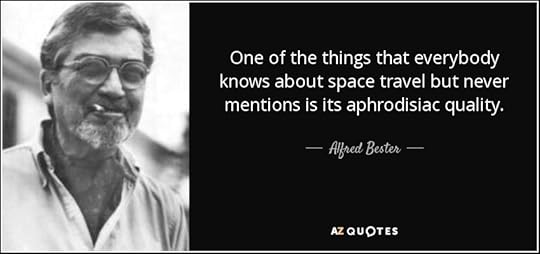
Alfred Bester was an American science fiction author, TV and radio scriptwriter, magazine editor and scripter for comic strips and comic books.
Though successful in all these fields, he is best remembered for his science fiction, including The Demolished Man, winner of the inaugural Hugo Award in 1953, a story about murder in a future society where the police are telepathic, and The Stars My Destination, a 1956 SF classic about a man bent on revenge in a world where people can teleport, that inspired numerous authors in the genre and is considered an early precursor to the cyberpunk movement in the 1980s.
This is an omnibus of two earlier collections of Bester's short fiction, The Light Fantastic and Star Light, Star Bright. The stories originally saw print between 1941 - 1974 in various genre magazines including Astounding, Analog, Unknown, and primarily F & SF, with a couple from original anthologies Star edited by Frederik Pohl and the Campbell tribute volume edited by Harry Harrison. It has Bester's best short work, with classics like 5,271,009, Fondly Fahrenheit, Adam and No Eve, They Don't Make Life Like They Used To, and The Men Who Murdered Mohammed. Bester was a master of satire and humor, especially during the 1950s. Also included are a few interesting short essays about his life and friends in the field. Recommended, especially to those who only are familiar with his more famous novels The Demolished Man and The Stars My Destination.
If the Borsch Belt had a SF syndicate, Bester may well be the Master of Ceremonies, his satires on science and fiction in general, a Vaudevillian approach to cosmic mysteries and fool-borne characters created to suffer through time holes and off-the-chart invasions.
5,271,009 • (1954) - mad genie gives mortal sucker 3 wishes type-of-story that could suffer under its own tired and cliched weight, but here Bester plays the wild card approach, using absolutely no tether in relaying this tale of a sadistic imp/Satan/Bester-incognito ravaging the soul of an artist with hallucinatory time-travels all over the ruined map of possibility. The bit when our broken hero is 10 years old again is a hilarious bit of anti-Bradbury slapstick, as though Stanley Elkin was toying with time-traveled perspectives and childhoods void of sentimentality.
Ms. Found in a Champagne Bottle • (1968) - something about a writer on a beach with multiplying ideas clashing like confetti, but the real star is one of Bester's finest, Fondly Fahrenheit (1954) - precursor to John Sladek's satirical robot works, a neck-snap narrative where personalities of an android and its trust-fund jackass owner merge into an unholy and rebellious union, Jekyl and Hyde meets Bonnie and Clyde. Future MurderTown escapades in full effect, Bester plays with syntax and viewpoint both off the cuff and off the rails; madcap experimentation well ahead of its time, a robotic inversion of the primate in Poe's Rue Morgue. Savage and necessary SF.
The Four-Hour Fugue • (1974) - the Northeast Corridor is an absolute slum. The only profitable enterprise in the foul, fetid East Coast scene is the art of perfume-making. Even the dying and rotting need some olfactory brightness. A scent scientist is suffering from a gap in his memory - every night he sleepwalks the dangerous streets with an unfamiliar scent leading him to a dark underworld, and what I hoped for was a speculative version of The Deadly Percheron (John Franklin Bardin), Bester dissolves his madcap chase into something as clean and tidy as The Dick Van Dyke Show.
The Men Who Murdered Mohammed • (1958) - a gold-standard comedy about the limitations of time travel. How much is singular, and how little is enough to change the course of history. Perhaps Bester really is the Mel Brooks of Speculative Fictions. Essential.
Hell Is Forever • (1942) • novella tinged with horror and mystery as souls are sold to the Devil in a murder revenge mystery with high-flying descents into Hell and Madness. When a hoax brings about a god-like demon, five decadent friends visit their own personal Infernos. Clunky with fuel overflowing over the rim, it's a horror tale that succeeds more as a surreal comedy with several punchlines, a trait of Bester as comedian and seeing what sticks.
Adam and No Eve • (1941) - a lone, rebellious astronaut unleashes his own vessel into space, only to find out what he's carrying may shift the astral plane (or even infect it), and yes, the reader can assume that the wasteland may not even have any judgement left. Eve in ashes, the world ready for a rewind. Dark and essential.
The middle chunk of this collection is middle tier, typical Bester conceptual brilliance, complex of its own catalyst but bawdy as a gin-soaked comedian heckling an equally inebriated crowd, tickling ribs in old-fashioned mockery. Quite funny how the brightness of the climaxes betrays the mad concepts:
Time Is the Traitor • (1953) - eternal heartbreak the core of this tale, where living as an immortal who can predict the future doesn't play kindly when it comes to his one true love (and all the misogyny that comes along with reviving said lover long-dead). Not much different, Oddy and Id (1950) turns into a Freudian expose on good luck and unattainable odds, while Hobson's Choice (1952) dives headfirst into population control and madcap statistics. Star Light, Star Bright (1953) plays with themes of child geniuses and the way they wish with harm and discontent on others while all they want is a hug; touching on themes of 'It's a Good Life' (Jerome Bixby, Twilight Zone).
They Don't Make Life Like They Used to (1963) - a fantastic novelette bringing us to a post-apocalyptic Manhattan where a former NYC socialite and a former professional wrestler team up in an unlikely union. Opposites don't always attract. Feels like Truman Capote writing Breakfast in Ruins, a playful battle of the sexes circa 1963 midtown. But appearing on the edges out of sight, they began to hear the sonic booms, the skyscrapers crumbling, and a great buzzing that may be coming from the ground under. A different type of invasion story. Classic.
Of Time and Third Avenue (1951) and Isaac Asimov (1973) repeat themselves after one drink too many - more time travel hijinx and more judgmental doubt from Bester being labeled a Science Fiction writer. The Pi Man (1959) and Something Up There Likes Me (1973) re-solidify the collection's strengths, as the latter tale tells of what happens when a satellite turns on its engineers/parents. Domesticated madness on a rebellious orbit, OBO the AI rebel, tries to make the Earth it patrols a hotwired and rewired mess. A pacifist A.I. or a computer infected by space germs? Or a child-like devil in the stars?
And Bester closes it out with My Affair with Science Fiction (1974) where he continues to show his madcap dissections of SF standards appeared belittled by life, 9 to 5 work and waiting for inspiration. Bester seemed like he could sell you a car, make you the finest martini, chew you out and then praise you as the finest pauper. He was one of the most reluctant forefather's of the genre, a bawdy and brassy jokester with a wit too big for The Age, perhaps.
This is a collection of some very good short stories, from 1941 through 1974. At least one of these has been included in other best of collections; I know I’ve read “Fondly Fahrenheit” before.
He likes embedding what he calls tricks into his stories; he started out as a mystery writer, and read voraciously collecting tricks that would make for good mystery clues, such as the years there was a moratorium on certain coins, or mysterious events, such as the disappearance of SYNCOM-1.
This sort of thing often doesn’t age well, and it helps to read these stories with an understanding of when they were written. And if you guess the trick, the story becomes very different than intended (such as the trick at the end of “Time is the Traitor”), as the story becomes, why is no one addressing this obvious flaw in their plan? In that case, the flaw is more obvious because it has been used many times since in other stories; it may well have been original in 1953.
A lot of his introductions don’t seem to match the story they’re paired with; but he covers that by saying he rarely remembers how or why he wrote something decades later. Which makes sense, though it does turn the introductions into odd attempts at fiction themselves.
They are also filled with reminiscences on people like John Campbell and Isaac Asimov. All are interesting, though of course not necessarily reliable given his other caveats. And he doesn’t just write about science fiction; he also wrote comic books, radio scripts, and television scripts; and interviewed for Holiday magazine.
One of the weird things is John Campbell’s objection to Bester using Freud heavily in his writing. Bester does, and expands on his use of Freudian theory in his essays. Campbell objected to this, telling Bester that Freud was a complete fraud and would soon be relegated to the proverbial dustbin of history. Campbell was absolutely right. But for the completely wrong reason. Campbell, writes Bester, thought Dianetics would soon solve all psychological problems in the world and take over from Freudian analysis.
I enjoyed these stories a lot more than The Stars My Destination; they were less reliant on old science fiction tropes and characters; I also tend to be more forgiving in short stories than in novel-length stories.
But writing isn’t logical and sensible. It’s an act of insane violence committed against yourself and the rest of the world.
The Demolished Man enthralled me so greatly that I obsessively grabbed every copy of Bester that came past. Due to a lack of organization this eventually resulted in having two copies of Golem100, one of The Computer Connection, and two of this. All unread.
I think I got partway through The Computer Connection before realizing that something was wrong. And Golem100--one copy of it, anyways--was similar.
With this collection I'm forced to confront the thought that maybe Alfred Bester isn't for me. While the stories are cleverly or even elegantly crafted, they really aren't about anything particularly compelling. And, unfortunately, the author introduces his stories, which results in a mishmash of background information, here in a jokey, informal style that I found rather grating.
Many of these stories seem focused on the internal state of the characters, either explicitly, as with "Fondly Fahrenheit" (a fever-dream where the story perspective is in perpetual nightmarish flux, as the unreliable narrator projects his identity and insanity) or "The Pi Man" (the inside of a truly weird mind), or implicitly, as with "They Don't Make Life Like They Used To".
"They Don't Make Life Like They Used To" was a standout for me. It's a "last people on Earth" story with the twist of the characters as Adam and Eve stand-ins, living in a strange detached state of grace. Despite being strangers, they think little of nudity. Despite being the last man and woman on Earth, the romantic / procreational / sexual aspect never seems to occur to either one. Despite the complete and total breakdown of society, they leave little IOUs in the stores they loot and worry about the mounting cost. There's something deeply not-right about both of them which is never adequately explained, followed by an event that changes everything, also not explained. It's a bewildering tale that leaves only about thirty percent of all information in the hands of the reader. Yet, I found it mesmerizing, more from what is not said than what is.
I usually don't read short stories, but I just finished re-reading "The stars, my destination" and decided that another Bester book was needed. This is a most uneven selection of stories, some very short (and to me pretty pointless, such as "Manuscript found in a champagne bottle") others a bit more developped, but still puzzling.
I guess what makes it for such an unsettling reading is that Bester was not just a Sci-Fi writer. He wrote comic strips, TV scripts, collaborated with travel magazines, etc... I liked "The Four-Hour Fugue", but it is a story that could take place in a contemporary setting, with only minor twists (in fact, I think the main plot twist was used more than once in TV serials).
"Disappearing Act" and "5,271,009" introduce ideas that were fully developped in "The stars, my destinaton", while "The Men Who Murdered Mohammed" develops an original idea about time travel and it is also quite funny.
So far, the weirdest tale is "They Don't Make Life Like They Used To". An unusual take of the last people left on heart, with a guy and a girl who act crazily, perhaps brain-damaged by the radiations.
Bester's SF novels are some of my favorites, so a venture into his shorter stories was overdue. Like his novels, these are terrific fun. Fantastic in ideas and execution, somewhere between his comic book and screenwriting past and his magazine writing future.
I gather that there are numerous compilations of his short SF floating around. This one is something of an omnibus that includes both the "The Light Fantastic" and "Star Light, Star Bright" collections, and about as thorough as one can find in a single volume. I'd recommend Bester's two famous SF novels first, then this one as a bonus, but probably any compilation you can find will do. It includes intros by the author to each, which are fascinating and hilarious glimpses of both his personality and process.
This is an omnibus that includes both the "The Light Fantastic" and "Star Light, Star Bright" collections. Being the first time I read Alfred Bester I did not know what to expect out of him. I was gladly surprised! Bester has a very particular style, like a mix of Azimov and Arthur C. Clarke, although he is not so "hard science" oriented, he is more borderline with Fantasy. I enjoyed a lot the introductions section prior to each of his stories, even though some reviewers here did not like that at all; to me, these introductions are a window back-in-time, these stories are from the fifties and sixties. It is like time travel. Alfred Bester has a very particular tempo or rhythm. The things he describes as "the texture and colors of the stories". He also refers to the tempo of stories making an analogy to musical pieces. My favorite stories were "5,271,009", "The Four-Hour Fugue", "Disappearing Act", and "Of Time and Third Avenue". I could not understand the end of "The Pi Man". As Alfred Bester states he likes to keep a part of the stories open to the imagination of the reader, meaning that not all the ends are clear and straightforward. He likes the reader to put some effort into finding his own conclusion. If that is an issue to you, you better start with one or two stories and see if you want to keep going. You also have to put things into a temporal perspective, the stories in this omnibus were written from 1941 to 1975, many concepts are not politically correct in our times. However, Bester was extraordinarily advanced for his time, with only a few depictions of women desperately needing the protection of men in the stories "Adam and No Eve" and "They Don't Make Life Like They Used To". Bester has no tolerance for religious doctrines, Creationism (people opposed to The Evolution of the Species concept), people denying Science (he would be ridiculizing anti-vaxxers right now), etc. Definitively, will look for his other novels and short stories. This book is a keeper in my SciFi collection.
Me gustan mucho los argumentos de Bester pero siempre me desconcierta un poco la forma atropellada en que se suceden los acontecimientos. Siempre como si el único camino posible fuese cuesta abajo, y acelerando todo el tiempo. Es algo confuso, pero no cabe duda de que en esta antología de cuentos hay excelente material. Me gustó sobre todo Afectuosos Farenheit, aunque El infierno es eterno no está nada mal. En Los hombres que asesinaron a Mahoma las cosas se ponen bastante confusas y Bester llega a conclusiones que me parecen un poco sacadas de la manga, pero hay que recordar que se trata de ciencia ficción escrita en su mayor parte durante los 50's. Algo se ha avanzado desde entonces (hablo de la parte científica, por supuesto).
Most of these stories appear in other Bester collections but the lengthy, early "Hell is Forever" is a brilliant surprise, the introductions are great, the autobiographical piece enlightening. Bester was one of the best. Not a single bad story here.
I read this years ago and I still remember it. I used to have a copy but over the years have lost it. I do miss it. Nothing in it was as good as Bester's novel The Stars My Destination, but still a good read for those who love not only science fiction but the short story. I was disappointed that the cover had nothing to do with the stories inside, though.
EDIT 11/2025: I found a copy up on the Internet Archive! I had forgotten that this book combines two of Bester's books of short stories, The Light Fantastic and Star Light, Star Bright.
Selections:
The Light Fantastic
* 5,271,009 * Ms. Found in a Champagne Bottle * Fondly Fahrenheit * Comment on Fondly Fahrenheit * The Four-Hour Fugue * The Men Who Murdered Mohammed * Disappearing Act * Hell is Forever
Star Light, Star Bright
* Adam and No Eve * Time is the Traitor * Oddy and I'd * Hobson's Choice * Star Light, Star Bright * They Don't Make Life Like They Used To * Of Time and Third Avenue * Isaac Asimov * The Pi Man * Something Up There Likes Us -- This supposedly humorous story about satellites is one of the worst things Bester wrote ... still, better than anything R. A. Lafferty did. * My Affair With Science Fiction
The Great Short Fiction of Alfred Bester, Vol. 1: Star Light, Star Bright
5,271,009 (1954) Ms. Found in a Champagne Bottle (1968) Fondly Fahrenheit (1954) The Four-Hour Fugue (1974) The Men Who Murdered Mohammed (1958) Disappearing Act (1953) Hell Is Forever (1942)
The Great Short Fiction of Alfred Bester, Vol. 2: The Light Fantastic
Adam and No Eve (1941) Time Is the Traitor (1953) Oddy and Id (1950) Hobson's Choice (1952) Star Light, Star Bright (1953) They Don't Make Life Like They Used to (1963) Of Time and Third Avenue (1951) The Pi Man (1959) Something Up There Likes Me (1973)
alcuni racconti sono in comune con "tutti i racconti 1950 - 1980 / l'uomo disintegrato" della mondadori, ma qui ci sono gustosissime introduzioni dello stesso bester, altri racconti (occhio al lungo e inquietante "l'inferno è eterno"), un'intervista a asimov e soprattutto un breve autobiografia che mostra quello che il lettore ha già intuito tra le righe dele sue opere: un uomo curioso, spiritoso, intelligente e capace di adattarsi ai lavori più incredibili. grande bester, un antitodo a tanta, troppa fantascienza che oggi si prende troppo sul serio...
Some authors can transition seamlessly between novels and short stories and write excellent examples of both. Bester was not one of those. As good as his novels are, his short stories don't have nearly the same appeal. While many of the characters do have some life and personality, the plots are dull and I found myself "skimming" in many cases and had to go back several pages and read it again.
For my taste, Bester shines more in his novels than his short stories, but still, there are some very clever and entertaining stories included in this collection.
Since I didn't finish the book my two stars might not be fair, but the first two or three stories didn't grab me so I returned it to the library when it was due.