

What do you think?

Many Moons
Princess Lenore, ill of a surfeit of raspberry tarts, wants the moon. She must have it, she says, to be well again. The King consults his wise men… but the Lord High Chamberlain cannot get the moon. Neither can the Royal Wizard. Nor the Royal Mathematician. Only when the King. In despair, calls on his lowly but clever Jester is the problem solved…
48 pages, Hardcover
First published January 1, 1943
About the author
James Thurber
394 books619 followersThurber was born in Columbus, Ohio to Charles L. Thurber and Mary Agnes (Mame) Fisher Thurber. Both of his parents greatly influenced his work. His father, a sporadically employed clerk and minor politician who dreamed of being a lawyer or an actor, is said to have been the inspiration for the small, timid protagonist typical of many of his stories. Thurber described his mother as a "born comedienne" and "one of the finest comic talents I think I have ever known." She was a practical joker, on one occasion pretending to be crippled and attending a faith healer revival, only to jump up and proclaim herself healed.
Thurber had two brothers, William and Robert. Once, while playing a game of William Tell, his brother William shot James in the eye with an arrow. Because of the lack of medical technology, Thurber lost his eye. This injury would later cause him to be almost entirely blind. During his childhood he was unable to participate in sports and activities because of his injury, and instead developed a creative imagination, which he shared in his writings.
From 1913 to 1918, Thurber attended The Ohio State University, where he was a member of the Phi Kappa Psi Fraternity. He never graduated from the University because his poor eyesight prevented him from taking a mandatory ROTC course. In 1995 he was posthumously awarded a degree.
From 1918 to 1920, at the close of World War I, Thurber worked as a code clerk for the Department of State, first in Washington, D.C. and then at the American Embassy in Paris, France. After this Thurber returned to Columbus, where he began his writing career as a reporter for the Columbus Dispatch from 1921 to 1924. During part of this time, he reviewed current books, films, and plays in a weekly column called "Credos and Curios," a title that later would be given to a posthumous collection of his work. Thurber also returned to Paris in this period, where he wrote for the Chicago Tribune and other newspapers.
In 1925, he moved to Greenwich Village in New York City, getting a job as a reporter for the New York Evening Post. He joined the staff of The New Yorker in 1927 as an editor with the help of his friend and fellow New Yorker contributor, E.B. White. His career as a cartoonist began in 1930 when White found some of Thurber's drawings in a trash can and submitted them for publication. Thurber would contribute both his writings and his drawings to The New Yorker until the 1950s.
Thurber was married twice. In 1922, Thurber married Althea Adams. The marriage was troubled and ended in divorce in May 1935. Adams gave Thurber his only child, his daughter Rosemary. Thurber remarried in June, 1935 to Helen Wismer. His second marriage lasted until he died in 1961, at the age of 66, due to complications from pneumonia, which followed upon a stroke suffered at his home. His last words, aside from the repeated word "God," were "God bless... God damn," according to Helen Thurber.
Thurber had two brothers, William and Robert. Once, while playing a game of William Tell, his brother William shot James in the eye with an arrow. Because of the lack of medical technology, Thurber lost his eye. This injury would later cause him to be almost entirely blind. During his childhood he was unable to participate in sports and activities because of his injury, and instead developed a creative imagination, which he shared in his writings.
From 1913 to 1918, Thurber attended The Ohio State University, where he was a member of the Phi Kappa Psi Fraternity. He never graduated from the University because his poor eyesight prevented him from taking a mandatory ROTC course. In 1995 he was posthumously awarded a degree.
From 1918 to 1920, at the close of World War I, Thurber worked as a code clerk for the Department of State, first in Washington, D.C. and then at the American Embassy in Paris, France. After this Thurber returned to Columbus, where he began his writing career as a reporter for the Columbus Dispatch from 1921 to 1924. During part of this time, he reviewed current books, films, and plays in a weekly column called "Credos and Curios," a title that later would be given to a posthumous collection of his work. Thurber also returned to Paris in this period, where he wrote for the Chicago Tribune and other newspapers.
In 1925, he moved to Greenwich Village in New York City, getting a job as a reporter for the New York Evening Post. He joined the staff of The New Yorker in 1927 as an editor with the help of his friend and fellow New Yorker contributor, E.B. White. His career as a cartoonist began in 1930 when White found some of Thurber's drawings in a trash can and submitted them for publication. Thurber would contribute both his writings and his drawings to The New Yorker until the 1950s.
Thurber was married twice. In 1922, Thurber married Althea Adams. The marriage was troubled and ended in divorce in May 1935. Adams gave Thurber his only child, his daughter Rosemary. Thurber remarried in June, 1935 to Helen Wismer. His second marriage lasted until he died in 1961, at the age of 66, due to complications from pneumonia, which followed upon a stroke suffered at his home. His last words, aside from the repeated word "God," were "God bless... God damn," according to Helen Thurber.
Ratings & Reviews
Friends & Following
Create a free account to discover what your friends think of this book!
Community Reviews
Displaying 1 - 30 of 502 reviews

November 27, 2024
A clever and amusing lesson on perspective and wisdom!

May 1, 2018
What do a Lord Chamberlain, a Wizard, and a Mathematician have in common? They all keep lists of what they have done for you, they all think about the world as a reality and they all are not helpful dealing with a princess.
It is only the court Jester who is wise enough to figure out that what really matters in the problem is what the princess thinks, not necessarily the reality of the situation. The jester simply asks the princess and fixes the problem.
This really is a whip-smart book. There is some hidden wisdom in this. I love the princesses answer to how she can wear the moon and it be in the sky. I never heard of this and it is a great book.
The artwork is like a dream, fuzzy and hinting at something. It is pretty brilliant. Sadly, my niece is growing up and she would not read this book because she thinks it for babies, so I was able to get her to read it to my nephew. They both ended up liking the story.
It is only the court Jester who is wise enough to figure out that what really matters in the problem is what the princess thinks, not necessarily the reality of the situation. The jester simply asks the princess and fixes the problem.
This really is a whip-smart book. There is some hidden wisdom in this. I love the princesses answer to how she can wear the moon and it be in the sky. I never heard of this and it is a great book.
The artwork is like a dream, fuzzy and hinting at something. It is pretty brilliant. Sadly, my niece is growing up and she would not read this book because she thinks it for babies, so I was able to get her to read it to my nephew. They both ended up liking the story.

December 22, 2021
Princess Lenore gets ill of a having too many raspberry tarts. She insists that she will get well only if she has the Moon. All of the king’s wise advisors fail to get the Moon to the princess, only the Court Jester knows how to deal with her request.
Thurber has a way with words, making the story playful and funny.
Many Moons is a charming, clever tale about understanding the perspective of children. Highly recommended.
Thurber has a way with words, making the story playful and funny.
The Lord High Chamberlain was a large, fat man who wore thick glasses which made his eyes seem twice as big as they really were. This made the Lord High Chamberlain seem twice as wise as he really was.
Many Moons is a charming, clever tale about understanding the perspective of children. Highly recommended.

July 10, 2026
When his ill daughter asks for the moon -- literally -- a king turns to his wise men for advice on how to fulfill her wish. While the chamberlain, wizard, and mathematician dither and obfuscate, the jester cuts to the heart of the matter in a clever way.
It's a bit too wordy and repetitive, but humor and imagination win the day.
This version is illustrated by Marc Simont. It seems a bit silly or greedy to have a new artist give the illustrations a go when the original one, Louis Slobodkin, won a Caldecott Medal, but hey, capitalists gonna capitalize and the author's great grandkids are gonna need funds for college someday.
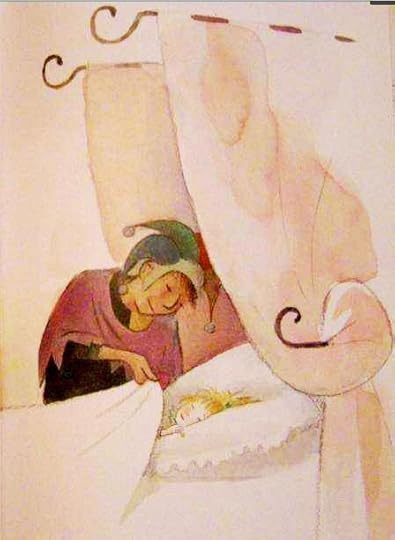
I can't say Simont's pictures are better, but they sure are brighter and better defined than Slobodkin's sketchy, minimalist style. And well, hey, maybe he does get the edge because his princess is cuter and his jester a little more human and a little less like he stepped out of a deck of cards.
Side note: My review of the version illustrated by Louis Slobodkin is here:
https://www.goodreads.com/review/show...
It's a bit too wordy and repetitive, but humor and imagination win the day.
This version is illustrated by Marc Simont. It seems a bit silly or greedy to have a new artist give the illustrations a go when the original one, Louis Slobodkin, won a Caldecott Medal, but hey, capitalists gonna capitalize and the author's great grandkids are gonna need funds for college someday.
I can't say Simont's pictures are better, but they sure are brighter and better defined than Slobodkin's sketchy, minimalist style. And well, hey, maybe he does get the edge because his princess is cuter and his jester a little more human and a little less like he stepped out of a deck of cards.
Side note: My review of the version illustrated by Louis Slobodkin is here:
https://www.goodreads.com/review/show...

October 15, 2022
Just came across this little story at a second hand shop so decided to check it out; cute! Actually one of a childhood tales I missed apparently....I liked the wise court jester ;)

August 7, 2013
The first time I encountered Many Moons by James Thurber, it was read to me. I was in third grade. If the illustrations were shown, I didn't see them. And they weren't necessary for me to enjoy the book -- I could picture it perfectly in my head. The story stayed with me for many years. If I ever knew, I soon forgot the name of the author. I've since forgotten the name of my third-grade teacher. But I've never forgotten how much I loved this book.
Years later, in my early twenties, I began reading Dorothy Parker. Which led to reading Robert Benchley. Which led to reading James Thurber. Thurber quickly became one of my favorite authors. But still I did not realize he wrote Many Moons. Not until about ten years later, when I was browsing in a bookstore, and I stumbled upon Many Moons. The version I found then was illustrated by Louis Slobodkin, which was good, but a bit manic and not quite as I remembered the book. Still, I bought the book. And read the book. And enjoyed the book.
A few years after that I was working as a children's librarian. In our department, we had been turning classical literature into puppet shows with quite a bit of success. I decided that Many Moons would be a great choice, so I pulled the book off of the shelf to type up a screenplay. The book on our shelf wasn't the Slobodkin version, though, it was the Marc Simont version, and the illustrations almost perfectly matched the illustrations I had carried in my head for thirty years. I was delighted. And the puppet show, by the way, was delightful.
Marc Simont passed away recently. He was 97, so his passing was sad but not surprising. Although he has illustrated many books, including other stories for Thurber, whenever I see any reference to him, I always think of this book, his Many Moons.
Years later, in my early twenties, I began reading Dorothy Parker. Which led to reading Robert Benchley. Which led to reading James Thurber. Thurber quickly became one of my favorite authors. But still I did not realize he wrote Many Moons. Not until about ten years later, when I was browsing in a bookstore, and I stumbled upon Many Moons. The version I found then was illustrated by Louis Slobodkin, which was good, but a bit manic and not quite as I remembered the book. Still, I bought the book. And read the book. And enjoyed the book.
A few years after that I was working as a children's librarian. In our department, we had been turning classical literature into puppet shows with quite a bit of success. I decided that Many Moons would be a great choice, so I pulled the book off of the shelf to type up a screenplay. The book on our shelf wasn't the Slobodkin version, though, it was the Marc Simont version, and the illustrations almost perfectly matched the illustrations I had carried in my head for thirty years. I was delighted. And the puppet show, by the way, was delightful.
Marc Simont passed away recently. He was 97, so his passing was sad but not surprising. Although he has illustrated many books, including other stories for Thurber, whenever I see any reference to him, I always think of this book, his Many Moons.
March 4, 2018
I really want to collect the juveniles of James Thurber. I read his adult books when I was a child (along with Robert Benchley, Emily Kimbrough, and Cornelia Otis Skinner) but only discovered this, The 13 Clocks, The Great Quillow, and The Wonderful O after I became a parent.
I did already love the quirky artistic style of Louis Slobodkin from The Middle Moffat and other books by Eleanor Estes. I imagine his work was responsible for helping me think about art as being more than just pretty & realistic pictures, like the horses of Wesley Dennis.
I find it interesting that this book was re-issued with art by Marc Simont, even though it was the original art that won the Caldecott. Simont's work is wonderful, too, though... I suppose I'd need both copies of this (and of 13Cs) to have a complete collection....
Anyway, to the story itself. I've probably read it 4-5 times so far over the years. Not too long, but substantial enough to be savored. Wordplay, heart, wisdom, cleverness, and joy. And juicy vocabulary words. The first page has the obligatory 'once upon a time' introduction, but then there's a page break. Read the second page as if it's the first. Isn't that a great first sentence? The specific detail, and then the word "surfeit." What child isn't going to be intrigued by that word?
Highly recommended to everyone. :)
I did already love the quirky artistic style of Louis Slobodkin from The Middle Moffat and other books by Eleanor Estes. I imagine his work was responsible for helping me think about art as being more than just pretty & realistic pictures, like the horses of Wesley Dennis.
I find it interesting that this book was re-issued with art by Marc Simont, even though it was the original art that won the Caldecott. Simont's work is wonderful, too, though... I suppose I'd need both copies of this (and of 13Cs) to have a complete collection....
Anyway, to the story itself. I've probably read it 4-5 times so far over the years. Not too long, but substantial enough to be savored. Wordplay, heart, wisdom, cleverness, and joy. And juicy vocabulary words. The first page has the obligatory 'once upon a time' introduction, but then there's a page break. Read the second page as if it's the first. Isn't that a great first sentence? The specific detail, and then the word "surfeit." What child isn't going to be intrigued by that word?
Highly recommended to everyone. :)

November 26, 2016
Illustrated by Marc Simont
The Princess Lenore isn’t feeling well, and she asks for just one thing – the moon. She is certain this is the only thing that will make her well again. Her father, the King, summons his most trusted advisors, and tasks them with securing the moon for the Princess. But to a man, they declare this impossible. Until the Jester arrives and looks at the problem from a different angle.
I love Thurber’s story-telling. I’ve previously read another of his fables for children, and I’m equally delighted with this one. Marc Simont’s illustrations are whimsical and perfectly fit Thurber’s text. I found myself poring over them, trying to find all the references in the text … “blood from a turnip,” “a rabbit out of a hat, and a hat out of a rabbit” et al. The fact that the Princess holds the key to the great puzzle no adult can solve will especially delight children, but adults can learn an important lesson as well.
The book was originally published with illustrations by Louis Slobodkin; it remains in print along with this newer version which I read. I’ll have to try to find that original edition to see Slobodkin’s Caldecott-Award-winning work.
The Princess Lenore isn’t feeling well, and she asks for just one thing – the moon. She is certain this is the only thing that will make her well again. Her father, the King, summons his most trusted advisors, and tasks them with securing the moon for the Princess. But to a man, they declare this impossible. Until the Jester arrives and looks at the problem from a different angle.
I love Thurber’s story-telling. I’ve previously read another of his fables for children, and I’m equally delighted with this one. Marc Simont’s illustrations are whimsical and perfectly fit Thurber’s text. I found myself poring over them, trying to find all the references in the text … “blood from a turnip,” “a rabbit out of a hat, and a hat out of a rabbit” et al. The fact that the Princess holds the key to the great puzzle no adult can solve will especially delight children, but adults can learn an important lesson as well.
The book was originally published with illustrations by Louis Slobodkin; it remains in print along with this newer version which I read. I’ll have to try to find that original edition to see Slobodkin’s Caldecott-Award-winning work.

October 5, 2009
Ivory, apes, and peacocks, rubies, opals, and emeralds, black orchids, pink elephants, and blue poodles, gold bugs, scarabs, and flies in amber, hummingbirds' tongues, angels' feathers, and unicorns' horns, giants, midgets, and mermaids, frankincense, ambergris, and myrrh, troubadours, minstrels, and dancing women.
May 19, 2011
Many Moons by James Thurber, illustrated by Louis Slobodkin is a fairy tale about Princess Lenore, who asks for the moon when she is sick. The King summons all his wise men but none of them know how to get the moon. The Court Jester turns out to be the one to solve the problem.
This charming, whimsical story has plenty of sly humor and a few challenging words (surfeit, physician etc.). Thurber writes about wisdom and the differing perceptions of children and adults. The concept of things being "in the eye of the beholder" is well portrayed by Thurber in this book that is a bit longer than many picture books.
I like the original illustrations by Louis Slobodkin which match the story well. The artwork is mainly in red, blue, black, white, gold and green.
The long lists of his advisors' accomplishments becomes pretty funny and has some funny, interesting items. Their ideas for keeping the Princess from seeing the moon are amusing and silly. The simple logic of the jester is wise indeed, as is Princess Lenore.
For ages K to 3rd, princesses, fantasy, fairy tale, space science, point of view, and James Thurber and Louis Slobodkin.
This charming, whimsical story has plenty of sly humor and a few challenging words (surfeit, physician etc.). Thurber writes about wisdom and the differing perceptions of children and adults. The concept of things being "in the eye of the beholder" is well portrayed by Thurber in this book that is a bit longer than many picture books.
I like the original illustrations by Louis Slobodkin which match the story well. The artwork is mainly in red, blue, black, white, gold and green.
The long lists of his advisors' accomplishments becomes pretty funny and has some funny, interesting items. Their ideas for keeping the Princess from seeing the moon are amusing and silly. The simple logic of the jester is wise indeed, as is Princess Lenore.
For ages K to 3rd, princesses, fantasy, fairy tale, space science, point of view, and James Thurber and Louis Slobodkin.
July 10, 2026
When his ill daughter asks for the moon -- literally -- a king turns to his wise men for advice on how to fulfill her wish. While the chamberlain, wizard, and mathematician dither and obfuscate, the jester cuts to the heart of the matter in a clever way.
It's a bit too wordy and repetitive, but humor and imagination win the day.
This Caldecott Medal-winning version is illustrated by Louis Slobodkin with barely there ink drawings that are ridiculously minimalist but still charming enough to help offset all the words.
Side note: My review of the version illustrated by Marc Simont is here:
https://www.goodreads.com/review/show...
It's a bit too wordy and repetitive, but humor and imagination win the day.
This Caldecott Medal-winning version is illustrated by Louis Slobodkin with barely there ink drawings that are ridiculously minimalist but still charming enough to help offset all the words.
Side note: My review of the version illustrated by Marc Simont is here:
https://www.goodreads.com/review/show...

March 10, 2019
The first time I came across this book was in a sixth grade reading textbook, but the story fascinated me with that particular version's illustrations and its story in how organized, but how thought-provoking it truly was. In the story, the King from a kingdom by the sea's daughter, Princess Lenore, has fallen ill, and the one thing that can cure her is the moon. The King seeks help from the Royal High Chamberlain (who looked exactly like Al Roker in the textbook version), the Royal Wizard, and the Royal Mathematician for their assistance, but all they can do is make assumptions about how far the moon is and what it is made of. That leaves him with no other choice but to ask the Royal Jester, who gives this book a twist.
Many Moons teaches us that one's answers to their concerns can often be found in the least expected places, some of which triggered by a sense of reason. How one perceives this tends to vary, but as long as it is effective, that's what matters. While this version's illustrations were a bit lackluster, I cannot help but refer to the illustrations from the textbook source. This book's underlying lesson is one that is bound to stay with you throughout time and its humor certainly has the ability to stick with you.
Many Moons is a great children's book that readers of all ages can enjoy!
Many Moons teaches us that one's answers to their concerns can often be found in the least expected places, some of which triggered by a sense of reason. How one perceives this tends to vary, but as long as it is effective, that's what matters. While this version's illustrations were a bit lackluster, I cannot help but refer to the illustrations from the textbook source. This book's underlying lesson is one that is bound to stay with you throughout time and its humor certainly has the ability to stick with you.
Many Moons is a great children's book that readers of all ages can enjoy!

April 30, 2025
A quick and amusing story with lovely drawings.

September 11, 2012
This book won the 1944 Caldecott, but this must've been another year where there wasn't much competition. I liked the book, though the story drones on for a bit. The book tells the story of a princess who falls ill and wants the moon, but all of her father's advisors say that the moon is impossible to get, until he asks the Court Jester, who takes a more logical-to-a-child approach to the situation. She gets her moon and gets well again. The next night, when the moon reappears, the king is frantically worried and consults all of his advisors again, who don't provide a good solution. The Court Jester just goes up and asks the princess what she thinks of the new moon and she says that of course there is a new moon, because when you take something away like teeth or flowers, there are always something of the same sort to replace it. This book, like "Frederick" by Leo Lionni, can be taught in the classroom as part of a philosophical discussion: http://www.teachingchildrenphilosophy.... Recommended for ages 6-9, 3 stars.

September 27, 2007
I love this story about a princess with a tummyache, who asks for the moon, and the jester who figures out how the king can get it for her. Way too wordy for a library storytime, this is a great lap book for parents to share with their own princesses. I prefer the illustrations by Marc Simont, even though the they aren't the ones that won the Caldecott.
May 12, 2021
A Thurber fairytale I somehow missed, with serenely floaty illustrations by Louis Slobodkin. Unsurprisingly, the jester saves the day, giving us a fable about how much more pleasant and beautiful the world can be when we abandon the scarcity model, with its mad dash for acquisitiveness and certainty, and trade it in for a philosophy of abundance that arises from the mind and heart. Blah blah blah, I loved it.

May 2, 2018
James Thurber can do no wrong.

April 26, 2022
When was the last time you read the word “surfeit” or “unguents” in a picture book? Or just any book for that matter? I so relish books that don’t shy away from using a rich vocabulary! It makes reading children’s books enjoyable for the adult and begins to expose the young to a vast world of words that is never too early to enter.
It’s a quirky story for sure, but very unique and I liked it for that reason. A princess is sick and her father says he will get her anything she wants as long as she gets better. The princess replies that if she had the moon, she would recover. But how does one get the moon?
Told with cleverness and humor, and pictures from one of my favs, this book is worth the read!
Note: parents, this book is longer than most picture books.
Ages: 5 - 12
Cleanliness: there is a wizard in the story who mentions the magic he’s performed for the king. There is one section that mentions unicorns, demons, giants, mermaids, witches, crystal balls, wands, potions, and diving rods. A picture of a giant shows his behind - not very detailed.
**Like my reviews? Then you should follow me! Because I have hundreds more just like this one. With each review, I provide a Cleanliness Report, mentioning any objectionable content I come across so that parents and/or conscientious readers (like me) can determine beforehand whether they want to read a book or not. Content surprises are super annoying, especially when you’re 100+ pages in, so here’s my attempt to help you avoid that!
So Follow or Friend me here on GoodReads! And be sure to check out my bio page to learn a little about me and the Picture Book/Chapter Book Calendars I sell on Etsy!
It’s a quirky story for sure, but very unique and I liked it for that reason. A princess is sick and her father says he will get her anything she wants as long as she gets better. The princess replies that if she had the moon, she would recover. But how does one get the moon?
Told with cleverness and humor, and pictures from one of my favs, this book is worth the read!
Note: parents, this book is longer than most picture books.
Ages: 5 - 12
Cleanliness: there is a wizard in the story who mentions the magic he’s performed for the king. There is one section that mentions unicorns, demons, giants, mermaids, witches, crystal balls, wands, potions, and diving rods. A picture of a giant shows his behind - not very detailed.
**Like my reviews? Then you should follow me! Because I have hundreds more just like this one. With each review, I provide a Cleanliness Report, mentioning any objectionable content I come across so that parents and/or conscientious readers (like me) can determine beforehand whether they want to read a book or not. Content surprises are super annoying, especially when you’re 100+ pages in, so here’s my attempt to help you avoid that!
So Follow or Friend me here on GoodReads! And be sure to check out my bio page to learn a little about me and the Picture Book/Chapter Book Calendars I sell on Etsy!

March 20, 2020
Many Moons, illustrated by Marc Simont.
This original fairy-tale from James Thurber, in which the young Princess Lenore becomes ill after eating too many raspberry tarts, and asks her concerned father for the moon, was initially published in 1943, and won its original illustrator, Louis Slobodkin, a Caldecott Medal in 1944. This newer edition, published in 1990, features the artwork of Marc Simont, who also worked on Thurber's The 13 Clocks and The Wonderful O . The text itself has not been changed.
I enjoyed this newer version of Thurber's classic story as much as the original. The word-play was as engaging, the humor as entertaining, and Simont's watercolor illustrations were charming. Slobodkin's were more cartoon-like and quirky, I think, and these more lyrical, but both have their appeal. I particularly liked the scene here in which we see (or don't see, as the case may be) the King as he knocks things over, while wearing the invisibility cloak made for him by the Royal Magician. Hilarious! Recommended to young fairy-tale readers, and to fans of Marc Simont's work.
This original fairy-tale from James Thurber, in which the young Princess Lenore becomes ill after eating too many raspberry tarts, and asks her concerned father for the moon, was initially published in 1943, and won its original illustrator, Louis Slobodkin, a Caldecott Medal in 1944. This newer edition, published in 1990, features the artwork of Marc Simont, who also worked on Thurber's The 13 Clocks and The Wonderful O . The text itself has not been changed.
I enjoyed this newer version of Thurber's classic story as much as the original. The word-play was as engaging, the humor as entertaining, and Simont's watercolor illustrations were charming. Slobodkin's were more cartoon-like and quirky, I think, and these more lyrical, but both have their appeal. I particularly liked the scene here in which we see (or don't see, as the case may be) the King as he knocks things over, while wearing the invisibility cloak made for him by the Royal Magician. Hilarious! Recommended to young fairy-tale readers, and to fans of Marc Simont's work.

March 1, 2012
In high school, I read two short stories by James Thurber - The Secret Life of walter Mitty and The Catbird Seat. I also used to own a paperback copy of his children's story, The Wonderful O. I didn't know about Many Moons until more recently, but I'm glad to have made the discovery. The story is about a princess who begs her father to get her the moon. He consults all the various royal assistants who have helped him in the past, trying to find a way to accomplish this task. When they finally devise a way to fool the princess into believing she has received the moon, the king then realizes he must also come up with an explanation for why the moon is still in the sky if his daughter has it in her possession. The most wonderful thing about this book is the credit it gives to children and their imaginations. It is the princess who ultimately defines what the moon means to her, and who provides the explanation for the moon being with her and in the sky simultaneously. I also love the clever writing, particularly when each of the king's advisers lists the things with which they have helped the king in the past. I also think the illustrations are lovely, and I wish they hadn't bothered with a reissue.

February 1, 2017
I enjoyed this one more than I thought I would. The little girl and the jester were both wise in their own ways. I appreciated the way that the jester accepted the girl and her ideas on her own terms. I also enjoyed the clever use of words in the story.

June 21, 2021
What a delightful and charming picture book for children. As adults, we keep score and maintain lists. We are such literalists that the impossible remains impossible. Yet, through the eyes of a child, all seems possible and wonderful. Would that we could recapture that wonder. Sigh...

May 18, 2017
Read the version illustrated by Slobodkin, and definitely prefer the other illustrations that we read last week.
Library book.
Library book.
March 20, 2020
Many Moons, illustrated by Louis Slobodkin.
Wonderful, wise, heartwarming and humorous, this original fairy-tale from James Thurber, celebrated cartoonist and short-story writer, as well as author of a number of (other) classic children's books - The 13 Clocks , The Wonderful O - follows the story of a sick little princess who wishes for the moon. Her indulgent father, determined that she shall become well, summons his Lord High Chamberlain, Royal Magician, and Royal Mathematician, but each in turn tells him that the idea is impossible: the moon cannot be brought to the princess. It falls to the Court Jester, consoling his sovereign in his distress, to observe that the moon means different things to different people, and to suggest that they ask the Princess Lenore what it means to her...
Originally published in 1943, Many Moons won illustrator Louis Slobodkin the prestigious Caldecott Medal in 1944.** The artwork, done in black and white, and then colored in with blue, pink and yellow accents, is quirky and engaging. The style is a little "scribbly," composed with lots of wiggling lines, but it is also very expressive, perfectly capturing the king's exasperation and despair, and the princess's solitude, lying in her bed. I love how Slobodkin captures the humor of the scenes in which the various royal advisers list all that they had done for the king, as the items they mention parade around the edge of the page, in a sort of informal decorative border. All that said, although the artwork is appealing, the real star here is the story, which had me chuckling in appreciation at a number of points - the long list that each adviser pulls out! the king's growing frustration! - and happily engrossed by the clever and witty wordplay at others. Highly recommended to young readers who enjoy fairy-tales, as well as to fans of James Thurber's wonderful work.
**Note: I understand that there is also a newer edition of this story that is illustrated by Marc Simont, who worked on Thurber's The 13 Clocks . I will have to pick that version up, to see how a different artist has interpreted this tale.
Wonderful, wise, heartwarming and humorous, this original fairy-tale from James Thurber, celebrated cartoonist and short-story writer, as well as author of a number of (other) classic children's books - The 13 Clocks , The Wonderful O - follows the story of a sick little princess who wishes for the moon. Her indulgent father, determined that she shall become well, summons his Lord High Chamberlain, Royal Magician, and Royal Mathematician, but each in turn tells him that the idea is impossible: the moon cannot be brought to the princess. It falls to the Court Jester, consoling his sovereign in his distress, to observe that the moon means different things to different people, and to suggest that they ask the Princess Lenore what it means to her...
Originally published in 1943, Many Moons won illustrator Louis Slobodkin the prestigious Caldecott Medal in 1944.** The artwork, done in black and white, and then colored in with blue, pink and yellow accents, is quirky and engaging. The style is a little "scribbly," composed with lots of wiggling lines, but it is also very expressive, perfectly capturing the king's exasperation and despair, and the princess's solitude, lying in her bed. I love how Slobodkin captures the humor of the scenes in which the various royal advisers list all that they had done for the king, as the items they mention parade around the edge of the page, in a sort of informal decorative border. All that said, although the artwork is appealing, the real star here is the story, which had me chuckling in appreciation at a number of points - the long list that each adviser pulls out! the king's growing frustration! - and happily engrossed by the clever and witty wordplay at others. Highly recommended to young readers who enjoy fairy-tales, as well as to fans of James Thurber's wonderful work.
**Note: I understand that there is also a newer edition of this story that is illustrated by Marc Simont, who worked on Thurber's The 13 Clocks . I will have to pick that version up, to see how a different artist has interpreted this tale.

December 22, 2025
Yep, still love this book.

September 1, 2016
1. Lenore is a princess who has fallen ill, and the only way to heal her is if she has the moon. The king loves his daughter very much as is prepared to do whatever to make her well again. He calls up his counsel one by one which consists of the Chamberlain, the Royal Wizard, and the Mathematician. The king asks each one to get him the moon, and each replies that the moon is too big and too far away to get for the princess. This upsets the so very much. Then the jester comes in and asks why he is upset, and the king explains to his the problem. The jester has an idea to ask the princess how big she thinks the moon is and what it is made of. She answers that the moon is made of gold and is the size of her nails. The jester then has the blacksmith make her a golden, nail-sized moon that she can wear as a necklace. Then Lenore is well again. The king is elated his daughter is well again, but is struck with terror when he realizes Lenore will become ill again when she realizes the moon isn't really on her necklace, and that it is still in the sky. He calls up the counsel again, and each wise man offers a solution to keep Lenore from seeing the moon. The king hates each idea and realizes there is nothing he can do to keep her from seeing the moon in the sky. By this point, it is night again, and the moon is shining. The jester comes in and sees that the king is sad again and asks him what is wrong. The king explains, and the jester decides to ask Lenore why she thinks the moon is back up in the sky. She replies that she believes it is because the moon is like her teeth, when she looses one a new one comes and replaces it. So in the end, the moon necklace works and Lenore does not become ill again.
2. I would say this book is appropriate for 1-3rd. It has lengthy pages so, it would have to be read by an independent reader. It's lexile is to high for a beginning reader. It is interesting and fun.
3. You could use this book as an example of fairy-tale if your are discussing different genres. You could possibly incorporate it into a fun lesson plan too.
4. I think little girls would like this book more than little boys would just because it is about a princess. However, I think that some boys would like it since it has a king, a jester, a wizard, etc.
5. You could incorporate this book into a literature circle, especially if the lesson of the week was over genres.
6. You could read this book aloud. It's a cute and fun book, but the boys in the room might be disconnected with it.
7. Similar books could be The Princess and the Pea, Rapunzel, etc.
8. This book doesn't have any other media connections.
2. I would say this book is appropriate for 1-3rd. It has lengthy pages so, it would have to be read by an independent reader. It's lexile is to high for a beginning reader. It is interesting and fun.
3. You could use this book as an example of fairy-tale if your are discussing different genres. You could possibly incorporate it into a fun lesson plan too.
4. I think little girls would like this book more than little boys would just because it is about a princess. However, I think that some boys would like it since it has a king, a jester, a wizard, etc.
5. You could incorporate this book into a literature circle, especially if the lesson of the week was over genres.
6. You could read this book aloud. It's a cute and fun book, but the boys in the room might be disconnected with it.
7. Similar books could be The Princess and the Pea, Rapunzel, etc.
8. This book doesn't have any other media connections.

August 2, 2016

This review was originally written for The Baby Bookworm. Visit us for new picture books reviews daily!
Hello, friends! In honor of the solar eclipse, JJ and thought we’d pick a special book to celebrate, and we did so from our home library: Many Moons, written by James Thurber and illustrated by Louis Slobodkin, a clever tale of childhood innocence, hope, and wisdom.
The Princess Lenore had grown very ill, so her father the King offers to bring her anything in the world to comfort her. Lenore has one not-so-simple request: the moon. She assures her father that if she has the moon, she will be well again. The King is eager to help his daughter in any way, and so he calls upon his royal advisors who, despite being able to list their accomplishments at tedious length, all insist that the moon is too far, too large, and too unstable to bring to the princess. But the King’s clever yet kind court jester may have just the idea to bring the moon Lenore wishes for.
This is sort of an odd story, but it has such a sweet, innocent and optimistic resolution, and one that involves a child being far cleverer than the adults around her, that its charm cannot be denied. In doing a bit of research for our review, I found that the story has actually been illustrated by two different artists (there is another version with Marc Simont as illustrator), but I am partial to Slobodkin’s spare, squiggly art that captures the childlike tone perfectly. Now, a few downsides: this one is a bit too long for baby bookworms and, being published in 1943, there are some regrettable art and language choices (the two I noticed were use of the word “midget” and a racist depiction of a minstrel). These are very minor to the plot and story, but should be mentioned nonetheless. If you can get past them, though, this is an otherwise lovely story of young imagination, and it’s Baby Bookworm approved!
Be sure to check out The Baby Bookworm for more reviews!

November 15, 2016
This was a book that my sister picked up for my niece from the library and it seemed like it was going to be a good book. Unfortunately upon opening the pages I noticed that there was more writing to a page than she is comfortable with thus making the story longer and the font is small, which led to my correct guess that she would get bored with the book before we got to far into it.
Furthermore there wasn't much room to like the characters for they were rather flat and bland with only the court jester having any true brains along with spoiled Princess Lenore. Otherwise I would have banned the rest from the court, especially those who held a record as to what they could and had done while at the same time denying the services expected of them.
The illustrations also weren't much to go along with but were of a much rather simpler frame. Although they were decent enough to decorate the story they didn't add nor take away from it.
And the writing..... Although it could be fun and interesting what child is going to know what surfeit is, let alone spell it?
All in all it was a decent book and maybe one for slightly older children who can read it on their own. For younger children who need an adult to continue reading to them this isn't friendly towards them unless you can make up your own story to go along with it even though the rest of the lessons learned can be applied to life.
Furthermore there wasn't much room to like the characters for they were rather flat and bland with only the court jester having any true brains along with spoiled Princess Lenore. Otherwise I would have banned the rest from the court, especially those who held a record as to what they could and had done while at the same time denying the services expected of them.
The illustrations also weren't much to go along with but were of a much rather simpler frame. Although they were decent enough to decorate the story they didn't add nor take away from it.
And the writing..... Although it could be fun and interesting what child is going to know what surfeit is, let alone spell it?
All in all it was a decent book and maybe one for slightly older children who can read it on their own. For younger children who need an adult to continue reading to them this isn't friendly towards them unless you can make up your own story to go along with it even though the rest of the lessons learned can be applied to life.
September 19, 2016
1. Book summary, in your own words (3 pts)
Many Moons is a Caldecott Medal book. It is a book about a princess who asked her father to get the moon for her. The king then sets out to do just that calling all his counselors. They all seem to think it is impossible, though. Will the princess ever get the moon?
2. Grade level, interest level, lexile (1 pt)
This would be a great book for K-2nd grade. It is a cute short story, very easy to read.
3. Appropriate classroom use (subject area) (1 pt)
I would use this book for the reading portion of class.
4. Individual students who might benefit from reading (1 pt)
Students who love books about princesses and doing the impossible would like this book.
5. Small group use (literature circles) (1 pt)
I would not use this book in small groups. I would probably want it to be a book read alone by the student.
6. Whole class use (read aloud) (1 pt)
I would read this book aloud to the students. I think it was interesting enough that all of the students would be interested in it. We could then discuss the perceptions each counselor has of the moon compared to the princess herself.
7. Related books in genre/subject or content area (1 pt)
The Wonderful O by James Thurber
The 13 Clocks by James Thurber
8. Multimedia connections (audio books, movie) available (1 pt)
There was an ebook for this book.
Many Moons is a Caldecott Medal book. It is a book about a princess who asked her father to get the moon for her. The king then sets out to do just that calling all his counselors. They all seem to think it is impossible, though. Will the princess ever get the moon?
2. Grade level, interest level, lexile (1 pt)
This would be a great book for K-2nd grade. It is a cute short story, very easy to read.
3. Appropriate classroom use (subject area) (1 pt)
I would use this book for the reading portion of class.
4. Individual students who might benefit from reading (1 pt)
Students who love books about princesses and doing the impossible would like this book.
5. Small group use (literature circles) (1 pt)
I would not use this book in small groups. I would probably want it to be a book read alone by the student.
6. Whole class use (read aloud) (1 pt)
I would read this book aloud to the students. I think it was interesting enough that all of the students would be interested in it. We could then discuss the perceptions each counselor has of the moon compared to the princess herself.
7. Related books in genre/subject or content area (1 pt)
The Wonderful O by James Thurber
The 13 Clocks by James Thurber
8. Multimedia connections (audio books, movie) available (1 pt)
There was an ebook for this book.
May 22, 2016
The story Many Moons, by James Thurber, is an adorable story of a sick, little princess who wants the moon to help her feel better and all the trouble her father the king goes through to get her the moon. This story was awarded the Caldecott award in 1944. The illustrations in this story are beautifully done and I would recommend this book especially to kids who love pictures and drawing.
I really enjoyed the illustrations in this story. With such a cute story, you definitely need some cute illustrations to go along with it and I think Mr. Thurber did an excellent job. The illustrations look like they are painted right on the pages with watercolors. They use many bright colors and create an image for each page that seems to move and pop off the page. Each picture shows a great summary of what is happening in the story on every page. I highly recommend this book for any kids who might be aspiring artists to try to create masterpieces of their own in Thurber’s style.
I really enjoyed the illustrations in this story. With such a cute story, you definitely need some cute illustrations to go along with it and I think Mr. Thurber did an excellent job. The illustrations look like they are painted right on the pages with watercolors. They use many bright colors and create an image for each page that seems to move and pop off the page. Each picture shows a great summary of what is happening in the story on every page. I highly recommend this book for any kids who might be aspiring artists to try to create masterpieces of their own in Thurber’s style.
Displaying 1 - 30 of 502 reviews