Who is the mysterious old man who lies on his deathbed in a hospital in 1939, and how does his passing mark the beginning of the first heroic age of the Marvel Universe - and signal the rise of the superhumans?
Ed Brubaker (born November 17, 1966) is an Eisner Award-winning American cartoonist and writer. He was born at the National Naval Medical Center, Bethesda, Maryland.
Brubaker is best known for his work as a comic book writer on such titles as Batman, Daredevil, Captain America, Iron Fist, Catwoman, Gotham Central and Uncanny X-Men. In more recent years, he has focused solely on creator-owned titles for Image Comics, such as Fatale, Criminal, Velvet and Kill or Be Killed.
In 2016, Brubaker ventured into television, joining the writing staff of the HBO series Westworld.
Ed Brubaker, the best interpreter of Captain America, gives the Marvel Golden Age of comics a spiffy new makeover.
Right now, Goodreader, you are probably saying to yourself, Jeff, if it was the Golden Age of comics, why the heck would it need a makeover? I’d tell you to PM Anne, who grew up reading this stuff, but she’s still sore about my endless critiques of her barbeque skills and that would probably get you nowhere. So:
Comics have come a long way since Castor Oil references. And pickles as euphemisms. And homo-erotic subtext.
Really, Jeff? Pickles as a euphemism. I think you’re reading too much into that panel.
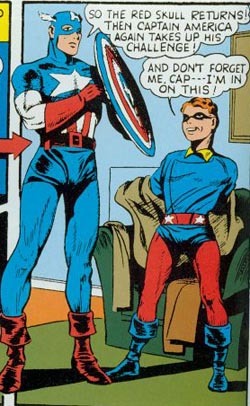
Perhaps, Goodreader, perhaps. How about this? A call to arms against Canada?
Vicious, godless, maple syrup gulping, Canadian bastards.
Go get ‘em, Cap.
And, of course, Bucky, too.
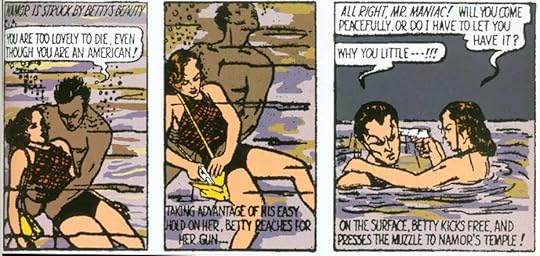
Time hasn’t been kind to everyone’s least favorite underwater jerk:
But it least back in the day, some floozie could even get the drop on him with a well-concealed gat.
And he was still dreaming about his own harem of surface women.
Holy Head Case! Way to help Flounder Boy with his babe action, Ma!
Bottom line: Brubaker does a yeoman-like job in invigorating the origin stories of Captain America, Bucky, Namor, the Human Torch and Toro, while still retaining the wonder and tempo of the times that they were created. If you liked the film, Captain America: The First Avenger or liked his Captain America run, I would check this out.
What difference does it make? You’ll both feel the boot heel of Murica on your cowardly Nazi family jewels soon enough.
Thanks to whoever suggested I read this, but as an Ed Brubaker guy I was bound to get to it eventually. This one is ambitious, drawn lovingly by Steve Epting, colored by Dave Stewart, and gives a nostalgic, retro and human feel to the Golden Age of comics. We get the origins of a band of not Thor or Hulk type superheroes, mostly regular guys, with an ala-Brubaker-Epting noir/Gotham Central vibe to it, maybe making the idea of superhero comics accessible to a wider audience. Why was it there was such a surge of interest in them in the forties (and for Brubaker, a big fan of this era)?
Brubaker, the best interpreter of Captain America, is maybe best with the Cap here, but all the characters in this world whose origins they tell seem poetically done, somehow. The time is the late thirties leading up to WWII, when there might be a need for the axis to require extraordinary heroism, maybe even superheroism. Angel tells the story, leading right up to Pearl Harbor.
So you get stories of the Human Torch, Bucky, Red Skull, Nick Fury, and others. Minor league folks, for the most part, which allows for some human backstories. One example is The Human Torch, created by scientists, a guy who becomes a flame when exposed to oxygen but doesn’t burn out.
It’s a lot, with the stories of many characters coming at you, so that part of it is a little challenging to someone who knows Captain America but not the Human Torch, but it provides a serious context for reading him and others. When it is about characters you know little about it is almost meta-comics; it’s a comic about the need for and love of comics. It talks about that move from saving people from domestic conflicts, from burning buildings to global threats, how’s it all born of the same foundation, whether crime-fighting or world war, it’s patriotism. It’s fighting bad guys for the good of mankind. It’s doing good. Brubaker and Epting make art out of pulp.
It’s comics lore, it’s history. It’s really good stuff, well done. Now I guess I have to read Kurt Busiek’s Marvels as a companion piece.
I read Marvels a while back and really loved it, but this was much better, in my opinion. Both stories run parallel to each other, but they are told from different points of view. The Marvels Project just has more of a story to it. I also loved the way the book was drawn. Beautiful! (Can you call a comic book beautiful?) Everything was glossy and larger than life, but it still had that Golden Age feel to it. I do want to mention one thing. John Steele. It nearly drove me crazy trying to figure out who in the world that guy was. I finally went to Marvel's web page and tried to look him up, but even they didn't have anything on him. Yay, Wikipedia! Not much on him, but at least I fell vindicated for not recognizing him.
Fantastic. This can be read as a sort of companion to the equally fantastic Marvels. Except that this book is set almost entirely just before and during World War II, and that it's entirely the perspective of a superhero instead of an outsider. But it has much the same feel, that it's a memoir of truly extraordinary times by someone very close at hand. There is a fair bit going on, and a lot of basically forgotten Golden Age characters. I think it actually helped me that I've read Marvels more than once, because I've already seen part of this happen before.
It's the late 1930s leading up to the most devastating of conflicts in mankind's history, World War 2, and a young doctor meets a dying old man called Matt Hawkins who tells him of a coming age - of marvels and heroes. From there the doctor realises that one person can make a difference in a world of hate and stands up for himself and others by wearing a mask and policing the streets at night as: the Angel.
Soon, scientists will create a man who bursts into flames when exposed to oxygen but doesn't die and who will become the Human Torch. A German scientist called Professor Erskine, who disagrees with Hitler's regime, will defect to America and perfect the super soldier serum which will give birth to Captain America. Meanwhile, the Nazis will have created a super soldier of their own in the form of the evil Red Skull. As John Steele battles Nazis from behind enemy lines in occupied France, Prince Namor avenges his fallen people by fighting the surface dwellers, and a young Nick Fury heads an early commando unit, the Howling Commandos.
"The Marvels Project" is a superb and engrossing comic book taking in the early days of the age of heroes. Ed Brubaker writes the story from the viewpoint of the Angel who sees ordinary people putting on masks and capes before real superheroes like Cap and the Human Torch show up. It's told beautifully with Brubaker capturing the tone and feel of the era perfectly. At times it feels like Alan Moore's Watchmen because it takes in an earlier time when it was just ordinary people in costumes instead of supes like Thor or Hulk but it only adds to the charm of the book.
The build-up to America's involvement in WW2 is paced beautifully with the creation of Captain America, with Brubaker retelling his origin here brilliantly. It’s a great jumping off point for those who aren't familiar with Cap's story but want to find out, and who better than Cap’s finest writer, Ed Brubaker? Steve Epting's art is incredible throughout. He does small conversation scenes in a lab between two people as artistically and tastefully as doing a full on depiction of Pearl Harbour. The only thing I will say is that he makes Red Skull look a bit too cartoonish, but otherwise the artwork is flawless.
"The Marvels Project" is beautifully written and illustrated and is nothing short of magnificence. I loved every page and can only give it the highest recommendation to fans of superhero comics and for those who are interested but not sure where to start. Utterly terrific storytelling - this is why comic books are art and not pulp.
Brubaker and Epting go back to the Golden Age as they retell and reshape the birth of Marvel. This really is one of my favourites .
The duo have covered early Marvel before via flashbacks in their Captain America run, but here Captain America is only one part of The Marvels Project. It's set before America enters the second world war. So it's during that time when the world is at unease.
Unlike Marvels, this is considered the 'in continuity' origin for Marvel. Brubaker keeps some of the existing stories intact, with the battle between Namor and the Human Torch in New York, and the origin of the Human Torch itself is very similar to what Busiek did in Marvels.
But he connects it all together better to make a story. Like the Namor and Human Torch battle is ended thanks to Captain America and Nick Fury helps Professor Erskine defect from the Nazis. We do get scenes like the Origin of Captain America again (which we have seen countless times over the years), but it's told through a slightly different point of view. All this is done to create a story that we haven't entirely seen before.
Also, I do really like Steve Eptings art. He's sometimes criticised because his characters can look a little stiff, which is sometimes the case, but he's really good at doing period stories (as he is further proving in his current ongoing Velvet). And although he's isn't in it that much, his Red Skull looks fantastic.
Brubaker & Epting continue a beautiful collaboration in the Steve Rogers sub-universe (or maybe Steve Rogers meta-universe?). This is almost Marvels-, Powers-, 1985- or Gotham Central-esque: a lot less superhuman capes, a lot more wide-eyed wonder from the normals point of view. Not that it's any less epic or enjoyable - on the contrary, with these two fleshing out the stories they don't seem so much "quaint" as poetic.
I really enjoy them mining this rich, faded historical backdrop of the Marvel universe and putting some rich, tasty meat on the bones of what originally were some pretty thin premises for otherwise-impossible to relate to origins of this whole phenomenon.
Perhaps in another 20 or 40 years this will look quaint and 2-dimensional but for the moment I'm enjoying the larger than life feeling these stories convey.
Really wish I could remember where John Steele fit into the Marvel myths tho. That one itches like crazy.
I enjoyed reading other Ed Brubaker comics! They're always packed with action and had a good plot line. This was good too but I just found that there were too many characters and so many different things happening at once at different places that I got confused. Nevertheless, a great and exciting read!
Ed Brubaker clearly loves Marvel's Golden Age (AKA Timely Comics) and World War II era superheroics. He injects his Captain America and Winter Soldier storylines with the feeling of these time periods, referencing and drawing from them very artfully, bringing those modern stories to life in a totally new way. With the Marvels Project, he finally gets a chance to just let loose in that time period, and I've gotta say, he does a great job.
Narrated by The Angel, a Batman-like superhero with no powers to speak of (just a couple of revolvers, which I find hilarious), everything in this story is filtered through the point of view of a relative outsider remembering only the most important points in the leadup to America's entry into WWII. Obviously this is not the real world, what with the masks and the capes and the bulletproof dudes, but Angel's narration really puts this firmly in the 40s.
I will say that it ultimately is a little weird that the Angel knows all this stuff, since some of it appears to be top secret and it's never shown how he would've found out about it. Additionally, his involvement in the events at hand is minimal at best, and as such feels like it's being narrated by a fairly unimportant character. However, this is a minor quibble, as the book really just reads like an animated history of the formation of the Marvel Universe.
I love seeing these old superheroes and how the general public reacts to them. This is stuff that's been explored before (Marvels, Astro City, etc.), but planting it so firmly in history makes for a really exciting read. We get origins for the original Human Torch, Toro, Captain America, Bucky, an introduction to John Steele, and a few other Golden Age heroes that Brubaker does an excellent job fitting into that era. The Marvels Project feels like a modern storyline and a classic storyline simultaneously, and I absolutely flew through it. If you've read any of Brubaker's other Cap stuff and enjoyed it, I highly recommend this one, as well.
There have been many retro stories since Alex Ross's Marvels, but The Marvels Project feels distinctly like a response to it. It's not just because of the name or time period - though The Marvels Project does retread some of the key historical events of Marvels. Marvels was primarily narrated from the perspective of a reporter whose career spanned the dawn of superheroes; this book is primarily narrated by an investigator in the same dawn. Where books like Marvels and New Frontier were keenly historically aware, The Marvels Project is more interested in comics lore. Our investigator becomes The Angel, a lower-tier hero whose narration is sympathetic to his fellow heroes, even as they completely outstrip him.
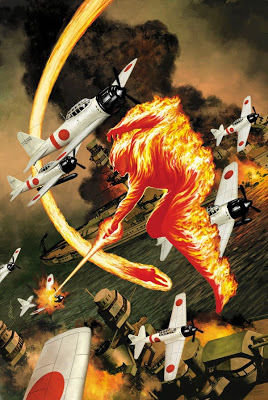
At its best, The Marvels Project channels the awe and magnitude of Marvels. During the second fight between The Human Torch and Sub Mariner, New York City is devastated and half-submerged under waves. Rather than focus on the fistfight, we watch as a generation of unpowered or less-powered heroes try to pull civilians to safety and stop buildings from collapsing. It's also there that Dave Stewart's art stands out the strongest, as he and his colorists capture the rapid motion of waves and destruction. The Human Torch is a vague silhouette of a man in a fireball, at once eerie and beautiful. Even at his brightest, the color pallet it muted, tinted as though by the newsreel quality of the time (though the book never descends into mere sepia-tone). With these colors, a flowing green cape fits right into the grey world of 1940s New York City.
Stewart's art direction and the combined efforts at awe are the strongest points, while plot is the weakest. This book was clearly written for people who are familiar with or have unquestioning love for superhero comics. You don't get Namor or Red Skull's origins; you're supposed to recognize U-Man and John Steele. The solace Ed Brubaker's writing offers is that most characters fall into the good (superheroes, U.S. soldiers) and the bad (Nazis, Nazi allies), with The Angel clearly explaining if somebody is in-between, making the story possible to follow for the uninitiated, if less satisfying. You will not fall in love with many of these characters because of their portrayal here; the point is that the world already fell in love with them, and in a pulpy way, this skims along and reflects upon their rise. Like the reporter in Marvels, The Angel's narration is reflecting on a world his audience is supposed to have lived in. Being a history, there is a great deal of character development insofar as characters change dramatically, but with very little depth of explanation as to why. If you read it with the intended sense of awe for the dawn of a new age, this is a fabulous book.
This eight-issue miniseries by writer Ed Brubaker and artist Steve Epting reimagines the early days of Captain America, Bucky, Namor the Sub-Mariner, Nick Fury, the Angel, the Human Torch, Toro, the Red Skull, and many other World War II-era characters from Timely Comics (which would later become Marvel Comics), and tells the story of how the Nazi-fighting super-team the Invaders were formed. It begins in the late '30s and ends on December 7, 1941.
On the one hand, this is basically just a retelling of origin stories that most serious comic fans already know. On the other hand, it's a beautifully told pulp story that evokes a sense of doom and a world in flux on the level of the old Norvell Page "Spider" stories. It could have easily taken the iconoclastic tone of Watchmen, but instead engages in mythmaking on a grand level. I can't quite put my finger on why I liked it so much. I like pretty much everything that Brubaker writes, but the tone of this work, and the feelings it evoked in me, were really something special.
I re-read this last night, and by the next morning, I'd forgotten most of the story... or maybe it was more of a "was there actually a story in this?" kinda feeling.
That's just it... there isn't much of a story, just a few snippets here and there to tie in some of Marvel's Golden Age characters.
It mostly centers around the Golden Age Angel, which was an obvious rip-off of the Batman. Once in a while you get a bit about the Human Torch, or the Submarinner or Captain America... and if you pay attention, you might notice Nick Fury in there as well.
A character I'd never heard of before, John Steele, also gets a little screen time... but frankly, this was an obvious ripoff of Philip K. Wylie's Gladiator.
Luckily, the art is nice and makes the whole thing worth looking at. It still lacks anything close to an actual story though.
Excellent work by Ed Brubaker and Steve Epting! It's clear in this book the love and enjoyment they had with the characters with Easter Eggs like old characters making special appearance that people new readers might not know about, Jim's badge number, Invader gang Steve, Jim, Namor his old grumpy self, Buck and Toro and paper clips in back of the story. Very enjoyable! I wish Ed was back on Captain America/Steve Rogers.
3'25 de 5⭐. No es que no me gustara su lectura, es solo que me ha decepcionado algo, y de ahí que le haya bajado una estrella. Lo más destacable es el arte de Steve Epting, tan detallista y casi fotorrealista. Y Ed Brubaker es uno de mis guionistas de cómic favoritos de todos los tiempos, junto a Greg Rucka, Frank Miller, Alan Moore, y Xavier Dorison, entre otros.
Mi razón para bajarle una ⭐ viene de la edición en la que lo leí: la de Marvel Héroes que encontré de segunda mano en la cuesta de Moyano de Madrid, la misma en la que tengo también el Marvel 1602 de Neil Gaiman. No me quejo de que el papel sea como de revista, dado el precio tan bajo al que los compré, sino que lo titularan erróneamente como "Capitán América: Proyecto Marvels", pero este superhéroe que, junto a Daredevil y Spiderman, es de mis favoritos de la Casa de las Ideas, no aparece hasta el n° 5, de 8 partes que hay en total.
En cambio, sí tienen más protagonismo otros personajes y superhéroes, que no desvelaré aquí para que os sorprenda más cada una de sus apariciones estelares. Precisamente ese es el otro fallo que tiene la edición de Marvel Héroes: al leerme su presentación previa, me destripó cada una de dichas apariciones de los Prodigios, así como algunos de los sucesos vividos por ellos. Lo bueno de las presentaciones es que van bien para ponernos un poco en contexto, pero yo no sabía apenas de los orígenes de Timely, que era como se la conocía en sus inicios a Marvel, al ser más fan del Cómic europeo, y del Americano siempre he preferido más DC, por lo que me chafaron el factor sorpresa en más de una ocasión.
Aún con todo, es una lectura muy entretenida que gustará a todos, tanto si sois marvelitas como si no.
I went in wanting to compare this read to Marvels & come out liking one over the other (find one a better story/read), but I honestly like them the same. Both Brubaker & Busiek take the same Marvel superhero origin story (stories), but tell them through very different lenses. Where Marvels was told by an outside perspective (macro), The Marvels Project is narrated by Angel, a superhero, and is told from an insider's perspective (micro). I'm sure readers will favorite one over the other, but I honestly liked both the same, and enjoyed the differences in storytelling. Actually, I got a little more in backstory and motive from this book, which I maybe liked more... Especially where Prince Namor was concerned. But other than that, the same!
The art here is a little gritty, darker, and on the ground (in dark alleyways & on dark streets). The story is violet, there's death , and there's a real focus on the fight against Nazis in WWII.
Overall, a 4 star story. I loved the variant covers by Gerald Parel, featured at the end of the book, especially #4 of Steve Rogers as a boy with the shadow of Captain America over one shoulder and Hitler on TV over the other.
I wanted to like this more than I did (Brubaker & Epting = so good!), but it just seemed to be missing a big plot twist or something. Or maybe I just missed it entirely? The John Steele character distracted me too, as he almost seemed to be heading in a "oh, he's really THAT GUY?!" direction, but he just ended up being "so, WHO was he?" instead. Love the old 1930's/1940's New York setting. Steve Epting is an understated master. I think it's time I read this again. EDIT: After reading it a second time, I realized where the problem is for me. I actually enjoyed all 8 issues so much; there's spies + intrigue, awesome action sequences, great characters, and evil on a global threat. My problem is that it builds and builds to a point where there is no real payoff. Sure it's all leading up to the Pearl Harbor attack of WWII - which is no doubt important - it just felt like we needed more. Probably another two issues would have been all it took. The Angel is an interesting character to tell the story through, but as the story concludes, it really didn't matter who was telling the story, which I see as a problem. Still, I'm happy to own this collection and will no doubt re-read it many times over.
This was an excellent early Marvel story, set in the golden age of heroes. This will probably be the last new material using the older heroes for quite some time, since Marvel thinks readers' sensibilities have changed (and they have; we kind of prefer decent stories nowadays, not 90% of the crap they put out so it can be licensed into movies and toys).
This takes place before and during the first issue of the legendary original Marvels series, with the advent of super-heroes and masked mystery men in New York. The original Human Torch, the Angel, Captain America, and Sub-Mariner are on hand, as well as quite a few more obscure characters like John Steele and the Ferret, and cameos by Thin Man, Destroyer and many others. The story itself is top notch, following the attempts to prepare the US for its seemingly inevitable entry into the War with Germany, and there are many hands in the fire to try and prevent that.
I'm not the biggest Brubaker fan, but this time he did his characters good; there's some unavoidable retroactive continuity, but everything's pretty true to the universe created by those early Timely Comics writers and artists, and fleshed out by Roy Thomas in the seventies.
Recommended reading for any golden age comic book fan.
Yes, I've been working on running through Ed Brubaker's time at Marvel Comics (excluding Daredevil). Here Brubaker makes very good use of Marvel continuity and history. When one evaluates the entire catalog of characters available to the company (pre-Disney ownership this included almost the entire Timely Comics line of the 1940s) it makes a good deal of sense to center a story around lesser known characters. That permits the creative team more leeway in character development and what one one does to characters (ex: kill a couple off, introduce one).
Combing a little bit (emphasis on little) bit of time travel (re: Matthew Hawk) with the early 1940s we see the beginning of the career of the non-superpowered Angel. Much like the use of narrative character in Marvels the Angel is a ground floor view to the introduction of superheroes to the world (Captain America, Human Torch and Sub-Mariner)
Decent story that is worth reading. Not the best, but certainly very good.
If you ever wanted to see how Golden Age stories for Marvel Comics would be written today, this is a good read. It's a bit of nostalgia for key characters that shaped the Marvel Age of comics in the 1960s and 1970s.
It give some much-welcomed character development for the Original Human Torch and Toro, Captain America, and Sub-Mariner. There are some original characters and side characters that kinda-sorta drag down the story, though. It would have been better to focus on the core characters because these are the most interesting to modern readers.
It works well as a mini series, but would probably have been even better as an ongoing series. If you liked Roy Thomas' Invaders work, this will make you happy!
The art is just gorgeous. Every panel is a masterwork.
A really great re-telling of the early days of the Marvel universe, utilising some familiar characters like Captain America, the Invaders, and Nick Fury, plus some long forgotten characters like John Steele and Red Hargrove.
A Golden Age tem aqui uma justa revisitação, em jeito de homenagem, eivada de magia-noir (marca d'água brubakeriana) e encantamento bélico cuja intensidade é digna de emparelhar com as mais belas sequências kubertianas de Enemy Ace.
Os seus pontos mais altos serão a opção feita para a narração, a edificação dos alicerces do imaginário dos Super-Heróis da Golden Age (que em «The Winter Soldier» se notam como desejadas colmatações de lacunas geeks) e o encerramento da própria história, enredada em si mesma.
Decerto que nem tudo serão perfeições, mas a arte de Epting (quiçá ainda melhor aqui que em «The Winter Soldier») está à altura do génio de Brubaker, e juntos bafejam o leitor com uma espécie de cápsula do tempo convertida em «Origem». Uma maravilha. [ou seja, não vou enumerar quaisquer pontos menores, porque estes são justamente obnubilados pelo brilhantismo da bigger picture.]
Such a cool retelling and reimagining of the Golden Age of Marvel comics!! I really loved this.
Let’s be honest... as influential and great as the golden age was... those panels, dated dialogue, vaudeville-esque exposition and garish colors make them a slog for modern readers such as myself. Now, full disclosure... I’ve done it before. I’ve read old shit that I struggled through in the name of being well rounded and “cultured,” but it wasn’t fun. This takes those amazing characters and brilliant stories and updates them for my palette. This was very, very enjoyable. The artwork popped. The action was fun to follow. The writing was slick, and everything flowed.
I’d love to see more stuff like this. There are many, many old stories that could use a 21st century makeover.
Is that heresy? Maybe! Who cares. This is good shit.
It was pretty good, but there are some parts where maybe they were a little too silver age and I didn't know who was what. My problem, not the books, but it was a lot of "I bet that's a cool Easter Egg for someone" but it wasn't me.
Now that I know there are sequels to the original Marvels I'm going to find them and see what's up. The descriptions all sound a little too much like "what if we just told this story again...?" but who knows.
edit: read it again after the first Marvels and the Marvels: Eye of the Camera series and yeah this is basically "hey what if we told this story again". Annoyed though that at least EotC tried to continue the story a bit so this seems a step backwards for sure.
By far one of the BEST Marvel mini series of all time in my opinion. Set in the 1930s & 40s, this book (told over 8 parts) tells (or retells depending on your POV) how the Marvel superhero universe came to be. There's a slit bit of retconning here and there but it works. What we have is an extended version of book 1 of the 1994 Marvels by Kurt Busiek & Alex Ross told from a heroes point of view and again, it just works! Very much worth a read before the new "Legacy" books tear up Marvel canon to make way for the movie canon.
Trying to get into the Invaders team and was told this is a good starting point. It retells the origin of Marvel's Golden Age WWII-era superheroes - like Captain America, Namor, & the original Human Torch - and the dawning of the first "superhero age" in the Marvel 616 continuity. Story was nicely told and the art is... fine but really not my taste (heavy black inking looks bad when paired with realistic painterly coloring IMO). Not something I'd go back and revisit, but it served its purpose of introducing me to the characters.