Jump to ratings and reviews
Rate this book

Cane

Rate this book
A literary masterpiece of the Harlem Renaissance, Cane is a powerful work of innovative fiction evoking black life in the South. The sketches, poems, and stories of black rural and urban life that make up Cane are rich in imagery. Visions of smoke, sugarcane, dusk, and flame permeate the Southern landscape: the Northern world is pictured as a harsher reality of asphalt streets. Impressionistic, sometimes surrealistic, the pieces are redolent of nature and Africa, with sensuous appeals to eye and ear.

116 pages, Paperback

First published January 1, 1923

723 people are currently reading
16933 people want to read

About the author

Jean Toomer

53 books144 followers
Jean Toomer (December 26, 1894 – March 30, 1967) was an American poet and novelist and an important figure of the Harlem Renaissance and modernism. His first book Cane, published in 1923, is considered by many to be his most significant. Of mixed race and majority European ancestry, Toomer struggled to identify as "an American" and resisted efforts to classify him as a black writer.

He continued to write poetry, short stories and essays. After his second marriage in 1934, he moved from New York to Doylestown, Pennsylvania, where he became a member of the Religious Society of Friends (also known as Quakers) and retired from public life. His papers are held by the Beinecke Rare Book Library at Yale University.

(from Wikipedia)

Ratings & Reviews

What do you think?
Rate this book

Friends & Following

Create a free account to discover what your friends think of this book!

Community Reviews

5 stars
3,381 (29%)
4 stars
4,005 (34%)
3 stars
3,023 (26%)
2 stars
917 (7%)
1 star
210 (1%)
Displaying 1 - 30 of 989 reviews
Profile Image for Cheryl.
525 reviews844 followers
January 12, 2020
My friend knows how infatuated I am with literature from the Harlem Renaissance era, so he called when he included this book on his teaching list. It brought back memories of the many literary socials we had over a few brews on our grad school's verandah: readings, discussions, snippets of music here and there, more readings, which led to social commentary and such, which, in turn, led to just plain chitchat about book preferences and how they affect everyday life; a conversation that lasted past midnight and brought our colleagues to the verandah for either a drink, or to say please keep it down I'm working on my lecture notes.

I could use layers of perspective, he told me. So I pulled this book from my shelf and highlighted sections. Then I pulled my copy of The New Negro, edited by Alain Locke (one of my favorite writers from that period), and highlighted William Braithwaite's excellent essay, "The Negro in American Literature" where he notes: "Cane is a book of gold and bronze, of dusk and flame, of ecstasy and pain..." To give a personal look at Toomer and the discussion around the writing and controversial publishing of Cane, I referenced sections of Langston Hughes' The Big Sea and highlighted sections of Henry Louis Gates' Afterword in this copy.

Jean Toomer was the first writer of the twenties to encapsulate black peasant life. Having lived in Georgia, I'm familiar with the Sparta he writes about and in most instances, the portrait remains the same. It is said that Ernest Gaines finds that he and Toomer shared a similar commitment to writing about the lives of black farmers. Cane, with its singular structure of poetry, prose and drama, contributed significantly to Afro-American modernism. Toomer referred to it as his "swan-song," the "song of an end." He was trying to record a fading art form that would transition during the first part of the twentieth century:

"The earth is round. Heaven is a sphere that surrounds it. Sink where you will. God is a Red Cross man with a dredge and a respiration-pump who's waiting for you at the opposite periphery. "

Toomer was a black man who passed as white (according to census records evidenced in this copy). While writing this book, he enlisted help from well-known African-American writers like Alain Locke and Claude McKay. He also attended literary gatherings in Harlem. Unlike his African-American colleagues, however, he could also attend white literary gatherings. Once Cane was published to much acclaim, Toomer hated when writers (like Waldo Frank) referred to him as a black man in their reviews of his book. He did not want to be given a race and felt that "a portrait of him as a Negro in the literary circles of New York" had been constructed. He eventually stopped marketing his book. The book didn't sell well, but made a literary mark and was printed in a second edition.

I wonder how, with all the references to race and n-words, with the sacred vernacular of Afro-American life, with those very intimate portrayals of black people, how could anyone read this, or want to read it, if they did not think it was written by a black writer? I may not love the poetry in Cane, but I admire the lyric in the prose. For instance, I always pause at the simple complexity in this sentence from Fern:"Face flowed into her eyes." The fragmented style of writing and the character portraits produce poignancy of people and place. Those who love drama may want to first turn to "Kabnis."
Profile Image for Reggie.
138 reviews465 followers
July 7, 2021
Respect and admiration are the first two words that come to mind when I consider what Jean Toomer did with Cane.

Cane is innovative and experimental. Filled with beautiful imagery and language. Cohesive themes to compliment it's not all times cohesive, yet not all times jumbled, structure. A structure that was ahead it's time, and is still ahead of our time. I can safely say, from the few fiction books that I've read in my lifetime, that there is no one that I've read who is putting a novel, if you will, together the way that Jean Toomer put Cane together.

The most fascinating thing about this novel is that it has become the first novel that I've labeled—which Toomer would probably hate—as "autobiographical in structure." Toomer was a man who did everything in his power to avoid being placed in boxes—especially if said box was a "race" box. He did everything in his power to make sure that his sole novel, published in 1923, couldn't be boxed, which surely explains why he included vignettes, stories, songs, poems, and even a drama within the world of Cane.

Ultimately—even with all of the high qualities that Cane possesses which results in many a reader throwing respectful and admirable remarks towards it—I didn't care. I had to work too hard to try and enjoy this book. I read it, then went back and listened to the audio version available on Spotify. Too many occasions occurred where I wondered if there was something better I could be doing with my time. A thought that typically occurs right before I'll DNF a book.

I'm glad to have given Cane a chance, but I'm probably more satisfied to be able to say that this novel is behind me. Perhaps my current relationship with Cane is the prime example of wrong time and place; A textbook case of Wrong Reader + Wrong Book = No compatibility.

Maybe some months, or even years away from each other will make our hearts grow fonder. Maybe next time our relationship will be 5 stars.
Profile Image for Tim Null.
349 reviews211 followers
September 1, 2024
I read the Penguin Classics version of Jean Toomer's Cane. It has a Foreword by Zinzi Clemmons and an Introduction by George Hutchinson. Hutchinson's introduction was my favorite part of this book. It motivated me to order Hutchinson's book on the Harlem Renaissance.

Right off the bat, Toomer painted a bleak picture for women in a world dominated by male cads. As the book progressed, Toomer's view of white males never improved.

Jean Toomer's professional and personal friendship with Waldo Frank was perhaps a precursor of the Black and Jewish alliance during the Civil Rights Movement in the 1960s.

I found Jean Toomer's Cane to be to the literary world what Pablo Picasso's paintings are to the art world: stunning and, at times, somewhat confusing. In short, Toomer's Cane isn't a beach read. It's a collection of stories and poems, and the stories are frequently more like profiles than adventures. Like a Picasso painting, Toomer's stories are very accessible at one level while remaining inaccessible at another. But that's understandable. In Hutchinson's introduction, we find that Toomer couldn't really speak his mind outloud because that might have gotten him hung from a nearby lamppost.

According to Hutchinson: Toomer, as a biracial man, anticipated a universe where race didn't matter because all the races would be mixed together. In Toomer's future universe, there would be no colored vs. non-colored dichotomy because we would all be different shades of the same color.

It seems now that the Trumpets are the ones who are anticipating Toomer's universe, and they are scared to death by the thought.

Toomer apparently anticipated someone like Donald Trump, and Toomer recommended that at his demise, we sing about the promised land with joy in our hearts.

"Brother, [Donald] is sinking.
Let's open our throats, brother,
Let's sing Deep River when he goes down."
Profile Image for Kevin.
595 reviews214 followers
December 25, 2022
As a writer, Jean Toomer was an experimenter and an innovator. His style intertwines poetry and prose in such a way that one flows in and out of the other. For me, Cane reads like improvisational jazz; there is often a repetition of verse that sounds more like song than soliloquy.

Nowhere is Toomer’s influence more readily apparent than in the work of Langston Hughes. Cane is a precursor to Langston’s The Ways of White Folks - the two complement each other so well that they very nearly read like volume 1 and volume 2 of the same narrative. On the other hand, Toomer’s characters seem much less stereotyped, much less binary, and perhaps, consequently, much less commercial. That may explain why almost everyone has heard of Langston Hughes and almost no one has heard of Jean Toomer.
Profile Image for Janet.
Author 25 books88.9k followers
January 30, 2015
An astonishingly beautiful, sensual, lyrical, formally experimental book. In character vignettes of one, two, three pages interleaved with short poems, Toomer explores the lives of black people, mostly in the rural south, specifically a tiny hamlet dominated by a sawmill (marked mostly by smells and sounds), sugar cane fields and pines, the timeseason--autumn, the time, dusk. In fact, every story in this collection could be called 'Dusk'--with all its overtones. Though largely rural, a couple of the portraits are of city people--and though Toomer was associated with the Harlem Renaissance, the city is Washington DC, where Toomer grew up, a weird liminal zone between North and South.

A man of mixed race, son of prominent people back several generations, an interesting American tale in itself, he struggled with America's sense of categorization of race. Toomer was a very complex person and his portraits are equally complex, and extremely poetic. He didn't write much after Cane, and spiritual quests occupied much of his life. He followed Gurdjieff, he was a Quaker, he corresponded with Edgar Cayce, and even studied Scientology. A restless seeker, he was a subtle and questioning man, and Cane is a tour de force.

Here's a lyric passage in a piece called "Blood-Burning Moon":

"Up from the deep dusk of a cleared spot on th edge of the forest a mellow glow arose and spread fan-wise into the low-hanging heavens. And all around the air was heavy with the scent of boiling cane. A large pile of cane-stalks lay like ribboned shadows upon the ground. A mule, harnessed to a pole, grudged lazily round and round the pivot of the grinder. Beneath a swaying oil lamp, a Negro alternately whipped out at the mule,and fed cane-stalks to the grinder. A fat boy waddled pails of fresh ground juice between the grinder and the boiling stove. Steam came from the copper boiling pan. The scene of cane came from the copper pan and drenched the forest and the hill that sloped to factory town, beneath its fragrance It drenched the men in circle seated around the stove. Some chewed at the white pulp of stalks, but there was no need for them to., if all they wanted was to taste the cane. One tasted it in factory town. And from factory town one could see the soft haze thrown by the glowing stove upon the low-hanging heavens."

Here's a passage from 'Fern': (my favorite story)

"We walked down the Pike with people on all the porches gaping at us. "Doesnt it make you mad?" She meant the row of petty gossiping people. She meant the world. Through a canebrake that was ripe for cutting, the branch was reached. Under a sweet-gum tree, and where reddish leaves had dammed the creek a little, we sat down. Dusk, suggesting the almost imperceptible procession of giant trees, settled with a purpose haze about the cane. I felt strange, as I always do in Georgia, particularly at dusk. I felt that things unseen to men were tangibly immediate. It would not have surprised me had I had vision. People have them in Georgia more often than you would suppose. A black woman once saw the mother of Christ and drew her in charcoal on the courthouse wall [this drawing appears in other stories]… When one is on the soil of one's ancestors, most anything can come to one…"
Profile Image for Alwynne.
940 reviews1,596 followers
November 12, 2020
Cane was a lyric essence forced out with great effort despite my knotted state. People have remarked its simply--easy flowing lyricism, its rich natural poetry; and they may assume that it came to bloom as easily as a flower. In truth, it was born in an agony of internal tightness, conflict, and chaos. It is true that some portions, after I had cleared the way, came forth fluently. . . . But the book as a whole was somehow distilled from the most terrible strain I have ever known. . . . The feelings were in me, deep and mobile enough. But the creations of the forms were very difficult. During its writing and after it, I [felt] that I had by sheer force emptied myself and given to that book my last blood. - Jean Toomer

Jean Toomer's landmark 1920s novel's experimental and episodic, sometimes difficult to follow, at times it seems Toomer's more interested in evoking an emotional or aesthetic response or in creating a series of impressions for readers to contemplate than he is in telling any kind of conventional story. So it didn't surprise me to find that sections were originally published in avant-garde, literary journals notably Broom and The Little Review.These were publications that typically featured writers like Virginia Woolf, suggesting that Toomer, who's now routinely associated with the Harlem Renaissance, was also strongly linked to the development of modernist styles of writing - there's a possibility that aspects of his work influenced Woolf's later more abstract narratives.

Toomer didn't see himself as a 'black' writer, at times he actively resisted that label. He was biracial, clearly deeply conflicted about his identity and his literary allegiances, often more explicitly interested in modernism than in exploring America's deep racial rifts and prejudices. Yet Cane with its play on genre boundaries and its fascinating mix of prose and poetic styles, is also a powerful representation of the trauma of living as a black person in a racist America. The numerous vignettes that make up the novel centre on black culture and black communities, their world is dangerous, brutal, full of threats that seep into every aspect of their existence, like the beautiful braided hair of a local woman that Toomer compares to a lynch mob's rope. There's a visceral immediacy in much of Toomer's book, particularly the passages set in a small town in Georgia, conveyed in scenes of lust, brutality, heartrending grief and the portrayal of dreams of a better life that will clearly never bear fruit.

Toomer's adept at conveying the fragility and violence of everyday existence for his characters, as well as their continuing strength and determination not to be defined by the racism they encounter, not to be reduced to little more than victims. Despite its challenging structure I found this surprisingly readable. Although, apart from the Georgia sections, I often found it hard to directly connect to Toomer's words, there's an unevenness, a lack of balance that detracts at times from Cane's sense and force, sometimes overblown, hyperbolic, and sometimes almost wilfully archaic and awkward. This isn't a book I can say I liked or even always admired - the portrayal of women here is particularly problematic - yet I was often gripped by it, at its best it's a haunting, impressive depiction of the experiences of Black Americans living in a particularly turbulent time and place.
Profile Image for Michael.
1,094 reviews1,967 followers
April 19, 2015
Powerful and poetic vignettes of blacks in rural Georgia and immigrants to the Washington D.C. area near the turn of the 20th century. We feel their daily integration with their mind-numbing, dusty work in the cane fields or saw mills and feel their struggle against internalized forms of racism and sexism. In the urban environment, we feel their mix of hopes for promised freedom and of their alienation and despair of continual poverty. Some find a connection in churches to the values from their rural origins while others seethe with anger and jealousies and get in trouble or numb themselves with drink. The rise of the jazz age call some to other avenues of hope and make a backdrop for others haunted by forbidden interracial lust.

Toomer’s capturing of the rhythms of speech by ordinary people is a marvel that feels to me the equal of the more prolific fellow member of the Harlem Renaissance, Langston Hughes. It was a bit of a surprise to experience his sensitivity in portraying women in his first six stories. I admire the adaptation of repetitive call and response schemes common to the Baptist church. One story begins and ends with the haunting refrain:
Betty was the white woman who had two Negro sons. She’s dead; they’ve gone away. The pines whisper to Jesus. The Bible flaps its leaves with an aimless rustle on her mound.

The poems placed between narratives make for moving or shocking interludes. For example, two poems frame a story of a black housekeeper who is courted by the white son of her employer. Jealousy on the part of a black admirer leads to a fight ending with the white getting his throat cut and the victor getting burned up in an old cotton factory by a white mob.

u>Portrait in Georgia
Hair—braided chestnut,
coiled like a lyncher’s rope
Eyes--fagots
Lips--old scars, or the first red blisters
Breath—the last sweet scent of cane
And her slim body white as the ash
of black flesh after flame


The following incantation is repeated three times with the story of the tragedy:
Red nigger moon. Sinner!
Blood-burning moon—Sinner!
Come out that fact’ry door.


I see why this work is considered a seminal voice in American literature. Although this book is typically identified as “black literature”, Toomer himself, whose mixed blood allowed him often to “pass” as a white, once advocated for a broader view in a letter to a magazine:

“From my own point of view I am naturally and inevitably an American. I have strived for a spiritual fusion analogous to the fact of racial intermingling. Without denying a single element in me, I have sought to let them function as complements. I have tried to let them live in harmony. Within the last two or three years however, my growing need for artistic expression as pulled me deeper and deeper into the Negro group. …Now I cannot see myself as aloof and separated. My point of view has not changed; it has deepened, it has widened.
Profile Image for robin friedman.
1,946 reviews414 followers
March 21, 2025
Jean Toomer's Cane

Jean Toomer's "Cane" (1933) is one of the lesser-known masterworks of American literature. An enigmatic figure, Toomer (1894 -- 1967) wrote "Cane" at the age of 27 and never published another novel, assuming that "Cane" itself can loosely be so described. The book frequently is described as initiating the Harlem Renaissance, even though Toomer did not live in Harlem when it was written and nothing in "Cane" is set there.

"Cane" is a difficult, modernistic book that resists easy summarization. It is a mixture of poetry, short stories and vignettes, and closet-drama. The book is in three sections, with the first set in a rural community in northeast Georgia while the middle section is set in African American neighborhoods of Washington D.C., and in Chicago. The third section returns to a small Georgia community. The writing is tight, imagistic, and suggestive. The book lacks plot and linear development. The unity the book has derives from allusiveness and from related themes.

Raised by an upper-middle class Washington, D.C. African American family, Toomer was a wanderer and a seeker. In 1922, he received an offer to teach at a rural school in Georgia for African Americans. This experience, his first exposure to rural African American life, resulted in "Cane". The book has a strong autobiographical flavor and an intensity which results from an overwhelming experience of discovering something for the first time.

Readers may differ about the main themes of "Cane". It discusses African American life, but in a form that was changing and passing away even as Toomer wrote about it. Toomer portrays rural southern African American life while contrasting it with developing In its portrayal of women and men and the different ways they understand sexuality, the book has a strong erotic component. The book also describes lonely, isolated people of both genders and different races who show an inability to make connections with others. While there are many realistic descriptive passages in "Cane", the predominant tone is one of mysticism. (In later life, Toomer became, successively, a student of Eastern religion, a follower of the Russian spiritual teacher Gurdjieff, and a Quaker.)

The first section of the book features six short stories set in Georgia interspersed with poems which illuminate them. Each of the stories focus on a different young woman and on the nature of her sexual experiences with men. Among other things, the stories show how men and women differ in their view of physical sexuality. The stories are raw, elliptical, and absorbing.

The second section of "Cane" opens with an impressionistic description of Georgia Avenue, a major African American thoroughfare in Washington, D.C. There is another combination of poetry and short stories, which tend to be slightly more elaborate than the stories in the first part. The stories suggest that African American migration to cities came at the cost of a loss of spontaneity and zest for life. Several of the stories have themes about sexual relationships between men and women that expand upon the earlier part.

The third and most difficult part of "Cane" is a short story in the form of a closet-drama, called "Kabinis". The primary character, Ralph Kabnis, shares traits with Toomer in that he is a northern African American who takes a job teaching in an African American rural Georgia school. Kabnis has difficulty understanding his new surroundings. As the story develops, he meets local African American men, an outsider who shares some of his own traits, and a series of young women, ranging from the innocent to prostitutes. There is also a mysterious, elderly, prophetic figure. The story is highly atmospheric and descriptive as Kabnis at the end comes to a degree of understanding of himself and of the southern African American experience.

In later autobiographical writings, Toomer offered the following observations about "Cane" and about why he never wrote a successor work. After describing the tension even in rural Georgia between traditional life and the pull towards urbanization, Toomer wrote:

"The folk spirit was walking in to die on the modern desert. That spirit was so beautiful. Its death was so tragic. Just this seemed to sum life for me. And this was the feeling I put into Cane. Cane was a swan-song. It was a song of an end. And why no one has seen that or felt that, why people have expected me to write a second and a third and a fourth book like Cane, is one of the queer misunderstandings of my life."

"Cane" brings an immediate emotional impact to the reader, while still demanding to be read slowly and carefully and pondered. I have used a Norton Critical Edition of "Cane" which includes valuable commentaries and critical articles, including Toomer's autobiographical writing quoted above. Toomer's novel also is available in a Library of America volume devoted to African American novels of the Harlem Renaissance. Lovers of American literature will want to get to know Toomer's seminal work.

Robin Friedman
Profile Image for Nancy Oakes.
2,019 reviews918 followers
February 2, 2021
I had no idea that I was going to love this as much as I do.

more soon. I need to think first.
Profile Image for Zadignose.
307 reviews178 followers
Read
April 5, 2017
This is quite a brilliant, remarkable, and odd book that somehow no one told me personally that I should read. Why has the secret been kept? Okay, a recent check confirms that Bloom had it on his Western Canon list. But Toomer's just a name, how was I supposed to know he's actually good?

It is, to a large extent, a portrait of many of the horrors and a few of the beauties of small-town post-slavery but-still-gravely-unjust southern life from a black perspective. It's also an uncharaterizable amalgam of styles and modes, incorporating some lyric poetry, some straight narrative, some psychological insight, some expressionistic stuff, some borderline surrealism, all processed deftly by an innovative and masterly mind.

Somehow he works in such oddities as this:
"Her mind is a pink meshbag filled with baby toes,"


...without throwing the novel into pure abstraction. Well, okay, but the whole "Rhobert" chapter is rather far-out, as far as far-out goes.

Here are some other little snippets I liked:

"...words is like the spots on dice: no matter how y fumbles em, there's times when they jes won't come."

"God, he doesn't exist, but nevertheless He is ugly."

"As he steps towards the others, he seems to be issuing sharply from a vivid dream."

"Th form that's burned int my soul is some twisted awful thing that crept in from a dream, a godam nightmare, an wont stay still unless I feed it. An it lives on words. Not beautiful words. God Almighty no. Misshapen, split-gut, tortured, twisted words."


Now, it's fair to say there are a couple of chapters where the author may trip up a bit. Though I may not be able to say why, the chapter "Box Seat," seemed to go wrong in precisely the same way most of the other chapters went right. Just something in the way the pieces fit together felt more put on, or something like that. And another chapter too, fell perhaps a little below brilliance. But I reckon those are the kinds of stumbles that happen when you dare to take big risks as an author and aim at something both fantastic and grotesque. And I'm not so confident in my judgement that they were stumbles, rather than something that just rubbed me the wrong way as I suspect one part or another of this book is likely to rub any reader the wrong way, once in a while.

Don't let my hesitation detract from the overall message that this book is a phenomenon.
Profile Image for Faith.
2,229 reviews677 followers
April 2, 2018
"Karintha is a woman. Men do not know that the soul of her was a growing thing ripened too soon. They will bring their money; they will die not having found it out...Karintha at twenty, carrying beauty, perfect as dusk when the sun goes down. Karintha..." This book is a structurally-inventive mix of prose, poetry and drama with beautiful language. This new edition also contains an essay about the question of race and the life and career of the mixed-race Toomer who was an important figure in the Harlem Renaissance and modernist literature.
Profile Image for Z..
320 reviews87 followers
Read
March 8, 2023
"Life bends joy and pain, beauty and ugliness, in such a way that no one may isolate them."

Jean Toomer's Cane wasn't the first work of fiction published by an American author of African descent (I'm phrasing it that way for a reason, which I'll get to later), but it was a watershed book which can fairly be said to have laid the foundation for the African American novel as we now know it. While some of the names remain familiar, few readers outside of university programs are likely to have encountered the fiction of Paul Laurence Dunbar, Charles W. Chesnutt, James Weldon Johnson, Harriet Wilson, William Wells Brown, or Hannah Crafts—all pre-Cane writers. The Black novelists who are widely read today—Larsen, Hurston, Wright, Ellison, Baldwin, and so on—all published their fiction in a post-Cane world.

That's an odd fact, because Cane doesn't read like the start of anything. Usually the earliest examples from an artistic tradition will have a certain rudimentary feel: Beowulf is important, but it's not exactly a nuanced study of the human condition. Cane, on the other hand, is complex, intricate, layered, referential, experimental; it's definitely commenting on earlier depictions of Black life, but it also feels like it could be deconstructing works which were still years in the future, like Their Eyes Were Watching God. It mixes genres, forms, styles, settings, and characters completely unapologetically, trusting the reader to keep up—or not. It has passages of lofty poetry but also isn't afraid to be blasphemous, violent, vulgar, or sexually explicit. Even the characters' names—Karintha, Carma, Cloine, Kabnis—sound like they belong in either a Greek myth or a sci-fi series. In short, Cane is an extremely modern work, or more accurately a Modernist one.

But Toomer wasn't just grafting a pre-formed Modernist sensibility onto Black literature—he was also right at the forefront of the Modernist movement itself. Cane was published in 1923. Ulysses and The Waste Land had come out only the year before. Virginia Woolf's major novels had yet to be published, and William Faulkner—who, naturally, gets all the credit for applying a Modernist lens to Southern American society—hadn't published at all. This passage from Cane's original foreword by Waldo Frank sounds just like the sort of thing that usually gets written about Faulkner:

It seems to me, therefore, that this is a first book in more ways than one. It is a harbinger of the South's literary maturity: of its emergence from the obsession put upon its minds by the unending racial crisis⁠—an obsession from which writers have made their indirect escape through sentimentalism, exoticism, polemic, "problem" fiction, and moral melodrama. It marks the dawn of direct and unafraid creation.


Wisely, Toomer doesn't plunge his reader straight into his most difficult material. The first section of the book is a series of vignettes of Black life in and around the sugarcane fields of rural Georgia, with prose meditations (only a few could really be called "stories") interspersed with poems and songs. This is the most traditional-feeling section of the book, both in terms of its fairly direct prose and its familiar, though often quite grim, subject matter. In the second section we jump without warning both to a new setting—the northern, urban, less overtly segregated worlds of Washington, D.C. and Chicago—and to a much denser stream-of-consciousness style. I found this the hardest section to follow, but the stream-of-consciousness also lends the characters here much more interiority than those in the Georgia section, which in turn makes them feel a little more real and less like literary archetypes. Finally, the third (and my favorite) section synthesizes these two modes, in the form of a long and obviously-autobiographical narrative about a Black northerner who has come to teach in the South, as Toomer himself briefly did. The format here becomes something like a stage play, blending colloquial dialogue with more dreamlike poetic soliloquies; it's more experimental that the earlier Georgia section, but more straightforward than the northern episodes.

I've tried to give a sense of Cane's various modes, but you really can't understand how much variety there truly is here without reading some sample passages. We go from workmanlike prose:

Carma, in overalls, and strong as any man, stands behind the old brown mule, driving the wagon home. It bumps, and groans, and shakes as it crosses the railroad track.


To imitations of spirituals and work songs:

God’s body's got a soul,
Bodies like to roll the soul,
Cant blame God if we dont roll,
Come, brother, roll, roll!


To more formal or experimental poems:

A spray of pine-needles,
Dipped in western horizon gold,
Fell onto a path.
Dry moulds of cow-hoofs.
In the forest.
Rabbits knew not of their falling,
Nor did the forest catch aflame.


To prose poetry:

It is a healthy pink the blue of evening tints a purple pallor.


To Joycean stream-of-consciousness:

Never see Dan again. He makes me feel queer. Starts things he doesnt finish. Upsets me. I am not upset. I am perfectly calm. I am going to enjoy the show. Good show. I've had some show! This damn tame thing. O Dan.


To phonetic dialogue:

An oh, I came near fergettin, brother, but Mr. Marmon⁠—he was eatin lunch when I saw him⁠—told me t tell y that th lumber wagon busted down an he wanted y t fix it fer him.


To something almost Shakespearean:

Master; slave. Soil; and the overarching heavens. Dusk; dawn. They fight and bastardize you. The sun tint of your cheeks, flame of the great season's multicolored leaves, tarnished, burned.


All of which is to say that Cane is a pretty obviously remarkable book. Nevertheless, it can be a challenging one to engage with as a reader. All of that register-shifting is a little disorienting, especially since there's no obvious throughline in the form of recurring characters or references. (That being the case, it does seem a little misleading to call this a "novel" rather than a sort of collection or compilation.) The subject matter is at least as challenging as the style, with plenty of discussion of lynchings, segregation, poverty, illegitimacy, alcoholism, religious hypocrisy, and any number of other abuses and social ills. Women play a central role throughout the book, but almost exclusively as objects of thwarted desire by sexually-frustrated and embittered men—no one would ever classify this as a "feminist" text. And in general, the characters who most resemble Jean Toomer—i.e. educated, light-skinned biracial men—tend to be the ones who receive the richest and most convincing characterization. At its best points I found Cane musical and hypnotic, but like so much Modernist writing it still registered more in my head than in my heart.

Cane is a textbook example of a complicated work which mirrors the contradictions of its complicated writer. At the beginning of this review I called Toomer "an American author of African descent" rather than simply "Black" or "African American." That's because Toomer himself, who was biracial and ambiguous in appearance, usually refused to identify directly with Blackness—he preferred to call himself simply "American." He was a manifestly brilliant and courageous artist, and yet after Cane (hailed by critics at the time as a promising start by a 28-year-old newcomer) he hardly wrote again, especially about race. He spent most of his remaining 47 years exploring the teachings of the Armenian mystic George Gurdjieff and then of Quakerism, with brief dabblings in Jungian psychology, spirtualism, and Scientology. Maybe he found his peace, but as a reader it's hard not to be disappointed by such an end to this particular life.

Looking back at Cane with these biographical details in mind, I notice that nearly every story here grapples with the impossibility of dividing Black from white in American life, with all of the most Toomer-esque characters almost completely consumed by anger, self-loathing, and desire for the simpler lifestyles they can't possess. Religion provides them no relief, and community very little. It's a bleak picture, but just as Toomer's life seems to explain his book, I think his book also explains much about his life.

In a better world than this one, I wonder what else he may have written.
Profile Image for Connie  G.
2,143 reviews709 followers
September 14, 2025
"Cane" is a three-part depiction of the post-World War I Black community written in prose and poetry. The first part is set in Jim Crow Georgia. The second part brings us to some Northern cities during the Great Migration. In the third part, an educated biracial Northerner is in a reverse Great Migration narrative set in Georgia. This section was originally a dramatic work that author Jean Toomer modified into a short story.

Part one is poetic and dreamy with many images of nature, slavery, and fields of cane and cotton. Cane is a prominent symbol since working on sugarcane plantations was a very brutal experience for slaves. The word "Cane" has a double meaning since the Puritans said that dark skin showed the "mark of Cain" or the "curse of Cain" in the Old Testament. Dusk is another important motif, an interstitial time between day and night. It also represents that space between black and white, slavery and emancipation, and the North and the South. Blacks are still being oppressed, and the legacy of slavery is with them. The black women in the stories are often regarded in terms of their sexual power. The first section was especially lyrical.

Wind is in the cane. Come along.
Caned leaves swaying, rusty with talk,
Scratching choruses above the guinea's squawk,
Wind is in the cane. Come along.


Part two shows young Blacks who have migrated to the northern industrial cities of Washington DC and Chicago. They are disappointed because they still encounter prejudice and they are not able to realize their dreams. There are pockets of Black cultural life in these urban cities. Like author Jean Toomer, some of his characters are biracial and able to pass for white. Religion is less important and is being replaced by a consumer culture in these post-war urban areas. Jazz halls, dance halls, and a literary movement are part of the Black experience in Washington DC as well as in other cities in the Harlem Renaissance.

Money burns the pocket, pocket hurts,
Bootleggers in silken shirts,
Ballooned, zooming Cadillacs,
Whizzing, whizzing down the street-car tracks.


Part three, titled "Kabnis," features a biracial, educated young man who has moved from the North to work in Georgia. He's searching for something he cannot find, and doesn't seem to fit in the South. Kabnis fears the dark history of Southern racial violence.

Father John is a deaf, blind, elderly former slave who lives in a cellar (which brings to mind the hold of a slave ship). He seems to represent the past as well as John the Baptist.

Toomer's writing is experimental, giving the reader a series of impressions with its mix of poetry and short prose works. "Cane" is an interesting work about a difficult time in history that requires some time for slow reading.
Profile Image for Octavia.
366 reviews80 followers
April 21, 2025
Jean Toomer is an Extraordinaire author. Reading this series of vignettes is nothing like I have ever experienced with literature. Out of this entire collection, the initial 'Karintha' is motivating me to examine into it deeper; realizing that story implies Karintha turns to prostitution as revenge for the misery life bestowed upon her.

There are countless key points in this story as well as the others. But, this one just kept taking me back to how Toni Morrison Blessed the world with, 'The Bluest Eye.' So, I have to take time and really examine this wonderful read for true Understanding. Nonetheless, there is something also to be said about the mannerism of all the men around Karintha. And, for this very reason, I will immediately revisit this one and possibly write an updated review later.

* An Impeccable Read 💛
Profile Image for leynes.
1,316 reviews3,684 followers
December 20, 2018
Jean Toomer’s Cane was published in a small edition in 1923. Despite favourable reviews, Cane was not reprinted until 1927. For the next forty years, it remained out of print. Like a nova, Toomer’s literary career exploded into brilliance with Cane, then faded from the view of all but the few who continuously scanned the literary galaxy. Cane proved to be a swan wong, not only, as Toomer believed, for the folk culture but also for his own writing career, as he only published one small book afterwards. No matter what it may have been for him, Cane still sings to readers, not the swan song of an era that was dying, but the morning hymn of a Renaissance that was beginning.
Night winds in Georgia are vagrant poets, whispering.
It was an anticipation of what was to come later. Zora Neale Hurston’s first novel was published in 1934, eleven years after Cane. Richard Wright made his bow with Uncle Tom’s Children in 1938, fifteen years later. Invisible Man by Ralph Ellison followed Toomer’s work by just thirty years. James Baldwin was not born when Toomer began to publish.

What became known as the “Negro Renaissance” (or “Harlem Renaissance”) was partly rooted in Cane. It evidenced racial pride in the feeling expressed by writers that they had to create without regard for stereotypical audience expectations if they were to understand the special experience of Black America. As Langston Hughes put it in a manifesto of the 1920’s: “If white people are pleased, we are glad. If they are not, it doesn’t matter.”

Toomer questioned the harmonies and values of his society. Cane is no conventional world of Black “primitives” or “exotics”. It is a montage: of women “ripened too soon”, impotized by the moral prescriptions of bourgeois society, transfixed into virgins and virgin-mothers by men who do not understand them, neuroticized by the tensions between their subconscious physical urges and their conscious conformity to society’s strictures against even the possibility of emotions—women who wail futilely against their society.

Cane is a world of men traumatised and destroyed by bigotry, men bent double by materialism, dreamers who cannot rouse themselves to action, men who rationalise their desires into idealised abstractions, men who cover in drink and sex to hide their fears, men who cannot afford help beyond that of material goods.
Black reapers with the sound of steel on stones
Are sharpening scythes. I see them place the hones
In their hip-pockets as a thing that’s done,
And start their silent swinging, one by one.
It isn’t necessary to know exactly what it means in order to feind pleasure in reading Cane. In fact it is easy to support the impression that Cane is a collection of fragments coincidentally unified by a common binding. It is a collection of character sketches, short poems, and a play. The first discrete section of the book contains six sketches. Each is set in rural Georgia and focuses on a woman’s relationship to her instinctual sexual being. The second discrete part of Cane follows the trail of history to portray characters who have migrated from the rural South to Washington D.C.

The theme of the first part is reinforced by the impressionistic style of narration that conveys the sensations of instinctual life as the narrator comes to feel them. With the second part that style is no longer functional for Toomer, because he believes the urban environment, in contrast to the world of cane and soil and pine, and the changing social experience cut people off from the sources of feeling and vitiate their spirit. Toomer, therefore, needs a style in the second part that covnveys the disintegration of collective and spontaneous life.

When Paul is at last ready to love, he insists upon talking about it to a doorman, assuring him that it is a genuine love, and thus donning spontaneity. When he returns from this self-conscious apology, Bona is already gone. Like Muriel and others in the world of Cane, Kabnis out of fear blocks the flow of spontaneous feeling.
I used t love that girl. Yassur. An sometimes when th moon is thick an I hear dogs up th valley barkin an some old woman fetches out her song, an th winds seem like th Lord made them for t fetch an carry th smell o pine an cane, an there aint no big job on foot, I sometimes get t thinkin that I still do.
The dominant contrast between the Georgia section of Cane and the Northern section is between a natural response to sexual drives and a self-conscious, frustrating inability to realise oneself. Part One thus shows the Black Southerner in his twilight hour, his strength and beauty still discernible against the complementary background of Georgia’s pine forests and cane fields, but his future definitely in jeopardy. In Part Two the background changes, becoming now the streets and “white-walled” buildings of Northern cities. There the women are afraid of their sexuality, and men are afraid to approach them. Civilisation stifles them; the pressure to conform makes them impotent.

It is also true, however, that consciously or subconsciously Toomer knew that he was visiting in the South. Thus, he could write sympathetically as one who feels kinship yet maintains artistic detachment. He desired merely to observe, to sense, and to reflect the milieu, not to change it. When he wrote of Washington and Chicago, however, he lost his detachment. He wanted to reform the people, to rid them of their indolence and their anxieties and their inhibitions. Consequently his tone became sharper, sardonic, satirical. Avey, he lamented, “is too much like a cow.” She lives by instinct, with few drives and fewer goals. Yet Toomer had not sat in judgment upon Karintha and Fern, who were also creatures of instinct. Toomer, one suspects, expected such behaviour from them—they were the Southern Blacks, “the children of nature”.
“Men are apt to idolize or fear that which they cannot understand, especially if it be a woman.”
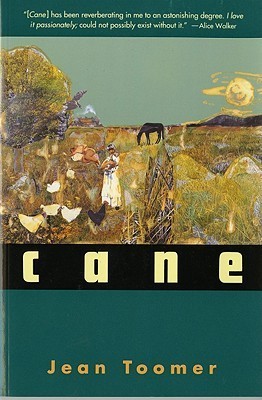
Cane is a challenging piece of experimental writing. It walks the line between feeding into the stereotype of Black people as over sexualised beings, and trying to write from a place within oneself, disregarding the social stigma and what white people might think. The women in Cane are objectified to the point that they become damaged. And though Jean Toomer is clearly trying to subvert this objectification of women, in doing so, he must (paradoxically) objectify them first. He writes with purpose. He tries to convey the message that no matter how hard women try, and no matter what they do, they are not permitted to be in control of their lives. Alice Walker said of the book, “It has been reverberating in me to an astonishing degree. I love it passionately, could not possibly exist without it.”
Profile Image for Jonfaith.
2,146 reviews1,747 followers
June 2, 2018
If you have heard a Jewish cantor sing, if he has touched you and made your own sorrow seem trivial when compared with his, you will know my feeling when I follow the curves of her profile, like mobile rivers, to their common delta.

I find it impossible this morning to attempt comment on a lynching or a literary reflection thereof. Despite my tone deaf groaning as of late about dialect, the final parable in this tome touched me. Earnest. Cane is a modernist mélange of prose and verse. A Biblical air is present but the motivations are Freudian.

This book was recommended to me about 10 years ago by a childhood friend. That friend was entitled to his own weary blues.
Profile Image for Cody.
988 reviews301 followers
March 26, 2025
HOUSEKEEPING 2025

You can't skip it! It is part of the canon! Hey, its Modernist AND you'll gain some small cultural foothold by saying you read 'Black writers!' Win-Win.
Profile Image for Bill on GR Sabbatical.
289 reviews88 followers
July 3, 2020
Tom bound to the stake. His breast was bare. Nails’ scratches let little lines of blood trickle down and mat into the hair. His face, his eyes were set and stony. Except for irregular breathing, one would have thought him already dead. Torches were flung onto the pile. A great flare muffled in black smoke shot upward. The mob yelled. The mob was silent. Now Tom could be seen within the flames. Only his head, erect, lean, like a blackened stone. Stench of burning flesh soaked the air. Tom’s eyes popped. His head settled downward. The mob yelled.

The white mob's lynching of Tom, a black man, in retribution for Tom's cutting the throat of Bob Stone, a white man who'd attacked him for seeing "his" Louisa, a black woman who worked for his family, is unusual within Cane, in the straightforwardness of the racial, sexual, and class conflict and violence. There is a lot of racial, sexual, and class tension in this 1923 modernist novel of African-American life in Georgia, Washington, D.C., and Chicago, but it more often is expressed in conflicted thoughts and rich dialogue than in physical confrontation. Women and men fear each other, blacks and whites fear each other, biracial women and men struggle with their identities and with society. The kaleidoscopic novel is in the form of short stories, vignettes, and a drama, stitched together with poetry, and in its formal experimentalism, themes, and time frame, it reminds me of Faulkner. I come away remembering feelings and striking images, but not with ideas.

Although I enjoyed listening to the free LibriVox recording on my daily walks, the complexity of the book far exceeded my ability to take it in, and I found myself reading an e-book of it after each listening session to correct and confirm my impressions.
Profile Image for Ken.
Author 3 books1,239 followers
July 12, 2008
Though not as well known as Langston Hughes, Jean Toomer is considered one of the shining stars of the Harlem Renaissance and this collection of short stories and poems is his best work. Published in the early 20's, it shows the influence of many writers of that period who were especially fascinated with the technique of repetition -- sentences, clauses, phrases, words, you name it. It's a tricky skill, as repetition can be both effective and annoying. Sherwood Anderson and Ernest Hemingway, in their short stories, could be effective with it. Gertrude Stein was just annoying.

Toomer was also ahead of his time in that he scorned use of apostrophes for contractions and possession, and quotation marks for dialogue. Instead he used the interview style of placing the character's name followed by a colon and what is said. The stories also employ dialect to replicate the way blacks spoke in his time.

Uneven, with some stories stronger than others, Toomer deserves props for his ability to bring forth mood and anger, lust and guilt, crime and punishment. He also excels at use of personification and creative use of verbs (wherein nouns become verbs, etc.).
Profile Image for Michelle.
653 reviews192 followers
January 15, 2019
What is the shape of a novel that has withstood the test of time? First written in 1923, Jean Toomer's Cane is an innovative work that rewrites the definition of "novel". Divided in three parts, each part is distinctive not only for its setting but also for its prose. The first is in part vignettes that exude a sexual allure. Seemingly unconnected descriptions of hued women and a landscape bound to the history of slavery are interwoven with bits of poetry and odes that resound like Old Negro spirituals. The middle passages carry the reader up North during the Great Migration. In this part the syncopated rhythms of jazz dominate the prose. Lastly, the reader returns home to the South in this short story/drama piece that recalls the fear of racial violence and questions the impact of Christianity on the black community through vernacular dialogue. Longing is a theme that runs throughout the work. Longing to be seen beyond the physical. Longing to be recognized and valued. Longing to be loved. Most of all, a longing to return to our true selves, emotionally and spiritually.

Special Thanks to NetGalley and Dover Publications for access to this work.
Profile Image for Elisa Berry.
41 reviews2 followers
March 17, 2008
This one is a gem; the writing is gorgeous, the stories absorbing. P-thought of you, this is a definite genre bender with episodic chapters/short stories and poetry, always referred to as a novel. Toomer is often grouped with the Harlem Renaissance and the stories center on the reverse migration of a urban Northern man to the rural South. However, Toomer never worked with black themes again and did not consider himself part of that community. As such the book exhibits a fractured experience and the language compliments this. Its singularity makes it that much more special.
Profile Image for Sasha.
Author 15 books5,031 followers
December 30, 2016
A wonderful, magisterial voice - at its best, up there with Whitman - but young and unfinished. It has that explosive, tightrope feel of some early works by brilliant writers. It's known as the first important black novel of the Harlem Renaissance, which is funny because it's not a novel - it's some sort of weird poem/play/novel hybrid - and Toomer, who was of mixed parentage, didn't identify as black. It's hard to see which he hated and feared the most - women or himself.
Profile Image for Nathan "N.R." Gaddis.
1,342 reviews1,654 followers
Read
September 24, 2016
Two readerships here for which this one is UEber=pertinent ::

1) readers of the Classics of African=American fiction.
2) readers of things experimental in the category of It's Not Really a Novel (but what then is it?)
3) Also, for readers of I Ain't An African=American Author and I Don't Write Experimental Novels/Stuff.

Really, this is one of the places it all began.
Profile Image for Abby.
1,641 reviews173 followers
July 30, 2015
“Cane” blew me away. Southern literature, in my opinion, contains some of the most powerful and immortal books in the American literary canon. The dark, enchanted history of the South brings forth ample material for colorful characters and complex social issues. Novels born in the South are born out of and into its troubled past–a landscape fraught with the difficult union of charmed myth and bloody reality. Toomer taps into the tragic legacy of slavery to write one of the best, most enduring novels about the African-American experience in the South. It’s beautiful, it’s graphic, it’s disturbing, it’s compelling–it’s everything a novel should be.

READ IF: You want to read one of the most outstanding books in American literature. Not even kidding.
Profile Image for Mark.
337 reviews36 followers
June 11, 2011
It's so difficult to categorize Cane. For the sake of convenience, one could call it a novel, and that is generally how the work is treated. But novel really neither describes the book accurately nor does it justice. Cane is an incantory combination of poetry and prose, vignettes that are loosely held together by the common theme of black American life in rural Georgia at the turn of the twentieth century. But the prose is highly poetic:

"Pine needles, like mazda, are brilliantly aglow. No rain has come to take the rustle from the falling sweet-gum leaves. Over in the forest, across the swamp, a sawmill blows its closing whistle. Smoke curls up. Marvelous web spun by the spider sawdust pile. Curls up and spreads itself pine-high above the branch, a single silver band along the eastern valley."

On the writing of Cane, the author, Jean Toomer, said, "The folk spirit was walking in to die on the modern desert. That spirit was so beautiful. Its death was so tragic. Just this seemed to sum life for me. And this was the feeling I put into Cane. Cane was a swan-song. It was a song of an end."

This new critical edition of Cane is the only way to approach the book. A full and detailed introduction by Henry Louis Gates, Jr, letters and personal documents of Toomer, critical essays, and all the associated scholarly apparatus help bring context and understanding to this rich but elusive text. I first encountered the book some years ago, and it has stuck with me--it's one of those books you can spend years coming back to, finding something new every time.
Profile Image for Katie.
493 reviews441 followers
January 21, 2015
More like 4 1/2 stars, but I'll round up just because I haven't rated any books 5 stars this year yet.

Jean Toomer's Cane really is a "literary masterpiece." I was in awe of his style and form, how he utilizes devices we associate with theater in a novel. I also loved the comparison of the North vs. the South, especially embodied in the last short story, "Kabnis."

I've got to say "The Box Seat" is my favorite story, though, followed closely by "Bona and Paul."

LOVE the Harlem Renaissance!!!
Profile Image for Charles.
Author 41 books287 followers
October 20, 2008
Combines poetry, essays and fiction in a unique format. Lyrically written. I much enjoyed it.
159 reviews3 followers
January 6, 2017
I was astonished that I had never heard of this book. I picked it up at random off the shelf at my local library. It is a thin book, poetic, spiritual, and revealing of the black culture in Jim Crow south in the 1920's in America. It is stunning writing. As a person interested in words and letting words carry the narrative, it is simply beautiful. Toomer's care with words carries a narrative of a world which existed, and still exists, parallel to Anglo-Saxon culture. The story, which seems random and episodic, is set primarily in Jim Crow Georgia, and it reveals the way what Toomer refers to a "negro" culture adapted to the realities of their social position. The violent, sexual, religious, and menial labor threads which permeated the culture are revealed with his careful and fearless words (Cane is a reference to the sugar cane which post slavery sharecroppers harvested in Georgia). Critics hailed his a new voice of Afro-American culture, which offended him greatly. Although he had written of a particular Southern and Northern culture with which he was familiar, he did not consider himself a "Black" writer. He was raised a son in an aristocratic white household. He had a trace of "dark blood", but also was also heir to a host of Anglo-Saxon cultures. He was so offended, similar to the reaction of J. D. Salinger and Harper Lee to their critics, that he never published another book. But the one he did publish in 1926 leaves an indelible impression in the minds of those who are fortunate enough to find it and read it.
Profile Image for Andrew.
2,258 reviews929 followers
Read
December 22, 2011
This was a thoroughly strange and surreal book, made all the more surreal by the fact that it was one of the first avant-garde black American novels. Toomer's world explodes with color and light, with shades of Faulkner and Sherwood Anderson. If there is a document of American magical realism, this is it.

It's too easy when describing the rural black South to rely on stereotypes and minstrelsy (Zora Neale Hurston, I'm looking at you). Toomer, to his credit, doesn't, at all. His world is too damn weird.
Profile Image for a.g.e. montagner.
244 reviews42 followers
April 1, 2025
Un capolavoro assoluto, un'opera unica in quello che forse fu il decennio d'oro della narrativa statunitense; qui pubblicato in un'ottima edizione.
Dicono sia fuori catalogo; ma se vi capita di averlo per le mani (biblioteche, bancarelle, prestiti, furti...) questo è un libro che vale assolutamente la pena di leggere.

Nathan Eugene "Jean" Toomer, nipote per parte di madre del primo governatore di colore della Louisiana (che guardacaso fino a quel punto si era dichiarato bianco), passò infanzia e giovinezza attraversando la color line razziale, come già i suoi genitori prima di lui, considerato di volta in volta "black" oppure "white". Di qui il desiderio di unità universale. Il nome stesso che si scelse, sebbene ispirato ad attori francesi, indica un desiderio di superare i confini di genere.
Un'esperienza ormai proverbiale come insegnante a Sparta, Georgia, risvegliò il senso di appartenenza alla cultura afro-americana, che lui considerava morente a causa dell'enorme esodo (The Great Migration) dal sud rurale ma segregazionista al nord urbano e ricco, cosmopolita ma alienante. Di qui l'urgenza di fissare nella letteratura una cultura al tramonto.
Toomer superò quindi in corsa i maggiori esponenti della Harlem Renaissance, pubblicando la migliore opera dell'intero movimento già nel 1923; salvo poi rinnegare l'etichetta di scrittore afro-americano. Per questo motivo litigò con Alain Locke, che nel 1925 lo incluse nell'antologia manifesto del movimento, The New Negro, e ruppe l'amicizia con Sherwood Anderson, il cui Winesburg, Ohio era stato una grande ispirazione per Cane. Andò meglio con un altro esponente del local color, Waldo Frank, a cui è dedicata la parte terza dell'opera.
Entro la fine degli anni '20 Toomer aveva perso interesse per la letteratura, dopo aver pubblicato uno dei migliori testi di un decennio che pure vide molti dei più grandi romanzi del secolo (potrei citare Faulkner, Fitzgerald e Hemingway senza uscire dai confini nazionali).

Cane è un libro unico, sui generis, a partire dalla struttura.
Non è un romanzo. La Harlem Renaissance ne produsse pochi e tardi, e questo è un tratto comune ad altri 'rinascimenti' letterari (ad es. la nahḍah araba del 19° sec.): un romanzo ha bisogno di tempo per essere letto ed ancora di più per essere scritto. Altri generi sono di più immediata fruizione: poesia, racconto, eventualmente il teatro; forme brevi che si prestano alla pubblicazione su rivista prima che in volume. Cane le contiene tutte.
È diviso in tre parti; le prime due sono costituite da racconti e poesie, alternate secondo uno schema fisso (nella seconda parte i racconti sono a volte sostituiti da poemi in prosa). La terza parte, invece, è occupata da un testo teatrale, "Kabnis".
Ciascuna delle tre parti ha una diversa ambientazione: il sud rurale nella prima, il nord urbano nella seconda (soprattutto Chicago e Washington D.C., curiosamente non NY); mentre la terza parla di un giovane insegnante, educato al nord, cui viene assegnata una cattedra in Georgia, dove riscopre la cultura degli africani d'America: chiari i rimandi autobiografici dell'autore. Qualcuno si è spinto fino a proporre una interpretazione per generi musicali di questa divisione: blues, jazz, spiritual (il ritorno alle radici).
Toomer mira dunque a salvaguardare il patrimonio di un popolo che si era affrancato solo parzialmente dalla schiavitù: un partimonio in buona parte orale di canzoni e folktales; ma vuole farlo con mezzi d'avanguardia. Il suo è un testo profondamente modernista: uno dei suoi punti di riferimento fu Dubliners di Joyce, un autore che Toomer adorava, ed è forte anche l'influenza imagista. Senonché spesso le sue poesie sono migliori di quelle imagiste...
Toomer ha un'abilità impressionante nel restituire la vividezza delle esperienze sensoriali che descrive: odore e sapore dello sciroppo della canna da zucchero che dà il titolo all'opera, suoni, rumori, melodie e sensazioni tattili. Oltre naturalmente ad un'intera gamma di stati d'animo, di blues.
Lo sperimentalismo si spinge fino a confondere i limiti dei generi letterari: spesso le storie brevi contengono delle strofe in poesia, le cui frasi sono a loro volta riprese anche in prosa. Le storie hanno un forte componente lirica, mentre le poesie sono discorsive, in versi liberi (l'ammirazione per Whitman è palese fin dalla citazione nel titolo: Cane come Leaves of Grass). I poemi in prosa sono una roba indescrivibile. "Bona and Paul", alla fine della seconda parte, potrebbe essere considerato un play nonostante l'ingombrante presenza di un narratore (cf. Thornton Wilder?), che ritorna anche nel seguente "Kabnis".
In questo delirio avantgarde, immagini e topoi letterari ritornano silenziosamente da un pezzo all'altro, stabilendo legami tematici sotterranei ma saldi.

Potrei sperticare le lodi di quest'opera ancora a lungo, ma farei bene a fermarmi qui.
In chiusura vorrei sottolineare che questa è un'ottima edizione, che farebbe la felicità anche degli addetti ai lavori. Non a caso la Marsilio è veneziana e le sue scelte editoriali sono influenzate da ca' Foscari, i cui professori fungono da editors.
In questo caso il contributo è particolarmente significativo: Werner Sollors è uno dei massimi esponenti dei race studies, particolarmente in ambito afro-americano; io ho potuto seguire alcune sue lezioni a Venezia. La sua introduzione è imperdibile. Utile anche la bibliografia.
La traduzione una volta tanto è ben fatta, precisa; inevitabilmente la musicalità dell'originale va perduta, ma le numerose sfumature di significato si possono cogliere appieno. Inclusi alcuni sottintesi che in inglese mi erano sfuggiti... Il testo a fronte è l'ideale per tutti: chi non sa l'inglese, chi vuole esercitarsi, e chi è curioso di scoprire le soluzioni adottate dalla traduttrice.
Displaying 1 - 30 of 989 reviews

Can't find what you're looking for?

Get help and learn more about the design.