

What do you think?

Armadillo
One cold winter's morning, Lorimer Black—insurance adjuster, young, good-looking, on the rise—goes out on a perfectly ordinary business appointment, finds a hanged man and realizes that his life is about to be turned upside down. The elements at play: a beautiful actress glimpsed in a passing taxi . . . an odd new business associate whose hiring, firing and rehiring make little sense . . . a rock musician who is losing his mind—and a web of fraud in which virtually everyone Lorimer Black knows has been caught and in which he finds himself increasingly entangled.
337 pages, Hardcover
First published January 1, 1998
About the author
William Boyd
70 books2,738 followersNote: William^^Boyd
Of Scottish descent, Boyd was born in Accra, Ghana on 7th March, 1952 and spent much of his early life there and in Nigeria where his mother was a teacher and his father, a doctor. Boyd was in Nigeria during the Biafran War, the brutal secessionist conflict which ran from 1967 to 1970 and it had a profound effect on him.
At the age of nine years he attended Gordonstoun school, in Moray, Scotland and then Nice University (Diploma of French Studies) and Glasgow University (MA Hons in English and Philosophy), where he edited the Glasgow University Guardian. He then moved to Jesus College, Oxford in 1975 and completed a PhD thesis on Shelley. For a brief period he worked at the New Statesman magazine as a TV critic, then he returned to Oxford as an English lecturer teaching the contemporary novel at St Hilda's College (1980-83). It was while he was here that his first novel, A Good Man in Africa (1981), was published.
Boyd spent eight years in academia, during which time his first film, Good and Bad at Games, was made. When he was offered a college lecturership, which would mean spending more time teaching, he was forced to choose between teaching and writing.
Boyd was selected in 1983 as one of the 20 'Best of Young British Novelists' in a promotion run by Granta magazine and the Book Marketing Council. He also became a Fellow of the Royal Society of Literature in the same year, and is also an Officier de l'Ordre des Arts et des Lettres. He has been presented with honorary doctorates in literature from the universities of St. Andrews, Stirling and Glasgow. He was appointed Commander of the Order of the British Empire in 2005.
Boyd has been with his wife Susan since they met as students at Glasgow University and all his books are dedicated to her. His wife is editor-at-large of Harper's Bazaar magazine, and they currently spend about thirty to forty days a year in the US. He and his wife have a house in Chelsea, West London but spend most of the year at their chateau in Bergerac in south west France, where Boyd produces award-winning wines.
Of Scottish descent, Boyd was born in Accra, Ghana on 7th March, 1952 and spent much of his early life there and in Nigeria where his mother was a teacher and his father, a doctor. Boyd was in Nigeria during the Biafran War, the brutal secessionist conflict which ran from 1967 to 1970 and it had a profound effect on him.
At the age of nine years he attended Gordonstoun school, in Moray, Scotland and then Nice University (Diploma of French Studies) and Glasgow University (MA Hons in English and Philosophy), where he edited the Glasgow University Guardian. He then moved to Jesus College, Oxford in 1975 and completed a PhD thesis on Shelley. For a brief period he worked at the New Statesman magazine as a TV critic, then he returned to Oxford as an English lecturer teaching the contemporary novel at St Hilda's College (1980-83). It was while he was here that his first novel, A Good Man in Africa (1981), was published.
Boyd spent eight years in academia, during which time his first film, Good and Bad at Games, was made. When he was offered a college lecturership, which would mean spending more time teaching, he was forced to choose between teaching and writing.
Boyd was selected in 1983 as one of the 20 'Best of Young British Novelists' in a promotion run by Granta magazine and the Book Marketing Council. He also became a Fellow of the Royal Society of Literature in the same year, and is also an Officier de l'Ordre des Arts et des Lettres. He has been presented with honorary doctorates in literature from the universities of St. Andrews, Stirling and Glasgow. He was appointed Commander of the Order of the British Empire in 2005.
Boyd has been with his wife Susan since they met as students at Glasgow University and all his books are dedicated to her. His wife is editor-at-large of Harper's Bazaar magazine, and they currently spend about thirty to forty days a year in the US. He and his wife have a house in Chelsea, West London but spend most of the year at their chateau in Bergerac in south west France, where Boyd produces award-winning wines.
Ratings & Reviews
Friends & Following
Create a free account to discover what your friends think of this book!
Community Reviews
Displaying 1 - 30 of 249 reviews

October 9, 2016
Thinly Disguised Transnistrian Lad Lit
But for the last 50 pages or so, I would have concluded that this was just a piece of well-executed Lad Lit.
However, the last pages persuaded me that there was something more happening beneath the surface of this novel.
William Boyd shows us nicely judged glimpses of the life of an East European migrant trying to integrate into the English business and social world. The novel never takes itself too seriously and proceeds at an agreeable comic pace.
Serendipity or Zemblanity
I decided to read the novel, when I was reading Nabokov's "Pale Fire". It came up when I found an antonym of the word "serendipity", while searching for the meaning of Zembla. In "Armadillo", William Boyd writes:
"Serendipity, the faculty of making happy and unexpected discoveries by accident. So what is the opposite of Serendip, a southern land of spice and warmth, lush greenery and hummingbirds, seawashed, sunbasted? Think of another world in the far north, barren, icebound, cold, a world of flint and stone. Call it Zembla. Ergo: zemblanity, the opposite of serendipity, the faculty of making unhappy, unlucky and expected discoveries by design. Serendipity and zemblanity: the twin poles of the axis around which we revolve."
So Boyd is responsible for coining the word "zemblanity", named after a fictitious country in "Pale Fire".
"Disturb All Anticipations"
The protagonist, Lorimer Black (an Anglicisation of his original Transnistrian name, Milomre Blocj), is a loss adjuster in the insurance industry. Boyd provides enough detail about how the industry works to convince us that he knows what he's writing about. However, what impresses most is how, by the end of the novel, he has used insurance as a credible metaphor for life:
"Insurance exists to substitute reasonable foresight and confidence in a world dominated by apprehension and blind chance."
"To our Savage Precursors, all life was a lottery. All his endeavours were hazardous in the extreme. His life was literally one big continuous gamble...But times have changed, civilisation has arrived and society has developed, and as society develops and civilisation marches forward this element of chance, of hazard, is steadily eliminated from the human condition...
"However much we seem to have it under control, to have every eventuality covered, all risks taken into account, life will come up with something that, as the good book says, 'disturbs all anticipations'.
"And this is what we, the loss adjustors embody. This is our vocation, our métier, our calling: we exist for one reason alone - to 'disturb all anticipations'."
"[Loss adjustors were] the people who reminded all the others that nothing in this world is truly certain, we were the rogue element, the unstable factor in the ostensibly stable world of insurance...When we do our adjustments of loss, we frustrate and negate all the bland promises of insurance. We act out in our small way one of the great unbending principles of life: nothing is sure, nothing is certain, nothing is risk-free, nothing is fully covered, nothing is forever."
"I do not mind contradictions, paradoxes, puzzles and ambiguities. What is the point of 'minding' something as inevitable and entrenched in our nature as our digestive system is in our body? Of course we can be rational and sensible but often so much of what defines us is the opposite - irrational and nonsensical."
"Adrift in Uncertainty and Chaos"
This plunge into the irrational and the nonsensical describes the dramatic arc of the novel:
"From a position of steady normality - steady job, steady prospects, steady girlfriend - he now found himself adrift in uncertainty and chaos: no job, no car, no girlfriend, insolvent, fatherless, sleepless, loveless..."
The Removal of the Integument
Just as some people seek insurance cover, we arm ourselves with armour to keep ourselves safe from spears, arrows and bullets, both real and metaphorical. This is the source of the title of the book (in Spanish, an armadillo is literally a little armed man):
"Every living organism is separated from its environment by a covering, or integument, that delimits its body. It seems to me that the process of adding an extra integument is unique to our species and easily understandable - we all want extra protection for our soft and vulnerable bodies. But is it unique to our species? What other creature exhibits this same sense of precaution and seeks out this kind of protective armour? Molluscs, barnacles, mussels, oysters, tortoises, hedgehogs, armadillos, porcupines, rhinos all grow their own. Only the hermit crab, as far as I can recall, searches for empty shells...to serve as shelter and protection of the body."
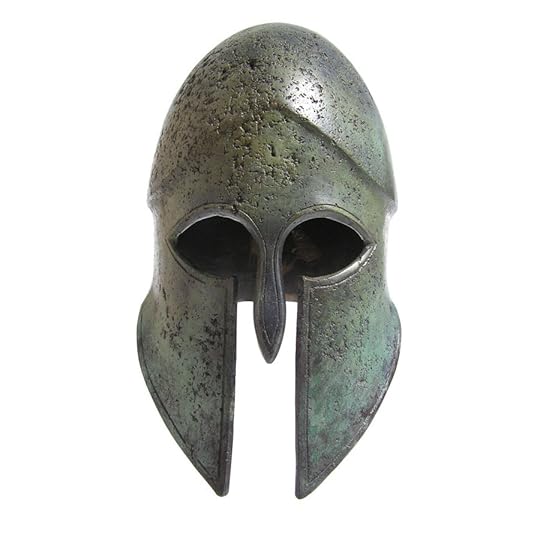
Only when Lorimer removes his treasured Greek helmet, abandons his armour, and takes a romantic risk does he become a rogue element (plot-wise) and his life escape its bounds to become a genuine adventure. You could say the same thing about the novel itself. For much of it, it's too controlled and almost formulaic (if never less than competent). Only towards the end does William Boyd rev up the zemblanity and unleash the beast that is within Lorimer, even if he doesn't destabilise our anticipations. In other words, he honours the compact with the reader and more or less gives us a happy ending.
But for the last 50 pages or so, I would have concluded that this was just a piece of well-executed Lad Lit.
However, the last pages persuaded me that there was something more happening beneath the surface of this novel.
William Boyd shows us nicely judged glimpses of the life of an East European migrant trying to integrate into the English business and social world. The novel never takes itself too seriously and proceeds at an agreeable comic pace.
Serendipity or Zemblanity
I decided to read the novel, when I was reading Nabokov's "Pale Fire". It came up when I found an antonym of the word "serendipity", while searching for the meaning of Zembla. In "Armadillo", William Boyd writes:
"Serendipity, the faculty of making happy and unexpected discoveries by accident. So what is the opposite of Serendip, a southern land of spice and warmth, lush greenery and hummingbirds, seawashed, sunbasted? Think of another world in the far north, barren, icebound, cold, a world of flint and stone. Call it Zembla. Ergo: zemblanity, the opposite of serendipity, the faculty of making unhappy, unlucky and expected discoveries by design. Serendipity and zemblanity: the twin poles of the axis around which we revolve."
So Boyd is responsible for coining the word "zemblanity", named after a fictitious country in "Pale Fire".
"Disturb All Anticipations"
The protagonist, Lorimer Black (an Anglicisation of his original Transnistrian name, Milomre Blocj), is a loss adjuster in the insurance industry. Boyd provides enough detail about how the industry works to convince us that he knows what he's writing about. However, what impresses most is how, by the end of the novel, he has used insurance as a credible metaphor for life:
"Insurance exists to substitute reasonable foresight and confidence in a world dominated by apprehension and blind chance."
"To our Savage Precursors, all life was a lottery. All his endeavours were hazardous in the extreme. His life was literally one big continuous gamble...But times have changed, civilisation has arrived and society has developed, and as society develops and civilisation marches forward this element of chance, of hazard, is steadily eliminated from the human condition...
"However much we seem to have it under control, to have every eventuality covered, all risks taken into account, life will come up with something that, as the good book says, 'disturbs all anticipations'.
"And this is what we, the loss adjustors embody. This is our vocation, our métier, our calling: we exist for one reason alone - to 'disturb all anticipations'."
"[Loss adjustors were] the people who reminded all the others that nothing in this world is truly certain, we were the rogue element, the unstable factor in the ostensibly stable world of insurance...When we do our adjustments of loss, we frustrate and negate all the bland promises of insurance. We act out in our small way one of the great unbending principles of life: nothing is sure, nothing is certain, nothing is risk-free, nothing is fully covered, nothing is forever."
"I do not mind contradictions, paradoxes, puzzles and ambiguities. What is the point of 'minding' something as inevitable and entrenched in our nature as our digestive system is in our body? Of course we can be rational and sensible but often so much of what defines us is the opposite - irrational and nonsensical."
"Adrift in Uncertainty and Chaos"
This plunge into the irrational and the nonsensical describes the dramatic arc of the novel:
"From a position of steady normality - steady job, steady prospects, steady girlfriend - he now found himself adrift in uncertainty and chaos: no job, no car, no girlfriend, insolvent, fatherless, sleepless, loveless..."
The Removal of the Integument
Just as some people seek insurance cover, we arm ourselves with armour to keep ourselves safe from spears, arrows and bullets, both real and metaphorical. This is the source of the title of the book (in Spanish, an armadillo is literally a little armed man):
"Every living organism is separated from its environment by a covering, or integument, that delimits its body. It seems to me that the process of adding an extra integument is unique to our species and easily understandable - we all want extra protection for our soft and vulnerable bodies. But is it unique to our species? What other creature exhibits this same sense of precaution and seeks out this kind of protective armour? Molluscs, barnacles, mussels, oysters, tortoises, hedgehogs, armadillos, porcupines, rhinos all grow their own. Only the hermit crab, as far as I can recall, searches for empty shells...to serve as shelter and protection of the body."
Only when Lorimer removes his treasured Greek helmet, abandons his armour, and takes a romantic risk does he become a rogue element (plot-wise) and his life escape its bounds to become a genuine adventure. You could say the same thing about the novel itself. For much of it, it's too controlled and almost formulaic (if never less than competent). Only towards the end does William Boyd rev up the zemblanity and unleash the beast that is within Lorimer, even if he doesn't destabilise our anticipations. In other words, he honours the compact with the reader and more or less gives us a happy ending.

December 15, 2016
Last week I read a blog post that articulates my response to ‘Armadillo’ better than I can. I’m just so angry and tired. The only possible way to enjoy this book is to overlook the fact that every male character is an arsehole who treats women like shit and every female character (barring one) is a sexy body with no personality who exists to please men. The one female exception is an elderly lady who says practically nothing other than that she’s ready to die, presumably because she is no longer sexually attractive to men and therefore has no reason to exist in the world. Whenever a woman appears in the narrative, not just her general attractiveness but specifically her breasts must be judged. This is by no means every example, just those I found with a quick flick through:
Page 14.
Page 110.
Page 151.
Page 177.
Even when breasts aren’t the focus, there’s this garbage (page 189):
The main character, Lorimer Black, could possibly have been interesting if I hadn’t viscerally hated him for his constant cruelty, disdain, and objectification of women. He cheats on his girlfriend and leers at her teenage daughter. He treats every girl and woman he meets as a sexual object. He claims to fall in love with a woman he glimpses in a taxi, then proceeds to stalk her in a profoundly creepy way. He uses work contacts to find her phone number, drops in unannounced at her place of work, lies to her, lurks around outside her home, follows her around, ignores her saying that she's not interested & married, and generally acts like a predator. Choice quote: “You do know, you must be aware, that I’m passionately in love with you. I’ll never take no for an answer.” That is not fucking acceptable! What is worse, and I’m spoiling the ending for your own good, this profoundly wrong and indeed illegal behaviour is rewarded by the object of Lorimer's affections leaving her husband, turning up naked in his bed, and inviting him to run away with her. Given that earlier in the book she does briefly call what he's doing stalking, I can only hope in vain that the final scene is a prelude to her having him arrested. Or perhaps murdered. Every other male character is portrayed as even worse towards women than Lorimer, seemingly to make him seem sympathetic by comparison. It doesn't work, but naturally I hated all of them too. It was exhausting.
This review is intended mainly as a warning. I cannot assess the merits of the plot, setting, and writing of ‘Armadillo’ as I couldn’t get past how profoundly, unremittingly, relentlessly sexist it was. This is some Hemingway-level shit. The idea that male novelists might actually think women are this far from being people absolutely horrifies me. My initial hopes of satirical intent were crushed long before I got through all 370 pages. For fuck’s sake, men, stop it.
Page 14.
Dymphna’s breasts were momentarily visible as she stooped to stub out her cigarette. Small with pale pointy nipples, he noticed. She really shouldn’t wear such low-
Page 110.
She was an ungainly girl, made more lumpy by pubescence, with dark hair and a sly, pointy face. Her small, sharp breasts caused her huge embarrassment.
Page 151.
A cheerful-looking matronly young woman bounced out of the French windows that gave onto the croquet lawn. She had a big shapeless bosom beneath a baggy bright jumper…
Page 177.
Finally she removed her jacket and scarf and finally he was able to look, guardedly this time, at her breasts. From the pleasing convexities and concavities of her vermilion polo-neck he calculated they were of perfectly average size but flattish, more grapefruit-halves than anything particularly conic.
Even when breasts aren’t the focus, there’s this garbage (page 189):
There was something grubbily attractive about the sullen girl who opened the door to him at DW Management Ltd in Charlotte Street, Lorimer had to admit. Perhaps it was her extreme youth - eighteen or nineteen - perhaps it was the deliberately botched peroxide job on her short hair, or the tightness of the leopard print t-shirt she was wearing, or the three brass rings piercing her left eyebrow, or the fact that she was simultaneously smoking and chewing gum?
The main character, Lorimer Black, could possibly have been interesting if I hadn’t viscerally hated him for his constant cruelty, disdain, and objectification of women. He cheats on his girlfriend and leers at her teenage daughter. He treats every girl and woman he meets as a sexual object. He claims to fall in love with a woman he glimpses in a taxi, then proceeds to stalk her in a profoundly creepy way. He uses work contacts to find her phone number, drops in unannounced at her place of work, lies to her, lurks around outside her home, follows her around, ignores her saying that she's not interested & married, and generally acts like a predator. Choice quote: “You do know, you must be aware, that I’m passionately in love with you. I’ll never take no for an answer.” That is not fucking acceptable! What is worse, and I’m spoiling the ending for your own good, this profoundly wrong and indeed illegal behaviour is rewarded by the object of Lorimer's affections leaving her husband, turning up naked in his bed, and inviting him to run away with her. Given that earlier in the book she does briefly call what he's doing stalking, I can only hope in vain that the final scene is a prelude to her having him arrested. Or perhaps murdered. Every other male character is portrayed as even worse towards women than Lorimer, seemingly to make him seem sympathetic by comparison. It doesn't work, but naturally I hated all of them too. It was exhausting.
This review is intended mainly as a warning. I cannot assess the merits of the plot, setting, and writing of ‘Armadillo’ as I couldn’t get past how profoundly, unremittingly, relentlessly sexist it was. This is some Hemingway-level shit. The idea that male novelists might actually think women are this far from being people absolutely horrifies me. My initial hopes of satirical intent were crushed long before I got through all 370 pages. For fuck’s sake, men, stop it.

February 14, 2025
Armadillo; meaning ‘little armed man’
After an exciting page one, I was INCREDIBLY bored 😑 However, for some strange, and unexplainable reason, I felt compelled to keep reading. Something in the writing was drawing me in…
The storyline follows one POV - Lorimer Black. He was a young, 31 year old, insurance adjuster. Oh, and he has a strange hobby of collecting antique helmets 🪖
One winter’s morning, he is up and out early, headed to an ordinary business meeting, when he finds the man, Mr Dupree, hanged. Following this is a series of rather unexciting events, which do however provide a strong background to Lorimer’s, or should I say - Milomre, background. There are some key elements at play throughout this story. Many of which I found mundane, despite their apparent importance.
However, The one element of this story I did enjoy was the relationship Lorimer developed with Flavia. The ups and downs. The secrets and dangers. The passion and fate, at play. The rational and irrational. In one of Lorimer’s many journal notes he considers: ‘I am as myself irrational and I am rational. If this is true for me, then it must be true for Flavia. Perhaps we are all equally irrational as we blunder onwards. Perhaps in the end this is what really distinguishes us from complex, powerful and all capable machines… this is what makes us human.’ - I liked this very much.
This was not Boyd’s finest work. But, there was something enticing about the writing that held my attention and made me want to keep reading. Am I glad to have read it? Yes. Would I recommend it? No, probably not. Boyd has written so much other fantastic novels and this one just didn’t quite hit the mark.
🌟🌟🌟 (a generous 3 stars 😕)
After an exciting page one, I was INCREDIBLY bored 😑 However, for some strange, and unexplainable reason, I felt compelled to keep reading. Something in the writing was drawing me in…
The storyline follows one POV - Lorimer Black. He was a young, 31 year old, insurance adjuster. Oh, and he has a strange hobby of collecting antique helmets 🪖
One winter’s morning, he is up and out early, headed to an ordinary business meeting, when he finds the man, Mr Dupree, hanged. Following this is a series of rather unexciting events, which do however provide a strong background to Lorimer’s, or should I say - Milomre, background. There are some key elements at play throughout this story. Many of which I found mundane, despite their apparent importance.
However, The one element of this story I did enjoy was the relationship Lorimer developed with Flavia. The ups and downs. The secrets and dangers. The passion and fate, at play. The rational and irrational. In one of Lorimer’s many journal notes he considers: ‘I am as myself irrational and I am rational. If this is true for me, then it must be true for Flavia. Perhaps we are all equally irrational as we blunder onwards. Perhaps in the end this is what really distinguishes us from complex, powerful and all capable machines… this is what makes us human.’ - I liked this very much.
This was not Boyd’s finest work. But, there was something enticing about the writing that held my attention and made me want to keep reading. Am I glad to have read it? Yes. Would I recommend it? No, probably not. Boyd has written so much other fantastic novels and this one just didn’t quite hit the mark.
🌟🌟🌟 (a generous 3 stars 😕)

February 28, 2021
Not long after this book was published, the financial services company I was working for brought it out in a branded paperback as one of a series of books that had insurance as the theme. Whoever decided that this book was suitable for the series clearly hadn't read it, as Lorimer Black, its hero, is involved in the business of 'special loss adjusting' which is the claims equivalent of protection racketeering.
This is a solid novel in the William Boyd oeuvre without having the ambition of later tomes like Any Human Heart or Sweet Caress. This one is plot- rather than character-driven. Which is not to say that the characters are one-dimensional, far from it. However, it's mainly the complicated story of one company's fire insurance claim that propels the narrative and towards the end it comes off the rails a bit because the twists and turns of the scam make it difficult to stay on track.
It's worthwhile for the time spent in Lorimer's company and I so wanted him to end up happy and victorious.
This is a solid novel in the William Boyd oeuvre without having the ambition of later tomes like Any Human Heart or Sweet Caress. This one is plot- rather than character-driven. Which is not to say that the characters are one-dimensional, far from it. However, it's mainly the complicated story of one company's fire insurance claim that propels the narrative and towards the end it comes off the rails a bit because the twists and turns of the scam make it difficult to stay on track.
It's worthwhile for the time spent in Lorimer's company and I so wanted him to end up happy and victorious.

August 5, 2021
To his colleagues Lorimer Black is a young, good-looking and successful insurance loss adjuster who seems to be in control of his life.But when one morning he goes on a perfectly routine business appointment only to find a hanged man. Not a great way to start any day. Whilst this experience was upsetting when his next assignment, to investigate a fire in a hotel under construction, he finds his life buffeted by forces over which will turn his life upside down.
Nothing is quite as it seems in this book including Lorimer Black's name, he was born Milomre Blocj, the youngest son of a large family of immigrants from Eastern Europe. Lorimer wants to blend in to English society and distance himself from his true identity. He is still close to his family and helps to support them but is trying to furnish himself with some added protective armour by collecting antique helmets.
Lorimer excels at his job, he is able to recognize when people are lying and have inflated their insurance claim but when one for 27 million pound claim is successfully reduced to 10 million pound payout his professional life begins to unravel.
His personal life is no less confused. He has trouble sleeping and spends nights studied and analysed at the 'Institute of Lucid Dreams'. He is having a casual affair with one of his former clients but becomes obsessed with an actress whom he tracks down and tries to win over.
The plot is meandering and whilst Lorimer isn't completely hapless he isn't a superhero either. 'Armadillo' is loosely a thriller but Boyd only allows Lorimer to see glimpses of the bigger picture. This vagueness is quite deliberate as Boyd tries to show that there are few easy answers here just as there are none in life.
There are touches of humour sprinkled throughout this book (Boyd certainly seemed to take pleasure in some of his characters' names). It is also a book with a message, you can never truly escape your past and mud rarely sticks to the wealthy, it's only the little men who get trod underfoot. But whilst I always enjoy his writing style (this is the fourth of his works that I've read) I can't help thinking that in this particular case he overplayed his hand. It ended up reading rather laddish and, for that reason alone, missed its mark.
Nothing is quite as it seems in this book including Lorimer Black's name, he was born Milomre Blocj, the youngest son of a large family of immigrants from Eastern Europe. Lorimer wants to blend in to English society and distance himself from his true identity. He is still close to his family and helps to support them but is trying to furnish himself with some added protective armour by collecting antique helmets.
Lorimer excels at his job, he is able to recognize when people are lying and have inflated their insurance claim but when one for 27 million pound claim is successfully reduced to 10 million pound payout his professional life begins to unravel.
His personal life is no less confused. He has trouble sleeping and spends nights studied and analysed at the 'Institute of Lucid Dreams'. He is having a casual affair with one of his former clients but becomes obsessed with an actress whom he tracks down and tries to win over.
The plot is meandering and whilst Lorimer isn't completely hapless he isn't a superhero either. 'Armadillo' is loosely a thriller but Boyd only allows Lorimer to see glimpses of the bigger picture. This vagueness is quite deliberate as Boyd tries to show that there are few easy answers here just as there are none in life.
There are touches of humour sprinkled throughout this book (Boyd certainly seemed to take pleasure in some of his characters' names). It is also a book with a message, you can never truly escape your past and mud rarely sticks to the wealthy, it's only the little men who get trod underfoot. But whilst I always enjoy his writing style (this is the fourth of his works that I've read) I can't help thinking that in this particular case he overplayed his hand. It ended up reading rather laddish and, for that reason alone, missed its mark.

August 5, 2019
Boyd wanders into Amis territory, the geography and the sociology are the same, but the comedy is not as dark. A well executed narrative carries you through an ultimately unconvincing plot.

December 30, 2025
Lorimeer Black an insurance loss adjuster is trying to make something of his life. He sees a woman for a fleeting minute called Flavia and becomes infatuated. The story is misogynistic and Lorimeer is not a likable character although he does like dogs.
He becomes involved unwittingly for a fire claim for a building and the story essentially says the richer you are the more corrupt and how you will not be caught. Flavia the woman he falls for is married and unhappy. However, their relationship is built on looks and Black is a shallow man. He suffers insomnia is ashamed of his family and has a weird relationship with them.
The story is intriguing and it kept my attention with its humor and Black’s infatuation and trying to do the right thing in his mind.
He becomes involved unwittingly for a fire claim for a building and the story essentially says the richer you are the more corrupt and how you will not be caught. Flavia the woman he falls for is married and unhappy. However, their relationship is built on looks and Black is a shallow man. He suffers insomnia is ashamed of his family and has a weird relationship with them.
The story is intriguing and it kept my attention with its humor and Black’s infatuation and trying to do the right thing in his mind.

August 16, 2011
Armadillo is the story of Lorimer a.k.a. Milo, an insomniac loss adjuster with a personality crisis and an obsession with collecting antique helmets who simultaneously falls in love with an actress glimpsed briefly in a taxi and becomes inadvertently embroiled in an elaborate fraud perpetrated by his own company. There's a straightforward narrative and a parallel set of excerpts from Lorimer's journal which provide a commentary on the action.
I chose to read this book after reading two of Boyd's later works and enjoying them because they seemed unpretentious and entertaining while still achieving a depth of field that made them qualify as bona fide literary thrillers.
Unpretentious Armadillo is not. One Amazon reviewer described it as 'the literary equivalent of bad Jazz. Incredibly self indulgent and so cloaked in over wordy description without hint of any story.' Another reviewer wrote, 'Every supporting character felt fake, one-dimensional, a function of the need to construct a filmable narrative.' I couldn't agree more, though I should point out that many more Amazon reviewers thought it was wonderful.
In my opinion the writing is monstrous, the characters totally unsympathetic, the milieu implausible and the whole thing reads like a study in egoism. I struggled to get to the end of it and I wouldn't wish it on my worst enemy.
I chose to read this book after reading two of Boyd's later works and enjoying them because they seemed unpretentious and entertaining while still achieving a depth of field that made them qualify as bona fide literary thrillers.
Unpretentious Armadillo is not. One Amazon reviewer described it as 'the literary equivalent of bad Jazz. Incredibly self indulgent and so cloaked in over wordy description without hint of any story.' Another reviewer wrote, 'Every supporting character felt fake, one-dimensional, a function of the need to construct a filmable narrative.' I couldn't agree more, though I should point out that many more Amazon reviewers thought it was wonderful.
In my opinion the writing is monstrous, the characters totally unsympathetic, the milieu implausible and the whole thing reads like a study in egoism. I struggled to get to the end of it and I wouldn't wish it on my worst enemy.
April 8, 2015
I love William Boyd. This book was quirky, I liked it.
December 15, 2024
Straight from the opening page this was a delight to read. This was a great story and moved at a great pace but still managed to remain clever, witty and rich in detail as we whipped along through the back lanes and dark side of late 90s London streets. All that arch humour, great characters and wonderful description. This genuinely thrilling plot makes for a belter of a read!...albeit with a bit of a crappy ending?...

January 15, 2023
Moderately funny.

January 10, 2013
Originally published on my blog here in December 2001.
The world of insurance is not really a very exciting one, but Boyd has managed to make it so in his novel about fraud and pretence. It concentrates on the profession which clearly has the greatest propensity for drama within the field, the insurance adjuster (who checks whether big claims that worry insurance companies are valid - leading here to suicides, death threats and assaults).
The central character is Lorimer Black, who starts the novel by discovering the body of a hanged man, driven to suicide by an insurance company's unwillingness to pay, is perhaps the most honest character in the novel, and he has created an entire new background for himself, disassociating himself from his Romanian origins. The plot is very complicated, but not too much so for enjoyment - the novel has made it to TV in a virtually unsimplified form without being impossible to follow.
Armadillo is a very well written, darkly funny novel, hopefully typical of Boyd, who is now going on my list of authors to read more from.
The world of insurance is not really a very exciting one, but Boyd has managed to make it so in his novel about fraud and pretence. It concentrates on the profession which clearly has the greatest propensity for drama within the field, the insurance adjuster (who checks whether big claims that worry insurance companies are valid - leading here to suicides, death threats and assaults).
The central character is Lorimer Black, who starts the novel by discovering the body of a hanged man, driven to suicide by an insurance company's unwillingness to pay, is perhaps the most honest character in the novel, and he has created an entire new background for himself, disassociating himself from his Romanian origins. The plot is very complicated, but not too much so for enjoyment - the novel has made it to TV in a virtually unsimplified form without being impossible to follow.
Armadillo is a very well written, darkly funny novel, hopefully typical of Boyd, who is now going on my list of authors to read more from.
February 26, 2009
Just discovered a group of fabulous British authors. This book is so well written with a Vonnegust-esque sense of humor but more action. A great read!

June 15, 2020
I seem to recall that when this book was originally published, just over twenty years ago, it drew slightly less critical acclaim than is normally lavished over William Boyd’s books. As a huge admirer of William Boyd, I clearly bought it very soon after its publication (my copy is a hardback from the first edition), but I have actually no recollection of having read it previously.
I have to say I enjoyed it. To be honest, it doesn’t match up to Restless or Any Human Heart, but then very few novels do. It marked a slight departure from his previous works as this was William Boyd’s first novel wholly set in Britain.
The central figure is known as Lorimer Black, and works for a firm acting as loss adjusters for a major insurance company. ‘Known as’ because we subsequently learn that Lorimer’s family are of Transnistrian descent, and his real name in Milomre Bloḉj. Lorimer remains close to his family, but not as close as they all are – his three elders sisters still live with their parents, while their brother lives just around the corner. Having taken to loss adjusting, Lorimer now lives in an elegant flat in Pimlico, although he has just bought a house in Silvertown, in east London.
We first encounter Lorimer as he arrives to attend an appointment with a recent claimant, whose factory had recently burned down. Harbouring suspicions about the fire, the insurance company had referred the application for loss adjustment consideration, and it had fallen to Lorimer. Turning up feeling nonchalant, and expecting a fairly straightforward opening discussion, Lorimer is aghast to find that the owner has hanged himself.
The police attend, and Lorimer, reeling from the shock, gives as much information as possible, before walking back to his car with a view to returning to the office. Just as he is about to pull out, a taxi comes hurtling by, blaring its horn. As Lorimer looks up his eyes fleetingly lock with those of the startlingly beautiful female passenger sitting in the back of the cab.
As if Lorimer doesn’t already have enough on his mind, he has been suffering from insomnia and is participating in a research study being overseen by one of his neighbours. This entails him spending several nights at a sleep laboraotory in Greenwich where he is fitted with electrodes so that his pulse and mental activities can be recorded while he sleeps (or at least tries to)
Tension builds right from the start, on as Lorimer has to negotiate the relentless foul temper of his boss, George Hogg, and a series of unexpected reorganisations within his firm. Shortly afterwards his car is vandalised, and he is mugged on the street.
Boyd relates all of this with his customary clarity of prose. The story is interleaved with extracts from ‘The Book of Transfiguration’, a journal kept by Lorimer, primarily to record his dreams, although it expands to include reflections on a wide range of aspects of life, including his observations on the great British café, and memories of some of his deeper student excesses.
I have to say I enjoyed it. To be honest, it doesn’t match up to Restless or Any Human Heart, but then very few novels do. It marked a slight departure from his previous works as this was William Boyd’s first novel wholly set in Britain.
The central figure is known as Lorimer Black, and works for a firm acting as loss adjusters for a major insurance company. ‘Known as’ because we subsequently learn that Lorimer’s family are of Transnistrian descent, and his real name in Milomre Bloḉj. Lorimer remains close to his family, but not as close as they all are – his three elders sisters still live with their parents, while their brother lives just around the corner. Having taken to loss adjusting, Lorimer now lives in an elegant flat in Pimlico, although he has just bought a house in Silvertown, in east London.
We first encounter Lorimer as he arrives to attend an appointment with a recent claimant, whose factory had recently burned down. Harbouring suspicions about the fire, the insurance company had referred the application for loss adjustment consideration, and it had fallen to Lorimer. Turning up feeling nonchalant, and expecting a fairly straightforward opening discussion, Lorimer is aghast to find that the owner has hanged himself.
The police attend, and Lorimer, reeling from the shock, gives as much information as possible, before walking back to his car with a view to returning to the office. Just as he is about to pull out, a taxi comes hurtling by, blaring its horn. As Lorimer looks up his eyes fleetingly lock with those of the startlingly beautiful female passenger sitting in the back of the cab.
As if Lorimer doesn’t already have enough on his mind, he has been suffering from insomnia and is participating in a research study being overseen by one of his neighbours. This entails him spending several nights at a sleep laboraotory in Greenwich where he is fitted with electrodes so that his pulse and mental activities can be recorded while he sleeps (or at least tries to)
Tension builds right from the start, on as Lorimer has to negotiate the relentless foul temper of his boss, George Hogg, and a series of unexpected reorganisations within his firm. Shortly afterwards his car is vandalised, and he is mugged on the street.
Boyd relates all of this with his customary clarity of prose. The story is interleaved with extracts from ‘The Book of Transfiguration’, a journal kept by Lorimer, primarily to record his dreams, although it expands to include reflections on a wide range of aspects of life, including his observations on the great British café, and memories of some of his deeper student excesses.

February 6, 2012
Not at all sure about this.... if it wasnt boyd, I think I would have either given up or perhaps not continued to seek him out.
Unlike the other two that I have read, this failed to engage me properly and I struggled to find its meaning and definitely failed to find the humour that was so promised by the words on the back.
It tells the story of Lorimer Black, who works in insurance as a loss adjuster. On the start of one of his days, he finds one of his claimee hung. A job of a loss adjuster is making sure that insurance firms dont pay out.
From then on, we find out more about Lorimer. He is a refugee from eastern eurpoe with an extended family over here. He is being setup in his job by a fairly horrid boss. There is another claim for a hotel fire that looks suspicious that he gets involved in.
He falls in love with an actress who makes a commercial for his film and pursues her, and through most of the book simply accepts the shit that everyone is throwing at him without complaint.
Not really sure where the book was trying to go. There was just enough for me to keep going but this was mainly because of past reputation rather than what I was getting out of this in particular.
Unlike the other two that I have read, this failed to engage me properly and I struggled to find its meaning and definitely failed to find the humour that was so promised by the words on the back.
It tells the story of Lorimer Black, who works in insurance as a loss adjuster. On the start of one of his days, he finds one of his claimee hung. A job of a loss adjuster is making sure that insurance firms dont pay out.
From then on, we find out more about Lorimer. He is a refugee from eastern eurpoe with an extended family over here. He is being setup in his job by a fairly horrid boss. There is another claim for a hotel fire that looks suspicious that he gets involved in.
He falls in love with an actress who makes a commercial for his film and pursues her, and through most of the book simply accepts the shit that everyone is throwing at him without complaint.
Not really sure where the book was trying to go. There was just enough for me to keep going but this was mainly because of past reputation rather than what I was getting out of this in particular.

May 16, 2023
chuckle material

June 26, 2020
Lorimer is true to himself, even though he comes across as a pig regarding his thoughts of women and how he depicts them, he does try and do the right thing. This is difficult as a loss adjuster with many twists and turns to hide the truth behind a suicide in the first page. It takes time to unravel the individual happenings leaving the reader questioning the circumstances and trying to fit the pieces together.
All the pieces come together in the last three chapters. It is a little dull and difficult to keep up with characters which are a little two dimensional. However, if you stick with the book it will not disappoint you. It is not a book for me but I would recommend it to its own audience.
All the pieces come together in the last three chapters. It is a little dull and difficult to keep up with characters which are a little two dimensional. However, if you stick with the book it will not disappoint you. It is not a book for me but I would recommend it to its own audience.
August 8, 2020
A very different style and narrative to other books I have read and enjoyed from William Boyd. I found it difficult to get to the heart of the story and to have any connection to the characters. Perhaps you have to be a man to understand or have some insight into the male psyche. I don't know. Nothing seemed to be resolved. Nothing seems to have changed because of what happened in the story. Not for me I am afraid.

September 5, 2023
Enjoyable if you don't mind women being written as two-dimensional non humans who seem only to exist as something for men to fuck. I genuinely enjoyed the pace, the characterization of the main character, and the ideas about assimilation and creating a new self, but the women aspect got tiresome pretty early on. I think William Boyd has what might be called a 'writing women problem'.

March 1, 2013
From BBC Radio 4 Extra:
Contemporary London satire read by Stephen Critchlow.
Contemporary London satire read by Stephen Critchlow.
April 5, 2020
Only William Boyd could write a story about Insurance and Loss Adjusting, and make it interesting! An unusual theme, with some memorable characters.


July 3, 2018
Armadillo is a superb novel about a young man making his way through London and modern life, starting with his origins in a displaced "Transnistrian" family living in Fulham, going through his higher education in Inverness (as far away from his family as he could go and stay in the U.K.), and then working his way into the misadventures of a "loss adjuster" for an insurance company always looking for ways to pay less than the face value of its policies.
Lorimer Black, not his original name, has no great pretensions in life except to collect ancient pieces of armor, be kind to others, defend himself from others, and deal with his susceptibility to romantic attraction, notably to an actress he glimpses, at first, in a passing car, Flavia Malinverno.
Boyd weaves the weather, household nuisances, bullying bosses, pissed-off insurance claimants, and secret passions together in a story that leaps genially forward in lively, agreeable prose. This is a novel that suggests, in gentler terms, Martin Amis. There's a hint of Jim Crace here, too, but these are affinities, not questions of influence--Boyd is his own writer, to be sure.
The major insurance scam at the center of the story doesn't overwhelm it in procedural manner, which is good. It's also amusing that Boyd finds a way to engage in a detective story summing up/explanation without the tedium of a full recapitulation. And then the loose thread, Flavia, is pulled in with a light deft touch that embraces, rather than quashes, its fundamental ambiguity.
We know why Lorimer pursues her, but we don't know why she lets herself be caught, or if, as it seems, that she really is caught, or how long she will remain caught.
Lorimer Black, not his original name, has no great pretensions in life except to collect ancient pieces of armor, be kind to others, defend himself from others, and deal with his susceptibility to romantic attraction, notably to an actress he glimpses, at first, in a passing car, Flavia Malinverno.
Boyd weaves the weather, household nuisances, bullying bosses, pissed-off insurance claimants, and secret passions together in a story that leaps genially forward in lively, agreeable prose. This is a novel that suggests, in gentler terms, Martin Amis. There's a hint of Jim Crace here, too, but these are affinities, not questions of influence--Boyd is his own writer, to be sure.
The major insurance scam at the center of the story doesn't overwhelm it in procedural manner, which is good. It's also amusing that Boyd finds a way to engage in a detective story summing up/explanation without the tedium of a full recapitulation. And then the loose thread, Flavia, is pulled in with a light deft touch that embraces, rather than quashes, its fundamental ambiguity.
We know why Lorimer pursues her, but we don't know why she lets herself be caught, or if, as it seems, that she really is caught, or how long she will remain caught.

August 1, 2023
I seem to be in the wrong state of mind to enjoy this book. I did read it and I did enjoy some parts. It is clear that Boyd is intelligent and witty and uses language well. So it's surprising that I couldn't really get into this.
Lorimer Black is a young insurance claims adjuster. This means he tries to pay out less than the client expects on claims, using whatever means he can. He's a decent person at heart and tends to read people well enough to get them to respond to him. He's doing well in his line of work until he comes across an odd case. Something's off about it and he can't figure out what. He manages to bring the claim down considerably with very little effort and that alone makes him wonder.
But that isn't all. There are other cases that raise questions. And he has to deal with a boss who is not a nice person.
Complicating his life is Flavia. He sees a billboard with a beautiful woman on it and immediately he must get to know her. He discovers who she is and where to find her and he pursues her. His obsession takes him well into the book, and was one of the reasons I did not like him as much as I might otherwise have. I felt he was incapable of paying attention to her preferences. He just had to have her.
Meanwhile, he visits his dying father and remembers where he came from. He changed his name to avoid ridicule about where he came from, and seeing his father reminds him of this change.
Toward the end he questions what brought him to where he is, after tumultuous changes, and what he needs to do.
I have to admit that I did not follow the financial finagling that went on, that led to Lorimer's sending letters charging corruption to various news sources. I tried to understand what had happened and could only make out that people or companies were cheated and some people made out big. I may just have not been in the mood to focus on it.
I hope the next reader gets more from this book than I did.
Lorimer Black is a young insurance claims adjuster. This means he tries to pay out less than the client expects on claims, using whatever means he can. He's a decent person at heart and tends to read people well enough to get them to respond to him. He's doing well in his line of work until he comes across an odd case. Something's off about it and he can't figure out what. He manages to bring the claim down considerably with very little effort and that alone makes him wonder.
But that isn't all. There are other cases that raise questions. And he has to deal with a boss who is not a nice person.
Complicating his life is Flavia. He sees a billboard with a beautiful woman on it and immediately he must get to know her. He discovers who she is and where to find her and he pursues her. His obsession takes him well into the book, and was one of the reasons I did not like him as much as I might otherwise have. I felt he was incapable of paying attention to her preferences. He just had to have her.
Meanwhile, he visits his dying father and remembers where he came from. He changed his name to avoid ridicule about where he came from, and seeing his father reminds him of this change.
Toward the end he questions what brought him to where he is, after tumultuous changes, and what he needs to do.
I have to admit that I did not follow the financial finagling that went on, that led to Lorimer's sending letters charging corruption to various news sources. I tried to understand what had happened and could only make out that people or companies were cheated and some people made out big. I may just have not been in the mood to focus on it.
I hope the next reader gets more from this book than I did.

March 25, 2015
I really enjoyed this book.
If you told me that I would enjoy a book about a London loss-adjuster quite so much, then I would have laughed at you. It was excellent. The young man in question, Lorimer Black, recently morphed from someone called, less conveniently, Milomre Blocj, is both savvy and likable. He has good taste in clothes and a particular passion for a 3,000 year old Greek helmet.
It is the plethora of little facts that make this novel, lots of little things happening, small insignificant everyday things being pointed out all over the place that makes it work for me.
William Boyd catches the feel of London, the host of oddball characters it contains, and that period of time when everything from the East of the city was on the up.
There are some wonderful pieces of description among the strange events of Lorimer's life. Here is one I liked
"He lay in his bed listening to the growing quiet of the night, always approaching silence but never achieving it, it's progression halted by a lorry's grinding gears, a siren or a car alarm, a taxi's ticking diesel, until, in the small hours, the first jumbos begin to cruise in from the Far East - from Singapore and Delhi, Tokyo and Bangkok - the bass roar of their engines like a slowly breaking wave high above, as they wheeled and banked in over the city on their final approach to Heathrow."
Lorimer is a bad sleeper - never able to get more than an hours or two, and I loved the way this sentence picked up that lack of quiet in the city as it almost reaches silence but never quite makes it. All the things that the poor sleeper would notice.
Have a read, enjoy the richness and the variety of the characters and puzzle your way through the changing fortunes of Lorimer Black.
If you told me that I would enjoy a book about a London loss-adjuster quite so much, then I would have laughed at you. It was excellent. The young man in question, Lorimer Black, recently morphed from someone called, less conveniently, Milomre Blocj, is both savvy and likable. He has good taste in clothes and a particular passion for a 3,000 year old Greek helmet.
It is the plethora of little facts that make this novel, lots of little things happening, small insignificant everyday things being pointed out all over the place that makes it work for me.
William Boyd catches the feel of London, the host of oddball characters it contains, and that period of time when everything from the East of the city was on the up.
There are some wonderful pieces of description among the strange events of Lorimer's life. Here is one I liked
"He lay in his bed listening to the growing quiet of the night, always approaching silence but never achieving it, it's progression halted by a lorry's grinding gears, a siren or a car alarm, a taxi's ticking diesel, until, in the small hours, the first jumbos begin to cruise in from the Far East - from Singapore and Delhi, Tokyo and Bangkok - the bass roar of their engines like a slowly breaking wave high above, as they wheeled and banked in over the city on their final approach to Heathrow."
Lorimer is a bad sleeper - never able to get more than an hours or two, and I loved the way this sentence picked up that lack of quiet in the city as it almost reaches silence but never quite makes it. All the things that the poor sleeper would notice.
Have a read, enjoy the richness and the variety of the characters and puzzle your way through the changing fortunes of Lorimer Black.

March 13, 2018
I really enjoyed this book, as I do most books by William Boyd, one of my favourite writers. In this, his talent for comic writing, first seen in "A Good Man in Africa", entertains, with brilliant character evocations as well as some truly funny scenes. The story itself is not a comedy though. Sort of a coming of age novel in someone who is already mid-30's - perhaps more of an awakening. The main character, Lorimer Black, lives a somewhat boring, conventional life as an insurance 'value-adjuster'. He comes from an Eastern European family (he has changed his name in an effort to flee his old life) and always struggles to fit in. His world is slowly turned upside down by a series of events including an infatuation with an actress, the death of a client, and the unwanted friendship of a colleague. Amusing, and, at times, poignant, this is highly recommended. Only real downside was the lack of a really cohesive ending, but this is likely a fault in my reading taste (I do like a nicely wrapped up satisfying end to a book). 4 stars 8/10

August 1, 2025
7/10. This was my first William Boyd novel. Not the best to have chosen, by all accounts, as reviews say that underwhelms compared with his others.
I found the writing very strong. He paints a character with great dexterity and colour and the narrative trips along in beautifully written, yet not pompous, prose. I felt like I could visualise every scene, which is important for me.
The story itself, however, is peculiar. The fraud being perpetrated is not resolved and Milo’s possible explanation doesn’t really make sense. The love story with Flavia also feels unsatisfactory and unconvincing. Arguably misogynistic and dated, actually, as is much of the one-dimensional depiction of women in this novel.
As a satire, the book also falls flat, as it is not really clear what is being satirised: British life in the late 1990s; the insurance industry; our vanity and need for protection?
In summary, therefore, I loved the writing and the characterisation. The story and any possible themes that can be derived from it…not so much.
I found the writing very strong. He paints a character with great dexterity and colour and the narrative trips along in beautifully written, yet not pompous, prose. I felt like I could visualise every scene, which is important for me.
The story itself, however, is peculiar. The fraud being perpetrated is not resolved and Milo’s possible explanation doesn’t really make sense. The love story with Flavia also feels unsatisfactory and unconvincing. Arguably misogynistic and dated, actually, as is much of the one-dimensional depiction of women in this novel.
As a satire, the book also falls flat, as it is not really clear what is being satirised: British life in the late 1990s; the insurance industry; our vanity and need for protection?
In summary, therefore, I loved the writing and the characterisation. The story and any possible themes that can be derived from it…not so much.
November 2, 2022
I love most of William Boyd's writing. His sense of place, his development of plot, his depiction of character are usually second to none. Yet even he found it hard to make an insomniac loss adjuster's life and adventures gripping enough for me to read the italicized counterstory. Yes, I finished the book, and at times I really wanted to read on. But it's one of those novels that i finished because I started it. There were moments of sheer joy - Lorimer's relationships with his women, including the ancient next door neighbour, were lovingly depicted, but really and truly those moments were few and far between. Sorry.
I look forward to Boyd's latest novel which I hope will be better than this. he's had time to practise, as I think this may have been quite and earlier one.
Why is it called Armadillo?
I look forward to Boyd's latest novel which I hope will be better than this. he's had time to practise, as I think this may have been quite and earlier one.
Why is it called Armadillo?

May 28, 2017
(First read February 1999)
Entertaining and engaging, but doesn't quite leave the impression on me that it did first time around. Times have changed, and so have I, I suppose. Lorimer/Milo's character feels more much more flimsy second time around. Also, the farcical elements of the fiction seem more forced. (As does, come to think of it, the whole mask conceit.) On the other hand, Boyd describes London's essential soullessness presciently. Plot wise, the book now feels like a more mature, restrained counterpart to London Fields-era Amis. Which isn't a bad thing in itself, but since one read 90s era Amis for his hyperbole...
Anyway, back to the shelf. Not sure I'll come back to this again.
Entertaining and engaging, but doesn't quite leave the impression on me that it did first time around. Times have changed, and so have I, I suppose. Lorimer/Milo's character feels more much more flimsy second time around. Also, the farcical elements of the fiction seem more forced. (As does, come to think of it, the whole mask conceit.) On the other hand, Boyd describes London's essential soullessness presciently. Plot wise, the book now feels like a more mature, restrained counterpart to London Fields-era Amis. Which isn't a bad thing in itself, but since one read 90s era Amis for his hyperbole...
Anyway, back to the shelf. Not sure I'll come back to this again.
September 28, 2019
Bit odd this one, for me. I think I may have had slightly confused expectations from the cover which seemed to suggest a faster paced thriller. Consequently, even past the half way stage I had a feeling of a story which had yet to get going, and altho the last 20 pages or so were very satisfying, somehow that feeling never really went away, which is a shame. There was much I did like, the story unfolded well, and was interesting as a study of how we can voluntarily move away from our roots and yet struggle with feeling rootless. There were good characters, little vignettes into other lives and the world of insurance / loss adjusting which I liked but somehow the whole wasn't what I'd expected.
Displaying 1 - 30 of 249 reviews