

What do you think?
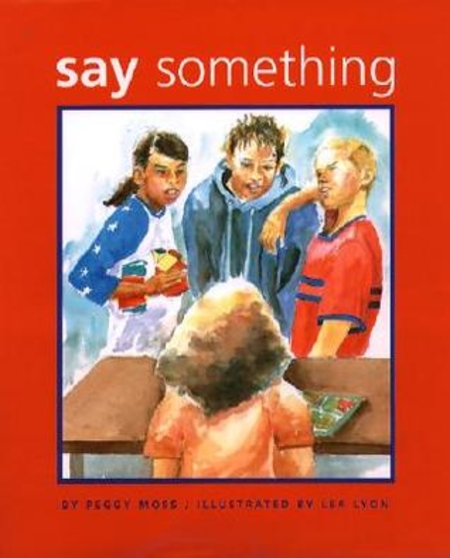
Say Something
The girl in this story sees it happening, but she would never do these mean things herself. Then one day something happens that shows her that being a silent bystander isn’t enough. Will she take some steps on her own to help another kid? Could it be as simple as sitting on the bus with the girl no one has befriended (and discovering that she has a great sense of humor)? Resources at the end of the book will help parents and children talk about teasing and bullying and find ways to stop it at school.One child at a time can help change a school.
Since its release in May 2004, this book has sparked Say Something weeks in schools from Maine to Shanghai. It has been turned into plays, distributed to hundreds of kids at conferences, read by principals on large screens, and rewritten by students in several schools (Do Something! is a favorite title). Most importantly, Say Something has helped start countless conversations among kids and adults about teasing.
We’re celebrating with this new edition, updated with a new cover and an author’s note.
Since its release in May 2004, this book has sparked Say Something weeks in schools from Maine to Shanghai. It has been turned into plays, distributed to hundreds of kids at conferences, read by principals on large screens, and rewritten by students in several schools (Do Something! is a favorite title). Most importantly, Say Something has helped start countless conversations among kids and adults about teasing.
We’re celebrating with this new edition, updated with a new cover and an author’s note.
32 pages, Hardcover
First published April 1, 2004
About the author
Peggy Moss
9 books1 followerPeggy Moss, children's author of Say Something, Our Friendship Rules, and One of Us,worked as an assistant attorney general in Maine in the civil rights unit and as associate director of the Center for the Prevention of Hate Violence. Peggy now works with schools across the US and Canada, helping students and educators from kindergarten to the college level create school environments that feel safe for everyone. A freelance writer, Peggy lives in Toronto with her husband and two daughters. "
Ratings & Reviews
Friends & Following
Create a free account to discover what your friends think of this book!
Community Reviews
Displaying 1 - 30 of 47 reviews

January 22, 2020
A young girl witnesses other children being taunted and bullied in Say Something, but although she sympathizes with the victims, and never participates in the bullying herself, she also never speaks out against it. Then one day, when her friends are absent, and she is sitting alone in the cafeteria, the girl finds that she too has become a target.
Although Moss has a clear didactic purpose here, her simple, effective narrative is never overwhelmed by its message, which flows naturally and believably from the story. I appreciated the author's depiction of the many different kinds of bullying possible - name-calling, shoving in the hallway, ostracism on the school-bus - and her compassionate approach to a difficult truth: that silence can cause its own kind of hurt. With a story that is sure to spark a sense of recognition in young readers, bright watercolor illustrations that depict a diverse student body, and a brief afterword about bullying, Say Something is the ideal starting point, for launching a classroom discussion of this important topic. Highly recommended!
Although Moss has a clear didactic purpose here, her simple, effective narrative is never overwhelmed by its message, which flows naturally and believably from the story. I appreciated the author's depiction of the many different kinds of bullying possible - name-calling, shoving in the hallway, ostracism on the school-bus - and her compassionate approach to a difficult truth: that silence can cause its own kind of hurt. With a story that is sure to spark a sense of recognition in young readers, bright watercolor illustrations that depict a diverse student body, and a brief afterword about bullying, Say Something is the ideal starting point, for launching a classroom discussion of this important topic. Highly recommended!

April 6, 2010
First, I have to say that I thoroughly enjoyed the watercolor paintings. These illustrations are beautiful (gorgeous colors!) and more importantly they capture what is going on perfectly. The facial expressions and body language of the kids is spot on.
I can’t think of a better book to get a discussion going about bullying and about what “non-participants” can and should ideally do about it. There are some great ideas and resources in the back of the book. The story itself stands on its own because it is interesting even without its message.
Re the message: It’s very possible that this book will save some lives and make some other lives much more bearable.
I can’t think of a better book to get a discussion going about bullying and about what “non-participants” can and should ideally do about it. There are some great ideas and resources in the back of the book. The story itself stands on its own because it is interesting even without its message.
Re the message: It’s very possible that this book will save some lives and make some other lives much more bearable.

July 5, 2017
A (child narrator) begins Say Something by," there's a kid in my school that gets picked on all the time." The narrator feels okay about the situation because she is not the one calling names, throwing things, or laughing. Until one day she sits alone in the cafeteria and is bullied by those same kids.
She feels worthless and gets angry at her peers. Why didn't they stand up for her? Which leads her to examine her own behavior.
The girl decides to befriend other children at school who are bullied.
Wouldn't the world be a nicer place if we all decided to befriend others who need a little help?
Say Something is a gentle and heart tugging story to be enjoyed by children and adults alike.
She feels worthless and gets angry at her peers. Why didn't they stand up for her? Which leads her to examine her own behavior.
The girl decides to befriend other children at school who are bullied.
Wouldn't the world be a nicer place if we all decided to befriend others who need a little help?
Say Something is a gentle and heart tugging story to be enjoyed by children and adults alike.

July 8, 2011
Moss, Peggy. (2004). Say Something. Gardiner, ME: Tilbury House, Publishers.
For children in kindergarten to fifth grade. This is an informational book for parents (or teachers and counselors) to use to help children understand bullying and how to handle a bullying situation. A young girl narrates the story, she shares with the readers bullying situations that she witnesses at school and on the bus, she does not take part in the bullying but she does not do anything to help those being bullied. Then, one day, her friends are gone and she must sit alone during lunch, a group of her peers comes over and makes her the topic of their jokes. I like how the book shows her emotions during this experience (by emphasizing facial expressions and body language), the narrator is angry, frustrated, and then begins to empathize with the other kids that are bullied. The next day, she sits next to a girl that usually sits alone and is bullied on the bus, and discovers that she is funny and they become friends. Peggy Moss stresses the importance of one person’s ability to say something and make a difference in this book and includes a page at the end of the book that encourages children to make a difference. Lea Lyon’s watercolor illustrations are realistic, detailed, and represent diversity in the children in the story. The story does a very good job at illustrating how bullying effects people, however, I think it could be more beneficial for children to understand how the bully feels. This book is ideal for sharing with a classroom of young students to open a unit on social issues or to generate discussion on bullying. The book is very informative but a child can still enjoy it as a story that has meaning to them. Parents, may use this book to help their children understand their feelings during a bullying situation, a counselor might be more effective at helping a child manage their feeling in this situation. This book could be used in several settings as long as the child has an adult or a peer to discuss bullying afterwards.
For children in kindergarten to fifth grade. This is an informational book for parents (or teachers and counselors) to use to help children understand bullying and how to handle a bullying situation. A young girl narrates the story, she shares with the readers bullying situations that she witnesses at school and on the bus, she does not take part in the bullying but she does not do anything to help those being bullied. Then, one day, her friends are gone and she must sit alone during lunch, a group of her peers comes over and makes her the topic of their jokes. I like how the book shows her emotions during this experience (by emphasizing facial expressions and body language), the narrator is angry, frustrated, and then begins to empathize with the other kids that are bullied. The next day, she sits next to a girl that usually sits alone and is bullied on the bus, and discovers that she is funny and they become friends. Peggy Moss stresses the importance of one person’s ability to say something and make a difference in this book and includes a page at the end of the book that encourages children to make a difference. Lea Lyon’s watercolor illustrations are realistic, detailed, and represent diversity in the children in the story. The story does a very good job at illustrating how bullying effects people, however, I think it could be more beneficial for children to understand how the bully feels. This book is ideal for sharing with a classroom of young students to open a unit on social issues or to generate discussion on bullying. The book is very informative but a child can still enjoy it as a story that has meaning to them. Parents, may use this book to help their children understand their feelings during a bullying situation, a counselor might be more effective at helping a child manage their feeling in this situation. This book could be used in several settings as long as the child has an adult or a peer to discuss bullying afterwards.

October 14, 2020
On Sunday night, we had our next Family Focus Trait family meeting about being upstanders. During this meeting, we read the book Say Something by Peggy Moss, illustrated by Lea Lyon, and we went through a few role plays in which we practiced what we might say or do to be upstanders. Read on to learn about Say Something.
⠀⠀⠀⠀⠀⠀⠀⠀⠀
Sometimes, it's hard to stand up to others when you know they're doing something wrong. It can be exceptionally hard when what they're doing is hurtful to a person (as opposed to other behaviors such as littering or defacing public property...), because we naturally fear that they'll turn their attention to us, and we'll be on the receiving end of the mean behavior instead.
⠀⠀⠀⠀⠀⠀⠀⠀⠀
In Say Something, the protagonist has witnessed many children being mean to others. Sometimes they are picked on, or called names, or have things thrown at them, or laughed at. The main character is very clear to say that she doesn't do any of those things, but she doesn't say anything to stop them either.
⠀⠀⠀⠀⠀⠀⠀⠀⠀
Then, one day, her friends are absent from school and she finds herself eating lunch alone in the cafeteria. Some kids come over and start to tell funny jokes, funny enough to make her laugh. Funny enough, that is, until the jokes are about her. She fights back tears, wishing she could just disappear... But when the mean kids leave and she has a chance to look around, she is shocked by what she sees.
⠀⠀⠀⠀⠀⠀⠀⠀⠀
All around her, children she knew just sat and watched. They didn't tell the jokes, and they didn't laugh, but they also didn't help her.
⠀⠀⠀⠀⠀⠀⠀⠀⠀
She recounts her experience to her brother that afternoon, telling him how mad she is at the kids who just sat and watched. He asks why she's mad at them, since after all, "They didn't do anything." Her response? "Right."
⠀⠀⠀⠀⠀⠀⠀⠀⠀
Right. They didn't do anything. And that hurts too.
⠀⠀⠀⠀⠀⠀⠀⠀⠀
We read this book and we talked about how much both behaviors hurt. It's hard to be an upstander, but we are hopeful that these intentional discussions and opportunities to practice will allow our girls to have the courage to stand up, rather than not do anything.
⠀⠀⠀⠀⠀⠀⠀⠀⠀
Sometimes, it's hard to stand up to others when you know they're doing something wrong. It can be exceptionally hard when what they're doing is hurtful to a person (as opposed to other behaviors such as littering or defacing public property...), because we naturally fear that they'll turn their attention to us, and we'll be on the receiving end of the mean behavior instead.
⠀⠀⠀⠀⠀⠀⠀⠀⠀
In Say Something, the protagonist has witnessed many children being mean to others. Sometimes they are picked on, or called names, or have things thrown at them, or laughed at. The main character is very clear to say that she doesn't do any of those things, but she doesn't say anything to stop them either.
⠀⠀⠀⠀⠀⠀⠀⠀⠀
Then, one day, her friends are absent from school and she finds herself eating lunch alone in the cafeteria. Some kids come over and start to tell funny jokes, funny enough to make her laugh. Funny enough, that is, until the jokes are about her. She fights back tears, wishing she could just disappear... But when the mean kids leave and she has a chance to look around, she is shocked by what she sees.
⠀⠀⠀⠀⠀⠀⠀⠀⠀
All around her, children she knew just sat and watched. They didn't tell the jokes, and they didn't laugh, but they also didn't help her.
⠀⠀⠀⠀⠀⠀⠀⠀⠀
She recounts her experience to her brother that afternoon, telling him how mad she is at the kids who just sat and watched. He asks why she's mad at them, since after all, "They didn't do anything." Her response? "Right."
⠀⠀⠀⠀⠀⠀⠀⠀⠀
Right. They didn't do anything. And that hurts too.
⠀⠀⠀⠀⠀⠀⠀⠀⠀
We read this book and we talked about how much both behaviors hurt. It's hard to be an upstander, but we are hopeful that these intentional discussions and opportunities to practice will allow our girls to have the courage to stand up, rather than not do anything.

October 21, 2019
This book is about the kids in school who get picked on. There are various reasons listed. They might be slow or not cool. I like how the book approaches a hard subject. The main girl is proud of herself for not getting involved. She doesn't bully. She doesn't sit by the kid on the bus who is made fun of. She stays away from the trouble. At first it seems like this is the right thing to do. You then realize she needs to stick up for her class mates. It's not until she gets made fun of that things take a turn. She is laughing along until the jokes are directed at her. Then she wishes she could be invisible. It causes her to realize how those other kids probably feel. You could say it's a wake-up call for her. She decides to make a change. She sits by the girl on the bus who always sits alone. I would use this book in my classroom to make my students see that all children have feelings. Sometimes they may get caught up in making fun of someone to try to fit in. They need to know how much it hurts. I would encourage my students to say something if someone is being treated poorly.
December 11, 2018
In these times when parents often hear about bullying at school, here is a conversation starter on this important subject. It isn't just adults that are affected by the Bystander Effect. The bystander effect, or bystander apathy, is a social psychological phenomenon in which individuals are less likely to offer help to a victim when other people are present. The greater the number of bystanders, the less likely it is that one of them will help .
Sometimes kids aren't confident enough in themselves to speak up or they don't want to draw unwanted attention.
This book shows that you can hurt people as much as the bullying perpetrator if you don't speak up and stand by while it happens.
The book makes it's point in a simple manner that makes it a good read either independently or together for Grades 5 and under.
Sometimes kids aren't confident enough in themselves to speak up or they don't want to draw unwanted attention.
This book shows that you can hurt people as much as the bullying perpetrator if you don't speak up and stand by while it happens.
The book makes it's point in a simple manner that makes it a good read either independently or together for Grades 5 and under.

February 27, 2017
1) Teacher choice award
2)pre-K-3rd
3) This book follows the story of a young girl as she witnesses her fellow peers get bullied, but sadly she does nothing to help.
Eventually, she gets bullied and others do nothing to help her. This teaches her an important lesson about being a bystander and not speaking up.
4) I love how the book the book teaches a very important lesson on being a bystander and doing nothing. Especially, in this day and age where cyberbullying is a serious topic.
5)use this book to set up the class culture of respecting each other and creating a safe classroom environment
2)pre-K-3rd
3) This book follows the story of a young girl as she witnesses her fellow peers get bullied, but sadly she does nothing to help.
Eventually, she gets bullied and others do nothing to help her. This teaches her an important lesson about being a bystander and not speaking up.
4) I love how the book the book teaches a very important lesson on being a bystander and doing nothing. Especially, in this day and age where cyberbullying is a serious topic.
5)use this book to set up the class culture of respecting each other and creating a safe classroom environment

May 15, 2018
A girl watches other children being bullied but does nothing. It’s only when she herself is bullied that she starts to realize how it feels. This motivates her to sit beside a girl who is being excluded.
The back of the book has two pages of suggestions for what you can do to stop bullying. Lea Lyon’s artwork is beautiful.
The back of the book has two pages of suggestions for what you can do to stop bullying. Lea Lyon’s artwork is beautiful.

June 27, 2018
Perfect addition to my elementary school counselor bookshelf. I love the illustrations, and the simplicity yet powerfulness of the message that is conveyed. I could definitely see myself using this across grade levels from kindergarten to fifth grade, and think that it would complement lessons around the effects of being a bystander and how much better it is to be an ally.

May 11, 2017
This was a good children's book to explain why teasing and bullying can be more harmful than it seems. I appreciate its simplistic approach as it can be hard to explain to kids serious subjects like bullying at a young age.

March 2, 2018
I had high hopes for this book, but to me it wasn't clear enough for children to understand the moral of the story. That being said, my oldest daughter is 3, so you have to be quite blunt. I do, however, think even an older child would need more clarity.

March 1, 2025
Say Something (Paperback)
by Peggy Moss
Found in a third grade classroom
this book shows the nature of bully proofing and how saying something when you see bully behavior can change the environment.
by Peggy Moss
Found in a third grade classroom
this book shows the nature of bully proofing and how saying something when you see bully behavior can change the environment.

January 16, 2025
A short picture book about bullying that would be a good discussion starter Although it's a bit dated, the illustrations still look fresh and contemporary.
March 12, 2013
Say Something is told from the perspective of an outsider analyzing various students who get bullied and teased at school. The student in the beginning of the story does not interfere or step in to help those who are bullied. Instead, she stands by and watches them get bullied. One day, the girl gets teased and made fun of in the cafeteria by her classmates. After the bullying is over, she looks around the cafeteria and notices the cafeteria was full of students and classmates she knows. Her classmates did not interfere while she was getting bulled. She understood they felt sorry for her, but they did not interject. When she goes home and tells her brother she was mad at the kids at the table who did not interject, he asked her “why”? She replied she did not understand why no one stood up for her while she was being teased. The next day at school, she sat next to the girl who often gets bullied and befriends her because she now understood what it felt like to be bullied and have no one step in.
This children’s book is a great book to use to teach students to stand up and step in when someone is being bullied. People who are bullied often want someone to speak up for them and stand up to the bully. They just want the teasing to be over. This book teaches children to say something to the bully, to the person who is getting teased, or to an adult who can help. Furthermore, this book shows how the student did not stand up for her fellow classmates when they were being bullied. It is not until she is bulled ad no one steps in for her, that she realizes it is important to speak up and stand up. Teasing happens to everyone. Students will want someone to speak up for them if they are being bullied. Furthermore, this book teaches whether you are the victim or a bystander, always speak up to the bully and tell them to stop. Voicing your opinion will confront the bully and make it harder for them to hurt your feelings. This book will help students learn how to cope with bullying when they see it in school.
This children’s book is a great book to use to teach students to stand up and step in when someone is being bullied. People who are bullied often want someone to speak up for them and stand up to the bully. They just want the teasing to be over. This book teaches children to say something to the bully, to the person who is getting teased, or to an adult who can help. Furthermore, this book shows how the student did not stand up for her fellow classmates when they were being bullied. It is not until she is bulled ad no one steps in for her, that she realizes it is important to speak up and stand up. Teasing happens to everyone. Students will want someone to speak up for them if they are being bullied. Furthermore, this book teaches whether you are the victim or a bystander, always speak up to the bully and tell them to stop. Voicing your opinion will confront the bully and make it harder for them to hurt your feelings. This book will help students learn how to cope with bullying when they see it in school.
Read
November 29, 2010Book Recommendation
I think this is a wonderful book because it's about how to be a good friend and bullying. It starts with a boy who is being teased by others at school. The main character, a girl about 12 years old, feels sorry for him but she doesn't say anything. She also sees a girl being teased on the bus but instead of standing up for her, just stays quiet. Things start to change for the main character when she has to eat alone in the cafeteria. Some kids come by and start to tell jokes about her. She begins to cry and feels ashamed as she sees people she knows just looking at her from other tables. She thinks, "I felt like I wanted to disappear." She wonders why no one stood up for her. The next day, she sat next to that lonely girl on the bus and made a new friend.
This is one of my favorite books because everyone can relate to what happens to all of the characters. Everyone has been teased. Everyone has teased someone else. Everyone has sat quietly when someone else is being bullied. BUT, not everyone has SAID SOMETHING. This book inspires people to say something when they see someone having their feelings hurt.
If you are wondering who would like this kind of book, my answer is: mostly younger kids who need to know about what to do in situations where people are being teased. I think teachers will like this book. They can use it to encourage good behavior at school and stop bullying in their classroom.
This book reminds me of THE GIVING TREE. In that book a boy learns a lot about friendship. In SAY SOMETHING, there are a lot of examples of people NOT being good friends because they didn't say something when others were being teased.
I think this is a wonderful book because it's about how to be a good friend and bullying. It starts with a boy who is being teased by others at school. The main character, a girl about 12 years old, feels sorry for him but she doesn't say anything. She also sees a girl being teased on the bus but instead of standing up for her, just stays quiet. Things start to change for the main character when she has to eat alone in the cafeteria. Some kids come by and start to tell jokes about her. She begins to cry and feels ashamed as she sees people she knows just looking at her from other tables. She thinks, "I felt like I wanted to disappear." She wonders why no one stood up for her. The next day, she sat next to that lonely girl on the bus and made a new friend.
This is one of my favorite books because everyone can relate to what happens to all of the characters. Everyone has been teased. Everyone has teased someone else. Everyone has sat quietly when someone else is being bullied. BUT, not everyone has SAID SOMETHING. This book inspires people to say something when they see someone having their feelings hurt.
If you are wondering who would like this kind of book, my answer is: mostly younger kids who need to know about what to do in situations where people are being teased. I think teachers will like this book. They can use it to encourage good behavior at school and stop bullying in their classroom.
This book reminds me of THE GIVING TREE. In that book a boy learns a lot about friendship. In SAY SOMETHING, there are a lot of examples of people NOT being good friends because they didn't say something when others were being teased.
April 1, 2016
"Say Something" is a book about bullying at school. There is a girl that always sees bullying occur all around her school. She notices these actions, but always explains that she would never go along with the bullying. The little girl never stands up for any of the individuals being bullied. Until one day she gets bullied in the cafeteria by other students. That is when she experiences the feeling of humiliation. After that day she begins to speak to those who were being bullied.
I think this book is great to read in any classroom. It demonstrates how many different actions can affect an individual. It also describes how people may feel when they just watch others get bullied without standing up for them. It explains the exact feelings of those being bullied as well. I like how it shows the perspective of those just watching others get bullied. It helps everyone involved in bullying to feel support and not feeling like they are alone. The book is very simple and it gets right to the point. It manages to expose challenges faced by children all over the world which produces feelings of empathy and sensitivity.
I think this book is great to read in any classroom. It demonstrates how many different actions can affect an individual. It also describes how people may feel when they just watch others get bullied without standing up for them. It explains the exact feelings of those being bullied as well. I like how it shows the perspective of those just watching others get bullied. It helps everyone involved in bullying to feel support and not feeling like they are alone. The book is very simple and it gets right to the point. It manages to expose challenges faced by children all over the world which produces feelings of empathy and sensitivity.
February 24, 2015
Deals with the subject of bullying in a pretty matter of fact way. By not saying anything you enable those who bully. The young girl notices kids being bullied but does not say or do anything until one day they bully her. When other kids watch and do nothing she now knows how those other kids felt and gets involved. There are helpful tips at the end of ways to help and places to get help. This story reminds me of a famous quote by Martin Niemoller a pastor who spoke out against Hitler and ended up in concentration camps.
"First they came for the Socialists, and I did not speak out—
Because I was not a Socialist.
Then they came for the Trade Unionists, and I did not speak out—
Because I was not a Trade Unionist.
Then they came for the Jews, and I did not speak out—
Because I was not a Jew.
Then they came for me—and there was no one left to speak for me."
Martin Niemöller
1892-1984
"First they came for the Socialists, and I did not speak out—
Because I was not a Socialist.
Then they came for the Trade Unionists, and I did not speak out—
Because I was not a Trade Unionist.
Then they came for the Jews, and I did not speak out—
Because I was not a Jew.
Then they came for me—and there was no one left to speak for me."
Martin Niemöller
1892-1984
April 10, 2012
A young narrator explains that she sees a lot of bullying going on in her school, but she never does anything to stop it. She acts as a bystander. But one day, her friends are absent and she sits alone at lunch, where she is made fun of. She becomes angry that other students are not helping her, and that they are only acting as bystanders while the teasing takes place. She then is able to empathize with the students who are bullied and befriends one girl who is often bullied. The author demonstrates to the reader that being a bystander only adds to the problem, and students need to stand up against bullies. This book addresses my essential question "How should we respond to bullying?" because it encourages students to not be bystanders and stand up to bullies.

September 19, 2009
Narrated by a nice girl, who never participates in teasing or bullying kids at her school...but she never says or does anything to stop it either. It is not until she herself becomes a target that she realizes there's something she can do...she can "Say Something". Great notes at the end, with good tips for kids to practice, like "That's Not COOL!" or "That's SO ten minutes ago", or "Knock it OFF!". Of course, the author stresses the importance of contacting a trusted adult if things escalate. Well received by 4th and 5th graders.
Read
February 4, 2016A girl notes the kids who are picked on all the time: the boy who never says hello, the girl who sits alone on the bus, and the boy who's slow. When one afternoon, she sits alone at lunch because her friends are out, another group of kids begin picking on her. She feels angry at the kids at the next table who just look at her, feeling sorry for her. When she complains about those kids to her brother, he points out they didn't do anything so she shouldn't be mad. The girl realizes doing nothing is wrong; the next day she sits next to the girl who sits alone and finds out she's really funny.
November 4, 2010
This book tells about a girl who knows three different kids at her school who are being ostracized in some way. Then one day she is bullied. At the end of the book, she becomes friends with one of the kids from the beginning of the book.
This is a great book....but it ends very abruptly. I am not sure why--maybe the publishers had a limit for the amount of pages for a picture book. But this story needed to go on a little further to a better resolution.
This is a great book....but it ends very abruptly. I am not sure why--maybe the publishers had a limit for the amount of pages for a picture book. But this story needed to go on a little further to a better resolution.

December 17, 2011
A school girl wonders at the boy who gets teased all the time, and the other boy people shove through the halls and the girl on the bus who sits by herself and gets laughed at. She doesn't participate in the teasing, but she doesn't say anything either. When she finds herself the target of teasing she gets mad and she finally understands what needs to happen.
Definitely a lesson-teaching book. Not recommended for a storytime.
Definitely a lesson-teaching book. Not recommended for a storytime.

February 13, 2011
I found this book when I was searching through children's literature for my thesis. It is a picture book based on the premise that it is not enough for a person not to join in when they see something happening they know is wrong like teasing or bullying. They must say something. Sometimes things are perpetuated not by peoples actions, but by their inaction. So say something.
May 9, 2012
Published in 2004, this is a story that can be read to children of all ages. The story is about a girl that feels that as long as she isn't the one that bullies, she is doing the right thing. It is only after a certain incident that she discovers the importance of being an advocate for others.

March 10, 2015
The illustrations in this book are pretty awesome, with great detail. This book is about a girl who notices other kids at school who are being picked on for walking slowly down the hall, sitting alone, etc. Until one day she gets picked on and she realizes that the people nearby are quiet. So she decides to say something..
This entire review has been hidden because of spoilers.
December 6, 2010
This book is about a little girl that did not stand up for people. One day the bullying happened to her and now she knows how the other kids feel. She learned that saying nothing is just as bad as being mean.

February 21, 2012
Students really need to learn this lesson - if they stand around and do nothing while someone else is bullied or teased, why should they expect anyone to defend them when they are targeted by the bully?
September 5, 2013
This would be a GREAT book to use at the beginning of the year to spark discussion about bullying. It would be beneficial in all elementary grades and would help students think about bullying and what to do if they ever encountered a bully.

November 4, 2015
Say Something deals with the issue of bullying from the point of view of a bystander. Research shows that one of the most proven ways to stop bullying is if bystanders stand up for the victim. This book deals with that in a positive way.
Displaying 1 - 30 of 47 reviews