Jump to ratings and reviews
Rate this book

Plus

Rate this book
Imp Plus, a brain removed from an individual with a wife and child, begins to develop self-awareness as it orbits the earth in a space capsule.

216 pages, Paperback

First published January 1, 1976

26 people are currently reading
1154 people want to read

About the author

Joseph McElroy

32 books234 followers
Joseph McElroy is an American novelist, short story writer, and essayist.

McElroy grew up in Brooklyn Heights, NY, a neighborhood that features prominently in much of his fiction. He received his B.A. from Williams College in 1951 and his M.A. from Columbia University in 1952. He served in the Coast Guard from 1952–4, and then returned to Columbia to complete his Ph.D. in 1961. As an English instructor at the University of New Hampshire, his short fiction was first published in anthologies. He retired from teaching in 1995 after thirty-one years in the English department at Queens College, City University of New York.

McElroy's writing is often grouped with that of William Gaddis and Thomas Pynchon because of the encyclopedic quality of his novels, particularly the 1191 pages of Women and Men (1987). Echoes of McElroy's work can be found in that of Don DeLillo and David Foster Wallace. McElroy's work often reflects a preoccupation with how science functions in American society; Exponential, a collection of essays published in Italy in 2003, collects science and technology journalism written primarily in the 1970s and 1980s for the New York Review of Books.

He has received the Award in Literature from the American Academy of Arts and Letters and fellowships from the Guggenheim, Rockefeller, and Ingram Merrill Foundations, and the National Endowment for the Arts.

Ratings & Reviews

What do you think?
Rate this book

Friends & Following

Create a free account to discover what your friends think of this book!

Community Reviews

5 stars
94 (36%)
4 stars
88 (34%)
3 stars
51 (19%)
2 stars
15 (5%)
1 star
8 (3%)
Displaying 1 - 30 of 38 reviews
Profile Image for Glenn Russell.
1,511 reviews13.3k followers
Read
July 26, 2023


PLUS by Joseph McElroy -among the most imaginative, astonishing, hyperweird novels ever written.

The novel features one and only one character: Imp Plus, a disembodied human brain orbiting Earth in a capsule.

We witness Imp Plus's thoughts and feelings and perceptions as Imp Plus travels in his capsule in outer space. We eventually learn the colorful details of Imp Plus's past but not until deep into the novel (hint: Imp Plus was once a human).

Here are a batch of direct quotes from this amazing work along with my corresponding reflections:

"There was a brightness. It was more outside than inside. It was also everywhere."

So intriguing. Imp Plus's experience here could trigger reflections on philosophy's perennial problem of the one and the many. Is the light an all pervasive unity? Or, rather, is there more than one light, defined by its position in space and/or our distinct perceptions?

"Imp Plus knew he had no eyes. Yet Imp Plus saw. Or persisted in seeing."

Since Imp Plus is now only an eyeless brain in outer space, any seeing has become an echo, a modified memory. And, of course, there's also the play of visual imagination as, for example, when we close our eyes and imagine worlds of fantastic landscapes and impossible creatures.

"The brightness could move. It had always been there. Now it was new. He know he was right. It had come out of darkness that was not new. Imp Plus had not wanted words for the brightness, and now the words Imp Plus needed were not the message pulses coming on the frequency from Earth asking for glucose readings."

So much packed into so few words. What is the brightness that can move? Is it the sun? Or, perhaps, Imp Plus' own light of awareness? And then there's language added to the equation. Obviously, Imp Plus feels a need to express himself in words but what language is programed into Imp Plus now that he's a combination brain and computer grid?

Joseph McElroy invites us to join him in exploring the nature of language, the nature of identity and our relationship with and to technology, especially technology's impact on language.

"Imp Plus had lost the knowledge of what had been lost.
The impulses he had had so long on the frequency from Earth asked for levels of light of glucose. But he received them at many points, so there were many gradients."

We're given the impression making the transition from human to cyborg has its challenges - Imp Plus senses he's lost something but he isn't clear on what exactly he's lost. Questions to keep in mind while reading: How does memory relate to our sense of self and individual growth? To what extent does our body play a key role in our being alive? What would be lost if we were a disembodied consciousness?

Joseph McElroy employs a basic vocabulary (no huge words) and a fairly simple syntax to construct a massively complex and sophisticated investigation into how language itself changes as it interacts with technology.

Plus requires careful attention from a dedicated reader. If you're up for a new way to look at language and life, here's your book.


American author Joseph McElroy, born 1930
Profile Image for Brian.
Author 1 book1,242 followers
December 4, 2013

He knew memory, but saw that it was not the same as remember.

There is a magic at work in this fiction - an illumination of being that is almost an impossibility in the telling. Consciousness is a mysticism that works in one direction of time. The blueprints and framework creating the great I are torched as they are made known. It is right and holy and a protection that we don't remember learning the word Mother. Milk. Love. So in penning a work that brings the Reader through that process where our wetwork receives the divine spark, McElroy shines the light. It is told as a process, not a starburst of recognition. We learned levels of self awareness as we would learn to speak language.

There came a time, for this singular reader, when McElroy's taxonomy of consciousness began to read like too much taxidermy of the soul. This is not the fault of the author. I will one day return to this novel. I don't expect that I could learn more, or see his words in a different way. But I can hope. The world isn't done with me yet.
Profile Image for Nathan "N.R." Gaddis.
1,342 reviews1,654 followers
Read
June 14, 2014

Hesiod’s Theogony.
Freud’s myth beyond the pleasure principle.
Genesis chapters one through eleven.
cogito ergo sum --> science.
Schelling’s The Ages of the World.
Philosophy coming to itself in Hegel’s History of Philosophy.
Consciousness from the This to Absolute Spirit ; The Phenomenology of Spirit.
Me Tarzan ; You Jane --> Us. Today. Now. Here.
Kasper Hauser.
Helen Keller, from nosight=nohearing=nolanguage to writing The Story of My Life.
From immersion of Dasein in everydayness to the thinking of the question of Being.
What is it like to be a bat?
The Benji chapter developed into the Molly chapter.
If a lion could speak.
Cosmicomics.
Joseph McElroy’s Plus.
Profile Image for Jonathan.
1,009 reviews1,229 followers
June 11, 2014

Joe has given himself an impossible task here. He has attempted to write a text which describes an emerging consciousness, a Being other than Dasien, who has enough of a memory of English words for them to be used in a rational manner. However, there is a fracture between signifier and signified, and an impossibly Other experience of existence being expressed. To give one example – a brain, of course, has no eyes and no nerve endings, so cannot "feel" or "see" in the way we use those words. However, IMP PLUS is connected to a number of sensory devices (for example one measuring the photosynthesis occurring in the plant beds beneath him) and this input is "experienced" in a way which is similar to the way our brain "experiences" the input it receives from our retina. IMP PLUS calls it "seeing", as that is the only appropriate word he can find, though what it signifies is different. This can make the process of reading, for us Readers, rather confusing.

IMP PLUS also has flashes of memory, which are both beautiful and sad, and which further complicate his Being.

And so it all depends on whether you can enjoy reading in a state of uncertainty, if you can resist the urge to attempt to decipher each sentence so that it makes sense from a human perspective. My advice would just be to let it all flow and see how you feel at the end…personally I enjoyed the whole thing, and found the end rather moving…but you may think differently, of course.


*********************
Joe writes in the same way a 3d Printer creates an object.


They create through additive processes, layering successive pieces of a component, building cross-section upon cross-section until an object is formed. Completion, and by completion in this metaphor I mean "understanding" or the state of "having-read" (synonyms in an ideal world, but often not in reality, of course), is only possible once all the layers have been laid.

If we imagine sitting on the tip of the nozzle of some impossibly huge 3d Printer what would we experience? We would, I think, feel something akin to that which occurs in Joe's novels (and this one in particular). We would leap around in seemingly random steps, we would jar and jerk, we would get sea-sick. To pause the printing after the creation of the first line would not assist in uncovering meaning. The meaning is not to be uncovered, it is to be built. There are sentences, paragraphs in this novel which, were we to refuse to move forward until they were "understood", could fix us in place forever. Joe asks for our trust, we must ride out the process until it is complete. It is not linear, but it is not confused, and it is guided by a complex and strict blueprint.

And yet, to step out of this metaphor for a moment, there are individual sentences of great beauty. The music of the prose is stunning. While we wait for meaning to emerge, we can just listen:


"Imp Plus found in all the folds whose fibers gripped each lens of those eyes he had held with his own lost eyes a sweet humor of sugar and blood which unfolding flowed over him.
It was a fluid ground laid down upon furrows, fissures, ridges, rolls.
It flowed over Imp Plus’s body now, except that he had no body. Flowed into folds that were his.
"


"That sight as far off now as a spring day when he'd been touched - he couldn't cast away the touch - by another laughter which moved up the grid of his back, and he had turned from the unhooded carburetor of a car that would not go and had seen first acres of sea crest skimmed by three broad-winged shearwaters"
8 reviews8 followers
January 23, 2018
Hard to know where to start with this novel – the usual question of “what’s it about?” doesn’t really seem adequate, almost childish considering this thing. I mean part of the book is about a language beyond language, a journey beyond the frail scope of human existence and into the very fabric of definition and meaning, the foundations of the self – the first real transhumanist novel? maybe.

As Yves Abrioux says in his erudite review (link here) the book is a ‘”posthuman Bildingsroman” which challenges the reader’s powers of apprehension, insofar as its context lies “outside normal human communication”’.

The prose of Plus is simultaneously simple and complex, baffling, maddening, beautiful – a potion of words that allows us a stark glimpse into the idea of the Self. As Imp Plus constructs his Self we’re invited to deconstruct ourselves. What we might find in that deconstruction isn’t a view of technology or language (and technological language) as our masters but our intimate relationship with them – how what we are is beyond familiar semiotics and meaning creation.

Flore Chevailier says in her essay (link here) that the erotics of McElroy’s fiction is based on the exploration of a hybrid language that merges Eros and science. I’d pretty much agree with that, McElroy is acutely aware – as so many writers aren’t – of our relationship with technology and how in some ways we’ve become a kind of technology or a part of it through our engagement with it, the us and them dynamic doesn’t work as such, we move and speak and be in the terms of technology now. And his prose often reflects that and Plus is maybe the most explicit example of this.

Imp Plus had lost the knowledge of what had been lost. (6)

And through this Imp Plus thought: or was suddenly looking back at having thought: that those particles that were just missing were driven away by the aim of his looking. (6)


A flash like a thought apart from him popped up. It was a silver sliver. Like the slivers that hung in the lowering light near the algae. Crook-winged waves folded into it long distance. (The light was lowering everywhere). The sliver Imp Plus popped out sailed on. It moved at a lean. A figure shining through the heavens at an angle. Proud filament launched by Imp Plus, its motion a long long breath drawn in. Was why it moved why it kept moving? (71-72)


Elegant, rewarding, and real.

Essentially Plus is about an engineer who died from radiation poisoning and whose his brain has been placed inside a capsule – Imp – blasted into space and is orbiting Earth. Much of the book revolves around Imp Plus attempting to see without eyes and the descriptions of what he “sees”. This seeing becomes a kind of phenomenological exercise, as Imp Plus’s new “sight” is merged with his old memories, and we see the seeing of seeing. The memories often take the form of his wife and kid:

Imp Plus looked beyond the strange slivers, looked for the shore, found it grain by grain hacked into by an ax of flesh. Grain upon grain visited salt by salt by waves of foam. He saw fingers in the water but then his own chlorella which the Acrid voice had said was only seaweed. Imp Plus looked for the seashore and saw four long fingers softened by water, saw teethlike digits he knew were toes paddling by the fingers that were bigger in the water. And the underwater fingers went for the toes, which were also swelled by the water. But the toes moved on beyond the fingers and beyond what grew back from the fingers that were hers and what grew still further back deeper in the shallows of the sea. But he found not her but a sunny plasm as if about to dissolve. Undivided she was but a blur of green and blue, orange and yellow and hold plasm, less there than his own chlorella beds were here winking under his eyeless sight here in orbit. (56-57)


Imp Plus’s reflections on the past are more than simple nostalgia, in the past he sees not only what he was but what he can become, memory is a key element in self development and definition and in McElroy’s fiction there does seem a preoccupation with the power of memory, notably in how it can aid what we can become.

At the heart of this book is loss – Imp Plus has lost his body but also the body of his wife, he’s lost the language that defined himself and thus his self, the end suggests a rebellion against his masters but also suggests he has pushed through his loss and become something anew, there’s a kind of bravery about Imp Plus, a kind of spirit even. And I’d argue that this book isn’t some cold scientific chore rather a kind of spiritual becoming for a largely secular age.

But the darkness down here was another light, not just the hand and face of the Sun at work in the evening communities of himself. (161)


Part of this novel seems concerned with our relationship with the Earth, with the processes of life on Earth, photosynthesis, the energies of plants and the Sun, where we fit into this and where we are when we lose our bodies but maintain our intellect. Transhumanism is obviously something that has gained more and more traction in recent year as technology continues to progress and McElroy’s Plus echoes many of the potential future scenarios talked about by optimistic transhumanists, particularly ideas about leaving your biological body and downloading your consciousness, the novel asks the questions of what we become when such a scenario becomes reality, and McElroy’s strength in this novel is that he doesn’t really give an answer, it’s neither good or bad, it’s something beyond that.


He saw the previous leaning that had been present enough to grow into itself. And this not distant past – the earlier tendings and extendings, the dark red or pale green ripples more gradient than motion, the turning of nets of micro-orbits of surface into silk films to see the Sun, yet cloudy silks to slow it – Imp Plus must incline away from the moment of those near memories; for they offered to slide him right down the axis of distance into all the shapes of Earth that could not be his now and would choke him in the words they threw up to him, shadows of what he saw and was and what he meant now instead to see and be, here in himself – that is, apart from Earth. (143-144)

As we can see in the paragraph above, Imp Plus is shedding the idea of his old self or at least the need of it “Imp Plus must incline away from the moment of those near memories“, admitting the disastrousness of his memories and how they threaten to “slide him right down” into his old Earth form and the words of that era of him, how his new self is “apart from Earth”.

Above all this novel is deeply moving.
Profile Image for Max Nemtsov.
Author 187 books576 followers
August 16, 2018
Бескомпромиссно, духоподъемно и жизнеутверждающе. Ебаная герметика, алхимия из Барроуза, Бекетта и Джеймза Келмена (хотя Келмен начал позже). В качестве кинематографического эпиграфа очень годится шизофренический советский фильм "Я был спутником Солнца" (там как показано начало эксперимента, мучительно описываемого в романе, так что, возможно, это был приквел).
Profile Image for Cody.
988 reviews300 followers
June 23, 2016
Recipe:
Take one part conventional Science Fiction story
Add two parts 'peppy' dialogue, 1 part vague 'techno' lingo
Slowly pour in love interest
Add 3/4 cup of 'saving the world' histrionics
Simmer on low for 45 minutes
Serve on decorative plate, garnished with edible flowers
Set entire plate on fire, beat it with the blunted side of an axe, and throw it out the window
Put head in blender
Enjoy!

Okay, where to begin? What can be said about Plus? I think everyone will get something different out of it. Some will be put-off by its obfuscating first 50 pages. Others (like me) will applaud the effort. What happens when one of the most verbose writers of our time willfully abnegates his ability to show the entire arch of consciousness dawning? McElroy dazzles as his prose gains complexity concomitant with Imp Plus' own. Still, it is an incredibly challenging read at the outset.

That's what we're dealing with here: instinct, sentience, cognizance, consciousness, the (re)forming of memory, desire, self-preservation...i.e. the entire experience of Awareness. It really is a thankless task to try to cram into 25,000 pages, much less 215. But, lest you be discouraged, it is ALSO wonderful and tragic and an apt metaphor for exploitation and human longing. (And the occasional glimpse of humor: "he always had a head for numbers.")

As McEloy says, Imp Plus is, in many ways, about "a brain becoming information." If that sounds like something that might interest you, I recommend it whole-heartedly. However, if the sentence, "what he was in might well be not other than he" throws you, best to look elsewhere. Either way, there IS tremendous advice for all and sundry within: TRAVEL LIGHT.
Profile Image for Daniele.
304 reviews68 followers
November 18, 2021
Una fatica smisurata, per lunghi tratti ho pensato che ci fosse un errore di editing e le parole fossero sparse sulle pagine a caso e invece no ....
Bò, non amo molto le cose scientifiche, ma credo che anche uno stupido come me possa capire qualcosa di più complesso se spiegato bene, qui invece c'è tanta confusione e poco più, una trama mai ben delineata, uso di termini tecnici complessi ecc ecc.
Una delle letture più faticose e insoddisfacenti degli ultimi anni, qualcuno lo reputa pure un mezzo capolavoro, sarei felice di poterci parlare e confrontarmi con loro per cercare a mia volta di capirci qualcosa in più ....
Profile Image for Christopher Robinson.
175 reviews124 followers
November 8, 2017
Incredible. Plus is my favorite of the McElroy novels I’ve read to date (my third, preceded by A Smuggler’s Bible and Lookout Cartridge). Brief but dense, lyrically technical prose that sounds absolutely gorgeous when read aloud. Very absorbing at the start, wonderfully baffling by midway, and incredibly moving by the end. I can’t recommend Plus highly enough. Also, go into it knowing as few details
about the plot as possible. Let yourself be truly surprised by Plus. It’s an unforgettable experience.
Profile Image for Ronald Morton.
408 reviews207 followers
March 20, 2016
Probably the weakest of the three McElroy books that I've read so far (the others at this point being Women and Men and Ancient History) and yet still a massive undertaking and accomplishment on McElroy's part.

Basically the book is a narrative about consciousness emerging, step by slow step - the narrative starts with basic awareness and then adds layer by layer - with additive vocabulary throughout the process - an awareness, and a remembered memory, that grows throughout the book.

I particularly loved the early attempts at distinction between IMP PLUS's true internal thoughts and his transmissions, as he early on is unable to differentiate between them, and I found the book echoing my own questions about the difference as I was thinking them.

This is one hell of a book, it's just considerably more slight than the other two I've read by McElroy, and yet it is still in its own way just as accomplished. This is a difficult narrative, and it really can't be overlooked how well it's executed, and with it, the sheer talent that McElroy brought to it.
Profile Image for Маx Nestelieiev.
Author 30 books401 followers
May 26, 2019
second reading in translation+app. 10 articles on Plus (+excerpt from Chevalaillier+Tabbi+Brooke-Rose books)+several interviews+tons of e-mails to author himself: cyborg-cyberpunk-sci-fi-post-human novel about experiment, especially linguistic one+Paul Weiss conception on cells and Noam Chomsky`s famous sentence+more Beckett than Joyce+crazy syntax+neologisms+tragedy without tragedy+brain bairn in cosmic pastoral+story on the unexpected growth=masterpiece
Profile Image for Маx Nestelieiev.
Author 30 books401 followers
January 31, 2016
++++++++++++++++++++++++++
review in the form of letter to Joe
++++++++++++++++++++++++++

Dear Joe! Greetings from Ukraine!
I hope your day is going well.
I have just finished your Plus (new ebook edition by Dzanc + I`ve just read your Plus Light you sent me + some articles about it) and I must say the truth - it is an amazing work of art, I think it is more some kind of sci-religious prose poetry than just ordinary prose.

Some Thoughts I Had While Reading
(probably you can just skip this part of my letter but I can`t keep silent of my intertextual impressions):
I hope you will have some interest of my humble impressions:

While reading I couldn`t stop thinking about Solaris by Stanisław Lem (I`m sure you read it as you read much more than me) - I think the ideas of this novel are quite relative to your Plus (or maybe even antithetical, opposite).

When IMP communicates with Ground it reminded me some McLuhanian discourse:
The [electric] light is pure information. It is a medium without a message (Marshall McLuhan from his Understanding Media: The Extantions of Man).
In my view your prose is just like this light for your devoted readers - something like medium but with message in the shape of pure information.

But the most interesting part is that your Plus reminded me some verses by Russian poet Osip Mandelstam (I think you`ve heard of him too).
When only dimly did Imp Plus hear the war on the Ground (part 12) - it reminded me passage 5 (or 6 - in some books) of his famous poem VERSES ON THE UNKNOWN SOLDIER (or Lines on the Unknown Soldier in other translations) - one of his last unfinished masterpieces (1937). I`ve found three translations of this work so I'm quoting them here (once again sorry for my verbiage - I hope it will be interesting for you a little - otherwise once again you can just skim through it):

VERSES ON THE UNKNOWN SOLDIER by Osip Mandelstam
6.
Does the skull have to develop –
From temple to temple, forehead-wide –
So that through its cherished eye sockets
Troops might be poured inside?
The skull develops from living –
From temple to temple, forehead-wide –
With the purity of its seams it teases itself,
Shines as the dome of consciousness,
Foams with thought, dreams about itself,
The cup of cups and the fatherland’s fatherland,
With a starry stitch held together,
The cap of happiness – Shakespeare’s father...
(Translated by Ilya Bernstein)

Lines on the Unknown Soldier
5
Is that why a skull must develop
Forehead-wide—from temple to temple—
So that into its dear eye sockets
The troops cannot help but pour?
A skull develops because of life
Forehead-wide—from temple to temple—
Mocks the smoothness of its own sutures,
Like an understanding cupola shines clear,
Foams over with thought, dreams of itself—
Goblet of goblets, fatherland to the fatherland,
Cap sewn with starry seams,
Cap of happiness—Shakespeare’s father…
(Translated by James McGavran)

Lines on the Unknown Soldier
6.
Is it for this the skull unfolds –
temple to temple - an entire span:

that armies, their soldiers, still murmur softly
through the precious sockets of his eyes?
A skull unfolds from living –
temple to temple - the entire span –
teasing itself with a purity of stitches,
readying itself as the cupola of insight,
foaming with thinking, dreaming itself itself –
the cup of cups and fatherland of fatherlands –
a cap embroidered with an astral rib –
good fortune's cap of happiness and blessings -
Shakespeare's father.
(Translated by Tony Brinkley and Raina Kostova)


P.(lu)S. Sorry for this chaos of thoughts!

My best wishes to you and your family!
Max.
+++++++++++++++++++++++++++++
Profile Image for David M.
477 reviews376 followers
May 19, 2016
A philosophical prose poem somewhat in the manner of the Unnameable, an exploration of the limits of personhood. Of course McElroy is far less grotesque than Beckett. The emotional content of his work can be difficult to register. By turns cold, paranoid, new age-y, and surprisingly traditional in his focus on familial themes. In its super-condensed and obscure fashion, Plus runs the gamut of McElory-isms.

This is now the fifth of his novels I've read. I would rank them in the following order, starting with his magnum opus

Women & Men
Actress in the House
Plus
Ancient History
Lookout Cartridge
Profile Image for alex.
33 reviews52 followers
February 16, 2020
There are so, so many things to admire about this incredible headtrip (ha) of novel. Perhaps the highest praise I can give it is that like the best minimalist art/music or non-narrative film, the rigorous constraints McElroy chooses to operate within don’t at all limit the pathos or depth of the experience. Rather, one is made to wonder why other novels need so much free rein, to marvel at the indulgence, and to consider how often they accomplish comparatively little with it.
Profile Image for andrew.
26 reviews11 followers
Read
December 31, 2020
Joseph McElroy leads and we follow. Perhaps we won't understand, not everything. But how often do we really understand? The pleasure in reading McElroy is that there is always more illumination than one can ever anticipate.

Plus puts the reader directly into the given situation. The situation is this: a man dying from a terminal disease agrees to have his brain removed and put into a capsule that will be launched into temporary synchronous orbit with Earth. The capsule containing this disembodied brain is IMP Plus. Or maybe you would say that the brain residing within the capsule is IMP Plus. Nevertheless, IMP Plus is becoming conscious or regaining consciousness as the novel opens. The language, the syntax, it's all very straightforward. There are simple observations, questions are posed. But understanding is not easy. We are, as we read, as ignorant as IMP Plus. A sense of awareness, a self-awareness, begins to arise. Along with the awareness comes flashes of memory. IMP Plus, in contact with mission control and communicating with two voices (the Good Voice and the Acrid Voice), develops an understanding of what his mission is, what his meaning is.

It is a fog that we struggle to see through as IMP Plus gains perception. Slowly, the sentences become more complex - there are more secondary clauses, a change of syntax. The content of the sentences will stay illusive as if the understanding can only be gained after we understand what it was that we have already read. And then, perhaps a couple of pages later, a phrase or a sentence is repeated in another context and suddenly the light is switched on and we understand it in both senses. There is a particularly fascinating psychological experience as you read further into Plus where you feel the disembodied brain's consciousness replicated in your own. It feels as if, because you are both learning at the same rate, there is a synchronous awakening inside of yourself. One reason that I felt an unusual sense of loss after finishing Plus is that I had to acknowledge that I will never be able to read it again for the first time.

And the sense of loss is there. It's on nearly every page. The loss of his previous life, his wife and child, his body. There is mention in a memory that the capsule is the same height as his earthly body. Is the capsule to be thought of as his new body? Does it make sense to say "his"? McElroy has created a consciousness that is both biological and technological. And he created it with nuance. This is most certainly not a scenario in which we shudder at the horror of the machines taking over. No, it's not that. McElroy is too skilled, too thoughtful, to manifold in his abilities to let it be that. There is humanity, maybe there is an evident soul within. For the science fiction-based scenario, this is such a deeply human book. And a deeply emotional book. It can be overwhelmingly beautiful and overwhelmingly sad.

I've neglected to even touch on so many of the astounding accomplishments in this work. There were some things that I thought a lot about while reading Plus that I felt convinced that McElroy had inserted within the closed capsule that is this book. Some of them: Plato's cave allegory from Republic, Julian Jaynes' The Origin of Consciousness in the Breakdown of the Bicameral Mind, Leo Marx's The Machine in the Garden. But of course, it's not necessarily the case that McElroy had any of these in mind. But it's the things within us, if we think of ourselves as our own closed capsules, that form our reality. Even if we lack the mechanics to see, as did IMP Plus, there will always be a continual unfolding reality in front of us.

As IMP Plus regains memory and perception and consciousness, there is also a sense of autonomy. The defiance, the ability to make choices (no matter how limited), reaches our most deeply felt sense of who and what we are. As this consciousness that is no longer bound to Earth begins to understand, it is only the embrace of this new self that will allow something like transcendence (I almost regret using that word) because these new circumstances, so foreign to us, are nonetheless a life unfolding. There is more to be regained but there is also more to be gained. And while, like the Acrid Voice said, one cannot orbit forever, there is discovery, illumination, understanding all possible encapsulated within.

Profile Image for Leif.
1,950 reviews103 followers
October 29, 2009
No. Perhaps you will glean more from Plus than I did if you are less tied to certain conventions of the novel, perhaps you will glean more from Plus if you are less tied (even) to departures from those conventions! Perhaps you will glean more from Plus if you are merely looking for uninteresting symbols placed at calculated distances apart, spaced semi-regularly over an interval of some two hundred pages. Perhaps then, and only then, will Plus reveal its majesty, its true brilliance.

Not for me!
Profile Image for burntpic.
44 reviews32 followers
April 1, 2024
Уход от доминирующего в более фрагментированное и расщепленное. Отстранение от говорящей головы, отрезанный от обычных практик, превращает его в шифры\коды и шум ощущений. Предел чувственного языка как технологии передачи смысла.
Автор говорил что это книга об одиночестве и попытках собрать себя заново.

Прошлое и настоящее поддерживается памятью. С этой точки зрения человек, полностью утративший память о своей прошлой жизни, становится другой личностью. Eсли оболочка - корабль Тесея, пожираемый паразитом, то владелец становится уже сам рак\решетка, отголоски человека-Эхо заглушены. Боди-хоррор как он есть, мы такие же мясные машины, которые думают, что владеют собой, а на самом деле имеем дело с последствиями своего тела, скорее заложники.

Имп Плюс из доминанты или иерархии стал сетевой структурой (фрагментированное и расщепленное состояние). Заявив себя как конкурентный агент через битву вирусов, шизо-субъект выиграл у нормисности. Избавившись от зависимости работодателя, земных воспоминаний, старого языка, становишься свободным. Плюсу было больно, грустно, одиноко в прошлом состоянии, но перейдя предел и мутировав (как говорится, что нас не убивает, делает сильнее), ему стала не нужна ни миссия, как цель жизни, ни земля с женщиной и ребёнком, ни симбиоз с хлореллой, от которой он тоже стал независим. Сэлф-мейд мэн 😎
This entire review has been hidden because of spoilers.
Profile Image for Sam.
157 reviews1 follower
February 16, 2021
The book seems to be too pretentious, while at the same time too incomprehensible. I don't mind, when an author tries to add some science to his novel, and does so a little bit ridiculously, because sci-fi books are mostly about plot and characters, not about science.

However, McElroy tries to be so "scientific", that it is not possible to get the plot. And then, somewhere in the beginning he writes [...] Chlorella contains photosynthetic cells [...]. Well, I'm not an expert in single-celled organisms, but this phrase made me suffer, and I think that everyone, who is familiar with the biology at least on college level, will feel the same. After this, I wasn't able to track neither the scientific basis of the novel, neither the plot.
293 reviews11 followers
March 8, 2025
Yeah – this is a strange one. I’d almost call it like a chemical fiction as where the IMP PLUS is throughout much of the novel is at a chemical level – the thoughts & actions are really chemical reactions of the “brain” (I think). Similar to some of the other more severe 60s/70s experimental novels I’ve read (JR and Omensetter’s Luck came to mind) this is really more like prose-poetry where all traditional forms of the novel are jettisoned in favor of a mood of sorts – it takes a few pages of reading to really get into it as it feels like McElroy is trying to show a consciousness removed from sense and his method is through the telling – the how’s and why’s of most science fiction are left behind in a more totalizing “what.” I haven’t read much Beckett beyond some plays but I was reminded of what I’ve read of his fiction – parts of Watt and Molloy – there’s a process to it.

So analyzing the plot or characters is really missing the point. I recently read Where we Meet The World (about senses) and Journey of the Mind (about the evolution of thought) and they actually felt like good primers for Plus, where trying to visualize what McElroy is writing becomes quite tough – the brain is severed from the body and becomes pure intelligence sent into orbit to obsreve the earth? Do tests on the sun? I’m not quite sure why Imp Plus is in orbit unless it is a test to see how humanity could survive in space powered by algae – the “brain” starts to grow limbs of some sort at one point and McElroy invents four words to try to express this new existence – wendings, morphogenodes, faldoream, shearow – there’s no visualization of these words and it points back to how this is an experiment in text and text as a means to reveal/chronicle consciousness. Glucose to me seemed to be energy and while at first the Acrid Voice felt like a contrary voice to Ground Control/Cap Com, after a while I wondered if “acrid” was a chemical voice dictating change and existence. If sight, sound, and sense are removed from thought, what’s left? Concern about salmonella/bacterial infection.

And as Imp Plus was once human, there are a smattering of memories that come up in different inclinations – maybe the last thing our Imp Plus remembered was the injection that turned him from the sickened engineer (or whatever) into Imp Plus & his memories of women on the beach. The running “joke” that as Imp Plus he would be “travelling light” – which might be both a joke (with no body, he would be travelling light for sure!) and a pun (I do feel that there’s something about human intelligence being reduced to its barest essentials and possibly being reduced to “light?” I’m not sure.).

It does end not really on a revelation, but more into an observation about experience – “if at last the great lattice had let this happen or had been surprised.” – fate & free will coming into play even if humanity has been reduced to a cellular form. Felt like I jumped into the deep end with McElroy – not sure if I’m ready for Women and Men, but I would like to check out Lookout Cartridge and Actress in the House next. Plus became a nice place to visit each night - I'd try to read a chapter or two, you really need a few pages to get warmed up and then into the rhythm of McElroy's prose - and then reading something more conventional after that chapter or two was really interesting - you'd forget how different Plus was when you were in it and then coming back to the "real" world was jarring.
Profile Image for Stewart Mitchell.
547 reviews29 followers
February 14, 2023
I’ve been trying to allow difficult books to wash over me and to accept that there are things I won’t understand the first time through, but it’s still frustrating to stare at a paragraph and read it multiple times without knowing what it’s trying to say. I liked this, I think. It’s clear that McElroy is extremely talented and I’m sure I’ll enjoy reading more of his work, but this one definitely doesn’t make me any less afraid of it than I was before. At least I can say I finally read one of his, though. Had to track down some stranger and give him $50 for his copy since it’s out of print, but I finally knocked one off the list.
Profile Image for Bria.
953 reviews81 followers
Read
June 24, 2025
Absolutely torturous to read. Through the tears of pain, you catch glimpses of the genius of this book that is just too high concept to be understood by mere human minds. I'm glad it exists but until I get the appropriate upgrades to my mental software (and hardware), I prefer to think and read about it than actually experience it firsthand.
Profile Image for Brent Woo.
322 reviews17 followers
June 24, 2017
Travel light.

I've never read anything like this. If this was made into a movie, it'd be the world's most boring movie. But as a book, it's compelling and strange. On the surface it's about a brain in some sort of spacecraft, orbiting Earth. And the book is the brain thinking to itself. It's Flowers for Algernon in a sci-fi setting, but like what if Charlie was... um, just a brain.

You know how there's some authors who are good at hinting what the story is, or giving teasers where you outline the story? McElroy gives almost nothing to hold onto. He uses bizarre Important Terms that are rarely defined and mundane words are twisted: "The more that was all around was getting closer." (22) Maybe once every 20 pages is a 'plot' point stated clearly, and even then it's always buried in some subordinate clause. This isn't awful, I guess, because your mind just runs wild without many answers, and it somehow remains interesting. I don't feel like he's trying to hide anything or be obscure on purpose, though.

There's flashes of those witty insights that I like Paul Auster for; fresh or weird takes on normal things in life, like: "Imp plus remembered having prepared to remember that eyes came from a need for nourishment." (39). Yuck, but it's true I guess, wherever there's eyes there's food. There's a lot to think about: the way he decided to tell this story, the content of the story itself. Speaking of, I got jeepers creepers halfway through thinking that this was going to turn into a horror novel: a brain in space sounds like the most terrifying exile.

It stirs in me lots of fun speculation about "language in the mind" and what language would be without a body -- no externalization systems, in Chomsky's terms; signified without signifier, for Saussure. McElroy doesn't say much, and probably doesn't care about that aspect. Fun to think about, but this book would probably just be cited in an entertaining introduction to an article; I don't think McElroy says anything substantial about it.

And also, it's weird because this book seemed to exist in a vacuum -- other than a couple mentions of places on Earth, California and some island, there's virtually no trace of human culture in this. There's no references to other books or any human event or history... truly felt like being in space. That's significant because I don't think there's any way to "prepare" for this book. I don't think reading anything else would give you a leg-up in understanding or help you get more out of it. You just have to dive in and see how you react. Even Pynchon is better read when you have good Americana chops: a healthy knowledge of classic American music and TV shows and celebrities goes a long way to enhance his stuff. Nothing will help you here.

I wasn't blown away, and probably wouldn't recommend this to anyone for all its opaqueness. It would feel like recommending Ulysses to someone -- people have to come to that on their own. Ok, I get that it's hard to write 200 pages if all you can deal with is what must be psychic conversation and like at most two incipient, impoverished senses. But it definitely got me thinking a lot, about the literary techniques and also the story itself. And I'm deadly curious about McElroy. This was such a weird book. And published in 1976. I hear almost all his stuff is like this. But maybe the ones with walking talking breathing humans are better, and so I'm still looking forward to when I can crack open my awesome mint copy of Women and Men (which by the way has the coolest GR id, #888888). I'm also interested in reading more sci-fi in general (McElroy states this is not sci-fi, but whatever): maybe some Stephenson or another PK Dick is in order.

A reviewer suggested the perfect accompaniment to this book is Philip Glass's 4-hour sequence of Music in 12 Parts. I listened to the whole thing a couple times while reading, and I'd agree. But I'm ready to come back down to earth.

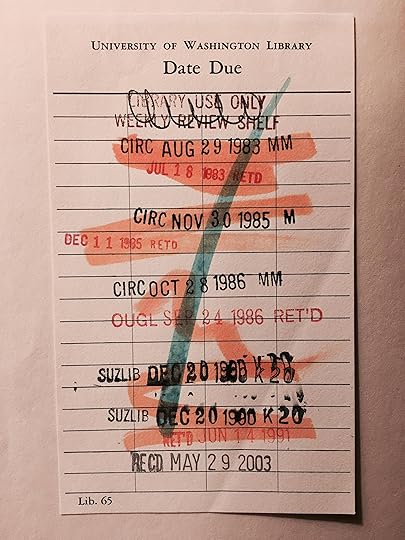
Here's the library checkout slip from the 1976 edition I read.

2 reviews1 follower
August 16, 2012
This book is a very tough read, but if you enjoy sci-fi then pick it up and give it a try.It's about a brain that has been removed from a body and is orbiting the earth.
Profile Image for Jim Howell.
23 reviews1 follower
January 10, 2021
Oh Lord, I just didn't care. I made myself finish, and it is not that long or difficult; I just didn't care.
Profile Image for Sam.
3 reviews6 followers
December 1, 2018
"All came together loosely arranged by a force. It was there & touched Imp Plus who could feel it but not reach it"

"Plus" is one of the strangest books I've read, and certainly the only thing resembling science fiction – or maybe, more appropriately, fiction about science. In some basic sense, "Plus" is about a disembodied brain (IMP Plus) of a one time engineer– who had been suffering from fatal radiation poisoning–inserted into an IMP device (Interplanetary Monitoring Platform, a real NASA initiative), orbiting Earth. Its fundamental mission is to report on glucose levels and chlorella development back to "Ground" via the "Concentration Loop". While at first things go fairly smoothly, with IMP Plus dutifully reporting the desired readings back to Ground, the true thrill of this novel is in witnessing the development of Imp Plus' own consciousness and his mission; recalling vague glimmers of memories from his former life (his lover, daughter, a vacation in Mexico) and the impossibility of reliving those now; his development of meaningful vocabulary, with a growing sense of tangible relations between elements; and fundamentally, an assertion of his own will over dictatorial and ultimately unseen forces. This is a book about loneliness, solipsism, narcissism, memory, the possibilities/limits of perception being, becoming, and ultimately personality. In a sense, "Plus" is just as much a realist fiction as thought experiment: McElroy dutifully and faithfully renders what it *would* (or could) be like were a disembodied brain to orbit earth and forced to "see" out of things that weren't eyes ("optic stalks"); as it was forced to reckon with glimmers of a past life which it will never again capture.

McElroy's prose here is deliberate, poetic, and insistent, as it must be – the closest he's come to "Unnameable" era Beckett. As IMP Plus accumulates words to describe his experience, McElroy cycles and recycles them to great impact. Words like "lattice", "crimson", "fold", and specific glimpses of memory like a "blind news vendor" or a woman on a beach muttering "Vanity" and "travel light" are obsessively turned over and over, reconfigured and re-contextualized creating a dizzying and transcendent relationship to the narrative and to IMP Plus' budding consciousness.

There are obvious frustrations and conceptual problems that arise from this premise, and the experience of reading it can be at times incredibly plodding, until McElroy swoops in with passages of such masterful beauty, facility, and poetic insight that it propels one to keep going, and insists that the reader care, culminating in an incredibly moving work. There is a tangible and marked progression here, which the reader activates and bears witness to by reading.

While I certainly enjoyed Plus far less than the two other McElroy's I've read (Women and Men and Lookout Cartridge), I found it illustrative of many of the same themes, from a radically different vantage. With "Plus", McElroy seems to be tackling the same problems of "Lookout Cartridge" from the reverse – while LC's Cartwright has seen too much which in turn reveals a sense of his consciousness and also a global network constantly unfurling (same could be said for Jim Mayn in W&M), Imp Plus cannot see at all, at least not in our traditional sense, and yet might have just as much to say about the question of perception, memory, and consciousness within the world, by precisely floating outside it.
Profile Image for Aditya Mallya.
485 reviews59 followers
November 23, 2019
Few authors must have set themselves as ambitious a task as Joseph McElroy does in Plus. He decides to write from the point of view of a being whose consciousness is just emerging. The manner in which he captures the sensory overload of raw consciousness is extraordinary - he also charts an entirely plausible journey for this character from sensation to sentience. With how convincingly it captures a hybrid human-artifical intelligence and what the perspective of this intelligence might look like, this is a book that might be decades or even centuries ahead of its time. However, as a reader in the present day I have to admit that this is one of the most difficult books I've ever read. Its stream-of-consciousness is nearly indecipherable (think James Joyce in space), and although this is intentional, it makes for impatient and taxing reading. I can't help but feel that this would have worked much better as a short story - it is much too tiring at novel-length.
117 reviews
December 2, 2022
i wish i had liked it but it really didn't hook me at all. the language is so damn complex, it's so hard to follow specially when you realize what the book is about and how little relevance any of what's said has. the concept is very interesting and maybe if it was in my native language or if i was in a different mood i would have loved it but i only stayed interested for the first quarter or so, then it mostly felt like a chore to keep going. maybe it doesn't deserve such a bad review, it's a great concept and interesting execution and so on but it didn't work for me
Profile Image for Jamie Teller.
68 reviews
July 17, 2023
Deeply admirable, occasionally very effective, often rather mystifying. McElroy’s attempt to write from the perspective of a consciousness at once alien and profoundly human results in a text that I found challenging—even impossible at times—to parse, but it’s hard to write it off as being simply confusing or self-indulgent. There’s a vision here, and McElroy pursues it with great devotion, but much of the time I simply had to let the words wash over me in a poetic haze.
Displaying 1 - 30 of 38 reviews

Can't find what you're looking for?

Get help and learn more about the design.