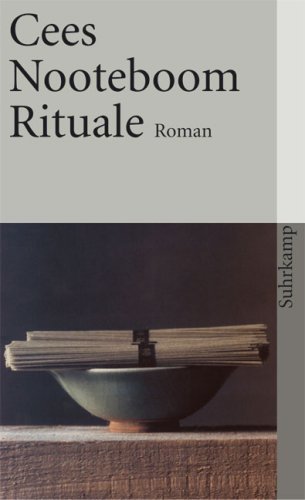
I did not like this. I don’t know if it was one of those instances where I simply wasn’t in the right frame of mind (now and then, this does seem to happen when I read) or if I just don’t like this kind of writing, but I came away from the book ultimately concluding that it was a tad smug, self-satisfied, and rather trivial at its core. It just didn’t do anything for me.
The opening section focuses on Inni Wintrop and starts in 1963 when he’s in his thirties and living in Amsterdam. He is a slightly oafish and self-involved character who, after an affair with a woman called Zita, unsuccessfully tries to kill himself. He then spends the rest of this section moaning a lot, in a fashion that I found immensely tiresome and unrewarding to read. After this, the book jumps back ten years to 1953 where Inni, as a young man in his twenties, met a man called Arnold Taads. This man, by comparison to Inni, is organised and focused, places emphasis on routine and ‘rituals’ as a method for living a more successful life, something which Inni finds loathsome. The last section jumps forward to 1973 when Inni is now a lonely, middle-aged man and he meets Arnold’s estranged son Philip who, like his father, has his means of procuring peace of mind, in this instance, eastern mysticism. Neither father nor son have especially good outcomes.
I mean, I like the idea of the book. We’re all living these pointless lives and while some claim to have insights or answers, it’s almost universally true that they’re utterly full of shit. There are no answers for life, certainly not from an individualist point of view. No special philosophy that can make sense of it all. In theory, what the book is exploring ought to have appealed to me, existentialist, personal, exploring the human condition from a point of view of cynical detachment. But I honestly just found his writing style very boring and unengaging. There’s something about the Dutch that just seems a little frivolous and glib to me, this assessment admittedly based on a small pool of experience. I mean, I suppose it could be worse... they could be Belgians.
From start to finish, I just didn’t enjoy any of this and found Nooteboom (really Holland, you gonna have names like that?) to be a writer of very prosaic prose which never entirely excited me. Plus, as I already stated, I just kept getting that sense of something flimsy here, a pleased-with-yourself smugness that made Inni insufferable and the twee middle-class worldview just a little banal and obvious. Maybe that’s the point (especially in contrast to the philosophies of the two other men) but it made him unpleasant as a character and as a method for promoting the ideas. I just didn’t care very much about any of it. It felt like listening to an idiot trying to say something profound. This is my first Cease nutBOOM so not the best start, but I’ll give him another try at some point.