

What do you think?
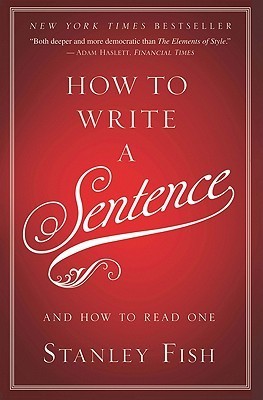
How to Write a Sentence: And How to Read One
In this entertaining and erudite New York Times bestseller, beloved professor Stanley Fish offers both sentence craft and sentence pleasure. Drawing on a wide range of great writers, from Philip Roth to Antonin Scalia to Jane Austen, How to Write a Sentence is much more than a writing manual—it is a spirited love letter to the written word, and a key to understanding how great writing works.
165 pages, Hardcover
First published January 6, 2011
About the author
Stanley Fish
67 books120 followersStanley Eugene Fish is an American literary theorist and legal scholar. He was born and raised in Providence, Rhode Island. He is often associated with postmodernism, at times to his irritation, as he describes himself as an anti-foundationalist.
He is the Davidson-Kahn Distinguished University Professor of Humanities and a Professor of Law at Florida International University, in Miami, as well as Dean Emeritus of the College of Liberal Arts and Sciences at the University of Illinois at Chicago, and the author of 10 books. Professor Fish has also taught at the University of California, Berkeley, Johns Hopkins University, Columbia University, and Duke University.
He is the Davidson-Kahn Distinguished University Professor of Humanities and a Professor of Law at Florida International University, in Miami, as well as Dean Emeritus of the College of Liberal Arts and Sciences at the University of Illinois at Chicago, and the author of 10 books. Professor Fish has also taught at the University of California, Berkeley, Johns Hopkins University, Columbia University, and Duke University.
Ratings & Reviews
Friends & Following
Create a free account to discover what your friends think of this book!
Community Reviews
Displaying 1 - 30 of 533 reviews

January 26, 2011
If it weren't for goodreads, I could imagine that no one else on earth would find the near fetish-like pleasure I found in this tiny little book. I cherished this thing like a teenage boy oggles over a centerfold, privately, under the covers, with a yellow glow from my bedside lamp, deconstructing sentences like porn deconstructs a woman's body. Fish (oh, I wish that were not your name) illustrates the finite forms of the limitless conveyor of all meaning -- the sentence, in a way that makes all great writing fresh and newly amazing. I have an urge to read the first sentence of every novel I own, a novel in itself, just to pick apart the form each author used to slice that first piece of cake. Of course Fish covers some old favorites, some Dickens, some Austen, but he also includes some amazing analysis of Martin Luther King Jr., Joseph Conrad, and Ford Maddox Ford. He even goes hip and takes a sentence from Tana French! I'm still not convinced that Gertrude Stein ever succeeded in her goal of keeping language ever in the present, each word with equal weight, but maybe that's because I don't believe that each word IS equal. I might even try a few of Fish's suggested exercises -- well, I did try in my head, but there is yet no evidence. I want to experiment on my son with one particular exercise: Write out Lewis Carroll's 'Twas Brillig, and ask him to replace the nonsense words with real ones. Will he be familiar enough with the work each word performs to know what kind of word fits where? That's part of what makes the poem so brilliant -- it uses language form to convey meaning, without loading the words themselves with any meaning at all. (Also, slithey toves are awesome.)
This is required reading for every writer and every reader reading above the Grisham/Picoult threshold. I withhold one star 'cuz he started getting preachy and exalted at the end, too worked up, perhaps, in his "last sentence" chapter to make a calm landing on his own last sentence. But I forgive him. All the sentences in the middle were just great.
This is required reading for every writer and every reader reading above the Grisham/Picoult threshold. I withhold one star 'cuz he started getting preachy and exalted at the end, too worked up, perhaps, in his "last sentence" chapter to make a calm landing on his own last sentence. But I forgive him. All the sentences in the middle were just great.

August 27, 2012
Oh good heavens above. This book was unbearable and this is from someone who loves to diagram sentences. Not since college have I forced myself to read such an esoteric, pompous, self righteous, condescending diatribe. I finished it wondering if it wouldn't have been more fun to read an instruction manual from Ikea.
Here's one excerpt, definitely typical of the whole freaking book (here he's talking about ONE sentence from Donne's Reflections):
"But God's literalism--the instantaneous conveyance of his intentions--is a feature of eternity where those to whom he speaks dwell within him; he is always, in a sense, speaking to himself; there is no distance to be bridged; no translation, in the root sense of being carried across space is necessary. Their perspective is limited by time and space, and because the discursive structures they employ reflect that limitation, the literalism they can achieve-- the literalism of the here and now-- is spectacularly inadequate to the literalism Donne celebrates as God's. That is why his sentence does not end with the proclamation of God's 'plain sense'; the real question is how do we get even a glimpse of that plainness when the instruments (of cognition, understanding, human language, sentences) at our disposal are actually obstructions, are in our way?"
Here's one excerpt, definitely typical of the whole freaking book (here he's talking about ONE sentence from Donne's Reflections):
"But God's literalism--the instantaneous conveyance of his intentions--is a feature of eternity where those to whom he speaks dwell within him; he is always, in a sense, speaking to himself; there is no distance to be bridged; no translation, in the root sense of being carried across space is necessary. Their perspective is limited by time and space, and because the discursive structures they employ reflect that limitation, the literalism they can achieve-- the literalism of the here and now-- is spectacularly inadequate to the literalism Donne celebrates as God's. That is why his sentence does not end with the proclamation of God's 'plain sense'; the real question is how do we get even a glimpse of that plainness when the instruments (of cognition, understanding, human language, sentences) at our disposal are actually obstructions, are in our way?"

May 10, 2011
Although an occasional worthwhile pearl sprang from the author's ponderously pedantic prose, by mid-exposition I found it so tedious to wade through the mire of words, words, words and pseudo-erudite opinions couched as fact, just to seek those few pearls, that I resorted to mere skimming of paragraphs rather than my usual preference of savoring the harmony of words put together to convey both meaning and feeling and whatever message the author intends; in fact, one could easily attain the gist of this author's thesis within the first half of the book, wherein lie the few jewels of value to the aspiring writer, whereas the second half of the book presents a tiresome succession of quotations from true literary classics - such as Milton, E.E. Cummings, and Joseph Conrad - each annoyingly parsed to death by author's personal interpretation of said sentences ad nauseam in a supercilious writing style mostly characterized by endless run-on sentences like this one; all of which made me ever so grateful to be reading his book - which I could put down whenever really bored by the relentless sophisms - and not to be suffering in his classroom, constrained to politely listen to him drone on until the rafters themselves began to weep.

March 11, 2011
PB (in rabble-rousing mode) : Gimme a GH as in “enough”!
Crowd of drunken Goodreaders : “GH!”
PB : Gimme an O like in “women”!
Crowd: O!
PB : Gimme a TI like in “station”!
Crowd : TI!!
PB : What’s that spell?
Crowd : GHOTI! GHOTI!!
PB : Yeah, but what does it sound like?
Crowd : FISH! FISH! FISH!
One of the blurbs on the back of this slender volume says :
Whether people like Stanley Fish or not they tend to find him fascinating.
Translation:
I know several people who deliberately bought clothes shop mannekins so they could take them home and label them STANLEY FISH and after a few daiquiris regularly stab them with breadknives yelling DIE FISH DIE
I mean to say, that’s a strange quote to use as a blurb, don’t you think?
I have myself many favourite sentences. Being some might say overfond of the unclassical music of our time, I choose to choose four delightful examples from three writers writing about that major minor art form :
1) A great pop song springs out of nowhere, sounds like other things but mostly resembles itself, and contains a series of musical and lyrical hooks so irresistible, so packed with slang, lust and alien rhythm, they have a comedic element.
2) Pop songs are the invention of a new kind of language, either sonically or grammatically, and a combination of sly gimmickry, bulging confidence and cultish insider knowledge gives them the seductive impact of novelty.
3) This is rock and roll made simply, bursting with baroque and brash ideas, keening and
self-centered, vigorously and impudently shedding echoes of bland Doo Wop,
monochromatic skiffling, mild crooning, bleached-out Berryisms, or Phil Spector inhuman
lushness.
4) I like old time delta pre-Cambrian blues, I like Mountain Folk
home-make instrumentals backing singalongs for the Innsmouth secret
cabals of south sea islander Dagon communions in the 4 Square
Pentecostal, I like those after-Bingo black-mass choirs that echo as far as the creaking bridge and back, and I especially like the guy with no teeth ignoring all the Finns and Fish-Faces and wailing and stamping and just keeps on and playing his alien American guitar on the glider out front of the Odd Fellows hall.
And one from the world of independent movies:
5) I've wept on every birthday I ever had because life is huge and fleeting and I hate certain people and certain shoes and I feel that life is terribly unfair and sometimes beautiful and wonderful and extraordinary and also numbing and horrifying and insurmountable and I hate myself a lot of the time but the rest of the time I adore myself.
So, I think we’re actually very rich in great sentences, you don’t have to go scurrying off to Johnny Milton or Lawrence Sterne, they’re very nearly a dime a dozen. Fish makes what could be a charming logflume through the Dollywood of literary style into a smart 20 kilometer hike through the forest of corrugated brows, too much like hard work for this dilettante. And anyway, where was Philip Roth, whose sentences can unhook bras from a range of 200 yards – scientifically proven at Harvard, I believe – or Donny DeLillo, whose enemies are often strangled to death by his patented brand of boa constricting sentences? Where was Henry James, and James Joyce? Stanley discusses opening lines of novels and doesn’t include this one from JJ :
Once upon a time and a very good time it was there was a moocow coming down along the road and this moocow that was coming down along the road met a nicens little boy named baby tuckoo .
Or what about this one he missed also by JJ :
In Rodot's Yvonne and Madeleine newmake their tumbled beauties, shattering with gold teeth chaussons of pastry, their mouths yellowed with the pus of flan Breton.
Now that's more like it.
So, this book could have been like WAY better, but I'm not turning into a Fish-stabber and I don't know why people appear to not love Mr Fish.
***********
QUOTES BY
1-2 by Paul Morley. Guardian
3. Michael Baker, Perfect Sound Forever
4. Harald Sundt, email to the Beefheart discussion group
5. by Jennifer Westfeldt and Heather Juergensen from Kissing Jessica Stein,
Crowd of drunken Goodreaders : “GH!”
PB : Gimme an O like in “women”!
Crowd: O!
PB : Gimme a TI like in “station”!
Crowd : TI!!
PB : What’s that spell?
Crowd : GHOTI! GHOTI!!
PB : Yeah, but what does it sound like?
Crowd : FISH! FISH! FISH!
One of the blurbs on the back of this slender volume says :
Whether people like Stanley Fish or not they tend to find him fascinating.
Translation:
I know several people who deliberately bought clothes shop mannekins so they could take them home and label them STANLEY FISH and after a few daiquiris regularly stab them with breadknives yelling DIE FISH DIE
I mean to say, that’s a strange quote to use as a blurb, don’t you think?
I have myself many favourite sentences. Being some might say overfond of the unclassical music of our time, I choose to choose four delightful examples from three writers writing about that major minor art form :
1) A great pop song springs out of nowhere, sounds like other things but mostly resembles itself, and contains a series of musical and lyrical hooks so irresistible, so packed with slang, lust and alien rhythm, they have a comedic element.
2) Pop songs are the invention of a new kind of language, either sonically or grammatically, and a combination of sly gimmickry, bulging confidence and cultish insider knowledge gives them the seductive impact of novelty.
3) This is rock and roll made simply, bursting with baroque and brash ideas, keening and
self-centered, vigorously and impudently shedding echoes of bland Doo Wop,
monochromatic skiffling, mild crooning, bleached-out Berryisms, or Phil Spector inhuman
lushness.
4) I like old time delta pre-Cambrian blues, I like Mountain Folk
home-make instrumentals backing singalongs for the Innsmouth secret
cabals of south sea islander Dagon communions in the 4 Square
Pentecostal, I like those after-Bingo black-mass choirs that echo as far as the creaking bridge and back, and I especially like the guy with no teeth ignoring all the Finns and Fish-Faces and wailing and stamping and just keeps on and playing his alien American guitar on the glider out front of the Odd Fellows hall.
And one from the world of independent movies:
5) I've wept on every birthday I ever had because life is huge and fleeting and I hate certain people and certain shoes and I feel that life is terribly unfair and sometimes beautiful and wonderful and extraordinary and also numbing and horrifying and insurmountable and I hate myself a lot of the time but the rest of the time I adore myself.
So, I think we’re actually very rich in great sentences, you don’t have to go scurrying off to Johnny Milton or Lawrence Sterne, they’re very nearly a dime a dozen. Fish makes what could be a charming logflume through the Dollywood of literary style into a smart 20 kilometer hike through the forest of corrugated brows, too much like hard work for this dilettante. And anyway, where was Philip Roth, whose sentences can unhook bras from a range of 200 yards – scientifically proven at Harvard, I believe – or Donny DeLillo, whose enemies are often strangled to death by his patented brand of boa constricting sentences? Where was Henry James, and James Joyce? Stanley discusses opening lines of novels and doesn’t include this one from JJ :
Once upon a time and a very good time it was there was a moocow coming down along the road and this moocow that was coming down along the road met a nicens little boy named baby tuckoo .
Or what about this one he missed also by JJ :
In Rodot's Yvonne and Madeleine newmake their tumbled beauties, shattering with gold teeth chaussons of pastry, their mouths yellowed with the pus of flan Breton.
Now that's more like it.
So, this book could have been like WAY better, but I'm not turning into a Fish-stabber and I don't know why people appear to not love Mr Fish.
***********
QUOTES BY
1-2 by Paul Morley. Guardian
3. Michael Baker, Perfect Sound Forever
4. Harald Sundt, email to the Beefheart discussion group
5. by Jennifer Westfeldt and Heather Juergensen from Kissing Jessica Stein,

February 14, 2013
I don't really read many books on writing. Some who have read my work might say it shows. Touche. I've just found very few books on writing that are actually engaging and interesting. Frankly, they bore me. Besides that, they actually keep me from writing.
So why did I pick this one up, you might ask. Well, like many good things in life, I picked this one up after hearing about it on NPR in this interview with the author, Stanley Fish. I've always appreciated a good sentence, but after listening to the interview, I felt compelled to pay closer attention to sentences, trying to find the sparkling gems amidst the long veins of narrative coal out there. But it was a long time before How to Write a Sentence percolated to the top of my "to read" pile because, well, I was busy writing sentences. To quote Buck Murdock from Airplane II, "Irony can be pretty ironic sometimes".
The work itself is divided up into ten chapters, some more instructive than others. It is a good book, theoretically speaking, but pedagogy is lacking. I would have expected more instructions but, as any good (or lazy) teacher is wont to do, Fish leaves it up to us to learn how to apply the theory herein. The author does an excellent job of taking a few representative sentences and breaking them down into what makes them so good. Yes, there are a few intellectual liberties taken, as one must expect with a work that leans more toward the academic than the popular. But, for the most part, Fish clearly identifies what makes these representative sentences tick.
My biggest complaint was that chapter ten, on "Sentences That Are About Themselves (Aren't They All?)," should have begun on page 145 with the section on Joseph Conrad, rather than on page 133, which I felt was an indulgent exercise in intellectualympics. That, and Fish's annoying proclivity for setting forth a theory, contradicting the theory, then telling the reader that he has contradicted himself . . . with no further explanation or closure. This one aspect gave me a strong dose of the rage I felt in graduate school when a teacher or another student would start off on an argumentative thread without ever finishing the argument. I suppose that this is meant to show off the speaker's/writer's intelligence and academic prowess. I am not impressed.
Nevertheless, this was a good book about writing, but not a great one. Definitely more worth your time than the vast majority of books on writing (many of which I've begun and tossed across the room). But wouldn't your time be better spent actually writing? Get to it!
So why did I pick this one up, you might ask. Well, like many good things in life, I picked this one up after hearing about it on NPR in this interview with the author, Stanley Fish. I've always appreciated a good sentence, but after listening to the interview, I felt compelled to pay closer attention to sentences, trying to find the sparkling gems amidst the long veins of narrative coal out there. But it was a long time before How to Write a Sentence percolated to the top of my "to read" pile because, well, I was busy writing sentences. To quote Buck Murdock from Airplane II, "Irony can be pretty ironic sometimes".
The work itself is divided up into ten chapters, some more instructive than others. It is a good book, theoretically speaking, but pedagogy is lacking. I would have expected more instructions but, as any good (or lazy) teacher is wont to do, Fish leaves it up to us to learn how to apply the theory herein. The author does an excellent job of taking a few representative sentences and breaking them down into what makes them so good. Yes, there are a few intellectual liberties taken, as one must expect with a work that leans more toward the academic than the popular. But, for the most part, Fish clearly identifies what makes these representative sentences tick.
My biggest complaint was that chapter ten, on "Sentences That Are About Themselves (Aren't They All?)," should have begun on page 145 with the section on Joseph Conrad, rather than on page 133, which I felt was an indulgent exercise in intellectualympics. That, and Fish's annoying proclivity for setting forth a theory, contradicting the theory, then telling the reader that he has contradicted himself . . . with no further explanation or closure. This one aspect gave me a strong dose of the rage I felt in graduate school when a teacher or another student would start off on an argumentative thread without ever finishing the argument. I suppose that this is meant to show off the speaker's/writer's intelligence and academic prowess. I am not impressed.
Nevertheless, this was a good book about writing, but not a great one. Definitely more worth your time than the vast majority of books on writing (many of which I've begun and tossed across the room). But wouldn't your time be better spent actually writing? Get to it!

April 6, 2013
This gets 2 stars because I enjoyed the first portion of the book wherein we explore what makes a good sentence and what makes a great one. I found the exercises mentioned to be helpful and a few of the key points he made to be illuminating.
However as a whole it seemed to lack thoroughness. Fish makes a point of criticizing "The Elements of Style" for assuming the reader has a level of previous knowledge, then he proceeds to do so himself.
He even goes so far as to specify that he'll later expand on certain vocabulary words, "...coordination, subordination, allusion, compression, parallelism, alliteration (all to be explained later)..." then fails to do so. Those topics come up later, but other than "subordination" he doesn't EXPLAIN any of them. If it wasn't going to be a beginners book he shouldn't have taken time in the first and second chapters to imply it would be. It feels like he started out well meaning but at some point simply got tired of writing this book and phoned the rest of it in.
The second part of the book was also misrepresented. The title implies he'll teach us HOW TO READ A SENTENCE. He doesn't. He just spends a few chapters describing, verbosely, how HE interprets examples of skillful written sentences. He never once indicates a path we might follow to find similar conclusions while reading future texts independently.
I didn't finish the second portion of the book because it wasn't instructive in the slightest. It was just Fish masturbatorily self-congratulating his insightfullness.
However as a whole it seemed to lack thoroughness. Fish makes a point of criticizing "The Elements of Style" for assuming the reader has a level of previous knowledge, then he proceeds to do so himself.
He even goes so far as to specify that he'll later expand on certain vocabulary words, "...coordination, subordination, allusion, compression, parallelism, alliteration (all to be explained later)..." then fails to do so. Those topics come up later, but other than "subordination" he doesn't EXPLAIN any of them. If it wasn't going to be a beginners book he shouldn't have taken time in the first and second chapters to imply it would be. It feels like he started out well meaning but at some point simply got tired of writing this book and phoned the rest of it in.
The second part of the book was also misrepresented. The title implies he'll teach us HOW TO READ A SENTENCE. He doesn't. He just spends a few chapters describing, verbosely, how HE interprets examples of skillful written sentences. He never once indicates a path we might follow to find similar conclusions while reading future texts independently.
I didn't finish the second portion of the book because it wasn't instructive in the slightest. It was just Fish masturbatorily self-congratulating his insightfullness.

April 2, 2017
If you find sentences exciting, then this book may be perfect for you. In fact, I found it fairly thrilling.
Fish (who wrote Is There a Text in This Class?: The Authority of Interpretive Communities, another favorite of mine) takes apart sentences and puts them back together. In the first several chapters, he makes the argument for mastering form before attempting to fill it with content, like a pianist practicing scales. He discusses several sentence forms and provides exercises which I found interesting (I actually did the exercises; although, of course, one could always do more). Then, in the next few chapters, he turns around and admits that of course content is equally important and that in order to write a really powerful sentence, a person has to have something worth saying.
In the end, it is apparent that as with all writing, form and content are both critical to the success of a work-be it an entire novel, poem, or a single line and its contribution to the entire edifice.
Fish's discussion of how to construct a sentence was fascinating; his discussion of how to read a sentence was perhaps even more enlightening. Or maybe just more fun. He uses many wonderful sentences to examine what makes a sentence work and it was a pleasure to simply to read these sentences (a pleasure then enhanced by his discussion of what makes the sentence work so beautifully.
I could read an entire second book on this subject just for the pleasure of the sentences Fish chooses and his artful analysis of them.
I'm particularly interested in how a sentence is written (hence what attracted me to the book in the first place, this and Stein writing on how to write a sentence, also exciting) but I think anyone interested in writing, literature, or language will find this book a pleasure to read.
Fish (who wrote Is There a Text in This Class?: The Authority of Interpretive Communities, another favorite of mine) takes apart sentences and puts them back together. In the first several chapters, he makes the argument for mastering form before attempting to fill it with content, like a pianist practicing scales. He discusses several sentence forms and provides exercises which I found interesting (I actually did the exercises; although, of course, one could always do more). Then, in the next few chapters, he turns around and admits that of course content is equally important and that in order to write a really powerful sentence, a person has to have something worth saying.
In the end, it is apparent that as with all writing, form and content are both critical to the success of a work-be it an entire novel, poem, or a single line and its contribution to the entire edifice.
Fish's discussion of how to construct a sentence was fascinating; his discussion of how to read a sentence was perhaps even more enlightening. Or maybe just more fun. He uses many wonderful sentences to examine what makes a sentence work and it was a pleasure to simply to read these sentences (a pleasure then enhanced by his discussion of what makes the sentence work so beautifully.
I could read an entire second book on this subject just for the pleasure of the sentences Fish chooses and his artful analysis of them.
I'm particularly interested in how a sentence is written (hence what attracted me to the book in the first place, this and Stein writing on how to write a sentence, also exciting) but I think anyone interested in writing, literature, or language will find this book a pleasure to read.

November 16, 2011
I dreamed I read this book in my Maidenform bra, and what a nightmare it was.

Want to Read
March 24, 2011A Collection of Thoughts Inspired by Paul Bryant's Review
http://www.goodreads.com/review/show/...
As usual, one of Paul Bryant's reviews acted as a powerful stimulus to think through some issues that have been percolating in the back of my mind for a while.
Paul is my favourite polymath-ematician and literary agent provocateur as well as my avant guardian.
Everything he writes is worth reading, contemplating, enjoying and following.
"A Confederacy of Dunces"
Jonathan Swift might be able to explain Fish's enemies (in quite a nice sentence, too):
"When a true genius appears in the world, you may know him by this sign, that the dunces are all in confederacy against him."
A Podcast
You might be interested in this podcast from this morning (24 March, 2011):
http://www.abc.net.au/rn/bookshow/sto...
Some Thoughts about Stanley's Fishing Expedition
I think most debate has become so passionate and subjective that it shocks people when somebody pretends or appears to be dispassionate and objective.
Form and substance is an ancient distinction, but who (else but Fish) today would say that form was more important than substance?
I think this is a reason why Fish could be perceived to be threatening by both the left and the right.
He is actually quite radical, in that he looks at the root of all things.
But by emptying the vessel of content, he becomes an empty vessel or a neutral medium.
He is more interested in the form or the structure (the medium not the message).
By failing to be overtly political, or interventionist or discriminatory (in a positive sense), he might alienate the left liberal.
But this doesn't make him an advocate of the status quo.
He purports to be neutral about the right and alienates them as well.
For them, he has a dangerous ability to see through the internal logic of the content and undermine the gravity of the conservative message.
The threat to both sides of politics is that this method of debate, by being empty and neutral, could be filled with powerful content in the hands of someone else.
To the extent that he is a master of form and rhetoric, his skills could be waylaid by a new Hitler or Stalin, who could use his skills to achieve an "evil" goal.
This abuse of form to convey a content message would betray Fish's own world view, but values inevitably seek to fill an empty, value-free space.
He could therefore be the author of his own downfall like the French Structuralists.
His skills are manageable in his hands, but what fate will befall his acolytes?
Fish has the ability of an old-style lawyer to be dispassionate, to be objective, to know all of the arguments for both sides, to detect the weaknesses in presentation, to be surgical in his precision.
His delivery is concise and precise, elegant and effective.
But he doesn't seek to use these skills as an adversary on behalf of one side versus another.
If he wanted to be a judge, he could probably be a very fair judge.
But he probably wouldn't want to be a judge, because that would force him to make assessments of the content, whereas his passion is for the form.
This means he sits outside the system, and he won't play the game that everybody else plays and believes in and takes so seriously.
He plays his own game, and the main game feels threatened by his lack of interest.
Their fear is that, if his ideas catch on, then other people will lose faith in the main game.
What he has done to people might be to undermine the content of their arrogant self-belief.
He is on the outside of the parade pointing out that the emperor is wearing no clothes.
Paul Links to "The King's New Clothes"
http://www.youtube.com/watch?v=W747Fd...
Gee, that brings back memories and how apt.
It must be over 30 years since I've heard that song, but what a song!
"And everybody was cheering like mad,
except one little boy. You see, he hadn't heard about
the magic suit and didn't know what he was supposed to see."
And from the original:
"But among the crowds a little child suddenly gasped out, "But he hasn't got anything on." And the people began to whisper to one another what the child had said. "He hasn't got anything on." "There's a little child saying he hasn't got anything on." Till everyone was saying, "But he hasn't got anything on." The Emperor himself had the uncomfortable feeling that what they were whispering was only too true. "But I will have to go through with the procession," he said to himself.
"So he drew himself up and walked boldly on holding his head higher than before, and the courtiers held on to the train that wasn't there at all."
So if my modest hypothesis is right, Stanley is a lawyer who doesn't want to be a courtier holding the train that isn't there.
And this from Wiki:
Andersen’s decision to change the ending may have occurred after he read the manuscript tale to a child,or had its source in a childhood incident similar to that in the tale.
In 1872, he recalled standing in a crowd with his mother waiting to see King Frederick VI.
When the king made his appearance, Andersen cried out, "Oh, he’s nothing more than a human being!"
His mother tried to silence him by crying, "Have you gone mad, child?"
Whatever the reason, Andersen thought the change would prove more satirical.
Formalist or Non-Conformist or both?
As paradoxical as it might seem, I wonder whether Fish is a non-conformalist.
Paul Links to Extracts from Fish's Critics
Paul wrote: "I finally checked Wiki and it turns out he's often in hot water
http://en.wikipedia.org/wiki/Stanley_..."
http://en.wikipedia.org/wiki/Stanley_...
I was going to say that this negative criticism of Fish reminded me a lot of the reaction to FR Leavis and TS Eliot and the New Criticism in the 40's and 50's:
http://en.wikipedia.org/wiki/New_Crit...
My own political and literary views are really influenced by the New York Intellectuals mentioned in the article:
http://en.wikipedia.org/wiki/The_New_...
And they absolutely hated the New Criticism.
They might be regarded as old fashioned now (some of them were part of the Old Left), but I still love reading their prose.
The amazing thing about Fish is how vehement and personal the criticism of him is, as if he is explicitly a threat to everybody, a clear and present danger.
They're all furiously dialling 911 (like he's some "campus killer" on the loose amongst our children).
If he was French, he would probably just be treated as an interesting, but eccentric, shit-stirrer.
Instead, they treat him like the Devil incarnate.
Some of his critics are people who I would otherwise respect (Eagleton).
Who would want to be a sophist or sophisticated?
I find Fish fascinating to listen to, because he adds to how I feel about things.
He's quite entertaining and invigorating and rejuvenating in a dry way (like a 21st century "Dead Poets Society").
His critics approach him as if their views are mutually exclusive, whereas I see them as complementary (if not complimentary).
But to pursue my analogies, he is a living technique, a methodology, a rifle, a cannon, and people are judging him for what could be done if his cannon got into the hands of others (like the NRA might say, you could argue that Fish's rifle or cannon isn't intrinsically bad, it's only bad in the hands of the wrong person).
You want to ask: isn't the worst thing that could happen that we could end up with a "loose canon" (sorry).
However, the thing is that he isn't loose in his methodology at all, he is actually incredibly rigid and disciplined and unforgiving (the lawyer in him).
I think that a lot of theorists envy him, because he actually came close to "inventing" something new, whereas they just play around with literature's "rich tapestry" using old techniques.
People will probably remember him long after they have forgotten his critics.
Which reminds me that I should be reading "A Confederacy of Dunces".
http://www.goodreads.com/review/show/...
As usual, one of Paul Bryant's reviews acted as a powerful stimulus to think through some issues that have been percolating in the back of my mind for a while.
Paul is my favourite polymath-ematician and literary agent provocateur as well as my avant guardian.
Everything he writes is worth reading, contemplating, enjoying and following.
"A Confederacy of Dunces"
Jonathan Swift might be able to explain Fish's enemies (in quite a nice sentence, too):
"When a true genius appears in the world, you may know him by this sign, that the dunces are all in confederacy against him."
A Podcast
You might be interested in this podcast from this morning (24 March, 2011):
http://www.abc.net.au/rn/bookshow/sto...
Some Thoughts about Stanley's Fishing Expedition
I think most debate has become so passionate and subjective that it shocks people when somebody pretends or appears to be dispassionate and objective.
Form and substance is an ancient distinction, but who (else but Fish) today would say that form was more important than substance?
I think this is a reason why Fish could be perceived to be threatening by both the left and the right.
He is actually quite radical, in that he looks at the root of all things.
But by emptying the vessel of content, he becomes an empty vessel or a neutral medium.
He is more interested in the form or the structure (the medium not the message).
By failing to be overtly political, or interventionist or discriminatory (in a positive sense), he might alienate the left liberal.
But this doesn't make him an advocate of the status quo.
He purports to be neutral about the right and alienates them as well.
For them, he has a dangerous ability to see through the internal logic of the content and undermine the gravity of the conservative message.
The threat to both sides of politics is that this method of debate, by being empty and neutral, could be filled with powerful content in the hands of someone else.
To the extent that he is a master of form and rhetoric, his skills could be waylaid by a new Hitler or Stalin, who could use his skills to achieve an "evil" goal.
This abuse of form to convey a content message would betray Fish's own world view, but values inevitably seek to fill an empty, value-free space.
He could therefore be the author of his own downfall like the French Structuralists.
His skills are manageable in his hands, but what fate will befall his acolytes?
Fish has the ability of an old-style lawyer to be dispassionate, to be objective, to know all of the arguments for both sides, to detect the weaknesses in presentation, to be surgical in his precision.
His delivery is concise and precise, elegant and effective.
But he doesn't seek to use these skills as an adversary on behalf of one side versus another.
If he wanted to be a judge, he could probably be a very fair judge.
But he probably wouldn't want to be a judge, because that would force him to make assessments of the content, whereas his passion is for the form.
This means he sits outside the system, and he won't play the game that everybody else plays and believes in and takes so seriously.
He plays his own game, and the main game feels threatened by his lack of interest.
Their fear is that, if his ideas catch on, then other people will lose faith in the main game.
What he has done to people might be to undermine the content of their arrogant self-belief.
He is on the outside of the parade pointing out that the emperor is wearing no clothes.
Paul Links to "The King's New Clothes"
http://www.youtube.com/watch?v=W747Fd...
Gee, that brings back memories and how apt.
It must be over 30 years since I've heard that song, but what a song!
"And everybody was cheering like mad,
except one little boy. You see, he hadn't heard about
the magic suit and didn't know what he was supposed to see."
And from the original:
"But among the crowds a little child suddenly gasped out, "But he hasn't got anything on." And the people began to whisper to one another what the child had said. "He hasn't got anything on." "There's a little child saying he hasn't got anything on." Till everyone was saying, "But he hasn't got anything on." The Emperor himself had the uncomfortable feeling that what they were whispering was only too true. "But I will have to go through with the procession," he said to himself.
"So he drew himself up and walked boldly on holding his head higher than before, and the courtiers held on to the train that wasn't there at all."
So if my modest hypothesis is right, Stanley is a lawyer who doesn't want to be a courtier holding the train that isn't there.
And this from Wiki:
Andersen’s decision to change the ending may have occurred after he read the manuscript tale to a child,or had its source in a childhood incident similar to that in the tale.
In 1872, he recalled standing in a crowd with his mother waiting to see King Frederick VI.
When the king made his appearance, Andersen cried out, "Oh, he’s nothing more than a human being!"
His mother tried to silence him by crying, "Have you gone mad, child?"
Whatever the reason, Andersen thought the change would prove more satirical.
Formalist or Non-Conformist or both?
As paradoxical as it might seem, I wonder whether Fish is a non-conformalist.
Paul Links to Extracts from Fish's Critics
Paul wrote: "I finally checked Wiki and it turns out he's often in hot water
http://en.wikipedia.org/wiki/Stanley_..."
http://en.wikipedia.org/wiki/Stanley_...
I was going to say that this negative criticism of Fish reminded me a lot of the reaction to FR Leavis and TS Eliot and the New Criticism in the 40's and 50's:
http://en.wikipedia.org/wiki/New_Crit...
My own political and literary views are really influenced by the New York Intellectuals mentioned in the article:
http://en.wikipedia.org/wiki/The_New_...
And they absolutely hated the New Criticism.
They might be regarded as old fashioned now (some of them were part of the Old Left), but I still love reading their prose.
The amazing thing about Fish is how vehement and personal the criticism of him is, as if he is explicitly a threat to everybody, a clear and present danger.
They're all furiously dialling 911 (like he's some "campus killer" on the loose amongst our children).
If he was French, he would probably just be treated as an interesting, but eccentric, shit-stirrer.
Instead, they treat him like the Devil incarnate.
Some of his critics are people who I would otherwise respect (Eagleton).
Who would want to be a sophist or sophisticated?
I find Fish fascinating to listen to, because he adds to how I feel about things.
He's quite entertaining and invigorating and rejuvenating in a dry way (like a 21st century "Dead Poets Society").
His critics approach him as if their views are mutually exclusive, whereas I see them as complementary (if not complimentary).
But to pursue my analogies, he is a living technique, a methodology, a rifle, a cannon, and people are judging him for what could be done if his cannon got into the hands of others (like the NRA might say, you could argue that Fish's rifle or cannon isn't intrinsically bad, it's only bad in the hands of the wrong person).
You want to ask: isn't the worst thing that could happen that we could end up with a "loose canon" (sorry).
However, the thing is that he isn't loose in his methodology at all, he is actually incredibly rigid and disciplined and unforgiving (the lawyer in him).
I think that a lot of theorists envy him, because he actually came close to "inventing" something new, whereas they just play around with literature's "rich tapestry" using old techniques.
People will probably remember him long after they have forgotten his critics.
Which reminds me that I should be reading "A Confederacy of Dunces".

September 12, 2012
It's unclear who this book was written for. It's certainly not an introduction to sentence writing, nor is it, judging by its relatively advanced (well, "inchoate" is in there) diction, for kids. It's hardly meant for an academic audience, though, as it routinely spurns "prescriptive" guides like Strunk and White (which certainly takes a beating). Fish also spurns the use of much established terminology and definitions contained in "the literature," opting instead to use his own terms, which for some reason he thinks will be more useful to a writer for their arbitrariness and distance from any sort of agreed-upon standard. In the end I decided the book must have been written for a much older audience, one familiar with books and reading and literature, and one with perhaps a slight germ of interest in the building blocks that make up those books, but with absolutely no desire to ever go about writing one themselves. This is certainly not a craft book (though nor is it really an entertaining, feel-good, celebratory celebration of (good) sentences). Where craft is concerned, Fish gives advice like "First, figure out what you want to do, then figure out how you're gonna do it." He presents certain "types" of sentences (again, the categorization is arbitrary and his own), then details how one can imitate that sort of sentence by essentially switching the verb and subject out with other verbs and nouns. (Fish also has a terrible habit of presenting a bunch of his own mimetic examples, then saying "These are my examples, and they aren't very good, but I'm sure I could do better." Do it then! This is your book! This isn't a spontaneous lecture!) Fish also has a knack for misinterpreting author after author after author—Salinger's Catcher in the Rye opener is a particularly egregious example, but it happens too with Roth and with Hemingway, and with Orwell and, I'm sure, with plenty others. Anyway, I'd say for all intents and purposes this book is worthless, unless you've never seen a sentence before and want to write one that sounds almost exactly like a bunch of arbitrary examples. One gets the idea that the entire book is nothing more than a guy who likes sentences sort of mumbling to himself long-windedly about what he happens to think about them.

May 19, 2011
"Some appreciate fine art; others appreciate fine wines. Stanley Fish appreciates fine sentences."
I never thought I would read a book entitled How to Write a Sentence: And How to Read One; even less did I think I would enjoy one. Yet, here I am and I can do no other.
Stanley Fish writes a book in which he introduces the sentence as a work of art. Not only does he succeed in convincing you that it is art, but he then succeeds at teaching you how to be a connoisseur of that art. His stated goal for the book is "to bring you into the little worlds made cunningly by as many writers as I can cram into a short book." He promises "to give you both sentence pleasure and sentence craft, the ability to appreciate a good sentence and the ability to fashion one." He succeeds.
He begins with form. He isn't concerned with the categories of words: nouns, verbs, adjectives, predicates, etc. Not because they aren't important--they are, he says--but because his focus is upon the form those words take when put together into sentences. That doesn't mean those categories can be ignored, rather that they are not the end for sentence craft. He then defines what a sentence is, less with a dictionary definition--his is "a sentence is an organization of items in the world, a structure of logical relationships"--and more with examples of finely crafted sentences.
From there, he moves into developing both sentence pleasure and sentence craft, simultaneously. The first task is to establish one in the sentence craft--which, for him, means mastering the form first. Fish assigns an exercise in which one takes a very short sentence "John hit the ball," and expands it to a 15-word sentence, a 30-word sentence, and finally a 100-word sentence. This is done without every losing the original meaning of the sentence "John hit the ball."
In the next exercise, again meant to focus on form rather than content, he takes the first stanza of Lewis Carroll's "Jabberwocky" and asks the reader to replace the nonsense words with good English words. One could take any poem (or have someone else do it for you) and replace random words with nonsense words. You, then, would put good English words back into the poem, focusing on the fact that only certain types of words can go into any one of the slots. The goal is to start understanding and articulating why an adverb has to go here, and a noun there. Substituting, Fish says, is the easy part, explaining how you knew to do it it the harder part.
All the while working through these exercises, Fish is introducing the reader to fine sentences. But, even as he introduces these fine sentences, he slowly and courteously explains what makes them fine. He points out the word order, the structure, certain words that hinge the thoughts together, or ways in which the author is able to slow down a fast-moving sentence at just the right moment, or speed up a slow-moving sentence.
He also explains how some sentences fall into categories; the first he calls the subordinating style (Andrew Kern has referred to it as the rational sentence.) He then gives examples of subordinating sentences, with exercises to mimic them and learn to write them. Then he introduces the additive style (what Andrew Kern refers to as organic writing.) Again, exercises are provided so that the reader can mimic and write additive sentences. Finally, he introduces the satiric sentence. The satiric sentence is important because it teaches the writer to write a sentence that "doesn't quite come out and say what it is saying, and what it is saying is often devastating." It teaches the writer to have control over his writing, in that "it is a mode of writing characterized by great control of tone over the length of sentences, paragraphs, and sometimes entire volumes." Satiric sentences are, of course, coupled with exercises and examples to mimic.
After introducing the reader to (and making him comfortable with) the categories of sentences, he goes over a two sentence types that don't really qualify as categories: first sentences and last sentences. These sentences are special because they have specific goals that have to be achieved if they are to do their job well. Breaking this down in and of itself helps the reader (and potential writer) to understand them better and to be able to produce them himself.
How to Write a Sentence: And How to Read One is an important book, not just for readers and writers, but for parents and children. It helps you to appreciate sentences, of course, but more importantly helps you to communicate through them. In a world of tweets and LOL's, this is a quickly dying artform--but, an art it is. And so what better description can I give of this book than that it is--as a good friend said--"the left-brained person's Strunk & White."
I never thought I would read a book entitled How to Write a Sentence: And How to Read One; even less did I think I would enjoy one. Yet, here I am and I can do no other.
Stanley Fish writes a book in which he introduces the sentence as a work of art. Not only does he succeed in convincing you that it is art, but he then succeeds at teaching you how to be a connoisseur of that art. His stated goal for the book is "to bring you into the little worlds made cunningly by as many writers as I can cram into a short book." He promises "to give you both sentence pleasure and sentence craft, the ability to appreciate a good sentence and the ability to fashion one." He succeeds.
He begins with form. He isn't concerned with the categories of words: nouns, verbs, adjectives, predicates, etc. Not because they aren't important--they are, he says--but because his focus is upon the form those words take when put together into sentences. That doesn't mean those categories can be ignored, rather that they are not the end for sentence craft. He then defines what a sentence is, less with a dictionary definition--his is "a sentence is an organization of items in the world, a structure of logical relationships"--and more with examples of finely crafted sentences.
From there, he moves into developing both sentence pleasure and sentence craft, simultaneously. The first task is to establish one in the sentence craft--which, for him, means mastering the form first. Fish assigns an exercise in which one takes a very short sentence "John hit the ball," and expands it to a 15-word sentence, a 30-word sentence, and finally a 100-word sentence. This is done without every losing the original meaning of the sentence "John hit the ball."
In the next exercise, again meant to focus on form rather than content, he takes the first stanza of Lewis Carroll's "Jabberwocky" and asks the reader to replace the nonsense words with good English words. One could take any poem (or have someone else do it for you) and replace random words with nonsense words. You, then, would put good English words back into the poem, focusing on the fact that only certain types of words can go into any one of the slots. The goal is to start understanding and articulating why an adverb has to go here, and a noun there. Substituting, Fish says, is the easy part, explaining how you knew to do it it the harder part.
All the while working through these exercises, Fish is introducing the reader to fine sentences. But, even as he introduces these fine sentences, he slowly and courteously explains what makes them fine. He points out the word order, the structure, certain words that hinge the thoughts together, or ways in which the author is able to slow down a fast-moving sentence at just the right moment, or speed up a slow-moving sentence.
He also explains how some sentences fall into categories; the first he calls the subordinating style (Andrew Kern has referred to it as the rational sentence.) He then gives examples of subordinating sentences, with exercises to mimic them and learn to write them. Then he introduces the additive style (what Andrew Kern refers to as organic writing.) Again, exercises are provided so that the reader can mimic and write additive sentences. Finally, he introduces the satiric sentence. The satiric sentence is important because it teaches the writer to write a sentence that "doesn't quite come out and say what it is saying, and what it is saying is often devastating." It teaches the writer to have control over his writing, in that "it is a mode of writing characterized by great control of tone over the length of sentences, paragraphs, and sometimes entire volumes." Satiric sentences are, of course, coupled with exercises and examples to mimic.
After introducing the reader to (and making him comfortable with) the categories of sentences, he goes over a two sentence types that don't really qualify as categories: first sentences and last sentences. These sentences are special because they have specific goals that have to be achieved if they are to do their job well. Breaking this down in and of itself helps the reader (and potential writer) to understand them better and to be able to produce them himself.
How to Write a Sentence: And How to Read One is an important book, not just for readers and writers, but for parents and children. It helps you to appreciate sentences, of course, but more importantly helps you to communicate through them. In a world of tweets and LOL's, this is a quickly dying artform--but, an art it is. And so what better description can I give of this book than that it is--as a good friend said--"the left-brained person's Strunk & White."

August 25, 2017
Started reading this book as part of my GWC duties.
The way Fish analyzes sentences is almost like poetry explication. The book is basically packed with examples of good sentences, along with Fish's explanation of how/why they work so well.
Ch. 1: Why Sentences?
8: "A sentence is, in John Donne's words, 'a little world made cunningly'"
8–9: promises and benefits: Fish promises to help readers appreciate, fashion, and read good sentences
10–11: The best way to improve one's own sentences is to analyze and imitate good sentences.
Ch. 2: Why You Won't Find the Answer in Strunk and White
13–14: Strunk & White assumes a prior understanding of grammatical technicalities
15/19: technical knowledge (grammar) divorced from purpose is unhelpful
16: "a sentence is an organization of items in the world"; "a sentence is a structure of logical relationships"
22: one can improve with exercises (e.g., make a sentence from a list of random words)
Ch. 3: It's Not the Thought That Counts
25–26: practicing within forms leads to better content, contrary to popular opinion (compare writing exercises to musical exercises/scales); see p. 27 for the connection to "invention" (the road to which is form)
26: Chomsky's "colorless green ideas sleep furiously"
30–31: examples of kinds of exercises (e.g., complete a sentence that starts with "Had I")
32–33: Wordsworth's sonnet on the freedom of forms; Fish: "You shall tie yourself to forms and the forms shall set you free."
references to Carroll ("Jabberwocky") and cummings
Ch. 4: What Is a Good Sentence?
35: good sentences have content that has an effect on people (cf. p. 37)
37–38: language does more that just reflect reality—it creates it; writing affects readers, and each revision changes how readers respond to the writer's "snapshot of reality"
38: recommendation of J. L. Austin's How to Do Things with Words
39–40: "when we write a sentence, we create a world, which is not the, but the world as i[t] appears within a dimension of assessment. . . . The skill it takes to produce a sentence—the skill of linking events, actions, and objects in a strict logic—is also the skill of creating a world"
40–41: Aristotle treated style grudgingly, in preference to logic over emotion (style was for people who were too easily swayed by eloquent manipulation); Cato and Sprat follow Aristotle in desiring a pure language free from obstacles to meaning (including eloquence)
41: reference to Swift's Gulliver
42: "Language . . . is perception"; Fish champions style (see Cicero's three-part taxonomy: high, middle, and low/plain)
44: "In short, pick your effect, figure out what you want to do, and then figure out how to do it"
Ch. 5: The Subordinating Style
45–46: contrast this with the additive style (Ch. 6; more like loose beads on a string); both styles are forms that communicate on their own, apart from content; subordinating style concerns relationships of causality, temporality, and precedence
46–48: analysis of Austen's first line of P&P; Fish doesn't seem to recognize that the line is a joke (not in the sense that it's necessarily untrue ["I was just joking"], but in the sense that it's supposed to be funny ["A person in possession of some cookies is in want of a friend to help him eat them."])
48: Fish commits a pet peeve of mine: people claim to know the key to improving in area X, yet they downplay their own examples (see pp. 50, 55)—does your advice work or not?
51: hypotaxis
51–52: references to Melville and Shakespeare
52–55: analysis of a line from MLK's Letter from Birmingham Jail (1963); main assertion becomes less and less necessary as the dependent clauses accumulate
55: Ciceronian period
56–59: analysis of a line from Milton's Apology Against a Pamphlet (1642); Milton on rhetoric, eloquence, truth, desire, good things, infuse . . . into others, well ordered; "Milton's words do what they describe" (imitative form)
60: references to Shelley's "Ozymandias" and Herbert's "Church Monuments"
Ch. 6: The Additive Style
62: Milton doesn't mean it?
62–63: essay style (62) = natural style (63)
63: Milton leads readers; he's a "controlling intelligence"
63: natural style is not more true or less of an art; "it's all art"
63: representation, being seen, filtered
65: doesn't PL have digressions? (or is this just about prose?)
66: Milton's subordinating style doesn't inculcate patience?
69: "recall"/"mime" (cf. p. 72: "proclaim"/"enact")
72: "sentence" = finished thought
72: Stein wanted to defeat subordination
72: sentence = logical relationships
73: Stein's influence on Hemingway
80: stream of consciousness; Auerbach
84: have to know rules before breaking them; "Nuns..."
88: practice and imitate
Ch. 7: The Satiric Style: The Return of Content
89–90: bridge chapter in which Fish chooses a certain kind of content (satire) to transition from how-to-write (formal) to how-to-read-and-appreciate (relaxed)
90: satire is "the art in which 'human vice or folly is attacked through irony, derision or wit'"; takes lots of formal skill; Austin's How to Do Things with Words
92–93: Wilde's The Critic as Artist (1891) and "The Decay of Lying" (1889); deadpan introduction helps
95–96: Swift's A Tale of a Tub (1704); surface tone is detached, but horror lies beneath—gives a satirical sentence power (two parts, the second of which responds inadequately to the first)
Ch. 8: First Sentences
99: "angle of lean" (anticipation)
100: no more imitation exercises because it's impossible to write first sentences without anything that follows
103: writers often work against expectations
106: not all first sentences are narrative (plot, character); some communicate mood, metaphor, and imagery
110: the poles of the first-sentence continuum are those that move away from deliberate thought, and those that insist on it (arguments)
Includes sentences by Christie, Melville, Hawthorne, Lawrence, Emerson, George Eliot, Mather, Taylor, and others.
Ch. 9: Last Sentences
119–22: more elegiac (promise less); makes readers more forgiving toward what is cliché/banal/unremarkable/sentimental, although some last sentences really do deserve their fame and can stand alone on their merit
124: "lost" in the last line of Frankenstein is Shelley's final allusion to Milton's PL
124: interesting analysis of the last line of Fitzgerald's The Great Gatsby
129: "[George] Eliot wrote in a Protestant tradition that privileges the interior action of faith over the performance of great deeds" [?]
131: "Nature's indifference to man is a prime trope of pastoral poetry"
Includes sentences by Dickens, Hemingway, Orwell, James, Mary Shelley, Fitzgerald, Conrad, Poe, Emily Brontë, George Eliot, Forster, and others.
Ch. 10: Sentences That Are About Themselves (Aren't They All?)
133–36: review of previous chapters
136: current chapter will focus on "sentences whose content is their form"
136–37: Sidney's Apology for Poetry
137–38: Milton's Apology; humanism (reading good deeds will inspire you to perform good deeds); must "be a true Poem" before writing good poetry (relation between ethics and aesthetics)
139–41: Milton's Ready and Easie Way; connections to Orpheus, Midas, Jason/Cadmus, Ezekiel, and Jeremiah
141–42: Bacon's "Of Truth"
142–45: Donne's Devotions (metaphorical God)
148: Ford's The Good Soldier has a narrator (John Dowell) "who pauses frequently to reflect on the act of writing"
154: mortality as a gift, and its connection to sentences and novels
156–57: Bunyan's The Pilgrim's Progress—analysis of the sentence where Pilgrim/Christian plugs his ears to the cries of his family and runs toward eternal life
Epilogue
159–60: Gertrude Stein loved diagramming sentences
Acknowledgments
161–62: lots of help from his editor, wife, friends, and copyeditor; the final sentence is itself a pretty good one: "It doesn't take a village [to write/publish a book], but it certainly takes friends"
The way Fish analyzes sentences is almost like poetry explication. The book is basically packed with examples of good sentences, along with Fish's explanation of how/why they work so well.
Ch. 1: Why Sentences?
8: "A sentence is, in John Donne's words, 'a little world made cunningly'"
8–9: promises and benefits: Fish promises to help readers appreciate, fashion, and read good sentences
10–11: The best way to improve one's own sentences is to analyze and imitate good sentences.
Ch. 2: Why You Won't Find the Answer in Strunk and White
13–14: Strunk & White assumes a prior understanding of grammatical technicalities
15/19: technical knowledge (grammar) divorced from purpose is unhelpful
16: "a sentence is an organization of items in the world"; "a sentence is a structure of logical relationships"
22: one can improve with exercises (e.g., make a sentence from a list of random words)
Ch. 3: It's Not the Thought That Counts
25–26: practicing within forms leads to better content, contrary to popular opinion (compare writing exercises to musical exercises/scales); see p. 27 for the connection to "invention" (the road to which is form)
26: Chomsky's "colorless green ideas sleep furiously"
30–31: examples of kinds of exercises (e.g., complete a sentence that starts with "Had I")
32–33: Wordsworth's sonnet on the freedom of forms; Fish: "You shall tie yourself to forms and the forms shall set you free."
references to Carroll ("Jabberwocky") and cummings
Ch. 4: What Is a Good Sentence?
35: good sentences have content that has an effect on people (cf. p. 37)
37–38: language does more that just reflect reality—it creates it; writing affects readers, and each revision changes how readers respond to the writer's "snapshot of reality"
38: recommendation of J. L. Austin's How to Do Things with Words
39–40: "when we write a sentence, we create a world, which is not the, but the world as i[t] appears within a dimension of assessment. . . . The skill it takes to produce a sentence—the skill of linking events, actions, and objects in a strict logic—is also the skill of creating a world"
40–41: Aristotle treated style grudgingly, in preference to logic over emotion (style was for people who were too easily swayed by eloquent manipulation); Cato and Sprat follow Aristotle in desiring a pure language free from obstacles to meaning (including eloquence)
41: reference to Swift's Gulliver
42: "Language . . . is perception"; Fish champions style (see Cicero's three-part taxonomy: high, middle, and low/plain)
44: "In short, pick your effect, figure out what you want to do, and then figure out how to do it"
Ch. 5: The Subordinating Style
45–46: contrast this with the additive style (Ch. 6; more like loose beads on a string); both styles are forms that communicate on their own, apart from content; subordinating style concerns relationships of causality, temporality, and precedence
46–48: analysis of Austen's first line of P&P; Fish doesn't seem to recognize that the line is a joke (not in the sense that it's necessarily untrue ["I was just joking"], but in the sense that it's supposed to be funny ["A person in possession of some cookies is in want of a friend to help him eat them."])
48: Fish commits a pet peeve of mine: people claim to know the key to improving in area X, yet they downplay their own examples (see pp. 50, 55)—does your advice work or not?
51: hypotaxis
51–52: references to Melville and Shakespeare
52–55: analysis of a line from MLK's Letter from Birmingham Jail (1963); main assertion becomes less and less necessary as the dependent clauses accumulate
55: Ciceronian period
56–59: analysis of a line from Milton's Apology Against a Pamphlet (1642); Milton on rhetoric, eloquence, truth, desire, good things, infuse . . . into others, well ordered; "Milton's words do what they describe" (imitative form)
60: references to Shelley's "Ozymandias" and Herbert's "Church Monuments"
Ch. 6: The Additive Style
62: Milton doesn't mean it?
62–63: essay style (62) = natural style (63)
63: Milton leads readers; he's a "controlling intelligence"
63: natural style is not more true or less of an art; "it's all art"
63: representation, being seen, filtered
65: doesn't PL have digressions? (or is this just about prose?)
66: Milton's subordinating style doesn't inculcate patience?
69: "recall"/"mime" (cf. p. 72: "proclaim"/"enact")
72: "sentence" = finished thought
72: Stein wanted to defeat subordination
72: sentence = logical relationships
73: Stein's influence on Hemingway
80: stream of consciousness; Auerbach
84: have to know rules before breaking them; "Nuns..."
88: practice and imitate
Ch. 7: The Satiric Style: The Return of Content
89–90: bridge chapter in which Fish chooses a certain kind of content (satire) to transition from how-to-write (formal) to how-to-read-and-appreciate (relaxed)
90: satire is "the art in which 'human vice or folly is attacked through irony, derision or wit'"; takes lots of formal skill; Austin's How to Do Things with Words
92–93: Wilde's The Critic as Artist (1891) and "The Decay of Lying" (1889); deadpan introduction helps
95–96: Swift's A Tale of a Tub (1704); surface tone is detached, but horror lies beneath—gives a satirical sentence power (two parts, the second of which responds inadequately to the first)
Ch. 8: First Sentences
99: "angle of lean" (anticipation)
100: no more imitation exercises because it's impossible to write first sentences without anything that follows
103: writers often work against expectations
106: not all first sentences are narrative (plot, character); some communicate mood, metaphor, and imagery
110: the poles of the first-sentence continuum are those that move away from deliberate thought, and those that insist on it (arguments)
Includes sentences by Christie, Melville, Hawthorne, Lawrence, Emerson, George Eliot, Mather, Taylor, and others.
Ch. 9: Last Sentences
119–22: more elegiac (promise less); makes readers more forgiving toward what is cliché/banal/unremarkable/sentimental, although some last sentences really do deserve their fame and can stand alone on their merit
124: "lost" in the last line of Frankenstein is Shelley's final allusion to Milton's PL
124: interesting analysis of the last line of Fitzgerald's The Great Gatsby
129: "[George] Eliot wrote in a Protestant tradition that privileges the interior action of faith over the performance of great deeds" [?]
131: "Nature's indifference to man is a prime trope of pastoral poetry"
Includes sentences by Dickens, Hemingway, Orwell, James, Mary Shelley, Fitzgerald, Conrad, Poe, Emily Brontë, George Eliot, Forster, and others.
Ch. 10: Sentences That Are About Themselves (Aren't They All?)
133–36: review of previous chapters
136: current chapter will focus on "sentences whose content is their form"
136–37: Sidney's Apology for Poetry
137–38: Milton's Apology; humanism (reading good deeds will inspire you to perform good deeds); must "be a true Poem" before writing good poetry (relation between ethics and aesthetics)
139–41: Milton's Ready and Easie Way; connections to Orpheus, Midas, Jason/Cadmus, Ezekiel, and Jeremiah
141–42: Bacon's "Of Truth"
142–45: Donne's Devotions (metaphorical God)
148: Ford's The Good Soldier has a narrator (John Dowell) "who pauses frequently to reflect on the act of writing"
154: mortality as a gift, and its connection to sentences and novels
156–57: Bunyan's The Pilgrim's Progress—analysis of the sentence where Pilgrim/Christian plugs his ears to the cries of his family and runs toward eternal life
Epilogue
159–60: Gertrude Stein loved diagramming sentences
Acknowledgments
161–62: lots of help from his editor, wife, friends, and copyeditor; the final sentence is itself a pretty good one: "It doesn't take a village [to write/publish a book], but it certainly takes friends"

November 27, 2012
I wanted to like this book but could not bring myself to do so. Perhaps it's pompous of me to say so, but Fish seems to be trying too hard to be clever and not hard enough to write simply, plainly, directly.

July 17, 2021
How self-indulgent is Stanley Fish’s How to Write a Sentence?
As a devotee of the art of the sentence, I found in this book the pleasure that comes from two people discovering that they love the same thing. Fish presents a sentence and that sentence opens up its richness to me and makes me want to analyze it six ways to Sunday. But this is Fish’s show, not mine. So I watch, exclaiming yes, yes yes, and sometimes singing along – because it’s always more fun when you sing along.
I enjoyed chapters one through seven more than chapters eight through ten. Fish divides his book into “how to write a sentence” and “how to read a sentence.” But this division feels like an afterthought. I rather suspect Fish ran out of steam after chapter seven and forced the remaining chapters. Or that he had two different books he wanted to write about sentences and he just stuck them together. Most of his examples in chapter eight (on first sentences) are taken from fiction. Some are from movies. All of the examples in chapter nine (on last sentences) are from fiction. This is in contrast to the primarily nonfiction examples in chapters one through seven.
As a book read purely for my enjoyment, this is only a slight criticism. But what about as a book read for education? The book’s full title is How to Write a Sentence and How to Read One. For students of English composition, I believe chapters one through seven are instructive. Students interested in a book on how to read fiction would be better served by David Lodge’s The Art of Fiction.
As a devotee of the art of the sentence, I found in this book the pleasure that comes from two people discovering that they love the same thing. Fish presents a sentence and that sentence opens up its richness to me and makes me want to analyze it six ways to Sunday. But this is Fish’s show, not mine. So I watch, exclaiming yes, yes yes, and sometimes singing along – because it’s always more fun when you sing along.
I enjoyed chapters one through seven more than chapters eight through ten. Fish divides his book into “how to write a sentence” and “how to read a sentence.” But this division feels like an afterthought. I rather suspect Fish ran out of steam after chapter seven and forced the remaining chapters. Or that he had two different books he wanted to write about sentences and he just stuck them together. Most of his examples in chapter eight (on first sentences) are taken from fiction. Some are from movies. All of the examples in chapter nine (on last sentences) are from fiction. This is in contrast to the primarily nonfiction examples in chapters one through seven.
As a book read purely for my enjoyment, this is only a slight criticism. But what about as a book read for education? The book’s full title is How to Write a Sentence and How to Read One. For students of English composition, I believe chapters one through seven are instructive. Students interested in a book on how to read fiction would be better served by David Lodge’s The Art of Fiction.

May 2, 2017
I love this book. It is the best book I have ever read on writing. Fish points out that the sentence is not only the essential unit of our language, it is how we express ourselves. The small volume covers an amazing amount of material--more than I know I could take in on the first reading. I'll be going back again soon, that's for sure.

September 8, 2018
If ever there was a water-is-wet text about syntax, this is it.

April 12, 2011
~WRITE A SENTENCE - CREATE A WORLD~
"I belong to the tribe of sentence watchers," says Stanley Fish and I all but jump with joy for digging deeper into my love of reading. Where I was reading for story, where I was reading for characters, where I was reading to escape my world and find a new one: I am now to be trained to read for subtle joy of a string of words said smoothly or roughly: said in a way for me to stop reading and marvel at the music of sentence that I encountered in my journey through a book.
"the practice of analyzing and imitating sentences is also the practice of learning how to read them with an informed appreciation. Here’s the formula: Sentence craft equals sentence comprehension equals sentence appreciation." In this finely crafted book, the author closely looks at three styles of sentences: the subordinating, the additive, the satiric, providing a way to break a sentence into a formula, following which one can easily create her own little masterpieces.
The content is not to be overlooked! Thus several chapters deal with taking a close look at many fine sentences, rolling them over and over in readers' mind for the best appreciation and understanding. The first and last sentences and the weight they carry got their own chapters, too, and made wish I noted first and last sentences of the many hundreds books I have read in my life as of today.
But of course, it is never too late to start! "I appreciate fine sentences. I am always on the lookout for sentences that take your breath away, for sentences that make you say, “Isn’t that something?” or “What a sentence!” Some of my fellow sentence appreciators have websites: Best Sentences Ever, Sentences We Love, Best First Sentences, Best Last Sentences." I have to say that Mr. Fish enjoys his sentences, indeed: I have swallowed this slim volume as if it was a ziplock full of homemade brownies: how lovely that a book that teaches to pay attention to the small but CORE units of speech and writing is excellent in every breath it takes!!!
Note that even though it is partly a "how-to" book, it reads more like a literary analysis, and a very refreshing, entertaining one: no need to really pause for exercises: you WANT to do them on the go; the principles stay in your head and you continue pay attention to sentences afterwords. "How to Read a Sentence" sharpened my interest in a book that I started, but dropped after first 20 pages or so: "The Tropic of Cancer" by Henry Miller. You see, I was reading for the story (none) and characters (highly disgusting to me) but the day I finished Mr. Fish's book, I picked up "The Tropic of Cancer" and breezed through 100+ pages in one sitting. The writing IS beautiful, and through it, even the characters became more tolerable...
Of course, all these wise sentences in the "How to Write a Sentence..." indulge thinking about life in general... as all the great writing and stories do... For example, this is one of my favorite quotes (and I took MANY from this book!):
"A famous sonnet by William Wordsworth begins, “Nuns fret not at their convent’s narrow room; / And hermits are contented with their cells; / and students with their pensive citadels.” Wordsworth’s point is that what nuns, hermits, and students do is facilitated rather than hindered by the confines of the formal structures they inhabit; because those structures constrain freedom (they remove, says Wordsworth, “the weight of too much liberty”), they enable movements in a defined space. If the moves you can perform are prescribed and limited—if, for example, every line in your poem must have ten syllables and rhyme according to a predetermined pattern—each move can carry a precise significance. If, on the other hand, there are an infinite number of moves to perform, the significance of any one of them may be difficult to discern. (This is one of the insights of information theory.) That is why Wordsworth reports himself happy “to be bound / Within the Sonnet’s scanty plot of ground.” It is a scanty plot because it is bounded, and because it is bounded, it can be the generator of boundless meanings."
Think about it... "if there are an infinite number of moves to perform, the significance of any one of them may be difficult to discern" Doesn't it make you wish to create a sort of a PLAN for the next 20 years, as they wise personal development people recommend to?...
I am absolutely thrilled to be "introduced" to Gertrude Stein, quoted abundantly through the book. She sounds like a very fine kind of writer, and a lady who appreciated sentences and had the most joy from "diagramming sentences" ever since she was a little girl: "The great modern theorist of the additive, or coordinating, style is Gertrude Stein, who explains in an amazing sentence why she doesn’t employ punctuation that carves reality into manageable units of completed and organized thought: When I first began writing I felt that writing should go on I still do feel that it should go on but when I first began writing I was completely possessed by the necessity that writing should go on and if writing should go on what had colons and semi-colons to do with it, what had commas to do with it what had periods to do with it what had small letters and capitals to do with it to do with writing going on which was at the time the most profound need I had in connection with writing. (Lectures in America, 1935)"
Needless to say that this book added a good many titles on my "to read" list, and I am only happy for it: I love reading, and the only thing I love more is reading really good literature. Books like this are like compass in the vast sea of information: not only they point you in the most picturesque direction of travel but teach you to navigate on the stars in the sky and pebbles by the beaches you are to pass.
"The skill it takes to produce a sentence—the skill of linking events, actions, and objects in a strict logic—is also the skill of creating a world."
And proud I am to be one of the aspiring creators of the new worlds!
Victoria Evangelina Belyavskaya

March 23, 2023
Mixed feelings about this one. On the one hand, Fish explores the power and beauty contained in dozens of different sentences, often leaving you in awe of the skill and insight of these different writers. He even offers some helpful attempts at imitating these sentences in your own writing. These are excellent aspects of the book and, in my opinion, make it worth reading.
But having finished the book, I can’t help but feel a bit unsatisfied. A book called “How to Write a Sentence and How to Read One” should leave me with great confidence that yes, now I know how to write a sentence! I can even read one! And yet I’m not totally sure Fish actually taught me *how* to write and read a sentence. Sure, he gave lots of great examples and identified some things that made great sentences work, but was there an overarching method that made sense of the cyclone of sentences? Not really.
Maybe I’m misjudging Fish’s purpose in writing the book, but I can’t shake the feeling that he over promised and underdelivered. So, 3.5 (rounding up for GR as usual). Definitely worth a read if you’re a sentence connoisseur, but don’t expect it to completely change the way you read and write.
But having finished the book, I can’t help but feel a bit unsatisfied. A book called “How to Write a Sentence and How to Read One” should leave me with great confidence that yes, now I know how to write a sentence! I can even read one! And yet I’m not totally sure Fish actually taught me *how* to write and read a sentence. Sure, he gave lots of great examples and identified some things that made great sentences work, but was there an overarching method that made sense of the cyclone of sentences? Not really.
Maybe I’m misjudging Fish’s purpose in writing the book, but I can’t shake the feeling that he over promised and underdelivered. So, 3.5 (rounding up for GR as usual). Definitely worth a read if you’re a sentence connoisseur, but don’t expect it to completely change the way you read and write.

October 26, 2012
Ostensibly, this is a book about how to craft an effective sentence. But it is also a celebration of those who have done it really well. Much of the book consists of examples by writers who perfected the art of constructing sentences, and by so doing helped us to perceive reality more beautifully, or ironically, or succinctly, or evocatively, than we ever would have been able to do on our own.
Through numerous examples, Professor Fish demonstrates the elements of good writing: What characteristics of sentences make us want to know more of the story? How do we write such sentences? How can we combine words to reflect a certain perspective, advance a point of view, or convey a particular emotion?
To my mind, the best example in the book is provided by an extensive quote from Martin Luther King, Jr.’s Letter From A Birmingham Jail (1963). In a famous passage, the late Dr. King explained why blacks had run out of patience waiting for civil rights. He anguished over the impossibility of explaining to a six-year-old child why the world, for blacks, was like it was, and he lamented seeing “the depressing clouds of inferiority beginning to form in her little mental sky….” In this short and incredibly masterful phrase, Dr. King packed in years of history; textured it with analysis; and freighted it with emotion. One can appreciate how and why he moved so many. I can't resist including the paragraph from which this phrase comes for your reading pleasure (the whole of the Letter is available online) :
Evaluation: Fish’s essay provides a lovely, short explication and appreciation of good writing, both for those who want to be counted among adept wordsmiths, and for those simply interested in appreciating the prowess of others.
Rating: 3.5/5
Through numerous examples, Professor Fish demonstrates the elements of good writing: What characteristics of sentences make us want to know more of the story? How do we write such sentences? How can we combine words to reflect a certain perspective, advance a point of view, or convey a particular emotion?
To my mind, the best example in the book is provided by an extensive quote from Martin Luther King, Jr.’s Letter From A Birmingham Jail (1963). In a famous passage, the late Dr. King explained why blacks had run out of patience waiting for civil rights. He anguished over the impossibility of explaining to a six-year-old child why the world, for blacks, was like it was, and he lamented seeing “the depressing clouds of inferiority beginning to form in her little mental sky….” In this short and incredibly masterful phrase, Dr. King packed in years of history; textured it with analysis; and freighted it with emotion. One can appreciate how and why he moved so many. I can't resist including the paragraph from which this phrase comes for your reading pleasure (the whole of the Letter is available online) :
We have waited for more than 340 years for our constitutional and God-given rights. The nations of Asia and Africa are moving with jetlike speed toward gaining political independence, but we stiff creep at horse-and-buggy pace toward gaining a cup of coffee at a lunch counter. Perhaps it is easy for those who have never felt the stinging darts of segregation to say, "Wait." But when you have seen vicious mobs lynch your mothers and fathers at will and drown your sisters and brothers at whim; when you have seen hate-filled policemen curse, kick and even kill your black brothers and sisters; when you see the vast majority of your twenty million Negro brothers smothering in an airtight cage of poverty in the midst of an affluent society; when you suddenly find your tongue twisted and your speech stammering as you seek to explain to your six-year-old daughter why she can't go to the public amusement park that has just been advertised on television, and see tears welling up in her eyes when she is told that Funtown is closed to colored children, and see ominous clouds of inferiority beginning to form in her little mental sky, and see her beginning to distort her personality by developing an unconscious bitterness toward white people; when you have to concoct an answer for a five-year-old son who is asking: "Daddy, why do white people treat colored people so mean?"; when you take a cross-country drive and find it necessary to sleep night after night in the uncomfortable corners of your automobile because no motel will accept you; when you are humiliated day in and day out by nagging signs reading "white" and "colored"; when your first name becomes "nigger," your middle name becomes "boy" (however old you are) and your last name becomes "John," and your wife and mother are never given the respected title "Mrs."; when you are harried by day and haunted by night by the fact that you are a Negro, living constantly at tiptoe stance, never quite knowing what to expect next, and are plagued with inner fears and outer resentments; when you go forever fighting a degenerating sense of "nobodiness"–then you will understand why we find it difficult to wait. There comes a time when the cup of endurance runs over, and men are no longer willing to be plunged into the abyss of despair. I hope, sirs, you can understand our legitimate and unavoidable impatience."
Evaluation: Fish’s essay provides a lovely, short explication and appreciation of good writing, both for those who want to be counted among adept wordsmiths, and for those simply interested in appreciating the prowess of others.
Rating: 3.5/5

June 18, 2014
I saw this book at the dollar bookstore, and despite loathing Stanley Fish for creating Reader-Response theory, I thought, well.......I would indeed love to write a sentence. Not that I can't, obviously, but that I wanted to learn how to do it all over again. I'm reading a book on sentence diagramming, so I thought it would be a perfect side fish, I mean dish. It was not to be. Mr. Fish does not teach the reader how to write a good sentence (although he provides plenty of examples). The problem, I think, is that so much writing is intuitive.
The first part of the book is better than the second, but mostly because I agree with Fish in that (often) form is more important than content. If your grammar is confusing, who's going to give a flying rat what you're trying to say? I was happy to have a famous professor launch an assault on the old motto: "It's the thought that counts."
Still, if you understand grammar, and you've done the requisite ditto sheets of parsing and diagramming, you understand that grammar is simply about the relationships that words have with other words. Those relationships are maintained by form. I liked Fish's use of Chomsky's example "colorless green ideas sleep furiously." Sense is (poetically) achieved because the words are placed in their agreed upon "slot." But what about "furiously sleep ideas green colorless"? Although I think I've experienced this after youthful partying, the sentence is "without meaning" because it is "without form." Learn the form(s), and voila, ta da, eureka, you're able to make grammatical sentences. Not necessarily good ones though.
The first part of the book is better than the second, but mostly because I agree with Fish in that (often) form is more important than content. If your grammar is confusing, who's going to give a flying rat what you're trying to say? I was happy to have a famous professor launch an assault on the old motto: "It's the thought that counts."
Still, if you understand grammar, and you've done the requisite ditto sheets of parsing and diagramming, you understand that grammar is simply about the relationships that words have with other words. Those relationships are maintained by form. I liked Fish's use of Chomsky's example "colorless green ideas sleep furiously." Sense is (poetically) achieved because the words are placed in their agreed upon "slot." But what about "furiously sleep ideas green colorless"? Although I think I've experienced this after youthful partying, the sentence is "without meaning" because it is "without form." Learn the form(s), and voila, ta da, eureka, you're able to make grammatical sentences. Not necessarily good ones though.

August 16, 2015
I should read books about great writing more often. Perhaps it would help me make the leap to regular professional writing. Regardless, there is a pleasure in reading works such as How to Write a Sentence: and How to Read One, by Stanley Fish.
This is not a dry textbook, though it does include writing exercises if you are interested. This is a quick read, but you would be wise to take your time. Each chapter is packed with great ideas about writing effectively at the sentence level. The book declares a relationship between analysis and appreciation. By extension, analysis and appreciation set one on a course to writing great sentences.
As this is a theory book, not a record of proven grammatical laws, you may find yourself disagreeing with various points the author makes. I did. Then he would point out his awareness of the very objections I was having. Astute, to stay the least. If you want to be a great writer, books like this are something to invest your time in. A great way to revisit fundamentals without killing the spirit of what makes writing so fulfilling: expression.
This is not a dry textbook, though it does include writing exercises if you are interested. This is a quick read, but you would be wise to take your time. Each chapter is packed with great ideas about writing effectively at the sentence level. The book declares a relationship between analysis and appreciation. By extension, analysis and appreciation set one on a course to writing great sentences.
As this is a theory book, not a record of proven grammatical laws, you may find yourself disagreeing with various points the author makes. I did. Then he would point out his awareness of the very objections I was having. Astute, to stay the least. If you want to be a great writer, books like this are something to invest your time in. A great way to revisit fundamentals without killing the spirit of what makes writing so fulfilling: expression.

February 9, 2011
I don't know why I thought I'd like this book. I always think I'm going to like books that tell you how to write. And I never do. I can never finish them. Maybe it's because I quibble too much with the suggestions and deny the marvelousness of the selections.
For the record, when Strunk & White said to avoid Latinisms, I stopped reading. Stupid. On the other hand, I am religious in following their advice on forming possessives.
When this book trotted out a sentence by Gertrude Stein, I stopped reading. Gertrude Stein would have been better off sentencing criminals than criminalizing sentences. A prose is a prose is a pose.
Not that you won't find something in this book. But if you want to know the answer to the title, it's:
How. To. Write. A. Sentence.
For the record, when Strunk & White said to avoid Latinisms, I stopped reading. Stupid. On the other hand, I am religious in following their advice on forming possessives.
When this book trotted out a sentence by Gertrude Stein, I stopped reading. Gertrude Stein would have been better off sentencing criminals than criminalizing sentences. A prose is a prose is a pose.
Not that you won't find something in this book. But if you want to know the answer to the title, it's:
How. To. Write. A. Sentence.

October 28, 2016
Fantastic little volume that serves as a concise introduction to rhetorical and literary analysis. Will be assigning for summer reading to AP language students.
Full of not only great examples and exercises, but also explanations of how to think about sentences. A great, great little book for those who need or want to think more closely about reading and writing.
Full of not only great examples and exercises, but also explanations of how to think about sentences. A great, great little book for those who need or want to think more closely about reading and writing.
April 22, 2023
Jesus was a fisher of men; Stanley Fish snags sentences. He scrutinizes, sounds, studies, savors, selects and salutes sentences, casting a broad net, covering centuries of English sentence construction, from Donne to Gertrude Stein and even Elmore Leonard.
What he doesn't do is teach you how to write them, other than suggesting you follow sentence forms that move you. Maintain the form, alter the vocabulary and voilà; a new sentence is born.
What Fish has done is write a sentence tribute, starting with a beautiful quotation by Anthony Burgess:
What he doesn't do is teach you how to write them, other than suggesting you follow sentence forms that move you. Maintain the form, alter the vocabulary and voilà; a new sentence is born.
What Fish has done is write a sentence tribute, starting with a beautiful quotation by Anthony Burgess:
And the words slide into the slots ordained by syntax, and glitter as with atmospheric dust with those impurities which we call meaning.If you love language, literature, writing and words. This book is worth a look.

August 12, 2021
Really interesting to read about the structure of sentences and how they can influence your expectations as a reader. Never realized it, but will definitely look more closely at the first sentences of upcoming books.
The first sentence chapter was IMO the best chapter. The chapters before that one beautifully explain how sentences work and how you can reproduce something similar.
The last sentences and sentences on its own chapter were a bit more difficult to read, probably because Fish uses early modern tractises to discuss several sentences. Even for a practised early modern reader, this can be a bit too much and difficult to follow.
The first sentence chapter was IMO the best chapter. The chapters before that one beautifully explain how sentences work and how you can reproduce something similar.
The last sentences and sentences on its own chapter were a bit more difficult to read, probably because Fish uses early modern tractises to discuss several sentences. Even for a practised early modern reader, this can be a bit too much and difficult to follow.

August 27, 2025
I wish I could sit down with Mr. Fish and just talk to him about sentences all day. My favorite part of reading this was how excited he got about talking about sentences and then I got super excited because the sentences are brilliant!!! So much poetry in a single line!!!
The approach here was definitely more learning about sentences through reading and analyzing them, which I appreciated after parsing through the more technical grammatical and syntax books. Those are helpful of course, but dry.
Honestly though, this made my English major heart so happy, just sitting here and analyzing great sentences and learning about why they’re great. The way it reads, how the words meld or clash against one another, how the sound affects the meaning, etc.
It’s also given me a different perspective to writing, since one of the more recent “rules” I’ve come across was that a sentence should always end with the most important piece of information. Obviously that’s helpful advice to follow, but I didn’t realize how much it put me in a box. Reading this book reminded me that you can internalize all the rules of writing, but true mastery of the craft is being able to break them in a meaningful way.
I emerge from this book now better able to appreciate the power of the sentence!
The approach here was definitely more learning about sentences through reading and analyzing them, which I appreciated after parsing through the more technical grammatical and syntax books. Those are helpful of course, but dry.
Honestly though, this made my English major heart so happy, just sitting here and analyzing great sentences and learning about why they’re great. The way it reads, how the words meld or clash against one another, how the sound affects the meaning, etc.
It’s also given me a different perspective to writing, since one of the more recent “rules” I’ve come across was that a sentence should always end with the most important piece of information. Obviously that’s helpful advice to follow, but I didn’t realize how much it put me in a box. Reading this book reminded me that you can internalize all the rules of writing, but true mastery of the craft is being able to break them in a meaningful way.
I emerge from this book now better able to appreciate the power of the sentence!

May 30, 2023
Great approach. Some of the examples got a bit tedious and some of them didn’t quite have the effect on me that they seem to for Fish, but still a helpful and interesting book. You won’t find another quite like it.

February 1, 2023
How to Write a Sentence by Stanley Fish is a gem. It’s a short, succinct examination of sentences the author likes.
Fish spoils the ending of some books. He limits it to stuff you might not care about, though, such as Middlemarch.
Thanks for reading my review, and see you next time.
Fish spoils the ending of some books. He limits it to stuff you might not care about, though, such as Middlemarch.
Thanks for reading my review, and see you next time.

June 3, 2021
First off, Stanley Fish (apart from the man himself) is a very unfortunate name, and this is coming from someone whose last name is, among other things, an implement for catching this man's surname. That aside, what to make of his book?
Backing up from my subjectivity inasmuch as is possible, let's look at the author's objectives. They are stated on page eight: ". . . I promise to give you both sentence pleasure and sentence craft, the ability to appreciate a good sentence and the ability to fashion one." (My emphasis.) Well, that's quite something — a promise to grant the reader certain abilities. That's a big task for any author, especially for one concerning himself with literature and (non-fundamental) writing. Some might say that it smacks a bit of hubris. It certainly struck me that way. I will say in advance that I think the thesis/aim of this book is a great one, and one very worthy of attention; I will also say that I enjoyed a great many things about Fish's methodology, strategy, and prose. But, almost everything comes down to his promise to readers: to make us both able to appreciate and create good sentences. So how does Fish go about this?
Roughly speaking, Fish's foremost precept is this, which is first found on page eleven: "Sentence craft equals sentence comprehension equals sentence appreciation." While one could take issue with the pithy word "equals", let's just take it at face value. If I can craft a sentence, I should be able to comprehend it; and if I comprehend it, I can therefore appreciate it. We have to remember that his audience is not people learning a language, but those that already know one, and who are trying to be better at it; with that in mind, I think his formulation a good one. Understanding sentences is obviously necessary for their appreciation, though one could always argue that even someone that cannot write can at least walk the borders of appreciation (even though their appreciation will be significantly less than someone who has learned proper sentence-craft). So far, so good.
After his first chapter, he then provides a few definitions, so that reader and author can come to terms. The first one is critical: what is a sentence? (Answer: it is: 1) An organization of items in the world; and 2) A structure of logical relationships.) Its basic formulation in English (and in other SVO languages) is constructed around the relationships of "doer/doing/done-to"; all the rest is additive (and sometimes lovely) fluff. Fish decries most English-learning and grammar-based programs, believing (like me) that knowing rote forms (e.g. parts of speech, what an adpositional phrase is) gives one only the appearance of knowledge, and not any actual ability to read or write. So, he gives his one rule of writing, and his cardinal error. The one rule is to make sure one's sentence-components relate properly (e.g. proper conjugation, singular/plural use), and the one error is that one's sentences don't turn out to be relationships but just random strings of words. In short, make sure your sentences have meaning, and don't just break down into strings of words. I don't think anything in this chapter is particularly controversial.
So how does one learn proper sentence-craft? Form, form, form! He's got this excellent quote on page 27: "When it comes to formulating a proposition, form comes first; forms are generative not of specific meanings, but of the very possibility of meaning." Of course you must have something meaningful to say to your audience, but without forms, you can't say anything. You'd just be mumbling to the void. To speak via metaphor: just as a pianist practices scales in order to play grander things, so too the writer must practice set forms in order to be ready to use them when the need arises spontaneously. One must be ready for the sentences one needs, and this requires both practice and conscious analysis. Ultimately, this prepares you for the purpose of writing: expressing content. People "write sentences in order to produce an effect, and the success of a sentence is measured by the degree to which . . . [it's] achieved." This only makes sense. If we have something truly worth saying, we need to know to whom we're speaking, as well as the best way to express it. That almost (almost) goes without saying. Language is an ordered reality, and Fish views writers as "selectors" who choose words in service to the expression of their content. The goal is not that the sentence contain everything that can possibly be said, but simply that it contains those things necessary to an author's purpose. And, from there, we can judge the sentence based on its efficacy.
So, we have literally infinite content in the world, though we, through our perceptions and sense-making apparatus, have a distinct set of content-directives to express; with our individuality online, we need to then decide how to say what it is we want to say. So, how many types of sentences are there that we need to learn? Well, there are many structures of sentences (e.g. "Even though . . ." // "But for the _________, . . ."), and we can and should practice these, but, in short, there are two primary types of sentences: the additive and the subordinating. Fish starts with the logical choice, being the subordinating sentence, in which things are given order in terms of causality, temporality, and precedence. Basically, these sentences give the effect of everything being in its right place; each word has been chosen carefully for its intended effect, and all is right in the world.
And then there's the additive, which is one that flummoxes me to no end. Read this gem from Gertrude Stein:
"When I first began writing I felt that writing should go on I still do feel that it should go on but when I first began writing I was completely possessed by the necessity that writing should go on and if writing should go on what had colons and semi-colons to do with it, what had commas to do with it what had periods to do with it what had small letters and capitals to do with it to do with writing going on which was at the time the most profound need I had in connection with writing."
Uf. Well, that's the extreme end of the additive style, which is clearly a style of greater freedom (one is reminded here of Frost's "playing tennis without the net"), informality, flow, stream of consciousness, and connectivity. This style has beautiful and strange effects on a reader, and anyone who has read Woolf knows what's up. Were I to continue the rest of my review which I don't intend to do but would find quite lovely and fun and jaunty I should do the rest of it that is my review in this additive style à la Stein but I keep finding myself wanting to add just a little comma here or a semicolon there because they have everything to do with it, that thing being writing and so I shall stop but only after I have come to the end of my rope with this beast let loose in my head and finally I hope you've enjoyed it.
Something interesting that Fish writes about is the meta-"content" of each style; that is, both of these sentences "say" something, even without regard to content. The subordinating style implies order, foresight, and conceptualization, and the additive style brings to mind carefree whimsicality, wind-in-the-trees nonsense, and a confusing looseness. This is true almost before the content is added. Yet, neither sentence type is better than another (this depends on purpose); nor is either more "pure". Both are, at heart, different ways of organizing experience. We all have our preferences, and while it may not behoove you to write your philosophical treatise like Stein, it may be equally unfitting to describe a dream like an argument from the Summa Theologica.
And then, to me, the book goes completely off the rails. Fish drifts into sentence-appreciation, and honestly just ends up picking apart sentences willy-nilly for the last chapters. He doesn't actually tell us how to read a sentence (nor how this would relate to appreciation explicitly); there is almost no guidance in this section of the book (though there wasn't much in the writing part, either), which calls back to mind his promise to readers. Let's have it again. "I promise to give you both sentence pleasure and sentence craft, the ability to appreciate a good sentence and the ability to fashion one." Well, he certainly gave the reader plenty to enjoy and learn in terms of sentence pleasure and craft, but about the abilities promised, I'm not quite convinced of his efficacy as a teacher. If someone completely inexperienced in writing (though functionally literate) picked up this book, for sure the book would fail; there are only three or four listed exercises for practice, and few criteria other than "make sure your sentence's relationships are solid". And, in terms of reading sentences for pleasure and appreciation, he never actually states how this is done. He just jumps from sentence to sentence, randomly picking them apart, but never giving anything larger in alignment with his objectives. One can read these last two chapters many times and not come away with an ability to appreciate even the finest sentence, or without having gained the ability to say why they appreciate something (which seems like an attendant good). (And how can one promise to increase another's appreciation, anyway? That's a monumental task, truly.)
Verdict: great book for sentence theory, general linguistic fun, and an introduction into some damn good sentences; non-existent pedagogically, and little help for the would-be connoisseur of sentences. A very mixed bag, and ultimately confusing (and confused) as to the book's proper audience.
Backing up from my subjectivity inasmuch as is possible, let's look at the author's objectives. They are stated on page eight: ". . . I promise to give you both sentence pleasure and sentence craft, the ability to appreciate a good sentence and the ability to fashion one." (My emphasis.) Well, that's quite something — a promise to grant the reader certain abilities. That's a big task for any author, especially for one concerning himself with literature and (non-fundamental) writing. Some might say that it smacks a bit of hubris. It certainly struck me that way. I will say in advance that I think the thesis/aim of this book is a great one, and one very worthy of attention; I will also say that I enjoyed a great many things about Fish's methodology, strategy, and prose. But, almost everything comes down to his promise to readers: to make us both able to appreciate and create good sentences. So how does Fish go about this?
Roughly speaking, Fish's foremost precept is this, which is first found on page eleven: "Sentence craft equals sentence comprehension equals sentence appreciation." While one could take issue with the pithy word "equals", let's just take it at face value. If I can craft a sentence, I should be able to comprehend it; and if I comprehend it, I can therefore appreciate it. We have to remember that his audience is not people learning a language, but those that already know one, and who are trying to be better at it; with that in mind, I think his formulation a good one. Understanding sentences is obviously necessary for their appreciation, though one could always argue that even someone that cannot write can at least walk the borders of appreciation (even though their appreciation will be significantly less than someone who has learned proper sentence-craft). So far, so good.
After his first chapter, he then provides a few definitions, so that reader and author can come to terms. The first one is critical: what is a sentence? (Answer: it is: 1) An organization of items in the world; and 2) A structure of logical relationships.) Its basic formulation in English (and in other SVO languages) is constructed around the relationships of "doer/doing/done-to"; all the rest is additive (and sometimes lovely) fluff. Fish decries most English-learning and grammar-based programs, believing (like me) that knowing rote forms (e.g. parts of speech, what an adpositional phrase is) gives one only the appearance of knowledge, and not any actual ability to read or write. So, he gives his one rule of writing, and his cardinal error. The one rule is to make sure one's sentence-components relate properly (e.g. proper conjugation, singular/plural use), and the one error is that one's sentences don't turn out to be relationships but just random strings of words. In short, make sure your sentences have meaning, and don't just break down into strings of words. I don't think anything in this chapter is particularly controversial.
So how does one learn proper sentence-craft? Form, form, form! He's got this excellent quote on page 27: "When it comes to formulating a proposition, form comes first; forms are generative not of specific meanings, but of the very possibility of meaning." Of course you must have something meaningful to say to your audience, but without forms, you can't say anything. You'd just be mumbling to the void. To speak via metaphor: just as a pianist practices scales in order to play grander things, so too the writer must practice set forms in order to be ready to use them when the need arises spontaneously. One must be ready for the sentences one needs, and this requires both practice and conscious analysis. Ultimately, this prepares you for the purpose of writing: expressing content. People "write sentences in order to produce an effect, and the success of a sentence is measured by the degree to which . . . [it's] achieved." This only makes sense. If we have something truly worth saying, we need to know to whom we're speaking, as well as the best way to express it. That almost (almost) goes without saying. Language is an ordered reality, and Fish views writers as "selectors" who choose words in service to the expression of their content. The goal is not that the sentence contain everything that can possibly be said, but simply that it contains those things necessary to an author's purpose. And, from there, we can judge the sentence based on its efficacy.
So, we have literally infinite content in the world, though we, through our perceptions and sense-making apparatus, have a distinct set of content-directives to express; with our individuality online, we need to then decide how to say what it is we want to say. So, how many types of sentences are there that we need to learn? Well, there are many structures of sentences (e.g. "Even though . . ." // "But for the _________, . . ."), and we can and should practice these, but, in short, there are two primary types of sentences: the additive and the subordinating. Fish starts with the logical choice, being the subordinating sentence, in which things are given order in terms of causality, temporality, and precedence. Basically, these sentences give the effect of everything being in its right place; each word has been chosen carefully for its intended effect, and all is right in the world.
And then there's the additive, which is one that flummoxes me to no end. Read this gem from Gertrude Stein:
"When I first began writing I felt that writing should go on I still do feel that it should go on but when I first began writing I was completely possessed by the necessity that writing should go on and if writing should go on what had colons and semi-colons to do with it, what had commas to do with it what had periods to do with it what had small letters and capitals to do with it to do with writing going on which was at the time the most profound need I had in connection with writing."
Uf. Well, that's the extreme end of the additive style, which is clearly a style of greater freedom (one is reminded here of Frost's "playing tennis without the net"), informality, flow, stream of consciousness, and connectivity. This style has beautiful and strange effects on a reader, and anyone who has read Woolf knows what's up. Were I to continue the rest of my review which I don't intend to do but would find quite lovely and fun and jaunty I should do the rest of it that is my review in this additive style à la Stein but I keep finding myself wanting to add just a little comma here or a semicolon there because they have everything to do with it, that thing being writing and so I shall stop but only after I have come to the end of my rope with this beast let loose in my head and finally I hope you've enjoyed it.
Something interesting that Fish writes about is the meta-"content" of each style; that is, both of these sentences "say" something, even without regard to content. The subordinating style implies order, foresight, and conceptualization, and the additive style brings to mind carefree whimsicality, wind-in-the-trees nonsense, and a confusing looseness. This is true almost before the content is added. Yet, neither sentence type is better than another (this depends on purpose); nor is either more "pure". Both are, at heart, different ways of organizing experience. We all have our preferences, and while it may not behoove you to write your philosophical treatise like Stein, it may be equally unfitting to describe a dream like an argument from the Summa Theologica.
And then, to me, the book goes completely off the rails. Fish drifts into sentence-appreciation, and honestly just ends up picking apart sentences willy-nilly for the last chapters. He doesn't actually tell us how to read a sentence (nor how this would relate to appreciation explicitly); there is almost no guidance in this section of the book (though there wasn't much in the writing part, either), which calls back to mind his promise to readers. Let's have it again. "I promise to give you both sentence pleasure and sentence craft, the ability to appreciate a good sentence and the ability to fashion one." Well, he certainly gave the reader plenty to enjoy and learn in terms of sentence pleasure and craft, but about the abilities promised, I'm not quite convinced of his efficacy as a teacher. If someone completely inexperienced in writing (though functionally literate) picked up this book, for sure the book would fail; there are only three or four listed exercises for practice, and few criteria other than "make sure your sentence's relationships are solid". And, in terms of reading sentences for pleasure and appreciation, he never actually states how this is done. He just jumps from sentence to sentence, randomly picking them apart, but never giving anything larger in alignment with his objectives. One can read these last two chapters many times and not come away with an ability to appreciate even the finest sentence, or without having gained the ability to say why they appreciate something (which seems like an attendant good). (And how can one promise to increase another's appreciation, anyway? That's a monumental task, truly.)
Verdict: great book for sentence theory, general linguistic fun, and an introduction into some damn good sentences; non-existent pedagogically, and little help for the would-be connoisseur of sentences. A very mixed bag, and ultimately confusing (and confused) as to the book's proper audience.

January 21, 2020
Surprising how fascinating and complex a sentence really is!
Why read this book? As Fish wrote, “Sentence craft equals sentence comprehension equals sentence appreciation.”
Why read this book? As Fish wrote, “Sentence craft equals sentence comprehension equals sentence appreciation.”
Displaying 1 - 30 of 533 reviews