Jump to ratings and reviews
Rate this book

Big Questions #1-15

Big Questions

Rate this book
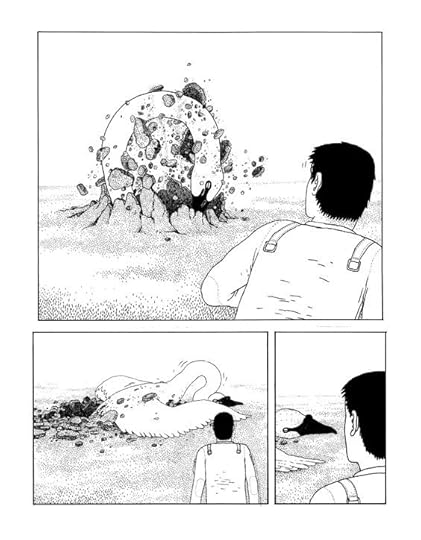
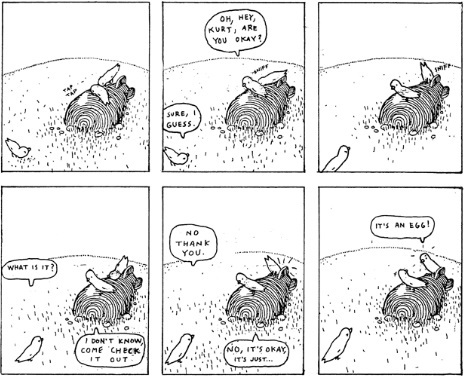
A haunting postmodern fable, Big Questions is the magnum opus of Anders Nilsen, one of the brightest and most talented young cartoonists working today. This beautiful minimalist story, collected here for the first time, is the culmination of ten years and more than six hundred pages of work that details the metaphysical quandaries of the occupants of an endless plain, existing somewhere between a dream and a Russian steppe. A downed plane is thought to be a bird and the unexploded bomb that came from it is mistaken for a giant egg by the group of birds whose lives the story follows. The indifferent, stranded pilot is of great interest to the birds—some doggedly seek his approval, while others do quite the opposite, leading to tensions in the group. Nilsen seamlessly moves from humor to heartbreak. His distinctive, detailed line work is paired with plentiful white space and large, often frameless panels, conveying an ineffable sense of vulnerability and openness.

Big Questions
has roots in classic fables—the birds and snakes have more to say than their human counterparts, and there are hints of the hero’s journey, but here the easy moral that closes most fables is left open and ambiguous. Rather than lending its world meaning, Nilsen’s parable lets the questions wander where they will.

592 pages, Paperback

First published April 12, 2011

73 people are currently reading
3246 people want to read

About the author

Anders Nilsen

76 books231 followers
Anders Nilsen is an American illustration and comics artist. He is the author of ten books including Big Questions, The End, and Poetry is Useless as well as the coloring book A Walk in Eden. His work has been featured in the New York Times, Poetry Magazine, Kramer's Ergot, Pitchfork, Medium and elsewhere. His comics have been translated into several languages overseas and his painting and drawing have been exhibited internationally. Nilsen's work has received three Ignatz awards as well as the Lynd Ward Prize for the Graphic Novel and Big Questions was listed as a New York Times Notable Book in 2011. Nilsen grew up in Minneapolis and Northern New Hampshire. He studied art in New Mexico and lived in Chicago for over a decade. He currently lives in Los Angeles.

Ratings & Reviews

What do you think?
Rate this book

Friends & Following

Create a free account to discover what your friends think of this book!

Community Reviews

5 stars
2,053 (48%)
4 stars
1,192 (27%)
3 stars
725 (17%)
2 stars
199 (4%)
1 star
92 (2%)
Displaying 1 - 30 of 329 reviews
Profile Image for XenofoneX.
250 reviews354 followers
September 25, 2023
Big Questions & Offensive Answers
'Dogs and Water'
Dogs and Water by Anders Nilsen was Nilsen's breakthrough work. But it was essentially a poetic condensation of his magnum opus - Big Questions - which was still being serialized through D&Q at the time. It was an easier-to-digest intellectual abridgment... a taste-test for the palatability of Nilsen's Neo-Symbolist allegories, exploring the deepest cave-systems of the human subconscious, tracing the ancient threads tying Archetypal Myths to their primordial origins, and the mutations of 'truth' that made existential philosophy so vital. The power behind the Symbolism & Philosophy of 'Dogs & Water' made it a surprisingly popular & accessible work... with an artistic consistency that 'Big Questions' doesn't possess, due to the development of his inimitable style, growing more confident over the long years of work. But while the artistic evolution of 'Big Questions' is smooth & organic, it works on another narrative layer, as unspoken shifts in perceptual complexity that keep pace with the changes of the characters following their 'religious experiences'...
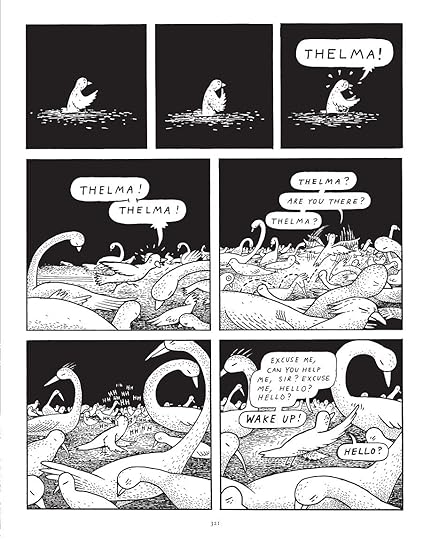
Poor bird... Thelma's followed Eurydice, I'm afraid, and you'll fare no better than Orpheus:
description

'Big Questions' centers on a quiet, rural patch of Anywhere, USA, surrounded by the vaguely threatening question-mark of the civilized world... which may or may not be facing some species of apocalypse... families reduced to bas-relief carbon silhouettes, adorning the last walls standing inside the irradiated ruin of the cities... or a vaccine-resistant strain of the Black Death, turning football stadiums into a hell of twisted, purple-skinned monsters waiting to die...
BUT: It doesn't really matter, except as an idle hypothesis to explain the nihilistic rage & sense of hopeless frustration tormenting the fighter-pilot/asshole who crashes his 'Bird' - a $40 ooo 000.00 Grumman F-14 Tomcat (I'm guessing, & Nilsen might have been 'guessing' himself, though the interior cockpit panels suggest photo-reference) - just after it 'lays' its last, big, deadly 'Eggs'.

The injured bird:
description

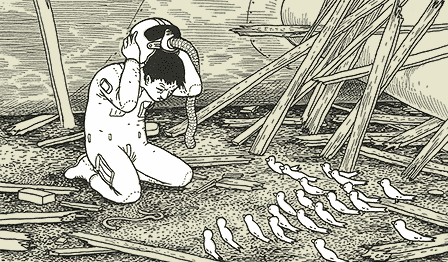
In 'Big Questions', however, the humans are not the protagonists. A mute, mentally challenged boy of 14 or 15 has just lost his Grandmother and his home. But his autism saves him from all but the dimmest sensations of pain & grief in the wake of this horror, and he moves on, following his toddler-like curiosity and hunger. The downed pilot, who also may have purposely grounded himself in the wilderness as part of an ill-planned desertion attempt (escaping a still-functioning society he wants no part of), is aware of little beyond whatever war is raging inside his skull. After running into the boy and discovering the severity of his mental handicap, he pays little more attention to him than he does the birds. The weird little birds doing weird shit that seem to be converging on his bomber, for some weird little reason. The birds are the protagonists. The boy & the pilot are mindless, occasionally bestial, NPC demi-gods.

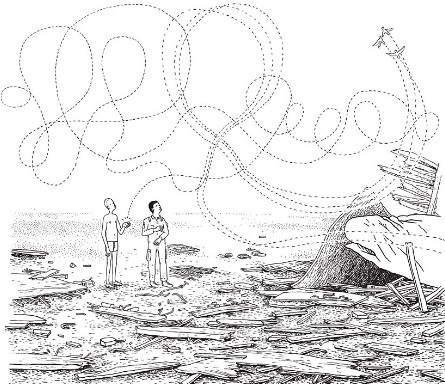
Charting a course through the wreckage:
description

As the main characters in this reversed fable, the bird's relatively harmonious relationships are disrupted, and their deepest beliefs challenged, by the sudden appearance of the aircraft/possibly-injured-mega-bird. Some of the little flock begin to attach religious importance to it, and to its' 'egg'... a gleaming metal bomb that is just waiting to 'hatch'...

I know exactly what this means. I just don't want to... um... ruin the fun of letting people figure it out themselves! Yeah, that's the ticket! My personal feeling is that a dying swan usually stands in for tragedy, & a giant fucking dying swan, bursting forth from the earth itself, is a tragic death omen. A BIG one, moving beyond the Shakespeare category, and into Book of Revelations territory.
description

Nilsen's biggest questions are concerned with meaning, faith, death, friendship, loyalty, and the importance of truth... even dangerous truths; or truths we know to be useful, but transitory, in a world of constantly evolving perceptions. The fact that the Big Questions are asked by the smallest of creatures has a simple but powerful allegorical significance: philosophy is not the exclusive domain of academics. Everyone must ask themselves these questions, and answer them. If not with The Truth, as best we can ascertain it, then a framework of metaphysical fantasy that is morally responsible, philosophically consistent, & NOT evangelical. The biggest question of all even applies to robins and sparrows and snakes and worms, despite never possessing the sentience to ask it: what is the meaning of life? The answer must be true for you, and it might be true to no one BUT you. The presupposition that 'truth' exists in some pure, objective ideal form is older than Christianity. Indeed, the universe that exists beyond our senses, past the limits of empirical data & the human perspective, most likely exists. Whether it does of doesn't, 'Absolute Truth' is, regrettably, irrelevant. Truth is the tool we use to build a consensus reality, and until something like quantum computing + A.I. makes Absolute Truth knowable, speculation is fun but useless. Even the malleable nature of truth is no argument against it. Science is always dealing with more unknowns than knowns, and yet even the craziest-sounding ideas have generated predictive models that have reshaped reality into something completely alien to Medieval eyes. Religious Prophecy - the superstitious equivalent of predictive models - generated nothing remotely accurate throughout the 1200-or-so years-long theocratic dominion of the Catholic Church. They're so convoluted & silly, that even with the benefit of centuries of hindsight, in front of a congregation of blindly devout ass-hats squinting hard & wanting to see the truth these 'prophecies' supposedly revealed after-the-fact, they're still embarrassingly sad & pointless.

Deep shit, man. A typically fun Nilsen NY Times comic.
description

Nilsen's characteristic style, an open, clean and sparse application of contours, combined with a Moebius-inspired dash-pointillism, is instantly recognizable. 'Big Questions' feels like it should be on the Buddhist Monk Bestseller List, & perhaps even outselling 'Buddha-lized! - Turning your Self-Help Start-Up into an Overnight Success, using 2500-Year-Old Ritualized Meditation, Mysticized Philosophies of Enlightenment, & the Promise of Nirvana & Eternal Bliss'. Maybe some day, decades from now, a young reincarnation of the Dalai Lama will recognize a dog-eared copy of Big Questions, among all the misleading items & objects supposedly owned by a deceased Holy predecessor, and declare it a sutra.

Then he'll read it, get into existential philosophy, and declare, as Dalai Lama, that Buddhism is a wonderful waste of time. But as far as bronze-age bullshit goes, it sure beats any fundamentalist interpretation of Islam, Christianity, Judaism, Socialism, or Scientology.

description
Warning! Completely Unnecessary & Offensive, Tangentially Related, Anti-Religion Harangue:


This is one of those physically, thematically, and critically BIG books, like Jimmy Corrigan, by Chris Ware; Asterios Polyp, by David Mazzuchelli; or Black Hole, by Charles Burns... and I think it's fair 'Big Questions' share such august company. It is the culmination of years of work, and any Art-comics fan should at least poke a stick at it & see if it bites.
Profile Image for Seth T..
Author 2 books959 followers
January 13, 2012
Big Questions by Anders Nilsen

Anders Nilsen wrote what I consider to be the worst comic I've ever read. Or mostly read. I didn't actually finish Monologues for the Coming Plague. Somewhere between two-thirds and three-quarters of the way through I ragequit, angered by my own dogged tenacity in pursuing a book that clearly wasn't going to be worth my time. This never happens. There are large numbers of books that I haven't finished due to apathy or dislike, but always the motivation for abandonment lies in the realm of disinterest rather than ire. Monologues carries the unique distinction* of being the only book to piss me off into retiring it. I don't believe in hipsterism (thinking it only a way for people to denigrate that which they fear might be more highbrow than they're comfortable with), but if I was prone to point at things being pretentious and obscure for the sake of being obscurely cool, Monologues would make that cut.** I don't plan to ever pick it up again. Despite the fact that Anders Nilsen's Big Questions is one of the best books I've read in 2011.

Soured by my experience with Monologues, it took some cajoling to bring me to the point at which I'd consider reading Big Questions. And by cajoling, I mean reading nearly everyone rolling over themselves with praise for the book — even if they didn't understand it. (Not understanding Big Questions and being forthright about its comprehension barrier seems to be a requirement for reviewing it.) The book made numerous end-of-year lists, and upon reading, it's easy to see why. Nilsen's very large book is that rambling, haphazard kind of meditation on meaning and purpose that seems tailor-made for Critical Praise. Inexplicable things happen. Some of it might even be symbolic. Ideologies are stoked, questioned, and burned in some neo-pagan, nihilistic frenzy. Big Questions is the song that never ends. It just goes on and on my friend. And critics and high school lit classes eat that stuff up.

If it sounds like I'm being a bit wry here, I blame the still-lingering aftertaste of Monologues. I'm still mad about it, apparently, and it's threatening to infect my read of what even by my standards is a very good book. Okay, I'll try to stop now.

Big Questions by Anders Nilsen

Big Questions is a curious animal of a book. Its method of gradual production threatens the sense that Nilsen knew what he was doing all along or that the book can be read as a single cohesive work. Nilsen, as he explains in the book's backmatter, began collecting the occasional one-page scraps of talking-bird cartoons he'd been producing for years. Almost accidentally, it seemed, a narrative began to form around these sometimes thoughtful finches. And then at last, the addition of arbitrary violence from the American military machine set in motion a grand tale spanning a milieu approximately the size of a sprawling backyard.

Still, Nilsen's production here shines even while it remains unclear how much stock we're meant to place in the book's place as single multi-threaded narrative (vs. that of intersecting anthology of incidents and stories).*** Despite the book's leisurely stroll through its story parts and Nilsen's often sparse storytelling, Big Questions ends up feeling a very full meal. There's a lot to think about and Nilsen's penchant for leaving his Big Questions often unanswered lends to its position as a Thoughtful Comic. (If it weren't for the book's $45 price tag, it'd almost certainly become a regular subject of graphic-novel–leaning book clubs.)

Big Questions by Anders Nilsen

While there is a plot to Big Questions, plot doesn't necessarily drive the work. There are things that happen to prompt the characters to their various means and ends, but those events and the motivational vectors they produce are always secondary to the discussions (verbal and otherwise) they generate. Big Questions is a book about questions, a book about how to arrive at or depart from ideologies. Across the simple landscape of these birds and their simple lives, Nilsen draws out a number of parables to ask simple questions about our own existence. Sometimes the circumstances or questions might seem too simple, but even then, the opportunity for thoughtfulness blossoms.

One of the unique attributes of a book crafted over the span of a decade is that readers will have a chance to chart the progress of the artist's abilities as cartographer of the world presented. We see this a lot with webcomics, as amateur cartoonists ply their hobby into a trade and are more and more able to practice their craft. Comparing the early, middle, and current examples of Megatokyo, Questionable Content, and Penny Arcade**** provides readers with a sort of metacommentary over the creator's ability to convey the story world — and the same thing occurs in Big Questions. Nilsen's early work appears larval and unaccomplished, but some of the later pages are simply beautiful — works of patience and attention. Even his birds, which remain simple throughout, are more readable and empathetic in the end than they were at the start. Not everyone will appreciate the evolution, but from an archaeological standpoint, the identifiable shift is rather charming.

Big Questions by Anders Nilsen

Finally, I would suggest that potential readers give Big Questions their attention. It's a big book and a good book and one that, despite occasional clumsiness, provokes thoughtful critique and critical thought. What exactly Nilsen's game is might not ever be made clear, but maybe it doesn't matter. Maybe some books are there less for what they say and more for what they ask.
______________________________

Notes

* Note to pedants: redundance is a valid literary technique.

** In reality, I think it unfair to judge the motivations of a creator (especially if I didn't take the time to finish or understand their work). Nilsen may have had any number of reasons driving his production of Monologues for the Coming Plague. I suspect he may have even anticipated the kind of antipathy readers like me would hold over the work. In the end, the book simply felt pretentiously wrought and was deeply overpriced.

*** Plus this adds to the delicious challenge of interpretation.

**** Megatokyo: early, middle, current

Questionable Content: early, middle, current

Penny Arcade: early, early-middle, middle, current
______________________________

[Review courtesy of Good Ok Bad]
Profile Image for Dave Schaafsma.
Author 6 books32.1k followers
October 25, 2015
I guess a lot of people might describe this as "minimalism" and others might call it "odd," and none of them would be wrong, but this book is less minimal and less odd than Nilsen's other works. This one is the most narrative, for instance, written over more than fifteen years. . . it's still interlocking fragments, but there is a kind of coherence, or one to be made here that is easier than in earlier works: It's about Big Questions, duh!

And the effect or approach to Big Questions: Yeah, they're "important," but most really important questions can be gotten at/explored, if not answered definitively, through very simple images and stories. . . sort of like Zen Koans or parables, though Nilsen tends to the surreal in his answers to such questions, seems to me. . . or the quirkily amusing, which to me makes sense. I like Ionesco and Beckett, and this MAY be Nilsen's landscape, too. And as with Beckett, there is profundity here. . . I am thinking of Beckett's short plays like Act Without Words. . . or the "minimalist" composer John Cage. I really, really like this work.
Profile Image for Hannah Garden.
1,053 reviews184 followers
January 20, 2014
If someone asked you what that book you're reading is about, you'd have to say, "It's about a bunch of little birds who discuss and are confronted by philosophical and existential issues and events," and you would sound like a total jerkoff who's about to over-pronounce 'macchiato' when you order it and then go sit by the window where everyone who walks by can see you, with your adorable gramma shawl perched around your shoulders and the logo on your tote bag facing out and I would see you and wish you would trip when you stood up because jesus are you even serious with that costume, but you know what, what are you going to do, it's not your fault, this book just happens to somehow frikken god dang *be* about a bunch of little cute damn tiny birds talking about and being confronted by some very deep and some very big questions. *The* questions, even. As in the only ones. Whose hand is it, anyway. Some poor idiot, maybe. Some creep sonovabitch. Mine. I don't know, I just don't know. It's not your fault. This book is a masterpiece. It made me sick and it is gorgeous and this world is terrible, just terrible, and also beautiful, and soft, and small, and bright and kind.
Profile Image for Michael Jandrok.
189 reviews359 followers
April 12, 2019
What the hell did I just read? Hold on a minute. I need some time to think about this. I’ll be back. Hang on a for a little bit while I try to sort this out in my head.

Ok, thinking about it really didn’t help. Might have made it worse. I really don’t know what to do here. The one thing that sticks to me most about this work is its inherent nature as a narrative that wasn’t necessarily supposed to be a narrative. Anders Nilsen himself states as much in the afterword. “Big Questions” began life as a series of comic strips featuring a cast of bird characters. The bigger story….that of the old woman and her mentally challenged grandson, the plane crash and the mysterious pilot who emerges from the wreckage, the cycle of life philosophical meanderings of the birds as they try to understand and make sense of all of these events...that all just sort of happened.

Ugh. This is an awesome and monumental work of illustration and words. It’s also frustrating as all get out. It’s 658 freaking pages and weighs almost 7 pounds. Yes, 7 effing pounds. Look, you know enough about this book to not need a ton of exposition, right? Because I can’t. I just can’t. It’s too much. My brain can’t handle trying to figure out a way to set the stage for you. You gotta do it yourself. I don’t even know why I’m attempting to review it. I don’t know HOW to review it. I’m just gonna throw some thoughts out there and see if they make any sense.

OBSERVATIONS:

Anthropomorphic animals are always a good way to go for a cartoonist. Nilsen manages to make his cast of critters interesting and takes care to make sure that each character has a distinct personality. Talking birds and snakes are the backbone of some of the greatest fables in history. Hard to go wrong with that choice.

Non-human characters trying to make sense of human actions and motivations is also a classic storytelling trope. Almost always, the animals come out looking smarter and wiser than their human counterparts. That is certainly the case with “Big Questions.”

“Big Questions” originally appeared in a series of 15 issues as a comic book published by Drawn & Quarterly. This book contains all of the material presented there, and adds around 50 pages or so of peripheral drawings and other miscellania. There is a big part of me that just wants to scream “HIPSTER ALTERNATIVE COMIX!!!!” at the top of my lungs. But I won’t do that. Well, no promises there.

The art evolves beautifully as the series progresses. The early strips look crude and overly simplistic. By the end of the book the art has developed into increasingly complex visuals, still sparse, but much more powerful in their ability to convey emotion and intent.

I think a lot of people have spent WAY too much time trying to figure out just what messages the plot is trying to convey. I’ll let the characters speak for themselves later. For now, please understand that life isn’t always necessarily about finding answers to questions. Most of the time that just leads to more questions. I am reminded of reading “Zen and the Art of Motorcycle Maintenance.” If you’ve read that book, you know of what I speak. If you haven’t read it, you should. It’s a stone classic of hippie philosophy wrapped up in a gigantic and wordy Zen koan. I think that “Big Questions” is the hipster, alternative version of “Zen and TAMM……” Yeah. That’s good. I’m keeping that.

I’m fairly certain that the downed pilot character is a murderer. That’s not a spoiler. It means virtually nothing in the greater scheme of the narrative. It just is what it is.

There is a whole lot of psychological and philosophical stuff going on here. All kinds of arcane symbolism, characters who embody mythical roles, etc. Jung would have had a field day trying to analyze this book.

In the end, though, I think it’s a long look inside the psyche of Anders Nilsen. And I think that dude has some unresolved issues. Ok, a LOT of unresolved issues. 658 pages and almost 7 pounds of unresolved issues.

It’s a gorgeous magnum opus. It’s a burden. It’s quirky. It’s very funny in parts. It’s very not funny in parts. It’s drawn with repetitive, meticulous, obsessive care. It’s a book about birds. And a snake. And a crone. And an idiot. And a murderer. And it’s a reminder that sometimes the Big Questions don’t always have the same answer. Or any answer at all. That’s why they are the Big Questions.

Final observation: I ordered a hardcover edition for around $27 on AbeBooks. I’ve seen this 7 pound doorstop on sale at one of my local Half-Price Books locations for $100. I would not pay 100 bones for this book, but I’d sell you MY copy for $100. It was way worth 27 clams, though. Look for deals and don’t pay collector’s prices. That goes for ANY book, but especially this one.

QUOTES FROM THE TEXT, BECAUSE THEY WILL TELL YOU MORE ABOUT THIS BOOK THAN I EVER COULD:

QUOTE #1:

(munch, munch….two birds are eating seeds….)

Bird #1: I’ve been thinking about some really big questions lately.

Bird #2: Yeah? Like What?

Bird #1: Well, like to what extent are we responsible for the fulfillment of our destinies? I mean, if my life is to be meaningful and full, is it up to me to make it that way, or can I just wait for circumstances to come together?

Bird #2: ?

Bird #1: What do you think?

Bird # 2: Uh. That second thing you said.

Bird #1: Yeah, I think so too.

(munch, munch…..birds continue to eat seeds…….)

QUOTE # 2: LOUIS AND MORRIS, TWO OF THE BIRD CHARACTERS

“Hey, Louis, you know what I could go for right now, after those snails? Some doughnuts. Yeah, I miss those doughnut crumbs we used to get. We used to get doughnut crumbs, like, what? Once a week or so? I didn’t even really appreciate it at the time. I’d just gobble them down. I barely tasted them. Although I did like chocolate the best. Or maybe the ones with the peanuts. It just goes to show you can’t take things for granted in life. You should live each day like it’s your last. That’s how I feel anyway.”

“Burp.��

No more quotes. The end. Live each day like it’s your last, kids. That’s as close as you are ever gonna get to the answer. All of the other crap is a waste of your time.

FINIS
Profile Image for Oriana.
Author 2 books3,830 followers
didntfinish-yet
January 2, 2015
September 2013
Keith: there's a book that, like, i really fucking insist you read
me: ok what is it?
Keith: http://www.drawnandquarterly.com/shop...
me: whoa, that looks great
i will put it on my to-read-eventually list
Keith: ugh you and your lists
me: well what else can i do?
Keith: READ THE GOOD ONES FIRST
me: haha ok ok

December 2013
me: so i'm like 75 pages into big questions and i kind of hate it
is it going to be like this the whole way or does it change?
Keith: why do you hate it?
me: i dunno man, partly because it's hard to figure out what's happening most of the time, partly because it's so bleak and sad
also because it seems so, like, lateral?
idk if that makes sense
but it doesn't seem like it's gathering itself to move anywhere, plotwise
like it's just going to meander for 70,000 pages
Keith: yeah, this would be like if you were in the first 5 mins of bambi and the mom and dad were both dead and you were like "shit i can't watch this whole movie"
you're 70 pages into a book with no words!
youve been reading it for 20 minutes and you're expecting it to do something cute to you
youve been ruined by your own taste

January 2014
Keith: dude
me: oh hai
are you mad I didn't finish big questions?
Keith: wait you didnt finish it?!?!??!
i was writing to bitch about something else
me: okay, tell me about that
Keith: no
go finish the fucking book
Profile Image for Dov Zeller.
Author 2 books125 followers
July 18, 2015
"Big Questions" is an artifact that goes beyond my idea of "book." Whatever it is, it may be the first of its kind. It is a marriage of old-school myth, odyssean epic, Aesop-ish fable, series of comic strips, graphic novel, filmic philosophical text.

And it's a journey into a unique, desolate, flat, comic world. One whose borders are, in themselves, a question. "Big Questions" invites us into this dubious world, and once we are there, the borders are unclear but still intensely confining. It doesn't take place in any known world, but on a piece of land that seems remote and disconnected. The only hint that the book's little world isn't all that's left of human and bird populations after some kind of apocalypse, is the bomb (sign of humanity), the airplane (aka giant bird), and a moment of hearing, through the airplane radio, the voices of other humans. There are no migrating birds coming through (that I recall at least), no humans aside from the two living in the cabin, before the grandmother dies and the plane crashes into the cabin... and the pilot of the crashed plane.

Nilsen creates a narrative that feels similar in desperation, anxiety and claustrophobia, to one of people trapped on an island. But this island isn't surrounded by water, thought there is a river running through it (where humans keep going for some strange reason. Their odd obsession with water, the finches observe.)

It is unclear why everyone remains trapped and cut off here. We don't know why the grandmother and her mute grandson live in a fabled cabin far from any other humans. And we are not given to understand who cut down the nearby tree belonging to one of our protagonist birds. Is the book hinting at a larger epidemic of deforestation? Is the cutting down of this one tree meant to add to the mystery, both in terms of the world of the story and of the existential implications/questions? Is the hand of the cartoonist meant to be seen as the woodcutter in this fable?

Though "Big Questions" focuses mainly on the lives of a group of finches in a world where trees are being cut down and bombs falling out of the sky and planes ("giant bird" to finches, "airplane" to the more worldly, bigger-brained crows) crash into cabins and give birth out of their heads to pilots, we also have three human characters and their stories are important in the book in that they become important to the narrative of the birds. They become part of the birds mythology just as other animals often become part of ours. They try to save the humans, to help the poor, helpless, hopeless creatures.

The unfolding drama of the finch community and the animals they interact with, raises question about prophecy, belief systems, perspective (and brain size.) It adapts greek/roman myths, prophetic literature, and brings more than a touch of Aesop into its pages, though it doesn't stay within the register of fable, but moves deftly between its many registers. There's a window into the world of fabulist birds, a touch of Nietzsche's, his ideas of perspective (and his acerbic wit), but also there's real cartoon relationships in here, between birds, and an occasional touch of ernest consideration of how humans might appear from the perspective of finches.

This is a bleak, beautiful and funny book. Definitely worth reading. If you are already feeling hopeless about the world and the state of humanity, I'm not sure if this will be a total downer or a bit of a thought-provoking reason for hope. Hmmmmm. I liked it a lot.
Profile Image for Allie.
1,426 reviews38 followers
October 22, 2022
I wish I could give this book so many more stars. It is an incredible read.

The main characters are mostly birds who talk to one another, goof off, and figure out their roles. It's equal parts surreal/philosophical and birds-being-weird funny stuff. They all have names, so it's not as hard as I thought it would be to tell the different finches apart.

The art is truly incredible. Nilsen goes from really simple to staggeringly detailed throughout. The line quality is so sensitive which results in incredibly nuanced drawings regardless of simplicity or complexity. Compositionally, he explores the comic form more often and more interestingly than most other graphic novels and graphic non-fiction I've read. There are boxed panels and unboxed panels, small framed close-ups inside larger scenes, characters progressing through a single wide view, etc.. In the afterward, he mentions how he was figuring it out as he went along -- very much to the benefit of the reader.

Since the book is a compilation of the whole Big Questions series, it's episodic but it has a cohesiveness that I feel many serialized comics lack. It's funny though because each episode is made up of a bunch of weird vignettes, making the individual episodes perhaps a little scattered but keeps the entire work together.

There is so much ambiguity, but it's really beautiful, productive, satisfying ambiguity.
Profile Image for Kitty G Books.
1,684 reviews2,971 followers
December 27, 2015
This is a story which is certainly quite an odd one and not to everyone's taste. I definitely found the concept of a society of birds giving their views on humanity and philosophy pretty great, but at times it was a little out there. There were some very 'punny' moments and some moments where you laugh out loud or roll your eyes and yet I always wanted to get back to it when I wasn't reading it.

I actually read the majority of this aloud with my boyfriend and we gave each bird and character their own personality and voice which really made it a lot of fun. The animated dialogue makes for some laughs and chuckles to be sure.

The art style for the birds I did really like even though it's very simplistic but the people were a little less convincing or beautiful. I think if the story had been in colour it could really have popped at some points but as it was the continuity of the birds led to some good moments for us (the reader) trying to guess who was who.

On the whole it's a hard book to describe but if you're not afraid of something rather 'out there' then maybe give it a try! It's witty and funny and the ending is a bit abrupt but it's also a little too crazy at times. I gave it a 3.5*s overall.
Profile Image for K.
347 reviews7 followers
April 10, 2013
My life is full right now. I am beginning to feel it is cluttered with tasks, activities, and events, when in reality is just rich with work, love, and friends. A clutter of blessings. This book is big and heavy, and for awhile I resented it for just having so much mass, when my life is so full. I begrudged it. But it has become my escape from to do lists and cuddling and eating, into to a vast open landscape, lonely and quiet, inhabited by creatures that are mysterious, distant, and sad, hungry and desperately seeking the answers to big questions. I feel at home in these pages, even with the startling cruelty of the crows.
Profile Image for Maricruz.
528 reviews68 followers
December 9, 2020
Un cómic filosófico con pajaritos, jaja, y qué más. No, en serio, Grandes preguntas es una de esas novelas gráficas que da para relecturas, una historia aparentemente sencilla que enmascara un contenido más complejo. No es una obra que te deje llena de certezas, sino más bien de esa incómoda sensación que te provoca la vida a veces. De que puedes estar equivocándote, de no saber demasiado bien adónde te diriges, de que quizás las cosas no estén tan mal o por el contrario estén peor de lo que piensas, y no sabes cuánto debieras preocuparte por ello.
Profile Image for Titus.
428 reviews56 followers
January 30, 2022
“To what extent are we responsible for the fulfilment of our destinies? I mean, if my life is to be meaningful and full, is it up to me to make it that way, or can I just wait for circumstances to come together?”


“Is the world being drawn inexorably along a path of degradation and destruction? Is there hope for the future or are we doomed? If we change our behaviour and try to direct our actions in a positive way, could we influence the course of world history?”


Big Questions by Anders Nilsen explores a whole plethora of themes, but the questions quoted above – posed by a small bird called Leroy on pages 3 and 17 respectively – are the ones at its heart. This is a work that invites different interpretations, but my reading is that it's first and foremost an exploration of the extent to which one has control over one’s own life – and, by extension, the extent to which life has meaning.


Big Questions is about people (well, mostly birds, actually) who live banal, predictable lives and then have their whole worlds overturned by catastrophic events far beyond their experience or understanding, and it's about their futile attempts to grasp for meaning when confronted with the unknown. This is a decidedly postmodern work, with the central irony being that the reader fully understands most of the events that are so incomprehensible and cataclysmic to the characters. As such, we can see that their theories and explanations are usually quite far off the mark, to both humorous and tragic effect. Equally, we see how in times of uncertainty, the people (or birds) who become leaders or prophets are the ones who are most charismatic or assertive, not the smartest or the best informed. In other words, Big Questions is a nuanced, sympathetic lampooning of humans' attempts to make sense of the universe, particularly through religion and ideology.


This is without a doubt a comic of ideas, but it's in no way dry or humourless. On the contrary, it's unfailingly entertaining – sometimes laugh-out-loud funny – with a rich cast of characters and a wildly unpredictable plot. What's more, it's profoundly human and often very moving. It's also a unique and fascinating work from a formal perspective: it starts out as a series of simple gag strips, with crude drawings and an understated tone (reminiscent of a lot of webcomics), but through a series of loosely connected vignettes, it eventually evolves into a true epic, as ambitious visually as it is narratively.


I feel I've done a poor job of conveying this so far, so now I'll state it plainly: I think Big Questions is a masterpiece, a truly great work quite unlike anything else I've read. It has everything I could want from a comic: it's thought-provoking, moving, amusing and endlessly engrossing. An instant favourite.


True to its title, this work brings more questions than answers, but I'll close with another quotation – this time from a little bird called Morris on page 11 – which I think sums up the philosophy that Nilsen presents:


“I feel like the world is speaking to me, Louis. It's saying that our only hope is to accept that we have no control over our lives, to throw ourselves into the arms of fate, let events take their course and savor their results. And I want dessert.”
Profile Image for Wendy Holliday.
609 reviews43 followers
April 6, 2012
I really don't know how to rate this at all. I like to give stars where stars are due, especially with a 600+ page monster that I easily read in 2 hours.

I like to think I'm intelligent. But I have my doubts sometimes. Recently, I came across a gushing email I sent to one of the Prinz Honor winners, thinking I was all smart and funny and congratulatory. Nope. The hasty email had a bunch of dumb typos that upon re-reading, made me look and sound like a 14 yr. old Twi-hard.

I'm sorry, Craig Silvey. Your book Jasper Jones, despite my "OMG ur so awesomeeeeeee!!!!" email, was a favorite from last year.

Despite temporary lapses in intellect, I do try to read things that make me think and hit me in my heart and soul. Everyone should too. It keeps you grounded.

But this massive philosophical door stopper had pure moments of 'WTF' for me along with, 'That's EXACTLY what I've been asking myself lately!!'.

So, between two stars and five stars is 3.5 stars, so I'm giving the benefit of the doubt and rounding up ... especially since Anders is kind enough to include a 'What this story is really about' at the end.
Profile Image for Lee Klein .
911 reviews1,056 followers
July 20, 2016
I love these enormous graphic novels that almost become cinematic as you turn several hundred pages. Such a beautiful physical object with thick sheets and a thick spine and overall serious rectangular heft contrasted by the open white expanse inside, a desolate territory offering a house, an old woman, an idiot, a plane that crashes into the house, the pilot, plenty of wonderfully named finches, an innocuous old snake, an owl, an underground afterworld, a bunch of catty crows (also wonderfully named), a pair of swans, and I think that's it. The story is totally organic and light, somehow despite morbidity and bursts of violence. Despite the title, I didn't really feel like this was as explicitly philosophical or idea-ist as most graphic novels I've read. It also, thankfully, wasn't as sad (I'm thinking Ware). Definitely loved time spent reading it -- was certainly charmed but maybe wasn't totally rapt or moved. Or maybe the enervating idiot and the mean-spirited pilot seemed too one note for me? Maybe if they were more human I would have raved a bit more? Anyway, absolutely an awesome Xmas gift for all your friends who read these fancy picture books.
Profile Image for Charles Hatfield.
117 reviews42 followers
June 9, 2012
In this eerily post-9/11 fable, a plane crash, an unexploded bomb, and the wanderings of two men—one the downed Pilot, the other a preverbal Idiot, i.e., either an imbecile or a saint—disrupt the lives of a motley community of animals, most particularly a charm of finches, who live on a vast, vague plain in some unspecified microcosmic world. One of the finches, Charlotte, reads “the giant bird” (the plane wreck) and its “egg” (the bomb) prophetically, becoming the evangelist of a new faith. Others, like Curtis, are skeptical, or, like Betty, caught between faith and skepticism. One finch, Bayle, becomes the disciple of the Idiot. Another, Algernon, is abducted by a Snake and thus discovers a ghostly underground world. Also appearing are murderous crows, a few hungry dogs and squirrels, and mysterious visions of swans.

Nature, red in tooth and claw, becomes the backdrop for pained spiritual and existential questioning. Long stillnesses and passages of achingly slow, deliberate movement sometimes give way to bursts of deadpan violence. The finches, despite being depicted from a distance without individual markings, and thus visually interchangeable, develop humanly complex characters; their relationships and conflicts, against the open-ended blank whiteness of the plain, constitute a fully realized story-world, rendered in exceedingly delicate strokes.

Collecting a series of minicomics begun as long ago as 1999, and showing Nilsen’s tremendous artistic growth over the past dozen years, the 600-page Big Questions is a minimalist epic: a spiraling story whose studied graphic austerity gradually reveals a terrific richness in terms of worldbuilding, characterization, and theme. Above all, the book achieves a dreamlike atmosphere: a quietness that is sometimes charming, sometimes full of threat. I found it at once terribly open, frightening even, and yet provokingly inscrutable. As Nilsen discovers and warms to his story—one of faith, interpretation, and existential crisis—those damn finches and their surroundings do become, to me, a world.

This is an incredible comic.
Profile Image for Raina.
1,718 reviews163 followers
March 26, 2012
This book is a monster.

It doesn't surprise me that Nilsen was working on it for years and years and years. You gotta admire a monsterwork like that.

I really dug the slow burn of this book. It starts out so so simply. Two birds...

Bird 1: Sure am getting sick of these seeds.
Bird 2: I know what you mean.

And Nilsen adds elements to the story so so quietly, so gradually, that you barely notice how complicated the story becomes until you're finished.

It is epic.

One word of caution: I had a really hard time telling the birds apart, and I'm not sure, but maybe I would have connected more with each one as a character if I had kept them straight. I didn't realize until I finished it that the flaps on the cover have a key to each bird/character. This might have helped if I had noticed it earlier.

And a note about the stars: If I was honestly indicating my affection for this book, I'd give it three stars. I usually reserve four stars for books I looked forward to reading and found enthralling. This was not that. But its pure epicness makes me admire it so much that I feel a responsibility to bump it up a star out of pure awe.
Profile Image for trestitia ⵊⵊⵊ deamorski.
1,539 reviews449 followers
April 11, 2021

Hikayenin çıkışı, sanat öğrencisi iken, bir dakikada 60 kağıda küçük bir obje çizim alıştırmasının, süreçte her sayfa bir comic paneli olup bir hikayeye verilmesiyle olmuş,,, çorak arazide kayıp bir asker, bir grup kuş, bir de uçak enkazı. Sonra da (daha uzun bir hikayesi var) bir seriye dönüşüyor- 15 yıl sürmüş tüm çalışma.


Çok katmanlı bir hikaye gibi, yani dümdüz bir zaman akışı yok. Tüm comicin bir mesajı yok, sonucu yok, iç içe geçmiş hikayeler olduğu için bütüncül, fakat ayrı ayrı göndermeler var.

Felsefi elementler mevcut ama büyük atmıyor. Benzetme üzerinden basit çağrışımlarla halletmiş işi. Amacının böyle olmadığına eminim ama bende absürd ve hiçlik arasında bir yere düştü.


Genel hattı ile de, düşen bir uçak, uçaktan önce düşen ama sonra patlayan bir bomba, kuşlar tarafından uçağın kuş, bombanın yumurta sanılması,,, ve başka diğer karakterler.


- They can't both be right. It's either a bird or not.
+ Well... Okay, let's say you were hatched in the hollow of a giant tree, right? And you'd never been outside of it. And... And furthermore, you couldn't even turn around to look out at the rest of the world... Like maybe you'd gotten stuck in some sap.
So then, if the sun was shining behind you, it would cast shadows of everything happening behind you, right? Onto the wall of the hollow, right?
And if that was all you'd ever seen, you'd have no way to know what was actually happening. You'd think the shadows were the real world. Right?
- ... ... Who would bring you food?


Platonun sağ kulağını sol el ile tutup adını bilmediğim başka bir filozofun temel canlı bilmemnesi savına geçmek başta komik gelse de çok vurucu değil mi? (çok yiyen ve yemek için yaşayan biri olarak bunun bir kaç yerde daha tekrar ettiğini görmek ayrı bi lezzet verdi)


Çizimler siyah beyaz, gölgelendirme yok. Sadelik ve efektifliğine isabetli olmuş.

aslında ne küçük, saçma, boş sorular
xoxoxo
iko
Profile Image for Keith.
Author 10 books286 followers
September 21, 2016
REREAD: in a remote woodland, a plane crashes. There is one death, and two survivors. Each survivor becomes a person of interest to the flocks of finches who live in the woodlands, and who know little of the outside world.

Through the course of the book, the birds guard over, fight over, die over, worship, and study the humans that have invaded their forest. The birds ask themselves, and each other, the Big Questions: why are we here? What is the best way to live our lives? Does existence have any intrinsic meaning at all?

Big Questions is not as sad the second time around, but it is more cohesive. Its statement of purpose is more clear, even if the birds still live and die in relative confusion about the value of their own lives. The crows are vampires, the owl is stupid, the dogs are beasts, the snake is a seer. The underworld is full of swans, and the finches have Big Questions.

6/25/11: It is giant and terrible and sad and took me two sittings to get through it; and I'll read it again at least once before I totally decide if I get it, or if the parts I don't think I get are there to get at all. At which point I might write something, or I might not. I'd suggest you go find this one yourself, really. Birds and snakes and planes and death. And grass and death.
Profile Image for Karl .
459 reviews14 followers
August 2, 2018
A contemporary of Jon Lewis and his True Swamp series we have instead of swamp creatures a gaggle of birds,a snake, some coyotes and a pair of rabbits.

Both series are expertly drawn although Neilsen opts for an efficient use of white as opposed to the density of Lewis’s swamp scenes. In both books we see philosophically inclined talking creatures trying to sort out life’s questions.

In Big Questions we also have the ongoing drama of two men who’s individual tragedies have linked them together along with the inquisitive birds who try desperately to make sense of their newly transformed environment.

Huge book. 600 pages. Drawn and Quarterly
Profile Image for Przemysław Skoczyński.
1,417 reviews49 followers
January 13, 2024
Proste ćwiczenie na studiach, polegające na rysowaniu jednego obiektu w ograniczonym czasie, a potem przerysowywaniu go wiele razy, jak również pojedyncze szkice, żarty i coraz dłuższe historyjki tworzone dla znajomych, wyewoluowały w ponad 600 stronicowy komiks tworzony piętnaście lat. „Big Questions” to nie tylko opus magnum samego autora, ale także idealny przykład równowagi treści i formy, mogący spokojnie rywalizować z najambitniejszymi dziełami literatury czy filmu.

Anders Nilsen pisze w posłowiu, że gdy już zaczął widzieć w swoich szkicach potencjał na większą historię, ta zaczęła pisać się praktycznie sama. Trzeba przyznać, że czytelnik jest w stanie ten flow poczuć. Coś, co od początku uderza, to rytm opowieści i przyjemność lektury, mimo, że mówi o rzeczach fundamentalnych. Ten efekt lekkości Nilsen uzyskuje dzięki dynamice i oszczędności dialogów, a także graniu pustymi przestrzeniami oraz w znacznej mierze narracją obywającą się bez słów. Rysunek jest raczej prosty, ale bogaty w rozwiązania formalne, co jakiś czas pojawiają się bardziej szczegółowe kadry z bogatym szrafowaniem. Prostota jest często pozorna, liczą się niuanse, tym bardziej, że wydarzenia dzieją się w świecie ptaków.

Historia kilku dni z życia antropomorficznych zwierząt skrywa całkiem głębokie sensy i zostawia czytelnika z wieloma pytaniami na temat naszej egzystencji. Najbardziej reprezentatywna dla całości wydaje się scena dialogu żywcem przeniesionego z „Jaskini Platona”, gdy jeden z uczestników stara się pogodzić skłóconych dyskutantów, mówiąc, że być może oboje mają racje, a pojęcie rzeczywistości zależy od tego, kto o niej mówi i na ile uda mu się dotrzeć do istoty rzeczy. Oczywiście to tylko głupiutkie ptaki, które ostatecznie banalizują takie rzeczy, ale prawdopodobnie dlatego jest to świetna egzemplifikacja tego, jak do pojęcia prawdy podchodzi przeciętny, pozbawiony refleksji człowiek.

Wśród całej masy ptaków, będących jedynie bezmyślnymi konsumentami, zdarzają się jednostki wybitne, zadające pytania ostateczne. Symbolem takiego podejścia jest Leroy, który po zadaniu pytania sowie, zostaje przez nią bezrefleksyjnie zjedzony. Nilsen stosuje metaforę ptasiej społeczności, by pokazać interpretację świata, jakiej dokonują ludzie, lecz z poważniejszymi konsekwencjami. Nie mogąc zrozumieć okoliczności, dorabiają ideologie do zjawisk, które przekraczają ich zdolność pojmowania. Dla ptaka niewybuch, który został zrzucony z samolotu to niemal relikwia. Coś, co wymaga kultu, opieki i przekonywania innych o wyjątkowości tego przedmiotu. Podobnie z lotnikiem, który przeżywa katastrofę samolotu i jawi się bohaterom jako wielkie pisklę. Brak zrozumienia zjawisk jest przyczyną tworzenia kultu i pseudonauki, jednocześnie wzmagając agresję, kłótnie, teorie spiskowe, ale również poczucie winy. Kilka splecionych ze sobą historii tworzy mikroświat, który da się przełożyć na świadomość współczesnego człowieka, ale metafora pojawia się na przestrzeni całej fabuły kilkakrotnie również w sensie dosłownym. Symbolika łabędzia zjadanego przez węża, podziemnego świata pełnego ptaków, a także ptaków uwalnianych z ust pilota, mogłaby stanowić temat bardzo ciekawych i obszernych prac o „Big Questions”. Jeśli chodzi o sam koncept, nie zdziwiłbym się gdyby komiks Nilsena inspirował Michaela Deforge podczas pracy nad „Birds od Mine”.

W jednym z ptasich dialogów pada stwierdzenie, że świat zdaje się mówić: „naszą jedyną nadzieją jest akceptacja faktu, że nie mamy kontroli nad naszym życiem, rzucenie się w ramiona przeznaczenia, pozwolenie zdarzeniom obrać ich kurs i delektować się rezultatami”. Być może nie jest to w pełni optymistyczna wizja, a jednak po lekturze „Big Questions” wydaje się najrozsądniejsza.

(tekst ukazał się na facebookowej stronie "Magazynu Kreski")
Profile Image for Blue.
1,186 reviews55 followers
August 26, 2021
A contemplative story told from the point of view of animals. A charm of finches live in a flat grassland by a stream. Every once in a while they get donut crumbs from the old woman and her grandson who live in a tiny house nearby. One of the birds is really curious about the grandson. Mostly, the birds eat, sleep, chat. One day, a bomb falls in the meadow. It doesn't explode. One of the birds thinks it's an egg. Arguments ensue. A little later, a plane crashes on the house, killing the grandmother. The pilot emerges. The birds think this is a giant bird and the pilot hatches from it. Some of them team up to try to feed the hatchling pilot. A new religion that interprets these events as important and revelatory is born. Some birds believe it, some are on the fence, some think it's bonkers. And then there's the bomb. And the snake. And the owl. And the squirrels. And the crows. And the dogs. And the afterlife of sorts.

With simple, clean lines, beautiful inking, Anders Nilsen tells a story full of humor, annoying philosophical arguments, serious bird fights and mysteries of life. I particularly liked certain birds or pairs that had interesting arcs. I did wonder whatever happened to Alma.

Recommended for those who like donuts, helmets, woodpeckers, swans, skeletons and tunnels.
Profile Image for Jeff.
673 reviews53 followers
November 20, 2023
Let’s start with some small questions:
q: A very strong 4 stars?
A: Yes and his heart was going like mad
q: For a 600+ page, mostly wordless, decade-long agglomeration of comics crafted into what very closely resembles a philosophical novel?
A: and yes
q: Or is it an allegory, like Plato's famous one?
A: I said yes

Alright, maybe Nilsen’s big book of big questions isn’t quite James Joycean, but that quote is (maybe? partially?) apropos.

A long book that even (especially) the least interested or avid reader could finish in a few short hours. Or you could savor it and reread it. Fine qualities, indeed.
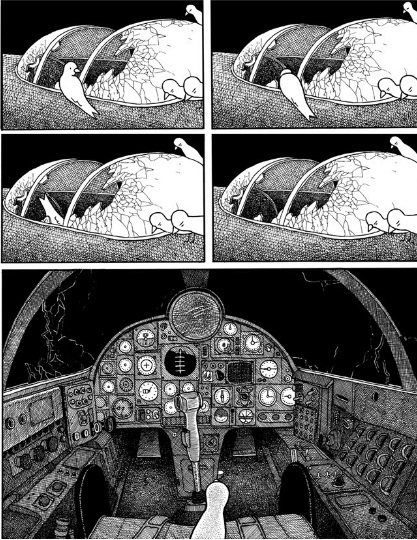
birds examining the cockpit
There’s not a lot of plot, though, hence many people have complained “Nothing happens!” Some might confuse the frequent series of wordless pages with an absence of Events. Then again, any book in which guns are brandished, planes are crashed, characters are killed, battles are waged, and insults are flung, clearly includes Happenings. Maybe “Nothing happens!” means, “Not enough happens per page for my taste!”? Well, for my taste, at least upon this first read, i was satisfied. [I was also satisfied upon re-reading.]

Nilsen starts with some short comics of crudely drawn birds (i had disturbing flashbacks to Clumsy):
(a) one bird will be anthropomorphized not only by the human language word balloons but also by the very human concerns being expressed in those word balloons and
(b) any other birds around it will ignore or dismiss the concerns.
There’s a strongly implied Aesopian Fable quality to these pieces. They recur sporadically as the book matures but resemble the proverbial sore thumb less and less.
birds examining the unexploded bomb
Maybe the fables blended better and better because i began to understand their personalities (not avianalities). I couldn’t distinguish one from another except by what their actions and language revealed about them. They’re all visually identical, which is consistent with how the human eye sees all finches, all crows, etc. We don’t need to identify individuals in these groups. And though i generally suffer from comix-induced prosopagnosia, i really don’t think it’s my lack of skill differentiating illustrated faces this time.

This is not to say that Nilsen’s drawings are poor. He exhibits subtle skill in expressing myriad forms of birdy body language (sorry, couldn’t resist) as well as helpful and closely observed recreations of their overall movement patterns. Moreso for the birds than for the humans.
birds flying out of son's hand as he and pilot watch
But if you need characters who are explicitly human in your fictions, then there might be just enough of that here. There’s an old lady and her grandson living literally in the middle of nowhere. She feeds seeds and donut scraps to the birds. Then there’s the pilot, a violent and very human addition to their otherwise uniquely idyllic world.

Individual finches develop affinities for the grandson or the pilot and/or the pilot’s plane. Oh, or the bomb.

Ingredients for plot thickening
(a) an unexploded bomb, about which most of the birds have an opinion, though none pierce the fourth wall with cognizance of Anton Chekhov’s dramatic rule
(b) a pack of bullying squirrels, who merely exacerbate how the Algernon + Thelma storyline violates Chekhov’s dramatic rule
(c) a sympathetic (wise?) old snake, who greatly affects the overall sense of Meaning and introduces Algernon to what might be a geological feature central to Big Answers
(d) an owl, who’s something of a foil for the snake
(e) a flock of smart-ass crows — owl:snake::crows:finches?

Birds are taken in hand (hence the sub-titular question). Birds battle over their metaphysical ideas and how they believe those ideas should guide their actions. Birds live and die as human actions impact their lives; humans:finches::god:humans?

Finally:
Big Sub-Question: Whose hand is it, anyway?
Big Sub-Answer: I will Yes
Profile Image for Monqeth.
319 reviews120 followers
May 1, 2018
ماذا يعني أن تكون طيرًا لا تعرف في الوجود إلا ما يطير أو لا يطير؟ هكذا بدأت القصة.

الكتاب يضم جميع إصدارات السلسلة التي قام المؤلف برسمها على مدار 15 سنة، فهناك من اقتنى الأجزاء المفرقة وهناك من اقتنى الكتاب.
السلسلة عبارة عن دراما مخلوطة بكوميديا سوداء، والقليل من الأسئلة الوجودية، مشابهة قليلًا لأسلوب كتاب " كليلة ودمنة " حيث تجد الحوارات هنا تصدر بشكل رئيسي من الطيور (الحمام - الغربان - البومة) وبعض الحيوانات الاخرى، وتصدر بشكل نادر من شخصيات بشرية. الحوارات هنا باللهجة الأمريكية السهلة.

أتفهم جيدًا أن البعض سيخرج من السلسلة المصورة ولا يعرف ماهي الفكرة الرئيسية للكتاب، وهذا لا بأس به؛ فماهو موجود بين دفتي الكتاب بسيط لدرجة تجعلك تتغاضى عن بعض التعابير أو الحوارات أو تأخذها من ناحية فكاهية محضة، فتنسى المقصود العميق من ورائها، لكن لاشك أنك ستضحك مرة، وستنزعج أخرى، وستتعجب ثالثة، بغض النظر عن فهمك للفكرة التي يختصرها البعض في عبارة Dont take life for granted " لا شيء يبقى على حاله في الحياة ".

بما أنني جديد في عالم الكوميكس والروايات المصورة، ولا أحب -بالعادة- أن أطالع رسومًا بالأبيض والأسود، لكن لا اعلم كيف جعلتني هذه السلسلة أستمتع كثيرًا بغض النظر عن مقاييسي، نعم الكتاب يقارب 600 صفحة، لكن بما أنه من نوع الروايات المصورة التي يندر أن تجد في الصفحة الواحدة أكثر من 7 أسطر؛ فلو جمعت النصوص التي فيه ورتبتها تحت بعضها البعض قد تخرج بكتاب من 100 صفحة ربما.
Profile Image for Chloe H..
465 reviews2 followers
August 11, 2015
Eh. It was okay, and definitely a technical achievement. But I think I need to admit to myself that the "Big Depressing Ideas Examined by a White Dude Through Illustrations of Deceptively Childlike Simplicity" genre of Graphic Novel is just not my favorite.
Profile Image for Daniel.
418 reviews18 followers
February 15, 2025
This book felt like a strange, creative experiment. That might have been interesting enough for 150 pages, but since it’s almost 600 pages long I’m afraid I was very glad to be done with it.
Profile Image for Jules Nymo.
277 reviews16 followers
May 23, 2021
Oh look! There's a bunch of birds doing some weird shit in front of my tent. What next?

I am uncertain how to describe this book. It's one hefty book that contains nearly six hundred pictures of birds and life. Let's start somewhere like this; Big Questions follow different birds out on the Russian steppe exploring their lives and opening up some big questions. The plane that crashed is thought to be a bird and the bomb that dropped along the way to many birds was an egg. The pilot became an interest of some birds who either seek his approval or are skeptical of him. Meanwhile, an idiot wanders through life alone after his caregiver died (from the crash), acquiring a new bird friend who adores him somewhere across the plains. These multiple tales from different birds, a snake, an idiot, and the pilot move from baffling events to humor to heartbreak, conveying an enormous sense of the wonder of it all, the world, and how vulnerable it is.

A lot of it is a philosophical look at life. The title could be a giveaway for it, but it's so much that somehow is weaved into simplistic tales of multiple characters and their encounters with others.

Some dialogues go like this:

Oh hello there! How fortunate that you should show up just now! I wonder if you would be willing to apply your acute powers of wisdom toward a certain philosophical quandary that has been bothering me. I just wonder, given the enormous complexity of world and the great uncertain. Er...

I mean if my life is to be meaningful and full, is it up to me to make it that way, or can I just wait for circumstances to come together?

We used to get doughnut crumbs, like, what? Once a week or so? I didn't even appreciate it at the time. I'd just gobble them down. I barely tasted them. Although I did like chocolate best. Or maybe the ones with the peanuts. It just goes to show, you can't take things for granted in life. You should live each day like it's your last.

I liked it a lot, especially how it ended. That was beautiful. The only problem was that the characters were drawn as if they all were twins. I couldn't tell some birds apart for the first half of the book. At that point, I realized there was a description of them in the book jacket. It helped some. Addressing characters frequently helps too, but still, they were so much alike. I managed better later on.
The book didn't hold my attention for the entirety of the reading. At times, I felt it became slow and dull. In the second half of the closure, things started to look up and get better. The last page was brilliant and leave you sitting saying ah there it is, the lesson.

I liked it. I wouldn't know if you would, but if you are into the philosophy aspect of life- or if you're just into little birds- this might be it.
Profile Image for Joey Shapiro.
343 reviews5 followers
June 24, 2019
this book broke my heart approx. one (1) dozen times! but very incredible and sweet and *huge* graphic novel about death and fate and god (but also birdseed). I’ve never been more invested in the well-being of finches in my life. This is a pro-Betty The Bird household!!
Displaying 1 - 30 of 329 reviews

Can't find what you're looking for?

Get help and learn more about the design.