
David Tallerman's Blog, page 15
June 18, 2019
Film Ramble: Drowning in Nineties Anime, Pt. 50
49 posts! 196 reviews! It's been a long road to get to this point, and there's been a great deal of nineties anime under the bridge. What began as an idle whim has become something between my main hobby and a second job, and I find myself weirdly okay with that. Along the way, my love of Japanese genre fiction and animation as a medium has only grown, and I've discovered some truly wonderful works, along with a lot that's silly but fun. As time sinks go, I've no regrets.
But no, that's not true, I do have one regret, and here at the big half century mark, I'm going to address that. Since my focus has always been on discovering gems I haven't seen, I've largely ignored the established classics of vintage anime, meaning that the list of works I've awarded nine, let alone ten stars to is awfully brief. By the same measure, so much of my time's been taken up with watching new stuff for these reviews that I haven't been back to revisit my favourites.
Basically, then, it's personal canon time: these are the films I unreservedly love and that helped give birth to this whole crazy experiment, and for the first and perhaps only time in this series we get to gaze at the dizziest heights of vintage anime for an entire post, in the shape of: Perfect Blue, Royal Space Force: The Wings of Honnêamise, Ghost in the Shell, and Jin-Roh: The Wolf Brigade...
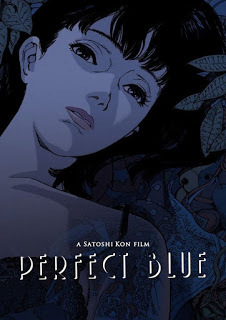 Perfect Blue, 1997, dir: Satoshi Kon
If there's a criticism to be leveled at Satoshi Kon's directorial debut Perfect Blue, it's that it's no more or less than a superlative thriller. And even that's perhaps harsh: not many thrillers comment so perceptively on the culture they inhabit, or are so mechanically fascinating, or dare to challenge their audience in such flagrant fashion. Nevertheless, with the benefit of hindsight and compared with everything Kon would do from here on in his extraordinary and all-too-short career, Perfect Blue is merely a smart, intricate, mind-bending genre picture made with outstanding craft.
But if it's true that Kon's characteristic mind games and fluid take on reality would subsequently be exploited to better effect - if I had to choose, I'd call Millennium Actress his masterpiece, out of a career consisting of nothing except masterpieces - it's also true that he hit the ground running, with a story ideally suited to the themes and approach he'd go on to make his own. Perfect Blue follows Mima Kirigoe, who we meet as she's bowing out of her idol group CHAM! to pursue a career in acting, much to the chagrin of her devoted fans, one of whom in particular seems to consider himself personally responsible for setting her back on the right path. That's hardly Mima's only worry, though, as her part in a straight-to-DVD thriller and the pressure to shed her little-girl idol persona drives her to make choices so wildly at odds with her natural inclinations that her troubled mind begins to splinter in all sorts of weird ways. Or could it be that she really does have a doppelganger, and that the fairy-like other Mima she keeps seeing somehow exists outside of her increasingly muddled imagination?
It's a great setup, an intriguing melting pot of Hitchcock, Lynch, and Argento, all of whom Kon references more or less explicitly; but it's easy to imagine a version of Perfect Blue that wasn't a classic worthy of discussion two decades later, and what pushes it over the line is largely a matter of dedication. Kon's contempt for an entertainment industry with no roles for women that don't fall into the categories of virgin and whore is palpable, and his adventures in reality-bending are wholeheartedly committed, the approach of an artist asking genuine questions about the extent to which we can trust our perceptions rather than an entertainer who simply wants to mess with his audience - though that's certainly a factor, and in the best of ways, one that's sly and playful without being smug or needlessly obscure.
Then of course there's the animation, which is as good as anything the nineties had to offer and holds up strikingly well today, and the score, which manages both freaky, disorientating pseudo-music and J-pop tracks so catchy that you can readily believe they'd be the work of a moderately successful idol group. Indeed, how Kon managed to conjure up such production values to make so adult and uncompromising a film is anyone's guess. That he did, and that it was successful enough for him to keep making films, is a fluke to be thankful for, even if it doesn't make his premature death at the age of 46 any less devastating. He'd go on to make better films than Perfect Blue, ones that transcended their material in ways it doesn't, and he would explore these same themes more vigorously in his series Paranoia Agent. But when that's the worst that can be said, you know you're looking at one heck of a movie.
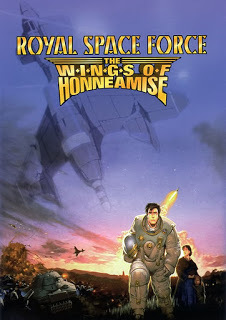 Royal Space Force: The Wings of Honnêamise, 1987, dir: Hiroyuki Yamaga
If Royal Space Force: The Wings of Honnêamise had nothing going for it beside its world building, it would still be one of the great genre films of the twentieth century. The kingdom of Honnêamise belongs to a world like and unlike our own, similar enough to be recognisable and relatable but alien in its every specific. This is one of the most designed movies ever made, with every element, from vehicles to telephones to clothing to lights to drinking glasses rethought in ways that are somehow both strange and correct. Yet it's also a movie that never feels designed, because the job has been done far too well to call attention to itself. We've no choice but to accept Honnêamise as a real place, absorbing its customs through osmosis rather than because they're forced on our attention.
Couple that with Hiroyuki Yamaga's assured, naturalistic direction, which refuses to treat the narrative as any sort of science-fiction, or really as fiction full stop, and what you get feels like a documentary beamed from another dimension. That approach is absolutely correct for its material, the story of an alternate space program in an alternate world, one where to be a member of the Space Force is a wholly disreputable career that only someone like our slovenly protagonist Shirotsugh Lhadatt, whose poor grades nixed his dreams of flying jets, would consider. When we meet him, he's too disheartened at the death of a friend to even bother turning up on time for said friend's funeral, and it's only a chance encounter with young, impoverished street preacher Riquinni that begins his journey toward being his world's first astronaut. But as the unlikely possibility that the Royal Space Force might actually accomplish something begins to look like a potential reality, so it grows increasingly clear that his government's motives are less than noble, or much to do with getting a man into space.
In a sense, it's easy to see why the result was a flop that nearly killed off the burgeoning Studio Gainax: it's an ambling story full of odd diversions, not least the sort-of romance between Lhadatt and Riquinni, which culminates in an atrocious act on Lhadatt's part that would break a lesser film, because it's damned hard to sympathise with him afterwards. But Wings of Honnêamise doesn't require us, or even particularly desire us, to sympathise with its protagonist. Indeed, to do so would perhaps be missing the point. Boiled down to its essence, its narrative is basically Oscar Wilde's adage, "We are all in the gutter, but some of us are looking at the stars," and that message is the heart of the film both on the level of character and in its wider themes, to be ultimately expressed in a closing few minutes as sublime as any sequence put to film.
Oh, and it neatly sums up Studio Gainax too, who at this point were just a bunch of young Turks with the arrogance to assume they could do animation better than anyone in the industry and the raw talent and scrupulous commitment to their craft to actually pull it off. Wings of Honnêamise offers some of the most astonishing hand-drawn animation you're ever likely to see, and at the same time looks unlike any animated film ever made, with that dedication to verisimilitude spilling over into every aspect. Lhadatt spends most of the film looking miserable, exhausted, or both; the movie's central action sequence is notable mostly for how much it refuses to be exciting; and the attention to detail is bewildering, especially in the special effects work of a certain Hideaki Anno, who models details as seemingly trivial as tumbling ice shards with the most exquisite, mind-boggling precision imaginable.
The culmination of those efforts is unique even by the standards of late eighties anime, a period when the medium was stretching itself to a degree that would never truly happen again. It's essential watching if you're an animation fan, that should be obvious; but it's also one of the most truly bold and original science-fiction films ever made, broaching material any Hollywood exec would dismiss as too bookish and complex to work on screen. And in ninety-nine out of a hundred cases, they'd be right; Royal Space Force: The Wings of Honnêamise is the sort of lightning strike you could only get when a bunch of genius creators set out to smash their way into an industry through sheer talent and have the arrogance to break all the rules along the way, including a few that would normally be better off not broken.
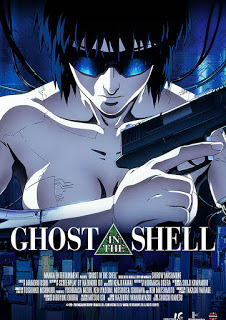 Ghost in the Shell, 1995, dir: Mamoru Oshii
I'm not going to say Ghost in the Shell is the best science fiction film ever made. I'm certainly not going to deny it either. There are other contenders, for sure, but I'll go this far without hesitation: Ghost in the Shell is as close to a perfect sci-fi movie as it's possible to get, and thus its only competition comes from other functionally perfect movies, the Blade Runners and Stalkers and Aliens of this world. And this struck me more on a rewatch than ever before: there's simply nothing unquestionably wrong with it, nothing to be definitively pointed out as a misstep. As a narrative, as a work of animation, as the creative vision of a singular director, as a philosophical argument even, it's basically flawless. For a little under ninety minutes of running time, it never puts a foot wrong, nor wastes a single frame, nor raises an idea that doesn't tie intimately into its central themes.
This certainly has a lot to do with Mamoru Oshii, a staggering talent who reached a peak here he'd never quite equal again, and refined techniques he'd developed on a series of lesser but still terrific classics over the last decade and change. What struck me forcibly coming back to Ghost in the Shell was the degree to which the film breaks down into discreet chunks that are rarely required to do more than one thing: generally they're action, plot, or thematic exposition, with a nebulous fourth category that might be classed as world-building, though it's as much to do with mood-building: I'm thinking here of the famous sequence where our protagonist, Major Motoko Kusanagi, wanders through the urban sprawl of New Port City, accompanied by Kenji Kawai's gorgeous, hypnotically alien score. Anyway, the point is that mostly scenes are expected to fulfill one purpose and to achieve that purpose outstandingly. Few directors could get away with this; there's a scene, for example, set in a brief moment of downtime, where the two main characters sit and basically discuss the movie's themes. It shouldn't work, yet it does, and the reason is Oshii, who's honed this economy of storytelling to such a remarkable degree.
It helps, of course, that the animation is some of the finest ever created. Normally in these reviews I'd have to caveat that with a nod to Disney and Ghibli, but not here: what Production I.G. and their collaborators accomplished is the pinnacle of the craft. Moreover, there's not a second where the medium inhibits the storytelling, not a shot that feels compromised by the technical difficulties involved with drawing complex three-dimensional objects in motion or layers of action or the minutia of expressions or anything else. Watch it on blu-ray and it's nearly impossible to grasp that it was made two and half decades ago; the only real clue is that pretty much nobody is producing hand-drawn animation so exquisite these days.
Should you not be an animation fan, I suppose you might argue that none of this is a reason to consider Ghost in the Shell an enduring masterpiece. You might even propose that it's merely riffing on familiar genre themes. Can mankind create an intelligence to rival its own? Can an AI ever be truly considered intelligent? How far can we modify ourselves and still regard ourselves as human? If we rely on external memories, can those memories be trusted? Interesting ideas to be sure, but none of them fresh, and all chewed over extensively since 1995. However, Oshii, along with scriptwriter Kazunori Itô, invariably finds new angles and challenging conclusions. The film is happy to conclude that one intelligence is much like another, and anyway, both are largely illusory: we think we think, therefore we probably are, for all the good it does us. And if that weren't enough, there's plenty else to get lost in around the margins, and some of that really is still novel: particularly, the film's treatment of gender identity and sexuality remains fascinating and complex.
So sure, I won't flat out claim that Ghost in the Shell is the greatest science fiction film ever made, or the greatest anime film, or the greatest filmed work of cyberpunk, but it certainly might be, and it absolutely belongs in the highest stratosphere of all those categories. It's a movie I never grow tired of, indeed one that I can never return to and not be surprised by; there are individual scenes of such brilliance that they're burned deep into my brain, yet I'm always startled by how new and unexpected the plot feels, how essentially distant and unreachable it all is. At the start I called Ghost in the Shell perfect, and that's not a word I use lightly, especially not when describing films, but here I do so unhesitatingly.
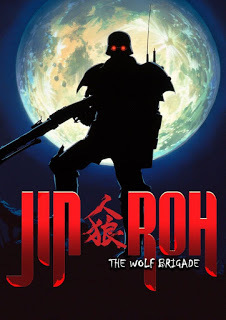 Jin-Roh: The Wolf Brigade, 1999, dir: Hiroyuki Okiura
With the benefit of hindsight, it's easy to view Jin-Roh as a last hurrah for the soon to be largely extinct art of purely hand-drawn animation. By 1999, the writing was on the wall; indeed, Ghost in the Shell, four years earlier, and made also by studio Production I.G., had already become one of the benchmarks that proved CG could be incorporated seamlessly into 2D animation. The approach taken here, amounting to an immensely laborious three year production cycle and some 80'000 cells, must have seemed dated even at the time. As the new millennium was ushered in, most of those involved would embrace the incoming technology wholeheartedly: writer Oshii, adapting from his own Manga, would reset the benchmark all over again with his sequel to Ghost in the Shell five years later, and assistant director Kenji Kamiyama would team up again with I.G. three years later to make arguably the greatest sci-fi anime series of all time, Ghost in the Shell: Standalone Complex, which would go a long way to rewriting the rulebook on how the skillful deployment of computer animation could up the bar of what TV animation was capable of.
All of which I present for basically two reasons. Firstly, Jin-Roh is a staggering work of animation, so smooth and realistic and subtle in its effects that it's awfully easy to forget you're watching an animated film at all. If it's not exactly what you'd call beautiful, that comes down entirely to its subject matter and not at all to its craft, which is in the very highest echelons of the medium. And secondly, Jin-Roh feels not of its time on almost every level. Even if you don't know to spot the lack of CG, it has the air of something that might have been made a decade earlier, in that window where costly experimentation in smart, difficult anime for adults briefly blossomed. And though Oshii's influence didn't extent beyond the script, this very much has the feel of his earlier works, particularly his two Patlabor movies. But none of that would matter much if it wasn't for the subject matter, and that's one of the things that makes Jin-Roh truly fascinating: its defiance of the cutting edge of animation technology is perfectly of a piece with the mood it creates and the story it tells.
That's not a story I want to spoil, but a bit of background should clarify my point. The movie takes place in an alternate nineteen-fifties Japan, one caught in an escalating conflict between domestic terrorism and ever more extreme law enforcement, the darkest facet of which consists of the Capital Police and their heavily armed and armoured forces, who've shown so little restraint that even the other branches of the police are getting twitchy about their antics; that they look like Nazi stormtroopers with glowing red eyes probably doesn't help matters, nor do the rumours that they're running a secret counter-intelligence unit from within their ranks. And what better way to take them down than by discrediting one of their number? Say, Kazuki Fuse, sunk in emotional stupor after watching a young girl blow herself up with a parcel bomb and now showing altogether too much interest in her older sister?
Cheery stuff, right? But truth be told, Jin-Roh is even more bleak and dour than all that. When it's not being an examination of how totalitarianism destroys hearts and souls - mostly by numbing them into oblivion, if the film is to be believed - it's sidelining as a particularly gothic, Germanic telling of the Red Riding Hood story, one that scorns the very notion of happy endings. Had Oshii directed himself, he might perhaps have found some poetry in the material, but Okiura doesn't appear to be trying - odd given that his return to feature directing, many years later, would be with the sweetly charming A Letter To Momo. Then again, it's not really a criticism, merely an observation: Jin-Roh is a joyless, suffocating vision that captures as well as anything I've encountered the hollow feeling of deep depression, and it's hard to imagine that Okiura ever intended it to be anything else, given how surehandedly he controls the material.
It may be apparent by now that, unlike everything else here, Jin-Roh: The Wolf Brigage is not a film I recommend wholeheartedly and to everyone. Its pace is leaden, its cynicism nearly overwhelming, and though there are some superb twists and bursts of action along the way, there's a reasonable chance you'll be feeling so bludgeoned on a first viewing that you might miss them. Indeed, it was the last movie I rewatched for this retrospective because a part of me wasn't eager to return to it - though admittedly that had as much to do with the fact that I'd recently seen Kim Jee-woon's recent re-imagining Illang, which I dare say may even improve on its source material. Nevertheless, Jin-Roh genuinely is a classic of its genre and close to indispensable. It might not make you happy, but sometimes it's the job of great art to make you feel like crap and open your mind a little, and sometimes that's every bit as valuable.
-oOo-
You know, I think this was something I needed to get out of my system. So I guess the fact that I had to write 196 reviews to get to this point is totally okay. Occasionally it's really satisfying to remind yourself of why you love something, and then to try and put that passion into words. I've no idea if I've done these four films any justice - honestly, I doubt such a thing is possible! - but the effort felt good. And there's no other possible conclusion than to say that, if there's anything here you haven't seen, for goodness' sake correct that fact as rapidly as possible ... these aren't just masterpieces of anime, they're masterpieces of cinema and of storytelling. Basically, they're flat-out masterpieces, and they deserve your attention.
Next time? Well, I know pretty much for certain where we'll be next, because I have about ten of these posts finished and ready to go, but suffice to say that, while some of it will be good and some it might even be great, it's going to be at least another fifty entries before we hit this kind of high point again.
[Other reviews in this series: By Date / By Title / By Rating]
But no, that's not true, I do have one regret, and here at the big half century mark, I'm going to address that. Since my focus has always been on discovering gems I haven't seen, I've largely ignored the established classics of vintage anime, meaning that the list of works I've awarded nine, let alone ten stars to is awfully brief. By the same measure, so much of my time's been taken up with watching new stuff for these reviews that I haven't been back to revisit my favourites.
Basically, then, it's personal canon time: these are the films I unreservedly love and that helped give birth to this whole crazy experiment, and for the first and perhaps only time in this series we get to gaze at the dizziest heights of vintage anime for an entire post, in the shape of: Perfect Blue, Royal Space Force: The Wings of Honnêamise, Ghost in the Shell, and Jin-Roh: The Wolf Brigade...
 Perfect Blue, 1997, dir: Satoshi Kon
If there's a criticism to be leveled at Satoshi Kon's directorial debut Perfect Blue, it's that it's no more or less than a superlative thriller. And even that's perhaps harsh: not many thrillers comment so perceptively on the culture they inhabit, or are so mechanically fascinating, or dare to challenge their audience in such flagrant fashion. Nevertheless, with the benefit of hindsight and compared with everything Kon would do from here on in his extraordinary and all-too-short career, Perfect Blue is merely a smart, intricate, mind-bending genre picture made with outstanding craft.
But if it's true that Kon's characteristic mind games and fluid take on reality would subsequently be exploited to better effect - if I had to choose, I'd call Millennium Actress his masterpiece, out of a career consisting of nothing except masterpieces - it's also true that he hit the ground running, with a story ideally suited to the themes and approach he'd go on to make his own. Perfect Blue follows Mima Kirigoe, who we meet as she's bowing out of her idol group CHAM! to pursue a career in acting, much to the chagrin of her devoted fans, one of whom in particular seems to consider himself personally responsible for setting her back on the right path. That's hardly Mima's only worry, though, as her part in a straight-to-DVD thriller and the pressure to shed her little-girl idol persona drives her to make choices so wildly at odds with her natural inclinations that her troubled mind begins to splinter in all sorts of weird ways. Or could it be that she really does have a doppelganger, and that the fairy-like other Mima she keeps seeing somehow exists outside of her increasingly muddled imagination?
It's a great setup, an intriguing melting pot of Hitchcock, Lynch, and Argento, all of whom Kon references more or less explicitly; but it's easy to imagine a version of Perfect Blue that wasn't a classic worthy of discussion two decades later, and what pushes it over the line is largely a matter of dedication. Kon's contempt for an entertainment industry with no roles for women that don't fall into the categories of virgin and whore is palpable, and his adventures in reality-bending are wholeheartedly committed, the approach of an artist asking genuine questions about the extent to which we can trust our perceptions rather than an entertainer who simply wants to mess with his audience - though that's certainly a factor, and in the best of ways, one that's sly and playful without being smug or needlessly obscure.
Then of course there's the animation, which is as good as anything the nineties had to offer and holds up strikingly well today, and the score, which manages both freaky, disorientating pseudo-music and J-pop tracks so catchy that you can readily believe they'd be the work of a moderately successful idol group. Indeed, how Kon managed to conjure up such production values to make so adult and uncompromising a film is anyone's guess. That he did, and that it was successful enough for him to keep making films, is a fluke to be thankful for, even if it doesn't make his premature death at the age of 46 any less devastating. He'd go on to make better films than Perfect Blue, ones that transcended their material in ways it doesn't, and he would explore these same themes more vigorously in his series Paranoia Agent. But when that's the worst that can be said, you know you're looking at one heck of a movie.
 Royal Space Force: The Wings of Honnêamise, 1987, dir: Hiroyuki Yamaga
If Royal Space Force: The Wings of Honnêamise had nothing going for it beside its world building, it would still be one of the great genre films of the twentieth century. The kingdom of Honnêamise belongs to a world like and unlike our own, similar enough to be recognisable and relatable but alien in its every specific. This is one of the most designed movies ever made, with every element, from vehicles to telephones to clothing to lights to drinking glasses rethought in ways that are somehow both strange and correct. Yet it's also a movie that never feels designed, because the job has been done far too well to call attention to itself. We've no choice but to accept Honnêamise as a real place, absorbing its customs through osmosis rather than because they're forced on our attention.
Couple that with Hiroyuki Yamaga's assured, naturalistic direction, which refuses to treat the narrative as any sort of science-fiction, or really as fiction full stop, and what you get feels like a documentary beamed from another dimension. That approach is absolutely correct for its material, the story of an alternate space program in an alternate world, one where to be a member of the Space Force is a wholly disreputable career that only someone like our slovenly protagonist Shirotsugh Lhadatt, whose poor grades nixed his dreams of flying jets, would consider. When we meet him, he's too disheartened at the death of a friend to even bother turning up on time for said friend's funeral, and it's only a chance encounter with young, impoverished street preacher Riquinni that begins his journey toward being his world's first astronaut. But as the unlikely possibility that the Royal Space Force might actually accomplish something begins to look like a potential reality, so it grows increasingly clear that his government's motives are less than noble, or much to do with getting a man into space.
In a sense, it's easy to see why the result was a flop that nearly killed off the burgeoning Studio Gainax: it's an ambling story full of odd diversions, not least the sort-of romance between Lhadatt and Riquinni, which culminates in an atrocious act on Lhadatt's part that would break a lesser film, because it's damned hard to sympathise with him afterwards. But Wings of Honnêamise doesn't require us, or even particularly desire us, to sympathise with its protagonist. Indeed, to do so would perhaps be missing the point. Boiled down to its essence, its narrative is basically Oscar Wilde's adage, "We are all in the gutter, but some of us are looking at the stars," and that message is the heart of the film both on the level of character and in its wider themes, to be ultimately expressed in a closing few minutes as sublime as any sequence put to film.
Oh, and it neatly sums up Studio Gainax too, who at this point were just a bunch of young Turks with the arrogance to assume they could do animation better than anyone in the industry and the raw talent and scrupulous commitment to their craft to actually pull it off. Wings of Honnêamise offers some of the most astonishing hand-drawn animation you're ever likely to see, and at the same time looks unlike any animated film ever made, with that dedication to verisimilitude spilling over into every aspect. Lhadatt spends most of the film looking miserable, exhausted, or both; the movie's central action sequence is notable mostly for how much it refuses to be exciting; and the attention to detail is bewildering, especially in the special effects work of a certain Hideaki Anno, who models details as seemingly trivial as tumbling ice shards with the most exquisite, mind-boggling precision imaginable.
The culmination of those efforts is unique even by the standards of late eighties anime, a period when the medium was stretching itself to a degree that would never truly happen again. It's essential watching if you're an animation fan, that should be obvious; but it's also one of the most truly bold and original science-fiction films ever made, broaching material any Hollywood exec would dismiss as too bookish and complex to work on screen. And in ninety-nine out of a hundred cases, they'd be right; Royal Space Force: The Wings of Honnêamise is the sort of lightning strike you could only get when a bunch of genius creators set out to smash their way into an industry through sheer talent and have the arrogance to break all the rules along the way, including a few that would normally be better off not broken.
 Ghost in the Shell, 1995, dir: Mamoru Oshii
I'm not going to say Ghost in the Shell is the best science fiction film ever made. I'm certainly not going to deny it either. There are other contenders, for sure, but I'll go this far without hesitation: Ghost in the Shell is as close to a perfect sci-fi movie as it's possible to get, and thus its only competition comes from other functionally perfect movies, the Blade Runners and Stalkers and Aliens of this world. And this struck me more on a rewatch than ever before: there's simply nothing unquestionably wrong with it, nothing to be definitively pointed out as a misstep. As a narrative, as a work of animation, as the creative vision of a singular director, as a philosophical argument even, it's basically flawless. For a little under ninety minutes of running time, it never puts a foot wrong, nor wastes a single frame, nor raises an idea that doesn't tie intimately into its central themes.
This certainly has a lot to do with Mamoru Oshii, a staggering talent who reached a peak here he'd never quite equal again, and refined techniques he'd developed on a series of lesser but still terrific classics over the last decade and change. What struck me forcibly coming back to Ghost in the Shell was the degree to which the film breaks down into discreet chunks that are rarely required to do more than one thing: generally they're action, plot, or thematic exposition, with a nebulous fourth category that might be classed as world-building, though it's as much to do with mood-building: I'm thinking here of the famous sequence where our protagonist, Major Motoko Kusanagi, wanders through the urban sprawl of New Port City, accompanied by Kenji Kawai's gorgeous, hypnotically alien score. Anyway, the point is that mostly scenes are expected to fulfill one purpose and to achieve that purpose outstandingly. Few directors could get away with this; there's a scene, for example, set in a brief moment of downtime, where the two main characters sit and basically discuss the movie's themes. It shouldn't work, yet it does, and the reason is Oshii, who's honed this economy of storytelling to such a remarkable degree.
It helps, of course, that the animation is some of the finest ever created. Normally in these reviews I'd have to caveat that with a nod to Disney and Ghibli, but not here: what Production I.G. and their collaborators accomplished is the pinnacle of the craft. Moreover, there's not a second where the medium inhibits the storytelling, not a shot that feels compromised by the technical difficulties involved with drawing complex three-dimensional objects in motion or layers of action or the minutia of expressions or anything else. Watch it on blu-ray and it's nearly impossible to grasp that it was made two and half decades ago; the only real clue is that pretty much nobody is producing hand-drawn animation so exquisite these days.
Should you not be an animation fan, I suppose you might argue that none of this is a reason to consider Ghost in the Shell an enduring masterpiece. You might even propose that it's merely riffing on familiar genre themes. Can mankind create an intelligence to rival its own? Can an AI ever be truly considered intelligent? How far can we modify ourselves and still regard ourselves as human? If we rely on external memories, can those memories be trusted? Interesting ideas to be sure, but none of them fresh, and all chewed over extensively since 1995. However, Oshii, along with scriptwriter Kazunori Itô, invariably finds new angles and challenging conclusions. The film is happy to conclude that one intelligence is much like another, and anyway, both are largely illusory: we think we think, therefore we probably are, for all the good it does us. And if that weren't enough, there's plenty else to get lost in around the margins, and some of that really is still novel: particularly, the film's treatment of gender identity and sexuality remains fascinating and complex.
So sure, I won't flat out claim that Ghost in the Shell is the greatest science fiction film ever made, or the greatest anime film, or the greatest filmed work of cyberpunk, but it certainly might be, and it absolutely belongs in the highest stratosphere of all those categories. It's a movie I never grow tired of, indeed one that I can never return to and not be surprised by; there are individual scenes of such brilliance that they're burned deep into my brain, yet I'm always startled by how new and unexpected the plot feels, how essentially distant and unreachable it all is. At the start I called Ghost in the Shell perfect, and that's not a word I use lightly, especially not when describing films, but here I do so unhesitatingly.
 Jin-Roh: The Wolf Brigade, 1999, dir: Hiroyuki Okiura
With the benefit of hindsight, it's easy to view Jin-Roh as a last hurrah for the soon to be largely extinct art of purely hand-drawn animation. By 1999, the writing was on the wall; indeed, Ghost in the Shell, four years earlier, and made also by studio Production I.G., had already become one of the benchmarks that proved CG could be incorporated seamlessly into 2D animation. The approach taken here, amounting to an immensely laborious three year production cycle and some 80'000 cells, must have seemed dated even at the time. As the new millennium was ushered in, most of those involved would embrace the incoming technology wholeheartedly: writer Oshii, adapting from his own Manga, would reset the benchmark all over again with his sequel to Ghost in the Shell five years later, and assistant director Kenji Kamiyama would team up again with I.G. three years later to make arguably the greatest sci-fi anime series of all time, Ghost in the Shell: Standalone Complex, which would go a long way to rewriting the rulebook on how the skillful deployment of computer animation could up the bar of what TV animation was capable of.
All of which I present for basically two reasons. Firstly, Jin-Roh is a staggering work of animation, so smooth and realistic and subtle in its effects that it's awfully easy to forget you're watching an animated film at all. If it's not exactly what you'd call beautiful, that comes down entirely to its subject matter and not at all to its craft, which is in the very highest echelons of the medium. And secondly, Jin-Roh feels not of its time on almost every level. Even if you don't know to spot the lack of CG, it has the air of something that might have been made a decade earlier, in that window where costly experimentation in smart, difficult anime for adults briefly blossomed. And though Oshii's influence didn't extent beyond the script, this very much has the feel of his earlier works, particularly his two Patlabor movies. But none of that would matter much if it wasn't for the subject matter, and that's one of the things that makes Jin-Roh truly fascinating: its defiance of the cutting edge of animation technology is perfectly of a piece with the mood it creates and the story it tells.
That's not a story I want to spoil, but a bit of background should clarify my point. The movie takes place in an alternate nineteen-fifties Japan, one caught in an escalating conflict between domestic terrorism and ever more extreme law enforcement, the darkest facet of which consists of the Capital Police and their heavily armed and armoured forces, who've shown so little restraint that even the other branches of the police are getting twitchy about their antics; that they look like Nazi stormtroopers with glowing red eyes probably doesn't help matters, nor do the rumours that they're running a secret counter-intelligence unit from within their ranks. And what better way to take them down than by discrediting one of their number? Say, Kazuki Fuse, sunk in emotional stupor after watching a young girl blow herself up with a parcel bomb and now showing altogether too much interest in her older sister?
Cheery stuff, right? But truth be told, Jin-Roh is even more bleak and dour than all that. When it's not being an examination of how totalitarianism destroys hearts and souls - mostly by numbing them into oblivion, if the film is to be believed - it's sidelining as a particularly gothic, Germanic telling of the Red Riding Hood story, one that scorns the very notion of happy endings. Had Oshii directed himself, he might perhaps have found some poetry in the material, but Okiura doesn't appear to be trying - odd given that his return to feature directing, many years later, would be with the sweetly charming A Letter To Momo. Then again, it's not really a criticism, merely an observation: Jin-Roh is a joyless, suffocating vision that captures as well as anything I've encountered the hollow feeling of deep depression, and it's hard to imagine that Okiura ever intended it to be anything else, given how surehandedly he controls the material.
It may be apparent by now that, unlike everything else here, Jin-Roh: The Wolf Brigage is not a film I recommend wholeheartedly and to everyone. Its pace is leaden, its cynicism nearly overwhelming, and though there are some superb twists and bursts of action along the way, there's a reasonable chance you'll be feeling so bludgeoned on a first viewing that you might miss them. Indeed, it was the last movie I rewatched for this retrospective because a part of me wasn't eager to return to it - though admittedly that had as much to do with the fact that I'd recently seen Kim Jee-woon's recent re-imagining Illang, which I dare say may even improve on its source material. Nevertheless, Jin-Roh genuinely is a classic of its genre and close to indispensable. It might not make you happy, but sometimes it's the job of great art to make you feel like crap and open your mind a little, and sometimes that's every bit as valuable.
-oOo-
You know, I think this was something I needed to get out of my system. So I guess the fact that I had to write 196 reviews to get to this point is totally okay. Occasionally it's really satisfying to remind yourself of why you love something, and then to try and put that passion into words. I've no idea if I've done these four films any justice - honestly, I doubt such a thing is possible! - but the effort felt good. And there's no other possible conclusion than to say that, if there's anything here you haven't seen, for goodness' sake correct that fact as rapidly as possible ... these aren't just masterpieces of anime, they're masterpieces of cinema and of storytelling. Basically, they're flat-out masterpieces, and they deserve your attention.
Next time? Well, I know pretty much for certain where we'll be next, because I have about ten of these posts finished and ready to go, but suffice to say that, while some of it will be good and some it might even be great, it's going to be at least another fifty entries before we hit this kind of high point again.
[Other reviews in this series: By Date / By Title / By Rating]


June 7, 2019
Short Story News May 2019
 As usual these days, the short story news isn't exactly coming thick and fast. Apparently it's been six months since I had anything to say on that front! But I figure I've gathered enough to more than justify a post, especially when there are a couple of seriously exciting bits of news to share.
If we're being honest, the two stories I had out over the Christmas period don't fall into that category. It was nice to have new work released, but not so much so when both suffered from some rather wonky editing. In the case of new UK-based cyberpunk magazine Write Ahead, I'm happy to put that down to teething troubles, since my story Glamorous Corpses appeared in the very first issue, and the general quality of the fiction and some lovely design work made the editorial slip-ups easier to ignore - though it was tough not to feel sorry for the author whose story appeared with line breaks inserted after every few words! But these things happen, right? And I sincerely hope this little 'zine sticks around, because the presentation is terrific. There have been a couple more issues since, and I'd tentatively recommend picking them up; I get the impression that the folks behind it were keen to learn from what they hadn't got quite right.
 I can't be quite so positive about the Bubble Off Plumb collection that Feral Cat Publishers put out. Honestly, my hopes for this one were muted after some not-so-great experiences in the run up to its release, and the end result is pretty much what I was expecting - though I hadn't guessed how many of the stories would be by the editorial team, so I guess I can still be surprised! As with any anthology, there are a few good pieces in there, though most would fare better with less typos. At any rate, I'm hoping my story Cat and Mouse wasn't a low point, and there's a bit of evidence on that front because - and here we finally get to the legitimately good news portion of this post! - it wasn't long before it got picked up for my first ever best-of. That would be NewCon Press's Best of British Science-Fiction anthology, which should be out pretty soon, and has one heck of a line-up: you can see the wonderful company I'm in here.
 Speaking of great company, a bit of news I think I nodded toward last time but couldn't yet come out with was that I've another story in one of those gorgeous anthologies that Flame Tree Publishing keep creating. This time it's Step Light, which originally appeared in Alfred Hitchcock Mystery Magazine. And as ever, the lineup is a mix of newer and classic fiction, which means that, along with numerous fantastic contemporary authors, I've now been published alongside Oscar Wilde and Fyodor Dostoevsky. I mean, Fyodor goddamn Dostoevsky! When you talk about wanting to appear alongside your personal favourite writers, you sort of don't expect it to include your actual literary heroes, but thanks to this series I've done awfully well on that front. You can find the full lineup here, and if you're curious as to where we contributors that aren't long dead got our ideas from you can learn about that here, or if you'd like to discover a bit about influences and writing practices then that would be here. Since my author copies are apparently in the post, I'm pretty certain this one's already out to buy, and I can't stress enough how fantastic and beautifully made these books are.
Speaking of classic authors, in a post that's lending itself well to neat links between paragraphs, I have managed to sell at least one original piece in recent months, rare as that's becoming, and if Dostoevsky is one of my all time literary heroes then H. G. Wells absolutely tops that list. Want to learn how to write short genre fiction? Then read Wells, because no one has ever done a better job of it. There aren't many authors I'd write what amounts to fan fiction for, let alone dream of creating an unofficial sequel to one of their best known works, but I love the hell out of Wells and The War of the Worlds is one of my all time favourite novels, and somehow that led to my coming up with The Last of the Martians, a follow-up that also has the temerity to challenge some of the basic assumptions in the one of the great SF novels of all time. Basically, if you're looking for a pacifist epilogue to a novel that literally has the word "war" right there in the title then I've got you covered. And it'll be appearing in the A Tribute to H. G. Wells anthology from Belanger Books, somewhere toward the back end of the year, with a Kickstarter campaign coming in the meantime.
 Weirdly though, given how exciting all of the above is, the sales I was most thrilled for weren't even in English. I've had a couple of pieces out in translation - I learned recently that my story Stockholm Syndrome has made it into multiple languages, including Spanish and Korean, courtesy of John Joseph Adams and his terrific The Living Dead anthology - but it was only last year that I actually got directly approached by an overseas publisher. So for the same to happen twice in rapid succession was definitely a shock.
 First came The Only Way Out Lies Farther In, in what I take to be an Italian version of the 'zine in which the story first appeared, The Dark, appropriately named Il Buio. And that was certainly cool, though they did change the title without asking ... I mean, Il Labirinto is fine and all, but it's not half so wordy and pretentious! But I can't read Italian, and there's a reasonable chance I won't ever be able to read Italian, whereas I've been learning Japanese for the last year and change and I genuinely do hope that one day I'll be able to work my way through the May 2019 issue of Japanese weird fiction venue Nightland Quarterly, as published by Atelier Third. I got a request from them out of the blue to use The Way of the Leaves, as featured in my collection The Sign in the Moonlight and Other Stories, and I was hardly about to say no, was I? I've yet to see a copy, but the cover is cool, and I've already learned that my name in katakana comes out as David Terraman, which is a useful thing to know.
And that's it for the moment, though I've vague hopes of devoting a bit more time to short fiction in the second half of the year, and I'm steadily plugging away at a second collection of horror and dark fantasy, which may or may not eventually see the light of day! I mean, it will, one way or another, I'm just not sure how I get to that point quite yet...
May 21, 2019
Black River Latest, A Savage Generation Updates, and Other Vague News
 Ah, writing! You'll have months of trudging, just trying to hit the next deadline, months of getting lost in a project, months when nothing much comes along and it feels like nothing might ever again, and then suddenly everything kicks off all at once and just won't stop. That's certainly what's been happening in recent weeks, in a mostly good (but also baffling and exhausting!) fashion.
Much of that comes down to the Black River books, and the fact that my clumsy scheduling left me getting the third ready for publication while writing the first draft of the fourth and final book. On that initial front, the news is all good; expect Eye of the Observer out somewhere around the end of this month or start of June. And as for book four - boy, first drafts, huh? They're always an adventure. To be honest, it ought to have been finished by now, and the reason it isn't is partly that I got distracted by another project demanding my immediate attention (see below) and partly that I've gone way over my intended word count. Like, entire chapters over! Basically my chapter plan held good until somewhere around the four fifths point and then exploded, meaning I had to go back to the drawing board for the big climax and that all bets were off about what amount of space it was liable to fit in.
If you've never written a novel, this probably sounds disastrous, and if you have written a novel, it probably still sounds a bit alarming, but actually it's all fine and under control. I'll be done in a day or two, unless the last chapter somehow turns into fifteen or something, and while there's a lot of cutting needed, I'd always rather that than get to the end realising I'm missing crucial sections. More to the point, the core of the book feels solid, and that's the big thing, right? It's not what I saw in my head when I set out yet, but the central elements are there, doing roughly the right things in roughly the right places. It's going to come together in the second draft, I know it, and in the meantime, there are already significant chunks I'm pretty happy with. Black River four is, in short, moving in the right direction.
 And that distraction I mentioned? That would be getting the edits through for A Savage Generation, my second Flame Tree Publishing thriller. They weren't altogether fun, but they were productive, and as always I was reminded of just how proud I am of the book, which feels completely different to anything else I've written in ways I can barely get my head around. If you happen to be a reviewer, you can already find an advance copy up on Netgalley here, and the book itself will be out in September.
But all of this news is quite specific, isn't it? And I promised vagueness in the title, didn't I? Okay, how about we wrap up with me saying that in the last month I've signed contracts with two separate publishers, one for a novella and another for a novel? But that I'm not at liberty yet to say what books or what publishers? That's pretty vague, right? Yeah, that ought to do it.
May 10, 2019
Film Ramble: Drowning in Nineties Anime, Pt. 49
Wow, we're getting awfully close to the big fifty, huh? Which is actually kind of a problem, because I have something vaguely ambitious in mind for the half century mark and I've done nothing towards it, but I do have a ton of these posts ready to go. Don't be surprised if the next one is 49.1! In the meantime, we're back with a round-up of some of those shorter titles that were a mainstay of the nineties anime landscape - including one, you'll be glad to hear, that's regularly cited as the worst to be released in that entire decade!
But which will it be from among Cybernetics Guardian, Kimera, Spectral Force, and Assemble Insert?
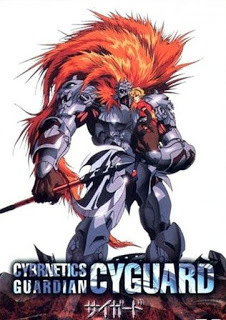 Cybernetics Guardian, 1989, dir: Kôichi Ôhata
In many ways, Cybernetics Guardian is the quintessence of anime from its era, that being the tail end of the eighties. At any rate, it feels like a perfect grab bag of many of the trends from the time, at least those in the types of anime geared predominantly toward an audience of teenage boys. It has cultists. It has demons. It had giant robots. It has, in fact, a giant robot that's also a demon summoned by cultists fighting another giant robot. Honestly, it's kind of great.
Given that Cybernetics Guardian is the sophomore effort of director Kôichi Ôhata, and given that Ôhata's debut was the risible M. D. Geist, this is sort of surprising. Arguably the main variable is one of budget: there's some splendid animation here, and a noted realism to the character designs that's quite striking. This being Ôhata, there are still occasional shots of almost incomprehensible shoddiness - at one point, I'd swear he inserts a piece of unfinished concept art as a background - and yet for the most part the impression is that, given the resources to do his vision justice, he's actually a capable helmer.
Mind you, that vision is definitely a ridiculous one. Even ignoring the bonkers premise by which a robot ends up somehow becoming the avatar of some malevolent god - I mean, I think that's what happened - there's a whole bunch of dumb jargon to drive up the silliness levels. That the main location is a slum named Cancer in a city called Cyberwood tells you much of what you need to know. And once again, there's little room for nuance or even basic storytelling in Ôhata's approach; given the preposterous but energetic rock / metal soundtrack by adorably named band Trash Gang, and given the frantic pace at which Cybernetics Guardian tears through its short running time, the experience really is a lot like watching a cool but incoherent music video. In its best moments, it's slightly delirious, and by the end it feels like the sort of dream you might have if you watched twenty hours of Manga Video releases back to back.
If Cybernetics Guardian had been made on the cheap, I'll likely have held it in just as much contempt as I do M. D. Geist. But it wasn't, it looks generally terrific, and that alone is enough to get it serious bonus points. Although, let's be honest, as much as I might mock the tattier, more teenage-boy-oriented end of the vintage anime market, I'd be lying if I said I didn't hold a certain affection for it. Within a very limited sense of the word, Cybernetics Guardian is definitely kind of awesome. I mean, come on! Cyberpunk demon samurai robot monsters! As such, while it may not be any sort of lost classic, or arguably even good, it's definitely worth the effort of tracking down on Youtube.
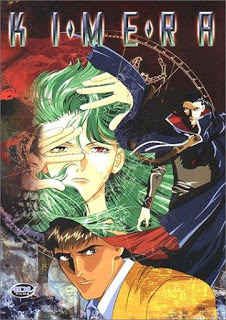 Kimera, 1997, dir: Kazuyoshi Yokota
I'm going to be kind and assume that Kimera wasn't a direct lift from Tobe Hooper's 1985 movie Lifeforce, if only because I can't find a date anywhere for the Manga the forty-five minute OVA drew from. However, that said movie exists does it no favours at all. It's not as though the world can't stand two vampires-are-really-space-aliens movies, that's a concept with its share of scope. But when one has the advantage of a feature run time and some solid effects - and to be frank, of Mathilda May walking around in the buff - and the other is a fairly low-budget piece of thoroughly middling animation less than half as long, it does make you think, "But why aren't I watching Lifeforce?"
I suppose that's terrible reviewing practice, but they are awfully similar, even down to the excess of nudity. If Kimera has a twist, it's that the titular sexy lady space vampire is actually an hermaphrodite, sort of, but given how much the script muddies that concept and then refuses to take it anywhere, you start to suspect the animators just had an inexplicable aversion to drawing breasts, as much as that goes against all previous experiences of nineties anime. That aside, the first half really doesn't do a great deal with its notions, and it's only small grace notes that give it a touch of character. I liked that the three vampiric figures are styled after different takes on vampire lore, there's some goofy humour that's out of place but still made me chuckle, and credit is due for the fact that the protagonist is a heroic travelling breakfast cereal salesman. I mean, I've no clue how that would even work - do shops not exist in this universe? - but it's certainly different.
Once Kimera gets the fundamentals of its setup out of the way, it does gain a bit more energy. In general, I'd say it gets steadily better as it goes along, and the last third is actually quite fun. There's a touch of outrageous gore, if that's your thing, and the concept heads off in some unexpectedly weird directions. Oh, and there's a truly splendid score, credited to someone or something called Sensation that apparently worked on nothing else ever. Mixing electronica, trance, and what I took to be cello compositions, one a contorted nod to Grieg's In the Hall of the Mountain King if my ears didn't deceive, it's eccentric and excellent stuff, so much so that I'd assumed it was by top composer Kenji Kawai in one of his "I'm too good for this material so I'm just going to do what the hell I like" moods.
You've probably guessed by now that I'm not recommending Kimera. It's fine for what it is, but what it is is a story that's been done better elsewhere, and even if that weren't the case, one unsuited to so short a running time. As much as I enjoyed the attempts to develop an interesting mythology, it does mean there's not much room left for anything else, and the thoroughly mediocre animation doesn't help any. Points for trying, and extra bonus points for such a fine score, but it's no great shakes that this one's been consigned to being an obscure footnote as that other space vampire movie.
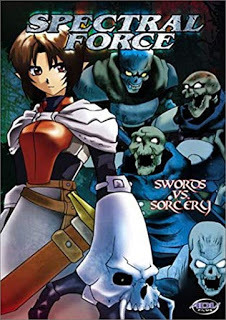 Spectral Force, 1998, dir: Yoshiteru Sato
I swear I don't make a habit of spending money on things I expect to be lousy. But there was something about Spectral Force that drew me. Partly it was the trailer, which was kind of mind-blowing in its lack of promise, and partly it was the sheer sense of horror that came off the reviews I read, and partly it was the cover, which was terrible and oddly charming at the same time. Now, having watched it, I think the last of those gave me the fairest idea of what to expect. Is it dreadful? Oh absolutely, and in a great many ways. But is it worthy of actual hatred? I'm inclined to say not.
Spectral Force is a video game series that's made little impact in the West, to the point where there isn't even enough information on Wikipedia for me to tell you how many of the things there are. But Spectral Force the anime is, I assume, based on the first game, and logic would suggest it was meant to be a sort of prologue. The land of Neverland - no, really - exists in a state of uneasy truce between humans and demons, with the latter providing a sort of benevolent dictatorship that they, at least, consider better than the chaos that would result from just letting all the various human tribes figure things out between themselves. And while there are a whole bunch of characters, our protagonist is half-demon princess Hiro, her on the cover there, who by the end of the first episode has found herself with more responsibility than she wants or can deal with and an outraged loathing for those accursed humans. Even though some of her best friends happen to be human.
That's only a fraction of what amounts to a heck of a lot of story for a two episode OVA. But even to get that far you have to see past the animation, and that's not easy. Spectral Force is so heinously ugly that it could win ugly contests. The problem that hits you first, and then keeps on hitting for the next fifty minutes, is the use of pre-rendered CG backgrounds and monsters that even in 1998 would have looked hellishly rough. But the character animation isn't that much better: it was clearly done on computers too, back in the days when you could really tell, and there are jagged, pixely lines all over the place, not to mention the occasional shot that simply doesn't function. Early on, two characters are introduced apparently walking on the spot, and it's so screamingly awful that it's unbelievable anyone could have okayed it. And for this I'm inclined to blame director Sato, who does nothing anywhere that could categorically be described as right and a lot that even a first-timer should have known to avoid.
Yet underneath it all, you can kind of see the shape of something better. The story isn't exactly what anyone would call coherent, but it dabbles in interesting ideas, and while there are too many characters to keep track of, a handful stand out enough that you vaguely care about what they're up to by the end. Hiro, in particular, deserves a longer, vastly better looking show around her, and the fact that she has something like an arc is really all that keeps the thing together. Though saying that, the music is perfectly fine and the Japanese voice cast give more than the material really deserves, so at least Spectral Force sounds better than it looks. The result is certainly not good - in fact, let's be frank, it's pretty damn bad - and yet I can't say I wasn't momentarily caught up in it.
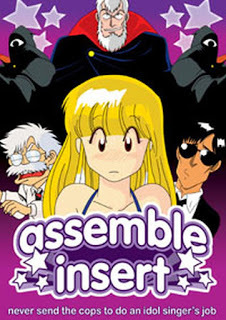 Assemble Insert, 1989, dir: Ami Tomobuki
Arguably, to be effective, comedy has to accomplish two things. First, obviously, it needs to be funny, and Assemble Insert manages that with aplomb, keeping up a steady and varied series of gags, from out and out parody of everything from sentai shows to energy drink adverts to jokes that rely on nothing more than a facial expression or a musical sting. But funny will only get you so far. Someone falling over can be funny given the right context, but ninety minutes of people falling over is more likely to leave you drowning in existential angst. So the second necessary element is that there's strong enough characters and sufficient plot to give a reason to care about what's going on, without ending up with such a convoluted narrative that there's no room left for humour.
And here, Assemble Insert goes from good to great. Its hook is appealingly stupid: faced with an onslaught of crimes from robot suit-wearing crooks operating under the nom de crime of Demon Seed, the government task force of out of their depth slackers decide that the best solution is to hold a talent contest to find someone with both the skills to combat the threat and the charm and talent to divert public attention from the destruction that occurs every time the criminals make a move. The result is as disastrous as you might expect until the appearance of final contestant Maron Namikaze, a 13 year old girl with outrageous strength and a passable singing voice. But faced with the responsibility of not only defeating Demon Seed but managing Maron's burgeoning idol career, the task force finds its priorities getting increasingly tangled.
A ludicrous setup then, but one with enough meat on its bones to make you care in the brief spells when it's not just being out and out funny. Maron is adorable, the varied government agents all have their own quirks (based, apparently, by creator Masami Yuki on the personalities of folks he worked with on his hit series Patlabor) and the result is somehow both preposterous and relatable. Indeed, Assemble Insert's biggest achievement is staying on just the right side of absurdity, opting for the most part to be droll rather than wacky. And all of this is wrapped up with some appropriately tacky J-pop tunes and animation that, while on the cheaper side of things, has such a terrific aesthetic that it barely matters: the character designs are so simplified that half the cast are missing noses and somehow it succeeds terrifically well. Put that all together and you get a nigh-on perfect hour of silly anime comedy that's one of the nicest surprises this years-long marathon through the world of vintage anime has yet to turn up.
-oOo-
I kind of love these shorter OVAs, which is a good job, since I end up watching enough of them. But objectively, in terms of spending actual, hard-earned money, they're a bit of a gamble. So I feel that this batch was something of a success, despite the fact that two titles weren't altogether very good. In retrospect, Kimera was probably the lowest point, by virtue of being a bit meh, or as meh as a film about androgynous space vampires could realistically hope to be. Objectively Spectral Force was far, far worse, but benefited greatly from my going in with rock bottom expectations and ended up as something I might even watch again before it gets sold on. (Assuming anyone else wants a copy!) Cybernetics Guardian, meanwhile, I've already rewatched, and it really is good fun, of a truly ludicrous sort, while Assemble Insert has gone straight onto my (admittedly really long by now) favourites list.
Next up? It's either the big fifty or I figure out a way to fudge the numbers!
[Other reviews in this series: By Date / By Title / By Rating]
But which will it be from among Cybernetics Guardian, Kimera, Spectral Force, and Assemble Insert?
 Cybernetics Guardian, 1989, dir: Kôichi Ôhata
In many ways, Cybernetics Guardian is the quintessence of anime from its era, that being the tail end of the eighties. At any rate, it feels like a perfect grab bag of many of the trends from the time, at least those in the types of anime geared predominantly toward an audience of teenage boys. It has cultists. It has demons. It had giant robots. It has, in fact, a giant robot that's also a demon summoned by cultists fighting another giant robot. Honestly, it's kind of great.
Given that Cybernetics Guardian is the sophomore effort of director Kôichi Ôhata, and given that Ôhata's debut was the risible M. D. Geist, this is sort of surprising. Arguably the main variable is one of budget: there's some splendid animation here, and a noted realism to the character designs that's quite striking. This being Ôhata, there are still occasional shots of almost incomprehensible shoddiness - at one point, I'd swear he inserts a piece of unfinished concept art as a background - and yet for the most part the impression is that, given the resources to do his vision justice, he's actually a capable helmer.
Mind you, that vision is definitely a ridiculous one. Even ignoring the bonkers premise by which a robot ends up somehow becoming the avatar of some malevolent god - I mean, I think that's what happened - there's a whole bunch of dumb jargon to drive up the silliness levels. That the main location is a slum named Cancer in a city called Cyberwood tells you much of what you need to know. And once again, there's little room for nuance or even basic storytelling in Ôhata's approach; given the preposterous but energetic rock / metal soundtrack by adorably named band Trash Gang, and given the frantic pace at which Cybernetics Guardian tears through its short running time, the experience really is a lot like watching a cool but incoherent music video. In its best moments, it's slightly delirious, and by the end it feels like the sort of dream you might have if you watched twenty hours of Manga Video releases back to back.
If Cybernetics Guardian had been made on the cheap, I'll likely have held it in just as much contempt as I do M. D. Geist. But it wasn't, it looks generally terrific, and that alone is enough to get it serious bonus points. Although, let's be honest, as much as I might mock the tattier, more teenage-boy-oriented end of the vintage anime market, I'd be lying if I said I didn't hold a certain affection for it. Within a very limited sense of the word, Cybernetics Guardian is definitely kind of awesome. I mean, come on! Cyberpunk demon samurai robot monsters! As such, while it may not be any sort of lost classic, or arguably even good, it's definitely worth the effort of tracking down on Youtube.
 Kimera, 1997, dir: Kazuyoshi Yokota
I'm going to be kind and assume that Kimera wasn't a direct lift from Tobe Hooper's 1985 movie Lifeforce, if only because I can't find a date anywhere for the Manga the forty-five minute OVA drew from. However, that said movie exists does it no favours at all. It's not as though the world can't stand two vampires-are-really-space-aliens movies, that's a concept with its share of scope. But when one has the advantage of a feature run time and some solid effects - and to be frank, of Mathilda May walking around in the buff - and the other is a fairly low-budget piece of thoroughly middling animation less than half as long, it does make you think, "But why aren't I watching Lifeforce?"
I suppose that's terrible reviewing practice, but they are awfully similar, even down to the excess of nudity. If Kimera has a twist, it's that the titular sexy lady space vampire is actually an hermaphrodite, sort of, but given how much the script muddies that concept and then refuses to take it anywhere, you start to suspect the animators just had an inexplicable aversion to drawing breasts, as much as that goes against all previous experiences of nineties anime. That aside, the first half really doesn't do a great deal with its notions, and it's only small grace notes that give it a touch of character. I liked that the three vampiric figures are styled after different takes on vampire lore, there's some goofy humour that's out of place but still made me chuckle, and credit is due for the fact that the protagonist is a heroic travelling breakfast cereal salesman. I mean, I've no clue how that would even work - do shops not exist in this universe? - but it's certainly different.
Once Kimera gets the fundamentals of its setup out of the way, it does gain a bit more energy. In general, I'd say it gets steadily better as it goes along, and the last third is actually quite fun. There's a touch of outrageous gore, if that's your thing, and the concept heads off in some unexpectedly weird directions. Oh, and there's a truly splendid score, credited to someone or something called Sensation that apparently worked on nothing else ever. Mixing electronica, trance, and what I took to be cello compositions, one a contorted nod to Grieg's In the Hall of the Mountain King if my ears didn't deceive, it's eccentric and excellent stuff, so much so that I'd assumed it was by top composer Kenji Kawai in one of his "I'm too good for this material so I'm just going to do what the hell I like" moods.
You've probably guessed by now that I'm not recommending Kimera. It's fine for what it is, but what it is is a story that's been done better elsewhere, and even if that weren't the case, one unsuited to so short a running time. As much as I enjoyed the attempts to develop an interesting mythology, it does mean there's not much room left for anything else, and the thoroughly mediocre animation doesn't help any. Points for trying, and extra bonus points for such a fine score, but it's no great shakes that this one's been consigned to being an obscure footnote as that other space vampire movie.
 Spectral Force, 1998, dir: Yoshiteru Sato
I swear I don't make a habit of spending money on things I expect to be lousy. But there was something about Spectral Force that drew me. Partly it was the trailer, which was kind of mind-blowing in its lack of promise, and partly it was the sheer sense of horror that came off the reviews I read, and partly it was the cover, which was terrible and oddly charming at the same time. Now, having watched it, I think the last of those gave me the fairest idea of what to expect. Is it dreadful? Oh absolutely, and in a great many ways. But is it worthy of actual hatred? I'm inclined to say not.
Spectral Force is a video game series that's made little impact in the West, to the point where there isn't even enough information on Wikipedia for me to tell you how many of the things there are. But Spectral Force the anime is, I assume, based on the first game, and logic would suggest it was meant to be a sort of prologue. The land of Neverland - no, really - exists in a state of uneasy truce between humans and demons, with the latter providing a sort of benevolent dictatorship that they, at least, consider better than the chaos that would result from just letting all the various human tribes figure things out between themselves. And while there are a whole bunch of characters, our protagonist is half-demon princess Hiro, her on the cover there, who by the end of the first episode has found herself with more responsibility than she wants or can deal with and an outraged loathing for those accursed humans. Even though some of her best friends happen to be human.
That's only a fraction of what amounts to a heck of a lot of story for a two episode OVA. But even to get that far you have to see past the animation, and that's not easy. Spectral Force is so heinously ugly that it could win ugly contests. The problem that hits you first, and then keeps on hitting for the next fifty minutes, is the use of pre-rendered CG backgrounds and monsters that even in 1998 would have looked hellishly rough. But the character animation isn't that much better: it was clearly done on computers too, back in the days when you could really tell, and there are jagged, pixely lines all over the place, not to mention the occasional shot that simply doesn't function. Early on, two characters are introduced apparently walking on the spot, and it's so screamingly awful that it's unbelievable anyone could have okayed it. And for this I'm inclined to blame director Sato, who does nothing anywhere that could categorically be described as right and a lot that even a first-timer should have known to avoid.
Yet underneath it all, you can kind of see the shape of something better. The story isn't exactly what anyone would call coherent, but it dabbles in interesting ideas, and while there are too many characters to keep track of, a handful stand out enough that you vaguely care about what they're up to by the end. Hiro, in particular, deserves a longer, vastly better looking show around her, and the fact that she has something like an arc is really all that keeps the thing together. Though saying that, the music is perfectly fine and the Japanese voice cast give more than the material really deserves, so at least Spectral Force sounds better than it looks. The result is certainly not good - in fact, let's be frank, it's pretty damn bad - and yet I can't say I wasn't momentarily caught up in it.
 Assemble Insert, 1989, dir: Ami Tomobuki
Arguably, to be effective, comedy has to accomplish two things. First, obviously, it needs to be funny, and Assemble Insert manages that with aplomb, keeping up a steady and varied series of gags, from out and out parody of everything from sentai shows to energy drink adverts to jokes that rely on nothing more than a facial expression or a musical sting. But funny will only get you so far. Someone falling over can be funny given the right context, but ninety minutes of people falling over is more likely to leave you drowning in existential angst. So the second necessary element is that there's strong enough characters and sufficient plot to give a reason to care about what's going on, without ending up with such a convoluted narrative that there's no room left for humour.
And here, Assemble Insert goes from good to great. Its hook is appealingly stupid: faced with an onslaught of crimes from robot suit-wearing crooks operating under the nom de crime of Demon Seed, the government task force of out of their depth slackers decide that the best solution is to hold a talent contest to find someone with both the skills to combat the threat and the charm and talent to divert public attention from the destruction that occurs every time the criminals make a move. The result is as disastrous as you might expect until the appearance of final contestant Maron Namikaze, a 13 year old girl with outrageous strength and a passable singing voice. But faced with the responsibility of not only defeating Demon Seed but managing Maron's burgeoning idol career, the task force finds its priorities getting increasingly tangled.
A ludicrous setup then, but one with enough meat on its bones to make you care in the brief spells when it's not just being out and out funny. Maron is adorable, the varied government agents all have their own quirks (based, apparently, by creator Masami Yuki on the personalities of folks he worked with on his hit series Patlabor) and the result is somehow both preposterous and relatable. Indeed, Assemble Insert's biggest achievement is staying on just the right side of absurdity, opting for the most part to be droll rather than wacky. And all of this is wrapped up with some appropriately tacky J-pop tunes and animation that, while on the cheaper side of things, has such a terrific aesthetic that it barely matters: the character designs are so simplified that half the cast are missing noses and somehow it succeeds terrifically well. Put that all together and you get a nigh-on perfect hour of silly anime comedy that's one of the nicest surprises this years-long marathon through the world of vintage anime has yet to turn up.
-oOo-
I kind of love these shorter OVAs, which is a good job, since I end up watching enough of them. But objectively, in terms of spending actual, hard-earned money, they're a bit of a gamble. So I feel that this batch was something of a success, despite the fact that two titles weren't altogether very good. In retrospect, Kimera was probably the lowest point, by virtue of being a bit meh, or as meh as a film about androgynous space vampires could realistically hope to be. Objectively Spectral Force was far, far worse, but benefited greatly from my going in with rock bottom expectations and ended up as something I might even watch again before it gets sold on. (Assuming anyone else wants a copy!) Cybernetics Guardian, meanwhile, I've already rewatched, and it really is good fun, of a truly ludicrous sort, while Assemble Insert has gone straight onto my (admittedly really long by now) favourites list.
Next up? It's either the big fifty or I figure out a way to fudge the numbers!
[Other reviews in this series: By Date / By Title / By Rating]
April 29, 2019
Eye of the Observer Has a Cover
 I tell you, it's been excruciating watching Kim Van Deun's phenomenal cover for the third Black River novel, Eye of the Observer, taking shape and not being able to share it - I mean, outside of sticking my phone under people's noses whenever a new version came through, that is.
One of my personal goals with this series is that each book will be something very different from the others, and that extends to the covers too, which means Kim dealing with even weirder demands that just, "Okay, this time we need to have the party squaring up to a giant eyeball." And I continue to be in awe of how much he rises to those challenges. Honestly, there's no way to sum up how much time and effort and - on Kim's part, anyway - how much skill and imagination goes into these things. But then, probably I don't need to, right? I'm pretty sure the results speak for themselves, and they're right there.
Another aspect that made this particular cover that bit trickier was spoilers - or rather, the avoidance thereof, since there are some major twists and turns along the way. I think we struck a pretty good compromise, all told. I mean, if you've read the first two books, I'd hope you're wondering what the heck's going on here. Is that Pootle? Or another observer? Are they about to fight or is that how people pose when they're making friends in the world of the Black River Chronicles? And where did Arein get that cool new staff from? The answers are, of course: read the book. Which you should be able to do very soon, since I delivered the final, edited files a few days ago.
At any rate, as much as I love this new cover, I don't love it quite so much as the full and uncut version that doesn't have my stupid name blocking a good chunk of Kim's gorgeous artwork. So here's what that looks like...

April 3, 2019
Film Ramble: Drowning in Nineties Anime, Pt. 48
Nineties anime saw its share of megafranchises, those properties that for whatever reason managed to massively capture the attention and affection of Japanese audiences, and some of them we've touched on already; Urusei Yatsura, Ranma 1/2, and Ah My Goddess! to name but three. Well, here's another, and indeed one of the most enduring: Tenchi Muyo!, which began life as a short OVA, would explode to the point where you can only really discuss it nowadays with reference to the Tenchiverse, a scope so broad that it takes in multiple series, incompatible timelines, and a handful of spin-offs. In fact, Photon: The Idiot Adventures, which I reviewed favourably a while back, apparently exists within that very universe. In short, Tenchi Muyo! was pretty damn huge, and pretty well loved. But does that mean it's any good?
By way of answering that question, let's have a gander at the first two Tenchi Muyo! Ryo-Ohki OVAs, and the films Tenchi Muyo in Love, Daughter of Darkness, and Tenchi Forever...
 Tenchi Muyo! Ryo-Ohki OVAs 1 & 2, 1992 - 1995, dir: Hiroki Hayashi
If I were trying to sell a nineties anime show to you, "It's one of the main progenitors of the harem comedy subgenre" certainly isn't the first place I'd go. Yet here we are, and here Tenchi Muyo is, and there's no getting around the fact: this is a show about one guy surrounded by a bunch of women, most of whom have crushes on him to various degrees, and that's a formula that's because awfully ubiquitous. The guy in question is Tenchi, you'll be shocked to discover, and the women who flock around him are many and varied: there's space pirate Ryoko, alien princess Ayeka, her little sister Sasami, ditzy space cop Mihoshi, and - my personal favourite - centuries-old mad scientist Washu.
Now, I've grumbled before about mere comedy love triangles in anime, so you can imagine my feelings on that convention with four female characters rather than two (Sasami, fortunately, is content to view Tenchi as more of a big brother.) Thank goodness, then, that Tenchi Muyo! has an ace up its sleeve: it's terrific science fiction, and perhaps more importantly, feels no need to draw attention to the fact. It's made clear, without ever being outright stated, that the space-faring races in this universe have develop to the point where they can do more or less anything they like. Wooden spaceships that are basically sentient trees? Other spaceships that turn into small rabbity creatures? Organic robots? Genetic manipulation? Phasing through walls? Sure, why the hell not! It's tremendously high concept stuff, which the comedy elements sort of nestle inside and rub up against, as though Friends were taking place in the world of Banks's Culture series. And though the former does sometimes get a bit tiresome, it always gives way to the latter just in time.
It helps, too, that with the exception of the dull and horridly designed Tenchi himself, the characters are rather splendid. Ryoko, with her dodgy past, thoroughly screwy moral compass, and vague attempts toward moral reform, is a highlight, and one of the rare occasions I've seen nudity used to develop character: there's something kind of terrific about the way she doesn't give one ounce of a damn about whether she has clothes on or not. Mihoshi the space cop is plenty fun, and as I said above, Washu is brilliant from the moment she appears. She's the only character who flat-out sexually propositions Tenchi, which is something you almost never see in anime, and she's also an unapologetic scientific genius who happens also to be female, which is something you almost never see anywhere in film or TV.
In short, then, this first incarnation of Tenchi Muyo! is good stuff, and - while I didn't altogether fall in love with it the way I have some other major franchises from the time - well worth the effort of hunting out. And that, as it turns out, isn't outrageously difficult, since it's all been re-released recently and the original set by Pioneer (or MVM in the UK) is still floating about too. All incarnations seem to lump the first two OVA series together as one, which is why I've reviewed them together. They certainly work well as a single thirteen episode story, at least if you ignore the brief cliffhanger that concludes that thirteenth episode.
 Tenchi the Movie: Tenchi Muyo in Love, 1996, dir: Hiroshi Negishi
It didn't take the Tenchi franchise long to get its first movie: a year after the second OVA series wrapped, the incomprehensibly named Tenchi Muyo in Love arrived in cinemas. And to its credit, a cinema release it certainly is: among its virtues, it's visually a step up from the already good-looking OVAs, with some stunning backgrounds, smoother character animation, and a couple of really knock-out sequences, particularly toward the climax. It also has a proper movie plot, rather than something that feels like an elongated episode: the escape of a time-and-space traveling criminal finds the gang shunted into the past to try and protect Tenchi's mother, since she's disappearing from old images of herself and Tenchi's beginning to vanish along with her.
And okay, so that big movie plot is just the plot of Back to the Future, but what the heck? It's a change of scene, and it gives some backbone and a note of urgency to the usual high-jinx. Particularly fun are the early sequences of Ryoko, Ayeka, and Sasami trying to pass themselves off as new arrivals; whoever thought Sasami would make for a convincing substitute teacher, or that Ryoko and Ayeka could get along as a pair of new students? It's silly stuff, but the meaningful narrative ticking away in the background helps make the comedy a relief rather than the clowning for its own sake that makes the odd weaker OVA episode something of a chore.
With all that, it's fair to say that if you have any affection for the franchise, you'll like Tenchi Muyo in Love. Whether you'll get anything from it as a new arrival to the show is another matter, though I'm inclined to think not. It doesn't do a thing to reintroduce the characters or explain crucial back story, and the fish-out-of-water comedy is going to resonate a lot less if you don't have the usual setup to compare with. At any rate, while the film is definitely likable, it's perhaps not lovable. Part of that is that the concept doesn't really hold up: there's fundamentally no reason for the villain to be striking at this point in the past, beyond an excuse to thrust the gang into high school and let them interfere with Tenchi's parents' attempts at getting together. And the villain, though stunningly designed, turns out to be awfully nothingy. I'd struggle to tell you what their motivations were or how they thought any of this would accomplish them.
However, the kicker is MVM's uncharacteristically crappy delivery: Tenchi Muyo in Love was spat out in a somewhat smudgy non-anamorphic print, meaning that unless you still have an old 4:3 TV kicking around, it's going to float in the centre of your telly looking like crap. If you're in the US, you can shell out for the blu-ray box set, but it's not cheap, and I'm not sure if even that would turn a good movie into a great movie. It's a fun, though flawed, diversion that both respects and adds to its source material, and it's only a shame that nobody thought to sit down and work out what the hell was going on with its disappointingly run-of-the-mill bad guy.
 Tenchi the Movie 2: Daughter of Darkness, 1997, dir: Satoshi Kimura
I don't know what precise status Daughter of Darkness had at the time of its release, but considering it a movie in the sense that Tenchi Muyo in Love was a movie feels like one heck of a stretch. It's barely an hour in length, does nothing to follow up on the established continuity, is somewhat less well animated than the OVA series, and apparently is barely even regarded as canonical due to almost none of the established creative team being involved. Also, it isn't very good.
The central problem is the basic concept, which is rather a large central problem to have. Essentially, Tenchi meets a teenage girl who, though she has no memory of anything else, insists she recognises him as her father. Thanks to visions of a weird goblin creature living in some sort of interdimensional den, we have a fair idea that this is nonsense, and there's every reason to think that Tenchi and the gang would arrive at the same conclusion, especially given how the OVAs have established that cloning and the creation of robotic duplicates are roughly as easy to the scientific minds of the Tenchiverse as making toast is to us. But of course then we wouldn't get the hilarity of watching Ryoko and Ayeka go nuts over the possibility that Mayuka really is Tenchi's daughter, perhaps from the future or another timeline. And we wouldn't get scene after scene of Mayuka being brainwashed into getting into uncomfortably sexual situations with her supposed father. Oh, the hilarity! No, there's no hilarity, that was a lie.
It is, in short, a stupid concept that basically dooms itself to failure from the off, and it's somewhat surprising that the film does actually manage to milk the odd good scene from it. In particular, there are some nice moments of character development, some of them rather mature and serious, that while they don't feel well-placed in this here story, are a meaningful addition to the canon as a whole. And while the movie doesn't look especially good in general - subpar animation aside, it's another crappy non-anamorphic release from our friends at MVM - there's at least some terrific design work toward the end, when we get to see the dark dimension that's behind all this nonsense. In fact, it's fair to say that Daughter of Darkness backloads its best material, which is always a wise course and leaves it looking a little better in memory than it probably was. As such, while it's thoroughly skippable and certainly not worth a moment's thought if you're not familiar with at least the first OVA, it's not so bad as to be a waste of time if you're on a Tenchi binge. All else aside, the fact that it succeeds on occasions to do right by its characters in ways the OVAs and first movie didn't always accomplish narrowly justifies its existence.
 Tenchi the Movie 3: Tenchi Forever, 1999, dir: Hiroshi Negishi
I've suggested before that there are essentially two directions you can take a film adaptation of a much-loved property: the one that tries to recreate a successful formula as precisely as possible or the one that tramples that formula and kicks it out the window. The latter, for obvious reasons, is rarer, though not half so rare in anime as elsewhere: you could argue that Urusei Yatsura: Beautiful Dreamer is the pinnacle for that particular approach. But Tenchi Forever comes awfully close, both in quality and for its insistence in refusing to do a single one of the things you might expect from the climax of a long-running and much-loved harem comedy.
And oh how I hate that term, and oh how I admire Tenchi Forever for apparently hating it too! My least favourite moments in all of Tenchi Muyo involved two strong, smart, capable female characters bickering like children over a man who was essentially a child himself, and hadn't a drop of personality to justify their behaviour, and it's awfully telling that this third film has precisely one such scene: a particularly bratty bit of business in which Ryoko and Ayeka finally insist that Tenchi ought to pick between them, and Tenchi storms off, only to vanish mysteriously and so set in motion the entire plot.
The thing is, they're right: in the OVAs, Tenchi resolutely refuses to address a situation in which two women with openly strong feelings for him are living in the same house and constantly demeaning themselves in an attempt to get his attention. He deals with the problem by ignoring it, and so the show can continue. But this was to be the end of all things Tenchi Muyo, and that means something truly extraordinary can happen: Tenchi can grow up. I don't want to spoil the plot, because it benefits hugely from being met with no foreknowledge, but suffice to say that it sees Tenchi in a complex and adult relationship, and immediately makes him a hundred times more likable and engaging as a result. Even more shockingly, it allows Ryoko and Ayeka to mature, to put their ridiculous differences aside, and even to cooperate.
Oh, and it looks and sounds fantastic. New character designs are a masterclass in keeping what works and kicking out what doesn't: Tenchi's is the biggest improvement, but Ryoko's is the best on its own merits, giving her both a grittiness and a hint of vulnerability and even making her slightly more alien. Similar attention has gone into the backgrounds, which are reliably superb, and the animation, which is terrific but for the odd minor hiccup. And Tsuneyoshi Saito's score, which sounds like it's wandered in from a breezy French drama, is perfectly attuned to the material in all sorts of interesting and unexpected ways.
In short, Tenchi Forever is great on all fronts except one: it's arguably a terrible Tenchi Muyo movie. It distorts the characters about as far as it can get away with, gives most of them precious little to do, and devotes its attention to a character that hasn't been mentioned up until this point and a setting that's a world away from the show's familiar trappings. There's precious little in the way of comedy, and it sidelines the space opera side of things too, which I probably ought to be bothered about. But you know what, I'm not! This is a genuinely excellent film - bar the odd OVA episode, the franchise's only real flirtation with genuine excellence - and awfully close to classic status, held back only by the fact that it would be unwatchable without some knowledge of what's come before and a suspicion that it will lose a lot on a rewatching, wedded to its central mystery as it is. But hey, I may be wrong, and even if I'm not, this was an awfully exciting note to end my deep dive into the Tenchiverse on.
-oOo-
So that was Tenchi Muyo! huh? Well, no, I barely scraped the surface here, even of what was produced in the nineties. But within our already way too flexible rules, that's as far as we get: everything else was series that would take far too long to dig into. And anyway, this seems like a nice place to walk away. After slightly mixed feelings throughout the OVAs and the first two films, Tenchi Forever was a splendid note to end on, and I'd hate to spoil that.
[Other reviews in this series: By Date / By Title / By Rating]
By way of answering that question, let's have a gander at the first two Tenchi Muyo! Ryo-Ohki OVAs, and the films Tenchi Muyo in Love, Daughter of Darkness, and Tenchi Forever...
 Tenchi Muyo! Ryo-Ohki OVAs 1 & 2, 1992 - 1995, dir: Hiroki Hayashi
If I were trying to sell a nineties anime show to you, "It's one of the main progenitors of the harem comedy subgenre" certainly isn't the first place I'd go. Yet here we are, and here Tenchi Muyo is, and there's no getting around the fact: this is a show about one guy surrounded by a bunch of women, most of whom have crushes on him to various degrees, and that's a formula that's because awfully ubiquitous. The guy in question is Tenchi, you'll be shocked to discover, and the women who flock around him are many and varied: there's space pirate Ryoko, alien princess Ayeka, her little sister Sasami, ditzy space cop Mihoshi, and - my personal favourite - centuries-old mad scientist Washu.
Now, I've grumbled before about mere comedy love triangles in anime, so you can imagine my feelings on that convention with four female characters rather than two (Sasami, fortunately, is content to view Tenchi as more of a big brother.) Thank goodness, then, that Tenchi Muyo! has an ace up its sleeve: it's terrific science fiction, and perhaps more importantly, feels no need to draw attention to the fact. It's made clear, without ever being outright stated, that the space-faring races in this universe have develop to the point where they can do more or less anything they like. Wooden spaceships that are basically sentient trees? Other spaceships that turn into small rabbity creatures? Organic robots? Genetic manipulation? Phasing through walls? Sure, why the hell not! It's tremendously high concept stuff, which the comedy elements sort of nestle inside and rub up against, as though Friends were taking place in the world of Banks's Culture series. And though the former does sometimes get a bit tiresome, it always gives way to the latter just in time.
It helps, too, that with the exception of the dull and horridly designed Tenchi himself, the characters are rather splendid. Ryoko, with her dodgy past, thoroughly screwy moral compass, and vague attempts toward moral reform, is a highlight, and one of the rare occasions I've seen nudity used to develop character: there's something kind of terrific about the way she doesn't give one ounce of a damn about whether she has clothes on or not. Mihoshi the space cop is plenty fun, and as I said above, Washu is brilliant from the moment she appears. She's the only character who flat-out sexually propositions Tenchi, which is something you almost never see in anime, and she's also an unapologetic scientific genius who happens also to be female, which is something you almost never see anywhere in film or TV.
In short, then, this first incarnation of Tenchi Muyo! is good stuff, and - while I didn't altogether fall in love with it the way I have some other major franchises from the time - well worth the effort of hunting out. And that, as it turns out, isn't outrageously difficult, since it's all been re-released recently and the original set by Pioneer (or MVM in the UK) is still floating about too. All incarnations seem to lump the first two OVA series together as one, which is why I've reviewed them together. They certainly work well as a single thirteen episode story, at least if you ignore the brief cliffhanger that concludes that thirteenth episode.
 Tenchi the Movie: Tenchi Muyo in Love, 1996, dir: Hiroshi Negishi
It didn't take the Tenchi franchise long to get its first movie: a year after the second OVA series wrapped, the incomprehensibly named Tenchi Muyo in Love arrived in cinemas. And to its credit, a cinema release it certainly is: among its virtues, it's visually a step up from the already good-looking OVAs, with some stunning backgrounds, smoother character animation, and a couple of really knock-out sequences, particularly toward the climax. It also has a proper movie plot, rather than something that feels like an elongated episode: the escape of a time-and-space traveling criminal finds the gang shunted into the past to try and protect Tenchi's mother, since she's disappearing from old images of herself and Tenchi's beginning to vanish along with her.
And okay, so that big movie plot is just the plot of Back to the Future, but what the heck? It's a change of scene, and it gives some backbone and a note of urgency to the usual high-jinx. Particularly fun are the early sequences of Ryoko, Ayeka, and Sasami trying to pass themselves off as new arrivals; whoever thought Sasami would make for a convincing substitute teacher, or that Ryoko and Ayeka could get along as a pair of new students? It's silly stuff, but the meaningful narrative ticking away in the background helps make the comedy a relief rather than the clowning for its own sake that makes the odd weaker OVA episode something of a chore.
With all that, it's fair to say that if you have any affection for the franchise, you'll like Tenchi Muyo in Love. Whether you'll get anything from it as a new arrival to the show is another matter, though I'm inclined to think not. It doesn't do a thing to reintroduce the characters or explain crucial back story, and the fish-out-of-water comedy is going to resonate a lot less if you don't have the usual setup to compare with. At any rate, while the film is definitely likable, it's perhaps not lovable. Part of that is that the concept doesn't really hold up: there's fundamentally no reason for the villain to be striking at this point in the past, beyond an excuse to thrust the gang into high school and let them interfere with Tenchi's parents' attempts at getting together. And the villain, though stunningly designed, turns out to be awfully nothingy. I'd struggle to tell you what their motivations were or how they thought any of this would accomplish them.
However, the kicker is MVM's uncharacteristically crappy delivery: Tenchi Muyo in Love was spat out in a somewhat smudgy non-anamorphic print, meaning that unless you still have an old 4:3 TV kicking around, it's going to float in the centre of your telly looking like crap. If you're in the US, you can shell out for the blu-ray box set, but it's not cheap, and I'm not sure if even that would turn a good movie into a great movie. It's a fun, though flawed, diversion that both respects and adds to its source material, and it's only a shame that nobody thought to sit down and work out what the hell was going on with its disappointingly run-of-the-mill bad guy.
 Tenchi the Movie 2: Daughter of Darkness, 1997, dir: Satoshi Kimura
I don't know what precise status Daughter of Darkness had at the time of its release, but considering it a movie in the sense that Tenchi Muyo in Love was a movie feels like one heck of a stretch. It's barely an hour in length, does nothing to follow up on the established continuity, is somewhat less well animated than the OVA series, and apparently is barely even regarded as canonical due to almost none of the established creative team being involved. Also, it isn't very good.
The central problem is the basic concept, which is rather a large central problem to have. Essentially, Tenchi meets a teenage girl who, though she has no memory of anything else, insists she recognises him as her father. Thanks to visions of a weird goblin creature living in some sort of interdimensional den, we have a fair idea that this is nonsense, and there's every reason to think that Tenchi and the gang would arrive at the same conclusion, especially given how the OVAs have established that cloning and the creation of robotic duplicates are roughly as easy to the scientific minds of the Tenchiverse as making toast is to us. But of course then we wouldn't get the hilarity of watching Ryoko and Ayeka go nuts over the possibility that Mayuka really is Tenchi's daughter, perhaps from the future or another timeline. And we wouldn't get scene after scene of Mayuka being brainwashed into getting into uncomfortably sexual situations with her supposed father. Oh, the hilarity! No, there's no hilarity, that was a lie.
It is, in short, a stupid concept that basically dooms itself to failure from the off, and it's somewhat surprising that the film does actually manage to milk the odd good scene from it. In particular, there are some nice moments of character development, some of them rather mature and serious, that while they don't feel well-placed in this here story, are a meaningful addition to the canon as a whole. And while the movie doesn't look especially good in general - subpar animation aside, it's another crappy non-anamorphic release from our friends at MVM - there's at least some terrific design work toward the end, when we get to see the dark dimension that's behind all this nonsense. In fact, it's fair to say that Daughter of Darkness backloads its best material, which is always a wise course and leaves it looking a little better in memory than it probably was. As such, while it's thoroughly skippable and certainly not worth a moment's thought if you're not familiar with at least the first OVA, it's not so bad as to be a waste of time if you're on a Tenchi binge. All else aside, the fact that it succeeds on occasions to do right by its characters in ways the OVAs and first movie didn't always accomplish narrowly justifies its existence.
 Tenchi the Movie 3: Tenchi Forever, 1999, dir: Hiroshi Negishi
I've suggested before that there are essentially two directions you can take a film adaptation of a much-loved property: the one that tries to recreate a successful formula as precisely as possible or the one that tramples that formula and kicks it out the window. The latter, for obvious reasons, is rarer, though not half so rare in anime as elsewhere: you could argue that Urusei Yatsura: Beautiful Dreamer is the pinnacle for that particular approach. But Tenchi Forever comes awfully close, both in quality and for its insistence in refusing to do a single one of the things you might expect from the climax of a long-running and much-loved harem comedy.
And oh how I hate that term, and oh how I admire Tenchi Forever for apparently hating it too! My least favourite moments in all of Tenchi Muyo involved two strong, smart, capable female characters bickering like children over a man who was essentially a child himself, and hadn't a drop of personality to justify their behaviour, and it's awfully telling that this third film has precisely one such scene: a particularly bratty bit of business in which Ryoko and Ayeka finally insist that Tenchi ought to pick between them, and Tenchi storms off, only to vanish mysteriously and so set in motion the entire plot.
The thing is, they're right: in the OVAs, Tenchi resolutely refuses to address a situation in which two women with openly strong feelings for him are living in the same house and constantly demeaning themselves in an attempt to get his attention. He deals with the problem by ignoring it, and so the show can continue. But this was to be the end of all things Tenchi Muyo, and that means something truly extraordinary can happen: Tenchi can grow up. I don't want to spoil the plot, because it benefits hugely from being met with no foreknowledge, but suffice to say that it sees Tenchi in a complex and adult relationship, and immediately makes him a hundred times more likable and engaging as a result. Even more shockingly, it allows Ryoko and Ayeka to mature, to put their ridiculous differences aside, and even to cooperate.
Oh, and it looks and sounds fantastic. New character designs are a masterclass in keeping what works and kicking out what doesn't: Tenchi's is the biggest improvement, but Ryoko's is the best on its own merits, giving her both a grittiness and a hint of vulnerability and even making her slightly more alien. Similar attention has gone into the backgrounds, which are reliably superb, and the animation, which is terrific but for the odd minor hiccup. And Tsuneyoshi Saito's score, which sounds like it's wandered in from a breezy French drama, is perfectly attuned to the material in all sorts of interesting and unexpected ways.
In short, Tenchi Forever is great on all fronts except one: it's arguably a terrible Tenchi Muyo movie. It distorts the characters about as far as it can get away with, gives most of them precious little to do, and devotes its attention to a character that hasn't been mentioned up until this point and a setting that's a world away from the show's familiar trappings. There's precious little in the way of comedy, and it sidelines the space opera side of things too, which I probably ought to be bothered about. But you know what, I'm not! This is a genuinely excellent film - bar the odd OVA episode, the franchise's only real flirtation with genuine excellence - and awfully close to classic status, held back only by the fact that it would be unwatchable without some knowledge of what's come before and a suspicion that it will lose a lot on a rewatching, wedded to its central mystery as it is. But hey, I may be wrong, and even if I'm not, this was an awfully exciting note to end my deep dive into the Tenchiverse on.
-oOo-
So that was Tenchi Muyo! huh? Well, no, I barely scraped the surface here, even of what was produced in the nineties. But within our already way too flexible rules, that's as far as we get: everything else was series that would take far too long to dig into. And anyway, this seems like a nice place to walk away. After slightly mixed feelings throughout the OVAs and the first two films, Tenchi Forever was a splendid note to end on, and I'd hate to spoil that.
[Other reviews in this series: By Date / By Title / By Rating]
March 28, 2019
Black River Updates
Yes, updates plural! It seems funny to have news on not one but two Black River books, but that's the situation we're in, and it's rather a nice position to be in. Not only am I prepping the third book, Eye of the Observer, for publication as we speak*, I'm knee deep in the first draft of the as yet to be (officially!) titled fourth. Actually, to be precise, I'm exactly at the halfway mark, assuming my chapter plan continues to survive contact with the enemy, as they do say no chapter plan does. Though in this case, I guess we ought to make that contact with my own inability to gauge what I can reasonably cram into five or six thousand words! It's one of those things you get steadily better at judging, but I doubt it's ever going to become an exact science. At any rate, it's safe to say that book four will exist in some sort of a completed form by around the end of April. Of course, that's only really the beginning of a long, long process, but getting the first draft done is one of the more satisfying deadlines along the way, and a good indication of what lies ahead, so there's that.
But probably if you're reading this you're more interested in where things are at with book three, what with that being the next in the series and all. And the answer is, very close indeed! Which is to say, the copy edit's done, effectively meaning that the book is finished, and I reckon we'll be revealing the cover any day now - I've seen an eighty percent done version and, yeah, Kim's knocked it clean out of the park again - and we've got an introduction ready from someone I'm awfully proud to be associated with. All told, the last pieces are slotting neatly into place.
So I guess the real news is, expect more news very soon. And indeed, expect The Black River Chronicles: Eye of the Observer very soon. We don't exactly have a release date set yet, but it's certainly narrowing down, and I'd be awfully surprised if the book's not out to buy before the end of May.
* Okay, not literally.
But probably if you're reading this you're more interested in where things are at with book three, what with that being the next in the series and all. And the answer is, very close indeed! Which is to say, the copy edit's done, effectively meaning that the book is finished, and I reckon we'll be revealing the cover any day now - I've seen an eighty percent done version and, yeah, Kim's knocked it clean out of the park again - and we've got an introduction ready from someone I'm awfully proud to be associated with. All told, the last pieces are slotting neatly into place.
So I guess the real news is, expect more news very soon. And indeed, expect The Black River Chronicles: Eye of the Observer very soon. We don't exactly have a release date set yet, but it's certainly narrowing down, and I'd be awfully surprised if the book's not out to buy before the end of May.
* Okay, not literally.
March 22, 2019
Film Ramble: Drowning in Nineties Anime, Pt. 47
Oh look, we're back to crazy randomness! And frankly, this post is about as crazily random as any arbitrary gathering of four anime titles could hope to be. Oh, I guess we have some more-than-familiar sub-genres - cyberpunk, demonic horror, zany fantasy parody, cute robot girls - but even then, the particular variations on those motifs are pretty out there. So maybe this is a theme post after all, and the theme is, weird variations on well-worn vintage anime tropes.
No, that's rubbish, I just picked stuff off the shelf. This time around: Gundress, Saber Marionette R, Detatoko Princess, and Vampire Princess Miyu...
 Gundress, 1999, dir: Katsuyoshi Yatabe
The crucial detail to note about a release that the US DVD proudly proclaims to be "Masamune Shirow's Gundress" is that it isn't Masamune Shirow's anything. And also that no-one at any point wears a dress made out of guns. But really, that first point is the important one: what we have here is a cinematic feature by a small studio who lucked into getting Shirow to do their character and mecha designs, and also into letting them hint that this was somehow a prequel to his Appleseed series. Given that Gundress isn't on a par with anything Shirow wrote, this fact has been frequently used as a stick to beat it with, and understandably so. However, I confess I found it sort of adorable: despite their apparent belief that they were creating something wildly new and exciting, the writers lift to an astonishing degree from Shirow's CV. Aside from the blatant Appleseed similarities, there's a ton of Ghost in the Shell, especially in protagonist Alissa, who at one point even gets to ride around on a pet robot that looks awfully like one of the Major's Tachikomas.
This is good news, because Shirow is great, and the recycled plot, in which a group of robotic suit-clad female mercenaries find themselves protecting a somewhat reformed black market smuggler from the shady influences who want him dead, needs all the help it can get. The fact that you can squint and pretend this might be a lesser Shirow adaptation does it favours it urgently needs. And mainly that's because Gundress is all sorts of ugly. I've seen suggestions it was released unfinished, and it certainly looks like that might be the case: outside of M. D. Geist, I haven't seen any professionally produced Japanese animation that was so obviously broken. My favourite example is a shot where one of the characters is climbing out of a locker and the animators forget to include her in the first couple of frames, so that she pops into existence like the assistant in a magic trick. if nothing else is quite that inscrutably awful, there are no end of sequences where it appears the inbetweening has gone astray, so that characters jolt across the screen, and others where the perspective or proportions are subtly but horribly wrong. Truly, the idea that this thing was released into cinemas in such a state is hard to credit.
Yet I come back to my point that, in its better moments - there genuinely are a handful! - you can just about comfort yourself with the lie that you're watching a piece of enthusiastic Shirow fan fiction. Had this come out in, say, 1990, and had it been a low budget OVA rather than a feature, it would be sort of charming. It reminded me of one of the better Manga Collection releases, admittedly in part due to AnimeWorks' rubbishy non-anamorphic release, but also because it has a scrappy charm that transcends its grosser faults. Indeed, I wasn't altogether surprised to find that it's by the same team who made my beloved Landlock. (Weirdly, Landlock, a budget OVA adaptation of a minor video game, looks approximately a thousand times better.) Also, the voice acting and score are solid, at least in the original Japanese, so Gundress sounds the piece even when it looks disastrous. I was inclined to give it a qualified pass for the bulk of its running time, as a likable homage to much better works; sadly, the big action finale, relying as it does almost solely on the weakest link of that dreadful animation, put the kibosh on that. As such, the kindest thing I have to say is that it's no worse that the actual Appleseed adaptation made a decade earlier, and that's slender praise.
 Saber Marionette R, 1995, dir's: Kôji Masunari, Kazuya Tsurumaki, Hidehito Ueda
It's fair to say that everything interesting about Saber Marionette R happens around the edges. Because the plot, which sees young prince Junior on the run after his brother imprisons his father and sets out to snatch the reins of the kingdom, couldn't be a lot more boilerplate. But that's okay: there's only three episodes here, somewhat less than an hour and a half if you ignore the credits, and a familiar plot is no great detriment when it's wrapped, as Saber Marionette R's is, amid interesting world building. Set in the sort-of-futuristic land of Romana (or as the box hilariously insists, Romania) the setting is an intriguing mix of cultural influences and styles, with deeply bonkers locations that somehow still have the vague air of a functional, lived-in universe.
All of this is helped, no doubt, by having the wider Saber Marionette franchise to draw on: R, as I understand it, is something of a retelling, that's possibly also a sequel, to the longer, better known, and greatly more popular Saber Marionette J. So there are plenty of big ideas ticking away in the background, and the show makes the right call in not explaining them beyond the bare minimum necessary to keep them from becoming distracting. The same goes for the characters, apparently more or less the same characters as in J: they're simple and one-note, but in a way that feels right for the material. The highlight is undoubtedly goofy, childlike bodyguard Lime, who manages to stand out even in the world of anime, where goofy, childlike female characters are approximately fifteen a penny.
It's also pretty damn weird. You could probably write a lengthy essay on its sexual politics, or the rationale behind how the good marionettes resemble children and are made sentient by "girl circuits", while the bad androids are modeled after adult women, called Sexadolls, and dress like strippers at a bondage party. But as with the world-building, that weirdness is arguably a bonus, adding shade and texture to what would otherwise by awfully straightforward. Given the unspectacular technical values bringing everything to life, the fact that it's all basically interesting to look at is a handy diversion.
The result is a show with plenty of obvious flaws, but none of them terribly bothersome except for a couple: the print released by AnimeWorks is so dark that it's tricky in places to tell what's going on, and the ending veers into a spot of exposition at a crucial moment that makes no sense without a knowledge of the wider universe. Neither fact is really that big a deal, and neither got in the way of me enjoying Saber Marionette R while I was watching. It's unquestionably minor stuff, a spin-off OVA to a largely forgotten series, but rather than being the sort of knocked-off crap you might expect, it's told with energy, heart, and a healthy dose of oddness.
 Detatoko Princess, 1997, dir: Akiyuki Shinbo
We meet princess Lapis of Sorcerland as she's blowing a mile-high floating garden out of the sky to save one small bird that might or might not be in danger, and that tells us most of what we need to know about her going in: namely that she basically means well but has all the good sense of a drunk water buffalo. Oh, and that she has, through her magical eraser, the power to nullify the magic of others, a fact that's kept her safe when by all accounts she should have been dead a thousand times over. Really, the only missing piece of the Lapis puzzle - and it's there, apparently, in the title, if you happen to read Japanese - is that she loves pudding to an irrational degree, so much so that she can't survive without it for more than three days.
Given that all the characters in Detatoko Princess are as thoroughly silly as Lapis is, that opening scene largely fills us in on what to expect over the next hour and a half, too: it's zany fantasy parody time, in the vein of Slayers and Maze and Dragon Half and oh so many other titles. In essence, what Detatoko Princess does is to set up any number of absurd elements and then fling them at each other and see what happens: it's not what you could call sophisticated, but enough of those ideas are genuinely funny for the approach to work more often than not, and when it doesn't you can be sure there'll be something else along in a second. This is pretty common of that branch of anime comedy that took delight in sending up the hackneyed conventions of fantasy, and I guess you love it or hate it. Me, I really do like this stuff, and Detatoko Princess made me laugh a fair bit, while at the same time being pleasurable company: it's an affectionate parody that refuses to judge its ridiculous characters and their foibles harshly, wherever they fall on the notional scale between hero and villain. (After all, Lapis is responsible for a good deal more death and destruction than any of her foes!)
I guess ultimately it's also fair to say that Detatoko Princess lacks much to distinguish it. There's the bizarre obsession with pudding, and an affection for fourth-wall-breaking signs that flash up regularly and are perhaps its weakest joke, I suspect because they relied on wordplay that defied translation. There's a gloriously dumb and catchy opening theme, a nearly as dumb and catchy closer, and the odd moment of animation that goes above and beyond the call of duty, maybe because director Shinbo seriously knows his stuff. (His CV wasn't so hot in 1997, but he's since got the superb Puella Magi Madoka Magica under his belt.) On the other hand, originality isn't everything. Detatoko Princess takes a half episode to find its feet, and those dumb signs are a waste of space, but it's still a lot of fun: the characters are marvelous, none more so that Lapis herself, the comedy is just the right side of wacky, and it's so deliriously random that there's no predicting where it will go in the next minute, never mind by the end of each episode. In short, a minor delight, but a delight nonetheless.
 Vampire Princess Miyu, 1988, dir: Toshiki Hirano
It's hard to make animation scary, and it's hard to tell a genuinely excellent horror story in under half an hour, and the fact that Vampire Princess Miyu pulls off both four times in a row is very much to its credit. Oh, perhaps it's more creepy than actually frightening, but that's fine, because it's creepy as as hell, with content, artwork, music, and some of the finest use of sound I've come across in anime combining to really crawl under your skin and stick there. Miyu might not give you nightmares (though, heck, maybe it will!) but if you're remotely susceptible, there's sure to be the odd image that will lodge in your subconscious.
For me, it's the dolls in the second and finest of its four OVA episodes. I've never found dolls remotely scary before, but then I never came across any that were - ah, but that way lies spoilers, and you deserve to come to Vampire Princess Miyu with as little foreknowledge as possible. Suffice to say that our nominal protagonist is psychic investigator Himiko, who one day, while on a particularly weird case, happens across the titular Miyu and her masked servant Larva. Miyu refuses to make clear whether she's an ally or an enemy, though it's apparent that she's no friend to the demonic Shinma that are taking an unhealthy interest in the human world. Either way, she certainly has a chuckle that's guaranteed to send shivers up your spine, and she's intriguing enough that Himiko increasingly finds herself shirking her day job in the quest for answers, though it's obvious to us and probably to her that none of those answers are going to lead anywhere good.
Now, eighties and nineties anime is positively dripping with psychic investigators and spooky little girls and battles against invading demonic forces, and it's fair to say that Vampire Princess Miyu is up to nothing terribly new. But it's even fairer to say that anything can feel fresh when it's done sensationally well. And for that matter, it's a good deal more wedded to an earlier period of Japanese horror than to anything its contemporaries were playing around at: the film I was most reminded of was the 1968 classic Kuroneko, given the strong focus on mood over gore and on tropes of Japanese folklore over more modern trends. Yet it doesn't feel dated, and in part that's due to how it finds exciting twists and nuance in ideas that at first glance are well past their prime. I mean, in a world of about a million scary doll movies, it takes inspired storytelling to discover an original angle - yet Miyu does so with apparent ease.
There are problems, but they're minor. In general, the show is strongest the furthest away it is from its arc plot, meaning that the first half is better than the second - though the second is still terrific. And Kenji Kawai's score is fabulous because, come on, it's Kenji Kawai, but it was written in 1988 and that means more use of synthesisers than is strictly necessary or best suited for such material. But that's all I've got. Heck, even the cover art and menus on AnimEigo's DVD release are gorgeous. Though that does bring us to one final problem, that of availability: inexcusably, AnimEigo felt it appropriate to split an OVA of less than two hours over a pair of disks, making it that bit harder and more expensive to find. Don't get me wrong, it's absolutely worth the effort, but it's also the case that Vampire Princess Miyu is well overdue being picked up for re-release.*
-oOo-
As I was putting this together, it very much felt like a post that could go either way, with a couple of fun but hardly standout titles and then the barely-mediocre Gundress - but boy did Vampire Princess Miyu pull things back from the brink. Now I feel it's been a great selection, and even Gundress was sort of okay, especially given how toxic its reputation is. More like this, please!
[Other reviews in this series: By Date / By Title / By Rating]
* And having said that, I'm staggered to find that not only are AnimEigo apparently still trading, you can buy Vampire Princess Miyu and other vintage titles from their website at perfectly reasonable prices. Given the hassle it took me to get a copy here in the UK, that makes me want to punch something a little bit, but if you're in the US then consider yourself lucky.
No, that's rubbish, I just picked stuff off the shelf. This time around: Gundress, Saber Marionette R, Detatoko Princess, and Vampire Princess Miyu...
 Gundress, 1999, dir: Katsuyoshi Yatabe
The crucial detail to note about a release that the US DVD proudly proclaims to be "Masamune Shirow's Gundress" is that it isn't Masamune Shirow's anything. And also that no-one at any point wears a dress made out of guns. But really, that first point is the important one: what we have here is a cinematic feature by a small studio who lucked into getting Shirow to do their character and mecha designs, and also into letting them hint that this was somehow a prequel to his Appleseed series. Given that Gundress isn't on a par with anything Shirow wrote, this fact has been frequently used as a stick to beat it with, and understandably so. However, I confess I found it sort of adorable: despite their apparent belief that they were creating something wildly new and exciting, the writers lift to an astonishing degree from Shirow's CV. Aside from the blatant Appleseed similarities, there's a ton of Ghost in the Shell, especially in protagonist Alissa, who at one point even gets to ride around on a pet robot that looks awfully like one of the Major's Tachikomas.
This is good news, because Shirow is great, and the recycled plot, in which a group of robotic suit-clad female mercenaries find themselves protecting a somewhat reformed black market smuggler from the shady influences who want him dead, needs all the help it can get. The fact that you can squint and pretend this might be a lesser Shirow adaptation does it favours it urgently needs. And mainly that's because Gundress is all sorts of ugly. I've seen suggestions it was released unfinished, and it certainly looks like that might be the case: outside of M. D. Geist, I haven't seen any professionally produced Japanese animation that was so obviously broken. My favourite example is a shot where one of the characters is climbing out of a locker and the animators forget to include her in the first couple of frames, so that she pops into existence like the assistant in a magic trick. if nothing else is quite that inscrutably awful, there are no end of sequences where it appears the inbetweening has gone astray, so that characters jolt across the screen, and others where the perspective or proportions are subtly but horribly wrong. Truly, the idea that this thing was released into cinemas in such a state is hard to credit.
Yet I come back to my point that, in its better moments - there genuinely are a handful! - you can just about comfort yourself with the lie that you're watching a piece of enthusiastic Shirow fan fiction. Had this come out in, say, 1990, and had it been a low budget OVA rather than a feature, it would be sort of charming. It reminded me of one of the better Manga Collection releases, admittedly in part due to AnimeWorks' rubbishy non-anamorphic release, but also because it has a scrappy charm that transcends its grosser faults. Indeed, I wasn't altogether surprised to find that it's by the same team who made my beloved Landlock. (Weirdly, Landlock, a budget OVA adaptation of a minor video game, looks approximately a thousand times better.) Also, the voice acting and score are solid, at least in the original Japanese, so Gundress sounds the piece even when it looks disastrous. I was inclined to give it a qualified pass for the bulk of its running time, as a likable homage to much better works; sadly, the big action finale, relying as it does almost solely on the weakest link of that dreadful animation, put the kibosh on that. As such, the kindest thing I have to say is that it's no worse that the actual Appleseed adaptation made a decade earlier, and that's slender praise.
 Saber Marionette R, 1995, dir's: Kôji Masunari, Kazuya Tsurumaki, Hidehito Ueda
It's fair to say that everything interesting about Saber Marionette R happens around the edges. Because the plot, which sees young prince Junior on the run after his brother imprisons his father and sets out to snatch the reins of the kingdom, couldn't be a lot more boilerplate. But that's okay: there's only three episodes here, somewhat less than an hour and a half if you ignore the credits, and a familiar plot is no great detriment when it's wrapped, as Saber Marionette R's is, amid interesting world building. Set in the sort-of-futuristic land of Romana (or as the box hilariously insists, Romania) the setting is an intriguing mix of cultural influences and styles, with deeply bonkers locations that somehow still have the vague air of a functional, lived-in universe.
All of this is helped, no doubt, by having the wider Saber Marionette franchise to draw on: R, as I understand it, is something of a retelling, that's possibly also a sequel, to the longer, better known, and greatly more popular Saber Marionette J. So there are plenty of big ideas ticking away in the background, and the show makes the right call in not explaining them beyond the bare minimum necessary to keep them from becoming distracting. The same goes for the characters, apparently more or less the same characters as in J: they're simple and one-note, but in a way that feels right for the material. The highlight is undoubtedly goofy, childlike bodyguard Lime, who manages to stand out even in the world of anime, where goofy, childlike female characters are approximately fifteen a penny.
It's also pretty damn weird. You could probably write a lengthy essay on its sexual politics, or the rationale behind how the good marionettes resemble children and are made sentient by "girl circuits", while the bad androids are modeled after adult women, called Sexadolls, and dress like strippers at a bondage party. But as with the world-building, that weirdness is arguably a bonus, adding shade and texture to what would otherwise by awfully straightforward. Given the unspectacular technical values bringing everything to life, the fact that it's all basically interesting to look at is a handy diversion.
The result is a show with plenty of obvious flaws, but none of them terribly bothersome except for a couple: the print released by AnimeWorks is so dark that it's tricky in places to tell what's going on, and the ending veers into a spot of exposition at a crucial moment that makes no sense without a knowledge of the wider universe. Neither fact is really that big a deal, and neither got in the way of me enjoying Saber Marionette R while I was watching. It's unquestionably minor stuff, a spin-off OVA to a largely forgotten series, but rather than being the sort of knocked-off crap you might expect, it's told with energy, heart, and a healthy dose of oddness.
 Detatoko Princess, 1997, dir: Akiyuki Shinbo
We meet princess Lapis of Sorcerland as she's blowing a mile-high floating garden out of the sky to save one small bird that might or might not be in danger, and that tells us most of what we need to know about her going in: namely that she basically means well but has all the good sense of a drunk water buffalo. Oh, and that she has, through her magical eraser, the power to nullify the magic of others, a fact that's kept her safe when by all accounts she should have been dead a thousand times over. Really, the only missing piece of the Lapis puzzle - and it's there, apparently, in the title, if you happen to read Japanese - is that she loves pudding to an irrational degree, so much so that she can't survive without it for more than three days.
Given that all the characters in Detatoko Princess are as thoroughly silly as Lapis is, that opening scene largely fills us in on what to expect over the next hour and a half, too: it's zany fantasy parody time, in the vein of Slayers and Maze and Dragon Half and oh so many other titles. In essence, what Detatoko Princess does is to set up any number of absurd elements and then fling them at each other and see what happens: it's not what you could call sophisticated, but enough of those ideas are genuinely funny for the approach to work more often than not, and when it doesn't you can be sure there'll be something else along in a second. This is pretty common of that branch of anime comedy that took delight in sending up the hackneyed conventions of fantasy, and I guess you love it or hate it. Me, I really do like this stuff, and Detatoko Princess made me laugh a fair bit, while at the same time being pleasurable company: it's an affectionate parody that refuses to judge its ridiculous characters and their foibles harshly, wherever they fall on the notional scale between hero and villain. (After all, Lapis is responsible for a good deal more death and destruction than any of her foes!)
I guess ultimately it's also fair to say that Detatoko Princess lacks much to distinguish it. There's the bizarre obsession with pudding, and an affection for fourth-wall-breaking signs that flash up regularly and are perhaps its weakest joke, I suspect because they relied on wordplay that defied translation. There's a gloriously dumb and catchy opening theme, a nearly as dumb and catchy closer, and the odd moment of animation that goes above and beyond the call of duty, maybe because director Shinbo seriously knows his stuff. (His CV wasn't so hot in 1997, but he's since got the superb Puella Magi Madoka Magica under his belt.) On the other hand, originality isn't everything. Detatoko Princess takes a half episode to find its feet, and those dumb signs are a waste of space, but it's still a lot of fun: the characters are marvelous, none more so that Lapis herself, the comedy is just the right side of wacky, and it's so deliriously random that there's no predicting where it will go in the next minute, never mind by the end of each episode. In short, a minor delight, but a delight nonetheless.
 Vampire Princess Miyu, 1988, dir: Toshiki Hirano
It's hard to make animation scary, and it's hard to tell a genuinely excellent horror story in under half an hour, and the fact that Vampire Princess Miyu pulls off both four times in a row is very much to its credit. Oh, perhaps it's more creepy than actually frightening, but that's fine, because it's creepy as as hell, with content, artwork, music, and some of the finest use of sound I've come across in anime combining to really crawl under your skin and stick there. Miyu might not give you nightmares (though, heck, maybe it will!) but if you're remotely susceptible, there's sure to be the odd image that will lodge in your subconscious.
For me, it's the dolls in the second and finest of its four OVA episodes. I've never found dolls remotely scary before, but then I never came across any that were - ah, but that way lies spoilers, and you deserve to come to Vampire Princess Miyu with as little foreknowledge as possible. Suffice to say that our nominal protagonist is psychic investigator Himiko, who one day, while on a particularly weird case, happens across the titular Miyu and her masked servant Larva. Miyu refuses to make clear whether she's an ally or an enemy, though it's apparent that she's no friend to the demonic Shinma that are taking an unhealthy interest in the human world. Either way, she certainly has a chuckle that's guaranteed to send shivers up your spine, and she's intriguing enough that Himiko increasingly finds herself shirking her day job in the quest for answers, though it's obvious to us and probably to her that none of those answers are going to lead anywhere good.
Now, eighties and nineties anime is positively dripping with psychic investigators and spooky little girls and battles against invading demonic forces, and it's fair to say that Vampire Princess Miyu is up to nothing terribly new. But it's even fairer to say that anything can feel fresh when it's done sensationally well. And for that matter, it's a good deal more wedded to an earlier period of Japanese horror than to anything its contemporaries were playing around at: the film I was most reminded of was the 1968 classic Kuroneko, given the strong focus on mood over gore and on tropes of Japanese folklore over more modern trends. Yet it doesn't feel dated, and in part that's due to how it finds exciting twists and nuance in ideas that at first glance are well past their prime. I mean, in a world of about a million scary doll movies, it takes inspired storytelling to discover an original angle - yet Miyu does so with apparent ease.
There are problems, but they're minor. In general, the show is strongest the furthest away it is from its arc plot, meaning that the first half is better than the second - though the second is still terrific. And Kenji Kawai's score is fabulous because, come on, it's Kenji Kawai, but it was written in 1988 and that means more use of synthesisers than is strictly necessary or best suited for such material. But that's all I've got. Heck, even the cover art and menus on AnimEigo's DVD release are gorgeous. Though that does bring us to one final problem, that of availability: inexcusably, AnimEigo felt it appropriate to split an OVA of less than two hours over a pair of disks, making it that bit harder and more expensive to find. Don't get me wrong, it's absolutely worth the effort, but it's also the case that Vampire Princess Miyu is well overdue being picked up for re-release.*
-oOo-
As I was putting this together, it very much felt like a post that could go either way, with a couple of fun but hardly standout titles and then the barely-mediocre Gundress - but boy did Vampire Princess Miyu pull things back from the brink. Now I feel it's been a great selection, and even Gundress was sort of okay, especially given how toxic its reputation is. More like this, please!
[Other reviews in this series: By Date / By Title / By Rating]
* And having said that, I'm staggered to find that not only are AnimEigo apparently still trading, you can buy Vampire Princess Miyu and other vintage titles from their website at perfectly reasonable prices. Given the hassle it took me to get a copy here in the UK, that makes me want to punch something a little bit, but if you're in the US then consider yourself lucky.
March 10, 2019
Announcing a Savage Generation
 It always seems like the really big news you have to sit on forever and a day! But okay, the cat's now out of the bag: The Bad Neighbour wasn't the only novel I sold to Flame Tree Press last year. There was a second, and now it has a cover and it's up on their website, so I reckon I'm okay for me to announce it.
The book now known as A Savage Generation has been through rather a lot of titles and iterations since I wrote the first draft the better part of a decade ago. For a long while it was just Funland, the first novel I wrote full time and the only one I've ever blogged regular progress reports on, what feels like half a lifetime ago. Then it became War For Funland and sat on the metaphorical shelf for a long time, as the sale of Giant Thief and the need to write its sequels absorbed all my attention. When I returned to it soon after I packed in the day job for good, it was with another new title, Degenerates, and a good deal more experience. I wasn't wholly happy with what I found, but there was a ton of stuff that worked - so the only way forward was to tear what I had down to its foundations and build it up again.
Under any other circumstances, I'd feel wary about a novel that had gone through such tumultuous growing pains. In this case, I genuinely think the result is something I couldn't possibly have written in any other way. it's a sprawling, complex novel, stuffed with characters and ideas and plot threads, some of which belong to a much younger me, some of which came in later. Perhaps it's not the most cohesive thing I've ever written, but it has an energy and sprawling ambition that I'm not convinced I could replicate if I just sat down and tried. Possibly it's even two books by two different versions of me mashed together, but if so, I spent many a month neatening the seams until I was certain the results stayed glued! In short, it's a crazy goddamn thing, but I'm proud of it, and I've glad it's found the home it has.
And here we are and I haven't said one word on what it's about, so here's the blurb:
Sickness is ravaging America, driving the infected to savagery.
Petty criminal Ben Silensky is determined to get his girlfriend Carlita and son Kyle free of the quarantined city they live in - determined enough to risk a foolhardy crime and then to team up with Carlita's equally desperate cop cousin Nando. Once they're out, Nando is certain they'll find a safe haven in the prison, White Cliff, where his uncle works. But unbeknownst to him, White Cliff has already become a survivalist colony named Funland under the management of entrepreneurial convict Plan John.
In Funland itself, guard Doyle Johnson is shocked when his ex-wife abandons his son Austin into his care. Fearing the vulnerable position he's been placed in, he recruits the help of Katherine Aaronovich, the prison's doctor. However, Aaronovich's traumatic past has left her with vulnerabilities of her own, along with a radical theory on the nature of the epidemic that will place all their lives in jeopardy.
As the last vestiges of civilisation crumble, Funland may prove to be the safest or the most dangerous of places, depending on who comes out on top - and what can't be held together will inevitably be torn apart.Oh, and the fact that it ended up under yet another new title? That's just because Flame Tree weren't thrilled with the previous one. But hey, I'm happy with what we settled on, and it surely does look cool in bright blood red, smeared across that image, doesn't it?
March 5, 2019
Finally Making Some Sense of These Nineties Anime Reviews
I swear that when I started reviewing vintage anime here on the blog, the intention wasn't for it to drag on to over forty-five posts, with no sign of stopping, let alone for it to take over as much as it has. What can I say? It's become a subject dear to my heart, and it's fun to write about, and frankly it's entirely slipped out of my control and taken on a life of its own.
I'd love to declare that I'm going to pack it all in, but I'm really not - there's still so much good nineties anime waiting to be hunted down and reviewed, I know it in my bones! However, I have been realising that it was time to make some sensible changes. My biggest misstep, other than starting this nonsense in the first place, was the way I've been keeping track of the posts: basically, adding a new one meant updating all of the previous ones, currently at forty-six and counting. That's an awful lot of pointless work.
So I've finally got around to something I've been planning for a good long while now, which is coming up with a proper index. Only, I can't work out how to do that in a way that covered all bases, so what we get instead is three indexes: you can now find any of the reviews I've written by date, title or score, should you happen to want to.
Yes, score! There are scores now! And that was an interesting exercise in itself. Some came easily, others less so, and I found myself forced to admit that a lot of stuff I'd thoroughly enjoyed probably wasn't, by any objective standards, actually that good. I mean, it broke my heart to give Battle Skipper a mere four out of ten, and it's all the harder for knowing that that's probably still over-rating it. And what the heck grade do you give something like Adventure Duo, which is certainly terrible and entertained me more than many a cinematic classic?
Speaking of which, it's noteworthy that I can now say for sure just what utter masterpieces I've managed to unearth. At first glance, the results are a bit dispiriting: only two titles get a full, flawless ten out of ten, and a mere five warrant nine out of ten. Dip a little below that, though, and things pick up considerably: there are a ton of eights and sevens, and some absolutely wonderful stuff in there. In fact, let's face it, you really have to get down to the two or threes out of ten to find titles I actively didn't enjoy. Oh, and I also now know that the highest scoring post on average was number eighteen, while funnily enough was immediately followed by the nadir of nineteen, and two of the three one out of ten marks I've awarded together in one place. Frankly, the thought that there was a week where I suffered through both Psychic Wars and Golgo 13: Queen Bee makes me want to invent time travel just so I can go back and give myself a hug.
At any rate, should you fancy skimming through the great heap of these reviews I've somehow piled up - or just finding out what's actually worth the effort of tracking down - there are now three ways you can do so, and here are the links:
Drowning in Nineties Anime Reviews: By Date
Drowning in Nineties Anime Reviews: By Title
Drowning in Nineties Anime Reviews: By Rating
I'd love to declare that I'm going to pack it all in, but I'm really not - there's still so much good nineties anime waiting to be hunted down and reviewed, I know it in my bones! However, I have been realising that it was time to make some sensible changes. My biggest misstep, other than starting this nonsense in the first place, was the way I've been keeping track of the posts: basically, adding a new one meant updating all of the previous ones, currently at forty-six and counting. That's an awful lot of pointless work.
So I've finally got around to something I've been planning for a good long while now, which is coming up with a proper index. Only, I can't work out how to do that in a way that covered all bases, so what we get instead is three indexes: you can now find any of the reviews I've written by date, title or score, should you happen to want to.
Yes, score! There are scores now! And that was an interesting exercise in itself. Some came easily, others less so, and I found myself forced to admit that a lot of stuff I'd thoroughly enjoyed probably wasn't, by any objective standards, actually that good. I mean, it broke my heart to give Battle Skipper a mere four out of ten, and it's all the harder for knowing that that's probably still over-rating it. And what the heck grade do you give something like Adventure Duo, which is certainly terrible and entertained me more than many a cinematic classic?
Speaking of which, it's noteworthy that I can now say for sure just what utter masterpieces I've managed to unearth. At first glance, the results are a bit dispiriting: only two titles get a full, flawless ten out of ten, and a mere five warrant nine out of ten. Dip a little below that, though, and things pick up considerably: there are a ton of eights and sevens, and some absolutely wonderful stuff in there. In fact, let's face it, you really have to get down to the two or threes out of ten to find titles I actively didn't enjoy. Oh, and I also now know that the highest scoring post on average was number eighteen, while funnily enough was immediately followed by the nadir of nineteen, and two of the three one out of ten marks I've awarded together in one place. Frankly, the thought that there was a week where I suffered through both Psychic Wars and Golgo 13: Queen Bee makes me want to invent time travel just so I can go back and give myself a hug.
At any rate, should you fancy skimming through the great heap of these reviews I've somehow piled up - or just finding out what's actually worth the effort of tracking down - there are now three ways you can do so, and here are the links:
Drowning in Nineties Anime Reviews: By Date
Drowning in Nineties Anime Reviews: By Title
Drowning in Nineties Anime Reviews: By Rating


