Mike Vardy's Blog, page 85
August 10, 2015
6 Clear Habits from 160 Creative Heroes

Did you know Nikola Tesla drew his blinds so he could work in the dark? Or that Andy Warhol carried art to give to fans he might meet on the street? Those stories are from Mason Currey’s book, Daily Rituals in which Curry has compiled the daily routines from some of history’s greatest creatives.
Many other figures from the book have more practical habits. We know that Benjamin Franklin and Isaac Newton were rigorous note takers. The Roman philosopher Seneca pondered why men were so frugal with their possessions but lax with their time. Questions about productivity have bounced around for hundreds of years.
It’s a reminder that we don’t need new apps, hacks, or tips to be more productive. You can always revisit your own habits – here are six places to start courtesy of Daily Habits.
1. Have a habit for your workday.
The book is built on the biggest idea of all – that some of the best writers, scientists, and explorers had habits. Whether it’s going to the same room or writing in the same way, many creatives do things the same way. William James said we build habits to, “free our minds to advance to really interesting fields of action.” Science has proved him right with the research on decision fatigue.
2. Wake, work, break.
No matter what time the people in the book rise – night owl or morning bird – they all follow the same pattern. Wake, work, break. There may be a bit of time for coffee or a bath during the wake portion of the day, but nearly all of the creatives follow this habit. Current research has supported these colloquial patterns. Duke psychologist Dan Ariely says that our brains are at their best during the 3-4 hours after we wake up. It also aligns with Five Proven Ways To Have a Better Work Day.
3. Take a break.
While we all understand that it means to wake and work, many of us don’t take a break. We must. Sigmund Freud walked on his breaks. Other creatives played games, saw guests, or dined with friends. Mike Vardy did a podcast episode with Dave Caolo about how they use games as a break from the work.
4. Always collect ideas.
A prime time for collecting ideas is while on those breaks. Life is full of examples of people who collected spare ideas while not actively working or trying to be productive.
Beethoven walked about with scraps of paper in his pocket so he could jot down any melodies that came to mind.
Soren Kierkegaard would rush into his house to write down a note while still wearing his hat and holding his umbrella.
Ryan Holiday mentions almost exactly the same thing, saying he will run into his house and yell, “don’t talk to me, I need to write this down.”
J.K. Rowling created Harry Potter on the back of a napkin while she waited for her train to depart.
5. Examine and treat your distractions.
We all have distractions, but the people in the book all found ways to deal with them. William Faulkner for example, once found himself working in a room with a door that lacked a lock. He did what anyone would do, he removed the knob entirely. Charles Dickens went the opposite route and added – an entire door – rather than remove. We face the same challenges only our door is digital. We can follow in Faulkner’s footsteps though and turn off notifications.
6. Take small steps.
A smaller idea that circulates among the modern writers is that little bits add up. The adage is that “Rome wasn’t built in a day” and it’s a lesson to internalize just that. Joyce Carol Oates praises these small steps, “if I retain only a single page from a full day’s work, it is a single page, and these pages add up.” Great work is done a day at time.
That’s six tips from over 160 people, but what did they miss? What ritual do you have that wasn’t included?
Comment below, and we’ll send one randomly selected commentator their own copy of Daily Rituals.
The post 6 Clear Habits from 160 Creative Heroes appeared first on Productivityist.


CommentsYou're in it to win it. Thanks for the comment, it's a great ... by Mike DarianoI've always wanted to read this book. Thanks for the chance to ... by Sharon A.


August 7, 2015
Review – Momentum
 Last month, I had the most amazing family vacation in Florida. For the first time in several years, I was able to kick back, relax with my loved ones and forget about the daily grind that would await me on my return home.
Vacations are not all good news, however. When I returned to normal life, I found it incredibly difficult to back into my routine. My 5am starts were gone and if I got out of bed by 6am, I’d consider that a great effort. The desire to exercise had fallen by the wayside. My reading had dropped off and the less said about the lack of writing, the better.
I needed help, so when I was asked to review Momentum, I jumped at the chance. I’d played about with habit tracking applications in the past yet never found one that I considered to be sustainable.
Until now that is.
Momentum is a simple, yet powerful habit tracker for iOS that helps you reach your goals with the minimum of effort.
Once downloaded, you are presented with your Calendar. This is actually the only piece of the app that I am not keen on as all of the date are grey in colour (I really don’t like grey!). I see this as a potential positive, however, as there is more of an incentive for me to complete habits on those days and turn them green! Clicking off a habit is extremely simple. Once they are set up, all habits appear in a horizontal scroll bar at the top of the screen. Simply scroll to the habit you have completed and tick the date it was completed (turning the date that magical green colour!). Of course, the goal here is to try and complete a streak of dates and thankfully the developers have made ticking the habits off a simple process as opposed to a chore. 
Below the Calendar are two tabs, one for Calendar (which always brings you back to this screen) and one called My Habits. This is where you will set your habits up when you first load the app, as well as maintain them in the future.
The option is there to configure how often the habit should repeat. At the moment, all of mine are daily, however I may look to tweak this to allowing me the weekend off for some of them in the future. Reminders can be set if you feel you really need a nudge (my 5am rising habit has a reminder set at 5:10am just in case I’m struggling for whatever reason!) and you can also set yourself a weekly target to measure yourself against.

You can also look at suggestions for alternative habits by clicking the Tips option to the right hand side of the Name entry field. Here, you will find ideas like Eat more vegetables, Sleep by midnight, Keep a journal and Meditate.
The free version of the application allows you to track three habits, whereas the Premium version allows for an unlimited number. At the time of writing, this was £1.99 ($2.99).
Like most productivity applications hitting the market, there is an Apple Watch version as well and best of all, this one is very useful to have. Yes, there is the occasional slow loading time whilst it is loaded on the phone, to then pull through to the watch, however once it is there, you have the ability to scroll through your daily habits, mark them as complete or skip them entirely. There is certainly room for it to develop further when Watch OS2 arrives, however in the meantime it is a nice complimentary addition to the iOS app.
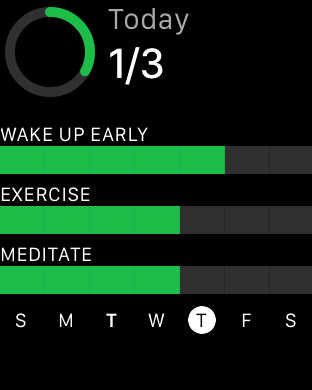
Further configuration options come in the form of an App Badge, which shows the number of habits you currently have outstanding, Sounds/Vibration alerts, various date parameters as well as a Daily Reminder that can give you an overview as to how much progress you are making. You can also Export your habit records to a CSV file, which can be a handy feature.
Overall, I’m quite impressed with Momentum. The developers have done a great job in packing a lot of features into a simple interface, which is one of the biggest challenges for a productivity application. The features you would count on in a habit tracking application are all present and correct and the addition of regular reminders is vital until your habits become automatic. There could have been slight improvements to the overall presentation, but that could just be myself being harsh and always on the look-out for applications that are aesthetically pleasing. What, in my opinion, Momentum lacks in looks it more than makes up for with ease of use and functionality. 
I’ve used it daily since I first logged onto it and I’ve already got ideas for the next habit stack I’m going to putting on there. It’s now an essential part of my workflow and for that, Momentum gets full marks from me. Here’s a link so you can check out Momentum.
The post Review – Momentum appeared first on Productivityist.


August 5, 2015
Ancient Productivity Advice That’s Relevant Today (Part II)
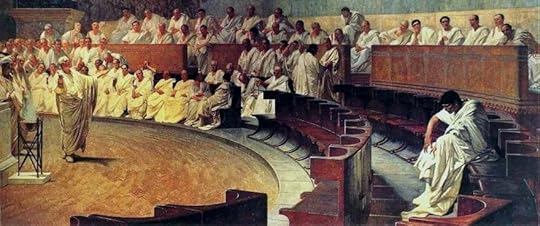
If a local pizza place has been around for twenty years, it can’t be bad pizza. If advice has been around for 2000 years, it can’t be bad advice. Here are four more suggestions from Roman author and philosopher, Seneca. (In case you missed part one it’s here.)
1. Don’t be expectant
“The greatest obstacle to living is expectancy, which hangs upon tomorrow and loses today.”
Don’t daydream of the future; take action. Do something that seizes the moment rather than speculating or being indecisive.
This is why posts on Productivityist consistently talk here about doing things, not planning things. It’s not productivity for the sake of productivity – it’s much deeper. It’s finding the things in life that make us alive and doing more of those things and make time for those things.
Seneca’s not scolding the idea of having a plan. Rather, in the words of Yoda, “Do or do not. There is no try.”
2. Avoid triviality
“It used to be a Greek failing to want to know how many oarsmen Ulysses had.”
The many sources of internet advice is a blessing, but also needs to be managed. A lot of advice – especially online – is about this triviality. Don’t fall for it. It doesn’t matter what the best way to fold a shirt is. It doesn’t matter if you should change apps. It doesn’t matter. The only thing that matters is doing.
Before kids, I loved to spend all weekend watching football. It was a gluttonous affair even before I got to the food. After kids, football moved from a necessary to something that is trivial. Kids don’t want to spend two consecutive days watching three-hour games, and consequently, I didn’t either.
Football became a as trivial to me as Ulysses’s oarsmen. It didn’t matter because our priorities and trivialities evolve along with our lives.
3. Be a learner
“By the toil of others we are led into the presence of things which have been brought from darkness into life.”
It’s through the wisdom of others that we can learn more than what we might in our lifetime. You can see this in coaching, like what Mike Vardy does. Seneca writes, “The person who learns, annex every age to theirs.”
Deep sea divers know this. When you are limited in how long you can breathe, you need to use your time efficiently. When John Chatterton was part of the dive crew that discovered a sunken U-boat 60 miles off the coast of New Jersey he knew he had to learn about the boat. The day after the underwater discovery he flew to Chicago and walked through the U-boat on display. And he did it again. He did 8 times in all.
Chatterton was using the “toil of others” to learn what the submarine looked like. He could have spent 25 minutes at a time underwater figuring things out. Instead, he leveraged the work of others to help him learn.
4. Make your way with vigor
“Now while the blood is hot you should make your way with vigor to better things.”
Seneca implores us to take action on this, and the other things we learned. His advice is to find the most important things in life, seize them, and not let go until we are done.
We should burn bright during the best part of our day. Whether it’s first thing in the morning, or late at night.
Lean toward action, not expectations. Tilt toward core truths not titillating trivialities. Be a learner. Go with vigor.
Which of these four lessons will you act on, today? Let me know in the comments or on Twitter, @MikeDariano.
–
These quotes all come from On The Shortness of Life by Seneca. There he alls writes: “It is not that we have a short time to live, but that we waste a lot of it.”
The post Ancient Productivity Advice That’s Relevant Today (Part II) appeared first on Productivityist.


August 3, 2015
The Simple Travel Hack I Use To Save My Time And My Sanity

I like going places, but I don’t like what it takes to get there all that much.
I’m sure I’m not alone here.
But I do spend time some away from home, as shown in the screenshot below from my TripIt profile.

I’ve been using TripIt for four years. I average about 12 trips per year and in 2015 I’ve done less than half of that. Even still, my past travels have shaped how I travel now and one of the things I pride myself on is “walking the productive walk” as much as I talk the talk.
In short, I like to make sure I’ve got as much as I can ready in advance.
I also don’t like to spend money on travel needs like shampoo and deodorant in the places I’m going to. I’d much rather use those funds for social activities and decent meals while there. That means I tend to travel a bit heavier than those who purchase and use what’s in the place they are visiting, but I don’t overdo it either. I’ve travelled enough now that I know what works and what doesn’t, which saves me time at home and abroad.
One of the things that helps me do this is a simple travel hack – a checklist of items that needs to be kept up to date for every trip I take. I’m going to break down this simple travel hack for you now so that you can have a more productive (and ultimately pleasant) travel experience going forward.
The Dopp Bag
I keep a dopp bag inside of my suitcase, even when it is put away and not in use. I also make sure it’s refilled upon my return from every trip. Here’s what I keep in my dopp bag.
Toothbrush with portable case: I do have a Phillips Sonicare at home but I don’t travel with it. It’s too bulky to carry comfortably, so I just keep my spare toothbrush in my dopp bag at all times instead so I never forget a toothbrush for any trip.
Floss x 2: You never know when you’re going to run out of floss and I don’t like to surprised during a session. So I always keep two of them in my dopp bag. (They take up little room, too.)
Comb: I picked up a comb at one of the hotels I stayed at and have used it on the road rather than a brush because it takes up less space.
Razor: I picked up a second Harry’s razor for travel and I also kept the small package of two blades from it to bring along. If I go through a blade on a trip I’ll simply replace it in the two-blade box when I get home.
Deodorant: This was a free one I got at Dad 2.0 Summit, so it’s a full-sized one. It takes up the most room in my dopp bag.
Q-tips: To gently clean the ears. I have about 10 in there on average for each trip.
Chapstick: I rarely get chapped lips, but I keep one in this bag in the event that it does happen. Again, it takes up little space.
Shaving soap: This is a solid shaving cream tin that I picked up from my local barber. It takes up more room than I’d like but it also means I have one less thing in the Ziploc bag (which I discuss below) that contains all of my small liquids.
Eyeglass cloth: I keep one in my dopp bag and exchange it with another when I get home so it can be cleaned. (Even though I have contact lenses I rarely wear them,. so they don’t come with me on trips very often. So they don’t stay in my dopp bag as a result.)
Eyeglass screwdriver: Just in case my glasses need tightening or fixing. It hasn’t happened yet, but I want to be prepared in case it does.
Shaving brush: I use this with my shaving soap. It’s a bit bulky but it’s necessary for me to get a decent shave while traveling.
The Ziploc Bag
I also keep a Ziploc bag with liquids inside my dopp bag, and when I pack for travel it is kept separate at the top of my carry-on for quick access. Here’s what is in that bag:
Shampoo: There are occasions where I don’t wind up in a hotel that has shampoo. It’s rare, but it does happen. So I keep this with my travel gear just in case.
Eyeglass cleaner: A small bottle to use.
Toothpaste: A travel sized toothpaste accompanies me on every trip. I almost always have to replace it in the bag when I get home, so we have several extras there for that purpose.
Hair gel: Using this is smaller than the hair clay I have, but it does mean I need to put it in this bag instead of leaving it in my dopp bag. As Peter Drucker said: “Everything is a trade-off.” (Although I’m certain he wasn’t thinking my particular circumstance would fit that quotation.)
Body wash: I still have body wash over soap because it has a longer shelf life. Using a bar of soap and then repacking it can get messy. I don’t do that kind of messy, especially when I’m traveling.
Conditioner: I like to condition my hair, but like the shampoo it’s not always at the hotel I’m staying at.
Rescue Remedy: I spray this on my tongue before traveling sometimes to calm my nerves. A lot of travel in one period of time can take its toll on me, so having this at the ready is a good thing.
Sunscreen: I received a small bottle of sunscreen at Macworld a number of years ago, and I just refill it with fresh stuff when it runs out. I have fair skin, so having this with me no matter where I go allows me to protect my skin without resorting to buying it while there.
I almost always grab a new Ziploc bag at the airport when I go somewhere as well. That gives me a spare in case the current one breaks or ends up with liquid all inside of it (which has happened).
When I return home from an travel, I replenish both of these bags as needed. Then I put the suitcase away until my next trip. Because of this routine, I never have to think about whether or not I have what is needed for my next trip other than the ideal clothing, footwear, and tech gear I need for the trip. That allows me to be more thoughtful about those items and spend more time on choosing them rather than worry about whether or not my razor is packed or if I have toothpaste in my bag.
Even if you just start preparing for future travel by doing the basics of what I do – having your dopp and Ziploc bag ready – you’ll be that much further ahead when you get ready for your next trip. And who knows? Maybe by adopting this practice you’ll see that being proactive with it will find its way to you being proactive in other aspects of your life.
Wouldn’t that be something?
I talk about some of the other things I do in advance of travel on a two-part bonus episode series of The Productivityist Podcast, available to Patreon supporters only. If you’d like to support the podcast – either at the $1 level or more – you’ll not only get bonus content and the occasional special offer, you’ll help me fund the show to make it even better. Click here to visit the Patreon page.
The post The Simple Travel Hack I Use To Save My Time And My Sanity appeared first on Productivityist.


July 31, 2015
Ancient Productivity Advice That Is Relevant Today (Part I)
“It is not that we have a short time to live, but that we waste a lot of it.” – Seneca
It’s easy to think that productivity advice is a new concept, but it’s not. Seneca, a Roman author and philosopher wrote advice to his peers 2,000 years ago.
His suggestions are still valuable today. They work because they are time tested nuggets of wisdom anyone can apply. Here are four lessons from Seneca that you can use right now:
1. Guard your time
“People are frugal in guarding their personal property; but as soon as it comes to squandering time they are most wasteful of the one thing in which it is right to be stingy.”
How often do we guard our finances or other areas of our life but not our time? This struck me heavily.
Last year, our family went to Disney World. Our vacation was planned nearly to the hour as it was our only week at Disney. When I arrived at home the next week, I didn’t feel the same urgency and went back to unplanned weeks.
A friend of mine once told me: “if something costs less than $20 and will solve a problem, spend the money.” So if you are hungry, buy food. Uncomfortable, buy clothes. Need a ride, pay for the cab. The rule guards his time and keeps him focused like a rail keeps a car from the edge of a cliff.
2. Give yourself time
“But can anyone dare to complain about another’s pride when he himself never has time for himself?”
Here Seneca asks us to look at how much time we give ourselves. Rather than complain about not getting a meeting, attention, or affection from someone else, we should seek those things from ourselves.
Imagine that time you’ve sent an email out or to wait for a Twitter update. To what ends does this time spent waiting serve?
Rather than complain or do more mental preparations, I moved on. Seneca advises us to do the same. Don’t spend your time with complaints about others when you need that time to make yourself better.
3. Build your level of focus
“It is generally agreed that no activity can be successfully pursued by an individual who is preoccupied since the mind when distracted absorbs nothing deeply,”
It’s a truth of parenting that pancakes only trail ice cream in the the hearts – and stomachs – of children. My daughters love to help make pancakes and our kitchen reflects it. Flour is on at least three surfaces, one of which is vertical. The kids hop between helping stir, pour, mix, sample, and spill.
This is not an environment of focus. It is an environment of chaos, and for Saturday morning pancakes–that’s fine. When it comes to diving deep into the work, we do there needs to be more focus. When it’s time to do your work, you need a full mental commitment.
4. Measure the right things
“So you must not think a man has lived long because he has white hair and wrinkles: he has not lived long, just existed long.”
We all know the feeling of a full days when that feels like we got nothing done. We’ve all also had the flip side where we crank out so much work before lunch that we feel superhuman. Examples are piled high of the ways that results matter most:
Taylor Pearson talked with Mike Vardy about the end of jobs.
Research shows that the way you start the day matters.
It’s why we are still figuring out how email helps (or hurts) our productivity.
It’s not what you do but what you get done. If you live a “garbage in, garbage out,” existence then you will fail. It was as true thousands of years as it is today.
Which of the four is the biggest hurdles for you? Hop into the comments and let me know.
The post Ancient Productivity Advice That Is Relevant Today (Part I) appeared first on Productivityist.


July 22, 2015
Why I Only Keep 4 Projects In ToDoist

Today’s guest post is from Jonathan Pearson, a millennial determined to leave the world in better shape than he found it. You can connect with him @JonathanPearson on Twitter or his website here.
I’m an avid ToDoist believer and user. The features of ToDoist, the feel of it, the platforms it’s on, and the price of it (free if you want) make it unbeatable for task and project management.
Like any other software or app, when I first started using ToDoist, I began to explore how to best use it and made it too complicated. .
Because I wasn’t extremely familiar with it, I began to borrow from other people and use their systems. I created projects for just about everything I could think of, started creating and borrowing custom filters, and even made labels of about anywhere I could think of.
After a few months of real and personal use, I came across a couple of problems.
One of the problems was that I had very similar projects that continued on forever. For example, I had a communications project and a social media project for the church that I work for. Both of these are ongoing “lists” and it got kind of confusing when sorting what went in which project. Some things bordered on the two of those. I would be ultimately left with a decision that I could never really fully justify. ToDoist only allows a task to be in one “Project,” so I’d often go looking at a project and not see a task that I thought should be there or I’d forget to do a task where it later made much more sense.
The second problem was the time I spent organizing tasks. It felt like I was spending more time sorting and organizing tasks than I was actually doing the tasks. After picking the right project, assigning correct labels and even trying to assign certain time labels, the process was really time-consuming.
I found a solution…
Now I have four projects.
I have a Level 1 project called personal with a sub-project called “side work.” I have several different “side projects,” with a label for each. This is really helpful with the new iOS apps that allow for labels (@) to be placed in the common language tasks creation window.,
I have a Level 1 project called Work with subprojects called Communications. I have purposely kept all of these as broad as possible. Now, instead of trying to decide what tasks go to which projects, I just add tags. This allows me to add more than one tag to a task. Later, when I want to figure out what tasks I have to do related to my family, I click on that label. Similarly, if I want to see everything I have to write, I click on the writing label and so on.

This approach allows me to sort in a different way and one that makes more sense to me. It helps me spend more time working on tasks than organizing them. It also gives me a better picture of what I need to do at home, at work, at my computer, and so on. Then, I can do them all while I’m there instead of running from task to task and going back to the same places over and over.
But wait…
For those occasional new, short-term projects, I still create a project and task dump into it. Since in my mind I can’t recall those tasks as quickly by labels, this seems to work better. It also helps me break down something unfamiliar into bite sized pieces.
Does it make sense to you?
For some, this doesn’t really work. For some, you can’t really see the shift. For those of you that are like me with a bunch of different ideas and lists and projects, you can see how this is valuable. Here’s a parting look at my label list.

I still keep labels to a minimum. This has really ramped up my productivity since I began the practice. For a minimal and organized thinker, this approach has provided me with much less decision making on where to place things and more time and power on getting it done.
The post Why I Only Keep 4 Projects In ToDoist appeared first on Productivityist.


July 21, 2015
A Look Back At The 2015 World Domination Summit

I’ve spent some time this week hanging out with Jeff Sandquist as he made the trek up to Victoria after, like me, being part of the World Domination Summit. One of the things we talked about over coffee was the experience he had there – which he wrote about here.
Then we talked about my experience there. Or rather, I talked about my experience there.
Unlike Jeff, this was my fifth WDS. I’m one of the two percent that has attended every single edition of the event. This year I took in many of the talks once again, but I also had a very clear takeaway overall: I’m far better at honing in on what I want than ever before, and this event is a big part of that.
How? Because it provides me a respite from the day to day, gives me some time to really be alone in my own thoughts when I want to be, and galvanizes me for the months to come. WDS isn’t just my recharge. It’s my reset.
As usual, there were some amazing speakers. The standouts for me – and why – were as follows:
Jon Acuff
Brad Montague and Kid President
Jeremy Cowart
Derek Sivers
Jon’s talk was aces. He was on point, humorous, and delivered the goods superbly. I’ve spoken to Jon before and much of what he said is aligned with my own thinking, but hearing it from someone else in a different way really worked for me.
Brad’s talk made me miss my kids, and also wanted me to do even more for them. It also made me want to pay even more attention to them going forward because there’s more magic there than I’m likely seeing. (He also made me feel even better about being a kid at heart.)
Jeremy’s talk was the most precisely delivered because it was designed that way. It was also incredibly powerful. Brad’s talk welled me up a bit; Jeremy’s talk had me in full blown tears.
Then there was Derek’s talk.
His talk was the perfect closer. It was simple and effective. It made me think, but not so much that it was too taxing (after all, it was the final talk over a two day stretch and energy levels were waning in some respect). The big thing it did for me was affirm some of what I’ve been doing here at Productivityist and confirm that there’s still more I could be doing. It also made me realize how far I’ve come and how much more I can go. The talk had a lot of blanks in its message that were easily filled by my own thoughts and feelings. It was the ideal way for me to wrap up my WDS experience.
Chris Guillebeau and the team that puts together this tremendous event haven’t wavered in the way they deliver the goods every year. I’m only scratching the surface about my overall experience; so much went on that it would take hours to write and would likely be diluted anyway.
Actually, one sentence can probably sum it up: I already bought my ticket for next year.
I was initially going to write this for The Productivityist Newsletter, but decided it was best to share it with all of you here instead. I also spent last week shifting away from MailChimp to ConvertKit, so expect to see some changes when this week’s newsletter is delivered. Not a subscriber yet? Click here and you’ll get exclusive, first-run content, a copy of my manifesto, and much more.
The post A Look Back At The 2015 World Domination Summit appeared first on Productivityist.


CommentsHey Mike, Great recap of the event; and like you we too were ... by David Knapp-FisherMike, This was my first year attending WDS. Meeting you in ... by Bruce HarphamIt was great to meet you at WDS, Mike! I have your business ... by Sarah
July 13, 2015
The Psychology of Procrastination and How to Avoid It
Paul is a productivity blogger who loves helping people improve their productivity so they can get more out of life. Learn more about how Paul works by checking out his free 7-Day Productivity Plan.
Do you ever suffer with procrastination? You know what you need to do, but actually starting that thing is tough, right?
Procrastination is one of the most common problems I come across when talking to people about productivity. Getting started on a task is often the hardest part and even with a clear goal in mind, making the first step can be hard.
In preparation for this post, I spent some time reading about different types of motivational theories to deconstruct why we procrastinate. In doing so, I’m hoping to make an argument that all you really need in order to stop procrastinating and start executing is a system for doing the work.
This post gets a bit geeky, so grab a coffee and let’s do this!
“THE EXECUTION FORMULA”
This little theory I’ve come up with is called “The Execution Formula”. I see it only fitting that I name it this as “executing” is the polar opposite of “procrastinating”. The best way I can illustrate this theory of mine is like this:
Motivation + System ➞ Discipline ➞ Execution
Let me talk you through the stages:
First, in order to execute effectively and stop procrastinating, we need to be motivated (more on this below). This means we need to be either pulled or pushed to do something i.e. we have to do something because we need to do it (like paying your bills) or do something because we actually want to do it (like going to the movies). But motivation on its own isn’t enough. This is why you find people who feel motivated to do something but struggle to start; they’re lacking a system.
If motivation is WHY you’re going to do something, then the system is HOW you will do that thing. The system helps create a sense of discipline. It’s also very important for helping you structure your work so you know when, where and how you’re going to do certain tasks.
When you have the motivation to do something and a system for executing, we arrive at “discipline”. This is basically the result of the previous two inputs. Discipline is particularly important for pull motivation when you have to do something you don’t necessarily want to do. Because we don’t really want to do this thing, it requires more discipline than if we were motivated to do something we genuinely want to do (push motivation).
Finally, we reach “execution”. If you’ve effectively motivated yourself and you have a system for doing the work, your improved discipline will help you execute and start working on the task at hand.
Okay, so that’s a basic look at “The Execution Formula”. Let’s dive into some of these components a little further to work out why we procrastinate and learn what we need to do to execute effectively.
TEMPORAL MOTIVATION THEORY
Temporal Motivational Theory can be defined as:
“Introduced in a 2006 Academy of Management Review article , it (temporal motivation theory) synthesizes into a single formulation the primary aspects of several other major motivational theories, including Incentive Theory, Drive Theory, Need Theory, Self-Efficacy and Goal Setting.”
And as an equation looks like this:

In other words, Temporal Motivation Theory combines the best of other motivational theories together into one master theory.
Let’s break apart this formula and define each component:
Motivation – Is your desire to reach an outcome.
Expectancy – Also know as self-efficacy, expectancy is your perceived probability of success. It’s your belief in yourself that you can do something.
Value – This is the reward associated with completing the task. For example, when you pay your bills, you’re rewarded with electricity, heating, and internet.
Impulsiveness – This is a person’s sensitivity to delay and is very closely linked to procrastination.
Delay – This is the amount of time you have to do something. Generally when you have more time to do something, the motivation to start is less.
As a basic example, let’s say you need to do some grocery shopping because it’s 4pm and you have no food for dinner. Your level of expectancy is likely to be pretty high (i.e. you believe you can succeed) in your shopping trip. The value that comes from the trip is that you’ll have food to eat for dinner later. Impulsiveness is low because procrastinating would mean you have nothing to eat later. Likewise delay is pretty low because you need dinner in a few hours and don’t have much time. Hence, your motivation to go shopping is high and you jump in the car and get going.
Now let’s look at an example that leads to procrastination:
Imagine you have to write an essay and you have four weeks to do it in. You’re pretty confident in your ability, but at the same time you don’t expect to get an A+. You’re not going to get a ton of value from this essay. Sure you might get a good grade if you really try, but it’s not like this essay is going to earn you any money. For these reasons, you become more impulsive. Let’s face it–there are more interesting things to do with your time, right? And of course, you have four weeks to finish the essay, so there’s no urgency to get going right away, so you leave it for now. Boom – procrastination!
There you have it – the basic components of motivation. Now let’s look at how having a system helps address each of these components of motivation so that you can avoid procrastination.
The Solution is a System.
When I say “system” what I really mean is a way of organising your work. For example, my system comprises of tools like Asana, Evernote and Sunrise Calendar which allow me to stay organised, plan my time, and execute effectively. But a system is about more than just the tools you use. It’s about adopting the right habits that allow you to work more effectively. For example, taking the time to plan your tasks for tomorrow, journaling and conducting monthly reviews. A system is an all-encompassing method that explains HOW you do your work.
Let’s look at how having the right system can work together with motivational theory:
Expectancy – A system helps create the belief that you can do something. For example, you may often think you don’t have time to do stuff. Well, think again! Work out how long a task is likely to take, then schedule blocks of time needed to complete it on your calendar. When you put everything onto your calendar like this, you can literally see how long the task is going to take. In your mind, you can see yourself completing it on time. Going through this scheduling process helps improve your self-belief that you can, in fact, get stuff done.
The other thing to note here is when you keep all your ideas and mental reminders locked up in your head, it can get a bit overwhelming. By going through the process of getting everything out of your head and into a system using tools like ToDoist or Asana you don’t have to worry about remembering to do stuff and you naturally start to believe in yourself more.
Value – Any good system usually starts with planning. By going through the proper planning process and working out your most important goals, you can increase the perceived value that can be gained from doing something. In a nutshell that’s what goal setting is, right? It’s about clearly defining the outcome you want. By getting clear on your goals you have more reason to do the work necessary to reach them and you’re less likely to procrastinate.
Impulsiveness – When you go through the planning and scheduling process above you make a silent commitment to yourself that you’re going to do something. You’re saying: “I’m going to achieve ABC by XYZ date and when I do I will achieve this result.” When you create structure around your goals and work like this, you’re less likely to be impulsive as you hold yourself accountable to these outcomes.
Delay – This one is a little harder to mitigate because most of the time it is outside of our control. When you don’t have much time to do something, your system can help you plan, prioritise, and execute on the most essential steps necessary to reach your outcome. When you have lots of time to complete a task, you have a bit more flexibility. But just because you have more time, doesn’t mean you should use it all. Your system can help you finish the job early and ensure you don’t spend too long on a task.
Having the right system puts structure around your work and this allows us to mitigate the causes of procrastination.
A WORD ABOUT DISCIPLINE
As I touched on above, discipline is your willingness to do what is necessary when motivation isn’t present. So when you’re experiencing pull motivation (i.e. you’re doing something because you have to not because you want to) then you need to be more disciplined. However, if you are working on something you’re passionate about, discipline is less important.
That’s not to say you don’t need to be disciplined when you’re working on the stuff you want to do. You still need the discipline to prioritise and choose the right things to work on first.
The good thing about having a system is that it helps create more discipline around your work regardless of whether you want to do it or not. So if you don’t want to do something but you have a system you can still execute effectively. And if you’re disciplined and you’re doing something you care about then you’ll be highly motivated and much more likely to execute and avoid procrastination.
YOUR TURN!
Now that you’ve learned more about the psychology of procrastination and the underlying components of motivation, why not take some time to refine your system? If you want to learn more about how I work, head on over to my website and check out my free email course: The 7-Day Productivity Plan.
The post The Psychology of Procrastination and How to Avoid It appeared first on Productivityist.


July 10, 2015
Two Ways to Avoid Internet Time Suck and Get More Work Done

You look up at the clock and gaze at the computer screen in disbelief. Where did the time go? There is still work to do. So you work frantically to finish and find yourself displeased with the results.
It feels as if you are your own worst enemy, right?
Maybe so, but let’s not jump to assumptions; before you beat yourself up, let’s step back for a second. The underlying problem lies in that there is no clear distinction between a device that is used for work and one that is used for play. Many times, the device is one in the same. Your computer is used for video chatting with Grandma, watching shows on Netflix, keeping up with friends, playing games, doing business, editing photos and many other tasks.
It is no wonder you find it hard to get work done on your computer when you do so many different things on it.
Each decision you make depletes you of mental energy. So when energy levels are low, you are much more likely to slip up. Some form of boundaries are needed–even if you consider yourself a creative person who dislikes rules (like me). Even pages have borders, right?
Without boundaries, everything blurs together and confusion follows.
Here are a couple steps you can take to get more work done:
1. Have A Work-only Computer.
Last summer, I bought an older used Mac laptop just for writing books. This computer has the bare essentials needed to write: iTunes, a calendar, Word and Scrivener. That’s all I use on it. I use parental controls to block the browser so going online or doing research is not a temptation. When I use that computer, there is no doubt what it is used for–writing. If I try to go online, I get the following message:

This little popup is just a reminder, a gentle boundary of sorts to help keep me on track. To get around it, I have to enter in my password and intentionally knock down boundary I put in place. It is possible to even limit what applications are used at all. So on my writing computer, only the bare necessities are used.
Now I know this can be considered an extreme approach for some—especially if you don’t want to own another computer. The good news is the second approach can apply to virtually everyone.
2. Have A Work Account On Your Computer.
Just set up a separate account on your computer for one specific task. Here is a screenshot of my writing account.

Remember, this account is only for one purpose. You aren’t browsing the web or playing games in this account. So if you are a photographer, maybe you would like to have a photography account which has Photoshop and Aperture. A musician might want have a music account that includes Pro Tools or Garageband.
This mindset is in alignment with Mike’s new mode-based approach to productivity as discussed here.
Another great thing about this approach is that it makes it easier to travel; no one wants to lug around two computers—it is just too cumbersome and inconvenient.
The real underlying goal of these approaches is to simplify your life. When you do this, it is much easier to establish good habits. Boundaries safeguard what is important to you and clearly define what it is you want to do. You could even have a “work” account on your computer and a “play” account as well.
The best systems are flexible and work with you, not against you. Do everything you can to improve your focus and you will see you are more productive and also create better work. To help you out, I’ve got a surprise for you–I wrote an ebook with Erik Fisher called Hit The Mark and it is available for free here.
The post Two Ways to Avoid Internet Time Suck and Get More Work Done appeared first on Productivityist.


CommentsThanks Nick! I really appreciate it. And congrats on your new ... by Jim WoodsBrilliant! #2 is so simple it's almost perfect! Great stuff, ... by Nick Pavlidis
July 8, 2015
Do YOUR Things

“We have a strategic plan. It’s called doing things.” – Herb Kelleher
I have this quote framed on a wall in my office. I can’t help but see it every day and it does what it is supposed to do…sort of.
It doesn’t make me do things. It makes me think about what my things are. I used to get caught up in all of the things that were on my to-do list, but I have realized that many of those things weren’t my things. They were someone else’s things. And my things were taking a back seat to them.
Your things rarely come from your email inbox or direct message. They come from what is derived from those emails and those messages. Yet so many times we go to those platforms to see what things are there for us…even if they aren’t our things to do (or to do next).
If you look at that quote above and change the “we” to an “I” then the only way you’ll really inspire the right kind of action is to add the word “my” in front of “things” when you read it.
So in my mind the quote reads:
“I have a strategic plan. It’s called doing my things.”
When you do your things, fiddling with tools becomes less of a thing to do. When you do your things, then the quality of your work is bound to increase because you’re not shifting focus nearly as much. When you do your things, you wind up being happier because you’re doing the things that belong to you – even if they are for someone else.
(Yes, your things can also be someone else’s things. But it’s best to treat them as yours first so you can really deliver.)
I’d love it if today – just as an experiment – you decided to do your things instead of everyone else’s. Be honest about what your things are. Be diligent and attack them head on.
Do your things. No one else will do them as well as you.
The post Do YOUR Things appeared first on Productivityist.