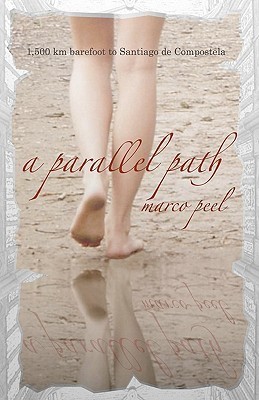
2002. Waking up naked next to a man she barely knows, after a night out of which she has no recollection, Nastasha realises she has lost something she can never recover. And it’s not just her shoes. Running away, she ends up following the old pilgrim’s road from Arles to Santiago de Compostela, a 1,500 kilometre walk. But while walking helps her forget, she is troubled by disturbing dreams that seem to predict the future, and frightening visions of a boy crossing her path, in an apocalyptic landscape, in another time.
1348. First to come down with the plague, Dominic survives to find himself alone. Nowhere to go, he stays on to help at the infirmary in Avignon, where he feels increasingly lost and lonely. Blaming himself for his father’s death, he sets off to Santiago, where his mother abandoned him at birth 13 years ago, in the hope of finding out who she was, who he is, and where he belongs.
Though centuries apart, they share more than the unusual choice to go barefoot. More, in fact, than they may wish to find out...
Made in Greece, born in Holland, raised in Mexico and educated in Australia, he finished his studies in Belgium to work in the Far East, Europe and the Caribbean.
A few years ago, he left his shoes at home to walk the Camino de Santiago. Architect and composer, he now lives in Spain with his wife and two sons.
first things first, i was provided a copy of A Parallel Path of Marco Peel in exchange of my honest review thank you for the copy :)
Synopsis: "2002. Waking up naked next to someone she barely knows, after a wild night out, Nastasha realises she has just lost something she can never recover. And it’s not just her shoes. Running away, she ends up following the old pilgrim’s road from Arles to Santiago de Compostela. 1,500 kilometres. Barefoot. While walking helps her come to terms with herself, she is troubled by disturbing dreams that predict the future, and frightening visions of a boy crossing her path in another, darker time. 1348. First to come down with the plague, Dominic survives to find himself alone. Nowhere to go, he stays on to help at the hospital in Avignon, where he feels increasingly lost and out of place. Blaming himself for his father’s death, he sets off to Santiago, where his mother abandoned him at birth 13 years ago, in the hope of finding out who she was, who he is, and where he belongs. A lonely pilgrimage under the shadow of the black death that will test his spirit and his faith. Though centuries apart, Nastasha and Dominic share more than the path under their bare feet. More, in fact, than they may wish to find out... well,this book was two things:interesting and confusing.good for me since i like these kind of books it tells the story od Nasty and Dominic two people who have almost nothing in common.they lived during different centuries.they came from different backgrounds,culture and in general their differences are too great to go unnoticed.but they have some similarities too.their tragic past,their need for the truth and as the synopsis says" Though centuries apart, they share more than their unusual choice to go barefoot. " and this exactly phrase is what this story is about.two people who search for the truth.redemption and theirselves. in their quest they find much more than they could ever imagine,some of which they desire and others that they wish they had never found.A Parallel Pathis a book about feelings and discoveries.some honorable and some well,not so much. so why only 3 stars?well,my problem with this book was Nasty.i just think that she and her story are flat.tragic,mysterious things happened to her and i am like zit,nada,nothing going on in my emotional radar.nothing.and confusing stories i can deal,boring characters,not so much so,the 3 stars go solely to dominic.his pov saved this story.
PS:alternating pov...not needed in this stories.it would be better if it was written in 3rd person or solely of dominic's pov.
This book describes the journeys of two pilgrims as they trek (barefoot) from Avignon in France to Campo Santiago in southern Spain. Although they follow the same route, they do so almost seven hundred years apart. They each carry their own emotional and spiritual burdens. They deal with the same problems of finding food and shelter along the route. They each encounter a cast of other pilgrims, itinerants and locals, some of whom are supportive and amiable, some of whom are not. Increasingly, as they walk, they become aware of another companion, benign and inspiring although insubstantial, and weirdly the two, separated by time, find commonality in their shared quest. On some levels this book worked really well, on others - not so much. So I find myself a bit torn. The first thing to say about this book is that it is a banquet of beautifully described scenery and minutely observed historic architecture. Anyone familiar with France and Spain will enjoy the sensitive and informed descriptions of hilltop villages, sprawling cities, walled towns, churches, monasteries and market places. The writer gives a faithful and detailed itinerary of the whole pilgrimage, town by town, hill by hill, and as such I think this book could easily be a pilgrim’s companion or an inspiration to take such a pilgrimage. It really is very well written, plus there are some really lovely pencil sketches of various landmarks and two informative maps. So, as a travelogue, it’s great. But as a novel, it has serious flaws. The meticulous description of the route - lovely in itself - does rather hamper the plot. Miles are covered, villages explored, mountains, woods and pasturelands traversed without really impacting the plot’s progression or the characters’ development. Both characters set off on their journeys plagued by a sense of guilt and shame which, in neither case, is warranted by the events which provoke it; both are much more sinned against than sinning. As a plot device, therefore this didn’t really work for me as an impetus for their pilgrimage. They have reason, indeed - family reasons, a desire for answers, the hope of a spiritual affirmation - but they are not developed by the writer. The interesting intersection of the two protagonists could have been used to much greater dramatic effect, turning this book into a ‘time-shift’ novel such as Daphne Du Maurier’s ‘House on the Strand’ or Michael Crichton’s ‘Timeline’. I wanted Dominic and Nastasha to interact much more palpably, to talk, to cross over into one another’s lives, to rescue each other physically as they do spiritually and emotionally. But their glimpses of each other were fleeting, inconclusive and frustrating. I really wished that the heroine had been given another name. Her diminutive ‘Nasty’ held all kinds of negative connotations, wholly undeserved. Having said that, the (male) writer really does get inside the head of his teenage female heroine to an extra-ordinarily good degree, not something I could say of many male writers. My conclusion is that this book could not be much better as a travelogue but could be substantially improved as a novel. Crucially, I believe the writer has the ability to improve it so that it becomes the book - travelogue and novel both - that it is crying out to be. I hope he does.
First of all, I awarded this book two stars instead of one, because I reserve a one-star review for books I couldn't even finish. Although I did skip about fifty pages towards the end, I read most of it.
This is a story about two people from different time periods making a pilgrimage to Santiago, Spain. Dominic is from the time of the Black Plague, and Nasty (yes, her name is Nasty, short for Nastasha) is from modern times. Both of these characters endured something tragic in the beginning of the novel, which showed some promise. They both decide to make this pilgrimage for their own reasons. That's when I started to get bored. Dominic's storyline was much more interesting, and I found myself skimming Nasty's chapters just to get to Dominic's. But then Dominic's started getting boring.
It took me over three weeks to finish this book, because I just wasn't motivated to finish it. Nasty meets mostly flat characters along her journey, while Dominic's friends are much more colorful. Nasty also has weird visions (every fifty pages or so, so cherish them when they come along). I found this aspect of the story to be pretty weak, but at least it adds something to Nasty's storyline.
As I was reading this story, I thought to myself that maybe I would enjoy it much more if (a) the writing style was better and didn't have as many run-on sentences, and (b) I was more religious. I might have understood the characters more if I understood where they were coming from, but I just didn't receive the message Peel was trying to get across to the reader.
All in all, I understand why this book only has a handful of reviews and was published four years ago. I might recommend this to a friend if they were really bored and looking to read about some kind of spiritual journey.
A Parallel Path is a really interesting tale of two people with seemingly no connection following the pilgrim's path of the Way of Saint James - one in modern times, the other in the time of the Black Death. Across the ages, they "feel" each other, sharing some common bond that neither can put their finger on, as unaware of each other as they are.
This is a really well-crafted tale. It's got some heartache, some depressing moments, some joys, and some triumphs. It wraps up nicely, with a few good insights into spirituality, even for those (like one of the main characters) who normally pay such things little mind.
About the only criticism I have for this book is that it feels longer than it needs to be. On the one hand, I can understand it, because even when one character is having an uneventful stretch, the other is discovering something or enduring some hardship. To make the "Parallel Path" work, time and scenery are stretched out side by side. But there are times where nothing happens for several days, and so the reader is presented with several pages of description. Still, the landscapes described - though it gets repetitive - make it sound as though this journey would be a heck of a thing to add to one's bucket list.
The tourism councils of France and Spain should be recommending this book to people, that's for sure.
So, in summary, this book can drag a bit in some places, and may feel repetitive at times, but the overall story is really intriguing, exceptionally well thought-out, and certainly worth the read. I must also commend the author on the research and study that obviously went into the descriptions, particularly during the 1300s.
Received this book for free in exchange for an honest review.
How It Made Me Feel: As a word, frustrated. It was very hard for me to get into this book from the get go. I was easily confused and at times, felt like the words were just rambling on, without a specific goal in sight. But as I kept reading, parts of it straightened out. I great enjoyed reading Nasty's portion of the story. She was easy for me to relate to and I found her travels and experiences entertaining. She is a well-rounded character who was easy to read.
What I Thought Worked: I greatly enjoyed the buildup of Nasty's character. I enjoyed seeing the places she went and the people she met.
What I Thought Didn't Work: I was not able to get into Dominic's story as easily. I found it a bit confusing at times, especially in the beginning, when referencing the Catholic church and the Father's.
Why It Got That Rating: I found, after finishing the book, that I only really enjoyed Nasty's journey. There were parts of Dominic's journey I liked, but not enough to enjoy the whole book. I was too easily confused.
Who Would I Recommend To: I would recommend to someone who enjoys European Historical Fiction or someone who enjoys stories with parallel character paths.
Last Impressions/Remarks: Wasn't a horrible book overall, I just found it difficult to get in to.
Part historical novel and part contemporary, A Parallel Path by Marco Peel got off to a slow start, and it was initially hard to see how the two alternating parts of this novel fit together. Both of the main characters struggle along the path as they walk the Way of Saint James, a pilgrimage from France to Spain, and in spite of being separated by more than 600 years they have many similar experiences. Peels descriptions of the time of the Black Plague in Europe during the middle ages are vivid and seem well researched, and his modern day sections serve as a travelogue through sections of France and Spain. His descriptions of the scenery are beautifully done, and add a richness to the story.
The character's struggles along the Way become a determination to see it through to the end, and it affected me the same way. By the end of the book I was rooting for both of them, and was invested in the story in way that I hadn't been at the beginning. There are enough twists and turns both in the path and in the characters lives to keep you guessing about what comes next. The biggest problem I had was the character Nastasha's nick name of "Nasty". It didn't seem to suit her at all, and I found it jarring every time I read it. This is a good read, but that small change coupled with a faster pace in the beginning could make it a great one.
When I was thinking of what to write for this review, I realised that all fiction is a journey. Not always in distance, but in time as well. Even when there's no traveling in a book there's still a journey to be made by the characters as they move through a series of events. Well, this book features two journeys, both along the same path,' the way of St. James,' the pilgrim 's journey from Avignon, France to Santiago in Spain. One is set in the middle ages, a journey through the time of the plague and the trials of the inquisition by a young man looking for his unknown beginnings. The other a modern day one, set not long after 9/11 by a girl escaping from a bad moment in her life. Both seek answers, both will find them in their own way. There's alsoa skein of mystery as the two walks become intertwined at different points in a most mysterious way. The real charm in this story is the walk itself, the settings of two different periods in time and the consequent changes that have happened along the route over the years. A very unusual book, that even I, an atheist, found to be a quite entertaining read. If you want something refreshingly different, that's nicely written then take a look at this story.
Review Parallel Path This is a book about two people who travel the Pilgrim’s Path of the Way of St James, although their journeys are more than 600 years apart. Time overlaps and merges. Each traveller is seeking answers – or perhaps an escape. I would have liked the two stories to have had more than one chapter at a time. The characters are well developed, but Nasty is an unpleasant abbreviation for the lovely name of Nastasha. The history and descriptions are painstakingly researched but there are boring repetitive domestic details about food, showers, sore feet etc. A long, interesting and well written book, but the plot sometimes disappears and I would not class it as a novel. I was given a free copy in exchange for an honest review.
In the past year I think I’ve read and reviewed novels from almost two dozen indie authors. Out of all of them, I suspect Marco Peel might be the most talented.
Before we get into that, let’s talk about “A Parallel Path.” This is Mr. Peel’s debut work, and interestingly enough, he published his second novel, “City on Clouds”, only a few months later. Both books are remarkably similar in their style and content. Both novels are “two-for-one” – they depict poignant tales of suffering and spiritual longing separated by approximately 800 years. “A Parallel Path” tells the story of Natasha, a restless young woman yearning for personal and spiritual freedom in modern day Europe, and Dominic, a virtuous young man living at ground zero of the Black Death in the 1300s. With seemingly no connection between them, Natasha (or “Nasty”), is stricken by recurring visions of Dominic and his world. Both characters succumb to a strange, almost supernatural compulsion to travel the pilgrimage route across France and Spain to Santiago de Compostela.
For those who read “City on Clouds”, all of this is probably sounding quite familiar. Even some of the names across the two books (Dominic, Aldic, Anais vs. Duran, Azemar, Alazais) are strikingly similar. Some readers may take exception to the “two-for-one” approach, but I love it. The message for me is although so much changes across the millennia, in the end we are all vulnerable to violence and suffering, and we all long for a sense of spiritual transcendence no matter what age we live in.
Another thing to note about “A Parallel Path” is the terrific sketches that accentuate the start of each chapter. I enjoyed these quite a bit. Ultimately, however, I would characterize this book as a bit of a “warm-up” novel before the author published the clearly superior “City on Clouds.” The problem with “Path” is, although it is set up nicely with interesting characters and a terrific premise, there’s not a lot of twists and turns, and after a while it starts to read more like a travel journal than a novel.
Getting back to Mr. Peel, he is a fascinating author because his themes are terrific, and he writes SUPERBLY. He is an immensely talented author. Despite this talent, I still don’t think he’s reached his true potential, and both of his books seem to get side-tracked with needless distractions such as bare feet.
In summary, “A Parallel Path” is interesting and extremely well-written, but “City on Clouds” is a much better novel (five stars). Considering his talent, however, I wonder if Mr. Peel is going to one day eclipse that novel as well and give us a genuine masterpiece.
“A Parallel Path” is Marco Peel’s debut novel. It features two engaging characters, Nastasha (who goes by the endearing nickname of “Nasty”) and Dominic. Nasty and Dominic are separated in time by nearly seven centuries as each is driven by unfortunate circumstances to undertake a walking trip along the Way of St. James, from Avignon to Santiago de Compostella.
The story follows the two travelers in alternating chapters as they pass through the same cities and towns and experience many similar events. As she makes her way along the path, Nasty discovers a mystical, psychic connection to Dominic. The book starts strongly, but Nasty’s tale begins to drag a bit as the days fade into the monotony of forests, unremarkable towns, roads, gravel, inconsequential characters, and multiple foot ailments. (I’ll hazard a guess that Peel will not be getting any endorsements from shoe companies.) Dominic’s journey is more interesting, with a number of exciting encounters – his journey through plague-infested Europe in the fourteenth century is more perilous than Nasty’s modern-day trek. Fortunately, the book eventually comes to strong conclusions in both of the parallel storylines, leaving this reader well-satisfied with the overall effort.
My main complaint is that there are too many writing errors (spelling, usage, punctuation, etc.) that detract from Peel’s otherwise clear narrative. I would encourage Peel to find a way to improve this aspect of his writing. One good start might be to consolidate or simply eliminate some chapters – at 370 pages, this work is not a quick read, and more pages unfortunately lead to more editing issues.
I rated the book four stars – a very strong debut from a promising author.
I also had a very hard time finishing the book. Nasty bored me to death. She just walked barefoot and took showers. The same thing over and over again no matter where she was in her journey. Everyone asked her why she was barefoot. And he had to tell them why. Over and over and over again. Oh yeah she did threw up a few times. But she didn't get the plague. Lucky girl. No plague for her. She just got pregnant. And she didn't have an abortion, why? And then, all those old diplomat men showed up to save her, while drooling over her young beauty. Please! And the ending was a major let down. Her step father, the rich guy who was an asshole but then wasn't an asshole, showed up to save her, and there was Peter, another old guy who saved her and paid for her doctor visit and what have you... Oh my, so set up and so blah. Those diplomats were everywhere to save her. I did get inspired to walk barefoot though. I tried it and liked it.
The other story was interesting. What was the kid name, I forgot. But I learned about Europe n the time of plague. It was new and refreshing and the boy was a good character. I bought it all, his search for the family secret, his father not being his father, his yearn for girls and the his guilt because of it.
This book could've been much better if the author put more work in it. It sure read as the second draft.
This entire review has been hidden because of spoilers.
I've this author's other available work and what I like about his writing is the ability to connect two seemingly separate timelines and tales into one seamless novel. This one is no different.
While I did enjoy the book, I felt like Dominic's journey had a little more purpose. Given the time period, religious pilgrimages were common and seemingly much more dangerous during Dominic's time than Nasty's especially given the plague going on. Nasty's chapters seemed to drag a little compared to Dominic's given the only thing she really faces is feet problems. It would have been nice to see a little more drama or conflict during Nasty's journey.
The book does weave together at the end like the author's previous work I read. I particularly love the history in this book. The author digs into several historical periods in both of the books I've read by him. It would be interesting to see what he can do if he dug his heels into the historical fiction genre itself
First, the disclaimer: I signed up to review this book when it was selected by the Goodreads Shut Up and Read! bookclub and got a free copy of A Parallel Path in exchange this honest review.
I found this book extremely frustrating. In places it was so good, so elegantly written, so moving and the combination of history and contemparary life so beautifully interwoven that I was dazzled and impressed by the author's skill. But at other times, this book read like a travelogue: "The next day we got to (pick place), found the hostel and found a clean/dirty bed, ate/made food, had a hot/cold shower. Talked/didn't talk to fellow travelers. Got up and did it again...barefoot."
Ugh.
The book is told in alternating points of view between Dominic, a thirteen year old boy who survived the Black Plague who walks the Camino de Santiago to discover what happened to the mother he never knew; and Natasha (nicknamed "Nasty"-- a choice I really didn't care for) walking the same route in 2001 or early 2002. For many writers, writing compellingly about the 14th century would be extremely difficult, but not for Marco Peel. These chapters leapt off the page, crackled with life. I couldn't wait for Dominic's chapters and I understood his quest completely.
Not so much for Nasty. A traumatic event precipitates her quest, but this event happens off stage, and she remembers nothing of it. Perhaps therein lies the problem: she doesn't know what she's doing, while Dominic's purpose is clear. So, for page after page, Nasty walks and we walk with her...without very much happening, not even in the flashbacks of her thoughts. For page after page after stultifying page, she describes scenery, talks about her feet, and the other travelers. She meets no real threats, and time and time again finds help when she needs it, so there's no drama or compelling problem that makes us care about her journey/safety...until the last couple of chapters when a not-unexpected development arises. It, too, is quickly resolved.
To call most of Nasty's chapter boring would be an understatement. I skimmed and skimmed, hoping that something would happen: that she would meet some kind of real danger, or reveal something of her past in an interesting flashback, or talk to some fellow traveller in some revealing way. Nope. The most interesting thing that happened was she had visions of Dominic.
Thank God for Dominic.
It's frustrating to see so much good and so much bad in the same book. Dominic's story was so good, so compelling it could (should?) have been the whole book. Nasty's story felt forced by comparison. To the extent I recommend this book, it's for the beauty of the writing about a boy from a time long past. You could skip all of the contemporary stuff and have read a wonderful, and much shorter, book.
This author should try his hand at historical fiction in a pure sense. I felt his accounts of the era of the Black Death, in 1348, in Europe's Middle Ages, were vivid and accurate (although my knowledge of that time period is limited). If I had tried to write a story that took place in 1348, I would have struggled, but this author does it with ease. I did enjoy Dominic's story much more. There did seem to be some jarring contrasts between the local populations along Dominic's route from southeastern France to northwestern Spain (which, according to the map, is pretty much a east-west route, crossing the France-Spain border). The maps in the book were oriented with the eastern orientation being rotated to the usual north bearing, so they were a bit confusing, but I imagine the author did it because the pages in a book are more suited for a landscape orientation, i.e. images that are wider than they are tall tend to be at a sideways orientation.
I found Nastasha's story rather dull. It's an interesting concept to put two stories side by side, sharing experiences as much as possible in two very different timelines, but for that to work, both stories have to be compelling. Nastasha's story was mainly that of travelling on foot, seeing local sights that are not remarkable by themselves. While emotions and self-discovery can make a routine travel tale refreshing, Nastasha's story was much more mechanical and milestone-observing than revealing. Although Nastasha does share a lot of character development, it just wasn't enough for the length of her story or as strong as Dominic's.
There is a twist at the end of the book that explains why the author chose to intertwine the two paths, but even incorporating time travel (a subject I love as a plot device) it seemed quite incredulous and skeptical, for reasons I can't explain here without giving away the ending. However, by then, Nastasha's story had already bored the reader. I understand the author's rationale for the novelty of sequencing the two personal tales together, but I still think Dominic's story would be stronger alone.
But as an account of some personal struggles during the Middle Ages, it's quite interesting actually.
(I received a free copy of this book in exchange for a review).
(This review may contain spoilers).
I remember having a conversation with someone about deja vu and the different theories about time that might link to why people have those kinds of feelings. One of those theories is that everything has already happened before and that time moves in a circle. I don't personally subscribe to that theory, but this almost seems like a good representation of that theory.
Out of the two storylines, I found Dominic's to be better written. I did spend a lot of the book assuming that I knew what was going on and there were a few surprises during the course of it.
It was interesting to see the parallels between Dominic's and Nasty's paths, but I felt that Dominic's were much better described. Even the food he ate varied, whereas I read about Nasty having warm bread and an apple more times than I felt was really necessary.
The idea of Nasty going barefoot was quite an interesting one and I felt that the author did a really good job of showing that, although it was her nature, there were still some problems and a few times when her feet got hurt and even infected. I did, however, think that the barefoot thing was mentioned a few too many times.
I also thought it was interesting how the people Dominic and Nasty met interacted with them. The idea of the pilgrimage is quite a cool one. If I had the time/fitness level/money, it's something I'm sure I would personally like to experience.
I didn't think everything was explained to my satisfaction in this book and I'd be interested in a sequel that further explores this storyline. I'd probably check out other books by this author in the future.
This is a journey of discovery for the two main characters, Nastasha in the 21st century and Dominic in the 14th, as they traverse the 1500 kilometre pilgrims' trail through France and Spain. Anyone who's done much barefoot hiking will immediately relate to the pleasant and not-so-pleasant surfaces they find underfoot, as well as the reactions of others to their chosen way of walking.
Along the way, both characters meet others from all walks of life, but there's a sense that, on the trail, everyone is equal.
As Marco says in his blurb, "they share more than their choice to walk barefoot. More, in fact, than they may wish to find out." This quickly becomes apparent as Nastashia begins having frightening visions of Dominic and the plague-ravaged hell-on-Earth he's walking through, while Dominic himself senses more than one presence watching over him. This supernatural element adds spice and tension to the underlying historical travelogue, with its ultimate resolution both satisfying and uplifting.
While I struggled a bit with the unfamiliar geography of western Europe, there's a map on the book's website that I found to be a good reference once I'd figured out east was at the top.
This is a book I'd recommend to anyone, but the barefooting element adds an extra dimension I can strongly relate to. It's a great read, becoming positively gripping towards the end, and well worth the price of admission.
This book is told through two different sets of eyes, one from Nasty's POV, set in present times and one from Dominic's POV set a further 700, or so year in the past. I like this author's work a great deal, and this book was another great offering. Telling two separate stories about two separate pilgrimage's.
Both stories had a dark side, the historical half, more so, tackling war, disease, rape-like circumstances and brutal in places.
I thought this book was well written, and easy to follow in its different stages, but I'm wondering if the two stories should've been split into two novella's, instead of lumping both stories into the same book. That was the only issue, as far I as I could see. No real stand out mistakes.
I think the historical part of the novel was a lot better than the present day segment, but that's just my preference.
I gave this book 3.5 stars out of a possible 5.
*I was given a copy of this book for an honest review.
This is a great story about self-discovery. I'm usually a big fan of character-driven stories, and this not only gave me well shaped characters with unique voices, but an intriguing plot as well.
This is a nice blend of historical and contemporary fiction. You also have a slight supernatural element added to the mix.
Overall, I thought the writing was strong and the characters were memorable. If you like coming-of-age stories then I would definitely recommend this.
In the interest of not giving too much away, this book is two narratives taking place in two different time periods. I personally strongly preferred the story taking place many years ago to the modern one. The details in that story were vivid and interesting. If you like historical fiction, you may enjoy this.
The book also has many pleasing illustrations as well.