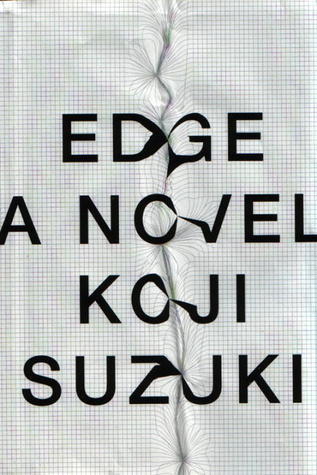
Edge begins with a massive and catastrophic shifting of the San Andreas fault. The fears of California someday tumbling into the sea--that have become the stuff of parody--become real. But even the terror resulting from this catastrophe pales in comparison to the understanding behind its happening, a cataclysm extending beyond mankind's understanding of horror as it had previously been known. The world is falling apart because things are out of joint at the quantum level, about which of course there's never been any guarantee that everything has to remain stable.
Koji Suzuki returns to the genre he's most famous for after many years of "not wanting to write any more horror." As expected from Suzuki, the chills are of a more cerebral, psychological sort, arguably more unsettling and scary than the slice-and-dice gore fests that horror has become known in the U.S. Never content to simply do "Suzuki"--as it were--but rather push the envelope on what horror is in general and for which readers have come to know him, Edge borders on being cutting-edge science fiction. The author himself terms this novel, which he has worked on for some years, a work of "quantum horror."
Suzuki Kōji (鈴木光司) is a Japanese writer, who was born in Hamamatsu and currently lives in Tokyo. Suzuki is the author of the Ring novels, which has been adapted into a manga series. He has written several books on the subject of fatherhood. He is currently on the selection committee for the Japan Fantasy Novel Award.
I cannot understand why 'Edge' by Koji Suzuki won the Shirley Jackson Award for 2012, unless this book was the best one for 2012, which is terribly sad when I think about that. I need a moment, gentle reader.
The English translation of this Japanese novel is very stilted. I think it is the translation which makes these sentences perform as if sung by a bad out-of-tune singer - but the novel is also a dud, as in a lit firecracker which fails to go boom.
People are disappearing all over the world. The evidence left behind does not show any sign of violence. It is as if folks simply vanished wherever they were sitting. But since people disappear all of the time, it is at the moment something of concern only to local authorities.
As the book opens, a German couple vacationing in California sees a car parked at the side of the highway to Soda Lake which appears recently abandoned. The car door is open. It looks like the driver got out and walked away. Curious, Hans stops his car to check it out despite his wife Claudia's protests. He walks to the car and he discovers toys and other paraphernalia which hint that a family had been sitting in the car, but now no one is in sight. He walks back to his car. It is empty. Where is Claudia? He becomes aware of a feeling he is being watched by something evil.
In Hawaii, a scientist, Mark Webber, a National Astronomical Observatory of Japan member, is looking at the stars through the Subaru telescope at Maunu Kea. What is worrying him is not what he sees, but what he is not seeing - certain stars. Where stars should be, have always been, now there is nothing but empty space.
At the Stanford University Linear Accelerator Center, Gary Reynolds is stunned. He had been testing a new IBM computer, Green Flash, by running a program which calculates the value of Pi. The computer began to churn out zeroes beyond the five hundred billionth decimal place. Zeroes. Pi is a proven irrational and transcendental number, so this answer is impossible. Impossible. Gary calls people, so other computers begin solving for Pi and - nothing but zeroes. All of the mainframes all over the world are solving Pi with zeroes ending the problem! The value of Pi has changed.
Saeko Kuriyama is waking up feeling suicidal in Japan. She got divorced six months ago, ending a marriage of five years. Eighteen years ago, her father disappeared. Now, at age 35, she is feeling a lump in her breast. She ignores her fear and depression and the lump She has a new journalist job which she has taken to distract herself. She is going to investigate for a TV show and a magazine the disappearance of a Japanese family. She has a reputation for being a good investigator, even though her biggest case, that of her father Shinichiro Kuriyama, went unsolved.
Shigeko Torii is a famous psychic. She is very old now and a drunk. Years ago, she had suddenly developed psychic powers after seeing the death of her young son in a deadly train crossing accident. The same TV show producers who contacted Saeko have hired Shigeko at the last moment to spice up the story. It also helps that Shigeko is a real psychic.
Actually, I'm going to stop introducing characters now, gentle reader. There are more, many more, people with walk-on parts, but none of them matter at all, including our main protagonists. Oh, they appear to matter for a short time upon initial introduction, but only Saeko's story has a resolution by the end of the book, and it is absolutely nonsensical. In other words, stupid.
For almost 400 pages the novel hints at a mysterious dissipation of quantum forces (there are four forces which we know act on atoms, gentle reader. I was a secretary not a scientist, so I suggest watching https://youtu.be/a-6skWBuHaE for an explanation. 'Edge' will not explain it much.)
The author fills out the vast empty spaces of the story with quickly aborted love relationships - short plot threads which are never spun into anything cohesive or useful. But that's not all! Perhaps hoping to satisfy the publishers, the author throws in from left field a supernatural bit four pages long which felt like a leftover scene from another book. A very bad book.
Characters and plot points are all dandelion seeds which float in and out of sight or turn out to have no reason to be part of the story other than as a MacGuffin https://en.m.wikipedia.org/wiki/MacGu... some characters are never heard from again like the German couple in California, others float into a scene, then out again, then in and out again, but without landing anywhere, and then there are the seeds which appear to be propagating into something lively, such as the detective Kitazawa, but instead they fade away into nothing.
The entire book fades away eventually. The characters, the plot, forward momentum - everything - dissipates like steam from a room after a window is opened, in this case, by the time the reader gets to page 251. Please, dear reader, do not bother picking 'Edge' up. It is labeled as a science-based horror story, but the only horrible thing about this book is that I wasted a week reading it. Don't make the mistake I made, gentle reader.
Probably more of a 3.5; I enjoyed it for what it is.
This is the second novel I've read this year that is set in Japan, at least partly, and deals with quantum physics (A Tale for the Time Being is the other) and yet the two couldn't be more different. The blurb calls this novel 'quantum horror;' I'd call it a thriller of science fiction with a big dose of fantasy, but that's too many words.
I can't figure out one of the more fantastical elements in the plot, but no matter (pun unintended) as I found this for the most part a page-turner. It lagged during too-lengthy explanations of mathematical concepts and the like, but it was a good change-of-pace for me at a time I needed it. I appreciate that the sex scenes (only a couple) are actually essential to the unfolding of the plot, though the heroine figures out way too much on her own at the end in order to let the reader know what happened eighteen years ago. The short epilogue fits with the novel's theme of there being no such thing as coincidence.
This is not my usual reading matter, but my son passes on to me all of Suzuki's translated works. I'm waiting for his books on childcare to be translated!
“Maybe the world has been destroyed. Maybe we just haven’t noticed yet.”
Kōji Suzuki is one of my favorite authors. He’s got this particular style of writing that presents a story as if it were something, and then it turns it into something else in a way that baffles you. He’s also very infodumpy and quite dense for which he usually seems to pick journalists or detectives as the main characters and then pairs them up with science professors who take charge of the science bits.
Edge starts off in quite a creepy scenario. Two tourists in the US doing a road trip to see landmarks are looking for a hotel around the area. They find a car and think to ask the occupants for directions, but the car is empty. And soon enough, they both vanish as well. In the sky, a star disappears instantly and without a trace. Simultaneously, number patterns stop being logical - the ‘pi’ number starts working erratically and it becomes impossible to use mathematical theorems because numbers aren’t numbering.
In Japan, a reporter named Saeko joins Hashiba’s team in investigating a strange disappearance with his TV crew. She’s haunted by the memories of his father, who also disappeared. Soon enough, everything gets weirder - mass disappearances, creepy encounters, solar flares, earthquakes, atoms, quantum physics, wormholes. This book has it all. The best part is this guy who keeps blaming the aliens (I was right there with you buddy, right until the very end).
I was super intrigued by the story. Suzuki has a way of writing that every next step feels very natural yet often sprouting for random thoughts the characters have about quantum physics. It makes me feel dumb, I never think about the stuff. But he dumbs it down enough that even I can follow the story so good for you. Getting to the end was just very exciting - so much was going on, and we had so little explanation. Like, what is going on? IS IT THE ALIENS? And then he flipped it, bringing back all the information that had been previously introduced, dumbed it down again, and said “look, I said all of this because this is what is happening” and I was mindblown. It was not the aliens.
And that ending. My God. So good. SO good. Chef’s kiss right there because I was so incredibly pleased.
I do have to mention the elephant in the room - a Japanese male author writing a female main character? Should we be scared? Well, yes. LOL. This is what keeps me from ever giving Suzuki 5 stars. We have breasts twitching, we have some sort of strange incest going on at some point, we have a very explicit scene that doesn’t end up in sex but could’ve… But I didn’t think it was too bad. I scratched my head many times when Saeko’s father decided to tell her to imagine ‘pathetic male ants’ penetrating the ‘big brown female ant’ to impregnate her, yes. But this book did something that truly surprised me, it captured ‘casual’ sexual harassment so well. Saeko picked up on men’s looks, she encountered a few creeps that were the average weirdo you meet on Tinder. So, yeah, I’m on the edge. Weird sex, breasts twitching, that weird incestish moment, but everything else was definitely on point. Also, this gets bonus points for adding LGBTQIA+ without being negative about it at all.
I hope Saeko finds herself in a good place now. I hope Hashiba does not or at least he learns how to keep it in his pants.
This book about cosmic, existential terrors is absolutely bonkers - sometimes in a good way, often in a bad way. Not sure if the translation from the Japanese is the culprit but the writing is often really terrible. It's so repetitive I often had my invisible red pen in hand, crossing out completely unnecessary do-you-get-what-I-just-said type sentences...but the imaginative story is packed with all kinds of ideas and even as you sense it's all going off the rails Suzuki keeps you reading (it certainly isn't his cardboard characters). I dunno...if you liked the Ring series (which I did) you might get into this. But caution is advised, even if you did. 2.5 outta 5 just for its absurdity alone
An unholy mixture of Michael Crichton and Erich von Däniken (neither of whom appear in the bibliography), Edge is proof positive that not only good books get translated. Its wooden characters regularly spout huge blobs of pseudoscientific bafflegab at each other, but frankly even their pillow talk is stilted. It's not the fault of the translation team, either, or at least I don't think it is. Apart from a few gaffes (such as the use of "throwback" instead of "setback"—admittedly a subtle distinction—in one place, and the jarring use of the colloquial "a ways" in several others), the translation seemed pedestrian but fairly competent—certainly not as poisonously unreadable as Dan Brown's native English.
No, it was the source material that lost me. Mysterious mass disappearances are becoming more frequent, and the reason is... well, everything, apparently. Black holes and quantum theory, sunspots and magnetism, earthquakes and Machu Picchu, the Bermuda Triangle and the Marie Celeste, pi suddenly becoming a rational number and zero a threat, ancient astronauts and wormholes and even something about having a third nipple conveying psychic powers... this is fiction written with the net down, where anything can be tied to anything else, the only link being some character's "of course!"
Those characters themselves struck me as labored constructions, whose motivations were either painfully obvious or unreasonably obscure—this despite their tendency to overexplain their feelings to each other like bad actors in a softcore porn movie. Saeko Kuriyama is the protagonist, a thirty-something divorcée whose first physical act in the book is to fondle her own breasts (did I mention the sexism? Yeah, this is one of those books, too, the ones that explain firmly what men want and what women want as if those were universal constants, less changeable than pi). Saeko's father, a successful publisher, is one of those who disappeared, which puts her in a good position to be a consultant for a TV show about a cluster of more recent disappearances, including the members of the Fujiyama family, whose house was found empty just like the Marie Celeste (cue spooky music)... and what does all this have to do with the German couple whose rental car was found empty in the desert east of Los Angeles, and the impending dissolution of the entire universe?
Now, I like conspiratarian fiction, topsy-turvy theories and counterfactuals, as even a brief look at my shelves will reveal. I still retain a soft spot for Allan W. Eckert's 1970s thriller The HAB Theory, for one specific example (its loopy thesis: ice cap buildup every so often causes the Earth to flip 90 degrees, so the poles become the equator)... but I still want there to be in the author's stance a hint of awareness that the work is fictional, and a certain amount of intellectual rigor, of internal self-consistency, when expounding even the craziest theories. That's not what I got here. I could not shake the feeling that Suzuki might be in painful earnest, that Edge was just a way to fictionalize and promote his own personal "theory of everything." I might be wrong about that. I hope I'm wrong about that. But that impression, along with its many other infelicities, left me unhappy with the book.
The novel opens with scientists testing a new computer by having it compute π into the deep decimals, then finding a pattern that shouldn't be there. Apparently this indicates that there is something fundamentally wrong with the universe. I never understood how such a shift would affect a computer programmed by humans and using a human-created system of mathematics, but let's just go with it. I was expecting a hard science fiction novel about scientists trying to figure out what is wrong, why it happened, and what, if anything, could be done. Instead, it mostly follows a TV documentary crew investigating cases of unexplained disappearances, and them trying to figure it out. They eventually do hire a scientist, but he is a nut case. The story gradually descends from science into pseudoscience into bad philosophy and superstition and ends with a bizarre, nonsense twist involving identity swapping and the Devil (!) So much for science. The last part of the book is simply ludicrous. This is one of those books that started out with a good rating in my head but I kept revising it downwards the further I got. Can't quite give it just one star because I did enjoy about 2/3 of it more or less.
2.5 and half stars, rounded up, mainly because it gave me an excuse to write this quick-response review. Also, because of...you'll see. Stay tuned.
This is not a book, Space Pilgrims, this is a quantum object composed of an indefinite (dare I say infinite) series of books that cross at a singular point and intertwine and interact and interfere with each other. In this 400ish pages there is quantum mechanics, speculative fringe science, romance, a locked room mystery, horror, folklore, fantasy, myth building, anti-myth building, a short and middling Haruki Murakami novel, and more things than I can list in this review. What you might read if you picked it up, Space Pilgrims, is what you observe. For everyone that comes to this space-time event, their own reading will collapse the quantum-book-wave into a text. Do not believe me? Look at the other reviews of this book and see how hard it is reconcile some of them with others. Almost like they are reading different books. Because they were. They collapsed the event differently.
Another proof? Read the blurb. How could you write that blurb for this book—describing both an event that would require spoilers to explain why it is the worst way to start a cover blurb and then goes on down to to describe very nearly a completely different novel than the one I read. Is that a problem? I assume not, because they engaged with a different Edge than I did. Because everyone must.
The final effect is a confusing muddle of contradictory parts. The rather interesting mystery that begins the novel becomes increasingly lost in a deep dive into a what-if scenario, with the "what if" being, "What if Michael Crichton just went full tilt on a bender and exploded past the boundaries of the known universe?" Once you brain struggles to resurface in a sea of unfinished threads, you are slammed full force into an about turn so violently fantastical that it is kind of beautiful, tripping very nearly into a brilliant strange science-fiction edge case, right down to an ending that is at once fable and modern pop-lit metaphor. Profane and Sublime hold hands, here, Space Pilgrims, and the hands they hold are their own.
Oh, let's not forget math, Space Pilgrims, glorious math. How Suzuki dances it across the page. And if it strains credibility then the fault is yours, because the math you read is the math you observe. Your brain created that math out of the quantum foam dripping from all possible Edge-verses. The mind boggles, surely.
Bonus fact, the first part of the first chapter (which, like the rest of the novel is a fuzzy state of near-being, because the extremely long first chapter (being roughly a novella in length) is preceded by a really long prologue that has multiple parts...it's not just math that Suzuki is redefining with the stroke of his quantum pen), has a scene that involves the word "breast" so many times that if you were to take a shot whenever you read the word breast you would collapse into a black-out drunk coma where all you could imagine would be the complete semantic saturation of the word breast: now a meaningless six letter thing that exists, independent of all other things. That this first chapter also includes a woman feeling bad for her rapist and other hints of sexual violence, I was nearly ready to end my association with this space-time collective collapsed into book form altogether but this theme, like all themes in the "book", bubble up and then cease to exist: quantum tunneled into other middling tomes elsewhere.
So, there is no review I can leave for this entity. To do so would be to hold on to rules of a literary, writer-reader-relationship universe that have now changed. I simply can say that I read it. And I reacted to reading it. And by doing so I created it. My version of it. Yours will be something else. Maybe better. Maybe worse. And isn't this true of all books, really? It's a metaphor.
Final score: an infinite cascade ranging from 0-stars to 5-stars (truly, there are parts that utterly shine) with a final average of 2.5 stars. Again, rounded up, because sometimes it is amazing to be amazed by a book, even if for the wrong reasons.
Koji Suzuki is best known as the author of the Ring series. Like most people, at least in the U.S., I have seen the movies but never read the books. I was looking forward to this new novel, especially since it won the 2013 Shirley Jackson Award. Jackson Award winners have been consistently high quality, literary horror tales.
I made it halfway through Edge. The low quality of the writing came as a disappointing surprise. Cliches and generalities litter the pages. Suzuki’s prose, based on this one example, has much in common with the amateurish if earnest efforts of high school authors writing for their literary magazines. I have never read a Clive Cussler novel, but I imagine they read much like this. Guaranteed bestseller status can make a mediocre author lackadaisical and immune to editing. Suzuki is a bestseller in Japan if not in the States. Perhaps he now considers his novels an inconvenient first step toward their more lucrative screen adaptations.
OK, some examples: Ideas and feelings several times “flood” into a character. We are told a character died of “a disease.” A city is built “right on top of” a fault line. An earthquake is caused by a “shift in an active fault.” (Duh.) I opened the book at random and pulled most of these from a single page. On another page I find a character who “froze with a choked exclamation of surprise.” A moment later he shoots out the door. Clumsy sentences struggle to convey a character’s thoughts and emotions. “Saeko hoped she had been wrong somehow. She didn’t welcome the idea that the bizarre vision she’d had might actually reflect reality.”
What this novel is doing with a Shirley Jackson award baffles me. Better novels have won in the past and better novels were nominated in 2013. Perhaps this is a poor translation. More likely it is a poor translation of a badly written book.
Seemingly impossible incongruencies begin to arise in basic mathematics, heralding the end of the universe.
Koji Suzuki’s dense, dull stab at an existential suspense novel is quite a slog to get through at times. It is intermittently effective in its brief apocalyptic sequences, but the narrative is consistently derailed by long, didactic, half-baked lectures on physics, history, and mathematics. Suzuki’s characters love to lecture each other and the author loves to lecture us, and it all reads like an info-dump of half-digested research. It doesn’t help that the narrative becomes increasingly incoherent by the end. It also features an unfortunate theme that seems to pop up fairly regularly in the Japanese fiction (by male authors) that I have read: men just naturally follow their gonads wherever they may lead, and if that happens to take them away from their families we should just accept it and try to sympathize with the pain they are going through.
It starts with a good premise, the fundamental mechanics underpinning the universe have shifted imperceptibly and reality is falling apart. People vanish without a trace, stars fizzle and disappear, space folds in upon itself. This premise is then ignored for roughly 80% of the book's length in favor of a plot that gets progressively sillier and sillier until the characters are having serious conversations about magic nipples. This book is insultingly bad.
The description of this book on the goodreads.com website states that the book is called EDGE CITY and that the book revolves around a tragedy that has struck California and has much larger implications for the entire earth and universe as we understand it. This is wrong. The book is called Edge and the California tragedy does not come until much later in the book.
So the description of the book (which I have seen elsewhere) is a bit of a spoiler. So that was disappointing.
The book was not disappointing in any way.
Basically the book revolves around the two main characters search answers to the mystery surrounding missing people. It is not a standard case of people going into hiding or being abducted. People are vanishing without a trace and there is absolutely no explanation for it. No evidence is present to suggest any sort of foul play. It is as if that person ceased to exist. As the story unfolds things become more and more confusing as disappearances start increasing and strange activities and phenomena start happening.
The great thing about this book is that it uses various scientific fields of study to create an actual horror genre situation, totally plausible and believable, while at the same time trying to explain the nature of the universe, our interconnectedness with it, and also attempting to explain the age old question of what is life all about.
The only problem with the book is that the science does get a bit dull, especially near the end when the climax occurs and our characters have to be clued in on what the situation is. Its a quick scene with a ton of exposition where a smaller character comes into the story and basically explains the situation to them (and us).
In general, Suzuki does a good job of trying to explain the science within the frame work of story telling and in that sense he does a very good job. There have been books I have read that was basically two characters talking at each other for five to ten pages about the concept the author was trying to convey. For the most part Suzuki does not do that, he keeps the science to a minimum and explains it in a creative way by incorporating various story telling techniques that make it palatable, with the exception of the ending which felt a bit forced.
Overall its a great book in my opinion, there are some wonderful scenes and very vivid imagery which would make it a fantastic movie to see on the big screen. Its suspenseful and intelligent, with a good build up of dramatic tension not only throughout the entire book but with each individual scene within the book as well. A smarter reader, a more careful reader, might find it predictable, especially when things start coming together at the end. A few times I realized things were very obvious if I would have taken the time to comprehend what I was reading earlier in the book.
But I don't read like that. I read it fast and I read it loose and when things start coming together I like being surprised by the obvious.
Great story. Scientists find out that solving for pi yields new numbers. Stars are disappearing from the sky. People are disappearing all over the world. This book mixes a little hard science and mathematics with some fantasy to answer the question as to what happens when mathematical truths turn out to be not so true.
As personal side note, I am always warning my wife that if anyone figures out how to divide a number by zero, reality will cease to exist and chaos will reign. She laughs at my paranoia and attributes it to a chemical imbalance. My fear is not unfounded. We still don't understand the idea of nothing. Beware the number zero, beware dark matter, beware the nothingness.
Mit Ach und Krach drei Punkte wegen der wirklich originellen Grundidee, die einen bei der Stange hält, weil man unbedingt wissen will, was die Veränderung von Naturkonstanten wie der Zahl Pi mit dem immer häufigeren Verschwinden von Menschen zu tun hat. Aber bis dahin braucht man sehr viel Geduld, um die weitschweifige, unbeholfene Erzähl- und Schreibweise zu ertragen. Ob es an der Übersetzung liegt?
This is the epitome of a book that bit off more than it can chew.
I tried to give leniency in case there were poor translations from the original Japanese to English, but the plot (while an interesting concept) is flawed and full of holes (no story relevant pun intended).
The perspective of the woman protagonist is so incredibly out of touch - pls just talk to a girl and see that she doesn't think of a man's "sexual caress" while she checks her breasts for cancer. I'm begging u bro.
The world we live in is based entirely on one infallible principle: that the math we use to describe it cannot fail. But what happens when a contradiction arises that threatens to destroy the countless systems on which it is based? Somewhere beyond the five millionth digit, π is changing. The eternal stream of numbers are turning up zeros. What does it mean? When people start disappearing and strange rumblings start occurring, all signs point to something bad on the horizon.
I was with this book right up to around the halfway mark, but after that it just started to annoy me. I don't know if it's a problem with the translating or a case of bad writing (I'm thinking it's the latter), but everything is told via exposition. Being told what a character is supposed to be feeling is really grating. It would have been bearable if only the story didn't then proceed to stick its head up its ass. Characters start making ludicrous assumptions about what is happening, then even after stating that it is only a conjecture, accepting it all as absolute fact. The last third of the book is purely the characters listening to a disgruntled scientist claim things that he has no way of knowing and everyone following it like it's the gospel truth.
As far as the characters themselves went, I probably would have liked this book more if it had stuck to Saeko the entire time. I was really enjoying the story until Hashiba took the stage. The man is a whiny dislikeable character who's only major conflict, only seems to be of relevance when it can provide a source of drama, all other times there is no trace of it. It's almost like the writer shoehorned it in at the last minute. His dilemma is so self-involved and unnecessary that it made me almost stop reading. Maybe it's a cultural thing, but I think that if you cut out all the sections from his perspective the story would be greatly improved.
The premise is interesting, but it's never really dealt with on the magnitude it should be. Many of the most interesting things happen off-screen and everything else moves at the speed of convenience. At one point one of the characters discover a grave threat about to unfold, but no one knows when, it could be days, years, but then he decides it will happen immediately, then arbitrarily changes the deadline to dawn and happens to be right. And even when they do work out a way around it they decide not to tell anyone, after pontificating on the value of all human life. It's just so irritating.
Good concept poor execution. Even leaving out the references to 2012 and the Mayan Calendar nonsense, this book just winds up confusing. There are too many things that seem to be purely for spectacle without any intention of explaining it. The epilogue could have made this a really deep story if it weren't for the rest of the cast ruining things down the middle.
Having read the Ring series, especially Loop, I expected more from this author, it's an alright book, maybe others will find it more appealing than I did, but it’s not as good as it could have been.
***Reading Challenge 2015: A book with a one-word title***
Okay, this book is one that belongs in a very rare category for me: abandoned.
Thatʻs right. Iʻm calling this one quits, and I do. Take this book and shelve it; I ainʻt readinʻ it no more.
Whatʻs weird about this is that I found this book quite charming in many ways. I loved the non sequiturs, the apparent and fairly frequent loss of focus on plot, circumstance, character integrity, chronology, and the offenses against good sense, good writing, coherence, and respect for the reader were minor enough to not be too annoying, but hey, Iʻm just tired of this story, as delightful and digressive as I find the telling.
Koji has just plum wore me out like a hand-me-down sock.
On the other finger, I would be remiss not to point out that some of the sentences in this book were utterly funny and grandly entertaining. I offer Exhibits 0001, 0002, and 0291 below:
0001: "Kissing and clinging to each other as they moved sideways through the space like mating crabs, they laughed out loud with each tumble." If you ainʻt laughing after reading that, something is seriously wrong with you.
0002: "A ring filled with darkness, it was a moving pitfall gouged into the earth to trap prey. He pictured internal organs, small and large intestines, and somehow felt an intense urge to urinate." Really? Me, too.
0291: "Turning away from the sky, she scanned the area under the Soga Shrine for a toilet. It was then that Saeko noticed." Uhm.
Oh, sure, blame it all on the translation. Thatʻs a strategy that fails as often as the bible fails, to be clear, I mean, to be accurate. And actually, at various low moments, the quality of the translation was one of the motivations to read.
So please, if anyone noticed I was reading this book and shelved the title as a result, I testify to you now: I did not and will not finish this book because I want to read something better and else.
From the author of THE RING. I have not read Suzuki before this. It's a page-turner billed as a Quantum Horror novel. It's much like early 20th century cosmic horror pulp with a large dose of 21st century Hard SF tacked on. I suspect some of the material passed over my head due to cultural ignorance of Japan. It's a pretty good story, 3 or 4 stars up until the last 40 pages. Where it turns to stupid faster than a bullet train. This is hand slapping forehead and tossing the book across the room, capital S Stupid. Utterly ruins the whole experience. And now I doubt I'll ever make the effort again to read more Suzuki.
Had Suzuki just stuck with the theme of phase transition, this book would have been interesting enough. But he obviously can't stick with anything, and the result is a novel in which everything causes everything else to happen and the reader is supposed to be awed by the mysteries of the universe as well as the author's scholarly audacity. Seriously, guy, third nipples as some sort of mark of the beast?? What the fuck is THAT doing in here? But I don't know why I'm so offended considering Suzuki is the guy behind that entire dipshit RINGU franchise. I'm a moron for picking this one up in the first place.
I wanted to abandon this book very early on, and I wish I had.
Classic mc "woman written by a man" as well as depictions of (supposed) breast cancer that feel almost sexualized at times.
Later on in the story it seems as though wormholes are about to be used as loopholes for infidelity, and although this does not ultimately materialize, there is no satisfying resolution for the characters' internal flaws.
Long expositions on quantum physics, science, and mathematics-- which may be someone's cup of tea, but simply isn't mine.
This entire review has been hidden because of spoilers.
I get it if people hate this book, its inevitable for the book to be questioned for how ridiculous it can be. This book is a rambling mess in bigger way but heck I'm too deep in the rabbit hole to admit that I dislike the story- oops sorry I meant the wormholes. In all honesty, and a very biased approach and mind you, my horror taste can be quite convoluted at times, this book enraptured me despite how messy it was. As stated by Suzuki himself, this book is in the realm of quantum horror, exploring on the science fiction of humanity and the collision of the vast universe as we understand through the lens of psyhics, astronomy, mathematics, ancient history and civilizations. Its the fascination and wondrous elements of sciences that heavily discussed in this story with cosmic horror larger than life that both can and cannot be explained scientifcally.
Following multiple mysterious disappearances of various peoples at different times, the story open up on a mystery of a couple & a family missing in the middle of the road. We then are introduced to our main character, Saeko Kuriyama, a freelance writer struggling with depression after a divorce & her relentless pursuance of finding her missing father. Another odd disappearance of a family in a small town brought a filming crew headed by the director Hashiba & Saeko whom is an excellent journalist had been recruited as part of the show. They investigated many bizarre occurences of missing people simply vanished & soon connect the dots to the tectonic faults & sightings of sunspots.
With tension & dreadful atmosphere, Edge potrayed the sense of unease throughout the story. It led you with questions & knowledge on the universe, the inexplicable effects of the irrationality of Pi reached an absolute zero, showcased the collapse of metaphysical realities of our existence in conjuction with the changes in mathematical theorem. Riddled with scientific discoveries & notes, the story can be hard to swallow at times & it gets confusing and dragged but the fascination with the whys and hows are prevalent as I keep on reading wanting to know. In the end, the closure is vague & tbh, it left me with an unsatisfying ending yet. There are plotholes & unanswerable questions but who am I to question on the topics that I dont have knowledge about.
Saw this at the bookstore and picked it up on impulse, guess I have no one to blame for recommending it. The story starts off well enough in the intro to grab the reader into the geeky premise of physical constants changing and the implications. However, the book fizzles from there from clunky translation, poor style (flipping between dialog and lecture-like lessons to make sense of the science), and plot holes the size of Kansas. I got the impression from the storyline that the world was waiting for humans to discover the weird constants changing before the apocalypse began. He vastly over-estimates the role of humanity and earth in the overall universe.
The end has some interesting and though-provoking tie ins, but I'd recommend Murakami's 1Q84 for anyone interested in Japanese sci-fi.
EDGE is pretty good and well worth checking out. An effective blend of folklore, advanced physics (that even I could grasp and I failed O Level maths twice), pure mathematics, cosmic horror, missing people, and lots of bizarre occurrences and ancient mysteries. It also has a curious aborted sex scene, and a couple of paranormal episodes so weird I reread them several times. It's translated from Japanese and the scientific detail is really well wrought, though some of the syntax and description elsewhere seemed odd compared to the other Suzuki I have read (with translations, which voice are we reading: translator or author?). Overall, this novel hits that blend of science fiction and horror I've always enjoyed.
This is a fantastic piece of science fiction and the base story is gripping. It would make a fantastic movie with a great lead female character. Unfortunately for me, whilst clearly from the bibliography it has been meticulously researched, the depth of the science, physics and astronomy weighed it down and I feel that for fiction this level of explanation takes away from the flow of the story itself. Not every piece of scientific background is needed to write good fiction and the author or edited could have given better consideration to cutting parts of this, which is why I can only award three stars when really, with better editing, it could have merited a good strong 4.
Started out interesting with a good premise and then took a really steep and confusing nose dive. I’m not even sure what I read in the last 60 pages it was just a bunch of ideas thrown together. There were a couple of loose ends that never got closure in a satisfying way and ones that weren’t revisited at all. I compare it to Pretty Little Liars the show, not in content but in how the concept of the show just spun out of control at the end even though the first half was pretty solid.
changed my two stars to a one star after reflecting on how not only is the plot a horrible mishmash but suzuki also manages to hit on every “man tries to write female protagonist and fails spectacularly” trope. the translation is also not great :/ fun premise but skip it
The first half really had me hooked, but by the end I was confused, annoyed, and worst of all for a horror novel, nowhere near scared. The translation was methodical, clinical, and clean, which while beautiful, removed all tension for me. It was also extremely repetitive. We would watch a character or a group come to a conclusion about the events of the plot, go to inform another character or group, and get another full page or so of the exact same information they had JUST explained, in almost the exact same language. It was grinding.
Another tendency I really did not have any patience for was the incredible leaping to conclusions. The characters would often imagine how a scenario that they had not themselves witnessed, and then declare "yes, this is absolutely how it must have happened." Saeko fully imagines a conversation between her father and another character at the end, and comes to some pretty serious conclusions based off of a conversation that she made up! And that was already in between all the third nipple stuff (wish I was joking), which came out of nowhere like a truck and made me wonder if I was actually reading some kind of parody or satire.
The premise of the horror at the center of this novel rests on the theory that humans naming a phenomenon (mathematical, physical, astronomical, etc) is what makes it real/gives it power. Since I wasn't convinced by that argument, I wasn't convinced by the horror. If a scientific theory collapses, that just means we misinterpreted the results or missed something. Start over and try again! Language (and math as a language) is powerful, but I don't buy that humans giving a name or a theorem to a phenomenon is what gives that phenomenon its power. It's how humans interpret the universe, not how the universe structures and powers itself.
Also: it feels extremely weird to me that this novel, with the author's gratingly narrow interpretations of gender and misogyny, would receive the Shirley Jackson award. I know that it is reserved for dark fantasy, psychological suspense, and horror, but Jackson wrote domestic horror that featured women. It genuinely irks me that this book won an award that is supposed to honor her. Saeko is the only reoccurring main female character in a cast of almost TEN. This book did not feel like something written in Jackson's tradition or voice; it is much closer to Lovecraft and his horror of the universe and of the unknown. But I understand why an award might not want to name itself after a super racist.
I wanted to love this; I love the idea of quantum horror. It just got to such a jumbled mess in the end that my initial enjoyment couldn't save it.
I'm not sure how to start this review, this is the first time I've felt so strongly about a book that I felt the need to create a Goodreads account, set it up, and immediately start writing this.
This book is engaging. I'm surprised that I read it to completion. Maybe that's the saddest part about it, it had so much promise, it was so close. I'll start from the beginning.
Edge by Koji Suzuki starts off with a description of the main character and my mind instantly went to "how men write women" as he describes her breasts shuddering. What a start, but-- a couple pages in, I was invested. Saeko is a divorcee trying to find purpose in her life after her father disappeared, she continues her search for him with a family friend (and this is all really well written, very engaging). Eventually, she is requested to be an investigative consultant for a TV series. The writer takes us through her investigation, her discovery, and eventually we see strange and chilling (un)natural phenomena that was very well described. Until this point, it ties in with the numbers thing, even if Suzuki doesn't really know how numbers and math works. He could've made it work, it -would have- worked, the story would've been great if he'd ended with sun spots and magnetic anomalies explaining the strangeness. Even if it made no sense scientifically, what/ever/.
Sigh. The mistake that this book makes is that it can't stick to any one thing. God, if it had just been a sci-fi mystery till the end, it would've been amazing. This is turning out to be less of a review and more of a rant, but whatever, I'm writing this for me, not necessarily you. I went through a lot reading this book. It's well written, the descriptions, the connections, the characters are all so addictive. It's why I'm so severely impacted by the let-down that begins during the second half.
The science is passably trash until we get to phases changes of matter. And?? The Devil. Oh. My God. I can't even organize the rest of my thoughts because I'm just thinking about how messy the book was.
Here's what I've got:
-Trash science, sooooooo much monologue. I skipped over it so that was fine since the rest of the book was engaging.
-The entire book tried to make connections to things in it that… didn’t connect to each other. 3rd nipple discovered on her dad’s body by the woman he was sleeping with vs the bump in Saeko's breast that the producer guy found. The stuff where “the phase change is information, and it’s information because that’s what EM wave stuff is, so it couldn’t go faster than the speed of light, but why were ppl disappearing before the stars and stuff started disappearing and the ground started disappearing, answer: it’s wormholes, the phase change randomly got to Earth before the wave of it came in because of wormholes ….
-Couldn’t stick to one antagonist: Magnetic fields → Fault lines → Sun flare activity → Fourth phase of matter → Dad's deal with the devil (??!?!?)
-author's bubble analogies made 0 sense. None, it was such a far reach that it felt of the cliff, rolled down, got stabbed by a rock, and splattered onto the ground. That's how much of a reach that analogy was.
-Really stupid thing to put the 5 lights in the Calcutta sky and it turns out it’s her halogen lamps from being born. That was fucking stupid, the same 2 universes aren’t colliding for everyone, only she’s going to that specific world where she’s reborn, why is everyone seeing the lights, is everyone being reborn, in the same exact way where they all happen to each have 5 halogen lights? And the ppl who see it and aren’t near the wormholes just die? Why do they even see it if the worlds aren’t colliding for them. Makes no sense.
-Should’ve stayed a mystery novel with a heavy focus on science, and chosen something he actually understood/simplified the wave of phase transfer.
-Using wormholes as an escape to another universe back in time is fine, but it’s bullshit to bring in the Mayans and whatever, author could’ve just used the tension from the reality of the fact of the world ending and everyone being afraid of uncertainty and losing life as they know it and losing touch with friends and neighbors, etc.
And the worst part, the WORST part is that the DEVIL, the DEVIL aughghh oh, I'm so mad. Saeko's dad participates in an affair with a woman (he's single tap, Saeko's mom passed when she was born) and her husband finds out. And it turns out her husband is the Devil. And he wants Saeko's dad to take his face and body and play the woman's husband so he (the Devil) can: be free.. conduct experiments on humanity and have fun…. and the Devil says either he does it and he'll switch Saeko's life (she was gonna get run over by a car) for a plane with 515 passengers. So Saeko's dad says okay, and 515 people die, Dad takes Devil's spot, BUT THEN he and the family predicted the phase transfer, so he finds a wormhole and send his family through there and CHANGES HIS IDENTITY AGAIN to the woman's brother in law who's very creepy and keeps staring at Saeko very disgustingly/sexually to hide his identity (why did the author have to make this a characteristic of Saeko's dad?? Couldn't he have been a creep in any other way?). AND BECAUSE Saeko's dad made the deal with the Devil, the order of the universe was disturbed, triggering a reverse big bang where all matter in the universe started disappearing (aka the phase transfer into this supposed 4th states of matter).
-Saeko is a genius for figuring all this out in the last chapter of the book, that's so smart and cool of her obviously (I'm Joking, because she actually figures out too much because the author cannot find a way to incorporate it in and finish the story). Anyway.
-3rd nipples = special abilities, btw, mystic or otherwise insightful to the universe. Saeko's dad had an extra nipple, the woman's husband had an extra nipple (apparently he's supposed to be the exact equal and mirror image to Saeko's dad) and apparently the bump in Saeko's breast also makes her special since it's ?a nod? to a 3rd nipple? Even though she doesn't have one? I have no conclusions about that, I just had to tell you that that's a part of it.
-In the end, Saeko is born with 5 halogen lamps looking down at her.
Some things I really loved about the book: good connection of the fault lines/magnetic anomalies/nature-related anomalies etc being where the wormholes are. Did a good job not telling the reader what was happening until the last couple pages but still didn’t make it feel like they’d found the answer a long time ago and were withholding it on purpose. Good job with keeping the reader in suspense. Chris was a cute character, kept saying stuff like “addressed each other like lovers” even though it’s established earlier in the book that Chris and isegai (idk how to spell it)were kicked out partially cuz of their relationship is why isegai returned to the US.
And I have one (1) question: why did saeko see Seiji fall when she and the producer guy went out to eat? It’s her dad? Someone please tell me what that was.
4/10, I hated it. I’d even give it 3/10 from how badly it disappointed me. If only it wasn't so engaging, I would've dropped it as soon as the phase transfer stuff started. Shouldve been a mystery sci fi not the devil bs. Giant waste of money and hours. I'm sad.
This entire review has been hidden because of spoilers.