John Clifford Mortimer was a novelist, playwright and former practising barrister. Among his many publications are several volumes of Rumpole stories and a trilogy of political novels, Paradise Postponed, Titmuss Regained and The Sound of Trumpets, featuring Leslie Titmuss - a character as brilliant as Rumpole. John Mortimer received a knighthood for his services to the arts in 1998.
This was really good and I'm sad. It's the last Rumpole I had left that was unread. I mean, there might be a short story or two here or there in a collection, but Rumpole on Trial was my last full length book that I hadn't read yet in John Mortimer's highly enjoyable courtroom/lawyer dramedy series. Guess I'll have to start all over again...HURRAY!!!
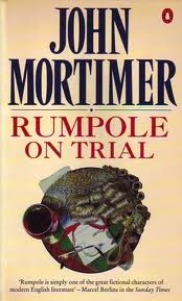
Rumpole on Trial (1992) is a collection of seven stories featuring everybody’s favourite barrister Rumpole of the Bailey
These stories embrace many of our favourite characters from 3 Equity Court: 'Soapy' Ballard, QC Philida and her husband, Claude Erskine-Brown, he of the wandering eye and thwarted ambition, along with other barristers, court staff, petty criminals and of course Mrs. R herself aka Hilda aka She Who Must Be Obeyed
Rumpole has to contend with devil-worshiping children, Erskine-Brown's efforts to become a QC, dishonest toffs, a murderous drug dealing wife, a clairvoyant, and many more.
The stories are the usual mix of humour, insight, social comment and profundity. They are also something of a time capsule, capturing late 20th century Britain in all is idiosyncratic and often unreconstructed glory.
The book saves the best until last. Rumpole on Trial is a real corker with Rumpole facing, and even seeming to welcome, disbarment.
These are the stories in this collection
Rumpole and the Children of the Devil Rumpole and the Eternal Triangle Rumpole and the Family Pride Rumpole and the Miscarriage of Justice Rumpole and the Reform of Joby Jonson Rumpole and the Soothsayer Rumpole on Trial
I love the Rumpole books and this one is no exception. A collection of short stories which feature all the denizens of the Inns of Court, some of the recurring shady characters that Rumpole is so fond of defending and his wife She Who Must Be Obeyed. You can't go wrong with lovable, grumpy Rumpole........he will make you smile and laugh out loud. A very endearing character in a very endearing series.
Rumpole on Trial is the 9th collection of Rumpole short stories by English author, John Mortimer. It's the 5th collection I've enjoyed so far. Mortimer is reliable, humorous, tells entertaining stories.
Rumpole is a barrister working out of a practice (Chambers) at 3 Equity Court; headed by 'Soapy' Ballard, with QC Philida, her husband, the reproachable Claude Erskine-Brown, who is jealous of his wife's success and has a wandering eye, the other barristers and staff of the court. As well, we are entertained by Rumpole's stern, but caring wife, Hilda (fondly known as She Who Must Be Obeyed).
Each of the 7 stories deals with cases involving Rumpole, his 'battles' with the judges in court and his dealings with issues in Chambers and with his wife. Rumpole has a way with getting to the crux of each case and also provides his wisdom to the staff at Chambers, often with the unwanted assistance of Hilda.
In this collection, we've got devil - worshiping children and holier than thou Social workers; the conniving of Erskine-Brown to get his QC and also to have Rumpole replaced. This latter issue comes to a head in the last story, Rumpole on Trial, where we find Rumpole with a severe tooth ache, an irritating murder, an irritating judge and where Rumpole begins to feel maybe he needs to move on to other things.
He's a great character, witty, crusty, smart and a pain in the arse to his head of chambers and to many of the officious judges he presents against. There are other excellent characters and for the most part they are the women who Mortimer fondly portrays; Hilda, the social - climbing, but practical wife; Liz Probert, one of Rumpole's younger compatriots, who is a radical and helps Rumpole even when the doesn't want it and new clerk of Chambers, Dot, how has all the men in a lather, especially Erskine-Brown and her fellow clerk, Henry.
The cases and suspects that Rumpole represents add nice color to the book and make the stories rich and entertaining. An excellent book and you even learn a bit about the British justice system, which makes the stories even more enjoyable. One of the better of the Rumpole collections I've enjoyed. I'm glad there are still a few more in the series. (4 stars)
A collection of seven stories featuring Horace Rumpole and colleagues - Phyllida Erskine-Brown now a judge; her husband, Claude still trying to become a QC and have an extra-marital affair without being caught; Mizz Liz Probert, the radical young lawyer and 'Soapy' Sam Ballard the head of chambers. Not to speak of 'She Who Must Be Obeyed AKA Hilda Rumpole, the indefatigable Timson family who keep Rumpole in bread and butter and 'Bonny' Bernard, their solicitor who always gives Rumpole his cases.
I think this is one of the best collections of Rumpole stories though it is currently only available second hand and not available at all as an e-book. I've always been especially fond of 'Rumpole and the Eternal Triangle' which is much more serious and poignant than many Rumpole stories and which sees him emerge from the case a sadder and wiser man. I also love 'Rumpole and the Soothsayer' with its neat twist at the end.
If you can get hold of a copy of this book then I guarantee that if you love Rumpole you will not be disappointed.
Book Bingo #5 - A Book That is More Than 10 Years Old
Now, that's no problem for me. However, I let the decision wait for a few day. Then rearranging and cleaning out books I came across my collection of Rumpole books. I hadn't picked them up for some time, being familiar with the solutions to most of the mysteries.
When dipping into them now I remembered the other reason for reading these delightful short stories. John Mortimer's style and Rumpole's personality are so engaging that it really doesn't matter if one knows the solution. These stories transport you to a different time with a rumpled knight in shining armor who just wants to get on with doing the one thing he may be able to control ... his job in getting various villains (and sometimes an innocent person) off of their legal charges.
What a joy it is to pick up this book at bedtime and dip into it before dropping off to sleep.
Rumpole is a fundamentally British comic character, a collection of quirks in the robes of an Old Bailey hack. But what John Mortimer does with his chief protagonist is to make him a surprising hero by virtue of his realistic honesty, his lack of actual sexism, racism or class prejudice in a world of characters more overtly respectable and more secretly unpleasant in the British legal system.
As with some other Rumpole collections, there's a timeliness to some of the subjects covered here, from children and devil worship to a famous miscarriage of justice (Mortimer more or less steals the Derek Bentley case wholesale, even to the point of having a dramatisation produced, with 'an intense young actor in the role of the accused' - Christopher Eccleston, in one of his earliest roles, played Bentley in 'Let Him Have It, Chris'), to the rise of popular psychics and even the fallacies of right-wing, disciplinarian groups who aim to 'teach moral fibre' to young ne'er-do-wells. And where would a Rumpole collection be without the looming threat of the end of Rumpole's career? In Rumpole On Trial, the title says it almost all, as a colleague in chambers contrives a chance to win their case, but the way they choose puts Rumpole himself in the frame, facing the prospect of being disbarred for breaking the rules of courtroom procedure. Meanwhile, there's also the possibility that Rumpole might be elevated beyond the circular rituals of an Old Bailey hack and made a circuit court judge, with the slow, inevitable death-by-boredom that would entail. More than in some other collections, this one shows you its workings earlier on, so you never particularly fear either for his elevation or his disbarring, but it's certainly well enough written to keep you listening without it becoming a chore - particularly as in the audiobook version, and in the absence of Leo McKern, Timothy West makes an absolutely serviceable Rumpole and gallumphs you along with him from witty riposte to wordy address to the jury, and eventually to a satisfying conclusion as Rumpole is forced to pay homage to the wisdom of his wife, the ever-formidable She Who Must Be Obeyed.
In a time when good, strong comic writing acts as a palliative against the Real World and its foolishness, you could do a lot worse than grabbing yourself some Rumpole, and this one in particular has some strong notes of social justice without turning Rumpole into a hippy. He's always cared about getting innnocent people acquitted - that's one of his strongest moral fibres, expressed in the idea that he will never turn prosecutor - and here, there are at least a couple of strong punches of a genuine, strong, simple morality, surrounded by people who say the right things while using innocents for their own purposes, allowing Rumpole - crusty, habitual, arguably cliched Rumpole - to stand relatively proud of the page, and of the society he keeps.
Rumpole is a barrister for the defense. While he attempts to protect people from the justice system, he makes ironic comments on the state of the world, the character of the judges and his wife Hilda's misunderstandings. I find it humorous. Your mileage may vary.
Two of these stories ("Rumpole and the Children of the Devil" and "Rumpole on Trial") are also part of "Rumpole on Trial: Selections from Rumpole on Trial". They are the best stories in this group but rest are pretty good.
Any modesty issues? It is clear that some of the characters tolerate adultery.
o Rumpole and the Children of the Devil: 8-year old Tracy Timson is picked up by Social Services because they are convinced that her father is a devil worshiper.
o Rumpole and the Eternal Triangle: A musician is shot dead, and the wife of the accused hires Rumpole. She flirts shamelessly with Rumpole and he grows suspicious.
o Rumpole and the Miscarriage of Justice: A police officer is murdered and the trial of the accused is rather spectacular, but the verdict is overturned for false confession. Rumpole defends the police officer who is accused of falsifying that confession.
o Rumpole and the Family Pride: Hilda's distant relatives invite the Rumploes to their castle. As they arrive they find a local coroner attempting to determine cause of death and it looks like the lord of the castle is suspected of murder.
o Rumpole and the Soothsayer: Rumpole must defend a fortune teller against the charges of fraud and deception. Apparently, it is the same fellow that "Soapy" Sam Ballard has been consulting.
o Rumpole and the Reform of Joby Jonson: Rumpole is defending a 16-year-old boy accused of attacking an old lady and stealing her money, but now the evidence (such as it is) that Rumpole would use to defend the lad is missing.
o Rumpole on Trial: Rumpole is charged with contempt of court and faces disbarment. To avoid this disaster all he has to do is to apologize to Judge Oliphant.
I love Rumpole, so why did I give the book only three stars? This is a late collection, and I'm guessing most of the stories were written after the TV series ended. I only recall seeing Rumpole and the Children of the Devil on the box. I'm a Rumpole superfan and completist, so I must have read the stories before, but some seemed unfamiliar. The one about Hilda's titled (distant) relatives is longer than usual, and Rumpole and the Soothsayer much shorter. As another reviewer pointed out, in most of the stories (and TV episodes) "the main trial, office politics, and home life all have a linked theme". The Soothsayer treats only of the trial of a spiritualist for fraud.
Mortimer's prose is always a joy to read. Some have damned him with faint praise - "almost as good as Wodehouse" - but to me he is in the best tradition of English humour. In his life at the bar he fought for freedom, and better conditions for prisoners (as head of the Howard League for Prison Reform - disparaged by his characters as a bunch of bleeding-hearts).
Here as in his other books (and the series) he uses Rumpole to highlight causes he cared about: the strange and cruel habit of upper-class Brits of sending their small children (aged seven) away to punitive boarding schools. Also conditions in prisons - at least the sanitation has improved.
Mortimer was a libertarian, and he enjoys poking fun at "Ms" Liz Probert with her feminist jargon. Nobody really talked like that in general conversation, but the abstract language of "male stereotypes" sounds familiar. Liz was brilliantly played in the TV version by Samantha Bond.
Perhaps I should give the book another star. Only the "Soothsayer" episode strikes a false note. It is the same old story of the fake medium who has real powers, much to his appalled surprise. Perhaps.
This entire review has been hidden because of spoilers.
There are seven Rumpole stories to enjoy in this edition. While there is the customary wit and dry humor at which Mortimer is so skillful, there are deadly serious legal issues to hold the reader's attention. 1.Rumpole And The Children Of The Devil: Rumpole defends a child who was unceremoniously taken from her parents and placed into "care" by misinformed, misguided welfare workers. 2. Rumpole And The Eternal Triangle: A beautiful musician tries to manipulate Rumpole in the course of a murder trial. 3. Rumpole And The Miscarriage Of Justice: Accusations arise concerning a possible wrongful murder conviction, which leads to scandal in the police and the courts. 4.Rumpole And The Family Pride: The Rumpoles are flattered to be invited to a weekend in a castle, by a cousin of Hilda's, who married a Lord. When the body of a homeless woman turns up dead in the estate's lake, Rumpole is called to action. 5. Rumpole And The Soothsayer: Rumpole's client is a fortune teller. 6. Rumpole And The Reform Of Joby Jonson: Young criminals are involved with, and manipulated by, corporate greed. 7. Rumpole On Trial: The title story. Accused of unprofessional conduct in court, Rumpole faces disbarment.
I first met Horace Rumpole in the British Television series. I read the books later, but as I read, I could not escape the actors who played the roles on television. There are some advantages to this but there are also some drawbacks to stories that are narrated in the first person. Rumpole's asides, given in his voice on TV (quotations of Wordsworth and Shakespeare) have more immediacy than seeing them on the printed page.
All that being said, the stories are still worthwhile as reading material. John Mortimer certainly knows his subject and writes about it clearly enough for American audiences to understand. The humour and the drama are both there, and the stories are short enough that one does not get all tied up in a convoluted plot. Since Mortimer also wrote the television scrips, the adaptation is remarkably faithful to the original.
Whether one experiences the literary of the video, either amounts to a good day in court at the Old Bailey.
"Rumpole and the Children of the Devil" - A 8 yo Timson accused of devil worship. Won. "Rumpole and the Eternal Triangle" - The female MC was likened to Sherlock Holmes' 'the woman'. "Rumpole and the Miscarriage of Justice" - A man was wrongfully convicted, or was he? Won. "Rumpole and the Family Pride" - Rumpole defended a Lord. Won. "Rumpole and the Soothsayer" - A short story about a man who could see the future. Won. "Rumpole and the Reform of Joby Jonson" - Youth delinquent reform. Lost, but perhaps not at the end. "Rumpole on Trial" - Rumpole got saved by his pupil, Liz Probert, & his wife.
This is an abridged audio version of Rumpole on Trial with two only episodes from the entire book. They are, however, the more substantial and longer episodes. Thus it runs over 3 hours.
Contents: “Rumpole and the Children of the Devil” “Rumpole on Trial”
Loved it, but I wanted more... a lot more.
If I listen to Rumpole on Trial again it will only be the full version.
I enjoyed the series on BBC decades ago. This is a collection of short stories about the down to Earth barrister ( I think!) dealing with the challenges of the court system and She Who Must Be Obeyed. He loves his crummy wine. He has a certain respect for his extensive clients. He is eccentric! This collection includes a story about " the woman" ala Sherlock Holmes, someone stealing evidence from Rumpole's house, and a family feud involving devil worship. Highly enjoyable!
I really do not know how to classify the books/audio/film episode of Rumpole's cases. The whole of his Inn, the Chamber of his law firm, the silks, the judges, his wife, "She Who Must Be Obeyed", those he defends seem to pop up in every case, so it is a serial story of the cases he represents. Rumpole is an honest, down-to-earth barrister who is just plain fun, entertaining to listen to or read.
It was a little difficult trying to decipher the "Olde English" meanings but, as with seeing the "Rumpole" shows on PBS, I did enjoy the different style of writing.