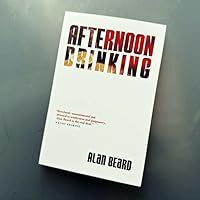
Third book in Markson’s Notecard Quartet. “Author” is thinking about writing a book, going about organizing his notes, and dealing with the fact that he is aging beyond the point of control. When death had come up in the previous books, there was at first an obsession with suicide, and then an obsession with mode of death. Here, we concentrate on place of death, mostly.
Here are some of my favourite bits from the book:
Werner Heisenberg was thirty-one when he won the Nobel Prize.
And nine years earlier had been given a grade of C on his doctoral examinations.
At the age of seven or eight, Sigmund Freud once deliberately urinated on the floor of his parents’ bedroom.
Mark Twain forgot Becky Thatcher’s name in the eight years between Tom Sawyer and Huckleberry Finn. And called her Bessie Thatcher in the later book.
Thomas Hardy’s anecdote about looking up a word in the dictionary because he wasn’t certain it existed—and finding that he himself was the only authority cited for its usage.
Tolstoy, to Chekhov:
You know I can’t stand Shakespeare’s plays, but yours are worse.
Victor Hugo could never get past page four of Le Rouge et le Noir.
January 1889, in Turin. Nietzsche, weeping, throws his arms around the neck of a mare being beaten by a coachman and then collapses in the street. Essentially the point of no return into his final madness.
A volume of Sherlock Holmes, which fictional Leopold Bloom has borrowed from a Dublin library and which is thirteen days overdue on fictional June 16, 1904, was listed as missing by the actual library in 1906.
Vaslav Nijinsky spent the last thirty-two years of his life in an insane asylum.
Thirty-two.
From a Hemingway letter, on T. S. Eliot:
A damned good poet and a fair critic; but he can kiss my ass as a man.
Keep apart, keep apart and preserve one’s soul alive—that is the teaching for the day. It is ill to have been born in these times, but one can make a world within a world.
Wrote George Gissing.
The curiosity that Jesus never appears to condemn slavery, though mentioning it in passing more than once.
Hobbes. Descartes. Pascal. Spinoza. Locke. Leibniz. Hume. Kant. Schopenhauer. Kierkegaard. Nietzsche. Santayana. Wittgenstein.
Not one of whom ever married.
Sigmund Freud was one of those who categorically refused to allow that the William Shakespeare of Stratford-upon-Avon could have been the author of the plays.
And told Arnold Zweig that it almost made him angry that Zweig believed otherwise.
Hermann Hesse was at one time a patient of Jung’s.
William Faulkner once allowed himself to be interviewed on radio during a University of Virginia football game.
And was introduced as a winner of the Mobil Prize.
Wondering if youngsters still read The Count of Monte Cristo.
Dickens’ best friend when, at twelve, he worked in the blacking factory: A boy named Bob Fagin.
I don’t understand them. To me that’s not literature. Said Cormac McCarthy of Henry James and Marcel Proust.
In 1817, being sent at the age of five from India to England for schooling, Thackeray was on a ship that stopped for provisions at an island west of Africa. A servant led him to a garden and impressed upon him to remember the man they saw strolling there.
The island being St. Helena.
At the age of eight or nine, Richard Brautigan once returned home from school and found that his entire family had moved away without a word.
Brautigan lived alone in an empty house for a week before neighbors tracked down an address and took up a collection for bus fare.
Reichenbach Falls.
I never found the companion that was so companionable as solitude. We are for the most part more lonely when we are abroad among men than when we stay in our chambers.
Says Walden.
The greatest artist who has ever written, George Eliot called Jane Austen.
To write only according to the rules laid down by previous classics signifies that one is not a master but a pupil.
Said Prokofiev.
To spend too much time in Studies is Sloth; To use them too much for Ornament is Affectation.
Said Bacon.
The only thing that we learn from history—is that we never learn anything from history.
Hegel said.
From far back in dimmest childhood he had been my ideal Elder Brother, and I still, through the years, saw in him, even as a small timorous boy yet, my protector, my backer, my authority and my pride.
Said Henry James, at the death of William.
Without music, life would be a mistake.
Said Nietzsche.
Age.
Dammit.
No one truly believes in his own death.
Said Freud.