

What do you think?

Headlong
Martin Clay, a young would-be art historian, suddenly sees opening in front of him the chance of a lifetime: the opportunity to perform a great public service, and at the same time to make his professional reputation - perhaps even rather a lot of money as well. Thus he finds himself drawn step by step into a moral and intellectual labyrinth.
400 pages, Paperback
First published January 1, 1999
About the author
Michael Frayn
114 books274 followersMichael Frayn is an English playwright and novelist. He is best known as the author of the farce Noises Off and the dramas Copenhagen and Democracy. His novels, such as Towards the End of the Morning, Headlong and Spies, have also been critical and commercial successes, making him one of the handful of writers in the English language to succeed in both drama and prose fiction. His works often raise philosophical questions in a humorous context. Frayn's wife is Claire Tomalin, the biographer and literary journalist.
Ratings & Reviews
Friends & Following
Create a free account to discover what your friends think of this book!
Community Reviews
Displaying 1 - 30 of 468 reviews

November 1, 2012
The combined smell of mildew, old food and wet dog was about to make me heave undigested pot roast, when our host had finally gotten around to telling us why he invited us to dinner.
“I heard you were something of a comic book aficionado and wanted your opinion on something.”
I eyed my wife and gave her the secret why-the-hell-did-you-accept-this-dinner-invitation-from-these-oddballs look. She countered with the you’re-going-to-walk-home-if-you-give-me-that-look-again look.
Getting up and walking to their den was a matter of avoiding the crotch sniffing dogs and trying to breathe through my mouth to inhale as little as possible the noxious food odor that had built up and was forcing itself out of the kitchen and into the hall way.
The room was filled with piles of books and old magazines. A comic was not in sight. He handed me a pile of a dozen of so that were under a wool sweater on his desk. Looking through them I didn’t find anything much of value, a few comics in poor condition from the fifties.
“I’ve had these things for years. Can’t even tell you where I got them from. You might find a few more in a few of the other piles.”
As I turned around to look, I caught a glimpse of my wife discreetly rolling her eyes. I picked up a few magazines off the top of a stack of Redbooks and National Geographic’s. Halfway through the stack I saw it. Action Comics! Number One! Superman lifting a car! My heart stopped beating. Breathing became forced! The room began to spin! I barely noticed the Labrador sniffing my crotch. “I am going to be rich”, I thought to myself. To our host, “I don’t think you have much of value here. Would you mind if I take these home and cross check them with a catalogue?”
The actual book revolves around a British philosophy professor/soon-to-be-amateur-con man’s attempts to swindle what could be a long lost painting by Brueghel the Elder out of its owner’s hands. There’s a lot of interesting background on the life of Brueghel as our protagonist attempts to prove if the painting is genuine and how it came into the hands of his asshat neighbor. Sadly, the “hero” has difficulty with the machinations of the “con”, zigging when he should have zagged – misreading all of the players, including his own wife.
This is a droll book in the same vein as Julian Barne’s Flaubert’s Parrot.
“I heard you were something of a comic book aficionado and wanted your opinion on something.”
I eyed my wife and gave her the secret why-the-hell-did-you-accept-this-dinner-invitation-from-these-oddballs look. She countered with the you’re-going-to-walk-home-if-you-give-me-that-look-again look.
Getting up and walking to their den was a matter of avoiding the crotch sniffing dogs and trying to breathe through my mouth to inhale as little as possible the noxious food odor that had built up and was forcing itself out of the kitchen and into the hall way.
The room was filled with piles of books and old magazines. A comic was not in sight. He handed me a pile of a dozen of so that were under a wool sweater on his desk. Looking through them I didn’t find anything much of value, a few comics in poor condition from the fifties.
“I’ve had these things for years. Can’t even tell you where I got them from. You might find a few more in a few of the other piles.”
As I turned around to look, I caught a glimpse of my wife discreetly rolling her eyes. I picked up a few magazines off the top of a stack of Redbooks and National Geographic’s. Halfway through the stack I saw it. Action Comics! Number One! Superman lifting a car! My heart stopped beating. Breathing became forced! The room began to spin! I barely noticed the Labrador sniffing my crotch. “I am going to be rich”, I thought to myself. To our host, “I don’t think you have much of value here. Would you mind if I take these home and cross check them with a catalogue?”
The actual book revolves around a British philosophy professor/soon-to-be-amateur-con man’s attempts to swindle what could be a long lost painting by Brueghel the Elder out of its owner’s hands. There’s a lot of interesting background on the life of Brueghel as our protagonist attempts to prove if the painting is genuine and how it came into the hands of his asshat neighbor. Sadly, the “hero” has difficulty with the machinations of the “con”, zigging when he should have zagged – misreading all of the players, including his own wife.
This is a droll book in the same vein as Julian Barne’s Flaubert’s Parrot.

October 16, 2022
Martin is a philosophy professor who stumbles upon a painting that he believes to be a lost work by Bruegel. He proceeds to try to con the painting away from its shady owner, while also carrying on a flirtation with the owner’s wife. Martin is pompous, weak, vacillating and incapable of pulling off an elaborate con. He is not an appealing character and I found it impossible to root for him. I felt sorry for his long-suffering wife and baby.
I only knew Frayn as the playwright of Noises Off, which I think is hilarious. I enjoyed some of the satirical aspects of this book, it even veered into slapstick at times. What I didn’t enjoy were the long discourses on painting, art history and even the history of the Netherlands. My eyes just glazed over at those points. They really dragged down the story. While the author maintained a light touch throughout the book, this caper should have been much more entertaining.
I only knew Frayn as the playwright of Noises Off, which I think is hilarious. I enjoyed some of the satirical aspects of this book, it even veered into slapstick at times. What I didn’t enjoy were the long discourses on painting, art history and even the history of the Netherlands. My eyes just glazed over at those points. They really dragged down the story. While the author maintained a light touch throughout the book, this caper should have been much more entertaining.

November 14, 2014
I've had it in my head to read this for a long time, as I enjoyed Frayn's Spies and the premise seemed one I'd like. I finally came across the book in a dimly lit very small branch library. It was above my head and under a long blue tarp. When I got the book into better light, I found the cover intriguing as it reminded me of the 'falling man' in the painting in A Month in the Country. (Except for each novel's mysterious falling man, no other comparison exists.)
I imagine Frayn's impetus to writing this novel was his own disagreement with Bruegel scholarship and instead of letting his research go to waste, he incorporated it straight into this book. As interesting as the research is, it didn't work for me as part of a novel. The other element of the story -- a sort of bedroom farce -- just wasn't something I found funny or even appealing.
The book got me googling various paintings though, and I enjoyed that immensely.
I imagine Frayn's impetus to writing this novel was his own disagreement with Bruegel scholarship and instead of letting his research go to waste, he incorporated it straight into this book. As interesting as the research is, it didn't work for me as part of a novel. The other element of the story -- a sort of bedroom farce -- just wasn't something I found funny or even appealing.
The book got me googling various paintings though, and I enjoyed that immensely.

September 29, 2020
A bit of a curate's egg, which I found a little disappointing, if only because it felt rather contrived compared with Spies.
The central idea, that a missing Bruegel masterpiece might be found in the house of a hard-up minor aristocrat who has no idea of its value, is just about plausible, and for me the best parts of the book are those where Frayn describes his own research into the art history. For me, the characters seemed a little too caricatured, and although the narrator is probably meant to be unreliable, his account stretches credibility rather too far.
I don't want to be overly harsh, as for all these caveats it is still an entertaining read, with some enjoyable comic set pieces.
The central idea, that a missing Bruegel masterpiece might be found in the house of a hard-up minor aristocrat who has no idea of its value, is just about plausible, and for me the best parts of the book are those where Frayn describes his own research into the art history. For me, the characters seemed a little too caricatured, and although the narrator is probably meant to be unreliable, his account stretches credibility rather too far.
I don't want to be overly harsh, as for all these caveats it is still an entertaining read, with some enjoyable comic set pieces.

July 4, 2017
This book was a very different, and somewhat overwhelming, reading experience.
Taking into account Michael Frayn's expertise as an excellent playwright, this book is not short in proving his prowess in dialogue development. In it, we are introduced to Martin, who narrates his moral and ethical struggles during a possibly history-changing art finding.
The fact that amazed me the most from the book is the author's ability to intertwine a monologue type of narrative with mid-XVI century Netherlandish art lectures, specifically about the work of master painter Pieter Bruegel the Elder; fact that gives a fiction novel a very interesting and enlighting flavor.
As mentioned above, the book is about Martin, a philosopher recently turned art historian who, coming upon a life-changing art finding, narrates to us his decision-making process in deciding how to proceed with the painting found.
The only thing I would consider slightly tiresome were the art descriptions, which are dense and more extensive than needed, making the reader lose the line of the narration. Nonetheless, Headlond is a very entertaining and funny book that, as the reader is drawn into the story in a swift fashion it also informs about one of northern Europe's renaissance master painters.
Taking into account Michael Frayn's expertise as an excellent playwright, this book is not short in proving his prowess in dialogue development. In it, we are introduced to Martin, who narrates his moral and ethical struggles during a possibly history-changing art finding.
The fact that amazed me the most from the book is the author's ability to intertwine a monologue type of narrative with mid-XVI century Netherlandish art lectures, specifically about the work of master painter Pieter Bruegel the Elder; fact that gives a fiction novel a very interesting and enlighting flavor.
As mentioned above, the book is about Martin, a philosopher recently turned art historian who, coming upon a life-changing art finding, narrates to us his decision-making process in deciding how to proceed with the painting found.
The only thing I would consider slightly tiresome were the art descriptions, which are dense and more extensive than needed, making the reader lose the line of the narration. Nonetheless, Headlond is a very entertaining and funny book that, as the reader is drawn into the story in a swift fashion it also informs about one of northern Europe's renaissance master painters.

November 12, 2022
This is not an easy boo to describe. It's a book good to discuss with another. There are no pat, easy answers on how it is to be judged.
Martin and Kate, two academics working in London, move out to their country place with their three-month-old baby. He is a philosopher working on a paper related to art history, which is indeed near to his wife’s academic field. She is on maternity leave. When the neighborhood’s landowner asks them to have a look at one of his family’s old oil paintings, peace and tranquility come to an abrupt end. Martin is thrown head over heels by one of the paintings. He is sure it is a missing Bruegel! He is determined to get his hands on it.
So first of all, we’ve got an action filled story set in contemporary times. Will Martin become the owner of the painting? We’re given also two couples and two marriages to observe—not only Martin’s and Kate’s, but also the marriage of the landowner and his wife. Tax evasion and the sale of art for the purpose of obtaining the best price is what we read about. Add to this a family dispute regarding ownership of the paintings, rambunctious dogs and relatives with a propensity for liquor.
The book has another focus, and it is definitely more interesting. Art and history in Belgium, Spain and the Netherlands in the 1500s. The book can be read solely for this. Having lived in Belgium, I found this topic fascinating. The book gave me a review of that which I have found difficult to understand. The events are not simple and there is a lot to be learned. Questions concerning Bruegel’s artwork as well as the political and religious conflicts of the 15th and 16th centuries are discussed. On the minus side, I am still somewhat confused. I have difficulty gluing all the facts into my head.
There is more to consider. Martin’s personality for one. He is irksome; you want to kick him sometimes. You can wonder if he acts reasonably. I think to understand him, you must view him as the ingrained academic that he is. So yes, ultimately, I do understand why he does what he does. I find his actions believable.
The wheeling and dealing over the paintings, the cheating and the subterfuge is not really something I enjoy. I’m chalking up another minus.
I also think the ending is too simple and quick.
I am changing my rating to three stars. I am glad to have read the book. I like the art and historical content. There is quite a bit to think about in terms of the couples’ marital relationships. There is humor in the telling. Nevertheless, the problems, pointed out above, cannot be ignored.
I listened to the audiobook read by Robert Powell. His accent is British. I think the characters sound authentic. They sound like you’d think they’d sound, and it Is not hard to follow. The narration I have given four stars.
***********************************
*My Father's Fortune 3 stars
*Headlong 3 stars
*Spies TBR
Martin and Kate, two academics working in London, move out to their country place with their three-month-old baby. He is a philosopher working on a paper related to art history, which is indeed near to his wife’s academic field. She is on maternity leave. When the neighborhood’s landowner asks them to have a look at one of his family’s old oil paintings, peace and tranquility come to an abrupt end. Martin is thrown head over heels by one of the paintings. He is sure it is a missing Bruegel! He is determined to get his hands on it.
So first of all, we’ve got an action filled story set in contemporary times. Will Martin become the owner of the painting? We’re given also two couples and two marriages to observe—not only Martin’s and Kate’s, but also the marriage of the landowner and his wife. Tax evasion and the sale of art for the purpose of obtaining the best price is what we read about. Add to this a family dispute regarding ownership of the paintings, rambunctious dogs and relatives with a propensity for liquor.
The book has another focus, and it is definitely more interesting. Art and history in Belgium, Spain and the Netherlands in the 1500s. The book can be read solely for this. Having lived in Belgium, I found this topic fascinating. The book gave me a review of that which I have found difficult to understand. The events are not simple and there is a lot to be learned. Questions concerning Bruegel’s artwork as well as the political and religious conflicts of the 15th and 16th centuries are discussed. On the minus side, I am still somewhat confused. I have difficulty gluing all the facts into my head.
There is more to consider. Martin’s personality for one. He is irksome; you want to kick him sometimes. You can wonder if he acts reasonably. I think to understand him, you must view him as the ingrained academic that he is. So yes, ultimately, I do understand why he does what he does. I find his actions believable.
The wheeling and dealing over the paintings, the cheating and the subterfuge is not really something I enjoy. I’m chalking up another minus.
I also think the ending is too simple and quick.
I am changing my rating to three stars. I am glad to have read the book. I like the art and historical content. There is quite a bit to think about in terms of the couples’ marital relationships. There is humor in the telling. Nevertheless, the problems, pointed out above, cannot be ignored.
I listened to the audiobook read by Robert Powell. His accent is British. I think the characters sound authentic. They sound like you’d think they’d sound, and it Is not hard to follow. The narration I have given four stars.
***********************************
*My Father's Fortune 3 stars
*Headlong 3 stars
*Spies TBR

August 18, 2013
A major disappointment...
Here we have a perfect example of how a book can affect people in very different ways. Highly recommended by several people whose opinions I value and with whom I often find myself in agreement, I assumed I would love this book. Hmm!
When our first-person narrator, Martin Clay, is invited by his cartoonishly-oafish country bumpkin neighbour to look at his art collection, Martin (though hardly an expert) thinks he has spotted a missing Breugel. Martin then plots how to acquire this painting for himself, ostensibly to have the honour of being the one who discovered it, but the two million or so he expects to get for it is a further motivation.
There seems to be an unfortunate habit developing amongst authors whereby they do a ton of research and then decide they're going to use it all - every single word - loosely bunging a flimsy plot into the gaps and then calling it a novel. At least sixty percent of this book is Frayn regurgitating the history of the 16th century Netherlands together with everything he could find on Breugel. Not subtly weaving it into the story and not with any redeeming beauty of writing - just pouring it out in a 'Look what I know!' kind of way.
"On the table in front of me I have Friedländer (of course), Glück, Grossman, Tolnay, Stechow, Genaille and Bianconi. They quote each other freely, together with various other authors not available in the London Library - Hulin de Loo, Michel, Romdahl, Stridbeck and Dvořák - and they refer to the often mutually contradictory iconography used in two breviaries illuminated by Simon Bening of Bruges in the second and third decades of the sixteenth century, the Hours of Hennessy and the Hours of Costa; in the Grimani Breviary, also done, a little earlier, by Simon Bening and his father Alexander Bening, although the calendar itself is attributed to Gerard Horenbout; and in our own dear 'Calendrier flamand', as I think of it, in the Bavarian State Library."
The other forty per cent is a fairly unsubtle farce as our unlikeable, intellectually snobbish hero tries to do down his equally unlikeable 'half-educated' neighbours, while trying not to fall out with his enigma of a wife - the woman with the least personality of any fictional character I have encountered. There are some funny moments, but many of the jokes are inviting the reader to join with the author/narrator in laughing at the bumpkins for their ignorance of art and philosophy or in mocking the narrator for his snobbery. This combination means that the whole book has a sneering quality which left me unable to empathise with any of the overblown unattractive characters.
Despite the fact that by a third of the way through I began to skip whole sections devoted to presumably partially made-up art history, it still took me the best part of two weeks to plough through the remaining snippets of plot, mainly because I couldn't bear to read any more about the tedious, self-absorbed and yet apparently irresistible-to-women Martin. And since the ending was pretty much inevitable it was hardly a surprise, except in that the author managed to make it more unpleasant than I anticipated by adding in an incident of entirely unnecessary animal cruelty.
Sorry to all of you who love Frayn - you're obviously seeing something in this that I'm not...but I'm afraid I found this one a major disappointment and doubt I'll be seeking out any more of the author's work.
www.fictionfanblog.wordpress.com
Here we have a perfect example of how a book can affect people in very different ways. Highly recommended by several people whose opinions I value and with whom I often find myself in agreement, I assumed I would love this book. Hmm!
When our first-person narrator, Martin Clay, is invited by his cartoonishly-oafish country bumpkin neighbour to look at his art collection, Martin (though hardly an expert) thinks he has spotted a missing Breugel. Martin then plots how to acquire this painting for himself, ostensibly to have the honour of being the one who discovered it, but the two million or so he expects to get for it is a further motivation.
There seems to be an unfortunate habit developing amongst authors whereby they do a ton of research and then decide they're going to use it all - every single word - loosely bunging a flimsy plot into the gaps and then calling it a novel. At least sixty percent of this book is Frayn regurgitating the history of the 16th century Netherlands together with everything he could find on Breugel. Not subtly weaving it into the story and not with any redeeming beauty of writing - just pouring it out in a 'Look what I know!' kind of way.
"On the table in front of me I have Friedländer (of course), Glück, Grossman, Tolnay, Stechow, Genaille and Bianconi. They quote each other freely, together with various other authors not available in the London Library - Hulin de Loo, Michel, Romdahl, Stridbeck and Dvořák - and they refer to the often mutually contradictory iconography used in two breviaries illuminated by Simon Bening of Bruges in the second and third decades of the sixteenth century, the Hours of Hennessy and the Hours of Costa; in the Grimani Breviary, also done, a little earlier, by Simon Bening and his father Alexander Bening, although the calendar itself is attributed to Gerard Horenbout; and in our own dear 'Calendrier flamand', as I think of it, in the Bavarian State Library."
The other forty per cent is a fairly unsubtle farce as our unlikeable, intellectually snobbish hero tries to do down his equally unlikeable 'half-educated' neighbours, while trying not to fall out with his enigma of a wife - the woman with the least personality of any fictional character I have encountered. There are some funny moments, but many of the jokes are inviting the reader to join with the author/narrator in laughing at the bumpkins for their ignorance of art and philosophy or in mocking the narrator for his snobbery. This combination means that the whole book has a sneering quality which left me unable to empathise with any of the overblown unattractive characters.
Despite the fact that by a third of the way through I began to skip whole sections devoted to presumably partially made-up art history, it still took me the best part of two weeks to plough through the remaining snippets of plot, mainly because I couldn't bear to read any more about the tedious, self-absorbed and yet apparently irresistible-to-women Martin. And since the ending was pretty much inevitable it was hardly a surprise, except in that the author managed to make it more unpleasant than I anticipated by adding in an incident of entirely unnecessary animal cruelty.
Sorry to all of you who love Frayn - you're obviously seeing something in this that I'm not...but I'm afraid I found this one a major disappointment and doubt I'll be seeking out any more of the author's work.
www.fictionfanblog.wordpress.com

April 27, 2010
I like boffin comeuppance humor – the kind where some bloviating egghead from the remotest groves of academe finds that his cluelessness about real life can come back to bite him. Martin, a second-rate professor of philosophy and a first-rate pedant, is the storyteller in this one. As you already know, the joke is on him. His new research interests concern art, iconology, nominalism, and assorted other obscurities. His wife is an art historian specializing in iconography (as opposed to iconology, which Martin distinguishes as a difference that matters). As they begin a working vacation in the country, they’re asked by a loutish neighbor nearby to look at some old family paintings. There’s one the lout knows is worth something, but it’s another that Martin believes through his particular expertise to be an unsigned, yet truly major piece by a noted Dutch artist.
Frayn’s work here was very skillfully done. As I’ve now come to expect from just about every writer from the Isles, he has a real way with words. But Frayn’s accomplishment goes beyond that. He gave Martin’s first person narrative a book-smart plausibility even as we readers were clued in to his debilitating lack of common sense. The good professor’s foil was the aforementioned lout, who was hoping to liquidate the remaining chunks of his inheritance. But the truth of the matter is that Martin’s biggest foe was Martin. If you’re like me and find yourself obliquely pulling for the guy, he’ll jangle your nerves with his missteps. And they were all so avoidable. (My dad couldn’t bear watching “I Love Lucy” for similar reasons – a heritable trait, I suspect.) Anyway, Martin could never see what the other players in the chess match might do; how even a nakedly greedy lunkhead could outmaneuver him in matters of finance. At the same time, he did superlative research into the neighbor’s painting. It was his idée fixe. He shed all kinds of light on its religious and societal context. And even the most abstract symbolism was explained or considered. Actually, the art history was more interesting than I would have thought even if it did, at times, go on for too long.
I rate this closer to 4 stars than to 3, but somewhere in that range. It was worth many a wry smile and even a few snickers. I got caught up in the story, too, which was somewhat surprising since plot is often just along for the ride in the boffin comeuppance genre.
Frayn’s work here was very skillfully done. As I’ve now come to expect from just about every writer from the Isles, he has a real way with words. But Frayn’s accomplishment goes beyond that. He gave Martin’s first person narrative a book-smart plausibility even as we readers were clued in to his debilitating lack of common sense. The good professor’s foil was the aforementioned lout, who was hoping to liquidate the remaining chunks of his inheritance. But the truth of the matter is that Martin’s biggest foe was Martin. If you’re like me and find yourself obliquely pulling for the guy, he’ll jangle your nerves with his missteps. And they were all so avoidable. (My dad couldn’t bear watching “I Love Lucy” for similar reasons – a heritable trait, I suspect.) Anyway, Martin could never see what the other players in the chess match might do; how even a nakedly greedy lunkhead could outmaneuver him in matters of finance. At the same time, he did superlative research into the neighbor’s painting. It was his idée fixe. He shed all kinds of light on its religious and societal context. And even the most abstract symbolism was explained or considered. Actually, the art history was more interesting than I would have thought even if it did, at times, go on for too long.
I rate this closer to 4 stars than to 3, but somewhere in that range. It was worth many a wry smile and even a few snickers. I got caught up in the story, too, which was somewhat surprising since plot is often just along for the ride in the boffin comeuppance genre.

June 9, 2009
I'm sure it is a well written and entertaining book for some people, clearly the author is a good one. He is good with words and has excellent insights and ways to describe the tension and distance between wife and husband. I hated reading this book, and could not wait until it was over. I refused to put it down, and forced myself to get thru it. I did not understand, nor was I interested in the descriptions of pieces of (perhaps) famous artwork. These art history lessons went on for dozens of pages at a time, all I was interested in was getting to the end!

March 15, 2009
What a frustrating book... It *should* have been a very interesting book, good premise and good writer (from other books I've read of his prior to this one) but somehow between way too much academic research and one-dimensional characters it fell off the rails. I really, really wanted to like it, but just didn't.

April 9, 2012
Huge entertaining and informative, Michael Frayn's book about an art historian turned frantic detective is a delight from start to finish. I simply coudn't put it down and when it ended, I went straight to my local library to get out books about the Netherlands and old Dutch masters!
The book will not only appeal to readers who like art history, it's a hilarious account of an otherwise inept man trying to track down an old masterpiece. A giant jigsaw puzzle that spans several centuries, the protagonist's rumninations about life, art, history, religion and political oppression of artists is thought-provoking and handled in an entertaining way. It's a great read - but then this is Michael Frayn, a master storyteller at work!
The book will not only appeal to readers who like art history, it's a hilarious account of an otherwise inept man trying to track down an old masterpiece. A giant jigsaw puzzle that spans several centuries, the protagonist's rumninations about life, art, history, religion and political oppression of artists is thought-provoking and handled in an entertaining way. It's a great read - but then this is Michael Frayn, a master storyteller at work!

December 1, 2025
I had previously read two novels by Michael Frayn that I loved, so I decided to try another. This book is about a married pair of academics, Martin and Kate Clay, who go on holiday to rural England with their baby daughter. Martin stumbles across an artwork that he believes is an authentic Bruegel and hopes to buy it at a bargain price since he thinks its owner has no idea of its value (assuming it is, in fact, authentic). Martin studies art history in Belgium, Spain and the Netherlands in the 16th century, the time Pieter Bruegel the Elder produced his artworks, primarily trying to convince himself it is genuine. The story relates his struggles with his conscience. It also tells the story of two couples and their relationships: Martin and Kate as well as the painting’s owner and his wife. The storyline becomes a bit farcical, and there is plenty of humor. Overall, though, I found it rather esoteric. It requires a deep interest in art and art history, since the research into the possible authenticity of the painting is extremely detailed. I am glad I read it but didn’t like it as much as Spies or Skios (both of which I highly recommend).

July 13, 2025
Headlong by Michael Frayn was on the Shortlist for the Booker Prize in 1999 https://en.wikipedia.org/wiki/List_of... and more importantly (for the under signed) it is included on Realini’s Best 100 Books of Fiction list at http://realini.blogspot.com/
10 out of 10
Reading Headlong is both an exhilarating, cathartic experience and a reason to sulk for those who think that maybe they have something to tell the world, if only they could sit down and share it with humankind, for when you read something so inspiring, sophisticated, dazzling, captivating, diving into the history of the Netherlands - when they have been occupied by the Spain, trapped into a cataclysm which was the result of their own…success, for they had wanted to place someone on the throne of Spain, had managed to do that, only to see the monarch become too Spanish and then impose a period of torture, murder on gruesome scale (reminding us of what is happening in places like Bucha and Mariupol in Ukraine right now) in the Netherlands – making readers much more knowledgeable in matters of art, Bruegel (there would be explanations in the book on the spelling, between Bruegel and Brueghel), than they had been before taking up this opus magnum that brings fantastic rewards, to the point where one has to realize that there are so many masterpieces in the world, that is pointless to try and write, unless one is at least ten times less gifted than Michael Frayn…
It looks like one could do no better than read one work by Michael Frayn every year, seeing that in 2020 I have been enchanted by Spies, which sits on the 1,000 Novels Everyone Must Read List http://realini.blogspot.com/2020/08/s... and then last year, another chef d’oeuvre from the same Magister Ludi caused elation, exuberance and mirth, Towards the End of the Morning is placed on the same Must Read compilation – one phenomenal aspect about these three fabulous works of fiction is that they delve into different domains, while Spies has two young boys at the center, Towards the End of the Morning looks at the hilarious events in which journalists are involved http://realini.blogspot.com/2021/10/t...
Martin Clay on the other hand is a philosopher, who is moving into the history of art, he is the narrator and main character of the third work of art created by stupendous Michael Frayn that has fallen from heaven on to this desk…he is going to stay in the countryside with his wife, Kate, who is an expert in iconography (hopefully, it is not a mix up, and she is not in fact into iconology, the difference, together with so much else art is explained in the novel, but it takes more than a dilettante to absorb it…on the other hand, there was the absolute miracle of being immersed in a book that otherwise would have bored, given the detail, the look at the minutia of the paintings, symbols, cardinals, kings, princes, merchants, packing and traveling with canvases involved, which gives an estimation the magnitude of the talent of Michael Frayn) and their infant daughter Tilda, or at least that is the initial plan
Tony Churt is a neighbor that visits the family, as they have just arrived from London, and he has a question to ask over dinner, where they also meet the much younger (half the age) spouse, who is half educated, says ‘wow’ a lot and laughs when Martin tries to explain what he does – it is true though that he becomes too erudite and opaque for a mere mortal, when he talks of nominalism, the Netherlandish painters, dropping names she had never heard before – the host has some paintings that he wants evaluated, eventually sold and with time, we would learn that Churt has quite a few people to cheat in the process…
There is a painting of The Rape of Helen, depicting the flight of the most beautiful woman with Paris – we find that she also took the treasure of Menelaus when she departed with Paris, as pointed out, something that is rarely known – and three more works – by Dutch ‘buggers’ as Tony Churt says – one of which provokes an epiphany, a transcendence, turning Martin into a different person, changing his life from the moment he sees it and thinks – he would be alternatively sure and then doubtful – that is a Bruegel that had been lost and now, with his supreme effort, vital effort, it would be recuperated and the whole world will remember him for his impeccable, sublime act of magnanimity, for he would take the lost chef d’oeuvre and give it back to a museum, which would evaluate it to a few million pounds…
This Bruegel would escape into obscurity, hidden in the vault of some rapacious, wealthy oligarch – in the present situation, we think of the ghouls from the entourage of the Monster in the Kremlin – that will keep it away from anybody and see in it only an investment – in a fabulous documentary, The Lost Leonardo, they explain how a painting of great value is one of the best to have for this type of rich beats, since they need things they can pack in a hurry and fly away (like now, taking refuge in the disgusting UAE, which is ‘neutral’ towards the war in Europe) and in that brilliant film, the Lost Leonardo ends up in the possession of Mohamad Bin Salman, de facto ruler of Saudi Arabia http://realini.blogspot.com/2022/02/o... though it is still debatable whether it is a Leonardo he has
Martin is thus determined to pretend he helps his neighbor, nay, he would help as far as it is possible, and then rescue the Bruegel and take it to the public to benefit, only he has to juggle with too many balls, given that he has to convince his wife to risk their financial security, then that he does not have an affair with Laura, later that this is just some mirage, with Churt, he will try to hide his obsession with the Bruegel – if it is a work of the master, for there are pros and cons, arguments to attribute it to him and then just as many reasons to think it is not the great Magister – and find an invented Belgian buyer, with the whole purpose of getting the desired lost masterpiece, some of the profit from it, but essentially, the recognition of his contribution, which will represent his life’s work, the best thing he will ever have done…
This miraculous saga is a perfect combination of humor, intrigue, unexpected events, depth, a touch of needed frivolity, the most exquisite immersion into the world of art, history of Europe, at least an important part of it, mixed with emotions – Laura falls for the attractive philosopher, gives up smoking for him, lures him into her bedroom, where the ‘Bruegel’ is parked for some time, then she is ready to quite a number of risky moves for the man that loves his family, but for a period of time, is enraptured with what he thinks, then doubts, only to be sure to be one of the most important paintings in the history of humankind, for which he will lie, negotiate, give all he has and more – indeed, one of the only aspects that annoyed me was the generosity he had towards Churt, why on earth would he make every effort to pay as much as possible to such a scoundrel, but then Michael Frayn is right, this is in the nature of the protagonist, who anyway has a plan to benefit from the few millions of pounds that the ‘Bruegel’ is worth…if it turns out to be authentic and comes into his hands at the end…
10 out of 10
Reading Headlong is both an exhilarating, cathartic experience and a reason to sulk for those who think that maybe they have something to tell the world, if only they could sit down and share it with humankind, for when you read something so inspiring, sophisticated, dazzling, captivating, diving into the history of the Netherlands - when they have been occupied by the Spain, trapped into a cataclysm which was the result of their own…success, for they had wanted to place someone on the throne of Spain, had managed to do that, only to see the monarch become too Spanish and then impose a period of torture, murder on gruesome scale (reminding us of what is happening in places like Bucha and Mariupol in Ukraine right now) in the Netherlands – making readers much more knowledgeable in matters of art, Bruegel (there would be explanations in the book on the spelling, between Bruegel and Brueghel), than they had been before taking up this opus magnum that brings fantastic rewards, to the point where one has to realize that there are so many masterpieces in the world, that is pointless to try and write, unless one is at least ten times less gifted than Michael Frayn…
It looks like one could do no better than read one work by Michael Frayn every year, seeing that in 2020 I have been enchanted by Spies, which sits on the 1,000 Novels Everyone Must Read List http://realini.blogspot.com/2020/08/s... and then last year, another chef d’oeuvre from the same Magister Ludi caused elation, exuberance and mirth, Towards the End of the Morning is placed on the same Must Read compilation – one phenomenal aspect about these three fabulous works of fiction is that they delve into different domains, while Spies has two young boys at the center, Towards the End of the Morning looks at the hilarious events in which journalists are involved http://realini.blogspot.com/2021/10/t...
Martin Clay on the other hand is a philosopher, who is moving into the history of art, he is the narrator and main character of the third work of art created by stupendous Michael Frayn that has fallen from heaven on to this desk…he is going to stay in the countryside with his wife, Kate, who is an expert in iconography (hopefully, it is not a mix up, and she is not in fact into iconology, the difference, together with so much else art is explained in the novel, but it takes more than a dilettante to absorb it…on the other hand, there was the absolute miracle of being immersed in a book that otherwise would have bored, given the detail, the look at the minutia of the paintings, symbols, cardinals, kings, princes, merchants, packing and traveling with canvases involved, which gives an estimation the magnitude of the talent of Michael Frayn) and their infant daughter Tilda, or at least that is the initial plan
Tony Churt is a neighbor that visits the family, as they have just arrived from London, and he has a question to ask over dinner, where they also meet the much younger (half the age) spouse, who is half educated, says ‘wow’ a lot and laughs when Martin tries to explain what he does – it is true though that he becomes too erudite and opaque for a mere mortal, when he talks of nominalism, the Netherlandish painters, dropping names she had never heard before – the host has some paintings that he wants evaluated, eventually sold and with time, we would learn that Churt has quite a few people to cheat in the process…
There is a painting of The Rape of Helen, depicting the flight of the most beautiful woman with Paris – we find that she also took the treasure of Menelaus when she departed with Paris, as pointed out, something that is rarely known – and three more works – by Dutch ‘buggers’ as Tony Churt says – one of which provokes an epiphany, a transcendence, turning Martin into a different person, changing his life from the moment he sees it and thinks – he would be alternatively sure and then doubtful – that is a Bruegel that had been lost and now, with his supreme effort, vital effort, it would be recuperated and the whole world will remember him for his impeccable, sublime act of magnanimity, for he would take the lost chef d’oeuvre and give it back to a museum, which would evaluate it to a few million pounds…
This Bruegel would escape into obscurity, hidden in the vault of some rapacious, wealthy oligarch – in the present situation, we think of the ghouls from the entourage of the Monster in the Kremlin – that will keep it away from anybody and see in it only an investment – in a fabulous documentary, The Lost Leonardo, they explain how a painting of great value is one of the best to have for this type of rich beats, since they need things they can pack in a hurry and fly away (like now, taking refuge in the disgusting UAE, which is ‘neutral’ towards the war in Europe) and in that brilliant film, the Lost Leonardo ends up in the possession of Mohamad Bin Salman, de facto ruler of Saudi Arabia http://realini.blogspot.com/2022/02/o... though it is still debatable whether it is a Leonardo he has
Martin is thus determined to pretend he helps his neighbor, nay, he would help as far as it is possible, and then rescue the Bruegel and take it to the public to benefit, only he has to juggle with too many balls, given that he has to convince his wife to risk their financial security, then that he does not have an affair with Laura, later that this is just some mirage, with Churt, he will try to hide his obsession with the Bruegel – if it is a work of the master, for there are pros and cons, arguments to attribute it to him and then just as many reasons to think it is not the great Magister – and find an invented Belgian buyer, with the whole purpose of getting the desired lost masterpiece, some of the profit from it, but essentially, the recognition of his contribution, which will represent his life’s work, the best thing he will ever have done…
This miraculous saga is a perfect combination of humor, intrigue, unexpected events, depth, a touch of needed frivolity, the most exquisite immersion into the world of art, history of Europe, at least an important part of it, mixed with emotions – Laura falls for the attractive philosopher, gives up smoking for him, lures him into her bedroom, where the ‘Bruegel’ is parked for some time, then she is ready to quite a number of risky moves for the man that loves his family, but for a period of time, is enraptured with what he thinks, then doubts, only to be sure to be one of the most important paintings in the history of humankind, for which he will lie, negotiate, give all he has and more – indeed, one of the only aspects that annoyed me was the generosity he had towards Churt, why on earth would he make every effort to pay as much as possible to such a scoundrel, but then Michael Frayn is right, this is in the nature of the protagonist, who anyway has a plan to benefit from the few millions of pounds that the ‘Bruegel’ is worth…if it turns out to be authentic and comes into his hands at the end…
August 7, 2011
Ever erudite, Michael Frayn always uses his deep knowledge of philosophy to inveigle something deeper into what, on the surface, might appear to be no more than comic novels. At one level, Headlong is a comic romp: we follow Martin Clay as he attempts to seize from his dull-witted neighbour what he thinks is a long-lost painting from Pieter Bruegel's series The Months. On another level, Frayn is excellent on academic obsession. What for some readers of this novel is a turgid interlude, for me at least was an exhilarating detective story, as Clay pieces together clues as to what Bruegel might really be saying in his series of paintings: a dark commentary on oppressive Spanish rule in 16th century Holland. Cleverest of all is a distinction made between iconography (roughly, conventional symbolism) and iconology (roughly, contextualized symbolism). While this is ostensibly about the paintings, it is really a reflection on human psychology: the signs we (and the characters in this novel) show to ourselves and those around us.
Not as good as The Trick of It, or A Landing on the Sun, or Spies, but still pretty damn good!
Not as good as The Trick of It, or A Landing on the Sun, or Spies, but still pretty damn good!

August 22, 2020
Martin Clay, is a philosopher who moves in to a country cottage with his art-historian wife and infant daughter on the pretext that getting away from the hustle of bustle of London will mean that he will finally be able to knuckle down and work on the book that he has never really got started.
On arrival into the country they are invited to have dinner with their neighbours, the Churts. The Churts' estate is run down and Tony Churt is seemingly always on the lookout on ways to make quick bit cash, and has an ulterior motive in asking them over. Tony wants the Clays to have a look at some old paintings that he wants to unload. He doesn't trust the big auction houses and hopes the Clays can give a valuation and find a way of selling them without him having to pay fees or commission.
There is a huge and ghastly picture by Giordano that Tony and three minor Dutch scenes. However, it is last painting that Martin is shown that he becomes really interested in. He believes that this a missing masterpiece by Pieter Bruegel. Afraid that the Churts will simply sell it to the highest bidder and that it will disappear in to a private collection somewhere abroad and wanting the renown as it's discoverer, Martin decides that he won't tell the the Churts what he suspects and hatches a plan to get it for himself.
Martin's wife Kate isn't convinced about it's authenticity so he sets out to prove his theory whilst at the same time trying to figure out how to get Tony to part with it without arousing his suspicion. Martin thinks that Tony is just a gullible country bumpkin but he soon learns that he more devious than he initially thought. To complicate matters even further Tony's wife, Laura, starts to make sexual advances towards Martin which only puts further stress on the Clay's own marriage.
The story quickly turns into a rather simple and rather entertaining little farce running alongside a more serious examination into the painter's life and the circumstances that might have led to this particular piece of work's disappearance, along the way giving an insight into a turbulent period of Dutch history. One that I for one knew nothing about.
The overall plot is perhaps a little thin and slightly out of balance (a little too weighted towards the art history) but on the whole I felt that Frayn juggled these two very different story-lines extremely well. The farce element kept me amused whilst the theories and history made for fascinating reading. The ending when it arrived was well executed and overall I found this a brisk and entertaining read that,if asked, would certainly recommend it.
On arrival into the country they are invited to have dinner with their neighbours, the Churts. The Churts' estate is run down and Tony Churt is seemingly always on the lookout on ways to make quick bit cash, and has an ulterior motive in asking them over. Tony wants the Clays to have a look at some old paintings that he wants to unload. He doesn't trust the big auction houses and hopes the Clays can give a valuation and find a way of selling them without him having to pay fees or commission.
There is a huge and ghastly picture by Giordano that Tony and three minor Dutch scenes. However, it is last painting that Martin is shown that he becomes really interested in. He believes that this a missing masterpiece by Pieter Bruegel. Afraid that the Churts will simply sell it to the highest bidder and that it will disappear in to a private collection somewhere abroad and wanting the renown as it's discoverer, Martin decides that he won't tell the the Churts what he suspects and hatches a plan to get it for himself.
Martin's wife Kate isn't convinced about it's authenticity so he sets out to prove his theory whilst at the same time trying to figure out how to get Tony to part with it without arousing his suspicion. Martin thinks that Tony is just a gullible country bumpkin but he soon learns that he more devious than he initially thought. To complicate matters even further Tony's wife, Laura, starts to make sexual advances towards Martin which only puts further stress on the Clay's own marriage.
The story quickly turns into a rather simple and rather entertaining little farce running alongside a more serious examination into the painter's life and the circumstances that might have led to this particular piece of work's disappearance, along the way giving an insight into a turbulent period of Dutch history. One that I for one knew nothing about.
The overall plot is perhaps a little thin and slightly out of balance (a little too weighted towards the art history) but on the whole I felt that Frayn juggled these two very different story-lines extremely well. The farce element kept me amused whilst the theories and history made for fascinating reading. The ending when it arrived was well executed and overall I found this a brisk and entertaining read that,if asked, would certainly recommend it.

June 18, 2021
DNFed at around 130 pages.
Reason: Too slow of a plot, too many long passages describing paintings or art catalogs, too many one-note characters. Reading "Headlong" is like attempting to trudge through molasses with 20 pound weights on your ankles. Hardly anything happens in the first 100 pages, and what does can be recounted in 5 seconds...with 2 seconds to spare.
I don't have the patience to wait another 100 pages just to see if it happens to get better or more interesting. It might, it might not, I can't be bothered to find out. (Shame that, because I actually like Frayn's writing.)
This was the last book in a series of reading Frayn's work. A Landing on the Sun is excellent, Spies is good. Skios is okay if you read it like watching a Netflix series with a philosophical message, and this one is a skip.
So on the basis of those 4, my personal conclusion about Frayn as an author is: a talented writer with hit and miss story concepts. Most likely a better scriptwriter than novelist.
Reason: Too slow of a plot, too many long passages describing paintings or art catalogs, too many one-note characters. Reading "Headlong" is like attempting to trudge through molasses with 20 pound weights on your ankles. Hardly anything happens in the first 100 pages, and what does can be recounted in 5 seconds...with 2 seconds to spare.
I don't have the patience to wait another 100 pages just to see if it happens to get better or more interesting. It might, it might not, I can't be bothered to find out. (Shame that, because I actually like Frayn's writing.)
This was the last book in a series of reading Frayn's work. A Landing on the Sun is excellent, Spies is good. Skios is okay if you read it like watching a Netflix series with a philosophical message, and this one is a skip.
So on the basis of those 4, my personal conclusion about Frayn as an author is: a talented writer with hit and miss story concepts. Most likely a better scriptwriter than novelist.

December 29, 2014
I'm normally a fan of all Frayn's work and count him as one of the best living writers we have. However, I'm sorry to say this book is on the whole a significant error of judgement in a wide variety of ways, and only just managed to redeem itself in the last one hundred pages or so. This isn't enough to make it a great work of literature or even a good book.
Here are the issues that are wrong with it:
Martin is a dull and weak man, who thinks of himself far more highly than he needs to. As a result, he's neither strong enough nor attractive enough as a character to carry this story.
The characters, particularly the wife Kate, are very shadowy indeed and really more caricatures than genuine people.
The long and dull ramblings about art and Bruegel are … well … long and rambling. Mind you, the ability to make the magnificent Bruegel dull is itself quite impressive. If Frayn had wanted to write an historical novel, he should have done so, as Martin is not strong enough to make the historical sections interesting. It's more of an info-dump than a narrative.
The first 280 or so pages are mind-numbingly tedious.
Here are the issues that are right with it:
After page 280, the plot suddenly becomes interesting and fast-moving enough for the weak characterisation to be unimportant. Actually, the plot did very much remind me of one of the episodes of Midsomer Murders, but for me that's no bad thing as it's a crime series I enjoy.
The Lady of the Manor Laura finally comes into her own at the end of the novel, though she's still sadly underwritten.
The final page is spot on, and (possibly, though the jury's still out ...) worth the 280 pages of drivel to get there. Much like Wagner then in that you have to suffer through one hell of a lot of opera boredom to arrive at that glorious final note.
Verdict: 2.5 stars (the 0.5 for that end page). Rambling nonsense, with an odd spark of genius here and there.
Here are the issues that are wrong with it:
Martin is a dull and weak man, who thinks of himself far more highly than he needs to. As a result, he's neither strong enough nor attractive enough as a character to carry this story.
The characters, particularly the wife Kate, are very shadowy indeed and really more caricatures than genuine people.
The long and dull ramblings about art and Bruegel are … well … long and rambling. Mind you, the ability to make the magnificent Bruegel dull is itself quite impressive. If Frayn had wanted to write an historical novel, he should have done so, as Martin is not strong enough to make the historical sections interesting. It's more of an info-dump than a narrative.
The first 280 or so pages are mind-numbingly tedious.
Here are the issues that are right with it:
After page 280, the plot suddenly becomes interesting and fast-moving enough for the weak characterisation to be unimportant. Actually, the plot did very much remind me of one of the episodes of Midsomer Murders, but for me that's no bad thing as it's a crime series I enjoy.
The Lady of the Manor Laura finally comes into her own at the end of the novel, though she's still sadly underwritten.
The final page is spot on, and (possibly, though the jury's still out ...) worth the 280 pages of drivel to get there. Much like Wagner then in that you have to suffer through one hell of a lot of opera boredom to arrive at that glorious final note.
Verdict: 2.5 stars (the 0.5 for that end page). Rambling nonsense, with an odd spark of genius here and there.

July 18, 2018
Headlong wraps a dark historical fable, laced with terror and fanaticism, into a delightful contemporary burlesque. But the book doesn't scale the sublime heights of Frayn's A Landing on the Sun, one of the most poignant novels I ever had the pleasure to read. Also Spies is more accomplished in the delicacy with which its unravels the moral dilemmas of divided loyalties in wartime Britain. But as a result of reading this book I've become a lot more interested in the tragic ebb and flow of Reformation and Counter-Reformation that five centuries ago washed over that part of the world where I happen to be living. A solid 3,5 stars.
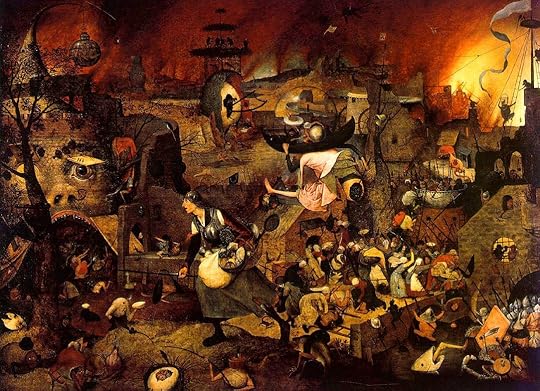
Pieter Bruegel the Elder, Dulle Griet, 1563
Pieter Bruegel the Elder, Dulle Griet, 1563
March 20, 2015
If I were to take my level of enjoyment in reading this novel as a guide, I would have given it 2 stars or maybe even only one. But given my respect for Frayne as a writer, as a playwright, and as a brilliant thinker, I didn’t want to contribute too much to a downward shift in his stats on Goodreads. I read this book for my book club, which is probably the only reason I read until the very end – although I was curious about how it would end, but furious that I had to suffer through so much frustratingly uninteresting stuff to get there.
It starts out well – I found myself laughing out loud at some of the early passages. But then it splits into two quite different stories. In one the first-person narrator schemes to get a painting which he believes to be a Bruegel away from a neighbor. In the second our narrator describes in great detail some very extensive scholarly research on the basis of which he attempts to prove that the painting really is a Bruegel (apparently Frayne actually did this research and incorporated it into the novel). These parts of the novel are interspersed in consecutive chapters, so that the reader is bounced back and forth from one to the other.
The Bruegel research includes some interesting tidbits about European history – especially about the Spanish domination of the Netherlands – as well as a lot of detailed discussion of the contents of a series of known Bruegel paintings. I think I would have enjoyed the Bruegel research if it had been presented as a talk with lots of illustrating slides – as it was presented in the book with text only, I found it very hard to keep track of the argument which relied heavily on the actual content as well as the symbolism of the contents of a number of paintings, and how these relate to the historical context in which they were painted.
As for the narrator’s schemes to snaffle the painting for himself, one very quickly realises that they are all going to fail, especially as they grow increasingly preposterous, working up to a ridiculous crescendo. I know this was all supposed to be funny, but the humor didn’t work for me – I just got tired of being inside the head of this narcissistic fool, who, moreover was involving himself and his eloquently silent wife in a rather large amount of debt to finance his obsession. Normally I love unreliable narrator plots – this one, however, was mostly tiresome. Also the two parts of the story – the scheming and the Bruegel research – are not a good fit, because in the one we have the machinations of a self-absorbed idiot, who, (in the second part) we are supposed to believe, is capable of doing rather complicated erudite research. It is possible that we are meant to see the obsessiveness of the research as a parody of what academics do, but there was too much earnestly complex detail for me to see it that way.

January 30, 2015
Headlong is a fun farce with a good dose of European and Art History thrown into the mix. Martin Clay and his wife Kate escape from London to the British countryside to finish academic books. He is a philosopher and she is an art historian. The adventure is set into motion when they are invited to dinner at a country estate. As they are leaving, the host asks for an opinion on some art work. The overwhelming urge to mansplain takes over so that Martin tromps over his wife and makes himself an art expert. This wanker goes on to become a painfully oblivious narrator as he negotiates the fine art world with a Helen of Troy painting while believing he has found an unknown Brueghel.
At times I got bogged down in the history, but would later find myself on Wikipedia looking for more detail. I think perhaps I was a reacting to Martin's over explaining. He can be rather unbearable. And that is the point. This is an, at times, uncomfortable immersion into British culture and an art history lecture with a narrator that reminds you of David Brent (British Office). All in all, it is worth the time investment; including the time spent on Wikipedia looking at art.
At times I got bogged down in the history, but would later find myself on Wikipedia looking for more detail. I think perhaps I was a reacting to Martin's over explaining. He can be rather unbearable. And that is the point. This is an, at times, uncomfortable immersion into British culture and an art history lecture with a narrator that reminds you of David Brent (British Office). All in all, it is worth the time investment; including the time spent on Wikipedia looking at art.

November 28, 2013
Having loved Spies and Skios, I was really looking forward to reading this. The early scene setting of Martin and his wife arriving at their country home and spending the evening with the local down-at-heel squire and his wife was very funny and drew me in but the story then gets bogged down in detail about Bruegel, his paintings, and other Netherlandish painters. At first I was really quite interested but that quickly changed to impatience with the lack of momentum in the storyline. It does pick up later on and ends in quite a whirlwind of farcical nonsense but I really didn't enjoy it very much.

August 26, 2026
Ο Martin Clay, ένας «φιλόσοφος» που προσπαθεί να γράψει ένα βιβλίο για την ιστορία της διακόσμησης, βρίσκεται στην αγγλική επαρχία με τη σύζυγό του. Εκεί γνωρίζει τον αλαζόνα και αγενή γείτονά τους, Tony, ο οποίος τον καλεί στο σπίτι του για να εκτιμήσει κάποιους πίνακες που θέλει να πουλήσει. Το βιβλίο ξεκινάει δυνατά και κόβει επιταγές ποιότητας, κάνοντας τον αναγνώστη να διαβάζει με ευχαρίστηση και να καταπίνει τις πρώτες σελίδες χαμένος σε μια σχετική αναγνωστική απόλαυση.
Ανάμεσα στα αδιάφορα έργα, ο Martin διαπιστώνει κάτι εκπληκτικό, εντελώς φαντάστιχ και σούπερ καλιφρατζελίστικ: έναν βρώμικο, παραμελημένο πίνακα που καλύπτει μια τρύπα στο τζάκι. Πείθεται ότι πρόκειται για έναν (τύμπανα αγωνίας) χαμένο πίνακα του Pieter Bruegel του Πρεσβύτερου — συγκεκριμένα τον έκτο πίνακα από τη διάσημη σειρά των "Μηνών" (από την οποία διασώζονται μόνο πέντε, όπως οι Κυνηγοί στο Χιόνι).
Κάπου εκεί το βιβλίο παίρνει την κάτω βόλτα, καθώς ο Frayn κάνει τεράστιες, εξαντλητικές «παρενθέσεις» δεκάδων σελίδων για την ιστορία της τέχνης, την εικονογραφία και την πολιτική του 16ου αιώνα. Ακόμα και αν σε συναρπάζει η λεπτομερής ανάλυση της φλαμανδικής ζωγραφικής, αυτά τα τμήματα μοιάζουν με στεγνό, επιτηδευμένο σχολαστικισμό («δήθεν», που λένε στο χωριό μου) που απλά φρενάρει την πλοκή.
Ύστερα είναι η εμμονή: Ο Martin παγιδεύεται σε ένα ντόμινο ψεμάτων, μυστικότητας και εμμονικής έρευνας για να επιβεβαιώσει την αυθεντικότητα του πίνακα και να τον αποκτήσει φθηνά από τον ανίδεο ιδιοκτήτη του, χωρίς να το καταλάβει ούτε η ίδια του η γυναίκα, αλλά ενώ ο συγγραφέας μας βομβαρδίζει με λεπτομέρειες για τη φλαμανδική ζωγραφική του 16ου αιώνα, τη ζωή του Bruegel, την εικονογραφία, αλλά και το ιστορικό πλαίσιο της προτεσταντικής μεταρρύθμισης και της ισπανικής καταστολής στις Κάτω Χώρες, η εμμονή του Martin περνάει λίγο σε δεύτερο πλάνο, καθώς την επισκιάζουν οι εμμονές του συγγραφέα.
Καθώς ο Martin προσπαθεί να ελιχθεί άκομψα, άχαρα και με την άνεση ενός ψαριού πάνω σε ποδήλατο ανάμεσα σε αμφίβολους εμπόρους τέχνης, την καχύποπτη γυναίκα του και τις παράξενες διαθέσεις της συζύγου του Tony, η κατάσταση ξεφεύγει γρήγορα από τον έλεγχό του, ο συγγραφέας αποτυγχάνει να κάνει τη θεωρία της τέχνης να διαβάζεται σαν ελαφρώς χιουμοριστικό θρίλερ ή comedy of manners και δίνει διαρκώς διαλέξεις που σε άλλο πλαίσιο θα είχαν εξαιρετικό ενδιαφέρον, εδώ όμως, απλώς πετάνε την όποια πλοκή από το παράθυρο και κλείνουν το παντζούρι πριν ακόμα σβήσει η φωνή της όπως πέφτει. Για να το θέσω πιο κομψά, η επιλογή του Frayn υπονομεύει το είδος της ιστορίας που ο ίδιος έχει αρχικά υποσχεθεί στον αναγνώστη.
Το βασικό πρόβλημα είναι ότι καρδιά και γενεσιουργό αιτία ίσως του μυθιστορήματος αποτελεί ένα πολύ πραγματικό και διάσημο αίνιγμα της Ιστορίας της Τέχνης: τη σειρά πινάκων «Οι Μήνες» (ή «Εποχές») που φιλοτέχνησε ο Pieter Bruegel ο Πρεσβύτερος το 1565 κατόπιν παραγγελίας του εύπορου εμπόρου Niclaes Jonghelinck από την Αμβέρσα. Ο κύκλος αυτός περιλάμβανε 6 πίνακες, καθένας από τους οποίους αντιπροσώπευε ένα δίμηνο του έτους (προφανώς η ντουζίνα έβγαινε ακριβή και τους χώσανε ανά δύο σε κάθε τελάρο). Από αυτούς τους 6 πίνακες, επιβιώνουν σίγουρα μόνο οι 5 (ρουφήχτε τώρα ιστορία τέχνης από εμένα, επειδή ο Flynn θα σας τα έκανε ζέπελιν):
1. Οι Κυνηγοί στο Χιόνι
2. Η Σκοτεινή Ημέρα
3. Η Συγκομιδή του Χόρτου
4. Οι Θεριστές
5. Η Επιστροφή του Κοπαδιού
6. Ο έκτος πίνακας, που θα κάλυπτε τον Απριλομάη (τη φροντίδα των προβάτων, το κούρεμα ή την πρώιμη συγκομιδή), λείπει από τα ιστορικά αρχεία, γενμικώς δεν ξέρουμε τι απέγινε.
Ο πίνακας λοιπόν που βρίσκει ο Martin καλυμμένο με στρώματα σκόνης και λίπους και ενδεχομένως σκατά, απεικονίζει βοσκούς να κουρεύουν πρόβατα, οπότε καταλήγει στο συμπέρασμα ότι αυτός είναι ο χαμένος 6ος πίνακας της σειράς. Δυστυχώς, οι πίνακες δεν χρησιμοποιούνται απλώς ως σκηνικό, αλλά ενσωματώνονται ως αυθεντική ακαδημαϊκή έρευνα στην πλοκή. Παρακολουθούμε την πραγματική διαδρομή της συλλογής Jonghelinck. Όταν ο Jonghelinck χρεοκόπησε, οι πίνακες δόθηκαν ως εγγύηση στο Δημοτικό Συμβούλιο της Αμβέρσας, πέρασαν στα χέρια του Αρχιδούκα Ερνέστου της Αυστρίας το 1594 και τελικά κατέληξαν στις αυτοκρατορικές συλλογές των Αψβούργων στη Βιέννη.
Για κακή μας τύχη, στο βιβλίο αναλύονται εξονυχιστικά οι συνθέσεις, οι οπτικές γωνίες, οι χρωματικές παλέτες και οι αναλογίες των τοπίων του Bruegel, καθώς συγκρίνεται ο πίνακας που βρέθηκε με τους Θεριστές και τη Συγκομιδή του Χόρτου. Σαν να μην έφταναν αυτά, ο Frayn εξετάζει αν οι πίνακες του Bruegel περιείχαν κρυμμένα μηνύματα κατά της ισπανικής κατοχής των Κάτω Χωρών υπό τον Δούκα της Άλμπα, ή αν ήταν απλώς απεικονίσεις της καθημερινής αγροτικής ζωής.
Και, φυσικά, αν ο αναγνώστης κατάφερνε να ξεπεράσει τον ήδη υψηλό συντελεστή δυσκολίας στο να αγαπήσει το βιβλίο, ο Martin είναι εγωκεντρικός, αλαζόνας, ανέντιμος και εμμονικός πρωταγωνιστής. Η «μανία» του να αποδείξει ότι έχει δίκιο και να βγάλει λεφτά τον κάνει έναν χαρακτήρα με τον οποίο είναι πολύ δύσκολο να ταυτιστείς (ή να συμπονέσεις). Τώρα που το ξανασκέφτομαι, το πρόβλημα δεν είναι απλώς ότι ο Martin είναι αντιπαθητικός· είναι ότι ο Frayn δεν κατορθώνει να μετατρέψει την αντιπάθεια προς αυτόν σε κωμική απόλαυση. Σα να έχεις όλα τα υλικά για παγωτό και να μένεις με γάλα, αυγά και ζάχαρη χυμένα στον πάγκο.
Ακόμη, η κωμωδία καταστάσεων βασίζεται πολύ στην εσωτερική παράνοια του Martin, έτσι το διαρκές «θα με καταλάβουν; / Ω ΠΟΥ ΝΑ ΠΑΡΕΙ δεν θα με καταλάβουν» καταντάει κουραστικό και επαναλαμβανόμενο αντί για αστείο ή έστω αγωνιώδες.
To make a long story short, που λένε στο χωριό μου: Ο Frayn προσπάθησε να ισορροπήσει ανάμεσα σε ένα ελαφρύ, φαρσικό μυθιστόρημα (με αντιπαθητικό πρωταγωνιστή) και σε μια σοβαρή ιστορική μελέτη. Μια συνταγή που (κατ’εμέ) αποτυγχάνει γιατί το αποτέλεσμα δεν είναι ούτε αληθινά διασκεδαστικό ούτε επαρκώς επιστημονικό γιατί μπλέκεται στα μπούτια του με λάθος τρόπο η πλοκή. Ο Frayn έχει βρει ένα εξαιρετικό πραγματικό μυστήριο και έχει κάνει εντυπωσιακή έρευνα, αλλά η έρευνα αυτή σε αρκετά σημεία καταπίνει τη μυθοπλασία που υποτίθεται ότι την καθιστά ενδιαφέρουσα, ή έστω, είναι τόσο εκτεταμένη ώστε, για μένα, παύει σε αρκετά σημεία να λειτουργεί ως κωμικό στοιχείο της μυθοπλασίας και αρχίζει να λειτουργεί σαν αυτόνομη πραγματεία. Και επειδή ο κεντρικός ήρωας δεν είναι αρκετά γοητευτικός ώστε να σηκώσει μόνος του το βάρος της αφήγησης, όταν η πλοκή υποχωρεί, δεν μένει αρκετή κωμωδία για να τη στηρίξει, δεν είναι ούτε τόσο διασκεδαστικό όσο υπόσχεται ούτε τόσο συνεκτικό ως μυθοπλασία όσο θα μπορούσε να είναι
Ανάμεσα στα αδιάφορα έργα, ο Martin διαπιστώνει κάτι εκπληκτικό, εντελώς φαντάστιχ και σούπερ καλιφρατζελίστικ: έναν βρώμικο, παραμελημένο πίνακα που καλύπτει μια τρύπα στο τζάκι. Πείθεται ότι πρόκειται για έναν (τύμπανα αγωνίας) χαμένο πίνακα του Pieter Bruegel του Πρεσβύτερου — συγκεκριμένα τον έκτο πίνακα από τη διάσημη σειρά των "Μηνών" (από την οποία διασώζονται μόνο πέντε, όπως οι Κυνηγοί στο Χιόνι).
Κάπου εκεί το βιβλίο παίρνει την κάτω βόλτα, καθώς ο Frayn κάνει τεράστιες, εξαντλητικές «παρενθέσεις» δεκάδων σελίδων για την ιστορία της τέχνης, την εικονογραφία και την πολιτική του 16ου αιώνα. Ακόμα και αν σε συναρπάζει η λεπτομερής ανάλυση της φλαμανδικής ζωγραφικής, αυτά τα τμήματα μοιάζουν με στεγνό, επιτηδευμένο σχολαστικισμό («δήθεν», που λένε στο χωριό μου) που απλά φρενάρει την πλοκή.
Ύστερα είναι η εμμονή: Ο Martin παγιδεύεται σε ένα ντόμινο ψεμάτων, μυστικότητας και εμμονικής έρευνας για να επιβεβαιώσει την αυθεντικότητα του πίνακα και να τον αποκτήσει φθηνά από τον ανίδεο ιδιοκτήτη του, χωρίς να το καταλάβει ούτε η ίδια του η γυναίκα, αλλά ενώ ο συγγραφέας μας βομβαρδίζει με λεπτομέρειες για τη φλαμανδική ζωγραφική του 16ου αιώνα, τη ζωή του Bruegel, την εικονογραφία, αλλά και το ιστορικό πλαίσιο της προτεσταντικής μεταρρύθμισης και της ισπανικής καταστολής στις Κάτω Χώρες, η εμμονή του Martin περνάει λίγο σε δεύτερο πλάνο, καθώς την επισκιάζουν οι εμμονές του συγγραφέα.
Καθώς ο Martin προσπαθεί να ελιχθεί άκομψα, άχαρα και με την άνεση ενός ψαριού πάνω σε ποδήλατο ανάμεσα σε αμφίβολους εμπόρους τέχνης, την καχύποπτη γυναίκα του και τις παράξενες διαθέσεις της συζύγου του Tony, η κατάσταση ξεφεύγει γρήγορα από τον έλεγχό του, ο συγγραφέας αποτυγχάνει να κάνει τη θεωρία της τέχνης να διαβάζεται σαν ελαφρώς χιουμοριστικό θρίλερ ή comedy of manners και δίνει διαρκώς διαλέξεις που σε άλλο πλαίσιο θα είχαν εξαιρετικό ενδιαφέρον, εδώ όμως, απλώς πετάνε την όποια πλοκή από το παράθυρο και κλείνουν το παντζούρι πριν ακόμα σβήσει η φωνή της όπως πέφτει. Για να το θέσω πιο κομψά, η επιλογή του Frayn υπονομεύει το είδος της ιστορίας που ο ίδιος έχει αρχικά υποσχεθεί στον αναγνώστη.
Το βασικό πρόβλημα είναι ότι καρδιά και γενεσιουργό αιτία ίσως του μυθιστορήματος αποτελεί ένα πολύ πραγματικό και διάσημο αίνιγμα της Ιστορίας της Τέχνης: τη σειρά πινάκων «Οι Μήνες» (ή «Εποχές») που φιλοτέχνησε ο Pieter Bruegel ο Πρεσβύτερος το 1565 κατόπιν παραγγελίας του εύπορου εμπόρου Niclaes Jonghelinck από την Αμβέρσα. Ο κύκλος αυτός περιλάμβανε 6 πίνακες, καθένας από τους οποίους αντιπροσώπευε ένα δίμηνο του έτους (προφανώς η ντουζίνα έβγαινε ακριβή και τους χώσανε ανά δύο σε κάθε τελάρο). Από αυτούς τους 6 πίνακες, επιβιώνουν σίγουρα μόνο οι 5 (ρουφήχτε τώρα ιστορία τέχνης από εμένα, επειδή ο Flynn θα σας τα έκανε ζέπελιν):
1. Οι Κυνηγοί στο Χιόνι
2. Η Σκοτεινή Ημέρα
3. Η Συγκομιδή του Χόρτου
4. Οι Θεριστές
5. Η Επιστροφή του Κοπαδιού
6. Ο έκτος πίνακας, που θα κάλυπτε τον Απριλομάη (τη φροντίδα των προβάτων, το κούρεμα ή την πρώιμη συγκομιδή), λείπει από τα ιστορικά αρχεία, γενμικώς δεν ξέρουμε τι απέγινε.
Ο πίνακας λοιπόν που βρίσκει ο Martin καλυμμένο με στρώματα σκόνης και λίπους και ενδεχομένως σκατά, απεικονίζει βοσκούς να κουρεύουν πρόβατα, οπότε καταλήγει στο συμπέρασμα ότι αυτός είναι ο χαμένος 6ος πίνακας της σειράς. Δυστυχώς, οι πίνακες δεν χρησιμοποιούνται απλώς ως σκηνικό, αλλά ενσωματώνονται ως αυθεντική ακαδημαϊκή έρευνα στην πλοκή. Παρακολουθούμε την πραγματική διαδρομή της συλλογής Jonghelinck. Όταν ο Jonghelinck χρεοκόπησε, οι πίνακες δόθηκαν ως εγγύηση στο Δημοτικό Συμβούλιο της Αμβέρσας, πέρασαν στα χέρια του Αρχιδούκα Ερνέστου της Αυστρίας το 1594 και τελικά κατέληξαν στις αυτοκρατορικές συλλογές των Αψβούργων στη Βιέννη.
Για κακή μας τύχη, στο βιβλίο αναλύονται εξονυχιστικά οι συνθέσεις, οι οπτικές γωνίες, οι χρωματικές παλέτες και οι αναλογίες των τοπίων του Bruegel, καθώς συγκρίνεται ο πίνακας που βρέθηκε με τους Θεριστές και τη Συγκομιδή του Χόρτου. Σαν να μην έφταναν αυτά, ο Frayn εξετάζει αν οι πίνακες του Bruegel περιείχαν κρυμμένα μηνύματα κατά της ισπανικής κατοχής των Κάτω Χωρών υπό τον Δούκα της Άλμπα, ή αν ήταν απλώς απεικονίσεις της καθημερινής αγροτικής ζωής.
Και, φυσικά, αν ο αναγνώστης κατάφερνε να ξεπεράσει τον ήδη υψηλό συντελεστή δυσκολίας στο να αγαπήσει το βιβλίο, ο Martin είναι εγωκεντρικός, αλαζόνας, ανέντιμος και εμμονικός πρωταγωνιστής. Η «μανία» του να αποδείξει ότι έχει δίκιο και να βγάλει λεφτά τον κάνει έναν χαρακτήρα με τον οποίο είναι πολύ δύσκολο να ταυτιστείς (ή να συμπονέσεις). Τώρα που το ξανασκέφτομαι, το πρόβλημα δεν είναι απλώς ότι ο Martin είναι αντιπαθητικός· είναι ότι ο Frayn δεν κατορθώνει να μετατρέψει την αντιπάθεια προς αυτόν σε κωμική απόλαυση. Σα να έχεις όλα τα υλικά για παγωτό και να μένεις με γάλα, αυγά και ζάχαρη χυμένα στον πάγκο.
Ακόμη, η κωμωδία καταστάσεων βασίζεται πολύ στην εσωτερική παράνοια του Martin, έτσι το διαρκές «θα με καταλάβουν; / Ω ΠΟΥ ΝΑ ΠΑΡΕΙ δεν θα με καταλάβουν» καταντάει κουραστικό και επαναλαμβανόμενο αντί για αστείο ή έστω αγωνιώδες.
To make a long story short, που λένε στο χωριό μου: Ο Frayn προσπάθησε να ισορροπήσει ανάμεσα σε ένα ελαφρύ, φαρσικό μυθιστόρημα (με αντιπαθητικό πρωταγωνιστή) και σε μια σοβαρή ιστορική μελέτη. Μια συνταγή που (κατ’εμέ) αποτυγχάνει γιατί το αποτέλεσμα δεν είναι ούτε αληθινά διασκεδαστικό ούτε επαρκώς επιστημονικό γιατί μπλέκεται στα μπούτια του με λάθος τρόπο η πλοκή. Ο Frayn έχει βρει ένα εξαιρετικό πραγματικό μυστήριο και έχει κάνει εντυπωσιακή έρευνα, αλλά η έρευνα αυτή σε αρκετά σημεία καταπίνει τη μυθοπλασία που υποτίθεται ότι την καθιστά ενδιαφέρουσα, ή έστω, είναι τόσο εκτεταμένη ώστε, για μένα, παύει σε αρκετά σημεία να λειτουργεί ως κωμικό στοιχείο της μυθοπλασίας και αρχίζει να λειτουργεί σαν αυτόνομη πραγματεία. Και επειδή ο κεντρικός ήρωας δεν είναι αρκετά γοητευτικός ώστε να σηκώσει μόνος του το βάρος της αφήγησης, όταν η πλοκή υποχωρεί, δεν μένει αρκετή κωμωδία για να τη στηρίξει, δεν είναι ούτε τόσο διασκεδαστικό όσο υπόσχεται ούτε τόσο συνεκτικό ως μυθοπλασία όσο θα μπορούσε να είναι

April 15, 2019
Great material: Low Lands. 16th Century. Art. Bruegel. Greed...
Unfortunately the flavor of these ingredients got lost in the effort of cooking.
Unfortunately the flavor of these ingredients got lost in the effort of cooking.

June 22, 2015
This book was quite different from anything I've read before, and I have to say, I loved it! The main character, Martin, is a hoot - someone who is so obsessed with taking ownership of a painting that he is sure is a long-lost Bruegel that things like money troubles and adultery seem like minor inconveniences in his quest. Since Martin is the narrator of the book we see everything from his perspective and are privy to his often hilarious thoughts and dry comments that he keeps to himself. I was laughing out loud from the very beginning.
As a lover of art history, I thoroughly enjoyed the in-depth research Martin goes through while trying to determine if the painting is actually a true Bruegel. The irony is, of course, that, in all he research he barely glances at the painting itself for more than a few minutes! The elaborate plan he comes up with to gain possession of the painting in question without alerting anyone (especially not its current owner) of the value of it is downright ridiculous. It is very entertaining to see everything unfold and to see what unexpected things occur that infuriate Martin and interfere with his maniacal plan.
The book drags a bit in the middle when Martin is mostly talking (or thinking) to himself while doing his research on Bruegel. The other characters in the book are eccentric in their own way and the narrative definitely loses steam when they are not in the picture. On the other hand, I have to say that I feel that after reading this novel I have gained considerable knowledge of the 16th century Netherlandish political landscape (of which I previously knew nothing), as well a great insight into the paintings of Bruegel. I can't wait to visit the Kunsthistoriches Museum and view the room of Bruegels with this new-found knowledge when I travel to Vienna in October!
My favorite parts of this book by far were the outrageous situations in which Martin found himself and the hilarious commentary that accompanied them. I was in stitches when he was driving the Land Rover for the first time and was discovering that it had a mind of its own and was making all the decisions for him. I was snorting with laughter when Laura was coming on to him and he was more concerned with trying to catch a glimpse of "his" painting over her shoulder. The final chase scene (as well as the lead-up to it) was entirely ridiculous, as were his priorities at the end of it.
At first I was a bit disappointed in the ending (it was less conclusive than I had hoped), but after further reflection I think that it was, in fact, very fitting. I also appreciated the irony when the value of the paintings he had deemed worthless was revealed. The whole book was a commentary on the folly of self-declared art experts with narrow focuses and how everything is relative in the art world. One art critic's trash is another's treasure. I found this book immensely enjoyable and am glad that I gave a book that had a somewhat strange premise a chance.
As a lover of art history, I thoroughly enjoyed the in-depth research Martin goes through while trying to determine if the painting is actually a true Bruegel. The irony is, of course, that, in all he research he barely glances at the painting itself for more than a few minutes! The elaborate plan he comes up with to gain possession of the painting in question without alerting anyone (especially not its current owner) of the value of it is downright ridiculous. It is very entertaining to see everything unfold and to see what unexpected things occur that infuriate Martin and interfere with his maniacal plan.
The book drags a bit in the middle when Martin is mostly talking (or thinking) to himself while doing his research on Bruegel. The other characters in the book are eccentric in their own way and the narrative definitely loses steam when they are not in the picture. On the other hand, I have to say that I feel that after reading this novel I have gained considerable knowledge of the 16th century Netherlandish political landscape (of which I previously knew nothing), as well a great insight into the paintings of Bruegel. I can't wait to visit the Kunsthistoriches Museum and view the room of Bruegels with this new-found knowledge when I travel to Vienna in October!
My favorite parts of this book by far were the outrageous situations in which Martin found himself and the hilarious commentary that accompanied them. I was in stitches when he was driving the Land Rover for the first time and was discovering that it had a mind of its own and was making all the decisions for him. I was snorting with laughter when Laura was coming on to him and he was more concerned with trying to catch a glimpse of "his" painting over her shoulder. The final chase scene (as well as the lead-up to it) was entirely ridiculous, as were his priorities at the end of it.
At first I was a bit disappointed in the ending (it was less conclusive than I had hoped), but after further reflection I think that it was, in fact, very fitting. I also appreciated the irony when the value of the paintings he had deemed worthless was revealed. The whole book was a commentary on the folly of self-declared art experts with narrow focuses and how everything is relative in the art world. One art critic's trash is another's treasure. I found this book immensely enjoyable and am glad that I gave a book that had a somewhat strange premise a chance.

August 26, 2007
I see that I had started this once before and gave up. I'm glad I returned to it, but I confess to ambivalent feelings now that I've made it to the end.
Martin Clay is a British philosopher who can never seem to finish his projects, married to a younger wife, Kate. Together, they and new baby Tilda go to the dilapidated country house they visit in the summer, ostensibly so that Martin can finish a book about nominalism in the Netherlands that you can tell he barely cares about.
To their surprise, they encounter a local landowner on their arrival, Tony Churt, a bumptious, arrogant owner of a great pile, surrounded by his manic dogs, his young sensual wife Laura and his many failed schemes to make money to save his estate.
The crux of the book is what happens on the Clays' first visit to the Churts, where Tony wants Martin's opinion on the value of a huge painting of the abduction of Helen. In the process, Martin sees another painting on a wooden board that immediately spellbinds him, and which we find out he suspects is by Peter Breugel the Elder.
From then on, Headlong is either a farce masquerading as an art history essay, or the obverse. When Frayn gets rolling with the farce, as he does in the frenetic climax of the book, it can be bracing and riveting. But when he takes you inside Martin's scholarly pursuit of trying to prove the painting is a Breugel and putting it in the context of the Spanish persecution of the Netherlands in the mid-1500s, you have to have a very high tolerance for geekiness (which I think I do, which is probably what got me through those passages).
In the end, though, my real problem with the book was that once again, I had encountered a main character whom the author had made you empathize with and even like, until you took two mental steps back and realized you never understood his sudden impulse of greed in the first place or exactly how much he loved anyone but himself.
Why three stars after all this doubt? Because Frayn is a wonderful writer, and sometimes, I just let that tip me one star up the ladder.

March 24, 2011
The main character of this book, a philosophy professor, finds a work of art in a neighbor's home that he thinks may be one of the most famous lost paintings in history. He immediately begins researching the artist he thinks painted it, as well as the time period he lived in (Netherlands in the 1500s), to prove that the painting really is what he thinks it is. The only problem is that he has an extremely difficult time getting a good look at the painting because he doesn't want the owner to know what a valuable possession he may have. The professor becomes more and more focused on getting his hands on this elusive painting and as a result becomes increasingly entangled in a web of deceit.
When I first started reading this novel, I wasn't so sure I was going to like it. The main character is a philosophy professor, and there are obscure academic terms thrown around as well as long sections of historical information. However, the farther I got into the book, the more I was pulled "headlong" into the storyline. Not only does the professor's situation get more desperate (and therefore more interesting) as the novel progresses, but his research findings tell their own story. What I first thought of as a dry and meaningless account of life in Netherlands hundreds of years ago slowly began to shape into a time period that was as full of drama as the professor's life.
After I finished the book, I did a few cursory searches about the painter and the paintings that are described in Headlong, and all of them are real, even the painting that is missing. It appears that the author did a huge amount of historical research himself, which makes the book all the better, in my opinion.
When I first started reading this novel, I wasn't so sure I was going to like it. The main character is a philosophy professor, and there are obscure academic terms thrown around as well as long sections of historical information. However, the farther I got into the book, the more I was pulled "headlong" into the storyline. Not only does the professor's situation get more desperate (and therefore more interesting) as the novel progresses, but his research findings tell their own story. What I first thought of as a dry and meaningless account of life in Netherlands hundreds of years ago slowly began to shape into a time period that was as full of drama as the professor's life.
After I finished the book, I did a few cursory searches about the painter and the paintings that are described in Headlong, and all of them are real, even the painting that is missing. It appears that the author did a huge amount of historical research himself, which makes the book all the better, in my opinion.

January 21, 2018
A young scientist from London, on a country holliday with his wife and a small child, stumbles upon, what he believes to be, a lost masterpiece, and falls in love with it in the matter of seconds. Putting at risk the future of his family, he devises a plan to get hold of the painting and at the same time desperately searches for proofs that what his heart tells him, is true.
The search for clues takes us on a research journey through the turbulent 16th century in Netherlands and it’s art world. The country was then, ruled by catholic Spanish kings, protestantism was new - and growing, holy inquisition was threatening anyone who opposed the dominance of the church, and it was also the beginning of renaissance.
The roller-coaster of the plot and the main character’s emotions, who struggles with his conscience and desires, the flood of knowledge about Bruegel and other painters of the period, the symbolism and iconography in 16 century painting, left me somewhat exhausted and slightly out of breath at the end and yet happy that since I have reached the end, I don’t have to hang in there any more.
Partly about art, history and human obsessions, I enjoyed it a lot - it is a fascinating, very good book.
The search for clues takes us on a research journey through the turbulent 16th century in Netherlands and it’s art world. The country was then, ruled by catholic Spanish kings, protestantism was new - and growing, holy inquisition was threatening anyone who opposed the dominance of the church, and it was also the beginning of renaissance.
The roller-coaster of the plot and the main character’s emotions, who struggles with his conscience and desires, the flood of knowledge about Bruegel and other painters of the period, the symbolism and iconography in 16 century painting, left me somewhat exhausted and slightly out of breath at the end and yet happy that since I have reached the end, I don’t have to hang in there any more.
Partly about art, history and human obsessions, I enjoyed it a lot - it is a fascinating, very good book.
March 24, 2011
I couldn't tell whether the author was being deliberately pendantic, arrogant, and judgmental of those not in the know because his character was supposed to be that way, or whether it really was like reading Chritopher Hitchens on art. The story of a (non art expert) who thinks he has unwittingly uncovered a long missing Bruegel, and his machinations to acquire the piece at all costs (for the sake of the world, he claims, but it seems the money doesn't hurt). Quite an annoying character. Some was interesting, but I had trouble following some of the iconography and his lengthy treatises convincing himself of the authenticity and found it a bit tedious.
January 26, 2013
Af first i really enjoyed this book - seemed to be introduving some interesting characters and an intriguing opening scenario. But it rapidly turned into what I see as a typical attempt at the booker candidate, for which you need a well written book of course, but importantly with a focus on an obscure and narrow subject, ideally with its own esoteric vocabulary, eg Japanese garden design, German 1920s architecture or (in this case) Belgian painters of the mid 16th century.
I have simple tastes - I look for a well written story. And although here there were a couple of instances where the author came dangerously close to doing this, ultimately he had a greater desire to show off all the fascinating art history he learnt to write this book and completely forgot to entertain the reader. Shame.
November 23, 2008
If you like art in historical context, there are things to like here. I could have done without some of the extramarital nonsense though... Don't read unless you REALLY want to hear about the Netherlands of the 17th century...
Displaying 1 - 30 of 468 reviews