

What do you think?

Ending Up
An alternative cover edition for this ISBN can be found here
The title refers to how we spend our retirement years, often called "golden," though in Kingsley Amis' hands anything but.
At Tuppenny-Hapenny Cottage a clutch of oldsters, brought together more by ill fortune than blood or love, struggles with problems that range from penury to prostate. That's the good news. The rest is Amis as usual, providing fun for himself and his readers at the expense of his characters.
The title refers to how we spend our retirement years, often called "golden," though in Kingsley Amis' hands anything but.
At Tuppenny-Hapenny Cottage a clutch of oldsters, brought together more by ill fortune than blood or love, struggles with problems that range from penury to prostate. That's the good news. The rest is Amis as usual, providing fun for himself and his readers at the expense of his characters.
176 pages, Paperback
First published January 1, 1974
About the author
Kingsley Amis
221 books580 followersBest known novels of British writer Sir Kingsley William Amis include
Lucky Jim
(1954) and
The Old Devils
(1986).
This English poet, critic, and teacher composed more than twenty-three collections, short stories, radio and television scripts, and books of social and literary criticism. He fathered Martin Amis.
William Robert Amis, a clerk of a mustard manufacturer, fathered him. He began his education at the city of London school, and went up to college of Saint John, Oxford, in April 1941 to read English; he met Philip Larkin and formed the most important friendship of his life. After only a year, the Army called him for service in July 1942. After serving as a lieutenant in the royal corps of signals in the Second World War, Amis returned to Oxford in October 1945 to complete his degree. He worked hard and got a first in English in 1947, and then decided to devote much of his time.
Pen names: [authorRobert Markham|553548] and William Bill Tanner
This English poet, critic, and teacher composed more than twenty-three collections, short stories, radio and television scripts, and books of social and literary criticism. He fathered Martin Amis.
William Robert Amis, a clerk of a mustard manufacturer, fathered him. He began his education at the city of London school, and went up to college of Saint John, Oxford, in April 1941 to read English; he met Philip Larkin and formed the most important friendship of his life. After only a year, the Army called him for service in July 1942. After serving as a lieutenant in the royal corps of signals in the Second World War, Amis returned to Oxford in October 1945 to complete his degree. He worked hard and got a first in English in 1947, and then decided to devote much of his time.
Pen names: [authorRobert Markham|553548] and William Bill Tanner
Ratings & Reviews
Friends & Following
Create a free account to discover what your friends think of this book!
Community Reviews
Displaying 1 - 30 of 152 reviews

November 13, 2015

British author Kingsley Amis’ 1973 novel of two old women and three old men living out their last days in Tuppenny-hapenny Cottage nestled among the trees and fields in a delightful English countryside. Sound quaint and perhaps charming? It is anything but quaint and charming – for the most part these five septuagenarians – Adela, the one squarely in charge, her brother, former army officer, Bernard, Bernard’s past sexual partner, a servant nicknamed Shorty, Marigold, an oldster becoming progressively more senile and finally George, an emeritus history professor who has suffered a serious stroke – are at each others' throats.
But being well-mannered modern day Brits, their hostility seethes beneath an ironic, sarcastic, understated and occasionally humorous surface, especially Bernard, who is both the most malicious and the most interesting of the five, a stark fact that speaks volumes about the nature of fiction. Wisdom, anyone? Hardly in evidence at Tuppenny-hapenny. In support of this observation, here are several quotes from Greco-Roman Stoic philosopher, the emperor Marcus Aurelius, coupled with incidents from the book:
“Dwell on the beauty of life. Watch the stars, and see yourself running with them.”
Over 200 pages with numerous references to listening to the wireless, taking time out to smoke, spending time planning one’s alcohol consumption and, of course, zeniths of zeniths, ultimate elixir to allay frustration and boredom, imbibing booze. However, must unfortunately, not one reference to the beauty of the natural world or the beauty of any of the arts or literature. Sure, somewhat begrudgingly, there’s singing a few songs together on Christmas day, but other than this thin musical gruel, plodding through life devoid of aesthetic experience.
“The best revenge is to be unlike him who performed the injury.”
Bernard gets his kicks and jollies from making life miserable for everyone else, not only Adela, Shorty, Marigold and George, but Marigold’s cat and George’s old dog. Damn those two for owning animals they actually have affection for and love tenderly! At one point Bernard soaks Marigold’s cat with his squirt-gun to frame Shorty and at another time sets off a stink bomb to frame George’s dog. Thus, in a way, we have a tale of caution. It is as if Kingsley Amis is asking readers of his novel to consider extracting a kind of Marcus Aurelius-style revenge by not turning out to be anything like Bernard.
“Accept the things to which fate binds you, and love the people with whom fate brings you together, but do so with all your heart.”
Turns out, the bedridden stroke-victim is the one who gracefully accepts his fate and expresses his gratitude for those gifts life does offer to him. We read George’s words of thanks for his newly restored ability to speak fluently, words he speaks whilst downstairs (he has to be carried from his bedroom) conversing with others in the parlor: “You’ve no idea how marvelous it feels. I don’t mind being half paralyzed now, except that it’s a nuisance to other people. The gift of language us a very precious thing.” And, almost predictably, George’s heartfelt sentiments are received with sarcasm by, you guessed it, our former military officer, ultimate black-bile stinker and enjoyer of others' misery - Bernard.
“You are a little soul carrying about a corpse, as Epictetus used to say.”
This is secular 1972 England. Religion plays little or no part in the lives of these old people. Unfortunately, along with religion, the spiritual dimension is conspicuously absent, one of the tragedies of our modern world – the experience of the inner light, the eternal aspect of our human nature linking us with the cosmos is either a very minor cord or an entirely forgotten cord. And the alternative? Habitually asking that most modern of questions: When can I have my next drink?
The humor in Ending Up arises naturally from the characters and the action; nothing struck me as forced to produce a laugh. Similar to B. S. Johnson’s House Mother Normal, I highly recommend this Kingsley Amis novel since odds are we will all live to see old age and a little bit of knowledge of this subject via literature isn’t a bad thing.

July 14, 2025
Ending Up by Kingsley Amis
10 out of 10
Discovering Kingsley Amis could be one of the most exhilarating, luminous, paramount, otherworldly and amusing experiences, given the extraordinary talent of an author that has won the Booker Prize – for which he was short-listed three times – and his first book, Lucky Jim, has been included on the All-TIME 100 Novels list -http://realini.blogspot.com/2018/05/l...
The extraordinary experience of reading Ending Up comes as no surprise for some acquainted with Kingsley Amis; say by having read the astounding, hilarious Lucky Jim, although the premise of this masterpiece - short-listed for the Booker Prize - does not encourage high expectations, not for mirth anyway.
Yet, the story of five retired men and women, residents of the dilapidated, at times cut off from the world Tuppenny- hapenny Cottage, provides laughter that can cause belly aches – hence a warning for the reader…
Bernard may be one of the favorite characters, in spite of his grumpiness, penchant for mischief and sometimes cruelty towards animals and companions alike, especially after one finds about his illness, that would explain in large part his nefarious ways, if not completely.
He shares the same room, given to circumstances, the fact that all the residents are short of money, with a former lover, called Shorty, a man given to drinking too much, in spite of the dangers that poses to his liver, as the visiting doctor indicates.
Adela is Bernard’s sister and the woman who keeps the house going, even if we will find out that she has health problems, perhaps natural for all those involved, given their senectitude, various accidents that have brought them together and their lack of means for better health care.
Shorty is the only one that helps Adela, for Bernard has an even poorer health, notwithstanding the fact that his leg problems appear to come and go rather haphazardly – or better said, according to his moods – Marigold and George, the remaining occupants of the cottage are not contributing to the upkeep of the household.
Marigold is an old friend of Adela, although she would never kiss her, hesitates whenever she is asked if she would go for a walk with her friend, facing the prospect of losing her memory and fearing that she would be senile, seeing as she is sending the same letter twice or more, with time she even forgets much – almost everything- about her late husband.
George is the brother in law of Bernard, a professor of history, specialized in the affairs of Central Europe, brother of the deceased wife of the most mischievous personage of this chef d’oeuvre, suffering from a near total paralysis after a heart stroke that keeps him in a bedroom at the upper floor, with few incursions in the sitting room downstairs.
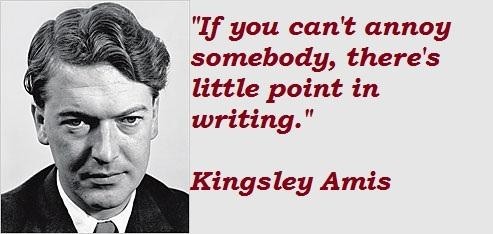
The only remaining “entertainment” seems to be creating havoc and suffering among the other inhabitants of the cottage, making one think of a quote of Kingsley Amis: “If you can't annoy somebody, there's little point in writing.”
Bernard tries to inflict pain on Marigold by attacking her cat with a water pistol first, making the rather haughty, pretentious woman to suspect Shorty,, who, although not fond of the arrogant cohabitant, has no hand in wetting the poor animal.
Another time, the same vile, if funny Bernard attempts to use a stink bomb to aggravate the feeling of loss that Marigold is already experiencing, seeing as she loses her ability to recollect various events, people or things, by making the poor amnesiac think that her insides are decomposing when she feels the awful, abominable smell.Ending Up by Kingsley Amis
Discovering Kingsley Amis could be one of the most exhilarating, luminous, paramount, otherworldly and amusing experiences, given the extraordinary talent of an author that has won the Booker Prize – for which he was short-listed three times – and his first book, Lucky Jim, has been included on the All-TIME 100 Novels list -http://realini.blogspot.com/2018/05/l...
The extraordinary experience of reading Ending Up comes as no surprise for some acquainted with Kingsley Amis; say by having read the astounding, hilarious Lucky Jim, although the premise of this masterpiece - short-listed for the Booker Prize - does not encourage high expectations, not for mirth anyway.
Yet, the story of five retired men and women, residents of the dilapidated, at times cut off from the world Tuppenny- hapenny Cottage, provides laughter that can cause belly aches – hence a warning for the reader…
Bernard may be one of the favorite characters, in spite of his grumpiness, penchant for mischief and sometimes cruelty towards animals and companions alike, especially after one finds about his illness, that would explain in large part his nefarious ways, if not completely.
He shares the same room, given to circumstances, the fact that all the residents are short of money, with a former lover, called Shorty, a man given to drinking too much, in spite of the dangers that poses to his liver, as the visiting doctor indicates.
Adela is Bernard’s sister and the woman who keeps the house going, even if we will find out that she has health problems, perhaps natural for all those involved, given their senectitude, various accidents that have brought them together and their lack of means for better health care.
Shorty is the only one that helps Adela, for Bernard has an even poorer health, notwithstanding the fact that his leg problems appear to come and go rather haphazardly – or better said, according to his moods – Marigold and George, the remaining occupants of the cottage are not contributing to the upkeep of the household.
Marigold is an old friend of Adela, although she would never kiss her, hesitates whenever she is asked if she would go for a walk with her friend, facing the prospect of losing her memory and fearing that she would be senile, seeing as she is sending the same letter twice or more, with time she even forgets much – almost everything- about her late husband.
George is the brother in law of Bernard, a professor of history, specialized in the affairs of Central Europe, brother of the deceased wife of the most mischievous personage of this chef d’oeuvre, suffering from a near total paralysis after a heart stroke that keeps him in a bedroom at the upper floor, with few incursions in the sitting room downstairs.
The only remaining “entertainment” seems to be creating havoc and suffering among the other inhabitants of the cottage, making one think of a quote of Kingsley Amis: “If you can't annoy somebody, there's little point in writing.”
Bernard tries to inflict pain on Marigold by attacking her cat with a water pistol first, making the rather haughty, pretentious woman to suspect Shorty,, who, although not fond of the arrogant cohabitant, has no hand in wetting the poor animal.
Another time, the same vile, if funny Bernard attempts to use a stink bomb to aggravate the feeling of loss that Marigold is already experiencing, seeing as she loses her ability to recollect various events, people or things, by making the poor amnesiac think that her insides are decomposing when she feels the awful, abominable smell.
Another prank is attempted on Shorty- the two have had no sex for many years – who is inebriated for most of the day, since he abuses large quantities of alcohol hidden in and around the house, on the day of a visit from the grandchildren of Marigold, taking advantage of the ensuing kerfuffle.
Bernard takes a used can of tomatoes from the trash, urinates in it, and then places the content on the fire, for he cannot use it if it is cold for his nefarious purpose, which is to pour it on the sleeping Shorty’s crouch, making him believe he is incontinent when he awakes…
Both vile attempts fail, for Shorty does not seem to mind – he even says to himself that this is not the first and will not be the last time he pees on himself- and Marigold does not have the chance to smell the stink bomb, George has.
There are further plans, once Bernard claims in front of the forgetting “Goldie” that robbers in the village might come any time soon and vandalize their cottage, maybe use violence, and when she asks about this, he pretends she has told him about it the previous day…
Furthermore, he attempts to create the impression that there is an attack on the house, takes a ladder, and cuts the telephone wire to further make his case and alarm the residents, even better cause them to panic.
Alas, this backfires, but there would be no more details that can constitute a spoiler that could in any way compromise the infinite pleasure of reading such a comical, mesmerizing, splendid masterpiece about five old people, their illnesses and their misfortunes, all coupled with phenomenal events.
It sounds hard to believe, but this is one of the best novels you can read this, or any other summer.
http://entertainment.time.com/2005/10...
Another prank is attempted on Shorty- the two have had no sex for many years – who is inebriated for most of the day, since he abuses large quantities of alcohol hidden in and around the house, on the day of a visit from the grandchildren of Marigold, taking advantage of the ensuing kerfuffle.
Bernard takes a used can of tomatoes from the trash, urinates in it, and then places the content on the fire, for he cannot use it if it is cold for his nefarious purpose, which is to pour it on the sleeping Shorty’s crouch, making him believe he is incontinent when he awakes…
Both vile attempts fail, for Shorty does not seem to mind – he even says to himself that this is not the first and will not be the last time he pees on himself- and Marigold does not have the chance to smell the stink bomb, George has.
There are further plans, once Bernard claims in front of the forgetting “Goldie” that robbers in the village might come any time soon and vandalize their cottage, maybe use violence, and when she asks about this, he pretends she has told him about it the previous day…
Furthermore, he attempts to create the impression that there is an attack on the house, takes a ladder, and cuts the telephone wire to further make his case and alarm the residents, even better cause them to panic.
Alas, this backfires, but there would be no more details that can constitute a spoiler that could in any way compromise the infinite pleasure of reading such a comical, mesmerizing, splendid masterpiece about five old people, their illnesses and their misfortunes, all coupled with phenomenal events.
It sounds hard to believe, but this is one of the best novels you can read this, or any other summer.
http://entertainment.time.com/2005/10...
10 out of 10
Discovering Kingsley Amis could be one of the most exhilarating, luminous, paramount, otherworldly and amusing experiences, given the extraordinary talent of an author that has won the Booker Prize – for which he was short-listed three times – and his first book, Lucky Jim, has been included on the All-TIME 100 Novels list -http://realini.blogspot.com/2018/05/l...
The extraordinary experience of reading Ending Up comes as no surprise for some acquainted with Kingsley Amis; say by having read the astounding, hilarious Lucky Jim, although the premise of this masterpiece - short-listed for the Booker Prize - does not encourage high expectations, not for mirth anyway.
Yet, the story of five retired men and women, residents of the dilapidated, at times cut off from the world Tuppenny- hapenny Cottage, provides laughter that can cause belly aches – hence a warning for the reader…
Bernard may be one of the favorite characters, in spite of his grumpiness, penchant for mischief and sometimes cruelty towards animals and companions alike, especially after one finds about his illness, that would explain in large part his nefarious ways, if not completely.
He shares the same room, given to circumstances, the fact that all the residents are short of money, with a former lover, called Shorty, a man given to drinking too much, in spite of the dangers that poses to his liver, as the visiting doctor indicates.
Adela is Bernard’s sister and the woman who keeps the house going, even if we will find out that she has health problems, perhaps natural for all those involved, given their senectitude, various accidents that have brought them together and their lack of means for better health care.
Shorty is the only one that helps Adela, for Bernard has an even poorer health, notwithstanding the fact that his leg problems appear to come and go rather haphazardly – or better said, according to his moods – Marigold and George, the remaining occupants of the cottage are not contributing to the upkeep of the household.
Marigold is an old friend of Adela, although she would never kiss her, hesitates whenever she is asked if she would go for a walk with her friend, facing the prospect of losing her memory and fearing that she would be senile, seeing as she is sending the same letter twice or more, with time she even forgets much – almost everything- about her late husband.
George is the brother in law of Bernard, a professor of history, specialized in the affairs of Central Europe, brother of the deceased wife of the most mischievous personage of this chef d’oeuvre, suffering from a near total paralysis after a heart stroke that keeps him in a bedroom at the upper floor, with few incursions in the sitting room downstairs.
The only remaining “entertainment” seems to be creating havoc and suffering among the other inhabitants of the cottage, making one think of a quote of Kingsley Amis: “If you can't annoy somebody, there's little point in writing.”
Bernard tries to inflict pain on Marigold by attacking her cat with a water pistol first, making the rather haughty, pretentious woman to suspect Shorty,, who, although not fond of the arrogant cohabitant, has no hand in wetting the poor animal.
Another time, the same vile, if funny Bernard attempts to use a stink bomb to aggravate the feeling of loss that Marigold is already experiencing, seeing as she loses her ability to recollect various events, people or things, by making the poor amnesiac think that her insides are decomposing when she feels the awful, abominable smell.Ending Up by Kingsley Amis
Discovering Kingsley Amis could be one of the most exhilarating, luminous, paramount, otherworldly and amusing experiences, given the extraordinary talent of an author that has won the Booker Prize – for which he was short-listed three times – and his first book, Lucky Jim, has been included on the All-TIME 100 Novels list -http://realini.blogspot.com/2018/05/l...
The extraordinary experience of reading Ending Up comes as no surprise for some acquainted with Kingsley Amis; say by having read the astounding, hilarious Lucky Jim, although the premise of this masterpiece - short-listed for the Booker Prize - does not encourage high expectations, not for mirth anyway.
Yet, the story of five retired men and women, residents of the dilapidated, at times cut off from the world Tuppenny- hapenny Cottage, provides laughter that can cause belly aches – hence a warning for the reader…
Bernard may be one of the favorite characters, in spite of his grumpiness, penchant for mischief and sometimes cruelty towards animals and companions alike, especially after one finds about his illness, that would explain in large part his nefarious ways, if not completely.
He shares the same room, given to circumstances, the fact that all the residents are short of money, with a former lover, called Shorty, a man given to drinking too much, in spite of the dangers that poses to his liver, as the visiting doctor indicates.
Adela is Bernard’s sister and the woman who keeps the house going, even if we will find out that she has health problems, perhaps natural for all those involved, given their senectitude, various accidents that have brought them together and their lack of means for better health care.
Shorty is the only one that helps Adela, for Bernard has an even poorer health, notwithstanding the fact that his leg problems appear to come and go rather haphazardly – or better said, according to his moods – Marigold and George, the remaining occupants of the cottage are not contributing to the upkeep of the household.
Marigold is an old friend of Adela, although she would never kiss her, hesitates whenever she is asked if she would go for a walk with her friend, facing the prospect of losing her memory and fearing that she would be senile, seeing as she is sending the same letter twice or more, with time she even forgets much – almost everything- about her late husband.
George is the brother in law of Bernard, a professor of history, specialized in the affairs of Central Europe, brother of the deceased wife of the most mischievous personage of this chef d’oeuvre, suffering from a near total paralysis after a heart stroke that keeps him in a bedroom at the upper floor, with few incursions in the sitting room downstairs.
The only remaining “entertainment” seems to be creating havoc and suffering among the other inhabitants of the cottage, making one think of a quote of Kingsley Amis: “If you can't annoy somebody, there's little point in writing.”
Bernard tries to inflict pain on Marigold by attacking her cat with a water pistol first, making the rather haughty, pretentious woman to suspect Shorty,, who, although not fond of the arrogant cohabitant, has no hand in wetting the poor animal.
Another time, the same vile, if funny Bernard attempts to use a stink bomb to aggravate the feeling of loss that Marigold is already experiencing, seeing as she loses her ability to recollect various events, people or things, by making the poor amnesiac think that her insides are decomposing when she feels the awful, abominable smell.
Another prank is attempted on Shorty- the two have had no sex for many years – who is inebriated for most of the day, since he abuses large quantities of alcohol hidden in and around the house, on the day of a visit from the grandchildren of Marigold, taking advantage of the ensuing kerfuffle.
Bernard takes a used can of tomatoes from the trash, urinates in it, and then places the content on the fire, for he cannot use it if it is cold for his nefarious purpose, which is to pour it on the sleeping Shorty’s crouch, making him believe he is incontinent when he awakes…
Both vile attempts fail, for Shorty does not seem to mind – he even says to himself that this is not the first and will not be the last time he pees on himself- and Marigold does not have the chance to smell the stink bomb, George has.
There are further plans, once Bernard claims in front of the forgetting “Goldie” that robbers in the village might come any time soon and vandalize their cottage, maybe use violence, and when she asks about this, he pretends she has told him about it the previous day…
Furthermore, he attempts to create the impression that there is an attack on the house, takes a ladder, and cuts the telephone wire to further make his case and alarm the residents, even better cause them to panic.
Alas, this backfires, but there would be no more details that can constitute a spoiler that could in any way compromise the infinite pleasure of reading such a comical, mesmerizing, splendid masterpiece about five old people, their illnesses and their misfortunes, all coupled with phenomenal events.
It sounds hard to believe, but this is one of the best novels you can read this, or any other summer.
http://entertainment.time.com/2005/10...
Another prank is attempted on Shorty- the two have had no sex for many years – who is inebriated for most of the day, since he abuses large quantities of alcohol hidden in and around the house, on the day of a visit from the grandchildren of Marigold, taking advantage of the ensuing kerfuffle.
Bernard takes a used can of tomatoes from the trash, urinates in it, and then places the content on the fire, for he cannot use it if it is cold for his nefarious purpose, which is to pour it on the sleeping Shorty’s crouch, making him believe he is incontinent when he awakes…
Both vile attempts fail, for Shorty does not seem to mind – he even says to himself that this is not the first and will not be the last time he pees on himself- and Marigold does not have the chance to smell the stink bomb, George has.
There are further plans, once Bernard claims in front of the forgetting “Goldie” that robbers in the village might come any time soon and vandalize their cottage, maybe use violence, and when she asks about this, he pretends she has told him about it the previous day…
Furthermore, he attempts to create the impression that there is an attack on the house, takes a ladder, and cuts the telephone wire to further make his case and alarm the residents, even better cause them to panic.
Alas, this backfires, but there would be no more details that can constitute a spoiler that could in any way compromise the infinite pleasure of reading such a comical, mesmerizing, splendid masterpiece about five old people, their illnesses and their misfortunes, all coupled with phenomenal events.
It sounds hard to believe, but this is one of the best novels you can read this, or any other summer.
http://entertainment.time.com/2005/10...
Read
July 26, 2018The Prince of Snark
Five old geezers sharing an over-stuffed house, but this is hardly the gently indulgent world of Quartet in Autumn nor the steely self-preservation of the residents in Mrs Palfrey at the Claremont. No, this is savage. Harsh.
Amis can be uproariously funny in his descriptions: I especially liked the idea of Marigold having a figure that, at 73, was 'still recognizably female' for example, and there's a delightful scene where Marigold puts in a request for a drink (alcoholic) in such politely indirect terms that Bernard can get off on responding to the words themselves rather than the sense behind them.
But it's hard to avoid the feeling that someone who is so judgemental of other people's weaknesses and foibles, someone so unforgiving as to create monsters merely in order to destroy can't have been pleasant company himself. It's with Muriel Spark that I'd make Amis share a cloud, then they could be snarky with each other.
Five old geezers sharing an over-stuffed house, but this is hardly the gently indulgent world of Quartet in Autumn nor the steely self-preservation of the residents in Mrs Palfrey at the Claremont. No, this is savage. Harsh.
Amis can be uproariously funny in his descriptions: I especially liked the idea of Marigold having a figure that, at 73, was 'still recognizably female' for example, and there's a delightful scene where Marigold puts in a request for a drink (alcoholic) in such politely indirect terms that Bernard can get off on responding to the words themselves rather than the sense behind them.
But it's hard to avoid the feeling that someone who is so judgemental of other people's weaknesses and foibles, someone so unforgiving as to create monsters merely in order to destroy can't have been pleasant company himself. It's with Muriel Spark that I'd make Amis share a cloud, then they could be snarky with each other.

June 16, 2023
Basically The Golden Girls, only more barbarous, and with a few Golden Boys thrown in. Alternatively, a group of five old fogeys share a house and generally get on each other's nerves. One drinks too much, and one not at all, one's had a stroke, and one's memory's gone AWOL. One of the characters is a particularly vicious gay...Happy Pride Month, I guess? The story is bookended by two sets of visitors--the reader never leaves the cottage, even when the characters do--with a bit of a lull in between. Unexpectedly Christmas-y, with an ending that's even more unexpected, but gloriously so. My first Amis, but not my last.

May 14, 2016
Hilarious, I love this book, and I love the elderly.

December 24, 2020
This was just what I needed, I haven’t laughed so much for a very long time while reading a book!

March 6, 2026
5 elderly people share a house, drink a lot, and get on each other's nerves.
Once upon a time, I worked at a county club, and a very mean old lady would come at least 3 times a week for lunch and bridge. She would drink gin and smoke cigarettes and was generally nasty. Me, being me, I wore her down after many years and got her to, well, like, is too strong a word, but tolerate. Finally, I asked her way she was so cranky and she told me she had been nice her whole life. And now that she was old, she could be as crabby as she wanted to. I just said, okay. And I brought her her gin. I believe she read this book.
Once upon a time, I worked at a county club, and a very mean old lady would come at least 3 times a week for lunch and bridge. She would drink gin and smoke cigarettes and was generally nasty. Me, being me, I wore her down after many years and got her to, well, like, is too strong a word, but tolerate. Finally, I asked her way she was so cranky and she told me she had been nice her whole life. And now that she was old, she could be as crabby as she wanted to. I just said, okay. And I brought her her gin. I believe she read this book.

May 25, 2014
I received an ARC of this title from the publisher.
In this comedy about old age, Amis provides us with a geriatric cast of characters living under the same roof who are basically trying to stay as comfortable and happy as possible before they die. There are five septuagenarians in total, three men and two women. Although they want nothing put peace in their final years, they manage to annoy each other and bicker to the point where peace is the last thing that any one of them is going find.
Adela is the one who holds the whole operation together by paying the bills, doing all of the cooking and shopping and generally trying to make peace among her roommates. She is not the most attractive woman and she has never been married but she is the caretaker to everyone in the house to the point that she ignores her own health issues.
Adela’s brother Bernand, the most cantankerous one of the bunch, is also the most amusing. He has a bad leg which seems to be better or worse, depending on whether or not he is asked to do physical labor. He provokes the others into arguments during conversation for his own amusement and he is very fond of attempting practical jokes. His favorite weapons are stink bombs, feces, a squirt gun and urine.
A happy drunk named Shorty is also one of the residents of the cottage. Shorty loves alcohol and he thinks he is fooling everyone about his habit by hiding bottles all over the house. He is also the servant of the group and is always cleaning up and serving tea. Shorty and Bernard are actually ex-lovers, which fact produces a few bawdy jokes throughout the book.
The other woman in the group is a flighty woman named Marigold. Marigold loves to write letters, spend time with her grandchildren and do everything she can to avoid Bernard. When Marigold starts losing her memory, she is desperate to keep this secret from Bernard whom she is sure will use this information against her.
The last member of the household is George, a former brother-in-law of Bernard. George is a kindly old professor who has had a stroke and cannot get around on his own. The group has taken him in because he has no where else to go and Bernard is not happy about this situation.
ENDING UP is a funny novel about the inevitability of growing old and dealing with the vast array of issues that come along with this mortal condition. It is ironic and funny that each of these septuagenarians are responsible for his or her own demise at the end of the book. Thanks again to the New York Review of Books for reviving another great classics.
For more of my reviews visit: www.thebookbindersdaughter.com
In this comedy about old age, Amis provides us with a geriatric cast of characters living under the same roof who are basically trying to stay as comfortable and happy as possible before they die. There are five septuagenarians in total, three men and two women. Although they want nothing put peace in their final years, they manage to annoy each other and bicker to the point where peace is the last thing that any one of them is going find.
Adela is the one who holds the whole operation together by paying the bills, doing all of the cooking and shopping and generally trying to make peace among her roommates. She is not the most attractive woman and she has never been married but she is the caretaker to everyone in the house to the point that she ignores her own health issues.
Adela’s brother Bernand, the most cantankerous one of the bunch, is also the most amusing. He has a bad leg which seems to be better or worse, depending on whether or not he is asked to do physical labor. He provokes the others into arguments during conversation for his own amusement and he is very fond of attempting practical jokes. His favorite weapons are stink bombs, feces, a squirt gun and urine.
A happy drunk named Shorty is also one of the residents of the cottage. Shorty loves alcohol and he thinks he is fooling everyone about his habit by hiding bottles all over the house. He is also the servant of the group and is always cleaning up and serving tea. Shorty and Bernard are actually ex-lovers, which fact produces a few bawdy jokes throughout the book.
The other woman in the group is a flighty woman named Marigold. Marigold loves to write letters, spend time with her grandchildren and do everything she can to avoid Bernard. When Marigold starts losing her memory, she is desperate to keep this secret from Bernard whom she is sure will use this information against her.
The last member of the household is George, a former brother-in-law of Bernard. George is a kindly old professor who has had a stroke and cannot get around on his own. The group has taken him in because he has no where else to go and Bernard is not happy about this situation.
ENDING UP is a funny novel about the inevitability of growing old and dealing with the vast array of issues that come along with this mortal condition. It is ironic and funny that each of these septuagenarians are responsible for his or her own demise at the end of the book. Thanks again to the New York Review of Books for reviving another great classics.
For more of my reviews visit: www.thebookbindersdaughter.com

December 30, 2015
A grim yet savagely funny book about five elderly people who share a house as they creep through their lives. Each of the five characters is drawn brilliantly. Each, even the vicious Bernard, can be pitied. I can only hope I don't end up in such a ménage!
There are many laugh out loud moments, as for instance when the local doctor is talking to Marigold, a woman who drives the others to distraction by using phrases such as "drinkie-pinkie":
"'Would you call her one of the most interesting people you know?'
'No, I don't think I would. But she's most frighfully sweetle-peetles.'
Acquainted as he was with Marigold's lingo, the doctor only just managed not to scream or to pitch forward on to the taseful orange-and-buff carpet ..."
The ending is positively Shakespearean.
A brilliant five star book with which to end the year.
There are many laugh out loud moments, as for instance when the local doctor is talking to Marigold, a woman who drives the others to distraction by using phrases such as "drinkie-pinkie":
"'Would you call her one of the most interesting people you know?'
'No, I don't think I would. But she's most frighfully sweetle-peetles.'
Acquainted as he was with Marigold's lingo, the doctor only just managed not to scream or to pitch forward on to the taseful orange-and-buff carpet ..."
The ending is positively Shakespearean.
A brilliant five star book with which to end the year.

June 25, 2026
I have never been a big Kingsley Amis fan and this book whilst intriguing won’t change my mind: it’s something about the boorish often drink sodden behaviour of the middle class white males and the cruel personal jokes about all the characters especially about bodily functions that repels me slightly.
None of the five ‘elderly’ ( I think all in their seventies - a bit close to home being 65 myself now) ‘inmates’ of a tired little country cottage are not at all likeable for the most part as they contemplate senescence and the wind down to death: ex army Bernard with his unfunny malicious practical jokes mostly trying to set the others and their pets against each other despite the fact he is hiding terminal cancer; alcoholic Shorty, Bernard’s ex Batman from his regiment, with whom he had a brief fling, and were both subsequently discharged from the army; Adela, Bernard’s sister who is unredeemably ugly and skivvies for them all; Marigold, Adela’s school friend, who is developing dementia and is reminiscent of Hyacinth Bouquet; Professor of European studies George, bed bound after a stroke with aphasia.
The action, including a rather awful Christmas, takes place solely in the cottage giving the novella a suitably claustrophobic feeling despite the visitations of Marigold’s grandchildren and great grandchildren. The house of cards spectacularly collapses at the end.
Overall average and I have the feeling this was included in the shortlist due to Amis’s literary presence and stature in the 1970s.
None of the five ‘elderly’ ( I think all in their seventies - a bit close to home being 65 myself now) ‘inmates’ of a tired little country cottage are not at all likeable for the most part as they contemplate senescence and the wind down to death: ex army Bernard with his unfunny malicious practical jokes mostly trying to set the others and their pets against each other despite the fact he is hiding terminal cancer; alcoholic Shorty, Bernard’s ex Batman from his regiment, with whom he had a brief fling, and were both subsequently discharged from the army; Adela, Bernard’s sister who is unredeemably ugly and skivvies for them all; Marigold, Adela’s school friend, who is developing dementia and is reminiscent of Hyacinth Bouquet; Professor of European studies George, bed bound after a stroke with aphasia.
The action, including a rather awful Christmas, takes place solely in the cottage giving the novella a suitably claustrophobic feeling despite the visitations of Marigold’s grandchildren and great grandchildren. The house of cards spectacularly collapses at the end.
Overall average and I have the feeling this was included in the shortlist due to Amis’s literary presence and stature in the 1970s.

January 30, 2025
It can be hard to fully invest yourself in a work when life is busy. Much unlike the five main characters presented here in Ending Up, who encounter the same variations of day from waking to sleep, with little change other than petty hijinks, failed memory, occasional pitied visits from grandchildren, or trips to the shop, I have found myself to be on the edge of both physical and mental collapse with my work schedule, internship, and coursework. So, with that to say, this quick read took me a little longer to finish than originally planned, and I'm afraid walking away from it may have done it a disservice. For to fully enjoy Ending Up I feel you must enmesh yourself with its characters, and losing sight of them can halt or hinder any sort of established connection which I find important in a work like this.
However, I still feel merited to share that there isn't anything extravagant about this novel, but it is so cleverly wicked, with an ending so particularly jarring that if anything I must applaud it for its boldness. I'd recommend it to those that enjoy works by Muriel Spark, or Barbara Pym, but more so the former.
However, I still feel merited to share that there isn't anything extravagant about this novel, but it is so cleverly wicked, with an ending so particularly jarring that if anything I must applaud it for its boldness. I'd recommend it to those that enjoy works by Muriel Spark, or Barbara Pym, but more so the former.

May 7, 2018
I'm sure you've all heard the comment of a book "I didn't care for the book since I didn't like any of the characters." Well those readers should stay away from Kingsley Amis and stick to romance or YA novels where there are plenty of characters to like.
On the other hand if you like reading about a bunch of snarky old age pensioners that have 45 hilarious ways of being irritable to each other, then this is the book for you. (The "45" comes from comments of Amis about specific irritations he put into his book from his own living conditions at the time of the writing.)
However, like the Hays Code of old, the snarks do not live happily ever after. They end up where we all end up - in a Thanatos ex Machina ending no less.
On the other hand if you like reading about a bunch of snarky old age pensioners that have 45 hilarious ways of being irritable to each other, then this is the book for you. (The "45" comes from comments of Amis about specific irritations he put into his book from his own living conditions at the time of the writing.)
However, like the Hays Code of old, the snarks do not live happily ever after. They end up where we all end up - in a Thanatos ex Machina ending no less.

March 25, 2011
Compellingly sour and Amis has an acute ear for comic dialogue.

October 4, 2023
silly book about miserable people. Mr Pastry is a great name for a dog

January 28, 2021
Funny and crazy like The Young Ones had all stayed together into their old age and Rik's sister had come to live with them. My copy has a Quentin Blake cover and there is something of Roald Dahl's cruel humour in it. I liked the 1972 setting as it reminds me of some very early childhood memories. It's short and often outrageous with a general sense of irritation at people of all ages, backgrounds and gender which I enjoyed. Probably not for everyone but Kingsley Amis had a very anarchic and 'English' sensibility.

July 8, 2022
Zzzzzzzz I'd write a review except battling my way to finish this book I've ended up falling asleep.

May 26, 2026
112 pages which pack in so much brilliantly bleak comedy about the humiliations and limitations of growing old. Amis is simultaneously absolutely merciless in his character portraits and yet altogether this feels like a really understanding portrayal of five flawed oldies growing old together and trying to make it work. Thank you very much Jude!!

January 7, 2022
Ending Up is many things at once. It is dark yet funny, irritating at times but nonetheless intriguing and I think, part of the reason that I enjoyed it so much was that lately I found myself quite unintentionally only reading books and watching movies about people that were my age - people who were young - and this made me feel a little guilty. After all, the idea of books, movies or art in general is exciting mainly because it gives you a chance to understand the lives and emotions of the people with whom your ways wouldn't possibly intercept in real life. Besides, reading books about the characters that you can relate to can be helpful to better process what is going on in your life or inside your head but read only these and you might end up in an emotional and theoretical loop. So, having had all these thoughts and reading Ending Up afterwards was so refreshing because I felt more... human (?) for genuinely enjoying a book about a group of septuagenarians living the last days of their lives in a cottage far away from everyone. The book also reminded me very much of Sartre's No Exit maybe because those living in Tuppenny-hapenny Cottage were also each others' hell. So, I would recommend this book to everyone wanting a small exercise on selflessness or empathy.

May 14, 2021
I’m astounded by how much I enjoyed this short little work.
Amis’ prose manages to steer the plot away from the obnoxiously mediocre trite found in those awful comedies good ol’ Bobby De Niro has decided to star in. You know the kind that bases its entire structure around old people acting badly, the kind where its presupposed that the audience will be shocked by the elderly acting puerile and all of the comedy is found by virtue of that alone. Of course this book is filled with such moments, but the emotional underbelly that is sustained throughout the work adds a wonderful balance that makes sure such antics do not become repetitive. The best thing is that this emotional underbelly isn’t the sickly sentimental variety, it only begins to rear its head as the book progresses and clarified some of the characters’ motivations. The book manages to achieve the heart and authenticity reminiscent of something like an episode of the Last of the Summer Wine, as well as possessing the dilapidated aesthetic of Withnail and I.
There are elements in the work that really separate it from other works that attempt to be comedic, there are some moments in the book that garner genuine and audible laughter (more than just a mere grin). I really think Amis was quite daring in some of the places he took the plot, but I won’t spoil that since the pure shock value really intensifies such moments. Such moments transcend the hijinks that these folks get up to, those that have read the work will know what I mean.
I could not recommend this work any higher, it achieves exactly what you would expect from such a work and manages to stretch out the limits of this seemingly innocuous and restrictive genre. I’m surprised it isn’t uttered in the same breath as Lucky Jim more often. In a similar fashion to that work, the book’s enjoyment certainly accelerates as it goes on and reaches its peak by the end.
Amis’ prose manages to steer the plot away from the obnoxiously mediocre trite found in those awful comedies good ol’ Bobby De Niro has decided to star in. You know the kind that bases its entire structure around old people acting badly, the kind where its presupposed that the audience will be shocked by the elderly acting puerile and all of the comedy is found by virtue of that alone. Of course this book is filled with such moments, but the emotional underbelly that is sustained throughout the work adds a wonderful balance that makes sure such antics do not become repetitive. The best thing is that this emotional underbelly isn’t the sickly sentimental variety, it only begins to rear its head as the book progresses and clarified some of the characters’ motivations. The book manages to achieve the heart and authenticity reminiscent of something like an episode of the Last of the Summer Wine, as well as possessing the dilapidated aesthetic of Withnail and I.
There are elements in the work that really separate it from other works that attempt to be comedic, there are some moments in the book that garner genuine and audible laughter (more than just a mere grin). I really think Amis was quite daring in some of the places he took the plot, but I won’t spoil that since the pure shock value really intensifies such moments. Such moments transcend the hijinks that these folks get up to, those that have read the work will know what I mean.
I could not recommend this work any higher, it achieves exactly what you would expect from such a work and manages to stretch out the limits of this seemingly innocuous and restrictive genre. I’m surprised it isn’t uttered in the same breath as Lucky Jim more often. In a similar fashion to that work, the book’s enjoyment certainly accelerates as it goes on and reaches its peak by the end.

July 31, 2018
Holy shit.
I think this was his masterpiece.
I think this was his masterpiece.

May 28, 2022
So this is what happens when you see a pile of NYRB on discount in one of your favourite bookshops after a productive meeting with people you admire and just feeling like you need to make this day even more perfect by purchasing a BOOK. Although my pile of ‘Want To Read’ books is not short of great titles that I genuinely can’t wait to read, I sometimes like to go a little rogue and pick up a peculiar book, that I would never typically choose to read, just because I felt attracted to it. This book had a beautiful cover and even a better premise suggesting that it would explore the final years of friends who have chosen to reside or ‘ENDED UP’ in a cabin in the woods until fate takes its course. The result of such a random decision was this strange reading experience that I just completed. I thought this book would regenerate my appreciation for life as I explore what its like to approach the ending but in the introduction Amis himself states that the book is not intended to be an examination of old age, AT ALL. The book shares the anecdotes and mundane, often irritating exchanges between five old people. Let’s just say it now, none of the characters have left an impression on me. This is a story about PASS TIME in old age. There is nothing here BUT THE MUNDANE. The excruciating, banal, mind numbing, often vulgar mundane. It is completely void of emotions and it will be impossible for you to connect with any of the characters on a deeper l level, I mean you can try but I DARE YOU. The book also has elements of what you can only describe as Quintessential Britishness, which automatically excludes you from being able to relate at many different points. The story is unnecessary and is incapable of conveying true human emotions. It was a strange account of pass timers who happen to be growing old, waiting for death but comforted by the company. It is most definitely not worth the read, what’s so ever ! Stay AWAY.
P.S. I have a rule that I cannot purchase a new book, until I have only ten in my bookshelf that I have not read. Having to clear my bookshelf before I can go ahead and order some delicious books from my GOOD READS list. Bad fiction is just unacceptable !
P.S. I have a rule that I cannot purchase a new book, until I have only ten in my bookshelf that I have not read. Having to clear my bookshelf before I can go ahead and order some delicious books from my GOOD READS list. Bad fiction is just unacceptable !

April 3, 2026
Right. So this is one that I sit pretty firmly on the fence about. I don't hate it, but I'm not exactly thrilled by it either. It has some issues, but it also got a couple decent chuckles out of me as well. This is where I really do wish we had half stars here to rate with because I'd give this a solid 2.5 stars if I could.
The humor does tickle my fancy at times, which doesn't surprise me given just how mid-century British it is. There are moments that feel right out of any number of classic comedies I've seen over the years. This feels especially true when we hit the ending. It's such an abrupt, darkly silly way to end the book, and yet also sort of Monty Python-esque, and I can't help but enjoy it for that.
On the other hand though, there are times when the book meanders into the duller side of British conversation and deep cultural references. Not that this is a problem, but if you get bogged down in a long stretch of them and don't understand what they're talking about it can become easy to lose touch with the narrative for a bit.
This is really exacerbated by the narrator of the audiobook and the poor editing involved therein. There are several incidents of the narrator mixing up the character voices they've established, and two of the old men have voices so similar it's not hard to get confused about who is speaking. Add in the fact that the narrator has a very odd sense of when to pause for breath, leaving the listener with some very awkward sentence pacing at times, and it does become a bit frustrating to listen at times.
So yeah, I'm sure this is a halfway decent book. The audiobook experience does hurt my overall score a fair bit. I have a feeling that this isn't the best work Kingsley Amis has to offer either though. Or at least I hope it isn't. I have several of his other books in audiobook format now thanks to an Audible sale and I'd like to hope that they do get better as I go on.
The humor does tickle my fancy at times, which doesn't surprise me given just how mid-century British it is. There are moments that feel right out of any number of classic comedies I've seen over the years. This feels especially true when we hit the ending. It's such an abrupt, darkly silly way to end the book, and yet also sort of Monty Python-esque, and I can't help but enjoy it for that.
On the other hand though, there are times when the book meanders into the duller side of British conversation and deep cultural references. Not that this is a problem, but if you get bogged down in a long stretch of them and don't understand what they're talking about it can become easy to lose touch with the narrative for a bit.
This is really exacerbated by the narrator of the audiobook and the poor editing involved therein. There are several incidents of the narrator mixing up the character voices they've established, and two of the old men have voices so similar it's not hard to get confused about who is speaking. Add in the fact that the narrator has a very odd sense of when to pause for breath, leaving the listener with some very awkward sentence pacing at times, and it does become a bit frustrating to listen at times.
So yeah, I'm sure this is a halfway decent book. The audiobook experience does hurt my overall score a fair bit. I have a feeling that this isn't the best work Kingsley Amis has to offer either though. Or at least I hope it isn't. I have several of his other books in audiobook format now thanks to an Audible sale and I'd like to hope that they do get better as I go on.

December 31, 2019
A humorous, sad, endearing, engaging, short novel about five old people, all around 70 years of age, who live together in a rundown cottage three miles for a town. They have known one another for many years and have gravitated together in their later lives due to boredom, loneliness and their economic situations.
The characters are well developed and enough happens to drive the plot along at a good pace. There are a number of humorous events. Bernard is quite a prankster, however a number of his pranks go wrong. Adela, Bernard’s sister, has never married and worked as a carer. Adela is the organiser and main housekeeper at the cottage. Shorty helps Adela, but he also drinks excessively. Shorty has been Bernard’s partner for many years. George had a bad stroke and cannot move his right side. George mainly lives in the cottage’s upstairs bedroom. Mrs. Marigold’s husband died five years ago and she came to stay in the cottage as she had known the other four. Mrs. Marigold has a funny speaking habit, she says ‘drinkle-pinkle’ for drink, ‘tackle-packle’ instead of to tackle, ‘sweetle-peetle’ instead of sweet and so on.
Kingsley Amis fans who enjoyed ‘Lucky Jim’ should enjoy this short novel.
Shortlisted for the 1974 Booker Prize.
The characters are well developed and enough happens to drive the plot along at a good pace. There are a number of humorous events. Bernard is quite a prankster, however a number of his pranks go wrong. Adela, Bernard’s sister, has never married and worked as a carer. Adela is the organiser and main housekeeper at the cottage. Shorty helps Adela, but he also drinks excessively. Shorty has been Bernard’s partner for many years. George had a bad stroke and cannot move his right side. George mainly lives in the cottage’s upstairs bedroom. Mrs. Marigold’s husband died five years ago and she came to stay in the cottage as she had known the other four. Mrs. Marigold has a funny speaking habit, she says ‘drinkle-pinkle’ for drink, ‘tackle-packle’ instead of to tackle, ‘sweetle-peetle’ instead of sweet and so on.
Kingsley Amis fans who enjoyed ‘Lucky Jim’ should enjoy this short novel.
Shortlisted for the 1974 Booker Prize.

September 22, 2022
Sometimes I lose myself in the universality or whatever of a novel, and other times I read something like this to be reminded of the unbelievably alien entity that is Englishness: cruelty, wit, detachedness or its semblance, and some other things as well, but mostly those.
December 6, 2024
Kingsley Amis brings his choleric wit to the topics of aging and death. Hijinks ensue. That said, I found the spirit of this book to be surprisingly sweet thanks to George, who steals the show despite his stroke-induced aphasia.

December 5, 2025
Kingsley Amis's writing is witty (as opposed to funny). Years ago I chuckled (as opposed to laughed) my way through Lucky Jim, which seemed to me a twentieth-century prototype for British humor, full of banter and bon mots, bores and misanthropes. In Ending Up, he sends up the elderly, here a collection of septuagenarian roommates, both the well-intentioned and the ill-intentioned, all of them, in typical Amis fashion, annoying. I didn't find this book to be as consistently humorous as Lucky Jim, but maybe this opinion is slightly colored by the fact that I'm a septuagenarian. Who knows? Still, the characters are just as sharply rendered and the situations just as cleverly drawn.

April 26, 2025
Any book that features an old person as the main character let alone a group of them living together??? I’m eating it up!!! Loved this. Love how they were all mostly flawed. Ly Adela. THE ENDING???
This entire review has been hidden because of spoilers.

November 7, 2017
I firmly liked this, but found the style slightly dated. It's interesting to compare this tale of geriatric co-habitees with later works in the same vein, particulary Best Exotic Marigold Hotel. Both feature groups of the elderly living together more for convenience than genuine affection. Kingsley's book is the first of his that I've read. At the time this book was originally published, his reputation was firmly established by Lucky Jim. So he was in a sense writing for an existing fan base who would have enjoyed - perhaps more than I - his ornate style. He was then in his 50s when projecting a life 20 years hence would have been amusing more than chilling. But it's that writing style that put me off more than anything. Some of his amusing asides and clever phrases are so banked in subjunctive clauses and thick layers of irony that I had to read them several times to get the joke. I gave up on a couple, assuming it was hilarious. That's really why I gave it a 3 not a 4. But the characters are good and varied, the plotting is fine (particularly Bernard's devious plans to upset his house-mates) and the ending both surprised and delighted. A good read.
June 27, 2022
A good study of interpersonal relationships between humans but others who also write on this better (Jane Austen, Sally Rooney) have warmth and compassion for the human condition- this was just spiteful and vindictive humour with no wholesomeness. As it was so nasty I didn’t enjoy the humour or the experience of reading it. I feel like the author was a bit too caught up in the cleverness of his own observations on how disgustingly some people behave without also observing that most people also have some redeeming qualities.

April 17, 2023
A short novella about 2 elderly women and 3 elderly men living together in a cottage in the English countryside. It consists of a lot of witty dialogue, banter if you will, and ends with a bang. It would make a great play. I just didn't connect with the humor so much... 2 or 3 stars.
Displaying 1 - 30 of 152 reviews