

What do you think?

First Novel
Either First Novel is a darkly funny examination of the relative attractions of creative writing courses and suburban dogging sites, or it's a twisted campus novel and possible murder mystery that's not afraid to blend fact with fiction in its exploration of the nature of identity. Paul Kinder, a novelist with one forgotten book to his name, teaches creative writing in a university in the north-west of England. Either he's researching his second, breakthrough novel, or he's killing time having sex in cars. Either eternal life exists, or it doesn't. Either you'll laugh, or you'll cry. Either you'll get it, or you won't.
288 pages, Hardcover
First published January 3, 2013
About the author
Nicholas Royle
180 books58 followersNicholas Royle is an English writer. He is the author of seven novels, two novellas and a short story collection. He has edited sixteen anthologies of short stories. A senior lecturer in creative writing at the Manchester Writing School at Manchester Metropolitan University, he also runs Nightjar Press, publishing original short stories as signed, limited-edition chapbooks. He works as a fiction reviewer for The Independent and the Warwick Review and as an editor for Salt Publishing.
Ratings & Reviews
Friends & Following
Create a free account to discover what your friends think of this book!
Community Reviews
Displaying 1 - 30 of 37 reviews

Read
March 25, 2022
First Novel by Nicholas Royle - combination mystery and metafiction where authors, books (especially first novels), creative writing students and stories swirl and swirl again.
The novel is divided into four parts where the first two parts require a reader's commitment in order to grasp how the various narrative threads might hang together. Actually, a much clearer picture is provided in the two concluding parts but there's good reason why the words A Mystery appear on the title page under First Novel.
My favorite sections of First Novel focus on the narrator's relation to his students in a college creative writing program. Also, the narrator's recounting and examining the many first novels he has on his shelves. And, lastly, his referencing (very much like author Nicholas Royle) his collection of white spine Picadors from the 70s, 80s and 90s.
First Novel makes for an enjoyable read but it's a complex novel that, again, demands a hefty amount of time and effort.


April 12, 2013
Sometimes I can happily coast along for quite a long while reading mysteries, thrillers, ghost stories, a bit of fantasy - books that, while not exactly complete fluff, are fairly lightweight, easy to read and entertaining in a straightforward way. Then I read a book that really reminds me exactly how much - and why - I LOVE literary fiction. First Novel (not, in fact, the author's first novel) is such a book.
The (anti?)hero of First Novel is Paul Kinder. He teaches creative writing at a university in (or somewhere around) Manchester. He is particularly obsessed with first novels - he collects them, examines them, and pores over photographs of writers' homes hoping to catch a glimpse of his own, long-forgotten, first novel. Paul is a solitary figure who seems to have lost his family in circumstances that remain unclear: what is certain is that he had a brief, ill-advised affair with a colleague, causing him to have a continuing erotic obsession with sex in cars, particularly below the flight paths of aircraft. This fetish is partially mirrored by that of Lewis, an eccentric stranger he meets at a friend's barbeque, who professes a hatred for pilots and asks constant questions about aeroplanes. Although Paul is repulsed by Lewis, he seems to forge a peculiar bond with the man and they are drawn together repeatedly throughout the book.
Running alongside Paul's first-person narrative (which itself is split between past and present) is another story, which begins with a historical flashback before progressing into a family history, spanning the decades up to the present day. As the narratives progress they seem to parallel each other more and more, until it becomes unclear what is real and what is fiction. How does this other story - ostensibly the work of one of Paul's creative writing students - connect to Paul's past? Which of Paul's enigmatic charges has written it, and why?
First Novel explores the overlap between fiction and reality, particularly referencing the habit of authors to make their first work autobiographical. Paul is interested in the way many succesful authors try to repress or deny their first novels, perhaps because they reveal too much about the writer. Some of his own behaviour is explained away as 'research', and the reader can't be sure whether he is behaving naturally and documenting it, or deliberately pushing outside his comfort zone in order to write about his experiences (with dogging, for example). Similarly, as the story nears its climax it becomes increasingly difficult to say which of the narratives is the 'true' account of Paul's life... Even though one of them begins as fiction-within-fiction and initially appears to have nothing to do with the character at all.
This is a metafictional piece of work, but it's also a complex mystery with a hell of a twist (well - several twists). It's not particularly difficult to read - it's definitely a book that can be read in one sitting (as I did, sat up until near to 2am because I just HAD to finish it) - but you have the sense that it is delving into so many layers of meaning, so many seemingly incidental details that are in fact intentional, that it is much smarter and deeper than it at first appears. When I reached the end I was astonished at how carefully and skilfully the author had woven everything together, and how many 'clues' I hadn't picked up on. I have the feeling this is a book I could read again from the beginning in a completely different way, and I'd probably notice hundreds of little things I missed the first time.
Either eternal life exists, or it doesn't. Either you'll laugh, or you'll cry. Either you'll get it, or you won't.
I didn't laugh or cry, but I absolutely adored this book. And I did get it - I think. Maybe I didn't. But either way, it's brilliant.
***
All the first novels mentioned in First Novel (for my own reference, because I'm interested in reading a lot of these, and I thought others might appreciate a list too):
Nineteen Seventy Four by David Peace
Robinson by Christopher Petit
Berg by Ann Quinn
Cold Water by Gwendoline Riley
Friction by Joe Stretch
Dreams of Green Base by Terry Wilson
The Horned Man by James Lasdun
Hotel 167 by Jane Solomon
Fermentation by Angelica Jacob
Pharricide by Vincent de Swarte
Glass People by Tom Darling
Nightspawn by John Banville
The Haunted Storm by Philip Pullman
The Bell Jar by Sylvia Plath
The Garden of Earthly Delights by Lawson Davies
Politics by Adam Thirlwell
The Cement Garden by Ian McEwan
The Blindfold by Siri Hustvedt
Fight Club by Chuck Palahniuk
The Summerhouse by Judith Meadows
A Matter of Life and Sex by Oscar Moore
This is the Life by Joseph O'Neill
Mystery Story by David Pirie
The (anti?)hero of First Novel is Paul Kinder. He teaches creative writing at a university in (or somewhere around) Manchester. He is particularly obsessed with first novels - he collects them, examines them, and pores over photographs of writers' homes hoping to catch a glimpse of his own, long-forgotten, first novel. Paul is a solitary figure who seems to have lost his family in circumstances that remain unclear: what is certain is that he had a brief, ill-advised affair with a colleague, causing him to have a continuing erotic obsession with sex in cars, particularly below the flight paths of aircraft. This fetish is partially mirrored by that of Lewis, an eccentric stranger he meets at a friend's barbeque, who professes a hatred for pilots and asks constant questions about aeroplanes. Although Paul is repulsed by Lewis, he seems to forge a peculiar bond with the man and they are drawn together repeatedly throughout the book.
Running alongside Paul's first-person narrative (which itself is split between past and present) is another story, which begins with a historical flashback before progressing into a family history, spanning the decades up to the present day. As the narratives progress they seem to parallel each other more and more, until it becomes unclear what is real and what is fiction. How does this other story - ostensibly the work of one of Paul's creative writing students - connect to Paul's past? Which of Paul's enigmatic charges has written it, and why?
First Novel explores the overlap between fiction and reality, particularly referencing the habit of authors to make their first work autobiographical. Paul is interested in the way many succesful authors try to repress or deny their first novels, perhaps because they reveal too much about the writer. Some of his own behaviour is explained away as 'research', and the reader can't be sure whether he is behaving naturally and documenting it, or deliberately pushing outside his comfort zone in order to write about his experiences (with dogging, for example). Similarly, as the story nears its climax it becomes increasingly difficult to say which of the narratives is the 'true' account of Paul's life... Even though one of them begins as fiction-within-fiction and initially appears to have nothing to do with the character at all.
This is a metafictional piece of work, but it's also a complex mystery with a hell of a twist (well - several twists). It's not particularly difficult to read - it's definitely a book that can be read in one sitting (as I did, sat up until near to 2am because I just HAD to finish it) - but you have the sense that it is delving into so many layers of meaning, so many seemingly incidental details that are in fact intentional, that it is much smarter and deeper than it at first appears. When I reached the end I was astonished at how carefully and skilfully the author had woven everything together, and how many 'clues' I hadn't picked up on. I have the feeling this is a book I could read again from the beginning in a completely different way, and I'd probably notice hundreds of little things I missed the first time.
Either eternal life exists, or it doesn't. Either you'll laugh, or you'll cry. Either you'll get it, or you won't.
I didn't laugh or cry, but I absolutely adored this book. And I did get it - I think. Maybe I didn't. But either way, it's brilliant.
***
All the first novels mentioned in First Novel (for my own reference, because I'm interested in reading a lot of these, and I thought others might appreciate a list too):
Nineteen Seventy Four by David Peace
Robinson by Christopher Petit
Berg by Ann Quinn
Cold Water by Gwendoline Riley
Friction by Joe Stretch
Dreams of Green Base by Terry Wilson
The Horned Man by James Lasdun
Hotel 167 by Jane Solomon
Fermentation by Angelica Jacob
Pharricide by Vincent de Swarte
Glass People by Tom Darling
Nightspawn by John Banville
The Haunted Storm by Philip Pullman
The Bell Jar by Sylvia Plath
The Garden of Earthly Delights by Lawson Davies
Politics by Adam Thirlwell
The Cement Garden by Ian McEwan
The Blindfold by Siri Hustvedt
Fight Club by Chuck Palahniuk
The Summerhouse by Judith Meadows
A Matter of Life and Sex by Oscar Moore
This is the Life by Joseph O'Neill
Mystery Story by David Pirie

January 23, 2017
First Novel by Nicholas Royle requires some patience as the various interweaving narrative threads take quite some time to converge, however the book repays perseverance. That said, it is an easy read, and consistently well written, and very clever and provocative.
Nicholas Royle fills the plot with either/ors to remind his readers that we are reading stories. As in life, so in this novel, every decision could go either way. The metafiction is not merely a clever device but something that, within the context of this novel, adds another layer of intrigue and interest.
The less you know about First Novel the better, though it's worth mentioning that it contains a lot of darkness, however I was engrossed throughout and have been thinking a lot about it since I finished it.
5/5
One additional point to mention that I found especially appealing...
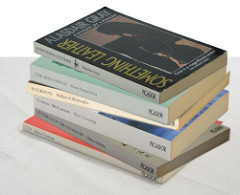
First Novel features a character who collects books. One of his passions is for the Picador paperbacks with white spines which were published in the 1970s through to the 1990s. Back in the 1970s and 1980s, whilst visiting a bookshop, I would generally make a beeline for the carousels exclusively dedicated to Picador paperbacks. Pretty much anything published by Picador was worthy of investigation.
Nicholas Royle fills the plot with either/ors to remind his readers that we are reading stories. As in life, so in this novel, every decision could go either way. The metafiction is not merely a clever device but something that, within the context of this novel, adds another layer of intrigue and interest.
The less you know about First Novel the better, though it's worth mentioning that it contains a lot of darkness, however I was engrossed throughout and have been thinking a lot about it since I finished it.
5/5
One additional point to mention that I found especially appealing...
First Novel features a character who collects books. One of his passions is for the Picador paperbacks with white spines which were published in the 1970s through to the 1990s. Back in the 1970s and 1980s, whilst visiting a bookshop, I would generally make a beeline for the carousels exclusively dedicated to Picador paperbacks. Pretty much anything published by Picador was worthy of investigation.
January 20, 2013
It annoyed me, which annoyed me becauase it is very accomplished. I am glad I don't study creative writing or live in Stockport.

February 4, 2013
A sly but somewhat unpleasant metafiction about identity and authorship, First Novel is, confusingly enough, Royle’s seventh. Like Royle, protagonist Paul Kinder is a college creative writing professor in Manchester. His particular obsession is with first novels, his own included. Yet it is sometimes a challenge to identify the real Kinder among the novel’s persistent “either/or” constructions, which set up nesting dolls of choice and consequence, lies and sordid secrets.
Those who prioritize coherence over craft in a novel may still find elements to enjoy here, if only Kinder’s passion for paper books: in the terrific opening sequence he systematically destroys a Kindle.
Those who prioritize coherence over craft in a novel may still find elements to enjoy here, if only Kinder’s passion for paper books: in the terrific opening sequence he systematically destroys a Kindle.
January 29, 2013
Exactly as the book description says: "Either you'll get it, or you won't.". Either it is a very good book, or it is a book that tortures the reader until the page 215 of 293, where you finally get some clue what it is supposed to be about. Well, all I got is that it is (probably) a book about a man with a split personality, and that I have to believe the author that the other people's stories somehow relate to him...

March 9, 2013
First Novel is a complex but entertaining book which brings together some initially disparate plot lines before allowing then to separate into fuzziness at the end. The title itself is ironic, since it is the author’s seventh novel, and the book makes use of metafictional tools, blurring real fictional events with elements which may or may not be fictionally true.
At the start of the novel we encounter the main protagonist, Paul Kinder, an author and lecturer in creative writing, as he dissects and ultimately sweeps into the bin a Kindle. This is what he effectively teaches his students to do with real books; he dissects their writing without ever really knowing what works, just as he cannot understand how the Kindle operates when he breaks it open.
Kinder is obsessed with anc collects first novels and pours over the pages of the Guardian Writers' Rooms series looking for one in particular. He can smell something from a successful first novel – literally. Something he recognises but cannot dissect or define, whereas his own mysterious first and only novel lacks any odour.
Kinder has a strong and distinctive voice. He is analytical and methodical, a loner. Things are described directly and logically. He has an obsession interested in aircraft, and in sexual relationships with them or in proximity to them, and his relationships with others are awkward. There is a hint of Asperser’s in his approach to life, but also darker undercurrents. Three mannequins peer out of his house, a substitute for his family who have in some way been lost. Harold Shipman makes an appearance.
"Either I will I do A, or I will do B” he tells himself, and us, as if it does not really matter which, and the choice is a random one, without much in the way of reason or purpose, without emotional or moral significance.
The novel is told mainly from Kinder's perspective and in particular focuses on his relationships with two of his students, Helen And Grace, and a Stanger (Lewis) who he encounters at a party and who seems to be hiding a mysterious and dark family secret of his own. Helen and Grace are creative writing students who each in their own way seem attracted to Paul. In the case of Helen, there are clearly sexual undercurrents whereas with Grace the reasons for the attraction are less clear. Lewis, on the other hand, repels Paul, while at the same time something about his story draws Paul into a closer and closer connection with him.
Interspersed with the main narrative is a secondary third person story of a young airman, Ray, who has fled a terrible personal tragedy and taken refuge in an overseas posting where he is about to play a part in another horrible accident. It is not immediately clear where this narrative is coming from – is it historical flashback, or part of another story, perhaps one being written by one of Paul’s students?
All of these strands are brought together before unravelling again into a welter of possibilities. The plot is complex and elements of it are surprising; there is plenty to hold a reader’s attention and this is certainly a book which would benefit from a second or third reading. However, it is probably not a book for a casual reader. There is a lack of linearity and clarity around what is “real” and what is “unreal”, elements which are attractive on one level but which would be puzzling to many. First Novel is a challenging book, but one that deserves success and may appear on literary prize lists later this year.
At the start of the novel we encounter the main protagonist, Paul Kinder, an author and lecturer in creative writing, as he dissects and ultimately sweeps into the bin a Kindle. This is what he effectively teaches his students to do with real books; he dissects their writing without ever really knowing what works, just as he cannot understand how the Kindle operates when he breaks it open.
Kinder is obsessed with anc collects first novels and pours over the pages of the Guardian Writers' Rooms series looking for one in particular. He can smell something from a successful first novel – literally. Something he recognises but cannot dissect or define, whereas his own mysterious first and only novel lacks any odour.
Kinder has a strong and distinctive voice. He is analytical and methodical, a loner. Things are described directly and logically. He has an obsession interested in aircraft, and in sexual relationships with them or in proximity to them, and his relationships with others are awkward. There is a hint of Asperser’s in his approach to life, but also darker undercurrents. Three mannequins peer out of his house, a substitute for his family who have in some way been lost. Harold Shipman makes an appearance.
"Either I will I do A, or I will do B” he tells himself, and us, as if it does not really matter which, and the choice is a random one, without much in the way of reason or purpose, without emotional or moral significance.
The novel is told mainly from Kinder's perspective and in particular focuses on his relationships with two of his students, Helen And Grace, and a Stanger (Lewis) who he encounters at a party and who seems to be hiding a mysterious and dark family secret of his own. Helen and Grace are creative writing students who each in their own way seem attracted to Paul. In the case of Helen, there are clearly sexual undercurrents whereas with Grace the reasons for the attraction are less clear. Lewis, on the other hand, repels Paul, while at the same time something about his story draws Paul into a closer and closer connection with him.
Interspersed with the main narrative is a secondary third person story of a young airman, Ray, who has fled a terrible personal tragedy and taken refuge in an overseas posting where he is about to play a part in another horrible accident. It is not immediately clear where this narrative is coming from – is it historical flashback, or part of another story, perhaps one being written by one of Paul’s students?
All of these strands are brought together before unravelling again into a welter of possibilities. The plot is complex and elements of it are surprising; there is plenty to hold a reader’s attention and this is certainly a book which would benefit from a second or third reading. However, it is probably not a book for a casual reader. There is a lack of linearity and clarity around what is “real” and what is “unreal”, elements which are attractive on one level but which would be puzzling to many. First Novel is a challenging book, but one that deserves success and may appear on literary prize lists later this year.

June 12, 2015
Either this will blow your mind. Or it won't. Either or. What is not uncertain however is that this book is sheer genius. Nicholas Royle plays with the interaction between fiction and reality, weaving multiple narratives until they come together to knock you off your feet! And the cover by Suzanne Dean is so brilliant you cannot help but gush about it. After you finish your novel, you turn back to the cover and you really understand what is going on there. Just like the narrative. Either you will read this book or you won't. But I strongly think you should.
June 14, 2017
I first read Nick Royle back in 1992 in Chris Kenworthy's The Sun Rises Red. The story was called The Mainstream. A cracking story. It was also where I first read Joel and M. John Harrison. It was what set me on my own writing path. I've bought all of Nick's books as they've come out, and I've loved them all, particularly The Director's Cut and Antwerp. I'm in awe of his skills as a writer, as a creator of strange, off-kilter situations containing people who could quite easily be you or me.
I'm a bit late to First Novel but I finally sat down with it the other day and read it in three sittings.
It's brilliant.
First Novel is about the place where fiction and reality feed into each other, feed off each other. Several narrative strands that seem to initially have little to do with each other gradually deepen and build to deeply moving conclusions. Finally they connect and very cleverly; so much so that a second reading would undoubtedly deepen your appreciation of the book. There's a deep metatextual quality to First Novel. I think there are elements of Nick deeply embroidered into these characters. You're aware that stories are being told within stories, and although you see that happening, it never takes you away from the emotional core of the book. At points I found it tremendously moving.
It's a fantastic read. I can't recommend it enough.
I'm a bit late to First Novel but I finally sat down with it the other day and read it in three sittings.
It's brilliant.
First Novel is about the place where fiction and reality feed into each other, feed off each other. Several narrative strands that seem to initially have little to do with each other gradually deepen and build to deeply moving conclusions. Finally they connect and very cleverly; so much so that a second reading would undoubtedly deepen your appreciation of the book. There's a deep metatextual quality to First Novel. I think there are elements of Nick deeply embroidered into these characters. You're aware that stories are being told within stories, and although you see that happening, it never takes you away from the emotional core of the book. At points I found it tremendously moving.
It's a fantastic read. I can't recommend it enough.
January 31, 2016
Jolly good stuff. I won't bother discussing the plot as there are already far too many spoiler-laden on-line reviews, including an Amazon 1-star that has provoked Nicholas Royle into responding (assuming he didn't write it himself).
I've given this 1 star extra because it mentions "Hotel 167" by Jane Solomon, which did cause me a WTF moment when I saw the reference. I'm one of the few people who read that book before they read this one. I found a copy of it in Skoobs near the Brunswick Centre, and since then I've bought a few more 2nd-hand copies to give away to people who are interested in psychiatric issues. It's a pity that this book simply repeats the idea that Solomon went on to become a tango dancer, as I'm not convinced that isn't simply a search-engine generated mistake that has entered received wisdom. The pictures on the dancer Jane Solomon's site don't look much like the author photo I remember on the back of the Picador paperback; and the "Hotel 167" author definitely isn't the same as the co-author of a terrible New Age book, even though Goodreads thinks they are the same. So there is a bigger textual (and hypertextual) mystery around that reference, aside from its appearance here, where not much is done with it.
I've given this 1 star extra because it mentions "Hotel 167" by Jane Solomon, which did cause me a WTF moment when I saw the reference. I'm one of the few people who read that book before they read this one. I found a copy of it in Skoobs near the Brunswick Centre, and since then I've bought a few more 2nd-hand copies to give away to people who are interested in psychiatric issues. It's a pity that this book simply repeats the idea that Solomon went on to become a tango dancer, as I'm not convinced that isn't simply a search-engine generated mistake that has entered received wisdom. The pictures on the dancer Jane Solomon's site don't look much like the author photo I remember on the back of the Picador paperback; and the "Hotel 167" author definitely isn't the same as the co-author of a terrible New Age book, even though Goodreads thinks they are the same. So there is a bigger textual (and hypertextual) mystery around that reference, aside from its appearance here, where not much is done with it.

October 6, 2019
Thoroughly enjoyed this mystery from Nicholas Royle (easily within my top three of his novels - and I believe I've now read them all).
There are three separate strands here which overlap and then appear to converge, although when you recall them closely you realise they don't quite converge much at all. There is strength in unsettlement. Whilst on the face of it the book is straightforwardly - almost factually - written, the parts which remain unsaid blink in and out of focus, so whilst by the end on the surface it feels like you have a grip on the overall story this is undermined to some extent by what's hidden. To say more would involve spoilers, but even so it's more of a puzzle and open to discussion and this - of course - is exactly the type of book that I love. I'm still thinking about it a couple of days afterwards, and I know I'll continue to think about it after that. Well, either I will, or I won't. Highly recommended.
There are three separate strands here which overlap and then appear to converge, although when you recall them closely you realise they don't quite converge much at all. There is strength in unsettlement. Whilst on the face of it the book is straightforwardly - almost factually - written, the parts which remain unsaid blink in and out of focus, so whilst by the end on the surface it feels like you have a grip on the overall story this is undermined to some extent by what's hidden. To say more would involve spoilers, but even so it's more of a puzzle and open to discussion and this - of course - is exactly the type of book that I love. I'm still thinking about it a couple of days afterwards, and I know I'll continue to think about it after that. Well, either I will, or I won't. Highly recommended.

June 8, 2013
A puzzling read, to say the least. It takes a while for all the plots, subplots and stories within stories to become clear, and once they do, they all fit together nicely. The overlap between reality and fantasy felt a little disorienting. For instance, the protagonist spends a lot of time thinking about The Guardian's Writers' Rooms series (which I've read), mentioning first novels such as The Cement Garden and The Horned Man (which I've read), and fantasizing about visiting Siri Hustvedt and Paul Auster in their Brooklyn apartment (which I'm sure we've all done at some point, right?) Anyway, everything turns very dark and disturbing and I must admit I was anxious to finish it and move on to merrier things. However, I have to respect a novel that offhandedly references my favorite short story by Du Maurier... Oh God, what a bloody silly way to die.

November 21, 2015
Odd, and often rather alienating, experimental, disorientating, with an anti hero so thoroughly dislikable, yet oddly attractive... I am not sure I quite grasped this novel. Certainly worth a try. I don't think I can add any more.
March 5, 2014
Unusual, hypnotic, compelling

May 8, 2020
3.5 stars. A very disconcerting read. I wanted to give it fewer stars, but I was gripped towards the end, so i obviously enjoyed it. Intensley dislikable main character. It definitely made me feel
Semi spoiler alert.
.
.
.
.
.
.
Its definitely an emotive book, which makes you want to carry on reading until the end. However, I didn't enjoy it. Made me feel a bit disturbed at points. Definitely made me want to hug my kids.
I also didn't like that the book, within a book, had too similar a writing style to be passed of as a separate author.
Semi spoiler alert.
.
.
.
.
.
.
Its definitely an emotive book, which makes you want to carry on reading until the end. However, I didn't enjoy it. Made me feel a bit disturbed at points. Definitely made me want to hug my kids.
I also didn't like that the book, within a book, had too similar a writing style to be passed of as a separate author.
This entire review has been hidden because of spoilers.

December 30, 2024
Wrapped up in books.
A Ballardian novel, set in South Manchester rather than South (of) London and the protagonist is obsessed with plane crashes, rather than cars (although he does have sex with a woman in a car in Feltham, a 15 minute drive from Shepperton (the Ballardlands)). It's also tricksy and metafictional, you need to stay with the book to grasp it; at one point we get an alternative novel detailing the same narrative but with all the actions the protagonist didn't take.
A Ballardian novel, set in South Manchester rather than South (of) London and the protagonist is obsessed with plane crashes, rather than cars (although he does have sex with a woman in a car in Feltham, a 15 minute drive from Shepperton (the Ballardlands)). It's also tricksy and metafictional, you need to stay with the book to grasp it; at one point we get an alternative novel detailing the same narrative but with all the actions the protagonist didn't take.

January 15, 2021
In growing hindsight, perhaps this on-going thread represents the start of an experimentation upon a new variation within the theme of Real-Time Reviewing fiction books…?
The detailed review (Novel Doodlings) of this book posted elsewhere under my name is too long or impractical to post here.
Above is one of its observations at the time of the review.
The detailed review (Novel Doodlings) of this book posted elsewhere under my name is too long or impractical to post here.
Above is one of its observations at the time of the review.

June 5, 2017
Took a while to get going, and the subject matter is by turns blackly humorous or simply dark and stony, but it gets to an interesting place in the end. Not a comfortable read if you want your characters to be likeable.
October 16, 2019
I liked this in places where there was clear enthusiasm for books, collecting and writers, but overall I found the plot muddly and unbelievable. Shame.

Read
September 10, 2023A beguiling novel about writing and personal history, that keeps you gripped throughout. Funny, shocking, and sad.
November 21, 2025
All over the shop, but just about hangs on to it. Certainly an enjoyable read.

Read
July 8, 2026Nice

Read
January 17, 2013Nicholas Royle’s First Novel is a bit of a misnomer because in fact it is his seventh. The title, however, is integral to the book whose protagonist Paul Kinder is obsessed with literary debuts. This is something he shares with Royle who says he’s also “very interested in first novels”. And that’s not the only similarity between the two men. Royle like Kinder is a novelist and a lecturer, albeit a more successful one than his fictional counterpart. He has several novellas and six other novels to his name, while Kinder is a one book wonder, striving to complete his second undertaking in between teaching, dogging, housebreaking, petty pilfering and uncovering a connection between his former wife Veronica, his neighbour Lewis and a man called Trevor. In truth, Kinder’s literary aspirations are secondary to the plot unlike his fascination with first novels, especially those that “have been lost or supressed or never followed up”. Kinder’s pathological interest in the subject is a projection of his own predicament, of his own failure to follow up his debut and his subsequent exploration of the psychologies of singular authors. “Why do we hear no more from these very talented writers,” he says to one of his students, “while others, far less talented, continue to write book after book after book?” It is a question that is never really answered, except to say “that first novels are important because it’s the first thing an author says about the world”. This notion is fundamental to the plot, which twists toward a startling and wholly unexpected revelation divulged by way of someone else’s first book.
Full review, here: http://goo.gl/z8pbm
Full review, here: http://goo.gl/z8pbm
June 23, 2013
I think this might be a post-modern novel. It is self-referential. At times it poses definite challenges to 'suspension of disbelief' in that it draws attention to its fictional nature, deconstructing story-making. Of course, invented events on a printed page do not matter - although we can ascribe great personal meaning and significance to them; they are not true. The main character in this book is so imbued with literacy that life becomes a fiction, nothing genuinely matters, and he can apparently only judge by what he likes, unable to bring any deeper standard to bear. At any moment in his life he can see choices, but they are the choices of a writer deciding where the plot should go.
The novel tells of the decidedly amoral escapades of a lecturer in creative writing at a Manchester university. We learn that perhaps he is damaged by past experiences and this may explain his apparent emotional and ethical numbness. However, doubt is continually shed on the extent to which his experiences are to be taken as genuine (within the fictional context) or the ramblings of a novelist's imagination. Other imaginations are at work within the confines of the book also, with the inclusion of extracts purportedly from students' work. 'Purported' is used advisedly, because, of course a novelist, in this case Nicholas Royle, can 'purport' anything and the reader has only literary conventions to rely on in interpretation.
The inclusion of fragments of historical fact such as the Shipman murders only serve to show the infrastructure used by a novelist to enhance their illusion.
Yes, weirdly interesting! And probably worth another read.
The novel tells of the decidedly amoral escapades of a lecturer in creative writing at a Manchester university. We learn that perhaps he is damaged by past experiences and this may explain his apparent emotional and ethical numbness. However, doubt is continually shed on the extent to which his experiences are to be taken as genuine (within the fictional context) or the ramblings of a novelist's imagination. Other imaginations are at work within the confines of the book also, with the inclusion of extracts purportedly from students' work. 'Purported' is used advisedly, because, of course a novelist, in this case Nicholas Royle, can 'purport' anything and the reader has only literary conventions to rely on in interpretation.
The inclusion of fragments of historical fact such as the Shipman murders only serve to show the infrastructure used by a novelist to enhance their illusion.
Yes, weirdly interesting! And probably worth another read.

May 31, 2015
I have just finished this and it's left me astounded and dizzy. I feel like a lover abandoned in bed by a mysterious, shape-shifting figure who didn't even give me their number. A meta-fictional thriller that establishes three equally compelling plots that blur and merge together until the reader feels completely disillusioned but exhilarated. It burns slowly at first, gathers momentum, eventually engulfing into almighty flames, leaving behind ashes of indistinguishable things. Royle is a highly talented writer, but one who expects his readers to be switched-on and calculating. What marks this out from the mound of other half-arsed, paperback thrillers is that it can be re-read as an entirely different book. Compelling, deft and impressive.

March 1, 2014
What a strange book. Added to my Amazon wishlist as a result of having read a review somewhere, intrigued by the cover, I eventually bought it as a 3 for 2 in Blackwells.
Started off fine and dandy, slight dislike of the way first person was handled, no problem with the disconnections, until the third part when it began to feel as if it had been written by someone with a contract to fulfil and nowt but a selection of too-small and half-writ bits to fill it, so somewhat unsatisfying.
The other trouble with novels like this is that I inevitably feel as if it's me that's stupid, for not getting it.
Started off fine and dandy, slight dislike of the way first person was handled, no problem with the disconnections, until the third part when it began to feel as if it had been written by someone with a contract to fulfil and nowt but a selection of too-small and half-writ bits to fill it, so somewhat unsatisfying.
The other trouble with novels like this is that I inevitably feel as if it's me that's stupid, for not getting it.
July 4, 2016
At first, this was leaving me cold and seemed like an attempt to mash together the styles of American psycho and Crash, which had worked rather better in the original books.
But as the story progressed, some events became more significant and intriguing and it began to weave itself together into quite an interesting set of small, interconnected things, playing with what was real, what was fiction, and when it happened.
The reveal did rather surprise me but then it possibly felt a bit rushed, as the book then hurtled to the end, but I suppose it makes sense with Paul's mental state.
But as the story progressed, some events became more significant and intriguing and it began to weave itself together into quite an interesting set of small, interconnected things, playing with what was real, what was fiction, and when it happened.
The reveal did rather surprise me but then it possibly felt a bit rushed, as the book then hurtled to the end, but I suppose it makes sense with Paul's mental state.
This entire review has been hidden because of spoilers.

January 18, 2013
Another writer writing about writers. The author teaches Creative Writing in Manchester. This is an intricate story with a real twist though. Really recommended to book lovers (not necessarily casual readers).

February 19, 2014
On the whole an enjoyable read.....a bit too self consciously clever at times. A detailed description of S Manchester .....which was fascinating having lived there but perhaps a bit unnecessary if you haven't !!

July 20, 2014
I found this very inventive, and very entertaining, though I couldn't shake the feeling that it could have ended with a little more... panache? It really could have upped the meta, I think. But that's a just a niggling complaint for what was a very fresh, enjoyable book.
Displaying 1 - 30 of 37 reviews