A SHADOWY FIGURE. AN INTENSE ROAR. THE SENSATION OF FALLING - FAST.
That's all Callum Harris remembers from his tumble over the waterfall. But when he wakes up in a hospital bed and finds his best friend trying to kill him, Callum knows something is seriously wrong. Unfortunately for him, the mysteries are just getting started.
Why are his parents acting like he's some big sports star all of a sudden? And why are all the buildings in town more run-down than Callum remembers? Worst of all... what happened to Callum's brother? Either Callum has gone seriously crazy or something happened when he went over the edge of the falls. Something impossible. Callum needs answers, and now. Because in this twisted new version of the life Callum knew, his former best friend isn't the only one who wants to see him dead.
Paul Blackwell has never gone over a waterfall himself, but he did jump off a sixty-foot cliff once—something he does not recommend to others. He lives in Montreal, the city of his birth. There, in a small apartment near the Lachine Canal, he listens to rumbling trains and writes thrillers late into the night. Undercurrent is his first book for teens.
I suddenly feel something press down over my face. And just then I remember how all that water felt, pouring over the falls onto me. It was like a mountain, pounding down, driving me under. The pillow is nowhere near as heavy. But it doesn't matter. I’m no more able to breathe than when I was at the bottom of the river, slammed against the rocks. And I'm no more able to stop my best friend, Bryce, who is now grunting with the effort of smothering me.
Undercurrent sucked me in (no pun intended, I swear on my grandmother's grave), but ultimately fell flat. This book started so brilliantly, but after that, the plot sunk with no explanation nor further investigation of the plot, and the ending is completely unsatisfactory. To call it an ending would be to give this book more credit than it deserves. It is not an ending. So many plotlines are left unresolved that despite my reluctance to read any more of this book, I'm actually hoping for a sequel so we get some kind of an explanation, because there is none. There's not even a cliffhanger. It's like someone ripped this book in half for all the sense and lack of resolution the ending made.
Facetiousness aside, this book was extremely disappointing to me. I was not kidding about the beginning; it was one of the best and most magnetic introductions I had read in awhile. I could easily believe I was in for a wild, surreal thriller of a ride as we are immediately inside Callum (Cal)'s head as he wakes up, thinking he was paralyzed, and apparently comatose to the people around him. His parents are upset and crying. His world is filled with pain, he has no memory of what happened. He senses things that are happening, but he's unable to move. His experience is one I'm sure all of us fear; that of being stuck, conscious, but fully immobile and paralyzed. A vegetative state in which your mind is working perfectly.
There's definitely something wrong. His mother calls him by a dimunitive of his name she never uses. He hears things, he smells things, but all of it is out of his range of senses. He hears a voice whispers "I hope you never wake up." He sees a young man in a Crocodiles T-shirt, who appears to be his brother Cole, only he never comes in to visit. His best friend Bryce tries to kill him.
When he wakes up, it is obvious things are not right. People are suspicious of him, whispering about him behind his back. He hears mention of a name he's never heard before, in association with him. "Neil Parsons." He finds out that he jumped over Crystal Falls, and amazingly, ended up alive. People have done it before. None have survived. He is an anomaly. It is a miracle he is even alive, let alone awake. He's interviewed by the sheriff, they're suspicious of his role in Neil Parsons' involvement. People are treating him the way they've never treated him before, with outright hostility. The football coach comes to see him, his parents bring him an issue of Sports Illustrated. They're treating him like they would his older brother, Cole.
Speaking of which, where the hell is Cole?!
HOLY CRAP!!!!!!! By the end of all these things in the introductory chapters, you can bet your ass I was intrigued! Unfortunately, it all went downhill from here.
You know, sometimes in life you end up in situations you never expect to be in. A reasonable person adapts to the situation. I'm not saying that in life one would generally find oneself in a situation where your life is not your life anymore, but the idea still holds. Learn, adapt. This is where Cal fails as a character for me, and this is one of the downfalls of the book.
Instead of adapting to the situation, instead of manning up (and, to be frank, Cal is a huge fucking pussy). You think I'm being harsh on him by calling him one? Trust me, I'm not the only one calling him that in the book. Don't get me wrong. I hate assholes, I hate douchebags, I love beta males. Cal is not a beta male. To call him a beta male is to insult awesome beta males everywhere. To be frank, Cal is a wimp. He cries, he sobs, he retches at the slightest provocation that something's wrooooooooong, man! He is a wimp, he is spineless. He chooses not to face the situation until the situation comes to him, he always takes the easy way out.
Because I’m a coward. That’s what that choice meant. Callum Harris is a coward.
Instead of manning up, doing what has to be done to uncover what the living hell is going on and adapting to the situation in a reasonable way, Cal instead chooses to be an ostrich. He buries his head in the sand. He pretends it's not happening. He goes around pretending that he's the same person he is before, he tries to talk to the people who were previously his friends but are so obvious not anymore. He moons like a girl over the Zoe-Deschanel-like Willow, and he is alternately turned on and repulsed by the stereptypical rich-girl-queen-bee-slut Ivy. And he luuuuuuuuuurves Willow, despite his lack of interactions with her before. He just does!
Because I’m in love with Willow, I realize. I’m uncomfortable even thinking it. After all, we’ve only just become friends this last year. I haven’t even kissed her yet. But I’m in love with her, I know. Why else would I have a collection of her lost bobby pins in my desk drawer—the ones she uses to keep her bangs out of her eyes and that I always find on my bed and on the sofa?
Now, onto my criticism of the plot? Wait, what plot? You know, the one where Cal figures out why he's living his brother's life? Oh, forgot about that. Apparently, so did the author. The majority of the book doesn't involve Cal investigating why things are the way they are, remember? He's a coward and an ostrich. For the majority of the book, Cal is going around trying to convince himself, trying to convince people that he's not really the Cal they think he is. It felt like he's not even interested in the whys of it, he's just trying to ignore the fact that all this is happening. He just wants things to be normal and go back to the way they were without doing anything about it.
And the ending, the supposed Big Reveal. There's a vague reference to quantum physics, and an insinuation of alternate universes, but NOTHING GETS EXPLAINED. People just pop up out of nowhere, things happen, Callum goes along without demanding an explanation because he just wants to save his own ass, being the selfish lily-livered zeta-male that he is. There is no ending. If you read this book wanting a clean tie-up, not even a happy ending, but at least a fairly conclusive one where improbably events, situations, people are explained, look elsewhere. This book's ending is a multi-colored scarf in progress with all the different colored strings hanging off it, waiting to be tied off.
Schroeder? Schrodinger? Not even subtle.
"There was a lot about some cat in a box that gets poisoned by gas when an atom does something, and how it can be both dead and alive at the same time, creating two branches of reality."
Ok, that's cute, trying to insert quantum physics into this book. The problem is that IT DOESN'T WORK IN EXPLAINING ANYTHING. Very little of the book is actually devoted to explaining or investigation what happened in Cal's life to make it that way. Unsatisfactory. No.
Undercurrent is a good book which I feel could have been a great book with some further development. It seemed to me that pretty much everything about this book was unfinished and the story was left hanging in a number of places. Perhaps the author will be kind enough to treat us to a sequel which will explore a number of things briefly touched upon in this novel and tie up all the loose ends, but judging by the ending, I am doubting that will be the case*.
I did like a lot about Undercurrent and I found it to be original (or so it seemed to me, anyway), intriguing and suspenseful. From start to finish, I hung on the author's every word and could only hope the conclusion would be as exciting as the weird mystery seemed to promise. And I think the "whats" were satisfying, but less so the "hows" and the "whys". I like the idea of this novel and the possibilities it suggests far more than I liked its actual execution.
The story is about a teenage boy called Callum Harris. He takes a tumble over a waterfall and wakes up in hospital being told it is a miracle he's alive. But the world Callum has woken up in isn't quite the one he remembers. Things are similar but different. The people are the same, but those he once called friends hate his guts and the guys who used to bully him both admire and fear him. Just what happened when he went over Crystal Falls? And why do those he trusted most now want him dead?
Is your mind ticking away right now? Sorting through the possibilities of what could have happened to Callum? I know mine was. This is one hell of an exciting read that keeps throwing up more and more mysteries - will you work it out?
However, I still have to come back to those things which just didn't work for me. One of the things I noticed almost immediately was Callum's tendency to be pretty damn stupid. Now, I'm not one of those readers who needs to like a protagonist to enjoy a book, I can deal with bratty, selfish or just plain mean main characters... but those who are ridiculously dense really get on my nerves. Those that keep refusing to see the obvious or refusing to accept something when it's been hammered home a million times. I felt Callum was deliberately refusing to work out certain things and I also felt that his reactions to many situations felt completely wrong. I think he took way too long to freak out about the fact that is life was totally upside down.
Also, the novel makes a small amount of progress in a number of interesting directions and then never returns to them. Like the idea that we all have a dark side that takes over occasionally. Callum began to admit that he was capable of doing some evil things but very little else was said about this. I think this book touched upon several fascinating concepts and abandoned them without further development. In fact, there is just a sense of abruptness about the whole novel. The characters and relationships are left halfway to being fully developed and the ending felt incredibly rushed and just... incomplete.
This whole novel just needed something else.
*I have been informed that the book was written with a sequel in mind but the publisher hasn't given it the thumbs up yet. Please? All this potential shouldn't go to waste.
I'm just gonna come right out and say it: you have to be a certain kind of reader to 'get' Undercurrent. If you approach this book the same way you approach any other young adult book, looking for the same linear storytelling and plot itself being the point of the book, you're going to be sorely disappointed. Me? I'm an avid of fan of classic sci-fi shows like The Twilight Zone and The Outer Limits, so for me at least it was fairly easy to guess what Paul Blackwell was aiming for with this one. Knowing what I do, I must say I quite enjoyed the old school sci-fi feel that he's captured precisely because of how differently this is written from your run of the mill young adult book.
For those who don't know how the sci-fi anthology series I mentioned work, each hour long episode tells a different story - but rather than being the kind of story with a beginning, a middle, and an end, where some sort of plot happens or the protagonist has to do something, they're stories that explore abstract ideas. Sure, they still have characters, setting, plot, but those considerations are secondary and only explored if they help advance the idea, otherwise the episodes are more like vignettes that make you think, where the ending makes you go hmmm on some sort of lesson, rather than delivering a plot where things happen and you're entertained and the end. One of my favorites, in fact, involve a reptilian species that has gifted Earth with a transporter system with an occasional flaw that sometimes it'll make a duplicate of the person using it on the sending side, and the entire episode revolves around the transporter operator being pressured by the aliens to kill the duplicate. You can look at that story as either one of a man who just spent sixty minutes waffling over whether to shove a lady out of an airlock - or, you can look at it as a rumination on the value of human life, or even whether a copy is every bit as 'alive' as the original. I took the philosophical road, which is why I 'got' Undercurrent.
Now, I'm not saying Undercurrent has anywhere near the existential quality of a Twilight Zone or an Outer Limits episode (I have a feeling such a book would be extremely poorly received by the young adult community at large), but rather that it gives off the vibes and has the feel of such an episode. What Paul Blackwell really does well is use all the familiar sci-fi conventions to great effect, starting with how we're thrust right into the middle of the story with Cal waking up in a hospital from a coma having fallen off a waterfall and immediately recognizing that something is off. What's really great is how Blackwell's writing really helps to set off Cal's post-waterfall reality from the pre-waterfall reality of his memories - now Cal himself is pretty dense as to what happens, whereas it's incredibly obvious to me what's going on, but the flip side of that is that he's a lot more casual about describing things that are different between the two realities, and that style really helps to keep the tone detached and mystery interesting in my mind, allowing me to catalog the differences and figure things out on my own, whereas a more genre savvy protagonist would probably have obsessively poured over every last detail, looking for the latest in hard science to explain his predicament, and completely ruined the whole thing in my eyes because this isn't that kind of story (although a closer balance between the two extremes would've made for an even better book).
No, what this is is a story that leaves almost everything hanging in the air, which is one of the best things about hard sci-fi. Because you're not supposed to get what happened, the point of the book is supposed to leave you with a feeling of 'what the hell happened', and then from what the book tells you you're supposed to go back and fill in the blanks. That, I think, is the strongest part of the book, although if it were up to me I'd have left out the last scene, because I actually feel it was tacked on to give readers who might not be familiar with science fiction conventions a 'firmer' ending. The abstract idea in this case is how the few little things, include one seemingly small decision Cal made regarding his brother Cole, that happened differently between these two realities ripples out to have these huge effects, not only Cal's character, but every little thing about the town, and as long as you can see it on a metaphysical level after the last page goes by, it's actually a brilliant form of writing. The takeaways could've been stronger and more developed, but as with most serious sci-fi you just have to be able to fill in a few blanks to see how Blackwell's trying to say how one or two simple decisions can create this drastically different character and outcome, connect all the dots along the way, and the satisfaction comes from realizing the point here is not why or how things happen, those aren't important and just kills any sense of a greater mystery, but why this story.
The real problem, I think, is that an Outer Limits or Twilight Zone episode doesn't make for a very good book - there simply isn't enough material. As a result, Undercurrent feels a bit on the thin side with not much of a plot. Still, it works as a piece of speculative fiction, and I'm rating it as such, just don't expect your average young adult experience and read this with an open mind.
EDIT - Also, I don't have a shelf called covers to brown paper bag, but this would be a prime candidate for such a shelf. Just sayin'
How is it that every good idea gets ruined all to hell these days? The idea behind Undercurrent wasn’t perhaps the most original but it was brilliant and it had so much potential. And yet the final result, the first-page-to-last-page experience, is as underwhelming and confusing as they come.
It all started promisingly, with Callum waking up in a hospital after an accident at the waterfall, confused, disoriented and desperate for answers. Instead of giving him some, his best friend tries to smother him with a pillow, and that’s only the first in a long series of events that simply refuse to make sense. Nothing is as it should be, including Callum himself. People consider him a bully and fear him, but he remembers being hardworking and quiet and kind.
There is clearly something wrong in this Callum-against-the-world scenario, but Callum just can’t figure out whether the world has gone completely insane, or his head trauma was even worse than they thought. Either way, I knew the answer pretty quickly, but Callum was far, far behind. I can’t imagine a single thing worse than guessing the mystery on page 20 and then spending the remaining 300 pages waiting for the main character to catch up. It’s a mind-numbingly boring experience and one I don’t care to repeat anytime soon.
In addition, my enjoyment of any particular book is largely dependent on the romance, and unfortunately, romance was not a point in favor of Undercurrent. It was barely there, for one thing, and what’s even worse, it was left almost entirely unresolved.
If there is one good thing I can point out about Undercurrent, it’s Blackwell’s writing itself. He has a way of gluing readers to their seats and making them wait, wide-eyed and anxious, while he builds the story slowly and thoroughly. If only he’d offered some answers in the end, he and I would have been the best of friends instead of just casual acquaintances. Talk of the sequel would have made me feel slightly better at the time if Undercurrent gave me any desire to read it. As it is, I’m left with no answers, no ending, and no interest in getting them whatsoever.
Now if you’ll excuse me, I need to put my snark back in the drawer where it belongs.
When I heard someone say this was reminiscent of The Butterfly Effect, which is one of my favorite movies ever, I jumped on the chance to read this book. It does have that neat butterfly effect factor, but I did find the book itself had no real… point. It's for entertainment only! When I finished the book I was stunned at where it left off, especially when no sign of a sequel can be found. It wasn't a cliffhanger per se, but it was a very odd ending that didn't feel like much of a conclusion.
Alas, I'm getting ahead of myself. And probably giving the impression that I disliked the book which is not the case. Undercurrent is honestly a fun, entertaining book that never let my attention falter. The whole alternate life deal had me fascinated from the start. You're always left wondering, questioning, pondering. Imagine waking up from an accident and your whole life has changed! Your friends are your enemies, your enemies are your friends, the friendly person you were is now known as a bully. I was captivated by this premise. I loved seeing Callum's reaction to all the changes; he was fighting hard to mend the wrongs while refusing to believe his memory of everything was false. It was both sad and exciting to see him try to figure it all out. Some things were changed for what people would consider "the better" seeing as he was now a popular jock with everyone hanging at his every word (or threat), but a lot of other things, the things that matter, were definitely not better. The girl he loves doesn't know him, his brother is paralyzed, and people hate him for the trouble maker he is. There is a reason why I love psychological thrillers and while this is more of a sci-fi thriller, you do find yourself wondering what if. What if you had made a different decision that one time? How much would be different if you hadn't…? These are just things I personally get so curious and intrigued about, so I had a fun time with this book.
With such a neat premise, though, I wish it would have been more intricate in a lot of ways. The main character, even though he was well developed enough, was a little slow to figure things out at times. I had guessed almost right away who the guy in the Crocodile's jacket was. I was also hoping for much more progress as far as the plot itself. The whole book consists of Callum figuring out why everything is so different. We don't learn much about the actual "science" or world building behind it - what's so special about the Crystal Falls to make it tear realities? How do others (like the teacher) know about the alternate existence? I mean, we all kind of wonder but we don't see people jump off cliffs to test the theory off of hope. What did he throw off of that waterfall with a light? A machine to send a message to another reality, yeah, but what is it? O_o Why was Cal brought to this particular reality (and there was only mention of that 1 other reality)? If you're going to introduce alternate realities based on the butterfly effect then there has to be countless realities for every single decision made in a life, no? Then when all is said and done we never do learn any details on what happened in his old reality, nor what's going to happen to him and his other self, now? And why was the whole bit about Neil even included? SO MANY QUESTIONS!! Basically, this plot was done for those who like the idea but don't want to really think about it much. I'm not one of those readers.
Undercurrent offers an intriguing but simple view into the world of alternate realities. It's always fun to see how different things would be with only one changed decision. I wish the book would have been more fleshed out, but it was an entertaining read, nonetheless.
Edit: The author did tell me there was a sequel in the works that's waiting on the green light. So that does help lessen some of my dissatisfaction regarding the unanswered questions. Yay!
-- An advance copy was provided by the publisher for review.
For more of my reviews, visit my blog at Xpresso Reads
I love this cover - dark and mysterious. I love the half cut face and the look of the wording on the cover. So the book intrigued me from the get go. The synopsis was interesting but I definitely read this one for the cover.
But I didn't love it like I thought I would. I just didn't feel all that pulled into the story. I found Callum to be incredibly frustrating - not because he wasn't a nice MC (I don't really need a nice MC to like a book) but he was frustrating in his inability to understand/accept that things weren't how he thought. He literally took almost all of the book to accept that his world was not the same after he came out of the waterfall - even though as soon as he was out, he knew. And he completely blew it every time - I thought there was a much better way for him to open talking to Willow or even to figure out some of the mysteries - like the pick up and the selling and even Ivy - he just didn't seem to be able to cope with anything or how to handle anything. Oh well, I'm glad I finally picked this one up and solved the mystery - although the answer felt rushed and the ending felt incomplete.
This book was a fun read. Something new, different and appealed me enough to keep on reading.
This was based on some theories of Physics. I really find Physics' theories, facts and discoveries intriguing so this book was something I enjoyed. Plus, my Physics teacher told me about some of these theories, I was glad that reading it in a book made me really get into it. And truly the ending left me pondering about mysteries of this vast universe.
Undercurrent was well-written. Great suspense throughout the book too.
After waking up from coma Cal finds his life utterly opposite. People who hated are his friends, those who were friends are now determined to kill him, his brother is in coma which he was not before, he's notorious guy now, plays basketball although he remembers he never knew how to throw a ball even..etc etc. Perplexed, he begins to find the reason for this flip of life. The answers leave him more astonished than ever.
Problem I had was with the main character i.e Cal. If everything has turned upside down why is he flowing along with it? Initially, he just acted like mindless robot. He didn't even try to figure out stuff. So naïve and stupid at times. You'll know what I mean once you read this book.
I really regret not reading this sooner. I received this arc one to two months ago but I got it at a weird time and it got hidden under the numerous other arcs I had been accepted for at the same time. The first time I did finally get to it, I didn't make much progress because the writing style is very funky, to say the least. So once again, I put it down to read other arcs.
I got back to it a few days ago and I'm overall, very happy that I didn't let it get forgotten.
The writing style was still very weird and required some a lot rereading before I could completely understanding what was going on. The first 3 - 4 chapters were extremely confusing. The writing style does get easier to read as you progress but I'm afraid that many other readers will loose interest before getting into the meat of the book, which is completely worth it.
My favorite aspect of this book is the awesome mystery. It's not a mystery book so to speak but it definitely has one. You ask a lot of question and every chapter leaves you with more questions so you just have to read one more chapter. And then another one. And then another one. You can't stop reading until, before you know it, you're turning the last page.
One of the huge downsides to this fast paced prose is the eventual loss of proper explanations.
The author definitely wrote this story in a way that made the reader ask a lot of questions. The narrator was as clueless (ok, a bit more clueless) as the reader was. By the end however, the reader is left with a lot of unanswered questions. I know what happened but why did it happen and how did it happen? We are left with a cheap "it just did" answer and that's the end of the book.
As I mentioned above, the main character was extremely stupid at times. He didn't see what was right in front of him. I understand why the author did that but I almost find plot-nesescary stupid even worse then just having a stupid character. In my opinion, it's a sign of shoddy writing. C'mon guys, I'm sure you could've found a better way to progress your plot than making your character a moron.
Callum wakes up with a feeling of amnesia because, well, his whole world is cray-cray. Instead of realizing that something is seriously wrong, Callum goes on for practically the entire book thinking everything is fine and he somehow forgot that he was a) an asshole, b) a football star, and c) the brother of a cripple.
Dude, that's not something you can just "forget". I can forget to ask someone a question. I can forget to do my homework. I don't go "Oh my god, I accidentally forgot that I have a crippled brother. Darn." That just doesn't happen.
The good thing is, besides that complaint, he was a pretty good hero. He didn't slut shame or act like a huge jackass to everyone. I did like him a lot, even though I did often want to slap him upside the head for acting like a huge moron.
This book really only had two characters of importance and . While I don't think I can count that as a flaw because it fits the story, I would have liked Other Dimension Girlfriend to have had more of a personality other then that bitch.
One point of disappointment is all the wasted potential with some of these ideas. It could have been amazing if some points were delved into more. There were a lot of little things that were mentioned once and then never heard of again. These little things could have made the book so much better.
The ending is the main reason that UNDERCURRENT couldn't get a full 4 star rating. It was extremely rushed and underdeveloped. It felt like it should have been 10 - 15 pages longer with less of an abrupt ending.
UNDERCURRENT could have been amazing if not for a few points. I do recommend this book however. It's a pretty good science fiction story with an engaging plot that makes you want to keep reading. Overall, I'd say that UNDERCURRENT has earned the
*
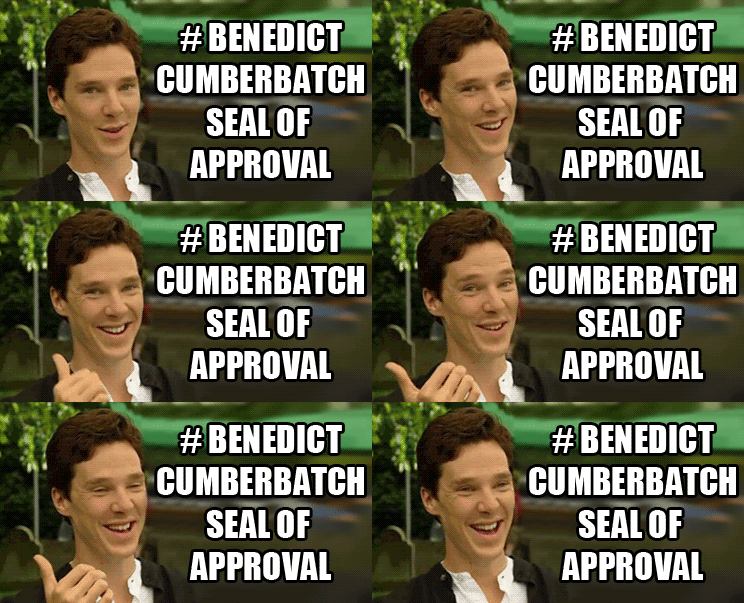
*please note, Benedict Cumberbatch has not actually given this book his seal of approval.
I could honestly not finish this book. It was horribly written, and the plot was all over the place. It was really disappointing and I had expected a lot more from this book. The character was so naive and you never knew what was going on because the character didn't, which made it feel like the author didn't.
Intense, suspenseful, and weird but a good weird. Highly recommend this over the falls craziness.
What if the life you thought you knew never really happened. What if the life you now live is the complete opposite of what you used to know. What if the person who was your best friend is now trying to kill you.
After seeing the very middling reviews of Undercurrent I had lowered my expectations going into it a bit. I don’t know if it was the lowering of my expectations or just the book itself but I came out of this one having had such a good time reading it. Callum was a really great MC and I loved watching him figure out exactly what was going on in the twisted world that he woke up in.
Callum wakes up after having fallen into Crystal Falls, the waterfall in his small town that no one has gone into and survived. Things are not right when he wakes up. His best friend wants to kill him, the most popular girl in school is climbing into his bed and the girl he thinks he loves has no idea why he is even talking to her. Needless to say things were pretty jarring to him when he woke up. I liked how the possibility of a head injury was used to make it a bit more believable that he would be sleuthing around to figure out why things have changed so much. It allowed him to hide much of what was going on in his head for fear of being taken to the hospital and getting checked back in. The use of flashbacks was also pretty interesting here because they came across as quite unreliable from what we were seeing as the plot progressed.
The secondary characters are a bit hard to comment on in this alternate reality tale. We come to know them one way through flashbacks that Callum has, but we also see them for who they are in this new world and the two are vastly different. I definitely appreciated how present the parents were here. They were always in the background and taking an interest in what was going on in their kids life, so kudos to the author for that little tidbit. One character that I wish we came to know more about was Willow. I know that Callum had an intense connection to her and was trying to rekindle that in this new world he woke up in but I never really felt that connection.
I think one of the benefits that I had going into this one was that I read it after the author had confirmed that a sequel has been green lighted. Knowing that, I was OK with the lack of science behind the Falls and how everything was able to be the way that it was. We don’t get a lot of answers here, and in a way I appreciated that a bit. It’s a very simplistic story as it is which makes it incredibly easy to follow and grasp. When science jargon is thrown into parallel universe/time travel stories I often have trouble wrapping my head around everything. That being said, I am happy to hear that we will get to delve into this world once again and get some of the finer details because I was left with my fair share of questions.
If you are looking for a fun read that is easily to follow and will have you turning the pages at a rapid pace I think Undercurrent is a great place to look. I’m pretty excited to meet Callum again and see exactly where Blackwell is planning to take the sequel.
An Advanced Reader's Copy was provided by the publisher in exchange for an honest review.
“It’s black where I am. All night sky and no stars”
I may have been a little lenient with the rating of this book but after reading two disappointing YA books this was definitely a relief so I decided to round up instead of rounding down.
This book starts with Callum waking up in a hospital but things aren’t the way he remembers them. For starters, his best friend tries to kill him when he is still in the hospital!
Callum is a complicated character. I am not sure whether I liked him or not because there were times when I was seriously annoyed with him but I never actually disliked him. Some of the things he does are just really stupid. He tries to go with the flow when he should have tried to figure things out right from the start. I, for one, would have felt a lot better if he had actually tried to ‘improve’ his image, everyone thinks he is an asshole and he does nothing to change that. I also think he should have tried to work things out with Bryce like he did with Willow. Aside from that, what I liked most about him was how much he cared about his family; it was evident from all the flashbacks.
I think the strongest relationship in this book was the one between Callum and Cole. I think it was portrayed really realistically. Cole can be a bully but he clearly loves his younger brother. That surprise in the end though, that really was sad.
One of the plus points in this book for me was that there wasn’t romance. Usually that wouldn’t be a plus point but after reading two YA’s that had HORRIBLE romances, it was kind of a relief. That is not to say the main character doesn’t share any relationship with a female. We know that Callum obviously has a crush on Willow but the thing is, the relationship between Callum and Willow is very well developed.
This book has a very interesting scientific concept and I think the author puts a rather original spin on it. I did guess what was going on pretty early on but the author still managed to surprise me.
The book did have an open ending but it didn’t bother me so much, mostly because I was so relieved. For most of the book I was shouting (in my head) for things to turn out the way I wanted them to and they did. I still have many questions but there is supposed to be a sequel. I hope it does get approved because with such an interesting concept, it would be a shame if there wasn’t more.
Harper Teen is one of my favorite publishers. I almost always enjoy every thing they publish, and I end up buying 90% of the books that I review by them. However, sometimes they publish a dud, and Undercurrent is their dud for the season, at least in my opinion. Callum is a detestable character. The secondary characters as well as the plot are under-developed, and the writing is subpar. This is a book that I'd recommend checking out from the library before buying. Some people loved it, and some people hated it. I'm one of those who hated it.
Callum (first off, I hate his name. It sounds like some gross body part/organ/deep sea creature) has no real emotions whatsoever. I could not connect to him at all. I finally figured out what's wrong with him... like another reviewer stated, he's a sociopath, plain and simple. He has no remorse and is extremely self-absorbed. I could not stand him. Someone wants to kill Callum? Well get in line, buddy, because so do I. He is one of the worst written characters I've ever read. The secondary characters are cardboard cut-outs and filler characters. They all seem exactly the same, and they are all incredibly dull. Everyone in this book has the same voice, and that voice is obnoxious. I couldn't bring myself to care about any of them, which made finishing this book a torturously boring experience.
The plot, which is about parallel dimensions really falls flat and is extremely under-developed. It doesn't really feel like there is a plot at all for most of the novel. Callum just kind of wanders around aimlessly while acting annoyingly arrogant and stupid. It wasn't hard to figure out what was going on, but good ol' Callum couldn't figure it out. Maybe if he'd pulled his head out of his butt he could have seen what was going on. ANYWAY, the ending also sucks. There is no fulfilling conclusion in this book. Oh no, it's as if Blackwell just got tired of writing and decided to stop about 3/4 of the way to the end. This is one of the worst endings I've ever read.
As I stated, I really wouldn't recommend this book to anyone, but since some people actually liked it, you may want to check it out from the library and see if you do, too. If you do try it, I hope you enjoy it more than I did.
I hate not liking a book, so it makes me sad to say that I really did not like Undercurrent. Which is really surprising because I normally like the books I get from Harper Teen.
Undercurrent is an alternate universe type of books and I have not ever read any of these types of books. I really wasn't sure what to expect but the back cover blurb sounded really interest. Callum wakes up in the hospital after going over a waterfall. He is the only person they ever have known to go over and make it out alive. Callum starts to realize right away that things are not the same as they use to be, but he can't quite figure out what is going on.
While in the hospital his best friend tries to kill him and he hears one of the nurses saying that she wishes he would have died. Why? He has no clue. His parents are divorced, but now they are together. His brother was a star athlete but now he is paralyzed.
He learns that what ever happened after he fell over the falls he is not the person everyone thinks he is, because now he is the star athlete. The thing is, Callum hates football!
Okay, so this could have been a good read but to me it just seem to drag on and on and repeat itself over and over. Callum seems so clueless as to what is happening. I mean does it really need to take over half a book for him to realize that something is very wrong and he is not in the same place he was when he went over the falls? You can only read so much about how different everything is, and about what is missing, etc.
I did not find this to be a fast paced thriller like it is said to be, I found it to be slow and boring and not real thrilling at all. Oh and don't even get me started on the ending! It ended so fast and abruptly I was like..What..that is it. I drugged through all of this for like a few pages of actual action and then bam it's over.
I hate not being able to say something positive about a book so I would like to say that I think the cover looks really cool! I really wish I could have loved this story but not every book is for everyone.
Confusing, exciting, and fun, Undercurrent is a novel that readers will enjoy! The story isn't perfect, it has some problems with the secondary characters that makes it a bit tough to like them. But it's a fun story about alternate realities and how one choice can make or break you. Literally.
While we're learning more and more about Cal, the writing for the story is more telling instead of showing during the first half. In the second half, the writing gets better, with more things being showed rather than told and it's smoother. It takes Cal longer than it should to figure things out and come up with a plan. The secondary characters in Undercurrent feel quite stiff and boring, they don't stand out or grabbed my attention. Also I wish that some characters had a much bigger role than they had, like the teacher and what makes him so special.
Even though Cal does take some time to figure things out, I love his character. He's very sweet and caring and persistent, especially when it comes to his friend, Willow. Somewhere during the middle of the story, things start to pick up and start to happen, people get hurt and tension is thick in the air. And by the end of the novel, everything is so intense it's crazy! Paul Blackwell does an amazing job describing the ending of the story. He gives readers a well-developed back flash and explanation as to why Cal's life has been turned upside down and a killer cliffhanger to end everything off.
Undercurrent is a fun ride. The ending is left open and it's exciting, the idea of alternate realities is a creative idea that I really enjoyed. I recommend this to anyone looking for a new science fiction novel or something different in the YA genre. I can't wait to read the next book!
Quick & Dirty: Cal Harris was only trying to set an example and make a point, instead he ends up in a three day coma and finally waking up is just the beginning of his nightmare.
Opening Sentence: A hundred and twenty gallons of water roar over Crystal Falls every second, it says on the plaques and in every pamphlet in town.
Review:
I enjoy reading thrillers like this one. The ending might be just a tad predictable and the plot may be just a smidge over done, but even with played out plots like this one, I enjoy finding just the few little things that make it stand out. Unfortunately, I couldn’t really find anything to really stand out in Undercurrent.
Cal, or Callum, as he prefers to be called, goes through a near-death experience that leaves him feeling completely out of sorts when he wakes up from a coma. It begins with subtle things like strangers acting more aggressively than necessary, his brother not visiting him in the hospital, his once best friend trying to kill him, that sort of thing. Literally, as soon as these first few scenes played out I pretty much knew exactly what I was in for throughout the rest of the book. Now, I said I like finding the unique things in common stories but Undercurrent pretty much had everything I would expect when characters are trying to “re-discover” their world. The sceevy guy is having an affair with an important town figure. The good kid becomes a bully. The hot chick wants the dork who used to be horrible at sports but now finds himself the star of the football team. Yeah. Seen it. Know it. Don’t need it again.
As predictable as it all was, I will credit Blackwell with keeping certain events just elusive enough that I wanted to keep reading. What’s up with the science teacher? Will the guy get the girl? Who is this dude in the sweatshirt that keeps popping up everywhere? Will Cal ever get his dog to love him the way she did before his accident?
I had my strong suspicions, most of which ended up right, but I had to keep reading to know for sure. I think that’s where Blackwell did the best work. There was just enough happening that I wanted and needed to see all the loose strings come together. However, with all that enticement, I felt like some of the questions were never answered at all. It isn’t a situation where he gives something of an ending to a situation and the rest is left for our imaginations. No, there are some blatant gaping loose ends.
On the other hand, Blackwell did a really great job with the back stories of some of the characters which he presented as flash-backs. I really like when a story goes smoothly from a really important memory back to the present without giving away why the memory was important at that moment or breaking the forward flow of the story. It’s an added bonus when more of the memory is added as the story progresses, something Blackwell did quite well.
Overall, I enjoyed the idea of the story. It needs some depth added to a few of the characters and maybe a less predictable twist. But, I will say it was well written and likeable enough. I just felt like I’d read it at least a dozen times before which was very disappointing.
Notable Scene:
“On the bridge,” I say, not that it could be any more obvious. “Just now. What did you just drop into the falls?”
Mr. Schroeder looks at me while the rain bounces off his jacket- and I am probably as wet and cold as when they pulled me out of the river. “It was a message,” he tells me wearily. “saying I was on my way.” He pulls the little black box out again, which now has a solid green light on it. “And according to this, the message was delivered.”
FTC Advisory: Harper Collins provided me with a copy of Undercurrent. No goody bags, sponsorships, “material connections,” or bribes were exchanged for my review.
Protagonist: I don't know if there has been any protagonist I've despised more. Callum Harris takes a majority of the novel to fully realize he's not in his same world after his tumble over the waterfall. Now, I understand being confused, as paranormal moments don't happen in real life, but when he was shown unparalleled evidence that the world he's in now, isn't his own, he still refused to believe it. He would think that either someone was playing a joke on him, or that his friends pretended not to remember him. The worst part was though, that just when I thought he'd get it, he would almost revert back to being oblivious.
Romance: I could tell that the author tried to add an aspect of romance to this story, though he didn't exactly succeed. Now, this romance even if done well wouldn't have been a main or even large focus of this story, however if done right it would have made the story a bit better. There was absolutely no romantic tension at all in this book, even with the "love interest" in fact, Callum, rather unconvincingly, just "realizes" that he's in love with one of his best friends without the readers seeing anything remotely romantic happen between them, not even in flashback form.
World-Building: This is yet another aspect that disappointed me. When I read the back of this book it sounded so mysterious and thrilling but what happened wasn't nearly as exciting as I had thought it would be. I had hoped for something conspiracy theory-esque, or maybe some paranormal action thriller, but nope, it's a fairly contemporary read with a touch of paranormal or sci-fi, depending on how you look at it. What we see in this world are two different universes one where Callum is nice to others but is seen as a nerd, not nearly someone who could be seen as cool, and another where Cal is a huge sports star and everyone in school either likes him, or fears him. I think the idea of these two worlds was great, but the execution and advertising was done poorly.
Predictability: The weirdest part about this book was that I could see many of the larger twists coming from a mile away, they were not only easy to spot or guess at, but it was very cliched. The smaller twists and revelations however, were fairly hard to gauge. I'm not too sure, at the moment, how I liked this weird switch up, it was at the least very interesting.
Ending: I'm not sure if this is the first installment to a series, which if it is I could try to forgive a lot, however if this is a stand alone, which I think it is, then this ending is probably one of the worst one's I've ever read, including Requiem by Lauren Oliver. There is no real conclusion or resolution to the story. There were so many things left unanswered and unfortunately those things were what kept me reading when I didn't want to. If this does turn out to be a series I will read the second one, but only to see if those questions are answered and not really because I want to.
Rating:
Yes, I have to give this two crests, it just wasn't what I thought it would be and the author's attempts at adding in romance or making our protagonist seem realistic were very failed. I would have loved to have my burning questions answered at the end like they were supposed to be, but unfortunately the lack of a good epilogue stopped that from happening.
UNDERCURRENT touches on a number of intriguing concepts alternate realities plus dark sides then getting what you never asked ask for… except only one of them is completely tackled. What aspect? He’s taken a fall, woken up to a town that sees him in a totally different light and treats him thus. My biggest frustration though is how it takes him forever to see things for what they were … instead it’s him constantly not accepting that maybe just there’s something more than just him having fallen and hit his head. FOREVER because even beyond the half way mark, he’d still react as he had been reacting early on SO that I just wondered were there an award for being purposefully dense, would he take it? Most Def.
So there I was with the feeling that he should have been doing something other than what he was. (that is, going with the flow, simply exclaiming, “Hey that’s different!” with little else.) I was expecting a bit more action once the facts had been absorbed (because obviously with all signs pointing to it you’d think he’d get recognize the difference as the outcome not just of some head trauma except that last bit… again: forever.) A good bulk of the book passes before things got real for Cal and consequently it took a longer while for things to pick up for me.
But even with his head buried in the sand, the life he was living (yet strangely enough was going along with anyway) was so very far from what his old one was. No longer little brother of scary guy, he was the scary guy; no longer the not quite popular one, but rather the opposite. The differences were striking; making his reaction all the more odd to me: there’s a lack of urgency here when my inner self was screaming at him to do something, (to do anything), actually NOW, kid!
Then there’s the not wholly unexpected dark aspect that came out. Popular kids and dark sides do tend to go matchy-matchy in YA don’t they? So there’s a scary/dark aspect to his new reality that’s more clearly laid out close to the end of the book. It was interesting; it was intriguing and I found myself paying closer attention when previously I’d been skimming. I truly do wish this was the focus rather than tit being a whole lot of Cal being dense… maybe, I would have enjoyed UNDERCURRENT a bit more. To make matters worse, there’s the fact that things end abruptly; consider, it had taken more than three quarters of Cal and I to click, then all of a sudden: ‘The end’? Aw, come on!
Imagine waking up one day and everything you thought was your life was suddenly different. Your friends are no longer your friends, and it seems that you are not even the person you thought you were. This is exactly what happens to Callum in Undercurrent, and when I read the synopsis I was immediately intrigued.
Callum is a pretty average teenage boy - he hates sports, has a close group of friends that aren't the most popular kids in school but aren't particularly picked on, and does OK in school. His older brother, Cole, is the all round sports star with a few skeletons in his closest, and their parents have recently split up. Callum isn't a particularly memorable character for his personality, but his situation is certainly unique.
The first thing that really stood out for me about Undercurrent was, that despite there being some female characters, there's not really any romance in this book, which is unusual for a YA novel. Instead, the focus is much more on the mystery surrounding Callum's life and his journey to try and uncover exactly who he is, and how his life could suddenly be so very different than what he remembers.
The overall tone is dark and mysterious, and there were quite a few twists that although I could sense they were coming, I rarely managed to guess what they were before they happened, and that made Undercurrent incredibly readable. The reactions of the people around him were so unpredictable to Callum and me as a reader that I had to keep coming back for more as Callum gradually uncovered exactly what was happening around him.
There is a smattering of internal dialogue which I did start to find a bit unnecessary and slightly irritating by the end of the book, but not enough that it ruined the book, I personally just couldn't see the point and it felt a little bit awkward.
Undercurrent's ending does feel slightly rushed, and there are a few points that didn't feel completely resolved, and although I didn't really need a lot more explanation, I can see where others may feel that it was a bit too neat and easy. In saying that however, the climax is pretty terrifying and chilling, and I was left feeling pretty satisfied overall.
If you enjoy mysteries, I can definitely recommend Undercurrent.
Dimensional stories are a new genre that I'm really loving. It a mix of moving action along with a mysterious force, pulling the reader into different worlds. I, for one, loved this story.
Plot: What would you do if you plunged into water and woke up in a different world? First, I freak out and then I think what do to. The plot moved well gathering the reader for great world building and characters. On the surface, the reader see and feels the gaps in the world. It's a daring experience trying to put everything together at once. I let the story guide me, putting myself in the thoughts of Callum, I let everything seeped into my mind slowly they way he did. He was smart and after thinking things through bit by bit, he slowly began to understand what is happening. It does move slow in the beginning, but it does have a lot of information to divulge, so give the book time to unfold.
Characters: There are some minor character that put the final piece of the puzzle and helped Callum. I felt like these guys (especially the end) was the comedy relief guys. No one understood their weird comments or actions. I knew to pay attention more to these guys cause they knew more than what they led on. Callum himself, did a big change in taking a role he didn't want to play and well played it perfectly. He did act strange at first but he got it. Callum questioned why he was so different in this world and what happen to change it. I always wondered myself what I would be like in another dimensional world. *shrugs*
Dimensional: This is the main part of the story and yes I loved it. It played out well from beginning to end, giving the reader an impressive experience. For me, dimensional stories are hard to pull off since they can be confusing. Blackwell doesn't confuse the reader at all, instead giving the reader a steady and exciting story to read.
Undercurrent is a dark, impressive story. With the perfect ingredients of action, mystery and dimensions, Blackwell excellent story telling moves the reader. With a vivid execution from start to finish, Undercurrent is an entertaining ride.
I enjoy reading a male POV once in a while, so I decided to give Undercurrent a try. I am glad I did- it was an entertaining read, and a nice change of pace from my usual girl-centered YA.
This book is all about the suspense and intrigue. This main character, Callum, wakes up in the hospital, having survived a trip over the falls. Early on he begins noticing that things don't seem right. The bulk of the book is about his journey to figure out what has happened to the life he remembers. I liked how the discovery process was done, and the plot was well-paced. The reader is given plenty of time to linger over and speculate about what has created this situation before the big reveal.
Callum, our narrator, is a winning hero. He's a nice guy who doesn't want any trouble, and the reader sympathizes with him as his world seems to crumble piece by piece. His observations are nicely detailed without becoming tedious.
As the blurb indicates, there is a "shadowy figure" lurking throughout the book. I like that there are several possible suspects, and that I wasn't able to guess right off the bat which was the right one. I kept moving the pages mainly because I wanted to learn this person's identity.
This book is difficult to discuss without giving spoilers, and I would caution you to refrain from reading many reviews if you're interested in this title. If you're interested, go with your gut on this one- and enjoy the ride.
Over the past year or so I've been reading more thrillers than I ever had in my whole 24 years on this planet. There's just something special about unraveling the mystery while you're on the edge of your seat.
Callum wakes up disoriented in a hospital surrounded with family and friends. He doesn't know how he got there when his best friend tries to smother him with a pillow. Soon he finds himself in a world where he's no longer the geeky, silent guy but the most popular one in school. Callum doesn't try to do anything. He doesn't question why are things the way they are. He just goes along with everything.
I already knew what was going on mostly because of the Goodreads shelves listing a very important spoiler. The story was still engaging but I wasn't trying to find out what is going on because of the spoiler. I found myself skimming whenever there wasn't any dialog, which is a sign of losing interest.
However, I was satisfied with the ending even though a lot of bloggers don't agree with me. We don't reveal every secret in this book but I was glad Callum got the ending he deserved.
At first glance this book is interesting and clever... Then, not so much. I was enjoying this book for about the first 2/3 of it, pretty good right? Then it all fell apart. My boy, Callum, could not understand that he wasn't home. Dorothy knew pretty quickly that she wasn't in Kansas, but Callum only thought it was some weird prank. That got tiring. The ending was a huge letdown for me. Too many unanswered questions. Even if this was written with a sequel in mind, there were still too many unanswered questions for me to feel like reading another one. And really, Callum isn't that smart, it's no fun seeing the world thru someone's eyes who doesn't understand anything he sees.
Very creepy thriller about Callum, a teen who goes over a waterfall in his town and ends up in an alternate version of his world where one decision changed everything.
Of course it takes Callum most of the book to figure out that this is case, but the reader knows much, much earlier. Callum would rather believe he's the one that's gone crazy, because the existence of a multiverse is crazy right?
Graded By: Brian Cover Story: No Boy Will Ever Read This Drinking Buddy: Which Way Did He Go, George? Testosterone Level: Overload Talky Talk: "Like That One Episode of the Twilight Zone." Bonus Factors: Alternate Reality, Crazy Science Teacher Bromance Status: I Love You Man...Um, It Is You, Right?
It's a good book but I didn't really understand the ending. Throughout the book, I felt asking a lot of "why" since it can be confusing while reading this book. I feel like there should be a second book
This was a very quick read, in part because it was fast-paced and kept me engaged and turning the pages. I wanted to get to the resolution. The ending left some strings hanging, but for the most part was satisfying.
Have you ever wondered how you would feel, or how you would react if your whole life were to turn around randomly? What would happen? What would you do? Who would you tell? Who could you trust? … I know, it's pretty confusing and you're probably thinking 'pff like if that would ever happen’ well it can, just ask Cal…. Cal or Callum as they use to call him.. “It's black where I am. All night sky and no stars. And silent. Or at least it was-- things are becoming less black, more of a dark red, like a pool of blood.-- I see something- a room, whiter than white- Then it's back to the red again. ‘Cal, can you hear us? Make a noise if you can hear us….” Callum Harris just woke up from the worst accident and actually survived it. After falling from the Crystal Falls Cal wakes up in a room hospital, everything seems normal, until strange things start to happen, the nurses hate him and his best friend just tried to kill him. After all this Cal is confused and scared and just wants to get out of there, but when he crosses town and gets home the only thing he receives are just more surprises, his entire life has switched, its like a plot twist, he doesn't even know who he is anymore…Now he will have to figure things out and face the changes...What will happen next? Will someone believe him? ‘Either Cal has gone seriously crazy or something happened when he went over the edge of the falls. Something impossible. Callum needs answers, and now. Because in this twisted new version of the life Cal knew, his best friend isn't the only one who wants to see him dead.’ Find out more by reading Undercurrent by Paul Blackwell. This book is a book that i will never forget, it was a great experience to read it, it is now one of my favorite books, personally i love suspense books because they really catch my attention it is the one thing that makes me want to keep reading, and i couldn’t have chosen a better book to describe that, Undercurrent is just full of mystery, of suspense… You don't know anything at the beginning, you're just as confused as the character, reading this book was like going on a journey with the main character (Callum H.) because he was just like us, confused since the moment he opened his eyes, since the moment he started living again. And the more you keep reading the more ya’ll both keep finding more things out, discovering things, surprises that we never expected. I would give this book a 10, i really recommend it, it is just impressive, everything about it, i really like how the author put the book together, he didn’t just do a simple book about this kid falling over the falls and surviving the accident and then it's just a memory 10 years later about how he didn't die etc etc- no… He absolutely went out of the box and took this story and turned it into a masterpiece, something more in depth, something that he obviously knew people were going to love. He added suspense, something that makes the readers interested in the book, something that makes them want to keep reading. I’ve never read a story like this before, like if i went through this it would just be mind blowing. The author keeps the book in such a great level of suspense and adds detail to it, he explains in depth everything that happens and it's better because you feel connected to the characters, he literally makes you feel what the character is feeling because he puts so much detail to it, you can picture exactly what is happening and it’s a great skill that all authors should have and demonstrate in their books. “A hundred and twenty thousand gallons of water roar over Crystal Falls every second, it says on all the plaques and in all the pamphlets around town. Which is almost two million glasses -- or two thousand bathtubs or six full swimming pools spilling every second, plunging eighty feet to boom against rocks and turn into mist, foaming and churning and swirling in a giant bowl before raging madly away downriver.” now imagine yourself falling with that water...




 cover
cover
 *
*