So, her reckless, anti-philanthropic passion could find no outlet-- and SHOULD find no outlet, she thought. So her own blood turned against her, beat on her own nerves, and destroyed her. It was nothing but frustration and anger which made her ill, and made the doctors fear consumption. There it was, drawn on her rather wide mouth: frustration, anger, bitterness. There it was the same in the roll of her green-blue eyes, a slanting, averted look: the same anger furtively turning back on itself.
David Herbert Richards Lawrence was an English writer of the 20th century, whose prolific and diverse output included novels, short stories, poems, plays, essays, travel books, paintings, translations, literary criticism, and personal letters. His collected works represent an extended reflection upon the dehumanizing effects of modernity and industrialisation. In them, Lawrence confronts issues relating to emotional health and vitality, spontaneity, human sexuality and instinct.
Lawrence's opinions earned him many enemies and he endured official persecution, censorship, and misrepresentation of his creative work throughout the second half of his life, much of which he spent in a voluntary exile he called his "savage pilgrimage." At the time of his death, his public reputation was that of a pornographer who had wasted his considerable talents. E. M. Forster, in an obituary notice, challenged this widely held view, describing him as "the greatest imaginative novelist of our generation." Later, the influential Cambridge critic F. R. Leavis championed both his artistic integrity and his moral seriousness, placing much of Lawrence's fiction within the canonical "great tradition" of the English novel. He is now generally valued as a visionary thinker and a significant representative of modernism in English literature. http://en.wikipedia.org/wiki/D.H._Law...
The floral, fiery, animal, earthy, easy-to-mock Lawrence that I love (akin to The Rainbow see my review HERE, and a rainbow is mentioned, as is a gamekeeper).
This novella is set as The Great War is ending. The first few pages are devoted to Lady Beveridge, “this little, worn bird of an out-of-date righteousness and aesthetic”. She visits German POW officers in a London hospital, and recognises an old family friend, Count Dionys. She encourages her beautiful, but sickly 25-year old daughter with “wild energy” to visit him, thus making herself irrelevant to the rest of the story (she’s briefly mentioned near the end) - not that she was necessary in the first place!
The stage is slowly set for a Lawrencian triangle of natural passion and unsubtle symbolism (“the white plucked lily of your body” with its secret, buried root) and a diversion into philosophical debate.
Daphne’s “adorable” husband, Basil, is a POW in Turkey, and the Count has an animal magnetism, despite his being physically unappealling. Whereas looking at her mother “filled the heart with ashes”, the dark little Count (those adjectives and variants of them are repeated like a mantra) fills her blood with fire. Fire: beautiful, bewitching, warming… dangerous.
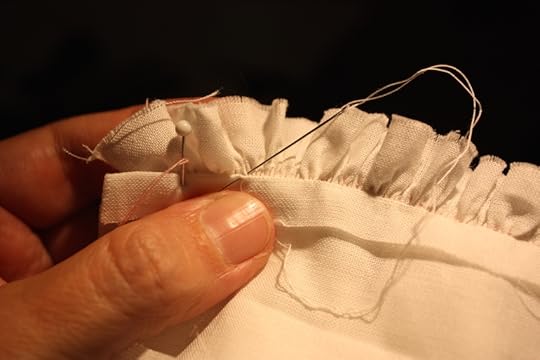
“I am a prisoner in other people’s clothes.” The Count asks Daphne to sew him some shirts, on condition she uses the thimble he gave her when she was 17, bearing his family’s heraldic scarab-like ladybird.
It’s a distant task (she does it at home, without having measured him) but also an intimate one, reflecting her contradictory feelings. The day after I read this, I learned that Catherine of Aragon continued to embroider Henry VIII’s shirts, long after he left her for Anne Boleyn - who objected in vain (see entry for Season 2, Episode 1, quoting Antonia Fraser HERE).
Then Basil returns...
Love in all its forms
I love the open-minded inclusiveness: “No form of love is wrong, so long as it is love, and you yourself honour what you are doing. Love has an extraordinary variety of forms! … If you deny the variety of love you deny love altogether… Love must be multi-form, else it is just tyranny, just death.”
True love implies willingness to sacrifice one’s own pleasure for that of the beloved. In this novella, it’s in a surprising way.
Dark flames of cold fire, and burning blood
Being Lawrence, love is inexorably linked to its opposite: “Hate is only the recoil of love.”
His use of such oxymorons in the context of animal passions is especially suited to relationships that are in some way taboo, as those he writes about often are.
“The Count had something that was hot and invisible, a dark flame of life that might warm the cold white fire of her own blood.”
Image: Flowers, flames, or blood? By Ear_Candy (Source.)
Quotes
Like The Fox, much is told by repeated mentions of eyes. I included many examples in my review of The Fox, HERE, so not listed as many in this review.
• “The true fire is invisible… it is running away from us… The yellowness of sunshine - light itself - that is only the glancing aside of the real original fire… There would be no light if there was no refraction, no bits of dust and stuff to turn the dark fire into visibility.”
• “True love is dark, throbbing together in darkness, like the wild-cat in the night, when the green screen opens and her eyes are on the darkness.”
• “She was looking into his eyes. She could see the darkness swaying in the depths. She perceived the invisible, cat-like fire stirring deep inside then, felt it coming towards her.”
• “Daphne’s voice had become slow and sonorous, like bronze.”
• “There was a strange incomprehensible coldness in his very fire.”
• “Bits of yellow wallflower shake raggedly, with a wonderful triumphance, out of the cracks of the wall.”
• “The tremble bleat of the growing lambs, and the deeper, contented baa-ing of the ewes.”
• “The darkness inside the room seemed alive like blood… The darkness flowed about them like thick blood, and time seemed dissolved in it.”
• “Her eyes were the saddest part of her… But they were full, languid, almost glaucus.”
More Lawrence
See my review of Selected Short Stories, HERE, for an overview of common themes, and links to reviews of his other novellas and short stories.
A strange story by Lawrence, and strange characters, which he is uniquely capable of creating. Set toward the end of World War I, a German prisoner, a Count, convalescing in an English hospital, is befriended by Daphne, the “Ladybird”. They are acquaintances from years earlier. Their relationship, their mutual attraction, seems to me unusual, reminding me of two of Lawrence’s other characters, Lady Chatterley and Oliver the gamekeeper. Another excellent piece of writing by D.H. Lawrence.
The book took my breath away. No review can do it justice. I will try and give you an inkling of what lies in store.
Being on a battlefield, remaining at home and loosing loved ones, caring for the maimed in a hospital, attempting to obliterate the enemy--and what if the enemy are those who were once friends before. This is war. Living through war, irrevocably changes a person. One’s outlook on life, no, one’s outlook on everything is forever changed. Even memories of the past are altered. D.H. Lawrence captures this lyrically. Beautifully.
People change during a war and so personal relationships do too. Here we come to experience what this truly means. My words are ordinary, mundane. Lawrence’s are not.
The writing is stunning, gorgeous, magnificent.
I have read a lot about wars. This one is up there with the best. Put it alongside All Quiet on the Western Front by Erich Maria Remarque. Both are set during the First World War. They are completely different but equally good.
I highly recommend listening to this as an audiobook, but it must be read by Margaret Hilton. I was so impressed by her narration of Lawrence’s The Virgin and the Gipsy that I knew I had to try more. Her narration is magnificent in both books. Lawrence’s writing reads as lyrical prose poetry. Capturing the mood of the writing is essential. This, Hilton does in spades. Words are spoken clearly, and the tempo is perfect too. Five stars for the narration.
I want to go on and on, tell you more--I keep trying to get across all that I felt. I don’t succeed. This is enough I cannot express all that Lawrence gets across in this short but elegant piece of writing.
في أول لقاء بينهما ، قال لها : "أنتِ كزهرة خلف صخرة ، قرب ماء متجمد ... في لقائهما التالي ، قال لها : أنكِ تقفين كزهرة سوف تذوب... قالت : إنني أصلبُ بكثير مما تتصور ..."ولكن فيما يبدو إنها اغفلت أن ما يبدو صلباً قد يكون الأسهل كسراً......
Breve racconto di un sempre eccellente Lawrence, qui gli eventi disastrosi della Grande Guerra sovvertono le vite e le coscienze dei suoi personaggi, una storia inquietante ed ammaliante tra il conscio e l'inconscio.
"...no form of love is wrong, so long as it is love, and you yourself honour what you are doing. Love has an extraordinary variety of forms...if you deny the variety of love you deny love altogether. Love must be multiform, else it is just tyranny, just death," writes Lawrence, through the voice of the Major. To me, this IS the voice of D.H. Lawrence as evidenced by his other works. Lovely.
کتاب رو تموم کردم. الان دوست دارم حسی که دقیقا بعد از خوندن کتاب بهم دست داد رو بنویسم. نمیدونم واقعا هدف نویسنده چیزی بوده که من برداشت کردم یا نه، اما... به نظر من در پایان این کتاب انگار انسان به این اگاهی می رسه که خیلی باید مراقب باشه! انگار روح شیطان در کمین روح ساده و پاک و سرگردان انسان هاست... انگار بیزاره از زیبایی روح و سادگی و پاکی و تعهد درونی انسانها! انگار هر جوری میخواد روح پاک و سرگردان رو به تسخیر خودش در بیاره و اونقدر اون رو در اعماق تاریکی فرو ببره که احساس کنه جزیی از اون تاریکیست.احساس کنه فقط در سیاهی و تاریکی احساس آرامش داره و به اونجا تعلق داره...اونقدر که حتی دیگران هم تسلیم تعلق اون روح به تاریکی بشن!! و اونوقت اون رو در تاریکی که یه آرامش ساختگی براش داشته رها کنه و پیروزمندانه بره! شاید دنبال تسخیر روح دیگری!! به نظر من اگر این وسط عشقی متعالی و حقیقی وجود داشت قدرت مقابله با ورود تاریکی و غلبه بر اون رو داشت.... به نظر من متن کتاب و ترجمش خوب بود و کتاب راحت �� خوب پیش رفت... شاید برداشت افراد دیگه با من متفاوت باشه اما این برداشت من در پایان کتاب بود...
“La macchina della guerra è ormai uscita dal nostro controllo e noi non sapremo più rimetterla in moto: finché sarà fatta tutta a pezzi. Noi avremo paura”.
“Then suddenly, without knowing, he went across in the dark, feeling for the end of the couch. And he sat beside her on the couch. But he did not touch her. Neither did she move. The darkness flowed about them thick like blood, and time seemed dissolved in it. They sat with the small, invisible distance between them, motionless, speechless, thoughtless.
Then suddenly he felt her finger-tips touch his arm, and a flame went over him that left him no more a man. He was something seated in flame, in flame unconscious, seated erect, like an Egyptian King-god in the statues. Her finger-tips slid down him, and she herself slid down in a strange, silent rush, and he felt her face against his closed feet and ankles, her hands pressing his ankles. He felt her brow and hair against his ankles, her face against his feet, and there she clung in the dark, as if in space below him. He still sat erect and motionless. Then he bent forward and put his hand on her hair.
'Do you come to me?' he murmured. 'Do you come to me?'
The flame that enveloped him seemed to sway him silently.
'Do you really come to me?' he repeated. 'But we have nowhere to go.'
He felt his bare feet wet with her tears. Two things were struggling in him, the sense of eternal solitude, like space, and the rush of dark flame that would throw him out of his solitude towards her.
He was thinking too. He was thinking of the future. He had no future in the world: of that he was conscious. He had no future in this life. Even if he lived on, it would only be a kind of enduring. But he felt that in the after-life the inheritance was his. He felt the after-life belonged to him.
Future in the world he could not give her. Life in the world he had not to offer her. Better go on alone. Surely better go on alone.
But then the tears on his feet: and her face that would face him as he left her! No, no. The next life was his. He was master of the after-life. Why fear for this life? Why not take the soul she offered him? Now and for ever, for the life that would come when they both were dead. Take her into the underworld. Take her into the dark Hades with him, like Francesca and Paolo. And in hell hold her fast, queen of the underworld, himself master of the underworld. Master of the life to come. Father of the soul that would come after.
'Listen,' he said to her softly. 'Now you are mine. In the dark you are mine. And when you die you are mine. But in the day you are not mine, because I have no power in the day. In the night, in the dark, and in death, you are mine. And that is for ever. No matter if I must leave you. I shall come again from time to time. In the dark you are mine. But in the day I cannot claim you. I have no power in the day, and no place. So remember. When the darkness comes, I shall always be in the darkness of you. And as long as I live, from time to time I shall come to find you, when I am able to, when I am not a prisoner. But I shall have to go away soon. So don't forget--you are the night wife of the ladybird, while you live and even when you die.'“
İngiliz edebiyatının klasik yazarlarından sayılan Lawrence’ın okuduğum ikinci kitabı oldu Uğurböceği. Kitap 96 sayfalık bir novella. Kavis Kitap’tan çıkan baskısını okudum. Çevirisi de oldukça güzeldi. Hikaye özelde bir aşk hikayesi. 1. Dünya Savaşı döneminde geçen novella bir solukta okunan bir kitap oldu benim için. Bunun dışında söyleyecek pek birşey yok kitaba dair. Savaşın ruhlarda yarattığı yıkıcılığı da hissettiriyor kitap.
Promozione in limine: fino a ieri ero convintissimo di attribuirgli unicamente una stella ma alcuni passi della seconda metà della novella mi hanno portato ad aumentare la valutazione. La storia di questo racconto è una vicenda d'amore "all'inglese" proprio come ce la potremmo immaginere assecondando i più superficiali stereotipi: algida, ingessata, piatta e ricca di emozioni ubiquamente castrate. Verrebbe quasi da gettare un'ombra sul ruolo che i grandi critici che riconoscono in Lawrence (che scrive "La Coccinella" nei primi anni '20) un antisegnano della grande tradizione modernista britannica. Ciò nonostante piacevoli sorprese, rispettivamente al capitolo 4 e 5. In primis interessante la prospettiva filosofica delle parole del Conte che, a dialogo coi coniugi, sembra resuscitare un Leviatano con vesti nuove, più attuali, quasi forse a devisare la stagione (necessaria sembrerebbe) dei totalitarismi che si sarebbe poi affermata in Europa. In secundis interessante il risvolto sentimentale in chiosa, un eros che è sempre fumigante e tenebroso e mai vizioso o sopra le righe (quasi come nella Lady Chatterley), ma che nonostante tutto regala una piacevole sorpresa, dal sapore di un legame evanescente e forse per questo estremamente autentico.
A novel written in 1921, set in 1918and 1919, as an aristocratic mother and daughter visit a German aristocrat prisoner they knew before the war, in hospital in London. The book acts as a vehicle to describe the impact of war on all the key actors - fatalism, forgiveness, fear, isolation, grief and the changing context for the aristocracy. Quite a compelling read.
تدور أحداث الرواية في فترة نهاية الحرب العالمية الأولى السيدة بيفيردج التي مات ابنها في الحرب لم تجد وسيلة أخرى سوى أن تذهب للمستشفيات تدور على الجرحى والأسرى حيث كان هذا الأمر يشكل لها حاجة ملحة لتتخلص من الشعور بالإستسلام والموت الذي خلفته ذكرى ولدها تلتقي بالصدفة بالكونت دايونيس البوهيمي جريحا وأسيرا يعاني من طلقتين في ذراعه وأخرى اخترقت صدره , تتذكره السيدة حين كان صبيا استأجر هو وعائلته جزء من بيتها تقف عند سريره كان رجلا وحيدا شاحبا يستلقي في هدوء الموت تناديه تذكره بنفسها يرد عليها بكلمة واحدة ! تعود السيدة في اليوم التالي برفقة ابنتها المتزوجة من رجل نبيل المحتد غادرها لأجل الحرب شيء ما في هذا الرجل يسترعي دفني لكي تكرر الزيارة , تتذكر الهدية التي أهداها إياها وهي طفلةهناك ما يجبرها للعودة كلما قررت أن تكون تلك الزيارة الأخيرة تدور الكثير من الحوارات بين الأثنين ولكن ينقل الكونت إلى منطقة أخرى !
الرواية خلابة سواء في التعرض لويلات الحرب وأثرها النفسي والتي عانى منها لورنس شخصيا أو في الحوار الدائر بين الشخصيتين الرئيسيتين في الرواية كان دافئا وراقيا جدا غوص عميق ..الإنفعالات والرغبات الذاتية لبطلة الرواية النهاية روحانية جدا : )
الكاتب هو صاحب رواية عشيق الليدي تشارترلي وأبناء وعشاق اللتان منعتا في إنجلترا لفترة طويلة
There's a side of Lawrence that makes him seem ridiculous and even awful (views on politics, bigotry) but he is undeniably a great writer. Ladybird is in part an antiwar story, among my favorites of his, a close second to Sons and Lovers.
kitaptan bir puan kesmemin tek nedeni beyaz geceler'den daha güzel olmaması. bunun dışında kitap bir şaheser, ayrıca kont karakteri dorian gray'in portresi'ndeki lord henry ile benzerlik gösteriyor. bu kadar
رواية شدتني من بدايتها والتعريف بالكاتب حتى النهاية، بعيدًا عن الحب الأبدي المظلم كنت في تساؤل حول العنوان المبهم "الخنفساء المنقطة " وماذا يعني ؟ إذ لم يكن غير شعار لأحد العوائل الأرستقراطية يرمز لهم. رواية خفيفة لطيفة إستمتعت بها.
Un bel racconto lungo che racconta le insidie dell'amore tra una bellissima, insicura nobildonna inglese, un conte tedesco ferito in guerra durante la I Guerra Mondiale e tenuto prigioniero in Inghilterra e Basil, l'aristocratico marito di lei, anch'egli reduce di guerra, ferito più nello spirito che nel corpo: anime inquiete, sconvolte dalla guerra, dalla solitudine, dall'incertezza del domani che, dietro l'apparente sicurezza degli agi quotidiani, cercano stabilità emotiva, porti sicuri in cui lasciarsi andare, amore eterno a qualunque prezzo.
Another novella that deals with the concept of power, the sources thereof and the relative independence of women vis-a-vis that of patriarchy. All framed within the context of World War I, and the changes that resulted from this cataclysmic event. Would have loved a proper novel exploring these issues.
La forma en la que el autor hace que el Conde diga cosas tan bonitas me tenia derritiendome de amor jaajaja, es un libro hermoso.
La prosa del autor es muy hermosa, es algo tediosa, sin embargo, eso te permite adentrarte en las emociones de los personajes. Moría porque algo más pasara y esa es la razón de las 3 estrellas, porque me dejaron con ganas de más.