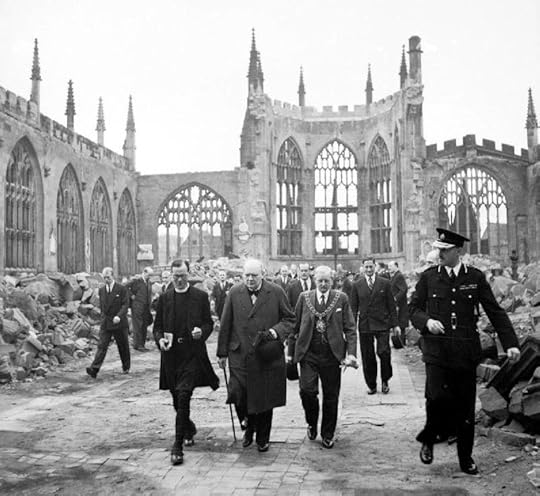
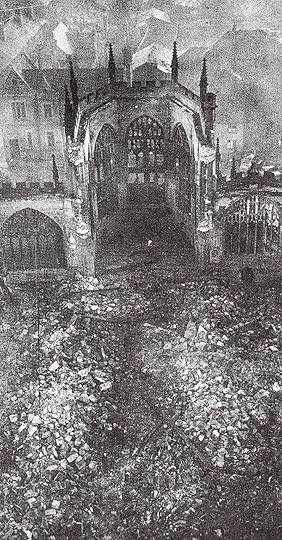
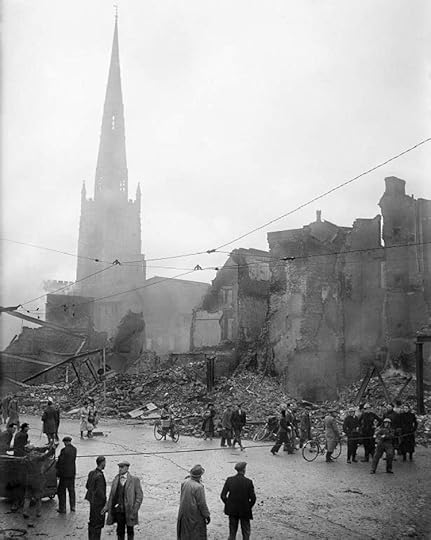
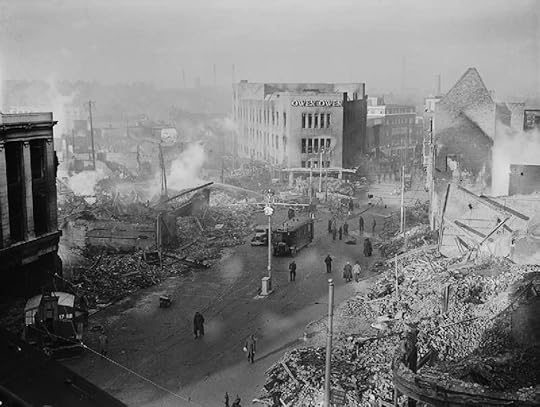
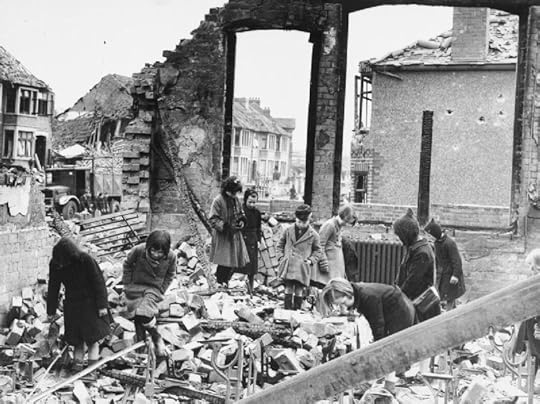
Even though I’m a fan of elaborate prose that leans toward the lyrical and poetic, I found myself absorbed in Helen Humphreys’s simply told story. Not that her prose isn’t pretty fine. It is...but straightforward in an elegant kind of way. She has an easy, gentle tone that belies the horrific nature of the scenes that unfold before our eyes. The bombing of Coventry, England by the German Luftwaffe on November 14, 1940, is at the heart of the narrative. Coventry was an industrial center where Triumph Motor Company, the Daimler Motor Company, and Alfred Herbert manufacturing which made machine tools, and many other factories were bombed. The streets became chaotic as people died in their homes, in air raid shelters, in Anderson Shelters, which were corrugated metal shelters set up in many gardens and backyards, and as they went about searching for safety. Besides the loss of life, the most heartfelt loss was probably St. Michael’s Cathedral, built in the late 14th and early 15th centuries, the only Cathedral that England lost to bombing during WW2.
We meet Harriet Marsh first in 1940 as a fire watcher; she is taking the place of a friend who has twisted his knee. Fire watchers are mostly old men and young boys who watch the roofs of Coventry and send up an alarm when bombs start falling. Dressed in her friend’s overalls and tin helmet, Harriet is on the roof of the Cathedral. When the author summons us to 1914 we meet Harriet as a young bride. Her groom, Owen, eighteen years of age, is going off to war. It is here that I become absorbed, for Humphreys’s descriptions are like an old vintage picture, soft around the edges. This is a young couple in love, and their lovemaking is new and sweet. Harriet observes Owen as he shaves and thinks him most beautiful. Before Owen’s leavetaking, he assures his bride that the war will soon be over.
There are two more main characters. One of them is Maeve, a young woman that Harriet meets briefly in 1914, just after Owen boards his train for basic training in France. It’s a meaningful meeting that will ripple out through time, a pebble dropped in the center of their young lives. The other main character is Jeremy, a young man, and fellow fire watcher in 1940. Jeremy seems so young to Harriet and more than a little lost as the entire city begins to catch fire. Harriet will accompany Jeremy as he searches for his mother. Their route is hellish and unforgettable.
It was interesting to me that Harriet writes ‘descriptions’ and Maeve is a bit of an artist. Through these pathways of communication, I gained insight into the characters. Harriet’s search for the perfect word and Maeve’s powers of observation as she sketches remind me that all of us are trying to bring meaning to our world and life experiences. Humphries details the horrors of a bombing blitz and shows how in the midst of war, we still look for relationship, a tender touch, a softening of the heart. This beautiful and well-written story is like an arrow there...to the heart.