

What do you think?

The Place of Shells
In the summer of 2020, as Germany slowly emerges from lockdown, a young Japanese woman studying in Göttingen waits at the train station to meet an old friend. Nomiya died a decade earlier in the Tōhoku tsunami, but he has suddenly returned without any explanation.
The reunited friends share a past that's a world away from the tranquillity of Göttingen. Yet Nomiya's spectral presence destabilises something in the city: mysterious guests appear, eerie discoveries are made in the forest and, as the past becomes increasingly vivid, the threads of time threaten to unravel.
With a literary style reminiscent of W. G. Sebald, Yoko Tawada, and Yu Miri, The Place of Shells is an astounding exploration of the strange orbits of memory and the haunting presence of the past.
The reunited friends share a past that's a world away from the tranquillity of Göttingen. Yet Nomiya's spectral presence destabilises something in the city: mysterious guests appear, eerie discoveries are made in the forest and, as the past becomes increasingly vivid, the threads of time threaten to unravel.
With a literary style reminiscent of W. G. Sebald, Yoko Tawada, and Yu Miri, The Place of Shells is an astounding exploration of the strange orbits of memory and the haunting presence of the past.
146 pages, Kindle Edition
First published July 9, 2021
About the author
Mai Ishizawa
4 books11 followersMai Ishizawa was born in 1980 in Sendai City, Japan, and currently lives in Germany. Her debut novel, The Place of Shells, won the Akutagawa Prize.
Source: New Directions
Source: New Directions
Ratings & Reviews
Friends & Following
Create a free account to discover what your friends think of this book!
Community Reviews
Displaying 1 - 30 of 127 reviews

September 8, 2025
Mai Ishizawa’s unnamed narrator left Japan to complete an art history doctorate in Göttingen, renowned German university city – the narrator’s life overlaps with Isizawa’s own. Three years later, it’s the first year of the Covid Pandemic and restrictions are slowly being lifted. In the middle of the sweltering summer, the narrator waits near the train station for a visitor, her old friend Nomiya. He’s here for an academic project. She hasn’t seen him for nine years, not since he died during the March 2011 tsunami that swept the coast of northeastern Japan. His body was never recovered. But this isn’t a conventional ghost story and Nomiya’s sudden reappearance isn’t presented as especially startling. Although, it seems significant that Nomiya’s arrival is close to the beginning of Obon, Japanese festival of the spirits of the dead when ghosts return to former homes and families. The narrator feels frozen somehow, still unable to fully process her reactions to what happened to Nomiya – at the time she was in Sendai in the Tōhoku earthquake zone. This physical distance has somehow been translated into emotional distance. On some level the narrator is grieving but uncertain if she actually has the right. Her anxieties and sense of isolation intensified by the ongoing pandemic.
Ishizawa’s award-winning narrative gradually forms a complex meditation on suffering, remembrance and time. As part of that it resurrects and reworks elements of Tumarkin’s concept of traumascapes: sites which witnessed devastating events. Here these are both internal and external. For the narrator her sense memories make the very ground she walks on seem precarious, it might open up under her feet at any moment. But the city is also weighed down by past traumas which slowly rise to the surface. During his walks in the surrounding forest, Hector, the small, truffle-hunting dog who lives with the narrator, starts to unearth curious objects – objects which turn out to be potent reminders of individual loss and sorrow. Strange smells flooding the streets trace back to Nazi book-burnings, the sound of distant footsteps carve out the path taken by Jews herded towards trains bound for concentration camps. Scenes from Göttingen’s history replay, shimmering, mirage-like manifestations.
Göttingen’s Planetenwegen - model of a planetary path found in numerous German cities - is abruptly altered. Pluto, associated with death and the underworld, once marked its ending but was removed when its astronomical status changed. Now it’s back flickering in and out of view, a lure for modern-day pilgrims. As people start to shed their Covid masks, history, time, even space, are also unmasking. The narrator is caught up in bizarre chains of association stirred by artworks she’s studying, particularly the saints rendered identifiable by symbols of their tortured lives and deaths such as the arrows piercing Saint Sebastian’s flesh. Shell imagery abounds and proliferates from the shells carried by pilgrims in search of peace or atonement to the shell dinner organised by the narrator’s friend and language tutor Ursula. The sight of scallops arouses memories of Nomiya’s childhood. Time refuses the linear instead it visibly spirals and loops.
Ursula’s guests include Terada a new pupil and a recent acquaintance of Nomiya’s. But Terada too is a spectre. He’s long-dead Torahiko Terada, scientific observer of earthquakes and responses to natural disasters. He also, uncoincidentally, appeared as Kangetsu Mizushima in one of Sōseki’s novels. The narrator’s detailed accounts of Göttingen’s layout become less geography than uncanny psychogeography; partly conjured through language like Terada’s invocation of abandoned Japanese systems of naming. Images of light and dark abound, figures disappear into “whiteness” recalling the city’s former scientists whose work fed into the bombing of Hiroshima and Nagasaki. The city and its inhabitants are transformed into a living, breathing archive. Irreality is supplanted by surreality.
Despite its hallucinatory aspect, Ishizawa’s novel has an oddly detached feel, dream-like yet restrained and disciplined. It’s partly inspired by Michael Ende, and by Natsume Sōseki’s story “Ten Nights of Dreams.” At one point, Terada suggests they’re playing out an “eleventh dream.” However, Ishizawa’s intricate reflections on memory, trauma and survivor guilt come to a surprisingly concrete, if ritualistic conclusion, one which finally provides the narrator with the release she so desperately craves. In many ways this is a very impressive debut and Ishizawa’s an author well worth following. But, like so many first novels, it’s overpacked, too detailed, too bristling with ideas. It’s definitely inventive, it could be moving and provocative too but there were times when I also found it off-puttingly forced or laboured. Translated by Polly Barton.
Thanks to Netgalley and publisher Sceptre for an ARC
Rating: 3.5
Ishizawa’s award-winning narrative gradually forms a complex meditation on suffering, remembrance and time. As part of that it resurrects and reworks elements of Tumarkin’s concept of traumascapes: sites which witnessed devastating events. Here these are both internal and external. For the narrator her sense memories make the very ground she walks on seem precarious, it might open up under her feet at any moment. But the city is also weighed down by past traumas which slowly rise to the surface. During his walks in the surrounding forest, Hector, the small, truffle-hunting dog who lives with the narrator, starts to unearth curious objects – objects which turn out to be potent reminders of individual loss and sorrow. Strange smells flooding the streets trace back to Nazi book-burnings, the sound of distant footsteps carve out the path taken by Jews herded towards trains bound for concentration camps. Scenes from Göttingen’s history replay, shimmering, mirage-like manifestations.
Göttingen’s Planetenwegen - model of a planetary path found in numerous German cities - is abruptly altered. Pluto, associated with death and the underworld, once marked its ending but was removed when its astronomical status changed. Now it’s back flickering in and out of view, a lure for modern-day pilgrims. As people start to shed their Covid masks, history, time, even space, are also unmasking. The narrator is caught up in bizarre chains of association stirred by artworks she’s studying, particularly the saints rendered identifiable by symbols of their tortured lives and deaths such as the arrows piercing Saint Sebastian’s flesh. Shell imagery abounds and proliferates from the shells carried by pilgrims in search of peace or atonement to the shell dinner organised by the narrator’s friend and language tutor Ursula. The sight of scallops arouses memories of Nomiya’s childhood. Time refuses the linear instead it visibly spirals and loops.
Ursula’s guests include Terada a new pupil and a recent acquaintance of Nomiya’s. But Terada too is a spectre. He’s long-dead Torahiko Terada, scientific observer of earthquakes and responses to natural disasters. He also, uncoincidentally, appeared as Kangetsu Mizushima in one of Sōseki’s novels. The narrator’s detailed accounts of Göttingen’s layout become less geography than uncanny psychogeography; partly conjured through language like Terada’s invocation of abandoned Japanese systems of naming. Images of light and dark abound, figures disappear into “whiteness” recalling the city’s former scientists whose work fed into the bombing of Hiroshima and Nagasaki. The city and its inhabitants are transformed into a living, breathing archive. Irreality is supplanted by surreality.
Despite its hallucinatory aspect, Ishizawa’s novel has an oddly detached feel, dream-like yet restrained and disciplined. It’s partly inspired by Michael Ende, and by Natsume Sōseki’s story “Ten Nights of Dreams.” At one point, Terada suggests they’re playing out an “eleventh dream.” However, Ishizawa’s intricate reflections on memory, trauma and survivor guilt come to a surprisingly concrete, if ritualistic conclusion, one which finally provides the narrator with the release she so desperately craves. In many ways this is a very impressive debut and Ishizawa’s an author well worth following. But, like so many first novels, it’s overpacked, too detailed, too bristling with ideas. It’s definitely inventive, it could be moving and provocative too but there were times when I also found it off-puttingly forced or laboured. Translated by Polly Barton.
Thanks to Netgalley and publisher Sceptre for an ARC
Rating: 3.5

April 18, 2025
We continued walking, like pilgrims of time, pilgrims of memory, though we carried no shells to vouch for our identity as such. All one needed to pass down the Planetenweg was one's own memories, our memory attributes.
The Place of Shells is Polly Barton's translation of the Akutagawa Prize winning 貝に続く場所にて by 石沢 麻依 (Mai Ishizawa).
The novel opens in early July 2020 with our first person narrator, a young Japanese woman(*) working on a PhD about the iconography of medieval saints, waiting at Göttingen train station for a visitor from Japan who they have not seen for 9 years.
Standing in the Shade of the deserted Station, I awaited the arrival of a visitor whose face had half vanished. Whenever I managed to sift through my memories and cobble together some form of resemblance, it would slip apart like water the next moment. Still I would continue, gathering up the little pieces, forcing them inside the outline of a head to create a collaged image. The repetition of this act filled me with a sensation of cowardice, not unlike probing an aching tooth with one’s tongue over and over.
It rapidly becomes clear that their visitor, Nomiya, vanished, presumed swept to sea and drowned, in the Tōhoku earthquake and resulting tsunami on 11 March 2011, a focus for the narrator's meditations, and he is now a ghost, although one taking physical form:
Nomiya had been in his house in Ishinomaki on that day. The town's fishing port floated in miniature inside the window frame of his second-floor bedroom, the gently breathing sea melding into the scenery of daily life. He had lived alongside it-lived with images of both its quiet and its bleakness forever superimposed in the recesses of his vision. In the time that accumulated inside him, his ears would have stored up the sound of the distant sea like conch shells, and his tactile, olfactory, and other sense memories must also have been interwoven with it.
The story, set to the backdrop of the pandemic, largely takes place over the next month and a half to the Obon festival, where the narrator and her friends speculate Nomiya may return to Japan for the ceremony at his ancestral graves.
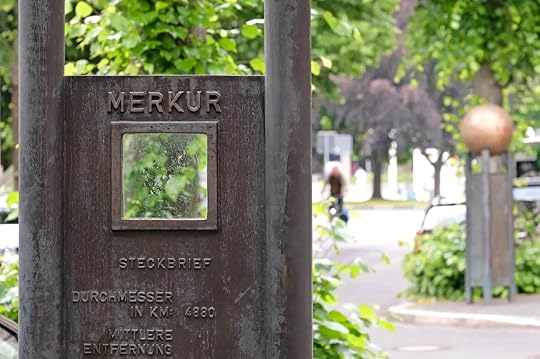
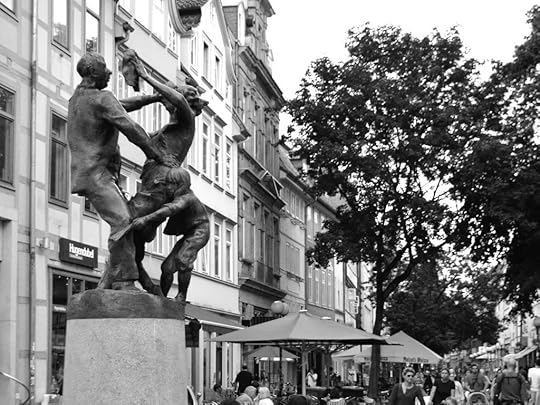
The Planetweg, a path that links the city centre to the train station, and out into the forest beyond, with a complete scale model of the solar system with planets placed at appropriate distances, forms a central thread to the story, including the interdetermine state of the Pluto monument, after it is relegated from planetary status, which, in this novel, appears and reappears. Other recurrent images include the sculpture Der Tanz situated close to Jupiter:
Approaching the place where the road intersected with the main street of the old town, we saw Jupiter. Beyond it, the frozen momentum of the dancers leapt vividly into my eyes, even at this distance. The buildings on either side that I'd always believed to be old were now flitting back and forth through memories, ruining my temporal perspective. The sight of them suddenly wearing the face of another time seemed deliberately designed to tease. We were passing through the portrait of a city that had worn so many different faces, looking at it while remaining unsure if we were appreciating it as a work of art, or witnessing its history. The trio of dancers whirled around energetically, their bodies moving with the fluidity of water and their spinning bronze musculature shining in the sun. The numerous masks that were ripped from their two faces became photographs and postcards in the air-words directed at someone now far away.
When Nomiya introduces the narrator to a fellow Japanese, a physicist at the university, it becomes clear that this is also a visitor from another time, Torahiko Terada (1878-1935), who as a high-school student studied under Natsume Sōseki (whose novel Ten nights of dreams also is a key motif for this book) and who spent 4 months in Göttingen in 1910-1911, although in a letter back to Japan he referred to it by a now old-fashioned use of Kanji rather than Katakana. Terada ended his academic career, after the 1923 Great Kantō earthquake, developing the field of earthquake studies, which provides a link back to the event at the novel's core.
In the Japanese of the past, rather than using the phonetic katakana alphabet to write the names of foreign places as is done now, each locale was assigned its own kanji exonym, which carried a specific meaning, but also conveyed the way it sounded to the ear.
[...]
In this old schema, Göttingen was written as moon, sink, plain—an open plain into which the moon was sinking. This beautiful, somehow melancholy combination of characters resonated with the Japanese fixations with the moon and with nature. Written in kanji, the name— 月沈原 — carried within it the power to spirit one away to a far-off location. The row of three quiet letters seemed to me both like a mask that the city had worn, and another face of the city woven into the fabric of time.
And this themes of masks and of time slippages is key to the novel, indeed increasingly manifests itself physically at the summer, and the story, progresses, with the different palimpsestic layers of the city over time, including WW2, becoming visible.
By now, as I was walking around the town, my eyes had grown accustomed to perceiving palimpsests of time.
Another key theme - in a what is a complex but multi-layered novel, concerns the attributes of saints, notably the scallop shell of St. Jacobi:
St. Jacobi-Kirche was roughly equidistant from Ursula's apartment and the Jupiter post. If your lowered your eyes to the cobbles out the front of the church, you found them dotted with bronze tiles, on whose surface the figure of a golden scallop rose up from a black background. The scallop was both the pilgrim's symbol and St. Jacobi's attribute. In German, scallop is Jakobsmuschel-St. Jacobi's shell, with St. Jacobi being the German name for St. James. The inextricable connection between the shell and the saint was evident both verbally and visually. If an icon wore a hat with a shell on it, you would instantly know it was St. James. This was a pictorial realm where the individual was identified not through their features or their bodily form, but through their attributes.
And the dog owned by one of the narrator's friends, normally trained to hunt truffles, proceeds to unearth other objects from the forest floor, these bring back memories and become personal attributes, for each of those involved.
We continued walking, like pilgrims of time, pilgrims of memory, though we carried no shells to vouch for our identity as such. All one needed to pass down the Planetenweg was one's own memories, our memory attributes.
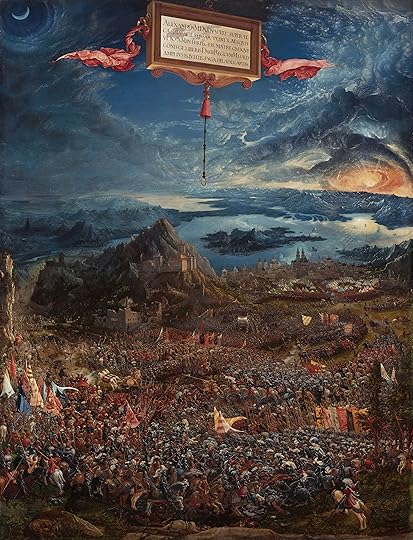
The Battle of Alexander at Issus, a key visual reference for the narrator
A beautifully written palimpsestic meditation on memory, history and loss in the aftermath of the events of 3.11 in 2011.
The Place of Shells is Polly Barton's translation of the Akutagawa Prize winning 貝に続く場所にて by 石沢 麻依 (Mai Ishizawa).
The novel opens in early July 2020 with our first person narrator, a young Japanese woman(*) working on a PhD about the iconography of medieval saints, waiting at Göttingen train station for a visitor from Japan who they have not seen for 9 years.
Standing in the Shade of the deserted Station, I awaited the arrival of a visitor whose face had half vanished. Whenever I managed to sift through my memories and cobble together some form of resemblance, it would slip apart like water the next moment. Still I would continue, gathering up the little pieces, forcing them inside the outline of a head to create a collaged image. The repetition of this act filled me with a sensation of cowardice, not unlike probing an aching tooth with one’s tongue over and over.
It rapidly becomes clear that their visitor, Nomiya, vanished, presumed swept to sea and drowned, in the Tōhoku earthquake and resulting tsunami on 11 March 2011, a focus for the narrator's meditations, and he is now a ghost, although one taking physical form:
Nomiya had been in his house in Ishinomaki on that day. The town's fishing port floated in miniature inside the window frame of his second-floor bedroom, the gently breathing sea melding into the scenery of daily life. He had lived alongside it-lived with images of both its quiet and its bleakness forever superimposed in the recesses of his vision. In the time that accumulated inside him, his ears would have stored up the sound of the distant sea like conch shells, and his tactile, olfactory, and other sense memories must also have been interwoven with it.
The story, set to the backdrop of the pandemic, largely takes place over the next month and a half to the Obon festival, where the narrator and her friends speculate Nomiya may return to Japan for the ceremony at his ancestral graves.
The Planetweg, a path that links the city centre to the train station, and out into the forest beyond, with a complete scale model of the solar system with planets placed at appropriate distances, forms a central thread to the story, including the interdetermine state of the Pluto monument, after it is relegated from planetary status, which, in this novel, appears and reappears. Other recurrent images include the sculpture Der Tanz situated close to Jupiter:
Approaching the place where the road intersected with the main street of the old town, we saw Jupiter. Beyond it, the frozen momentum of the dancers leapt vividly into my eyes, even at this distance. The buildings on either side that I'd always believed to be old were now flitting back and forth through memories, ruining my temporal perspective. The sight of them suddenly wearing the face of another time seemed deliberately designed to tease. We were passing through the portrait of a city that had worn so many different faces, looking at it while remaining unsure if we were appreciating it as a work of art, or witnessing its history. The trio of dancers whirled around energetically, their bodies moving with the fluidity of water and their spinning bronze musculature shining in the sun. The numerous masks that were ripped from their two faces became photographs and postcards in the air-words directed at someone now far away.
When Nomiya introduces the narrator to a fellow Japanese, a physicist at the university, it becomes clear that this is also a visitor from another time, Torahiko Terada (1878-1935), who as a high-school student studied under Natsume Sōseki (whose novel Ten nights of dreams also is a key motif for this book) and who spent 4 months in Göttingen in 1910-1911, although in a letter back to Japan he referred to it by a now old-fashioned use of Kanji rather than Katakana. Terada ended his academic career, after the 1923 Great Kantō earthquake, developing the field of earthquake studies, which provides a link back to the event at the novel's core.
In the Japanese of the past, rather than using the phonetic katakana alphabet to write the names of foreign places as is done now, each locale was assigned its own kanji exonym, which carried a specific meaning, but also conveyed the way it sounded to the ear.
[...]
In this old schema, Göttingen was written as moon, sink, plain—an open plain into which the moon was sinking. This beautiful, somehow melancholy combination of characters resonated with the Japanese fixations with the moon and with nature. Written in kanji, the name— 月沈原 — carried within it the power to spirit one away to a far-off location. The row of three quiet letters seemed to me both like a mask that the city had worn, and another face of the city woven into the fabric of time.
And this themes of masks and of time slippages is key to the novel, indeed increasingly manifests itself physically at the summer, and the story, progresses, with the different palimpsestic layers of the city over time, including WW2, becoming visible.
By now, as I was walking around the town, my eyes had grown accustomed to perceiving palimpsests of time.
Another key theme - in a what is a complex but multi-layered novel, concerns the attributes of saints, notably the scallop shell of St. Jacobi:
St. Jacobi-Kirche was roughly equidistant from Ursula's apartment and the Jupiter post. If your lowered your eyes to the cobbles out the front of the church, you found them dotted with bronze tiles, on whose surface the figure of a golden scallop rose up from a black background. The scallop was both the pilgrim's symbol and St. Jacobi's attribute. In German, scallop is Jakobsmuschel-St. Jacobi's shell, with St. Jacobi being the German name for St. James. The inextricable connection between the shell and the saint was evident both verbally and visually. If an icon wore a hat with a shell on it, you would instantly know it was St. James. This was a pictorial realm where the individual was identified not through their features or their bodily form, but through their attributes.
And the dog owned by one of the narrator's friends, normally trained to hunt truffles, proceeds to unearth other objects from the forest floor, these bring back memories and become personal attributes, for each of those involved.
We continued walking, like pilgrims of time, pilgrims of memory, though we carried no shells to vouch for our identity as such. All one needed to pass down the Planetenweg was one's own memories, our memory attributes.
The Battle of Alexander at Issus, a key visual reference for the narrator
A beautifully written palimpsestic meditation on memory, history and loss in the aftermath of the events of 3.11 in 2011.

July 27, 2025
Erudite and contemplative, mixing Covid-19 isolation with the ramifications of the 2011 Tohoku earthquake and tsunami. Germany's remembrance culture also comes back, and art history features heavily
Memories of pain are always fresh, that goes for people and for places
The debut of Mai Ishizawa is set in Gottingen, a German town most known for the Max Plank institute of physics, linked to human exploration into the quantum state of uncertainty. This is only one of the clever mirrors The Place of Shells contains, as we follow our narrator, starting of with an opening scene in a sun bleached Gottingen station during Covid-19, waiting for a man who might be a ghost, after an intermezzo of 9 years.
A lot of metaphors of humans being planets, with the characters walking through a model of the solar system in the town follow, and this metaphor richness is even commented upon: Stacking up metaphors and images is the only way we have of describing, because that is the least painful way of thinking of him.
The translation by Polly Barton feels very natural and manages to capture the many nuances of language and even historical ways of writing in kanji.
The pandemic creates a kind of liminal space, a suspension that gives time for reflection on uncomfortable topics, framed in the novel as: Covid-19 making it easier to meet with the dead than the living
The masks and constellation/gravity/star chart/solar system metaphors are rather much in my view, like a cheesecake reminding her of Jupiter, but our main character is a doctorate student in art.
Also all the German characters in the middle being called Ursula, Agatha and Agnes feels rather cliche in a sense.
A feeling of being unmoored, either as a body in the sea or as a student in a foreign country is strong in the book, and it does remind me a bit of Han Kang her writing, maybe The White Book or We Do Not Part most, as in those novels, memory, remembrance and the reverberations of the past in the present play key roles. And someone has teeth growing out of their back at some point which definitely gives me Han Kang vibes.
The European art references then again make me think of Mark Haber his writing in Saint Sebastian's Abyss. On this: I love art but this half art class on depiction of saints feels rather didactic, as do the links to Pluto, the demoted dwarf planet and god of death
Shells feature more near the end of the book, including those of scallops which in German (and Dutch) are linked to saint Jacob, and also in cake form in madeleine baking, very Proust. The writing is very good, the themes are excellent and universal, and I was reminded a bit of The Book of Records, another recent book that is so erudite it both thrills and alienates at the same time.
I was not completely captured, but this author is definitely someone to watch because this debut is impressive!
Quotes:
When is someone close enough to feel grief about the passing of another?
How memory carves a path through the natural world
You’d be better off if you stopped treating the past as someone else’s dream
Memories of pain are always fresh, that goes for people and for places
The debut of Mai Ishizawa is set in Gottingen, a German town most known for the Max Plank institute of physics, linked to human exploration into the quantum state of uncertainty. This is only one of the clever mirrors The Place of Shells contains, as we follow our narrator, starting of with an opening scene in a sun bleached Gottingen station during Covid-19, waiting for a man who might be a ghost, after an intermezzo of 9 years.
A lot of metaphors of humans being planets, with the characters walking through a model of the solar system in the town follow, and this metaphor richness is even commented upon: Stacking up metaphors and images is the only way we have of describing, because that is the least painful way of thinking of him.
The translation by Polly Barton feels very natural and manages to capture the many nuances of language and even historical ways of writing in kanji.
The pandemic creates a kind of liminal space, a suspension that gives time for reflection on uncomfortable topics, framed in the novel as: Covid-19 making it easier to meet with the dead than the living
The masks and constellation/gravity/star chart/solar system metaphors are rather much in my view, like a cheesecake reminding her of Jupiter, but our main character is a doctorate student in art.
Also all the German characters in the middle being called Ursula, Agatha and Agnes feels rather cliche in a sense.
A feeling of being unmoored, either as a body in the sea or as a student in a foreign country is strong in the book, and it does remind me a bit of Han Kang her writing, maybe The White Book or We Do Not Part most, as in those novels, memory, remembrance and the reverberations of the past in the present play key roles. And someone has teeth growing out of their back at some point which definitely gives me Han Kang vibes.
The European art references then again make me think of Mark Haber his writing in Saint Sebastian's Abyss. On this: I love art but this half art class on depiction of saints feels rather didactic, as do the links to Pluto, the demoted dwarf planet and god of death
Shells feature more near the end of the book, including those of scallops which in German (and Dutch) are linked to saint Jacob, and also in cake form in madeleine baking, very Proust. The writing is very good, the themes are excellent and universal, and I was reminded a bit of The Book of Records, another recent book that is so erudite it both thrills and alienates at the same time.
I was not completely captured, but this author is definitely someone to watch because this debut is impressive!
Quotes:
When is someone close enough to feel grief about the passing of another?
How memory carves a path through the natural world
You’d be better off if you stopped treating the past as someone else’s dream

May 30, 2025
This was a strange reading experience. It went a little like:
Started the book: Wow this is stunning, Polly Barton’s Japanese translations feel so much more mature and distinctive than other Japanese translators who always manage to sound the exact same.
50 pages in: I’m absolutely going to finish this in one afternoon.
Pages 50-120: Things are starting to move a little slower, the symbolism is starting to feel a bit overdone, a bit on the nose.
Pages 120-the end: I set it down for a month, read a 600 page book without once wanting to pick this up and finish up its few remaining pages. Every time I tried to just get a few pages in, I found it unbearable and the last thing I wanted to read and put it back down.
So in the end, I’m not sure what to make of it. I think I remain impressed with the writing and the translation, but less so with the story it’s telling.
I suppose my advice for this one is if you feel like you’re on a roll, you feel like you’re in it, to get through it quick and don’t put it down.
Started the book: Wow this is stunning, Polly Barton’s Japanese translations feel so much more mature and distinctive than other Japanese translators who always manage to sound the exact same.
50 pages in: I’m absolutely going to finish this in one afternoon.
Pages 50-120: Things are starting to move a little slower, the symbolism is starting to feel a bit overdone, a bit on the nose.
Pages 120-the end: I set it down for a month, read a 600 page book without once wanting to pick this up and finish up its few remaining pages. Every time I tried to just get a few pages in, I found it unbearable and the last thing I wanted to read and put it back down.
So in the end, I’m not sure what to make of it. I think I remain impressed with the writing and the translation, but less so with the story it’s telling.
I suppose my advice for this one is if you feel like you’re on a roll, you feel like you’re in it, to get through it quick and don’t put it down.
September 19, 2025
I struggled with this book more than I care to admit, and I almost didn’t finish it. The premise really intrigued me—a friend presumed dead in the 2011 tsunami suddenly reappearing years later in Germany—but the story never delivered on that haunting setup.
The prose is heavy, abstract, and often so fragmented that it felt like wandering through fog. Symbols pile up—saints, planets, shells, ghosts, physics, even strange objects dug up by a dog in the forest—and instead of weaving into something profound, they just weighed the narrative down. The atmosphere was certainly unique, but I found it more exhausting than immersive.
I know the novel aims to capture grief and memory in all their messy, unresolved forms, but the execution left me disconnected. There were no characters I could truly grasp, no momentum to carry me forward, and no emotional anchor to make the surreal elements resonate.
For some, this will be poetic and deeply moving. For me, it was tedious, confusing, and ultimately unsatisfying.
The prose is heavy, abstract, and often so fragmented that it felt like wandering through fog. Symbols pile up—saints, planets, shells, ghosts, physics, even strange objects dug up by a dog in the forest—and instead of weaving into something profound, they just weighed the narrative down. The atmosphere was certainly unique, but I found it more exhausting than immersive.
I know the novel aims to capture grief and memory in all their messy, unresolved forms, but the execution left me disconnected. There were no characters I could truly grasp, no momentum to carry me forward, and no emotional anchor to make the surreal elements resonate.
For some, this will be poetic and deeply moving. For me, it was tedious, confusing, and ultimately unsatisfying.

February 27, 2026
Dieses Buch hat mir meine Freundin A. geschenkt — und gesagt, ich würde ihre Begeisterung dafür sicher verstehen. Und ich verstehe sie. Das ist das Verrückteste und gleichzeitig Poetischste, das ich seit langem gelesen habe. Ein Buch über Trauer und Erinnerungen, über Trauma und Freundschaft und trotzdem ganz leicht und abgedreht. Es müsste viel bekannter sein!

July 26, 2025
I don't know how to explain it, but this felt like reading a 500 page book, even though it's a fairly short read.
I liked the way the author reflects on memories and how they affect our lives, but I am not really sure what to make of this book overall.
Did I like it? Not sure
Did I hate it? Not really
Did I get it? I think so, but not completely...
Would I recommend it? Maybe, I don't know...
I liked the way the author reflects on memories and how they affect our lives, but I am not really sure what to make of this book overall.
Did I like it? Not sure
Did I hate it? Not really
Did I get it? I think so, but not completely...
Would I recommend it? Maybe, I don't know...

May 13, 2025
This is a short experimental novel that leaves much, too much perhaps, to the reader’s imagination. Its strength its uniqueness, in trying something different in the genre of horror and ghost stories.
In the midst of the pandemic, 2020, the narrator is in Göttingen in Germany, where she meets Nomiya. Both are students of medieval religious art, and both survivors of the Tōhoku earthquake and tsunami of 2011. Disaster, it seems, abounds.
There is a thread of mystery that runs through the piece, but that is not the priority for Ishizawa, for whom the focus is on the ghosts of those ‘swallowed up by the sea’ in the tsunami; it is in effect, a meditation on grief. The author creates a world in which the distinction between ‘dead’ and ‘alive’ is blurred, and consequently the plot doesn’t follow a logical pattern. This may take a while to get accustomed to, and won’t be to the liking of many readers, in such a short novel. To appreciate it, I found it necessary to surrender to the style, not be too concerned about reality, and go with it, as the surreality grows.
For me, it’s a piece of writing to be admired rather than enjoyed. Not surprisingly, it’s a debut novel, and it does set Mai Ishizawa up as a young writer to watch out for.
In the midst of the pandemic, 2020, the narrator is in Göttingen in Germany, where she meets Nomiya. Both are students of medieval religious art, and both survivors of the Tōhoku earthquake and tsunami of 2011. Disaster, it seems, abounds.
There is a thread of mystery that runs through the piece, but that is not the priority for Ishizawa, for whom the focus is on the ghosts of those ‘swallowed up by the sea’ in the tsunami; it is in effect, a meditation on grief. The author creates a world in which the distinction between ‘dead’ and ‘alive’ is blurred, and consequently the plot doesn’t follow a logical pattern. This may take a while to get accustomed to, and won’t be to the liking of many readers, in such a short novel. To appreciate it, I found it necessary to surrender to the style, not be too concerned about reality, and go with it, as the surreality grows.
For me, it’s a piece of writing to be admired rather than enjoyed. Not surprisingly, it’s a debut novel, and it does set Mai Ishizawa up as a young writer to watch out for.

November 25, 2025
But the objects that appeared before my eyes weren't enclosed inside a frame like an artwork- they were the reality that lay outside of it….I kept on seeing the gap, almost an unbreachable chasm, that existed between the irreality of pictures and the irreality of reality.
April 3, 2025
This feels weirdly similar to a Modiano book (e.g. Ballerina which I just finished). I liked all the wandering around Göttingen while puzzling over a low stakes mystery.

October 5, 2025
Really liked. learned about saints, felt sad. want to lend this to my prof who said we are in an era of spatial literature — no we are not!! We’re in an era of loss and loss is temporal

June 4, 2025
I found this short novel enjoyable, although it took me a while to understand what it was about and where it was about. There's a dreamy quality to it, as we follow a young Japanese woman in Göttingen, during Covid, as she meets an old friend and colleague at the train station. Her friend has actually died in 2011 in the earthquake and following tsunami; but he has suddenly returned and is now in Göttingen as well.
There are quite a few more characters, and a truffle dog who keeps unearthing lost objects in the local woods; there's a miniature solar system set up in the streets that seems to move; there are ghosts. There's a lot going on and it can be confusing at times. It comes together at the end, and I enjoyed the characters and the descriptions of their memories.
The translation by Polly Barton is, as always with her translations, impeccable.
Free ARC sent by Netgalley.
There are quite a few more characters, and a truffle dog who keeps unearthing lost objects in the local woods; there's a miniature solar system set up in the streets that seems to move; there are ghosts. There's a lot going on and it can be confusing at times. It comes together at the end, and I enjoyed the characters and the descriptions of their memories.
The translation by Polly Barton is, as always with her translations, impeccable.
Free ARC sent by Netgalley.

March 25, 2025
Spellbound, hypnotic, and lyrical, The Place of Shells drifts through the tides of memory and the inescapable enchantment of past wounds.

January 14, 2026
This felt unreadable at times. I found it more captivating near the end of the book where it seemed to reach a flow state into the surreal but a lot of it was really confusing and the lack of plot made it hard to follow or want to pick up. I am disappointed in it as the premise sounded great but it went really off the rails with the concept.

July 31, 2025
I loved this! I might be biased, but I really loved this.
I stumbled upon this book a few weeks ago when a Canadian book podcast mentioned it and where the plot takes place. My reaction was "Wait a minute. WHAT?!"
This book takes place in Göttingen. I studied and lived in Göttingen.
The protagonist is a phd student in art history. I studies art history.
What are the odds?!
I just had to read it and I am so happy I did. I loved the way Mai Ishizawa describes Göttingen. So lush, so detailed, I felt like I was there, inside the story. At the same time it was an outsiders view of a German city and it was so cool to see what the protagonist (and author) focus on. All those details that I never actively thought about when I lived there. I was impressed by the plot. It got weird and had some scenes I usually don't enjoy reading, but everything fit perfectly together. Loved the themes of loss, grief and memories. Especially since the book creates a bridge between Göttingen during Covid in 2020 and the memories of the 2011 tsunami in Japan or the past in general. At the same time it created a bridge for me between my present self and my memories of my time in Göttingen as a student. It was a very fascinating reading experience.
It took me a moment to understand what was happening, love how subtely it is done at the beginning until you fully grasp it around 2/3 of the way. I want to write so much more but it's such a short book, I don't want to spoil anything.
I stumbled upon this book a few weeks ago when a Canadian book podcast mentioned it and where the plot takes place. My reaction was "Wait a minute. WHAT?!"
This book takes place in Göttingen. I studied and lived in Göttingen.
The protagonist is a phd student in art history. I studies art history.
What are the odds?!
I just had to read it and I am so happy I did. I loved the way Mai Ishizawa describes Göttingen. So lush, so detailed, I felt like I was there, inside the story. At the same time it was an outsiders view of a German city and it was so cool to see what the protagonist (and author) focus on. All those details that I never actively thought about when I lived there. I was impressed by the plot. It got weird and had some scenes I usually don't enjoy reading, but everything fit perfectly together. Loved the themes of loss, grief and memories. Especially since the book creates a bridge between Göttingen during Covid in 2020 and the memories of the 2011 tsunami in Japan or the past in general. At the same time it created a bridge for me between my present self and my memories of my time in Göttingen as a student. It was a very fascinating reading experience.
It took me a moment to understand what was happening, love how subtely it is done at the beginning until you fully grasp it around 2/3 of the way. I want to write so much more but it's such a short book, I don't want to spoil anything.

April 11, 2025
really lovely book about memories becoming material and finding ways to navigate them. everyone has difficult memories that are not fully reconciled, here we see those manifest in different ways. tragedy is the looming shadow, and how we accept our reactions to things that we are both near and far from. near enough to be inescapable but far enough to not directly touch you.

August 5, 2025
jfc i do not know why reading this was pure agony lol it’s less than 150 pages and took me a month, it’s not hard to read but i could not focus on it for the life of me. perhaps the only thing of interest for me here is that it is set during 2020 lockdown. it feels like there was an extremely small window of time COVID was acknowledged by fiction of any media? but thank god we eradicated it nothing to see here 😇 oh also more than one review quoted on the back refers to the book as an “attempt” if i were the author…ouchie wawa
anyway now to forever wonder what it would be like to read in the original Japanese (not really for i am forgetting)
anyway now to forever wonder what it would be like to read in the original Japanese (not really for i am forgetting)

July 10, 2025
“The wind that whistled past my ears carried on it a distant rustling of paper. The scene superimposed translucently upon this one was that world of blue that I never got to see, calling out from afar. Now, from over a great distance, that blue came slipping this way. From my fixed avian vantage point, I held those blues on top of one another in my vision, waiting for them to disappear.“
Such wonder coming across prose that reads like my own thoughts, yet is so new and refreshing. a novel that reads much like the feelings and sensations it deals with: cool, white and blue, sunlight through trees in the summer afternoon, the feeling of closing your eyes in the heat, scenes superimposing on themselves but never confused.
A very thoughtful work about grief, memories and time.
Such wonder coming across prose that reads like my own thoughts, yet is so new and refreshing. a novel that reads much like the feelings and sensations it deals with: cool, white and blue, sunlight through trees in the summer afternoon, the feeling of closing your eyes in the heat, scenes superimposing on themselves but never confused.
A very thoughtful work about grief, memories and time.
Read
April 24, 2026Although a little longer than a novella this was at times a dense and multi layered read. Polly Barton's translation was finely tuned in capturing the nuances here. There was a whole stack of references and motifs, Altdorfer, Soseki, the Planetenweg, Gottingen, Ishinomaki. The narrative interweaves between the aftermath of 11. 3 and of a student navigating Gottingen, the new acquaintances, memories of Nomiya who had disappeared, engulfed in the tsunami, and of Nomiya's reappearance, or the memory of.
The book is a melancholy read, caught in a pause between multiple lines of history, the city, the tsunami. Through a cast of orbiting characters, Agatha, Ursula, Mr Terada, the novel finely articulates the search between appearance, memory, the past and present, the living and the passed. An intriguing read and well crafted translation.
The book is a melancholy read, caught in a pause between multiple lines of history, the city, the tsunami. Through a cast of orbiting characters, Agatha, Ursula, Mr Terada, the novel finely articulates the search between appearance, memory, the past and present, the living and the passed. An intriguing read and well crafted translation.
August 29, 2025
Really strange and felt like being half asleep after taking a Benadryl … I quite liked it! I’m sold on anything with recurring imagery of shells and trinkets
June 1, 2025
An ambitious book about a person's personality unravelling being stretched between reality and imagination. Our Japanese protagonist lives in Germany and struggles with the trauma post a major tsunami event back home in Japan, which caused the disappearance of a close friend, and affected most of her social circle. Now, several years later and in Germany, our protagonist experiences increasingly absurd things, but doesn't seem affected by them as much as by the reappearance of a friend from the old days.
I struggled with this book. I understand it won awards, but it's unclear what for. Maybe post-modern literature is not for me - there is no real structure, no plot, no character development, no beginning middle and end, and no discernible point. It comes across as a book that some people feel should be important and make themselves sound smart for saying they read it, but, when all is said and done, it's not a good book. It might be a good piece of post modern art (arguably), but it's not a good work of literature.
My thanks to Netgalley and the publisher for providing me with an early copy of this book in return for an honest review.
I struggled with this book. I understand it won awards, but it's unclear what for. Maybe post-modern literature is not for me - there is no real structure, no plot, no character development, no beginning middle and end, and no discernible point. It comes across as a book that some people feel should be important and make themselves sound smart for saying they read it, but, when all is said and done, it's not a good book. It might be a good piece of post modern art (arguably), but it's not a good work of literature.
My thanks to Netgalley and the publisher for providing me with an early copy of this book in return for an honest review.
January 2, 2023
「しかし、言葉と感覚の距離感は、私の中でも渦巻いている。「戦争」「空襲」「噴火」などの言葉に対して、私は感覚を伴うイメージがあるわけではない。「津波」にしても、私は感情的にこの言葉と結びついている気がするだけで、その言葉を見に刻んで暮らし、そしてあの水の壁を目の当たりにした人にとっては、感傷で距離を測り間違えていると映るのではないだろうか。さらに、自信のない時に、身体や感覚が馴染むにつれて、私もまたその言葉の厚みを失いつつあるような気がしてならない。インターネットで日本の地震や台風、豪雨の記事を読む度に、その疑いが拭われずに跡を残す。そして、感情の裏には、あの日の記憶や今も跡を残す場所、そして野宮への裏切りとみなす言葉の感覚があるのかもしれなかった。」(P.41)

April 30, 2025
I love new directions! I love literature! (This was such a satisfying, enjoyable read)

September 25, 2025
interesting concept to address nostalgia and trauma, but oversaturated with metaphors while being far too rooted in reality (ie covid).
October 2, 2025
unique, beautifully descriptive, and thought provoking. it took me a while to finish but i’m glad i did.

Read
August 22, 2025Just as the shell on its cover suggests, The Place of Shells is a beautifully hypnotic, shifting mosaic of a novel—one that unearths memory and suppressed grief in the aftermath of insurmountable tragedy, nine years after the 2011 tsunami in Japan. In Göttingen, Germany, a university student awaits the arrival of Nomiya, a friend who perished in the tsunami.
Together, they wander through the town’s scale model of the solar system before parting ways. Yet as days pass, their circles of acquaintances begin to overlap in unsettling ways. Meanwhile, objects from the past mysteriously resurface along a forest path at the edge of Göttingen, conjuring the town’s own buried traumas: the disappearances of people during the Nazi regime, echoing the more recent disappearance of land and lives in the tsunami.
The novel’s recurring shell imagery and spiral-like narrative draw the reader into an abyss—layer upon layer of memory, time, and loss. Past and present ripple against each other, overlapping and superimposing, until the boundary between them becomes porous. Surreal events accumulate, and the search for truth—or reconciliation—proves as elusive and fragile as memory itself.
Though slim, this is not a novel to rush. Its sentences carry a quiet weight, a haunting undertow that slows your reading, urging you to drift with it. Polly Barton’s translation renders Ishizawa’s prose with a poetic clarity that feels both ethereal and precise. The Place of Shells is an unexpectedly layered work, one that reveals as much as it withholds, like an intricate pattern hidden within the curve of a shell.
Together, they wander through the town’s scale model of the solar system before parting ways. Yet as days pass, their circles of acquaintances begin to overlap in unsettling ways. Meanwhile, objects from the past mysteriously resurface along a forest path at the edge of Göttingen, conjuring the town’s own buried traumas: the disappearances of people during the Nazi regime, echoing the more recent disappearance of land and lives in the tsunami.
The novel’s recurring shell imagery and spiral-like narrative draw the reader into an abyss—layer upon layer of memory, time, and loss. Past and present ripple against each other, overlapping and superimposing, until the boundary between them becomes porous. Surreal events accumulate, and the search for truth—or reconciliation—proves as elusive and fragile as memory itself.
Though slim, this is not a novel to rush. Its sentences carry a quiet weight, a haunting undertow that slows your reading, urging you to drift with it. Polly Barton’s translation renders Ishizawa’s prose with a poetic clarity that feels both ethereal and precise. The Place of Shells is an unexpectedly layered work, one that reveals as much as it withholds, like an intricate pattern hidden within the curve of a shell.
Read
August 18, 2025Supposedly very short but took me a while! Mai Ishizawa and Polly Barton you said crazy things xx
With an art historian's eyes, the narrator looks over the city of Göttingen, over fellow characters, over the scape of their own memory. In the place where judgement usually resides, the narrator brings observation. They recognise polysemy (polyphony?) in the novel's figures, which to me engines the book. For that, the reader (well just speaking for me) is rewarded with X-ray insight through layers from the restored varnish to the fibres of the canvas; and the pleasure and the potency of seeing metaphors come together. Wisely I think, it does not try to be encyclopaedic. The span of these two axes (if you will) are lit (lambent, limned; quoting); other aspects (outbursts, extended cast, resolution(?)) are obscured. There's something restrained beneath the surface that maybe I'm supposed to see but I can't exactly make out.
A little funny that the last session of reading was accompanied by (Verdi's) Lacrymosa going nonstop in my head.
Would reread; in fact kind of need to reread to have really read it.
With an art historian's eyes, the narrator looks over the city of Göttingen, over fellow characters, over the scape of their own memory. In the place where judgement usually resides, the narrator brings observation. They recognise polysemy (polyphony?) in the novel's figures, which to me engines the book. For that, the reader (well just speaking for me) is rewarded with X-ray insight through layers from the restored varnish to the fibres of the canvas; and the pleasure and the potency of seeing metaphors come together. Wisely I think, it does not try to be encyclopaedic. The span of these two axes (if you will) are lit (lambent, limned; quoting); other aspects (outbursts, extended cast, resolution(?)) are obscured. There's something restrained beneath the surface that maybe I'm supposed to see but I can't exactly make out.
A little funny that the last session of reading was accompanied by (Verdi's) Lacrymosa going nonstop in my head.
Would reread; in fact kind of need to reread to have really read it.

April 30, 2025
i don't love symbolism. nor am i too fond of metaphors. i have a disdain for eureka-inducing devices that, after inspiring that initial 'aha' moment of recognition, fail to probe the depths and nuances inherent to meaning, the complexity of the 'thing' represented (not to mention the complexity of the process of representation itself).
but i do recognize the impulse behind symbolism. the urge to find resonances between our experiences and objects. the desire for there to exist personal(ized) meaning in the otherwise arbitrary things of our everyday environment.
it's a way of seeing ourselves and others in different forms. grafting our feelings and experiences onto the things of the world, leaving our traces and marking the spaces and times we have dwelled in, even if it is fleeting—or precisely because this existence is fleeting.
but i do recognize the impulse behind symbolism. the urge to find resonances between our experiences and objects. the desire for there to exist personal(ized) meaning in the otherwise arbitrary things of our everyday environment.
it's a way of seeing ourselves and others in different forms. grafting our feelings and experiences onto the things of the world, leaving our traces and marking the spaces and times we have dwelled in, even if it is fleeting—or precisely because this existence is fleeting.

September 15, 2025
this honestly took me longer than it should have, but, omfg, such a profound novel on the guilt and grief that hunted and haunted witnesses/survivors after tragedies, both (inter)national and personal, marvelously narrated by an unnamed art historian.
the language, with its strange metaphors and alluring repetition, affirmed the way i remembered people, places, and phenomena: afraid of forgetting and anxious about reliving, yet always grateful when memories persisted.
the language, with its strange metaphors and alluring repetition, affirmed the way i remembered people, places, and phenomena: afraid of forgetting and anxious about reliving, yet always grateful when memories persisted.

March 22, 2026
4.5 stars!!
this book is so beautiful and so so sad my god. the way this book speaks about memory it really hits deep. there's so many lines I highlighted in this book but I think my no 1 would be "you'd be better off if you stop treating your past like someone else's dream"
there's 2 pages of (important and significant) body modification part that becomes body horror to me immediately (if there's one thing I will not get over is my fear/disgust for body horror) so I deducted .5 stars because of that.
this book is so beautiful and so so sad my god. the way this book speaks about memory it really hits deep. there's so many lines I highlighted in this book but I think my no 1 would be "you'd be better off if you stop treating your past like someone else's dream"
there's 2 pages of (important and significant) body modification part that becomes body horror to me immediately (if there's one thing I will not get over is my fear/disgust for body horror) so I deducted .5 stars because of that.
Displaying 1 - 30 of 127 reviews