

What do you think?
Mcgraw-Hill Series in Mechanical Engineering
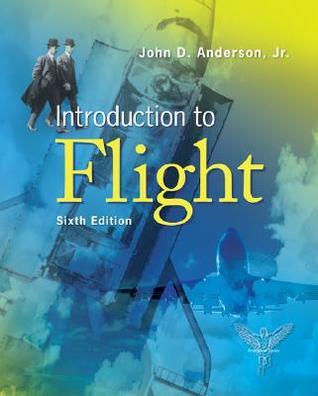
Introduction to Flight
Noted for its highly readable style, the new edition of this bestseller provides an updated overview of aeronautical and aerospace engineering. Introduction to Flight blends history and biography with discussion of engineering concepts, and shows the development of flight through this perspective. Anderson covers new developments in flight, including unmanned aerial vehicles, uninhabited combat aerial vehicles, and applications of CFD in aircraft design. Many new and revised problems have been added in this edition. Chapter learning features help readers follow the text discussion while highlighting key engineering and industry applications.
912 pages, Hardcover
First published January 1, 1978
About the author
John D. Anderson Jr.
21 books61 followersJohn D. Anderson, Jr. (born October 1, 1937) is the Curator of Aerodynamics at the National Air and Space Museum at the Smithsonian Institution in Washington, DC and Professor Emeritus in the Department of Aerospace Engineering at the University of Maryland, College Park.
Ratings & Reviews
Friends & Following
Create a free account to discover what your friends think of this book!
Community Reviews
Displaying 1 - 16 of 16 reviews

February 3, 2024
really liked this one. the jumping between topics really keeps you guessing about what's next, but this only adds to the suspense of trying to understand what's happening. Anderson really keeps you on your toes as the story progresses, though sometimes he cuts corners by leaving things unexplained. there are also quite some plot holes that can ruin the immersion
January 14, 2019
it was the gate through which we entered the Aerospace field

September 16, 2019
The way the book is written is absolutely astonishing and explains each idea very precisely and simply..i think the book is amazing as an introduction and a gate into aerospace engineering

December 11, 2024
Working on my undergrad aerospace engineering degree and I think I’ve read through this twice — once my freshman year and once my senior year. It’s honestly a pretty good read it explains the concepts very well and it’s fairly easy to understand.

October 3, 2020
It would probably make more sense to read this before Fundamentals of Aerodynamics by Anderson, but I didn't follow that route. This book is simpler, but also more focused on aircraft. In that, it was fun to learn more about the airplanes themselves, rather than strictly the air flow. The book is chock-full of interesting historical sidenotes and very readable. Because it is at a lower level, however, some of the derivations/explanations leave something to be desired from my mathematical/physics standpoint. That is Anderson often simply gives a formula without explaining how it is arrived at, but that may be a huge positive for those who just want a good introduction.
If you're interested in aerodynamics at all, this is an excellent resource and great for teaching the fundamentals. I went with a second edition because it was significantly cheaper, but I'm sure the more recent additions have interesting new material.
If you're interested in aerodynamics at all, this is an excellent resource and great for teaching the fundamentals. I went with a second edition because it was significantly cheaper, but I'm sure the more recent additions have interesting new material.

September 10, 2022
Unlike most college textbooks, this book doesnt just give you the mathemathical foundations of Flight, it helps you develop a physical intuition of the subject & its historical background. This is how every textbook should be, I wish I read it in my first year in college.
January 31, 2008
ketabe kheili khobie vase kasae ke riazishon khobe va eshghe formolan!

December 21, 2018
Author gives basic idea about the world of aeronautics and astronautics by explaining various topics necessary to get a good grasp on subject of Aerospace.

February 18, 2026
Probably the best engineering textbook I've had the pleasure of reading. The key difference with other texts is that Mr. Anderson is clearly commited to making sure the student understands everything in an intuitive way, not just in a "plug-and-chuck" fashion as is common elsewhere.
He talks to the student, using a sometimes lighter, informal tone, but always stressing the seriousness which the subject demands. The examples shown are elucidating and the equation derivations provide great insight into the mechanisms behind aerodynamic phenomena. I look forward to reading more of Mr. Anderson, for sure.
He talks to the student, using a sometimes lighter, informal tone, but always stressing the seriousness which the subject demands. The examples shown are elucidating and the equation derivations provide great insight into the mechanisms behind aerodynamic phenomena. I look forward to reading more of Mr. Anderson, for sure.

June 28, 2024
Very interesting book! Lots of great information on the history of flight and how aircraft work, from the way they are able to stay in the sky to how different aspects of their geometry can affect efficiency and performance capabilities. All formulas and principles are derived via the principles of calculus and newtonian mechanics, and every chapter has very specific practice problems which were a huge help! I would highly recommend this book to anyone who is interested in aerospace engineering.

November 8, 2022
Only textbook I've gone out of my way to read

June 18, 2026
Passed this class with a B :P

June 6, 2018
I suppose Introduction to Flight is acceptable for teaching underclassmen, but Anderson's pedagogy leaves a lot to be desired.
Coming back to it as a graduate, I can't imagine what my professor for Introduction to Aerospace Design was thinking giving us design problems with this as our reference text. Anderson skims over a lot of important concepts and explains other poorly, to say nothing of his preference for unclear notation (see Aircraft Propulsion for a much better approach to aerothermodynamic symbolism, and Elements of Spacecraft Design for astrodynamical equations). There's also a lot of assumptions embedded in the text which even Anderson's other books don't include. Based on my own academic experience, giving the whole picture up-front and then applying the simplifying assumptions pays tremendous dividends for years afterwards.
I would strongly advise getting ahold of the solutions manual unless the course's office hours are unusually helpful. Just sorting out the English units is a struggle in itself.
Coming back to it as a graduate, I can't imagine what my professor for Introduction to Aerospace Design was thinking giving us design problems with this as our reference text. Anderson skims over a lot of important concepts and explains other poorly, to say nothing of his preference for unclear notation (see Aircraft Propulsion for a much better approach to aerothermodynamic symbolism, and Elements of Spacecraft Design for astrodynamical equations). There's also a lot of assumptions embedded in the text which even Anderson's other books don't include. Based on my own academic experience, giving the whole picture up-front and then applying the simplifying assumptions pays tremendous dividends for years afterwards.
I would strongly advise getting ahold of the solutions manual unless the course's office hours are unusually helpful. Just sorting out the English units is a struggle in itself.

January 15, 2020
A must read book for aeronautical engineers I almost read it twice and still reading it again
A very useful book which concentrates on the fundamentals and explain them in easy way with not much sophisticated equations highly recommended for all aeronautics students
A very useful book which concentrates on the fundamentals and explain them in easy way with not much sophisticated equations highly recommended for all aeronautics students
December 21, 2014
Very well written introduction to flight. Even deals with space in a small segment. Thorough, clear text.

July 30, 2015
really great
Displaying 1 - 16 of 16 reviews