

What do you think?
Sector General #1-3
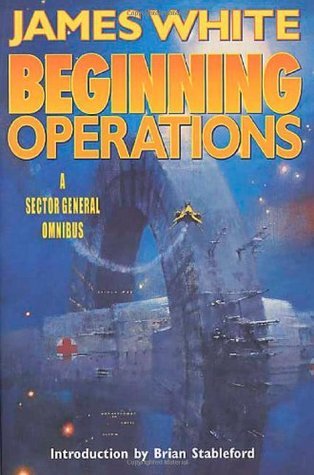
Beginning Operations
Sector General: A massive deep-space hospital station on the Galactic Rim, in the depths of outer space, where human and alien medicine meet. Its 384 levels and thousands of staff members who work there, human and alien both, have a single mission: To care for all patients, of all species. At Sector General, anything can happen, and frequently does. as staff work to meet the needs of any conceivable alien patient, though that capacity is always being strained as more (and stranger) alien races turn up to join the galactic community. Sentient viruses, interspecies romances, undreamed-of institutional catering problems...it all lands on Sector General's doorstep. And the only thing weirder than a hitherto unknown alien species is having a member of that species turn up in your Emergency Room. Here is Beginning Operations (Sector General Omnibus 1, Bks 1-3)
Contents:
* Introduction (Beginning Operations) • essay by Brian Stableford
* Hospital Station [Sector General • 1] (1962) / collection by James White: Medic (1960) novelette (variant of O'Mara's Orphan); Sector General (1957) novelette; Trouble With Emily (1958) novelette; Visitor at Large (1959) novelette; Out-Patient (1960) novelette
* Star Surgeon [Sector General • 2] (1963) / novel by James White.
* Major Operation [Sector General • 3] (1971) / collection by James White: Invader (1966) novelette; Vertigo (1968) novelette; Blood Brother (1969) novelette; Meatball (1969) novelette; Major Operation (1971) novelette
Contents:
* Introduction (Beginning Operations) • essay by Brian Stableford
* Hospital Station [Sector General • 1] (1962) / collection by James White: Medic (1960) novelette (variant of O'Mara's Orphan); Sector General (1957) novelette; Trouble With Emily (1958) novelette; Visitor at Large (1959) novelette; Out-Patient (1960) novelette
* Star Surgeon [Sector General • 2] (1963) / novel by James White.
* Major Operation [Sector General • 3] (1971) / collection by James White: Invader (1966) novelette; Vertigo (1968) novelette; Blood Brother (1969) novelette; Meatball (1969) novelette; Major Operation (1971) novelette
511 pages, Paperback
First published June 2, 2001
About the author
James White
96 books141 followersLibrarian Note:
There is more than one author in the Goodreads database with this name.
James White was a Northern Irish author of science fiction novellas, short stories and novels. He was born in Belfast and returned there after spending some early years in Canada. He became a fan of science fiction in 1941 and co-wrote two fan magazines, from 1948 to 1953 and 1952 to 1965. Encouraged by other fans, White began publishing short stories in 1953, and his first novel was published in 1957. His best-known novels were the twelve of the Sector General series, the first published in 1962 and the last after his death. White also published nine other novels, two of which were nominated for major awards, unsuccessfully.
White abhorred violence, and medical and other emergencies were the sources of dramatic tension in his stories. The "Sector General" series is regarded as defining the genre of medical science fiction, and as introducing a memorable crew of aliens. Although missing winning the most prestigious honours four times, White gained other awards for specific works and for contributions to science fiction. He was also Guest-of-Honour of several conventions.
There is more than one author in the Goodreads database with this name.
James White was a Northern Irish author of science fiction novellas, short stories and novels. He was born in Belfast and returned there after spending some early years in Canada. He became a fan of science fiction in 1941 and co-wrote two fan magazines, from 1948 to 1953 and 1952 to 1965. Encouraged by other fans, White began publishing short stories in 1953, and his first novel was published in 1957. His best-known novels were the twelve of the Sector General series, the first published in 1962 and the last after his death. White also published nine other novels, two of which were nominated for major awards, unsuccessfully.
White abhorred violence, and medical and other emergencies were the sources of dramatic tension in his stories. The "Sector General" series is regarded as defining the genre of medical science fiction, and as introducing a memorable crew of aliens. Although missing winning the most prestigious honours four times, White gained other awards for specific works and for contributions to science fiction. He was also Guest-of-Honour of several conventions.
Ratings & Reviews
Friends & Following
Create a free account to discover what your friends think of this book!
Community Reviews
Displaying 1 - 30 of 76 reviews

September 15, 2016
I found a small, unassuming mass market member of this series at the library, probably because "White" is awfully close to "Zelazny." That was back in the old days when inter-library loan was a serious pain in the butt, so I discovered new reads by eyeballing Every Single Book in the Sci-Fi/Fantasy section. Because how else would I know it was there? The only way was to use these paper cards and that's how you found out if the library had that book (the cards were typewritten, no less, and sometimes had White-out corrections and sometimes very precise, tiny writing by a librarian). I know that this reference will be confusing to the kids, so here's a picture:

Which, by the way, made my Virgo heart super nostalgic for this:

At any rate, that was how I discovered the Sector General series, which was an absolute treat. This was even before I was a medical person, mind you; back in the day when I loved all things biological. What I loved about the series then are the same things I love about it now: first, the conviction that there is a path of co-existence; and second, that the universe is full of some really strangely cool beings. As one brilliant reviewer said, "it's more Star Trek than Star Trek" because there aren't any villains.
But the absolute truth is that I sort-of-read and sort-of-skimmed this. A lengthy introduction clues the reader in to how Sector General began, and the transition from magazine serial to full-length story. Having read many of the later books, the first book, Hospital Station seems particularly rough. Chapters introduce some of the main cast at Sector General. Interestingly, some of the concepts played around with here will get their day in print, namely, how Chief O'Mara really became Station head (Mind Changer), the problems with diagnostician tapes (Star Healer), and how giant silky caterpillars manage in space.
The second book, Star Surgeon suffers from early writer-itis, particularly the transition from serial stories to full-length books. Chapters seem choppy, with little sense of an overall arc, and in fact, storylines that one would think continue end up being sidelined.
The last Major Operation ended up being a very odd mix. While conceptually the aliens were fascinating, at a certain point there is so much danger and lives lost by the hospital staff, it seems to negate the anti-violent premise.
The last thing I'll throw in there is that these early editions have a strong sexist bent... when a woman--a nurse--finally appears. Her role will be improved in later editions, but there's a fair bit of objectification here. Annoying, but generally benevolent in that old-man kind of way, particularly as she is amazingly competent.
I wanted to go back and re-read to do one of my real reviews, but just... couldn't. And the library called in their loan (because they are still my main supplier). For a really thoughtful, comprehensive review, see https://www.goodreads.com/review/show...
Two and a half stars, rounding up because of positivity.
Which, by the way, made my Virgo heart super nostalgic for this:
At any rate, that was how I discovered the Sector General series, which was an absolute treat. This was even before I was a medical person, mind you; back in the day when I loved all things biological. What I loved about the series then are the same things I love about it now: first, the conviction that there is a path of co-existence; and second, that the universe is full of some really strangely cool beings. As one brilliant reviewer said, "it's more Star Trek than Star Trek" because there aren't any villains.
But the absolute truth is that I sort-of-read and sort-of-skimmed this. A lengthy introduction clues the reader in to how Sector General began, and the transition from magazine serial to full-length story. Having read many of the later books, the first book, Hospital Station seems particularly rough. Chapters introduce some of the main cast at Sector General. Interestingly, some of the concepts played around with here will get their day in print, namely, how Chief O'Mara really became Station head (Mind Changer), the problems with diagnostician tapes (Star Healer), and how giant silky caterpillars manage in space.
The second book, Star Surgeon suffers from early writer-itis, particularly the transition from serial stories to full-length books. Chapters seem choppy, with little sense of an overall arc, and in fact, storylines that one would think continue end up being sidelined.
The last Major Operation ended up being a very odd mix. While conceptually the aliens were fascinating, at a certain point there is so much danger and lives lost by the hospital staff, it seems to negate the anti-violent premise.
The last thing I'll throw in there is that these early editions have a strong sexist bent... when a woman--a nurse--finally appears. Her role will be improved in later editions, but there's a fair bit of objectification here. Annoying, but generally benevolent in that old-man kind of way, particularly as she is amazingly competent.
I wanted to go back and re-read to do one of my real reviews, but just... couldn't. And the library called in their loan (because they are still my main supplier). For a really thoughtful, comprehensive review, see https://www.goodreads.com/review/show...
Two and a half stars, rounding up because of positivity.

January 5, 2017
Years ago when I was a member of the SFBC, I ordered three omnibus editions of the Sector General stories. I read them one right after another, and then they held down my bookcase until last year when I decided to bring them down to where I live now. They've been holding down the bookcase here ever since, but the way 2016 ended, I thought it would be appropriate to begin 2017 in deep space. So I have begun my second journey on my James White omnibuses. (Sounds weird, but that is the plural form; I checked. LOL)
I remember being blown away by these books way back when, but this time I kept getting distracted by Things that I must not have noticed or paid attention to before. For one, these stories were originally published in various magazines between the years 1957 and 1971. This makes for a lot of repetition in each story when they are read together. So I began to skim all the bits with the history of the hospital, or the explanations for the various routine procedures which take place.
I also noticed more the constant taglines describing one or the other of the characters. One senior doctor had a teasing sense of humor, and at least once in every story we are reminded that he would pull your leg until it came off at the hip. By the end of this first book I was already thinking that for myself whenever I saw the character's name pop up.
Naturally all the doctors are either 'he' or 'it', and female staff members are not even mentioned in the early stories. Later on they do show up, but are portrayed as you would expect from a sci-fi writer of the early years. And then there was the chief psychologist's statement to our main hero Dr. Conway. He has lectured him about his attitude and working too hard; says he hasn't even heard any rumors about girlfriends. Conway replies that he simply does not have the time and doubts that he ever will (that was expected, considering he is The Hero and ends up having to solve all the big problems that come along).
So what does O'Mara say? "Oh, well, misogyny is an allowable neurosis." EXCUSE ME?! I had liked O'Mara at first. He was the hero of the very first story in this collection, and solved his problem in an interesting and creative way. But in the next stories he was not just a doctor on staff, he was the chief psychologist for the entire hospital, responsible for keeping his staff in mental balance. And he makes such a statement? Piffle and other judgmental words.
Another Thing that shows up when these stories are read in a clump like this is the formula. Each alien being that shows up injured is panicked and freaks out, causing chaos until Our Hero can figure out how to help it. Later stories get more involved in politics and war rather than in the actual cases of sick or injured aliens, and that (for me) got a bit dull.
Even though my older and wiser self is not as captivated by this trip as I remember being, I won't get off the omnibuses until I reach the end of the line. So off I go on number 2, Alien Emergencies: A Sector General Omnibus!
I remember being blown away by these books way back when, but this time I kept getting distracted by Things that I must not have noticed or paid attention to before. For one, these stories were originally published in various magazines between the years 1957 and 1971. This makes for a lot of repetition in each story when they are read together. So I began to skim all the bits with the history of the hospital, or the explanations for the various routine procedures which take place.
I also noticed more the constant taglines describing one or the other of the characters. One senior doctor had a teasing sense of humor, and at least once in every story we are reminded that he would pull your leg until it came off at the hip. By the end of this first book I was already thinking that for myself whenever I saw the character's name pop up.
Naturally all the doctors are either 'he' or 'it', and female staff members are not even mentioned in the early stories. Later on they do show up, but are portrayed as you would expect from a sci-fi writer of the early years. And then there was the chief psychologist's statement to our main hero Dr. Conway. He has lectured him about his attitude and working too hard; says he hasn't even heard any rumors about girlfriends. Conway replies that he simply does not have the time and doubts that he ever will (that was expected, considering he is The Hero and ends up having to solve all the big problems that come along).
So what does O'Mara say? "Oh, well, misogyny is an allowable neurosis." EXCUSE ME?! I had liked O'Mara at first. He was the hero of the very first story in this collection, and solved his problem in an interesting and creative way. But in the next stories he was not just a doctor on staff, he was the chief psychologist for the entire hospital, responsible for keeping his staff in mental balance. And he makes such a statement? Piffle and other judgmental words.
Another Thing that shows up when these stories are read in a clump like this is the formula. Each alien being that shows up injured is panicked and freaks out, causing chaos until Our Hero can figure out how to help it. Later stories get more involved in politics and war rather than in the actual cases of sick or injured aliens, and that (for me) got a bit dull.
Even though my older and wiser self is not as captivated by this trip as I remember being, I won't get off the omnibuses until I reach the end of the line. So off I go on number 2, Alien Emergencies: A Sector General Omnibus!

June 25, 2013
There are plenty of locales in fiction that seem like fun places to at least visit, if not live. There's everyone's favorite Middle-Earth, Jack Vance's Dying Earth, David Zindell's Neverness or even M John Harrison's Viriconium, places that are so well-realized that it seems a shame we can't pop over and hang out there for a bit.
Hospitals are probably the last places that ANYONE wants to visit just for kicks, so I have to give James White credit for making this one enticing at least. Sector General is White's grand contribution to the world of SF, the setting for a series of novels he wrote throughout his entire career all centered on a 384 level space hospital that seeks to cater to the health needs of a wide host of aliens, with a rather startling variety of species to act as doctors and nurses for beings that constantly force them to write new pages in the medical textbooks.
It's a clever scenario and what's impressive is how much mileage that White gets out of it. Most writers would have just done a story or two, maybe one big novel but over the course of thirty years he kept plugging away at it. Now all of the stories seem to be available in omnibuses and this one covers the first three novels in the series.
Right from the start it betrays the short stories origins. The chapters that are featured in "Hospital Station" were more or less all published in SF magazines at the time (barring the first chapter, which basically shows us how Chief Psychologist O'Mara managed to get his job) and for the most part follow the same format. A strange alien comes in with a medical issue that none of them really know how to solve and eventually someone comes up with an off-the-wall solution to solve it. Quickly enough we meet the principal cast, Doctor Conway, chief Diagnostician Mannion, empathetic alien Doctor Prilicla and the stunningly hot nurse (at first) Murchinson, who Conway is sort of sweet on.
The initial tales are interesting but it's clear that little streamlining was done to make them fit into the collection, which is trying to pass itself off as a novel. And we do see progression in the characters, mostly Conway who goes from being underestimated but slightly incompetent to more skilled but still underestimated. He gets no better at romance either. But the format hamstrings the stories and displays the seams quite often, as information is often repeated in each chapter like it's the first time we're experiencing it (like the designations for species, a four letter format that gets confusing when people are referred to those instead of names . . . even when spelled out it's difficult for the reader to figure out, or the fact that Diagnosticians are able to hold more "tapes" than the average person). But each story does follow the same pattern, which is that after fumbling around without knowing what to do about a particularly odd medical case, Conway comes up with a solution that he doesn't tell anyone about and instead lets everyone believe he's an idiot for no reason until the case resolves itself and reveals him to be a genius or very lucky. The first time (or even the second) that it happens it makes sense because he's new, when it's clear that his hunches are worth going by, he still keeps it a secret in what can only be assumed to be a case of low self-esteem. But considering that he's surrounded by other medical geniuses that are probably no stranger to unorthodox solutions, you'd think that someone would at least listen. In fact, most of the stories would be ten pages long if Conway just opened his mouth earlier.
But the aliens and the science are interesting, giving the books a nice sub-Asimov vibe as everyone stands around and talks about stuff while most of the action happens offscreen, if it happens at all. But it wasn't really a format that could sustain itself and White makes an attempt to break out of it in "Star Surgeon", the second novel. That one has a weird format, that starts out as one of the typical strange, only to be solved about halfway through and the alien revealed to be sort of a doctor of civilization, the hospital agrees to help him on his case, only succeeding in pissing off an entire empire in the process. Thus out of nowhere the book suddenly turns into a war novel, as Conway has to mastermind an evacuation and deal with all the casualties that are streaming in from the armed Monitor Corps. White actually handles the shift well and the change from a piecemeal series of encounters to a sustained plot does liven things up. The book also shows a charming sense of the times it was written in, as when one doctor details how women can't use the tapes (which are recordings that overlay alien knowledge onto your own so you can better operate on specific species) because their pretty little heads just can't handle it (I'm paraphrasing but sadly not by much). White also is almost completely adverse to anything resembling romance even when he has two of his characters engaging in romance. Conway and Murchinson's courtship is handled more chastely than a nun-approved "Twilight" even though they're supposed to be wild about each other and when a character offhandedly reveals in a throwaway line they've married it doesn't even seem that surprising that he deals with it so perfunctorily.
So, "General Hospital in Space", it's not. Fair enough. Closer to "House", maybe, if everyone in "House" was really, really nice all the time (for all of O'Mara's insults or threats, he comes across as a sputtering uncle who knows you'll do the right thing, lad). I was personally hoping for a quirky "St Elsewhere" vibe and we have that in some of the strange personalities that populate the hospital but for the most part it's good clean old-school SF fun, with nothing exceptionally shocking or challenging.
Still, the bloodlessness works against him at several points, most notably during the climax of "Star Surgeon" when everyone basically decides they want to stop fighting and just . . . stop. This abhorrence from anything remotely resembling violence neuters the end of the last book, which is another ambitious attempt to expand the premise. Here we have linked short stories in the old Doc Smith style, where the conclusion of each story expands our knowledge of what's going on. The hospital rescues an alien in a spinning ship and as the stories go on eventually realize they have to treat an entire planet. The execution here isn't clunky at all, with one problem smoothly easing its way into the next, with the climax feeling like White is attempting to do his take on Lem's "Solaris" (or at least respond to it since White's premise that you can find common ground with pretty much any alien no matter how strange is a polar opposite to Lem's view) but because of that need to assume that everyone can understood it sucks a lot of the potential strangeness away. The book teeters just on the edge of being bogged down but recovers and if not for that aforementioned bloodlessness (someone gets their foot chopped off and it seems no worse than bumping your elbow) could actually be quite believable. But when you're told how many people are dying in the attempt to save the patient, you wonder why someone doesn't go "Uh, shouldn't we just cut our losses here?" There's the Hippocratic Oath and there's just being foolish.
But there's lots of little things to savor even if White isn't capable of coming up with a masterpiece of a plot or delivering an emotional gut punch the setting of Sector General is so much fun and seeing different alien species coming together to solve a problem is noteworthy in itself, a far cry from other SF tales that saw aliens as either The Enemy or an incomprehensible Other. Which seems to be White's point, that even if science can find a way, if you don't have people who are willing it won't make any difference.
Hospitals are probably the last places that ANYONE wants to visit just for kicks, so I have to give James White credit for making this one enticing at least. Sector General is White's grand contribution to the world of SF, the setting for a series of novels he wrote throughout his entire career all centered on a 384 level space hospital that seeks to cater to the health needs of a wide host of aliens, with a rather startling variety of species to act as doctors and nurses for beings that constantly force them to write new pages in the medical textbooks.
It's a clever scenario and what's impressive is how much mileage that White gets out of it. Most writers would have just done a story or two, maybe one big novel but over the course of thirty years he kept plugging away at it. Now all of the stories seem to be available in omnibuses and this one covers the first three novels in the series.
Right from the start it betrays the short stories origins. The chapters that are featured in "Hospital Station" were more or less all published in SF magazines at the time (barring the first chapter, which basically shows us how Chief Psychologist O'Mara managed to get his job) and for the most part follow the same format. A strange alien comes in with a medical issue that none of them really know how to solve and eventually someone comes up with an off-the-wall solution to solve it. Quickly enough we meet the principal cast, Doctor Conway, chief Diagnostician Mannion, empathetic alien Doctor Prilicla and the stunningly hot nurse (at first) Murchinson, who Conway is sort of sweet on.
The initial tales are interesting but it's clear that little streamlining was done to make them fit into the collection, which is trying to pass itself off as a novel. And we do see progression in the characters, mostly Conway who goes from being underestimated but slightly incompetent to more skilled but still underestimated. He gets no better at romance either. But the format hamstrings the stories and displays the seams quite often, as information is often repeated in each chapter like it's the first time we're experiencing it (like the designations for species, a four letter format that gets confusing when people are referred to those instead of names . . . even when spelled out it's difficult for the reader to figure out, or the fact that Diagnosticians are able to hold more "tapes" than the average person). But each story does follow the same pattern, which is that after fumbling around without knowing what to do about a particularly odd medical case, Conway comes up with a solution that he doesn't tell anyone about and instead lets everyone believe he's an idiot for no reason until the case resolves itself and reveals him to be a genius or very lucky. The first time (or even the second) that it happens it makes sense because he's new, when it's clear that his hunches are worth going by, he still keeps it a secret in what can only be assumed to be a case of low self-esteem. But considering that he's surrounded by other medical geniuses that are probably no stranger to unorthodox solutions, you'd think that someone would at least listen. In fact, most of the stories would be ten pages long if Conway just opened his mouth earlier.
But the aliens and the science are interesting, giving the books a nice sub-Asimov vibe as everyone stands around and talks about stuff while most of the action happens offscreen, if it happens at all. But it wasn't really a format that could sustain itself and White makes an attempt to break out of it in "Star Surgeon", the second novel. That one has a weird format, that starts out as one of the typical strange, only to be solved about halfway through and the alien revealed to be sort of a doctor of civilization, the hospital agrees to help him on his case, only succeeding in pissing off an entire empire in the process. Thus out of nowhere the book suddenly turns into a war novel, as Conway has to mastermind an evacuation and deal with all the casualties that are streaming in from the armed Monitor Corps. White actually handles the shift well and the change from a piecemeal series of encounters to a sustained plot does liven things up. The book also shows a charming sense of the times it was written in, as when one doctor details how women can't use the tapes (which are recordings that overlay alien knowledge onto your own so you can better operate on specific species) because their pretty little heads just can't handle it (I'm paraphrasing but sadly not by much). White also is almost completely adverse to anything resembling romance even when he has two of his characters engaging in romance. Conway and Murchinson's courtship is handled more chastely than a nun-approved "Twilight" even though they're supposed to be wild about each other and when a character offhandedly reveals in a throwaway line they've married it doesn't even seem that surprising that he deals with it so perfunctorily.
So, "General Hospital in Space", it's not. Fair enough. Closer to "House", maybe, if everyone in "House" was really, really nice all the time (for all of O'Mara's insults or threats, he comes across as a sputtering uncle who knows you'll do the right thing, lad). I was personally hoping for a quirky "St Elsewhere" vibe and we have that in some of the strange personalities that populate the hospital but for the most part it's good clean old-school SF fun, with nothing exceptionally shocking or challenging.
Still, the bloodlessness works against him at several points, most notably during the climax of "Star Surgeon" when everyone basically decides they want to stop fighting and just . . . stop. This abhorrence from anything remotely resembling violence neuters the end of the last book, which is another ambitious attempt to expand the premise. Here we have linked short stories in the old Doc Smith style, where the conclusion of each story expands our knowledge of what's going on. The hospital rescues an alien in a spinning ship and as the stories go on eventually realize they have to treat an entire planet. The execution here isn't clunky at all, with one problem smoothly easing its way into the next, with the climax feeling like White is attempting to do his take on Lem's "Solaris" (or at least respond to it since White's premise that you can find common ground with pretty much any alien no matter how strange is a polar opposite to Lem's view) but because of that need to assume that everyone can understood it sucks a lot of the potential strangeness away. The book teeters just on the edge of being bogged down but recovers and if not for that aforementioned bloodlessness (someone gets their foot chopped off and it seems no worse than bumping your elbow) could actually be quite believable. But when you're told how many people are dying in the attempt to save the patient, you wonder why someone doesn't go "Uh, shouldn't we just cut our losses here?" There's the Hippocratic Oath and there's just being foolish.
But there's lots of little things to savor even if White isn't capable of coming up with a masterpiece of a plot or delivering an emotional gut punch the setting of Sector General is so much fun and seeing different alien species coming together to solve a problem is noteworthy in itself, a far cry from other SF tales that saw aliens as either The Enemy or an incomprehensible Other. Which seems to be White's point, that even if science can find a way, if you don't have people who are willing it won't make any difference.

December 26, 2022
Medical science fiction. A massive hospital in space, catering to a multitude of aliens with different needs.
“Each section has a different atmosphere and habitat to cater for the many different species... how to design a spacesuit for a surgeon with eight legs?“
The individual parts seem to be collections of novellas and shorter works, that were bundled into books eventually. I am pretty sure that I will continue with the omnibus, as I am interested to see how the author and his style will develop.
Included in this omnibus:
Hospital Station, copyright © 1962 | My review
Star Surgeon, copyright © 1963 | My review
Major Operation, copyright © 1971 | My review
Potential further reading: Murray Leinster’s Med Ship series was mentioned somewhere.
“Each section has a different atmosphere and habitat to cater for the many different species... how to design a spacesuit for a surgeon with eight legs?“
The individual parts seem to be collections of novellas and shorter works, that were bundled into books eventually. I am pretty sure that I will continue with the omnibus, as I am interested to see how the author and his style will develop.
Included in this omnibus:
Hospital Station, copyright © 1962 | My review
Star Surgeon, copyright © 1963 | My review
Major Operation, copyright © 1971 | My review
Potential further reading: Murray Leinster’s Med Ship series was mentioned somewhere.

August 13, 2010
Reading Beginning Operations is the most fun I have had with a scifi book in a long time. It was like M.A.S.H in space, though with a furry, teddy bear-like creature instead of Radar. The General Sector hospital is definitely a place I would love to visit, with its fascinating setup, interesting characters and exciting adventures. The aliens are creative and well-drawn and the whole concept of the hospital and its working really intrigued me. There is translation equipment for all patients and staff so that everyone can easily communicate with each other and a cafeteria built to accommodate the different eating habits of each alien species. I particularly enjoyed reading about the various hospital wards and how they are suited up for the needs of each individual patient and their unique environments, since what is necessary for one patient to live can be deadly for another. And since it is impossible for any doctor to remember how to care for each existing alien species, there are educational tapes that can be downloaded into a doctor’s brain, feeding him all the information he needs about the creature he is caring for. I felt like each of these elements really made the deep-space hospital a believable place for me. And while I would recommend that readers of Beginning Operations space out their reading of the stories, and perhaps takes breaks between them, I personally couldn’t stop myself from reading one story after the other because I was enjoying them so much.
But despite my enjoyment of Beginning Operations I have to admit that the book was not without its faults. While I quickly breezed through the first two books, the last one dragged for me. Part of it might have been because the stories do tend to repeat themselves and I should have really taken a break between each book before continuing on to the other, in order to enjoy the stories more fully. But the main problem was that the last story just didn’t interest me as much as the others. The story begins with Conway’s investigation into his friend’s erratic behavior but then it veers in a completely different direction and never really returns to the original story line. I also had a really hard time following what was going on and I just couldn’t picture the new situation that Conway had stepped into. After enjoying the previous books in the omnibus so much I was disappointed with the last story, which I could barely bring myself to finish.
The second problem is a bit trickier because I recognize that it is due to the time period in which the stories were written, but the condescending attitude towards women really bothered me. A couple of times, in the second story of the omnibus, nurses are spoken to or about in a very degrading manner by the doctors. One nurse is told not to worry her “pretty little head” about something and another one is told not to strain her “pretty little brain,” which made me want to throttle the doctors who spoke. I also think it’s strange that White was able to imagine a hospital in deep-space, full of exotic alien creatures, but the idea of a female doctor was beyond him. And while I do take into consideration that this has to do with the fact the story was written in the 1960’s, it still really irritated me.
And finally, I would have really liked for there to have been more of a focus on the head psychologist, O’Mara, who is relegated to the background after the first short story. I found him to be the most interesting of all the characters and I was really hoping to learn more about him.
Beginning Operation is one of the few scifi books that I enjoyed reading as much as I enjoy reading fantasy. It was lighthearted, fun and engaging and though it was easy to put down when I needed to, due the way the stories were divided, I was always eager to pick it up again. I highly recommend it for anyone looking for a good scifi romp though I suggest you take your time reading the book and take breaks between each story for maximum enjoyment.
To read the full review visit SFF Chat
But despite my enjoyment of Beginning Operations I have to admit that the book was not without its faults. While I quickly breezed through the first two books, the last one dragged for me. Part of it might have been because the stories do tend to repeat themselves and I should have really taken a break between each book before continuing on to the other, in order to enjoy the stories more fully. But the main problem was that the last story just didn’t interest me as much as the others. The story begins with Conway’s investigation into his friend’s erratic behavior but then it veers in a completely different direction and never really returns to the original story line. I also had a really hard time following what was going on and I just couldn’t picture the new situation that Conway had stepped into. After enjoying the previous books in the omnibus so much I was disappointed with the last story, which I could barely bring myself to finish.
The second problem is a bit trickier because I recognize that it is due to the time period in which the stories were written, but the condescending attitude towards women really bothered me. A couple of times, in the second story of the omnibus, nurses are spoken to or about in a very degrading manner by the doctors. One nurse is told not to worry her “pretty little head” about something and another one is told not to strain her “pretty little brain,” which made me want to throttle the doctors who spoke. I also think it’s strange that White was able to imagine a hospital in deep-space, full of exotic alien creatures, but the idea of a female doctor was beyond him. And while I do take into consideration that this has to do with the fact the story was written in the 1960’s, it still really irritated me.
And finally, I would have really liked for there to have been more of a focus on the head psychologist, O’Mara, who is relegated to the background after the first short story. I found him to be the most interesting of all the characters and I was really hoping to learn more about him.
Beginning Operation is one of the few scifi books that I enjoyed reading as much as I enjoy reading fantasy. It was lighthearted, fun and engaging and though it was easy to put down when I needed to, due the way the stories were divided, I was always eager to pick it up again. I highly recommend it for anyone looking for a good scifi romp though I suggest you take your time reading the book and take breaks between each story for maximum enjoyment.
To read the full review visit SFF Chat

June 1, 2011
You know, I was really enjoying this - pacifist SF is unusual, and it has some great aliens - and then, halfway through the second book of the omnibus, he drops a misogyny bomb. I'm sorry, but if you can imagine spider-like chlorine-breathing aliens being people but not human women, you fail not only at SF but also at realism. And (some) male writers were noticing that women were people in every period from classical history onwards, so 1963 is not an excuse.

March 9, 2024
One of the races in Barlowe's Guide to Extraterrestrials: Great Aliens from Science Fiction Literature are the Cinruss, an insectoid race that inhabits the future history of James White’s Sector General series. When I first read Barlowe’s Guide in the early ‘80s, it introduced me to a number of authors whom I subsequently read: Jack Chalker, Keith Laumer, F.M. Busby, Jack Vance, Harry Harrison, and others. Yet, though the Cinruss were one of my favorite entries, I never got around to reading White.
Until now, after taking advantage of a reasonably priced omnibus of the first three books in the series on Kindle: Hospital Station, Star Surgeon and Major Operation.
Sector General is an enormous space station dedicated to the medical needs of every species in the Galactic Federation and any other race that might need their help. White wrote about the myriad crises faced by the humans and ETs of the station into the late ‘90s (RIP – 1999). And Dr. Conway is his protagonist for nearly all of the stories in these first three books. Conway joins the staff as a young, inexperienced intern who exhibits a knack for solving unusual problems and a strong (one might even say, fanatical) commitment to the station’s ethos of healing.
These first three books remind me of TOS and TNG (and all her sister series through Enterprise) Star Trek – an optimistic view of the future where humanity has finally grown up and has helped create a society that promotes cooperation over competition and believes violence is not an answer. It’s also reminiscent of the series House: Conway is a genius MD who’s called upon to resolve apparently hopeless cases.
I never became enamored of the series. The writing is fine but I found Conway’s character annoying. That and the stories were formulaic. Like a typical House episode (or any procedural for that matter), there’s a medical crisis, Conway resolves it after several false steps, and all is well. I will say that the writing in Star Surgeon, when Sector General becomes a battle zone, can be harrowing as the station is turned into a military base (much to the staff’s dismay) and is nearly destroyed. It’s definitely the best of the three novels here, IMO.
Guarded recommendation but I don’t think you need to add this to your “must read before I die” list.
Until now, after taking advantage of a reasonably priced omnibus of the first three books in the series on Kindle: Hospital Station, Star Surgeon and Major Operation.
Sector General is an enormous space station dedicated to the medical needs of every species in the Galactic Federation and any other race that might need their help. White wrote about the myriad crises faced by the humans and ETs of the station into the late ‘90s (RIP – 1999). And Dr. Conway is his protagonist for nearly all of the stories in these first three books. Conway joins the staff as a young, inexperienced intern who exhibits a knack for solving unusual problems and a strong (one might even say, fanatical) commitment to the station’s ethos of healing.
These first three books remind me of TOS and TNG (and all her sister series through Enterprise) Star Trek – an optimistic view of the future where humanity has finally grown up and has helped create a society that promotes cooperation over competition and believes violence is not an answer. It’s also reminiscent of the series House: Conway is a genius MD who’s called upon to resolve apparently hopeless cases.
I never became enamored of the series. The writing is fine but I found Conway’s character annoying. That and the stories were formulaic. Like a typical House episode (or any procedural for that matter), there’s a medical crisis, Conway resolves it after several false steps, and all is well. I will say that the writing in Star Surgeon, when Sector General becomes a battle zone, can be harrowing as the station is turned into a military base (much to the staff’s dismay) and is nearly destroyed. It’s definitely the best of the three novels here, IMO.
Guarded recommendation but I don’t think you need to add this to your “must read before I die” list.
May 18, 2024
Космический госпиталь - 4
Звездный хирург - 3
Головний герой (тот самий хірург) настільки не подобається, що поки що не маю наміру дочитувати цикл. Доволі легка фантастика, але бувають і неочікувані повороти в сюжеті.
Загальна оцінка за 2 прочитані книги циклу - 3,5.
Звездный хирург - 3
Головний герой (тот самий хірург) настільки не подобається, що поки що не маю наміру дочитувати цикл. Доволі легка фантастика, але бувають і неочікувані повороти в сюжеті.
Загальна оцінка за 2 прочитані книги циклу - 3,5.
February 17, 2013
Medical mysteries in spaaaaace. Think the TV show House, if all the patients were aliens and the main character was even more sexist. It's all quite a bit silly, and I'm not sure if I was meant to be taking it more seriously than I was. Come on, levitating dinosaurs?
This is tough book to rate, because some of the biological ideas are fantastic, but everything else is so dated; moreover, the whole thing is marred by bad, repetitive prose. The worst is the sexism, and the other little 1960s "it's a manly man's world" things, like all the doctors eating steak all the time while thinking that salad is rabbit food. Things like that are just laughable. I'm surprised James White didn't have the doctors walking around smoking in the hospital corridors as well.
I have the second and third omnibuses so I'll probably read those too at some point, but only when I'm bored and want some popcorn-SF.
Hard SF or literature, this is not.
This is tough book to rate, because some of the biological ideas are fantastic, but everything else is so dated; moreover, the whole thing is marred by bad, repetitive prose. The worst is the sexism, and the other little 1960s "it's a manly man's world" things, like all the doctors eating steak all the time while thinking that salad is rabbit food. Things like that are just laughable. I'm surprised James White didn't have the doctors walking around smoking in the hospital corridors as well.
I have the second and third omnibuses so I'll probably read those too at some point, but only when I'm bored and want some popcorn-SF.
Hard SF or literature, this is not.

July 4, 2012
I highly recommend these books as they are wonderfully original in the world of sci-fi as they delve into a complex, alien medical universe. Not many interesting, medical sci-fi books out there. Think of it as a hybrid CSI/ER/Star Trek: DS9 set in space. Just an absolutely fantastic series to read.
The series, as a whole, is not without its flaws. There is a great deal of repetition. At times, whole paragraphs are regurgitated in most, if not all, the books with only minor adjustments when describing a certain character, environment or general medical knowledge. Some may argue that this is expected since these stories probably came out at uncertain intervals in a sci-fi magazine. Nevertheless, in book form (when you are reading it all at one go), the constant repetition can make a story seem stale.
That does not happen for me, however. James White successfully weaves an engaging world with full of strange and unusual creatures who I rooted for when they are faced with complicated medical puzzles. I was hooked from the first book until the end.
The characters come to life in these books. Despite their alienness, there is a humanity in every character that I can identify with easily. I find myself rooting for a character and then stop to realise that I'm cheering on what is basically described as some giant, black armadillo creature. It is just a really fun series to read.
There's an overwhelming feeling of positivity and goodness in these books that is absent in most sci-fi books today. Eventhough these books were written more than a decade ago, there is a freshness to them that withstands the test of time and I am glad I had a chance to read them.
The series, as a whole, is not without its flaws. There is a great deal of repetition. At times, whole paragraphs are regurgitated in most, if not all, the books with only minor adjustments when describing a certain character, environment or general medical knowledge. Some may argue that this is expected since these stories probably came out at uncertain intervals in a sci-fi magazine. Nevertheless, in book form (when you are reading it all at one go), the constant repetition can make a story seem stale.
That does not happen for me, however. James White successfully weaves an engaging world with full of strange and unusual creatures who I rooted for when they are faced with complicated medical puzzles. I was hooked from the first book until the end.
The characters come to life in these books. Despite their alienness, there is a humanity in every character that I can identify with easily. I find myself rooting for a character and then stop to realise that I'm cheering on what is basically described as some giant, black armadillo creature. It is just a really fun series to read.
There's an overwhelming feeling of positivity and goodness in these books that is absent in most sci-fi books today. Eventhough these books were written more than a decade ago, there is a freshness to them that withstands the test of time and I am glad I had a chance to read them.
October 16, 2013
I had vague memories of liking the Sector General books as a kid and wanted to revisit them. I still think the entire concept of stories where the conflict is figuring out how to heal strange alien life forms instead of fighting them is great, and he did come up with a lot of very weird and interesting aliens. But looking at the books now, they're also terribly dated and awful about women and Conway is kind of an asshole, and the formula of him pulling the answers out of nowhere at the last minute every time got a little old. (Also, it cracked me up that he consumes nothing but steak, like a true 1950s manly man of the future.)

February 22, 2015
Rereading a classic for the dozenth time. It is a bit dated in handling of female characters, which bothers me more now than it used to. Specifically, all the nurses that were mentioned as having gender were female, and all doctors male. Earth human females were supposedly not capable of sharing their minds with alien memories the way the doctors had to do regularly, because they were too fastidious or something. Other than that, it was quite enjoyable and I will likely reread the rest of the series in the near future.

October 19, 2017
What a great set of stories.
It's very much the TV show ER meets Star Trek: Deep Space Nine, meets the Asimov robot series (where two guys solve a whole bunch of robot problems that nobody else can figure out).
It's obviously dated - especially with its treatment of human women. However, some of the technology, the humanism, and themes are very relevant in 2017.
The 4-letter system they use to classify sentient beings (who, by the way, all refer to themselves as "human" in their own language) is brilliant. The imagination of the author to create not only alien species but their anatomy, gravity requirements, atmosphere, food, and then on top of it: their ailments that the protagonist needs to diagnose is second to none.
I can't believe I haven't read this sooner! If you are a sci-if fan and you are looking for a classic that you might have overlooked, then you should check this book out.
It's very much the TV show ER meets Star Trek: Deep Space Nine, meets the Asimov robot series (where two guys solve a whole bunch of robot problems that nobody else can figure out).
It's obviously dated - especially with its treatment of human women. However, some of the technology, the humanism, and themes are very relevant in 2017.
The 4-letter system they use to classify sentient beings (who, by the way, all refer to themselves as "human" in their own language) is brilliant. The imagination of the author to create not only alien species but their anatomy, gravity requirements, atmosphere, food, and then on top of it: their ailments that the protagonist needs to diagnose is second to none.
I can't believe I haven't read this sooner! If you are a sci-if fan and you are looking for a classic that you might have overlooked, then you should check this book out.

July 20, 2021
This is a wild ride. It keeps getting recommended in places as a great optimistic space opera, so I finally picked it up. Plus, the concept, an intergalactic space hospital that treats all sorts of different lifeforms is amazing.
But the execution, at least in these first early books, is weak and uneven for a couple of reasons.
First, while the protagonist clearly states that he doesn't feel allowed to feel any of the softer emotions, he also doesn't show many. He acts more as your typical swashbuckling starship captain than a compassionate psychologist.
And second, White did a great job of imbuing all sorts of aliens with personhood. As long as they were male. Any female--including human females!--were either completely absent or strictly stereotyped as a nurse. It was really off-putting, and deeply jarring.
Reviews seem to suggest later books get better, but it's going to be a while before I'm up to giving them a chance.
But the execution, at least in these first early books, is weak and uneven for a couple of reasons.
First, while the protagonist clearly states that he doesn't feel allowed to feel any of the softer emotions, he also doesn't show many. He acts more as your typical swashbuckling starship captain than a compassionate psychologist.
And second, White did a great job of imbuing all sorts of aliens with personhood. As long as they were male. Any female--including human females!--were either completely absent or strictly stereotyped as a nurse. It was really off-putting, and deeply jarring.
Reviews seem to suggest later books get better, but it's going to be a while before I'm up to giving them a chance.
April 11, 2026
It has taken me a while to read this omnibus but I have enjoyed it throughout. I loved procedural medical dramas on TV, and these boons are basically the same principle but in space, with aliens, and great adventures.
I like the idea of the 'tapes' that allow doctors of one species to think and act (and understand) like doctors of another species. I loved that there was a chief psychologist, and the empath characters were interesting.
I am please to have read this - thanks to Raj for buying me this!
I like the idea of the 'tapes' that allow doctors of one species to think and act (and understand) like doctors of another species. I loved that there was a chief psychologist, and the empath characters were interesting.
I am please to have read this - thanks to Raj for buying me this!
This entire review has been hidden because of spoilers.

April 1, 2020
A re-read. 3.5 stars

April 16, 2020
I simply love James White's novels. First of all, the fundaments of his universe are based on peace, collaboration, passion and a deep sense of mission. Second, it's an easy read. Even the repetitions (fully justified by the timestamp of each novel) are helping out, I ended up knowing by heart what a DBDG or a SRJS is. I hope one day I'll be able to see these stories on a screen as well.

February 11, 2020
Beginning Operations (A Sector General Omnibus) by James White
I was looking forward to reading this book because I had very much enjoyed a couple of the later works of this author. However, Beginning Operations (which is an omnibus of the first three Sector General novels) did not quite live up to my expectations.
This is classic science fiction from the 1960s, but with a rare pacifist message.
The book is really a series of short stories or vignettes which unfold in the setting of the same massive galactic hospital.
While the content is very imaginative and positive, it certainly has a dated feel to it.
James White proved that he had a fertile imagination through the aliens he envisaged, who are certainly not of the Roswell kind. He described oxygen, chlorine, and methane breathers, and the many strange shapes and sizes of those from planets with wildly different environments and gravitational strengths. There are even some who need hard radiation to survive, and like to bathe in the heat of atomic furnaces.
However, it will probably be noted that the author failed to predict technologies and attitudes of the coming decades. For example, despite the many widely differing environments on the hospital station, many of which would be instantly lethal to a being unsuited to them, people can simply walk in and out through the airlocks without any security measures like ID cards or passwords. For this reason, a runaway shape-changing alien is able cause havoc on the station. Also, the staff do not carry portable communicators, and have to rush to the nearest wall unit to answer urgent messages.
All the doctors and administrators seem to be male, while the nurses who get ordered around are female and sometimes objects of desire. At one point, the protagonist's superior states that misogyny is an allowable neurosis. So, while some elements of the story may be considered groundbreaking, in other ways it is very much a work of its time.
Although this is pacifist literature in an age dominated by military science fiction, and features many species of aliens all working together toward a common objective, the way that humans sometimes refer to their alien colleagues and patients is less than flattering, and seems to imply an overall sense of human superiority. Some of the medical cases are quite interesting, but the minimal character development can sometimes make the stories feel a little flat and unengaging.
I would, however, highly recommend other works by this author. All Judgement Fled (1968) is in some ways similar to Hospital Station, but has more complex and convincing characters and a more interesting plot. The Silent Stars Go By (1991) shows a far greater level of maturity, and is probably his best work.

January 30, 2017
This is basically House meets Star Trek: bizarre medical mysteries faced by a crack team of human and alien doctors in a staggeringly huge intergalactic hospital, a joyful sense of wonder, a delight in problem solving, and a belief that we have the capacity to get through the Cold War, get our act together as a species, and get into space without obliterating ourselves.
This is clearly the start of White's writing career: in the beginning, he has a nasty habit of having his protagonists shout "Eureka" and solve the problem (while we, who are supposedly in their heads, see no hint of their thoughts) before smugly explaining everything to the audience. By the later stories, White is better able to lay clues and give the reader a shot at figuring things out. You can also see White evolving as a human being: in the first stories, women either don't exist or are mainly decorative, and while xenophobia is a firing offence for hospital personnel, misogyny is explicitly allowed. By the second book, women can be brave and resourceful, but have certain inherent limitations to their intelligence and mental flexibility. By the third, the female character has risen from pediatric nurse to pathologist and has much to contribute to the team. For stories written in the 1950s and early 1960s, that's quite an evolution.
Since this is an omnibus, it makes sense to talk about each of the individual volumes. Hospital Station does a great job of introducing us to the characters and the scope of the world through a series of standalone stories. Star Surgeon starts off with a typical medical mystery which deepens and broadens into something far richer. It's a stunning read. Major Operation, by contrast, brings us back to a bizarre and somewhat silly medical mystery, anticlimactic after Star Surgeon, but still enjoyable.
This is clearly the start of White's writing career: in the beginning, he has a nasty habit of having his protagonists shout "Eureka" and solve the problem (while we, who are supposedly in their heads, see no hint of their thoughts) before smugly explaining everything to the audience. By the later stories, White is better able to lay clues and give the reader a shot at figuring things out. You can also see White evolving as a human being: in the first stories, women either don't exist or are mainly decorative, and while xenophobia is a firing offence for hospital personnel, misogyny is explicitly allowed. By the second book, women can be brave and resourceful, but have certain inherent limitations to their intelligence and mental flexibility. By the third, the female character has risen from pediatric nurse to pathologist and has much to contribute to the team. For stories written in the 1950s and early 1960s, that's quite an evolution.
Since this is an omnibus, it makes sense to talk about each of the individual volumes. Hospital Station does a great job of introducing us to the characters and the scope of the world through a series of standalone stories. Star Surgeon starts off with a typical medical mystery which deepens and broadens into something far richer. It's a stunning read. Major Operation, by contrast, brings us back to a bizarre and somewhat silly medical mystery, anticlimactic after Star Surgeon, but still enjoyable.

March 24, 2013
Fun and fast, this collection of the first three Sector General books is at once progressive and regressive. Progressive as it envisions an egalitarian future where wildly different species and races work together for the betterment of all, and regressive in it's attitudes towards women. The author seems determined to make us aware that his protagonists are real men who are rather distracted by the attractive nurses (no female doctors - at least not human doctors that is) and a healthy desire to eat steak for every meal and the accompanying disdain for salad.
That said, the books are clever, interesting and peopled with dozens of alien races and the problems facing the institutional integration of so many differing species in one place.
That said, the books are clever, interesting and peopled with dozens of alien races and the problems facing the institutional integration of so many differing species in one place.

July 9, 2026
This review is of the kindle edition
I have these books in paperback but they are old and my eyesight isn't up to reading small print now. But dammit, it's good to re-read these stories. I LOVE traditional early sci-fi: Heinlein's juveniles, Asimov, White, 'Doc' Smith etc.
Yes, the writing is old-fashioned but the stories still engross me, and the characters are still as magical and wonderful as they were when I first read them. I've pre-ordered every one of White's books that are coming out in the next couple of months.
I can't wait!
I have these books in paperback but they are old and my eyesight isn't up to reading small print now. But dammit, it's good to re-read these stories. I LOVE traditional early sci-fi: Heinlein's juveniles, Asimov, White, 'Doc' Smith etc.
Yes, the writing is old-fashioned but the stories still engross me, and the characters are still as magical and wonderful as they were when I first read them. I've pre-ordered every one of White's books that are coming out in the next couple of months.
I can't wait!

March 2, 2013
Good, old-fashioned science fiction, focusing more on ideas and ingenious ways to solve problems than character development. Imagine a medical show (House MD/ER style without the soap opera, just with the diagnosis problems) set in space, with patients of alien origin of all shapes and sizes.

December 30, 2016
A little old fashioned (turns out that the first stories were published in the mid fifties or thereabouts). But otherwise right up my alley. A little like the show House MD in space. Medical and xenobiological mystery of the day.

July 3, 2021
(Strangely, most of the typos in this ebook are in the original--didn't they actually proofread these things?)
Having watched maybe one episode of "House," I can say that these books strike me as "House" in space: there's an intriguing problem--usually medical--and it gets solved. That part of the books is interesting and entertaining. White has a creative mind when it comes to alien physiologies. There's even a SPACE WARRRR in this book.
Compilations are always nice, because you can slide painlessly from one book into the next; this one is ... interesting, given that the first two books were published in the early 1960s and the last in 1971. Because you can tell.
You can tell because White's writing really improved; by 1971, he's--thankyou, thankyou, thankyou--no longer having the protagonist do something reprehensible that just happens to accidentally be the truly only thing he (always he) should have done.
You can tell because a lot of stuff that's supposed to be amusing ... isn't. (Or maybe if I were drunk; I'm not actually sure.) For example, O'Mara, who was kind of, sort of okay at the beginning (though he does a reprehensible thing), in the second book becomes a character I wished somebody would punch in the snoot. I assume his gruffness is meant to be amusing and endearing. It just plain isn't. (Mercifully, there's less of O'Mara in the third book. I look forward to having no O'Mara at all.)
And you can reeeeally tell because even a writer coming up with stunningly creative biologies for amazingly inventive aliens couldn't figure out that female-type creatures could possibly be--you know--human beings; and that cultures would probably change over the course of centuries. In the first two books, doctors are male; nurses are female; and that's that. The men are manly men who repress emotions (Conway gets angry when someone mentions him becoming upset at a patient dying during an operation) and who eat nothing but steak, salad and other fiber being the kind of thing only aliens eat. And the wimmins is referred to as "girls" and are safely stashed away from those filthy-minded mens who just wants them for the sex: the nurses' quarters are separate and apparently patroled by a robot that ensures that no hanky-panky happens between men and women, because adults surely can't be allowed to decide for themselves whether or not to have a physical relationship without benefit of marriage.
The worst is in book #2, when O'Mara starts to mention women's "pretty little brains" and truly shines when he explains why those "girls" won't be mentally absorbing the recorded experiences of alien physicians: "'As for the girls,' he went on, a sardonic edge in his voice, 'you have noticed by this time that the female Earth-human DBDG has a rather peculiar mind. One of its peculiarities is a deep, sex-based mental fastidiousness. No matter what they say they will not, repeat not, allow alien beings to apparently take over their pretty little brains. If such should happen, severe mental damage would result.'" Geeee. Wowwww.
And, ohhhhh, Murchison. In the first books, White really works that old sexist trope that them nurses is gorgeous little airheads who are sexually immoral and hot to trot. Murchison is ogled and commented on; and, even in the third book in this compilation, almost every man in the books seems compelled to make sexist remarks about her or become immature the instant her husband looks at her or mentions her or touches her in public. I do have to say she's courageous and greatly skilled, and White doesn't present her as poorly as he could have. (I grew up in the 1960s; I'm just glad they're over.) By the third book, she's become a pathologist and is instrumental in solving the medical problem at the heart of the novel. And still has to listen to stupid remarks.
Having read the last book in the series, I know White improves (though Murchison is still the object of immature remarks). But, boy, if you want a look into the mindset of the '60s, you'll certainly get it here.
Having watched maybe one episode of "House," I can say that these books strike me as "House" in space: there's an intriguing problem--usually medical--and it gets solved. That part of the books is interesting and entertaining. White has a creative mind when it comes to alien physiologies. There's even a SPACE WARRRR in this book.
Compilations are always nice, because you can slide painlessly from one book into the next; this one is ... interesting, given that the first two books were published in the early 1960s and the last in 1971. Because you can tell.
You can tell because White's writing really improved; by 1971, he's--thankyou, thankyou, thankyou--no longer having the protagonist do something reprehensible that just happens to accidentally be the truly only thing he (always he) should have done.
You can tell because a lot of stuff that's supposed to be amusing ... isn't. (Or maybe if I were drunk; I'm not actually sure.) For example, O'Mara, who was kind of, sort of okay at the beginning (though he does a reprehensible thing), in the second book becomes a character I wished somebody would punch in the snoot. I assume his gruffness is meant to be amusing and endearing. It just plain isn't. (Mercifully, there's less of O'Mara in the third book. I look forward to having no O'Mara at all.)
And you can reeeeally tell because even a writer coming up with stunningly creative biologies for amazingly inventive aliens couldn't figure out that female-type creatures could possibly be--you know--human beings; and that cultures would probably change over the course of centuries. In the first two books, doctors are male; nurses are female; and that's that. The men are manly men who repress emotions (Conway gets angry when someone mentions him becoming upset at a patient dying during an operation) and who eat nothing but steak, salad and other fiber being the kind of thing only aliens eat. And the wimmins is referred to as "girls" and are safely stashed away from those filthy-minded mens who just wants them for the sex: the nurses' quarters are separate and apparently patroled by a robot that ensures that no hanky-panky happens between men and women, because adults surely can't be allowed to decide for themselves whether or not to have a physical relationship without benefit of marriage.
The worst is in book #2, when O'Mara starts to mention women's "pretty little brains" and truly shines when he explains why those "girls" won't be mentally absorbing the recorded experiences of alien physicians: "'As for the girls,' he went on, a sardonic edge in his voice, 'you have noticed by this time that the female Earth-human DBDG has a rather peculiar mind. One of its peculiarities is a deep, sex-based mental fastidiousness. No matter what they say they will not, repeat not, allow alien beings to apparently take over their pretty little brains. If such should happen, severe mental damage would result.'" Geeee. Wowwww.
And, ohhhhh, Murchison. In the first books, White really works that old sexist trope that them nurses is gorgeous little airheads who are sexually immoral and hot to trot. Murchison is ogled and commented on; and, even in the third book in this compilation, almost every man in the books seems compelled to make sexist remarks about her or become immature the instant her husband looks at her or mentions her or touches her in public. I do have to say she's courageous and greatly skilled, and White doesn't present her as poorly as he could have. (I grew up in the 1960s; I'm just glad they're over.) By the third book, she's become a pathologist and is instrumental in solving the medical problem at the heart of the novel. And still has to listen to stupid remarks.
Having read the last book in the series, I know White improves (though Murchison is still the object of immature remarks). But, boy, if you want a look into the mindset of the '60s, you'll certainly get it here.
August 15, 2025
Omnibus of 3 books
Hospital Station: 4 stars
Star Surgeon: 4 stars
Dr. Conway is pulled into an interplanetary war that revolves around the giant Sector General multi-species hospital.
I really enjoyed this book because James White obviously did a lot of thinking about aliens. Frequently in science fiction books, aliens are upright bipedal organisms with fur or wings - not really much different from humans. This book has a classification system for patients that includes level of physical evolution (which has no connection to level of intelligence), type and distribution of limbs and sense organs, metabolism, and pressure and gravity requirements. So you end up with 'mobile vegetables', forty-foot armored fish, beings that breathe chlorine gas, and (my favorite) aliens who have to be in a superheated five hundred degree environment. Now imagine you're in the middle of a warzone trying to evacuate over three hundred levels of patients into make-shift ambulances and you get lines like "Fully staffed and with provisions for six FROBs and a Chalder as well as twenty of their own species". I actually tensed up as Conway had to try to figure out these jigsaw puzzles on the fly while trying to prevent as much loss of life as possible.
I will definitely continue reading this series. One thing to be aware of going in, though, is that while the author was great at imagining respectful and even relationships between humans and aliens, he was dragging along that mindset of 'women are not as good as men' so the human females are all nurses and lesser than. It's wild that a mobile vegetable might unconsciously be thought more equal than a woman. Ugh. Ignore that and enjoy the rest.
Major Operation: 4 stars
Conway may be over his head as he is called in to tend to an ailing planet - not a planet of people, a person who is a planet and does not know how to communicate.
I liked the way this started off small, with an alien being transported to Sector General who is basically a sentient doughnut that has to keep rolling to keep its circulatory system going. No rest ever or it dies. When the staff figure that one out, there's a new mystery with a tool that can be shaped by the mind, then trying to find the species that made the tool because it wasn't the Rollers, then up to 'the entire planet is sick!' James White was great at stringing you along this way since these stories were originally published over time in SF magazines. I will definitely be reading more.
Hospital Station: 4 stars
Star Surgeon: 4 stars
Dr. Conway is pulled into an interplanetary war that revolves around the giant Sector General multi-species hospital.
I really enjoyed this book because James White obviously did a lot of thinking about aliens. Frequently in science fiction books, aliens are upright bipedal organisms with fur or wings - not really much different from humans. This book has a classification system for patients that includes level of physical evolution (which has no connection to level of intelligence), type and distribution of limbs and sense organs, metabolism, and pressure and gravity requirements. So you end up with 'mobile vegetables', forty-foot armored fish, beings that breathe chlorine gas, and (my favorite) aliens who have to be in a superheated five hundred degree environment. Now imagine you're in the middle of a warzone trying to evacuate over three hundred levels of patients into make-shift ambulances and you get lines like "Fully staffed and with provisions for six FROBs and a Chalder as well as twenty of their own species". I actually tensed up as Conway had to try to figure out these jigsaw puzzles on the fly while trying to prevent as much loss of life as possible.
I will definitely continue reading this series. One thing to be aware of going in, though, is that while the author was great at imagining respectful and even relationships between humans and aliens, he was dragging along that mindset of 'women are not as good as men' so the human females are all nurses and lesser than. It's wild that a mobile vegetable might unconsciously be thought more equal than a woman. Ugh. Ignore that and enjoy the rest.
Major Operation: 4 stars
Conway may be over his head as he is called in to tend to an ailing planet - not a planet of people, a person who is a planet and does not know how to communicate.
I liked the way this started off small, with an alien being transported to Sector General who is basically a sentient doughnut that has to keep rolling to keep its circulatory system going. No rest ever or it dies. When the staff figure that one out, there's a new mystery with a tool that can be shaped by the mind, then trying to find the species that made the tool because it wasn't the Rollers, then up to 'the entire planet is sick!' James White was great at stringing you along this way since these stories were originally published over time in SF magazines. I will definitely be reading more.
February 10, 2018
Book #: 8
Title: Beginning Operations
Author: James White
Category: Popsugar Basic: A book you meant to read in 2017 but didn't get to
Rating: 4 out of 5 stars
James White wrote a series called Sector General, about a multi-species interstellar hospital dealing with the problems of treating patients from a wide variety of environments suffering from a wide variety of ailments. The stories are clever and well-written and I intend to track down the rest of the series.
The novel is actually an omnibus edition of the first three novels in the series, Hospital Station, Star Surgeon, and Major Operation. The second two are more like actual novels. The first one is more of a short story collection in sequential order.
My one dislike about the series is about the first story and it may stem from the story being a one-shot stand-alone before the series developed. O'Mara is a misfit among the construction crew working on building the hospital. There's an accident, two alien workers are killed and the third injured. A call is sent to his home planet and O'Mara is given the task of taking care of him until help arrives. No one is expecting him to make it, and when he dies they can blame O'Mara and get rid of him. O'Mara is an outside-the-box thinker and the patient pulls thru. The bureaucrats
make him the chief administrator of the hospital for his problem solving abilities.
The rest of the series, so far, centers on Dr. Conway, an outside-the-box thinker who's a misfit. An almost identical character to O'Mara, except he's a medical doctor and O'Mara is the over-worked administrator who keeps dumping his worst problems on Dr. Conway because he keeps solving them. It's like the first story doesn't quite fit the mold of the rest.
Title: Beginning Operations
Author: James White
Category: Popsugar Basic: A book you meant to read in 2017 but didn't get to
Rating: 4 out of 5 stars
James White wrote a series called Sector General, about a multi-species interstellar hospital dealing with the problems of treating patients from a wide variety of environments suffering from a wide variety of ailments. The stories are clever and well-written and I intend to track down the rest of the series.
The novel is actually an omnibus edition of the first three novels in the series, Hospital Station, Star Surgeon, and Major Operation. The second two are more like actual novels. The first one is more of a short story collection in sequential order.
My one dislike about the series is about the first story and it may stem from the story being a one-shot stand-alone before the series developed. O'Mara is a misfit among the construction crew working on building the hospital. There's an accident, two alien workers are killed and the third injured. A call is sent to his home planet and O'Mara is given the task of taking care of him until help arrives. No one is expecting him to make it, and when he dies they can blame O'Mara and get rid of him. O'Mara is an outside-the-box thinker and the patient pulls thru. The bureaucrats
make him the chief administrator of the hospital for his problem solving abilities.
The rest of the series, so far, centers on Dr. Conway, an outside-the-box thinker who's a misfit. An almost identical character to O'Mara, except he's a medical doctor and O'Mara is the over-worked administrator who keeps dumping his worst problems on Dr. Conway because he keeps solving them. It's like the first story doesn't quite fit the mold of the rest.

December 11, 2022
Medical sci-fi is a somewhat niche genre, but the Sector General novels are purported to be the granddaddy of them all. They collect the tales of the staff on a huge space station that serves as a state-of-the-art hospital for any and all types of intergalactic life forms, its mission to boldly seek out and cure whatever ails patients, whether well-known or just discovered. It's an egalitarian pacifist society where war is abhorrent and all knowledge is worth questing for.
If that sounds like a fun ride, by all means seek out this old-skool space romp. But the things that make it awesome are the same ones that make it kind of a drag. The stories that make up the novels were originally serialized in 60s & 70s pulp mags, so they're full of unfettered crazy big ideas... and reading them straight through results in some repetitive passages that surely served as "reminder" info in the parted-out version. This is "golden age" mode of sci-fi storytelling, where problems are solved by application of brainpower, determination, and good clean hard work...and populated by Gary Stu-type characters who don't have much development beyond their impressive ability to conjure up the solution to a problem that's stumping everyone else. It's very much a product of its time, filled with rampant casual sexism (women can't be doctors, and everyone openly ogles the hot one)...yet the female characters are consistently shown to be just as competent and knowledgeable in their skillset as the old boys club.
What rub me as flaws are indeed the features of this type of storytelling, so I'll probably be passing on the rest of the series... but this book does inspire me to find more modern stuff in this vein.
If that sounds like a fun ride, by all means seek out this old-skool space romp. But the things that make it awesome are the same ones that make it kind of a drag. The stories that make up the novels were originally serialized in 60s & 70s pulp mags, so they're full of unfettered crazy big ideas... and reading them straight through results in some repetitive passages that surely served as "reminder" info in the parted-out version. This is "golden age" mode of sci-fi storytelling, where problems are solved by application of brainpower, determination, and good clean hard work...and populated by Gary Stu-type characters who don't have much development beyond their impressive ability to conjure up the solution to a problem that's stumping everyone else. It's very much a product of its time, filled with rampant casual sexism (women can't be doctors, and everyone openly ogles the hot one)...yet the female characters are consistently shown to be just as competent and knowledgeable in their skillset as the old boys club.
What rub me as flaws are indeed the features of this type of storytelling, so I'll probably be passing on the rest of the series... but this book does inspire me to find more modern stuff in this vein.

April 22, 2023
James White’s Sector General series should be required reading for ANYONE assigned to first contact missions. Note in the first paragraph below (from Alien Emergencies), the inclusion of specialists in communications, philosophy, and psychology. Note the exclusion of specialists in any of the hard sciences. And the military. (Note also, the more effective way.)
“The Cultural contact people were the elite of the Monitor Corps, a small group of specialists in e-t communications, philosophy and psychology. Although small, the group was not, regrettably, overworked …
“… During the past twenty years,” O’Mara went on, “they have initiated First Contact procedure on three occasions, all of which resulted in the species concerned joining the Federation. I will not bore you with the details of the number of survey operations mounted and the ships, personnel and materiel involved, or shock you with the cost of it all. I mention the Cultural Contact group’s three successes simply to make the point that within the same time period this hospital became fully operational and also initiated First contacts, which resulted in seven new species joining the Federation. This was accomplished not by a slow, patient buildup and widening of communications until the exchange of complex philosophical and sociological concepts became possible, but by giving medical assistance to a sick alien.”
I can’t recommend White’s work enough. Finally, an intelligent approach to alien life. (Because yes, pretty much every novel I’ve read, and every movie I’ve seen, to date, has been embarrassing for its UNintelligent approach to alien. Why haven’t we discovered intelligent life out there? Because we’re too stupid to visit.)
“The Cultural contact people were the elite of the Monitor Corps, a small group of specialists in e-t communications, philosophy and psychology. Although small, the group was not, regrettably, overworked …
“… During the past twenty years,” O’Mara went on, “they have initiated First Contact procedure on three occasions, all of which resulted in the species concerned joining the Federation. I will not bore you with the details of the number of survey operations mounted and the ships, personnel and materiel involved, or shock you with the cost of it all. I mention the Cultural Contact group’s three successes simply to make the point that within the same time period this hospital became fully operational and also initiated First contacts, which resulted in seven new species joining the Federation. This was accomplished not by a slow, patient buildup and widening of communications until the exchange of complex philosophical and sociological concepts became possible, but by giving medical assistance to a sick alien.”
I can’t recommend White’s work enough. Finally, an intelligent approach to alien life. (Because yes, pretty much every novel I’ve read, and every movie I’ve seen, to date, has been embarrassing for its UNintelligent approach to alien. Why haven’t we discovered intelligent life out there? Because we’re too stupid to visit.)

June 18, 2020
Throwback SF at its best
I first read a few Sector General stories back in the seventies. They were very enjoyable back then. In the ensuing 40+ years, our technology has advanced measurably. And that’s where this author misses.
Their communication devices are akin to rotary telephones. No imagination. Tablets? Not one in sight. Computers? All hard wired and taking up large rooms. Yes, back in the sixties.
Fortunately the tech isn’t the star, it’s the characters that bring Sector General to life. Dr. Conway and Dr. Mara are the leads, and they take the authors’s novel to the outer reaches of our galaxy.
Five Star all the way. Now on to omnibus two....
Enjoy!
I first read a few Sector General stories back in the seventies. They were very enjoyable back then. In the ensuing 40+ years, our technology has advanced measurably. And that’s where this author misses.
Their communication devices are akin to rotary telephones. No imagination. Tablets? Not one in sight. Computers? All hard wired and taking up large rooms. Yes, back in the sixties.
Fortunately the tech isn’t the star, it’s the characters that bring Sector General to life. Dr. Conway and Dr. Mara are the leads, and they take the authors’s novel to the outer reaches of our galaxy.
Five Star all the way. Now on to omnibus two....
Enjoy!

August 26, 2024
The book Beginning Operations by James White is a wonderful book set in a giant, interstellar hospital where anything can happen. Every day there is some new problem or issue, due to how many different species and races visit there. It’s a collection of science fiction medical stories ranging from symbiotic doctors, planetary surgery, and babysitting a giant alien baby. It is often funny how there are often miscommunications and misunderstandings. I would rate this 4 out of 5 stars. It’s a lengthy yet entertaining read. Beginning Operations follows the experiences of a certain Dr. Conway, and his coworkers, which consist of both human and non-human creatures.
Displaying 1 - 30 of 76 reviews