

What do you think?

Barbie Chang
Barbie’s cultural artifice is unmasked by Victoria Chang’s imagination, lifting the struggle of Asian American experience to mythic levels.
96 pages, Paperback
First published November 14, 2017
About the author
Victoria Chang
29 books471 followersVictoria Chang's latest book of poems is With My Back to the World (Farrar, Straus & Giroux and Corsair in the UK), which received the Forward Prize in Poetry for the Best Collection. Her most recent book is The Trees Witness Everything (Copper Canyon Press, 2022). Her prose book, Dear Memory, was published by Milkweed Editions in 2021. Her recent book of poems, OBIT, was published in 2020 by Copper Canyon Press. It was named a New York Times Notable Book, as well as a TIME, NPR, Publisher's Weekly, Book of the Year. It received the LA Times Book Prize, the PEN Voelcker Award, and the Anisfield-Wolf Award. It was also a finalist for the Griffin Poetry Prize and the NBCC, and long listed for the NBA. She is the Bourne Chair of Poetry and the Director of Poetry@Tech at Georgia Tech.
Her website is www.victoriachangpoet.com. Twitter: @VChangPoet.
Her website is www.victoriachangpoet.com. Twitter: @VChangPoet.
Ratings & Reviews
Friends & Following
Create a free account to discover what your friends think of this book!
Community Reviews
Displaying 1 - 30 of 100 reviews

January 15, 2018
I loved this collection. Victoria Chang manages to be breathtakingly clever while retaining an emotional heart. Whether Barbie is dealing with the "mean girls"--the "circle" of women who exclude her at her child's school, searching for love with Mr. Darcy or struggling with parents who are sick and old and with whom, it appears, she has had difficult relationships, the poems were funny, intelligent, and moving. Chang's language left me frequently breathless and I admired the fast pacing of the poems. Add to this a collection of haunting sonnets, this is altogether a wonderful work.

Read
October 17, 2017Ugh, Barbie Chang is so cool, y'all. This is one of those collections non-poetry readers could get into and learn so much about what makes a good collection, from the way this is structured and organized to the themes and social commentary. I can't get over the brilliance of the way these poems work together, the couplets throughout that are interrupted by sonnet sequences. And I am here for all of the themes, especially the running commentary on the "circle" of moms from which Barbie Chang is very much excluded. :D
Read this, then read Victoria Chang's other awesome collections.
Read this, then read Victoria Chang's other awesome collections.

March 20, 2018
If you could only read the work of 10 poets writing now Victoria would be one of them. Can't say enough good things about this and her other books.

April 27, 2018
Loved this book! Such a cool concept and such wonderful poems — from the collection’s structure to the individual poems themselves. The couplets contain such great language and rhymes, in addition to the storytelling and imagery. So happy I read this.

April 1, 2018
From the very first poem, Victoria Chang takes the reader on a sonic journey through Barbie Chang's life. This book led me into a world of lyric rumination--how we will always be aware of "the Circles" that surround our lives, and how we can go into a place of sly romanticism when the world gets awry. I knew very early in reading Barbie Chang that I would be texting friends about this book, and I haven't stopped.

March 7, 2025
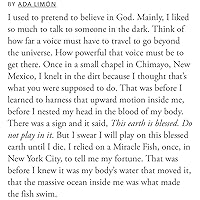
“love is / the only thing that is not an argument”
“darkness underneath the coat of blinding night / is truth and the only difference between truth and / everything else is that you can see everything else”
“darkness underneath the coat of blinding night / is truth and the only difference between truth and / everything else is that you can see everything else”
January 1, 2026
I ask the sky for
help but it just gives me the next rain
***
there must be a
God only God makes me listen this way I take
my quill and write God a note but there are no
more words they have flown beyond the lights
all the letters shaped like question marks
help but it just gives me the next rain
***
there must be a
God only God makes me listen this way I take
my quill and write God a note but there are no
more words they have flown beyond the lights
all the letters shaped like question marks

August 27, 2026
👗
“Is A Windcatcher”
Is a windcatcher still a windcatcher
if there is no wind
moving it is Barbie Chang still a
woman if there is no
man hunting her if she does not
look in the mirror
doesn’t she exist if she walks past men
and they do not look
at her is she still alive is a signified
without a signifier
really impossible can that which is
signified ever become
a signifier what is a birdfeeder the bird or
the birdseed the moon
at night stretches on her bed like a
blue dress when it
goes down a child foolishly believes
it is gone
Based on this collection, Victoria Chang is one of my new favorite poets. I related deeply to these poems, in which she explored motherhood, caring for aging parents, feeling like an outsider, the male gaze, visibility/invisibility, all-consuming love, and more, plumbing the darker thoughts and desires that lie underneath the placid surface she projects to the people around her.
And she used to live in Irvine? No wonder I related to her feelings of not fitting in to the “Circle” of moms—the ones who rule the social world of her daughter’s school and make a point of excluding anyone who doesn’t fit their standards.
🌈
“Barbie Chang Got Her Hair Done”
Barbie Chang got her hair done for
the school auction
she was afraid sick of the Circle since
she heard of their
shopping for matching dresses so out
of the nest she flew
into the auction thinking she could
outmaneuver her
loneliness thinking she could overcome
being classified thinking
she could be an agent of her own
classification in came
the Circle drunk tossing coins at baskets
one in pink one in
green one in orange one in purple
matching floral
barrettes glowing like a rainbow that
seemed low enough
to reach to touch Barbie Chang would
never admit it but
she still wanted the rainbow to rain on
her to wear bows in her
hair that meant she belonged somewhere
else she owed it to
her children to make friends to blend
into the dead end
These poems made me feel protective of Chang, to sit next to her and whisper, “Honestly? Fuck the Circle. They suck.” But I related so much to her longing to win their approval, even as she can see they’re not great people—to get the party invitations, to wear the matching outfits, to be welcomed into a group of easy chatter, to be effortlessly cool. But, from what I could tell, Chang was excluded not because of awkwardness and having a weird personality (like me), but because the Circle is racist and shallow. (But Chang won a Guggenheim Fellowship and is the Director of Poetry at Georgia Tech, which seems like sweet revenge against the Circle, who are all probably still in Irvine doing nothing of significance.)
The collection takes a turn with a series of brilliant sonnets that are largely about motherhood. Again, relatable. Also? I know from experience that sonnets are not easy to write, and Chang gifts us with 15 of them.
🪑
“8”
Someone says it is difficult to write poems
that are both domestic and ambitious if your
small head is my earth if I have concerns only
for the internal affairs of your body then how
am I domestic our home has more than four
sides there are wars in rooms furniture in
formation if I am your domestic servant why is
it assumed we are domestic that we are small
and petty that we are controllable unwild you
betray me over and over I play you and prey
on you this is not domestic there is no floral
sofa no salad plate no bingo hall just falling
bodies the trouble with falling bodies is
someone needs to catch them
🏹
“11”
When a boy throws sand on your face
the hunter’s bow and arrow tucked behind
my choking heart bends and I must do
everything to suppress otherwise to summon
the wren in me the festival but how lovely
his round face would look pocked with
sand how happy my hand would be to throw
grains toward his face into the plumbing
of a body I care little about here a giant ficus
tree can lift up a sidewalk here I am lean with
only a canister of water I am broken down in
this valley no goodwill I am embroidered
with love and grief with the exact moment
your breathing becomes slow and deep
Grief also flows through this collection as Chang witnesses her father unraveling through dementia and her mother’s lungs failing. Their deaths give her relief that they’re no longer suffering, but it’s mixed with a longing to have done more, said more, even as her parents didn’t seem to love her in the ways she needed.
📱
“Barbie Chang’s Father Calls”
Barbie Chang’s father calls again calls
her again again he calls
her still knows how to dial a cellphone
Barbie Chang’s father has
another problem always has a problem
doesn’t know he is
liminal he says Barbie Chang’s mother
criticizes him all is wrong
today today he calls his hands “handles”
today his handles hurt
today Barbie Chang’s mother handles
the bad news poorly
today the doctor thinks three months
but says six no one can
fix Barbie Chang’s mother once her
mother had good hearing
could hear anything see and smell
everything corners were
always too sharp too dark no hearth
always harping on
everyone what was wrong with everyone
too dumb too short too tall
not enough college collar too white
moon too fraction
moon too waxing when she is not yelling
at him or asking about the
taxes has Barbie Chang finished her
taxes again asking about
the taxes the same taxes or whether she
can fix his brain she lies
on her side thin body shaped
like a large ear
And ever present in this collection are love and desire, because those feelings don’t disappear with parenthood or maturity or grief—perhaps they even intensify because we know how precious and rare they are, because parents dealing with their own aging parents often experience passion in short bursts or stolen moments. Chang explores love through a character she names “Mr. Darcy,” for reasons she doesn’t explain and doesn’t have to. It’s poetry, after all. She also leans into her ambivalence toward the male gaze, and her own gaze in return.
✈️
“Mr. Darcy Comes Again”
Mr. Darcy comes again through
the uneven grass in
a blue cape boots long hair a white
shirt with sleeves that
cover his palms the terminal part of
his body but nothing
terminal here even silence is not
silent Barbie Chang
sits again at terminal E gate 33 and
waits for a plane that
never arrives there are eyes on the
runways in the fog
planes look like nightgowns the people
In the airport don’t
speak they only gasp her gasp when
she sees the man again
in the fog in the threads of the trees
she wants to be the girl
who wrestles a man’s heart into a
balcony into something
more than four parts she wants to
wrestle the same man’s
heart over and over but what if there
are at least nine hearts
what if she only has one balcony is this
why her gasp is trapped
in her throat she wants the gasp to
elope in the form of
something other than a man she wants
to throw up the gasp so
she can finally be free of its ring and
creep she wants it to
leave her alone wants it to leave
wants it
👑
“Then Barbie Chang”
Then Barbie Chang and Mr. Darcy
are in the backseat
of a car kissing not the light kind
but one where their
hands are on each other’s cheeks
holding each other’s
heads as if they will fall off why does
so much love come at
the beginning then disappear then
once again at the
moment before death why can’t the
same kind exist in
between the breaths in the afternoon
in the sitting room
little girls dress like princesses one pink
one blue one yellow they
wear plastic heels because they still think
they will never fall
🕳️🕳️
“In and Out These Men Go”
In and out these men go in Barbie
Chang’s life and run
her life too many run ins and starings
how do they see her
lies so clearly then they disappear it
might be months before
she sees them again once she saw one
every day from afar
but then he moved now she is only
moved by movies the
in and out the losing under the frozen
river there are still things
moving when did her footprints stack up
like a deck of cards
when did having change to dying
the mother in a child’s
drawing is always smiling but why are
her eyes always
two large holes if you must have an
answer ask the
body it is the only thing that aspires
toward failure
Chang’s daughter is ever present in this collection as she expresses the fierce protectiveness, frustration, fear, and raw love that come with being a parent. She also seemed to carry guilt about not belonging to the Circle of moms because that meant her daughter was excluded, too, and missed out on the friendships and invitations that came with the approval of the queen bees of the neighborhood. This was another feeling I deeply related to.
🦌
“Barbie Chang’s Daughter”
Barbie Chang’s daughter befriends the
new girl at school but
before they can form a bond the new girl’s
mom tells Barbie Chang
that her own daughter should not tie
herself down too fast and
in one week the new girl walks past
Barbie Chang’s daughter
no longer talks to her the mother works
hard to send cards to
the Circle one by one she stars their names
because they are free
to star names free to have stars next to
their names Barbie Chang
can no longer play dead because she
must be seen to play dead
she realizes she is not what others name
her would we name a
deer something else if it could see the
ocean would the deer
even name itself a deer if we’ve never
seen a deer does it mean
it doesn’t exist if Barbie Chang perches
on a hill with binoculars
waiting for deer and sees someone else
looking for deer
watching her instead does that mean she
exists or that she’s a deer
The collection ends with letter-like poems that are presumably written for her daughter.
The formatting of this poem is different in the book, but this is the best way I could replicate it here:
❤️
“Dear P.”
There / will be / a circle / of girls there will / be
many circles of / girls / who turn into circles of
women / there will be many / parties many grills with
corn and / meat losing its red center / there will
also be / a circle of crows who circle the / circle of
boars / who circle / the circle of grass / work
their way / into its center there will be a / circle
of gnats / who / circle the dirty / boars because
there / are / awards for / grouping / easier than
absence / easier than working against / easier than
separating / water / with curtains / good things are
often in / pieces / are backing / away / from
doorways / are alone / the heart / is / alone in
our / bodies / because / it must be / to / love
I’ve found that my favorite artworks or pieces of writing inspire me to sit down and create something of my own. Reading this collection has me seeing poetry everywhere and scribbling my own lines. My poems will probably stay in their notebooks where they belong, but the creative impulse is still a gift and I’m grateful to Chang for that. The students who get to learn from her probably don’t even realize how lucky they are.
Key to my ratings:
⭐️⭐️⭐️⭐️⭐️ A personal favorite and/or an exemplary, near-perfect book for its genre. Either repaired or broke my heart, or perhaps broke it and then put it back together again? Regardless, my heart is not the same after reading it.
⭐️⭐️⭐️⭐️ A memorable, excellent example of its genre that likely made me cry, laugh out loud, hug the book to my chest, or all of the above.
⭐️⭐️⭐️ An enjoyable read that was possibly a bit flawed or not fully my cup of tea, but still a solidly good book. I would likely recommend it to someone if they liked the genre.
⭐️⭐️ A book I was able to get through, but wasn’t a positive reading experience. Still has merit on some level.
⭐️ I don’t have the attention span to finish one-star books, so I’ll probably never use this rating.
“Is A Windcatcher”
Is a windcatcher still a windcatcher
if there is no wind
moving it is Barbie Chang still a
woman if there is no
man hunting her if she does not
look in the mirror
doesn’t she exist if she walks past men
and they do not look
at her is she still alive is a signified
without a signifier
really impossible can that which is
signified ever become
a signifier what is a birdfeeder the bird or
the birdseed the moon
at night stretches on her bed like a
blue dress when it
goes down a child foolishly believes
it is gone
Based on this collection, Victoria Chang is one of my new favorite poets. I related deeply to these poems, in which she explored motherhood, caring for aging parents, feeling like an outsider, the male gaze, visibility/invisibility, all-consuming love, and more, plumbing the darker thoughts and desires that lie underneath the placid surface she projects to the people around her.
And she used to live in Irvine? No wonder I related to her feelings of not fitting in to the “Circle” of moms—the ones who rule the social world of her daughter’s school and make a point of excluding anyone who doesn’t fit their standards.
🌈
“Barbie Chang Got Her Hair Done”
Barbie Chang got her hair done for
the school auction
she was afraid sick of the Circle since
she heard of their
shopping for matching dresses so out
of the nest she flew
into the auction thinking she could
outmaneuver her
loneliness thinking she could overcome
being classified thinking
she could be an agent of her own
classification in came
the Circle drunk tossing coins at baskets
one in pink one in
green one in orange one in purple
matching floral
barrettes glowing like a rainbow that
seemed low enough
to reach to touch Barbie Chang would
never admit it but
she still wanted the rainbow to rain on
her to wear bows in her
hair that meant she belonged somewhere
else she owed it to
her children to make friends to blend
into the dead end
These poems made me feel protective of Chang, to sit next to her and whisper, “Honestly? Fuck the Circle. They suck.” But I related so much to her longing to win their approval, even as she can see they’re not great people—to get the party invitations, to wear the matching outfits, to be welcomed into a group of easy chatter, to be effortlessly cool. But, from what I could tell, Chang was excluded not because of awkwardness and having a weird personality (like me), but because the Circle is racist and shallow. (But Chang won a Guggenheim Fellowship and is the Director of Poetry at Georgia Tech, which seems like sweet revenge against the Circle, who are all probably still in Irvine doing nothing of significance.)
The collection takes a turn with a series of brilliant sonnets that are largely about motherhood. Again, relatable. Also? I know from experience that sonnets are not easy to write, and Chang gifts us with 15 of them.
🪑
“8”
Someone says it is difficult to write poems
that are both domestic and ambitious if your
small head is my earth if I have concerns only
for the internal affairs of your body then how
am I domestic our home has more than four
sides there are wars in rooms furniture in
formation if I am your domestic servant why is
it assumed we are domestic that we are small
and petty that we are controllable unwild you
betray me over and over I play you and prey
on you this is not domestic there is no floral
sofa no salad plate no bingo hall just falling
bodies the trouble with falling bodies is
someone needs to catch them
🏹
“11”
When a boy throws sand on your face
the hunter’s bow and arrow tucked behind
my choking heart bends and I must do
everything to suppress otherwise to summon
the wren in me the festival but how lovely
his round face would look pocked with
sand how happy my hand would be to throw
grains toward his face into the plumbing
of a body I care little about here a giant ficus
tree can lift up a sidewalk here I am lean with
only a canister of water I am broken down in
this valley no goodwill I am embroidered
with love and grief with the exact moment
your breathing becomes slow and deep
Grief also flows through this collection as Chang witnesses her father unraveling through dementia and her mother’s lungs failing. Their deaths give her relief that they’re no longer suffering, but it’s mixed with a longing to have done more, said more, even as her parents didn’t seem to love her in the ways she needed.
📱
“Barbie Chang’s Father Calls”
Barbie Chang’s father calls again calls
her again again he calls
her still knows how to dial a cellphone
Barbie Chang’s father has
another problem always has a problem
doesn’t know he is
liminal he says Barbie Chang’s mother
criticizes him all is wrong
today today he calls his hands “handles”
today his handles hurt
today Barbie Chang’s mother handles
the bad news poorly
today the doctor thinks three months
but says six no one can
fix Barbie Chang’s mother once her
mother had good hearing
could hear anything see and smell
everything corners were
always too sharp too dark no hearth
always harping on
everyone what was wrong with everyone
too dumb too short too tall
not enough college collar too white
moon too fraction
moon too waxing when she is not yelling
at him or asking about the
taxes has Barbie Chang finished her
taxes again asking about
the taxes the same taxes or whether she
can fix his brain she lies
on her side thin body shaped
like a large ear
And ever present in this collection are love and desire, because those feelings don’t disappear with parenthood or maturity or grief—perhaps they even intensify because we know how precious and rare they are, because parents dealing with their own aging parents often experience passion in short bursts or stolen moments. Chang explores love through a character she names “Mr. Darcy,” for reasons she doesn’t explain and doesn’t have to. It’s poetry, after all. She also leans into her ambivalence toward the male gaze, and her own gaze in return.
✈️
“Mr. Darcy Comes Again”
Mr. Darcy comes again through
the uneven grass in
a blue cape boots long hair a white
shirt with sleeves that
cover his palms the terminal part of
his body but nothing
terminal here even silence is not
silent Barbie Chang
sits again at terminal E gate 33 and
waits for a plane that
never arrives there are eyes on the
runways in the fog
planes look like nightgowns the people
In the airport don’t
speak they only gasp her gasp when
she sees the man again
in the fog in the threads of the trees
she wants to be the girl
who wrestles a man’s heart into a
balcony into something
more than four parts she wants to
wrestle the same man’s
heart over and over but what if there
are at least nine hearts
what if she only has one balcony is this
why her gasp is trapped
in her throat she wants the gasp to
elope in the form of
something other than a man she wants
to throw up the gasp so
she can finally be free of its ring and
creep she wants it to
leave her alone wants it to leave
wants it
👑
“Then Barbie Chang”
Then Barbie Chang and Mr. Darcy
are in the backseat
of a car kissing not the light kind
but one where their
hands are on each other’s cheeks
holding each other’s
heads as if they will fall off why does
so much love come at
the beginning then disappear then
once again at the
moment before death why can’t the
same kind exist in
between the breaths in the afternoon
in the sitting room
little girls dress like princesses one pink
one blue one yellow they
wear plastic heels because they still think
they will never fall
🕳️🕳️
“In and Out These Men Go”
In and out these men go in Barbie
Chang’s life and run
her life too many run ins and starings
how do they see her
lies so clearly then they disappear it
might be months before
she sees them again once she saw one
every day from afar
but then he moved now she is only
moved by movies the
in and out the losing under the frozen
river there are still things
moving when did her footprints stack up
like a deck of cards
when did having change to dying
the mother in a child’s
drawing is always smiling but why are
her eyes always
two large holes if you must have an
answer ask the
body it is the only thing that aspires
toward failure
Chang’s daughter is ever present in this collection as she expresses the fierce protectiveness, frustration, fear, and raw love that come with being a parent. She also seemed to carry guilt about not belonging to the Circle of moms because that meant her daughter was excluded, too, and missed out on the friendships and invitations that came with the approval of the queen bees of the neighborhood. This was another feeling I deeply related to.
🦌
“Barbie Chang’s Daughter”
Barbie Chang’s daughter befriends the
new girl at school but
before they can form a bond the new girl’s
mom tells Barbie Chang
that her own daughter should not tie
herself down too fast and
in one week the new girl walks past
Barbie Chang’s daughter
no longer talks to her the mother works
hard to send cards to
the Circle one by one she stars their names
because they are free
to star names free to have stars next to
their names Barbie Chang
can no longer play dead because she
must be seen to play dead
she realizes she is not what others name
her would we name a
deer something else if it could see the
ocean would the deer
even name itself a deer if we’ve never
seen a deer does it mean
it doesn’t exist if Barbie Chang perches
on a hill with binoculars
waiting for deer and sees someone else
looking for deer
watching her instead does that mean she
exists or that she’s a deer
The collection ends with letter-like poems that are presumably written for her daughter.
The formatting of this poem is different in the book, but this is the best way I could replicate it here:
❤️
“Dear P.”
There / will be / a circle / of girls there will / be
many circles of / girls / who turn into circles of
women / there will be many / parties many grills with
corn and / meat losing its red center / there will
also be / a circle of crows who circle the / circle of
boars / who circle / the circle of grass / work
their way / into its center there will be a / circle
of gnats / who / circle the dirty / boars because
there / are / awards for / grouping / easier than
absence / easier than working against / easier than
separating / water / with curtains / good things are
often in / pieces / are backing / away / from
doorways / are alone / the heart / is / alone in
our / bodies / because / it must be / to / love
I’ve found that my favorite artworks or pieces of writing inspire me to sit down and create something of my own. Reading this collection has me seeing poetry everywhere and scribbling my own lines. My poems will probably stay in their notebooks where they belong, but the creative impulse is still a gift and I’m grateful to Chang for that. The students who get to learn from her probably don’t even realize how lucky they are.
Key to my ratings:
⭐️⭐️⭐️⭐️⭐️ A personal favorite and/or an exemplary, near-perfect book for its genre. Either repaired or broke my heart, or perhaps broke it and then put it back together again? Regardless, my heart is not the same after reading it.
⭐️⭐️⭐️⭐️ A memorable, excellent example of its genre that likely made me cry, laugh out loud, hug the book to my chest, or all of the above.
⭐️⭐️⭐️ An enjoyable read that was possibly a bit flawed or not fully my cup of tea, but still a solidly good book. I would likely recommend it to someone if they liked the genre.
⭐️⭐️ A book I was able to get through, but wasn’t a positive reading experience. Still has merit on some level.
⭐️ I don’t have the attention span to finish one-star books, so I’ll probably never use this rating.

November 26, 2017
Victoria Chang’s “Barbie Chang” is a terrific, carefully crafted collection of poems concerned largely with the social nuances and pressures of fitting in with those in your peer and age groups. These concerns are complicated by the dynamics of race and social status (one poem describes the titular character trying to appear not to associate with other Asian people in order to fit in with her coworkers), as well as being a mother who is trying to safely shepherd her young daughter into a world she is still trying to successfully navigate through while simultaneously dealing with ailing parents.
Desire and acceptance, shown through love, social relationships, economic symbols, and family structures, power these poems and it seems that this yearning is what animates the lines to jump from track to track syntactically. Bereft of punctuation, these poems show Chang to be a master of pacing, as the poems double back or jump forward, loop and echo and play solely on their constituent parts, unaided by punctuation or most modes of enjambment (the lines for most of the book follow a strict length pattern). I don’t know of another poet writing in English who can do more in a single line than Victoria Chang; each poem is layered with intricate connections between words, lines, sounds, and images, that add to the narrative and emotions on display. It makes this book a joy to read.
Desire and acceptance, shown through love, social relationships, economic symbols, and family structures, power these poems and it seems that this yearning is what animates the lines to jump from track to track syntactically. Bereft of punctuation, these poems show Chang to be a master of pacing, as the poems double back or jump forward, loop and echo and play solely on their constituent parts, unaided by punctuation or most modes of enjambment (the lines for most of the book follow a strict length pattern). I don’t know of another poet writing in English who can do more in a single line than Victoria Chang; each poem is layered with intricate connections between words, lines, sounds, and images, that add to the narrative and emotions on display. It makes this book a joy to read.
May 8, 2021
This was an excellent collection of poems and I really enjoyed reading it. The imagery and diction is superb, and a lot of the poems are really powerful and make your heart go out for the writer. Chang captures her experiences as an Asian American woman while also writing about universal themes.
Themes include feeling excluded and “othered”, the pressure to fit in social circles, racism, internalized racism, toxicity, the idea of love, having a complicated relationship with ailing parents and taking care of them, and being a mother.
Themes include feeling excluded and “othered”, the pressure to fit in social circles, racism, internalized racism, toxicity, the idea of love, having a complicated relationship with ailing parents and taking care of them, and being a mother.

May 27, 2022
I want to change the ending before this / begins I want to know how to begin without / the softness of sentimentality
is probably one of my favourite lines from a poem ever. I enjoyed Barbie Chang SO much.
My first brush with Victoria Chang was with the heart-wrenching poetry collection Obit, written to cope, reflect and mediate on Chang's loss of her mother. This one possesses the same amount of grief and clamor, while also being incredibly agile and clever.
she wonders who is observing / them two terrestrial specks / celestial sextants aligned only in the / night if they zoom in / they will see two fingerlike test tubes / filled with fire
The outcome? Me, swooning, gasping and weeping out loud over every piece in this collection. It was such a tactile, playful and precise look at the Asian American (feminine, motherly, daughterly, womanly) self within a larger societal context.
how does she turn her back if there is / no one watching her
the / trouble with being a / mother is that you too must die
I absolutely adore Victoria Chang's imagery and language use and will look forward to reading more of her works <3
every woman / begins and ends with another woman
May 22, 2025
well done thematically, extremely clever language! did not always work for me all the time. a few poems felt insubstantial. "he tells Barbie Chang she / is demented his dementia / is self centered it has no more center" ouch! parents dementia aging grieving that hurts. also “the moon / at night stretches on her bed like a / blue dress when it / goes down a child foolishly believes / it is gone” a good read (goodreads lol) but wasnt quite effective at haunting me
“I want to change the ending before this
begins I want to know how to begin without
the softness of sentimentality it exhales
from my pencil from the edge of my hair
through the heart as something wept seeps
down my arm through my fingers and comes
a speech that speaks for me and fills this page
with seaweed green swaths of love I cross them
out force new words storm words out through
a straw but they take the shape of a girl’s
handwriting there’s a heart on the lowercase i
it looks like a microphone and when I sing into
it my voice comes back softer like a lullaby”
“I want to change the ending before this
begins I want to know how to begin without
the softness of sentimentality it exhales
from my pencil from the edge of my hair
through the heart as something wept seeps
down my arm through my fingers and comes
a speech that speaks for me and fills this page
with seaweed green swaths of love I cross them
out force new words storm words out through
a straw but they take the shape of a girl’s
handwriting there’s a heart on the lowercase i
it looks like a microphone and when I sing into
it my voice comes back softer like a lullaby”

February 18, 2020
This is a challenging and exceptional collection of poems. What makes it challenging is the absence of punctuation and line breaks that would indicate syntax. Instead, Parts I and III are written in couplets (one long line, one short), and Parts II and IV are long, unbroken text blocks. The lines have a rhythm that takes time to discern, but it's there. What makes it exceptional are the lines and moments that capture profound ideas clearly: "maybe her life is/ scarce because it's not/ about filling up but emptying out..." or the line about the acorn being the nut with a little hat and that it is the perfect metaphor for the truth. There's a mastery of words and associations throughout the poems that carry more than just clever juxtapositions. For a sequence of verse about parents' decline (through dementia) and death (through lung cancer), ostracism, and longing, the pairing and contrast of words and phrases creates resonance that is meant to emphasize the images while also transcending it. This is must read.

November 22, 2022
Barbie Chang Got Her Hair Done
Barbie Chang got her hair done for
the school auction
she was afraid sick of the Circle since
she heard of their
shopping for matching dresses so out
of the nest she flew
into the auction thinking she could
outmaneuver her
loneliness thinking she could overcome
being classified thinking
she could be an agent of her own
classification in came
the Circle dunk tossing coins at baskets
one in pink one in
green one in orange one in purple
matching floral
barrettes glowing like a rainbow that
seemed low enough
to reach to touch Barbie Chang would
never admit it but
she still wanted the rainbow to rain on
her to wear bows in her
hair that meant she belonged somewhere
else she owed it to
her children to make friends to blend
into the dead end
Barbie Chang got her hair done for
the school auction
she was afraid sick of the Circle since
she heard of their
shopping for matching dresses so out
of the nest she flew
into the auction thinking she could
outmaneuver her
loneliness thinking she could overcome
being classified thinking
she could be an agent of her own
classification in came
the Circle dunk tossing coins at baskets
one in pink one in
green one in orange one in purple
matching floral
barrettes glowing like a rainbow that
seemed low enough
to reach to touch Barbie Chang would
never admit it but
she still wanted the rainbow to rain on
her to wear bows in her
hair that meant she belonged somewhere
else she owed it to
her children to make friends to blend
into the dead end

May 25, 2026
Reading this stunning collection has been making me think about how much quiet endurance is asked of women, especially those expected to keep performing competence, beauty, grace, motherhood, desirability, all at once, while privately carrying loneliness or exhaustion that nobody rewards them for admitting. The poems feel so attuned to the humiliations of class anxiety too, that constant awareness of who belongs effortlessly and who has to rehearse belonging every single day. Maybe that’s what moves me most about the collection so far: its understanding that alienation does not always arrive dramatically. Sometimes it comes dressed as suburban normalcy, as politeness, as ambition, as wanting very badly to be accepted by a world that keeps measuring your worth before you even speak.

May 19, 2026
i loooove internal rhyme & assonance & whatnot so the barbie chang sections (1 and 3) were great. rly sonically pleasing. the unpunctuated sonnet sequence in section 2 i didn't rly care for. the ideas & feelings r nth new: the invisibility of being a minority and the emptiness of the suburban american dream (hello crenshaw? hello friedan?), ailing parents and motherhood anxieties. but chang does them well. besides the recurring characters, some other recurring things i liked were the motif of black hair and the titles being shortened versions of the first lines.
favs: The Prognosis Is Poor, Barbie Chang Has No Intention, There Are Lungs, In And Out These Men Go
favs: The Prognosis Is Poor, Barbie Chang Has No Intention, There Are Lungs, In And Out These Men Go

February 5, 2019
I have rarely come across a book of poems that has the thematic integrity that Barbie Chang has. It takes you through a journey - first you experience being an outsider, wanting to get in, then realizing it isn't worth getting in, then realizing it may have been okay to be an outsider when it was just you - now you also have a child, and wanting your child to not suffer the same pains you did knowing full well there is no way of escaping it.
December 26, 2022
if she sticks
her head out the window
as if she is on a train maybe night
will take her head off
Favorites:
Barbie Chang Parks
Barbie Chang’s Father Paid
Barbie Chang runs
Once Barbie Chang Loved
Barbie Chang Can’t Stop Watching
Mr. Darcy Leans
Is A Windcatcher
These Men Can Be Collected
Barbie Chang Has No Intention
Dear P.
Barbie Chang Pokes Through
Dear P. There will be a circle
her head out the window
as if she is on a train maybe night
will take her head off
Favorites:
Barbie Chang Parks
Barbie Chang’s Father Paid
Barbie Chang runs
Once Barbie Chang Loved
Barbie Chang Can’t Stop Watching
Mr. Darcy Leans
Is A Windcatcher
These Men Can Be Collected
Barbie Chang Has No Intention
Dear P.
Barbie Chang Pokes Through
Dear P. There will be a circle
March 21, 2025
Didn’t blow me away as much as “Obit” did, but it’s hard for anything to blow me away as much as “Obit” did. Victoria Chang is inventive, fun to read, & a great poet to teach in workshop settings. I thoroughly enjoyed this collection.

December 20, 2022
i can tell the author is a giant nerd for literary theory

January 11, 2023
i love victoria chang always 5 stars always pulls at my heart and makes me feel introspective and softer

Read
March 16, 2023the structure and rhythm of Chang's poems makes me want to read all of them out loud and I find it really compelling
August 14, 2024
2.5
not bad but not my preference in types of verse
not bad but not my preference in types of verse
January 20, 2025
Enjoyed this


April 11, 2025
the poems are fun to read out loud
sometimes circulates around same topics
some poems feel transitional rather than standing up on their own
sometimes circulates around same topics
some poems feel transitional rather than standing up on their own
November 22, 2018
This collection by Victoria Chang was perhaps my favorite book that I read this year. Love the combination of humor and social commentary. Many of the poems make use of couplets while also using enjambment to create surprise and suspense. I was especially intrigued by the poems that refer to "the Circle" (the group of parents observed at Barbie Chang's child's school). The "Dear P" poems in section IV are lovely and intense and memorable--the letter form makes these poems feel especially intimate; though the reader knows these letters are addressed to "P," one can't help but feel that these letters are also meant for us: "...it's okay to not spin the diamond that begs for your finger it's okay..."
April 4, 2018
I would give it 6 stars if I could. I read it twice.
Displaying 1 - 30 of 100 reviews