Jump to ratings and reviews
Rate this book

Kew Gardens

Rate this book
In 1927, at The Hogarth Press, Virginia Woolf produced and published a limited edition of what was to become one of her best-loved stories. The book's jacket design and page illustrations were by her sister, artist Vanessa Bell.

More than sixty years later, The Hogarth Press at Chatto & Windus has published a lovely facsimile of that prized edition of 'Kew Gardens'.

The lush and haunting story circles around Kew Gardens one hot day in July, as various odd and interesting couples walk by and talk, exchanging words but letting thoughts and memories float languorously above the glossy leaves and exotic blooms, while at their feet, a determined snail makes its way slowly across a mountainous flower bed.

Elegantly produced, a precise replica of that 1927 special edition, with Vanessa Bell's jacket and decorative drawings, this is a rare treat for Bloomsbury devotees and all who love beautiful books.

123 pages, Hardcover

First published January 1, 1919

48 people are currently reading
2532 people want to read

About the author

Virginia Woolf

1,824 books28.7k followers
(Adeline) Virginia Woolf was an English novelist and essayist regarded as one of the foremost modernist literary figures of the twentieth century.

During the interwar period, Woolf was a significant figure in London literary society and a member of the Bloomsbury Group. Her most famous works include the novels Mrs. Dalloway (1925), To the Lighthouse (1927), and Orlando (1928), and the book-length essay A Room of One's Own (1929) with its famous dictum, "a woman must have money and a room of her own if she is to write fiction."

Ratings & Reviews

What do you think?
Rate this book

Friends & Following

Create a free account to discover what your friends think of this book!

Community Reviews

5 stars
494 (18%)
4 stars
979 (37%)
3 stars
872 (33%)
2 stars
248 (9%)
1 star
47 (1%)
Displaying 1 - 30 of 288 reviews
Profile Image for Ilse.
551 reviews4,435 followers
January 17, 2025
Evanescent moments of being

’Doesn't one always think of the past, in a garden with men and women lying under the trees? Aren't they one's past, all that remains of it, those men and women, those ghosts lying under the trees,... one's happiness, one's reality?’

Kew Gardens is the third short story by Virginia Woolf I have read by now, and although I would be hard pressed to indicate my favourite one (A Haunted House and In the Orchard the other ones) it is easy to understand why Kew Gardens, replete with various themes, perspective shifts, vibrant colours and pulsating sensations is one of her most beloved ones . Its success also brought a certain change of fortune for the Woolfs and the Hogarth press.

IMG-1591

Woolf meanders among fragments of conversation, thoughts and observations of human as well as non-human characters - four duo’s (a young and a mature couple with children, two ladies, a young and an old man seeming son and father) strolling along an oval flower-bed, sharing the garden with a snail, a grasshopper, a thrush, a few butterflies – and flowers and trees. Woolf blends and blurs human and animal consciousness into a wondrous painting throbbing with life, turning the eyes to small details and the different time focus and variegated experience of velocity in movement of all the living creatures coming together fortuitously in that garden unaware of each other’s existence, like living in another world. The visual perceptions are intensified by the soundscape evoked be the myriad of ’wordless voices’ oscillating against the backdrop of war and the murmurs of the city, the hustle and bustle of the traffic surrounding the Gardens in London.

IMG-1553

What stayed with me from the effervesce of fleeting moments is the prominent and moving role Woolf gives to the little snail - so stubborn, determined and willing to make its way creeping through the flowerbed, exploring and considering to overcome the obstacles it meets. The reader gets to see the snail as well as the garden from the snail’s perspective:

’In the oval flower bed the snail, whose shell had been stained red, blue, and yellow for the space of two minutes or so, now appeared to be moving very slightly in its shell, and next began to labour over the crumbs of loose earth which broke away and rolled down as it passed over them. It appeared to have a definite goal in front of it, differing in this respect from the singular high stepping angular green insect who attempted to cross in front of it, and waited for a second with its antennæ trembling as if in deliberation, and then stepped off as rapidly and strangely in the opposite direction. Brown cliffs with deep green lakes in the hollows, flat, blade-like trees that waved from root to tip, round boulders of grey stone, vast crumpled surfaces of a thin crackling texture–all these objects lay across the snail’s progress between one stalk and another to his goal. Before he had decided whether to circumvent the arched tent of a dead leaf or to breast it there came past the bed the feet of other human beings.’


IMG-1560

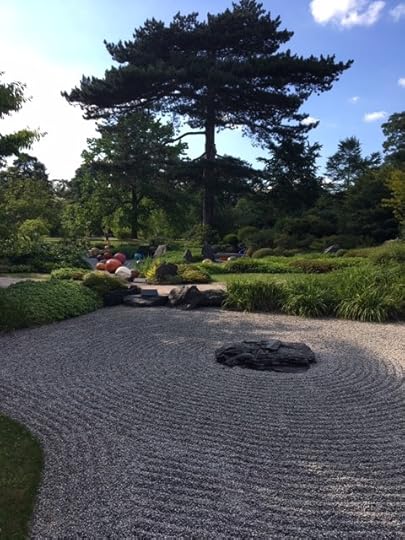
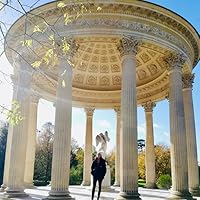
Reading the story for a second time after visiting Kew Gardens with my children in the July heat in 2019, it struck me that the story – also set on a blazing hot day in July – was published in 1919, so precisely 100 years ago. When we were walking towards Kew alongside the river Thames, approaching the Gardens coming from Ham house, I was unaware Virginia Woolf had been living in Richmond from 1914 to 1924. On 26 November 1917 she wrote in her diary that she went to Kew with Leonard and ‘saw a blazing bush, as red as cherry blossom, but more intense – frostily red – also gulls rising and falling for pieces of meat, their crowd waved aside suddenly by three very elegant grey cranes’. When moving there, Kew Gardens soon became a favourite walking destination of hers, often wandering there with her dogs, as her doctors advised her to go for long walks. Perhaps, without knowing so, we had been walking where she used to walk? I like to imagine we did.

The story can be read here.
Profile Image for Diane S ☔.
4,901 reviews14.6k followers
August 31, 2020
3.5 Woolf and I don't always get along. I find her stream if consciousness novels, very difficult to comprehend at times, though without doubt she was a talented writer. This short story though is lovely. The colors, descriptions of the garden, the intricate details, made me yearn for our local arboretum. The butterflies, dragonflies, painting a wonderful scene. The people who visit, the man who remembers proposing to his wife here and others who walk through. It is the snail though that wins my heart, as Woolf returns to him a few times as he tries to navigate over a twig and continue on his way. Can find this in various forms on the web, including a librevox recording.
Profile Image for Sidrah Anum.
60 reviews353 followers
September 4, 2019
"Doesn't one always think of the past, in a garden with men and women lying under the trees? Aren't they one's past, all that remains of it, those men and women, those ghosts lying under the trees....one's happiness, one's reality?"

Thoughts of animate and inanimate objects in the Kew Gardens during a brief period of time described amazingly and poetically by Woolf!
Profile Image for Piyangie.
625 reviews769 followers
July 11, 2022
Kew Gardens is my first short story of Virginia Woolf. And I'm greatly impressed. I think only Virginia can write such an abstract story with mastery.

Kew Gardens describes a summer evening in July in the Royal Botanical Garden in Kew. Four different couples, a couple with children, two men - one old and one young, two lower middle-class women, and a young couple new to love walk past a flower bed absorbed in their own separate worlds. Their thoughts, words, and actions form the story of this short fiction.

I have often observed that Virginia writes no proper stories. She describes places, observes nature, exposes the human mind and emotion. And these combined is her story, which is uncommon yet fascinating at the same time.

The beauty of this short work lies undoubtedly in Virginia's writing. It is as grand as in almost all the books I've read of her so far. I may say that her writing is even grander in this short work. I'm certain it is much due to the setting being the beautiful Botanical Gardens of Kew, which gave her ample material to paint a beautiful and vibrant picture with her imaginary brush.

Every book of Virginia Woolf leaves me in a sort of wonder, and it was the same with Kew Gardens. The brilliance of this author is that she can author both short and long works with equal mastery. So it is no wonder that with every read, she grows more in my esteem.
Profile Image for Annelies.
165 reviews3 followers
February 14, 2017
Only Woolf can write about ordinary things in such a short story and make you long for more. She easily moves from one subject to another in a natural way. You can imagine Kew Gardens on this summers day. Feel the sun, see the colours of the flowers, subject you to the struggle of the snail to move forward, see and hear the people strolling around. Actually there happens quite of nothing but she makes it look like a great deal. That's the capacity of a really great author.
Profile Image for Kenny.
599 reviews1,492 followers
May 15, 2019
"Doesn't one always think of the past, in a garden with men and women lying under the trees? Aren't they one's past, all that remains of it, those men and women, those ghosts lying under the trees…one's happiness, one's reality?"

1

Kew Gardens is a beautifully, charming story from Virginia Woolf. With several edits it could easily fit within Woolf's Mrs. Dalloway or her Mrs. Dalloway's Party: A Short Story Sequence.

Woolf, once more, revisits her favorite themes of passion, desire, love, and regret; in short, Woolf turns her perceptive again on humanity, once more using stream of consciousness. What Woolf does brilliantly here is to capture the chaos of life in all its pain, darkness and beauty.

1
Profile Image for Paula Mota.
1,662 reviews561 followers
April 26, 2025
#A story a day to chase the blues away #14

"Kew Gardens", Virginia Woolf, Reino Unido, 1919

Há contos que se sobrepõem nas duas colectâneas que já li de Virginia Woolf, mas “Kew Gardens” é um dos poucos que não constava de nenhuma delas. Nada que uma terceira não resolva.
Dentro do canteiro oval de Kew Gardens, primorosamente descrito, acompanhamos o lento percurso de um caracol e, em redor, a passagem de pares de pessoas: duas amigas de idade, um homem idoso e um mais jovem e dois casais, um jovem e outro casado há mais de uma década.

The figures of these men and women straggled past the flower-bed with a curiously irregular movement not unlike that of the white and blue butterflies who crossed the turf in zig-zag flights from bed to bed.
Profile Image for MihaElla .
328 reviews512 followers
November 22, 2022
Lovely story! Here is how Virginia Woolf embraces her new role of a gardener in Kew Gardens , as she goes on throwing seeds all around, without even looking where they are landing. Why for careful attention? Enough that she has in abundance, so when the right season comes, some of them will sprout and will become huge tress and blossoming flowers, spreading their fragrance and giving a wonderful colourful spectacle to whoever passes by them.

thus one couple after another with much the same irregular and aimless movement passed the flower-bed and were enveloped in layer after layer of green blue vapour, in which at first their bodies had substance and a dash of colour, but later both substance and colour dissolved in the green-blue atmosphere. How hot it was!....[…] Yellow and black, pink and snow white, shapes of all these colours, men, women, and children were spotted for a second upon the horizon, and then, seeing the breadth of yellow that lay upon the grass, they wavered and sought shade beneath the trees, dissolving like drops of water in the yellow and green atmosphere…

A sort of garden of paradise, but ultimately this garden exists in you, so one has to remember what one has forgotten, especially who one is. Nonetheless with Kew Gardens it is easier to feel again or to exist still in the garden of Eden. So, the point in the story is to keep one tethered to the idea that this existence is the garden, and there is no other garden, as we’re already in it. In other words, there is nothing bad in life, to give and to receive, just go into the garden and see ;)

Voices. Yes, voices. Wordless voices, breaking the silence suddenly with such depth of contentment, such passion of desire, or, in the voices of children, such freshness of surprise; breaking the silence? But there was no silence […] all the time the voices cried aloud and the petals of myriads of flowers flashed their colours into the air.
Profile Image for Edita.
1,584 reviews591 followers
September 8, 2019
[...] and in the drone of the aeroplane the voice of the summer sky murmured its fierce soul.
*
Doesn’t one always think of the past, in a garden with men and women lying under the trees? Aren’t they one’s past, all that remains of it, those men and women, those ghosts lying under the trees. . . one’s happiness, one’s reality?”
*
She stood there letting the words fall over her, swaying the top part of her body slowly backwards and forwards, looking at the flowers.
*
The couple stood still on the edge of the flower bed, and together pressed the end of her parasol deep down into the soft earth. The action and the fact that his hand rested on the top of hers expressed their feelings in a strange way, as these short insignificant words also expressed something, words with short wings for their heavy body of meaning, inadequate to carry them far and thus alighting awkwardly upon the very common objects that surrounded them, and were to their inexperienced touch so massive; but who knows (so they thought as they pressed the parasol into the earth) what precipices aren’t concealed in them, or what slopes of ice don’t shine in the sun on the other side? Who knows? Who has ever seen this before?
Profile Image for Chavelli Sulikowska.
226 reviews265 followers
March 29, 2020
Penned in 1917, this is one of Woolf’s earliest stories. Perhaps this is why it is more delicately rendered and uplifting than her later novels, many of which tend to express a more realist and abrupt style. Kew Gardens is a delight to read, almost whimsical. I fancied myself wandering nonchalantly amongst the nodding flowers and flourishing leaves, marvelling at the beauty of the natural world – this doesn’t sound like typical Woolf modus operandi at all….and it isn’t! There is a real softness, dare I say femininity to this story. It is touching in its innocence, forests, “blanketed with the wax petals of tropical roses, nightingales, sea beaches, mermaids and women drowned at sea…”

Wonderfully though it still has the hall marks of Woolf genius – modern tone, stream of consciousness, loose plot, focus on the minutiae – my favourite passage is her detailed description of a garden snail, personified as both “doubtful” and “determined,” navigating a course under a fallen leaf – so comical and sweet: “It appeared to have a definite goal in front of it, differing in this respect from the singular high stepping angular green insect who attempted to cross in front of it, and waited for a second with its antennæ trembling as if in deliberation, and then stepped off as rapidly and strangely in the opposite direction. Brown cliffs with deep green lakes in the hollows, flat, blade-like trees that waved from root to tip, round boulders of grey stone, vast crumpled surfaces of a thin crackling texture–all these objects lay across the snail’s progress between one stalk and another to his goal. Before he had decided whether to circumvent the arched tent of a dead leaf or to breast it there came past the bed the feet of other human beings…”

Glimpses of people drift, almost ethereally, in and out of the story – a couple, “his hand on hers expressed their feelings in a strange way, as these short insignificant words also expressed something, words with short wings for their heavy body of meaning…” as other couples “with much the same irregular and aimless movement passed the flower bed and were enveloped in layer after layer of green blue vapour…” emphasising a sensation of lightness of being, of moving through an almost unreal, hypnotic environment that exists separate to our usual reality.

Kew Gardens also highlights Woolf’s personal affection and appreciation for the natural world – she spent years writing from her garden studio (though I believe it was her husband who had the green thumb), and evidence suggests she drew much inspiration from writing in this country environment rather than a town house in the city.

I don’t see why Mrs Dalloway and Orlando etc., should receive all the acclaim in terms of Woolf’s work – much can be said for her shorter and earlier works. She may have still been “cutting” her literary teeth and sharpening her claws for the development of the much bleaker masterpieces that were to come. But it is in works such as Kew Gardens we can appreciate her growth as a writer and the diversity of the pen.
Profile Image for Chrissie.
2,811 reviews1,421 followers
September 24, 2020
I like this because it captures the feel of a walk in a public garden on a hot summer day. Reading this, one’s own memories are recalled. Children, young couples and the elderly are here, along with verdant trees, brilliantly colored flower beds, flitting dragonflies and butterflies. A snail’s arduous journey is followed. We are given conversations and the thoughts of a few, even the snail’s. A married man remembers the woman he once proposed to. On this day, he is accompanied by another woman, the woman he did marry and their two children.

While I like this, once it is over it doesn’t leave you thinking. It has for me too little meat on its bones to give it more stars.

I listened to this narrated by Andrea Giordani. Being so short, it is only eighteen minutes long, it is hard to judge the narration. It was OK—so two stars. Some of the words were hard to hear.

ETA: I wish instead I had listened to this at Librivox, here: https://librivox.org/short-story-coll... It is the fourth chapter in a collection of short stories by Virginia Woolf, all of which are read by Elizabeth Klett. Her reading is excellent. By the way, the next story in the collection, The Mark on the Wall, is good too.


********************

Jacob's Room 4 stars
Mrs. Dalloway 4 stars
Night and Day 3 stars
The Voyage Out 3 stars
To the Lighthouse 3 stars
Kew Gardens 3 stars
The Mark on the Wall 3 stars
A Room of One's Own 1 star
The Waves 1 star
391 reviews467 followers
May 14, 2022
Kew Gardens is a beautifully written short story. The fleeting scenes, the setting, it felt so atmospheric.
Profile Image for Mohsin Maqbool.
85 reviews79 followers
November 6, 2016
WILLIAM Wordsworth loved Nature and proved his love through innumerable poems in his poetry. Similarly, Virginia Woolf too loved Nature and proved her love with alluring descriptive passages in her prose. And mind you, few writers can write the way she does.
You will feel like reading the first paragraph itself from the short story “Kew Gardens” again and again. Yes, it is that beautiful. And I am not exaggerating. Here is living proof of that.
“From the oval-shaped flower-bed there rose perhaps a hundred stalks spreading into heart-shaped or tongue-shaped leaves half way up and unfurling at the tip red or blue or yellow petals marked with spots of colour raised upon the surface; and from the red, blue or yellow gloom of the throat emerged a straight bar, rough with gold dust and slightly clubbed at the end. The petals were voluminous enough to be stirred by the summer breeze, and when they moved, the red, blue and yellow lights passed one over the other, staining an inch of the brown earth beneath with a spot of the most intricate colour. The light fell either upon the smooth, grey back of a pebble, or, the shell of a snail with its brown, circular veins, or falling into a raindrop, it expanded with such intensity of red, blue and yellow the thin walls of water that one expected them to burst and disappear. Instead, the drop was left in a second silver grey once more, and the light now settled upon the flesh of a leaf, revealing the branching thread of fibre beneath the surface, and again it moved on and spread its illumination in the vast green spaces beneath the dome of the heart-shaped and tongue-shaped leaves. Then the breeze stirred rather more briskly overhead and the colour was flashed into the air above, into the eyes of the men and women who walk in Kew Gardens in July.”
What else have you noticed unusual about the first para? That she loves delving with colours like an artist from his palette on canvas. In fact, the story written prior to “Kew Gardens” in “Monday or Tuesday” is called “Blue & Green” and is only concerned with these colours, but in an extremely imaginative way. In the above-mentioned extract, she has used red, blue, yellow, gold, brown, grey, silver-grey and green. Of these, she has used “red, blue and yellow” in exactly the same order no less than four times. However, that is not the end of these trio of colours as they crop up again later: “In the oval flower bed the snail, whose shell had been stained red, blue, and yellow for the space of two minutes or so, now appeared to be moving very slightly in its shell, and next began to labour over the crumbs of loose earth which broke away and rolled down as it passed over them.”
Here is one more extract that mentions lots of lovely colours: “Yellow and black, pink and snow white, shapes of all these colours, men, women, and children were spotted for a second upon the horizon, and then, seeing the breadth of yellow that lay upon the grass, they wavered and sought shade beneath the trees, dissolving like drops of water in the yellow and green atmosphere, staining it faintly with red and blue.”
Mr. Snail seems to be playing an important part in this story as he keeps popping up again and again. In the short story written immediately after “Kew Gardens” called “The Mark on the Wall”, the shell-carrier will become the cynosure of all eyes. As to how, you will have to read the short story yourself.
“…in short the little machine stands in any convenient position by the head of the bed, we will say, on a neat mahogany stand.” I remember that expensive wood like mahogany, Burmese teak and oak was used for making furniture during my schoolboy days in the ’60s and early ’70s. Now chip board and even formica are used as wood has become rare and expensive. Why? Because of the cutting down of trees and destruction of entire forests at a rapid pace by the timber mafia, especially here in Pakistan. Some rural populations also encroach upon forest land, thus destroying the habitats of animals, birds and insects. Even paper is being recycled for publishing books because of the rarity of trees.
The war being alluded to in “Kew Gardens”, published in 1919, is World War I which lasted from 1914 to 1918. It is likely that Miss Woolf caught fragments of people’s conversation during her visits to the gardens when the war was on and made them a part of her story. Or maybe she was writing her story in a notebook while actually sitting there under the shade of a tree.
Profile Image for George Ilsley.
Author 12 books314 followers
December 29, 2022
So few stories include the perspective of a snail, and that is a tragedy!

This wonderful short story from Virginia Woolf dips into the souls and feelings of various characters as they stroll through Kew gardens. A snail too is also featured, as it navigates its outsized landscape.

There is much beautiful writing here, compressed into the short format, which expands (dare I say blooms) into a large complex world in the reader's imagination. Insightful glimpses into the intimate lives of the many characters, held together by the slow determined progress of the marvellous snail, overcoming the obstacle of a leaf.

Charming, intimate, and evocative.
Profile Image for Vaishali.
1,166 reviews312 followers
August 17, 2019
Interesting: Mother Nature in her myriad forms encounters human visitors... yet her simplicity creates more lovely, elegant subject matter than our complex, arrogant species.

"But in the man those gestures were irresolute and pointless. He talked almost incessantly. He smiled to himself and again began to talk, as if the smile had been an answer."

Nailed it.
Profile Image for Anisha Inkspill.
497 reviews59 followers
June 10, 2019
Set in London’s Kew Gardens, the story is made up of fragments of conversations of four separate pairs of people as they pass the same location in Kew which is bursting with colour and beauty. Woolf gives us very little and leaves the rest to our imagination to fill in the gaps. It struck me how no pair was alike, there’s a mix here of class and gender, even the two stories with a romantic theme differ, one’s more reminiscing and the other's subtext highlights it's a date.

This story is one of many of Woolf’s writing experiments. She wanted to update the story mode form to fit the twentieth century. The setting heightens the ordinary and every day by its tranquil setting and yet it was published in 1919, a year after WW1 ended; a big bloody war where many lives were lost. The only hint of this war and impact is the old man who slips into grief but it’s only a moment as his companion help him to snap him out of his gloom by pointing to a flower, flowers described with the vibrancy and the colours of life.
Profile Image for John Hatley.
1,383 reviews232 followers
February 11, 2025
In astonishing detail, the author gives us fleeting glimpses into the lives of visitors to Kew Gardens in London.
Profile Image for Hon Lady Selene.
579 reviews85 followers
August 21, 2024
Yawnfest - but it was interesting to read about the entrance fee to Kew Gardens back in 1919:

""Lucky it isn't Friday," he observed.
"Why? D'you believe in luck?"
"They make you pay sixpence on Friday."
"What's sixpence anyway? Isn't it worth sixpence?"
"

Busting out ye olde Inflation Calculator off Google and finding the price to be worth £25.88, ever so slightly less than today's entrance fee, I can only say yes - it is worth it.

So leave it to Woolf to suck all the Beauty out of it.
Profile Image for Heval.
36 reviews1 follower
April 27, 2023
Snigelperspektivet var att dö för
Profile Image for Hally.
281 reviews113 followers
September 17, 2023
Her writing is mind-blowing but you can tell she was so judgemental lol.
Profile Image for Alicia.
19 reviews5 followers
December 7, 2012
It's incredible how such a short story can make you realise about daily-life stuff. Especially loved the way she described nature. "Yellow and black, pink and snow white, shapes of all these colours, men, women, and children were spotted for a second upon the horizon, and then, seeing the breadth of yellow that lay upon the grass, they wavered and sought shade beneath the trees, dissolving like drops of water in the yellow and green atmosphere, staining it faintly with red and blue."
Profile Image for Lorna.
1,051 reviews734 followers
January 25, 2018
This beautifully written short story takes place on a summer day in Kew Gardens just outside of London. An example of the descriptive prose, "The petals were voluminous enough to be stirred by the summer breeze, and when they moved, the red, blue and yellow lights passed one over the other, staining an inch of the brown earth beneath with a spot of the most intricate colour." Perhaps I loved this book as it was reminiscent of a lovely day we spent in Kew Gardens.
Profile Image for Vivian Chen (Vivian's Book Pavilion).
199 reviews32 followers
October 13, 2016
This is post originally on Vivian's Book Pavilion Literature Page

The first time I read this story…I had completely no idea what I was reading. It’s so…flat. You read people walking around the garden, telling their past, and a snail moving across a leaf. Besides, I read this story before I even took my first literature lesson, double trouble. But, after I had a discussion with my teacher and classmates, I can’t help but wonder how brilliant and interesting this story was!
Kew Garden was written after World War 1, so I personally think there are a lot of connection between them, especially we all know that England played an important part in WW1. There are a lot of metaphors inside the story, and only when you look deep down while you find the story interesting…otherwise? You will think this is just a horrible one, only with vivid description. Now, where should we start? Let’s start with the snail. You might ask…”Really? A snail?” Yes, it’s a snail, and we had discussed it for an entire class. What did the snail represent? Personally, trace back to WW1, I think the snail is a metaphor to all people mentioned in Kew Gardens. Why? Take a look at its movement, it appeared whenever a couple was going to be introduced. The narrator described it’s movement in such a detail, especially the part that the snail being block by a green insect and how it decided it’s’ pass. Didn’t the snail looked exactly like those people? They talked about their past, tracing back their memories, and what the life might be without the war, and how they made their decision in such a time. Yes, some questioned me that none of their conversation mention “WW1,” BUT THE BACKGROUND!!!! BACKGROUND GUYS!!! Besides, it’s the best explanation to me that the snail metaphor those people about their life after WW1. While the others? They can’t explain it all, there are some great things about the others’ idea, but I can’t help but find out those little, tiny difference in the story. So, this is my best explanation.
Something rather than the snail? I think how the narrator described Kew Garden was rather interesting. In the beginning, the narrator focused on the entire garden, how the flowers looked like and those color. And then slightly moved to focus on the snail and people. At the end, our professor mentioned the part that “green blue” repeatedly appeared. After that, the entire focus turned back to the whole garden scene, or a bird-view scene. Imagine you’re watching a movie of Kew Garden, and what’s the favorite filming usage? Exactly. The director tends to focus on everything, and moved on to the vital part, till the end, everything became a blur and the entire view appeared again. I really love how Virginia Woolf described the story, it was quite a view to imagine. Perfect for reader who needs to imagine. I can totally paint a picture of this story…if my painting skilled is as good as my English skill. By the way, the ending “on the top of which the voices cried aloud and the petals of myriads of flowers flashed their colours into the air.” I really think this is a great scene to describe how the vitality of life blossom after the war.
So the smaller part…well…there are a lot to say. The most interesting part to me is Simon and Eleanor, where Eleanor mentioned “one’s happiness, one’s reality.” It’s such a complicated quote if you really wanted to go deep into it. What’s reality? What’s happiness? To me, traced back and force to Eleanor’s conversation, I’ll think that “one’s happiness” present “Doesn’t one always think of the past, in a garden with men and women lying under the tress?” and “For me, a kiss…” As for reality? “those men and women, those ghosts lying under the trees,…” Why would I make such a statement? Happiness’, well…often traced back to our past. It might be real, it might be a dream. But till the end, we all must go back to reality, just like those ”ghost” under the tree!!! To Eleanor, her happiness lied in the kiss and the past. As for her reality? Simon and herself walking under the tree.
Profile Image for Jonathan.
994 reviews54 followers
January 25, 2016
A really enjoyable short story, not so much for the plot but more for the gloriously atmospheric descriptive passages of the hot July afternoon spent by the characters in Kew Gardens. The illustrations by Livi Mills perfectly compliment this new edition (although I am kicking myself for not buying the Vanessa Bell illustrated reprint that came out about 17 years ago!).
Profile Image for Ashley Marilynne Wong.
421 reviews22 followers
July 28, 2017
A typical Virginia Woolf short story in which the stream of consciousness technique is masterfully employed. Very poetic with a high level of intricacy.
Displaying 1 - 30 of 288 reviews

Join the discussion

Can't find what you're looking for?

Get help and learn more about the design.