

What do you think?

The Lemon Table
In his widely acclaimed new collection of stories, Julian Barnes addresses what is perhaps the most poignant aspect of the human condition: growing old.
The characters in The Lemon Table are facing the ends of their lives–some with bitter regret, others with resignation, and others still with defiant rage. Their circumstances are just as varied as their responses. In 19th-century Sweden, three brief conversations provide the basis for a lifetime of longing. In today’s England, a retired army major heads into the city for his regimental dinner–and his annual appointment with a professional lady named Babs. Somewhere nearby, a devoted wife calms (or perhaps torments) her ailing husband by reading him recipes.
In stories brimming with life and our desire to hang on to it one way or another, Barnes proves himself by turns wise, funny, clever, and profound–a writer of astonishing powers of empathy and invention.
The characters in The Lemon Table are facing the ends of their lives–some with bitter regret, others with resignation, and others still with defiant rage. Their circumstances are just as varied as their responses. In 19th-century Sweden, three brief conversations provide the basis for a lifetime of longing. In today’s England, a retired army major heads into the city for his regimental dinner–and his annual appointment with a professional lady named Babs. Somewhere nearby, a devoted wife calms (or perhaps torments) her ailing husband by reading him recipes.
In stories brimming with life and our desire to hang on to it one way or another, Barnes proves himself by turns wise, funny, clever, and profound–a writer of astonishing powers of empathy and invention.
241 pages, Paperback
First published February 29, 2004
About the author
Julian Barnes
147 books7,221 followersJulian Patrick Barnes is an English writer. He won the Man Booker Prize in 2011 with The Sense of an Ending, having been shortlisted three times previously with Flaubert's Parrot, England, England, and Arthur & George. Barnes has also written crime fiction under the pseudonym Dan Kavanagh (having married Pat Kavanagh). In addition to novels, Barnes has published collections of essays and short stories.
In 2004 he became a Commandeur of L'Ordre des Arts et des Lettres. His honours also include the Somerset Maugham Award and the Geoffrey Faber Memorial Prize. He was awarded the 2021 Jerusalem Prize.
In 2004 he became a Commandeur of L'Ordre des Arts et des Lettres. His honours also include the Somerset Maugham Award and the Geoffrey Faber Memorial Prize. He was awarded the 2021 Jerusalem Prize.
Ratings & Reviews
Friends & Following
Create a free account to discover what your friends think of this book!
Community Reviews
Displaying 1 - 30 of 412 reviews

November 14, 2015
"Cheer up! Death is round the corner."Despite Julian Barnes's own words, this inventive collection of short stories, that talk about growing old and dying, is neither depressing nor sentimental. It can be read and understood by people of all ages.
Indeed, the stories of The Lemon Table tells us of breathing people and I can easily identify with the diverse characters and their sense of lost opportunities, with their regret and the fear of what lies ahead. Perhaps, it's not about age after all, for at all ages we deal with challenges and disillusionments.
It's beautifully written and thought provoking, but not plot-driven.
“Love might or might not promote kindness, gratify vanity, and clear the skin, but it did not lead to happiness; there was always an inequality of feeling or intention present. such was love's nature. of course, it 'worked' in the sense that it caused life's profoundest emotions, made him fresh as a spring's linden-blossom and broke him like a traitor on the wheel.”In an odd way, it gives sense to human existence.
Highly recommended!
_____

June 9, 2014
Julian Barnes makes me feel smarter. My mind fractures, in a good way, and I see familiar things in new light, unfiltered and layered. I have to remind myself I’m not British.
The Lemon Table takes eleven stabs at the meaning of growing old. I read this now, at a time when I am asked to enter senior events at the golf club and am offered a discount on breakfast out. I accept the former and decline the latter. I still have some pride. Topics change. I hear more of knee replacements, Florida in winter, bowel movements; less of scandal, lived Blues, dreams. I don’t remember it ever being this windy. Last night I saw a friend’s father at a party, sitting in a corner chair. I went to say hello. With a trained reflex, he pretended to know me. “It’s been so long.” I was told he’d have no clue. Later, I went to say goodbye. He looked scared now. His hand shot to his head, helpless against the silence of his mind. I wondered, driving home, if regrets were erased along with the names. Or do they linger till the end?
You don’t have to have read Madame Bovary to read and love Flaubert s Parrot and you don’t have to have read Flaubert’s Parrot in order to read and love Knowing French, one of the stories here. I like to think that it’s based on some real event, that some 81 year-old woman started writing to Barnes and that he wrote back and that at some point she asked him, “Do you swear as much as your characters, I should like to know?” I should like to think that really happened, if just that much, and Barnes needed to wrap a story around it.
This is masterful writing. Some of Barnes’ best. Such as this:
One feeling at least grows stronger in me with each year that passes—a longing to see the cranes. At this time of year I stand on a hill and watch the sky. Today they did not come. There were only wild geese. Geese would be beautiful if cranes did not exist.
That’s music, melody. It’s an old man, weighing his success and his failure. What might have been. Waiting for The Silence.
You can read the rest of that one here: http://www.independent.co.uk/arts-ent...
The Lemon Table takes eleven stabs at the meaning of growing old. I read this now, at a time when I am asked to enter senior events at the golf club and am offered a discount on breakfast out. I accept the former and decline the latter. I still have some pride. Topics change. I hear more of knee replacements, Florida in winter, bowel movements; less of scandal, lived Blues, dreams. I don’t remember it ever being this windy. Last night I saw a friend’s father at a party, sitting in a corner chair. I went to say hello. With a trained reflex, he pretended to know me. “It’s been so long.” I was told he’d have no clue. Later, I went to say goodbye. He looked scared now. His hand shot to his head, helpless against the silence of his mind. I wondered, driving home, if regrets were erased along with the names. Or do they linger till the end?
You don’t have to have read Madame Bovary to read and love Flaubert s Parrot and you don’t have to have read Flaubert’s Parrot in order to read and love Knowing French, one of the stories here. I like to think that it’s based on some real event, that some 81 year-old woman started writing to Barnes and that he wrote back and that at some point she asked him, “Do you swear as much as your characters, I should like to know?” I should like to think that really happened, if just that much, and Barnes needed to wrap a story around it.
This is masterful writing. Some of Barnes’ best. Such as this:
One feeling at least grows stronger in me with each year that passes—a longing to see the cranes. At this time of year I stand on a hill and watch the sky. Today they did not come. There were only wild geese. Geese would be beautiful if cranes did not exist.
That’s music, melody. It’s an old man, weighing his success and his failure. What might have been. Waiting for The Silence.
You can read the rest of that one here: http://www.independent.co.uk/arts-ent...

January 28, 2022
"Why make the assumption that the heart shuts down alongside the genitals?"
"The Fruit Cage"
The eleven stories in The Lemon Tree describe life and the events in life mostly from the perspective of aging males. Their circumstances and how they react may differ, but there is often a reckoning of past regrets and the realization that more of their lives have been lived than remain to be lived. Yet, the author's wry humor and frequent irony had me smiling, and occasionally a loud chuckle would escape
Two of my favorite stories deviate from the older man. "A Short History of Hairdressing" describes in three sections the experience of getting a hair cut: by a young boy, a college-age young man, and a man on in years. The very young boy is nervous, scared of what the results may be, anxious to forge through the process as his mother has instructed. The collegian, bored with the banal chatter of the barber and feeling intellectually far superior. The older man just enjoying all the new pampering.
The changes in terms and procedures are so accurate and amusing: barber to stylist, barbershop to salon, shampoos and head and neck messages the norm. Coffee? Tea? Not like the old days!
Another favorite is told through letters from an elderly lady in, what she calls an old folkery, to Julian Barnes. In her A-Z search of appealing fiction, she arrives at the Bs and begins a razor-sharp correspondence with Barnes. Filled with French words and expressions and references to well-known authors and titles, it is a very entertaining and hilarious exchange.
There are themes of missed chances as in "The Story of Mats Israelson, family secrets revealed late in life in "The Fruit Cage", illicit desires in the ramblings of an Alzeimer patient muttered as his wife reads him recipes in "Appetite". Two stories involve music. "The Silence"entails the flashbacks of a famous composer (thought to be based on Sibelius), his accomplishments, shortcomings, and inability to produce one more masterpiece. The avid concert goer in "Vigilance" becomes a self-appointed vigilante when others in the audience interrupt his concentrated listening of Mozart and Shostakovich. This one is very funny.
All the stories in this collection show Barnes' deep understanding of people and his command of the language. The themes of aging and regret would only be sad or sentimental in less able hands. Barnes is able to deliver clever, thought-provoking, and somehow uplifting interpretations of lives well lived and questionably lived.
"The Fruit Cage"
The eleven stories in The Lemon Tree describe life and the events in life mostly from the perspective of aging males. Their circumstances and how they react may differ, but there is often a reckoning of past regrets and the realization that more of their lives have been lived than remain to be lived. Yet, the author's wry humor and frequent irony had me smiling, and occasionally a loud chuckle would escape
Two of my favorite stories deviate from the older man. "A Short History of Hairdressing" describes in three sections the experience of getting a hair cut: by a young boy, a college-age young man, and a man on in years. The very young boy is nervous, scared of what the results may be, anxious to forge through the process as his mother has instructed. The collegian, bored with the banal chatter of the barber and feeling intellectually far superior. The older man just enjoying all the new pampering.
The changes in terms and procedures are so accurate and amusing: barber to stylist, barbershop to salon, shampoos and head and neck messages the norm. Coffee? Tea? Not like the old days!
Another favorite is told through letters from an elderly lady in, what she calls an old folkery, to Julian Barnes. In her A-Z search of appealing fiction, she arrives at the Bs and begins a razor-sharp correspondence with Barnes. Filled with French words and expressions and references to well-known authors and titles, it is a very entertaining and hilarious exchange.
There are themes of missed chances as in "The Story of Mats Israelson, family secrets revealed late in life in "The Fruit Cage", illicit desires in the ramblings of an Alzeimer patient muttered as his wife reads him recipes in "Appetite". Two stories involve music. "The Silence"entails the flashbacks of a famous composer (thought to be based on Sibelius), his accomplishments, shortcomings, and inability to produce one more masterpiece. The avid concert goer in "Vigilance" becomes a self-appointed vigilante when others in the audience interrupt his concentrated listening of Mozart and Shostakovich. This one is very funny.
All the stories in this collection show Barnes' deep understanding of people and his command of the language. The themes of aging and regret would only be sad or sentimental in less able hands. Barnes is able to deliver clever, thought-provoking, and somehow uplifting interpretations of lives well lived and questionably lived.

September 9, 2021
Birbirinden güzel onbir hikaye. Ortak noktaları yaşlılarla ilgili olması. Yaşlıların ortak noktası ise ölüm korkusu. Ölüm korkusu yerini bazen seks/cisellik takıntısına bazen de anıları tekrarlamaya bırakıyor. J. Barnes’in mizahi zekası ağırlığını koymuş öykülere.
Bu kitabı sadece öylü sevenlere ve J. Barnes hayranlarına değil, aynı zamanda (ve ısrarla) öykü yazanlara, öykü yazmak isteyenlere de öneriyorum.
Bu kitabı sadece öylü sevenlere ve J. Barnes hayranlarına değil, aynı zamanda (ve ısrarla) öykü yazanlara, öykü yazmak isteyenlere de öneriyorum.

July 22, 2014
A disparate collection of short stories, connected by considerations of ageing, though the settings (geographical and historical) and style vary considerably. The other common themes are secrecy, lies and self-delusion.
Some contrast different life stages, whereas others focus on someone already getting on. It's not exactly uplifting, but it's not gloomy either.
Why this, why now?
My book acquisition is largely accidental, or rather, I browse second-hand bookshops for authors that I want to read, books I've heard of, or titles that catch my eye. Having bought a book, it might be days, weeks or years until I read it, triggered by a mix of what I've just read (whether I want something similar or contrasting) and what I've seen here on GR.
When I came across this book, I had read a recent Barnes that I loved (The Sense of An Ending, reviewed here: https://www.goodreads.com/review/show...) and a very early one that showed promise, but was not great (Staring at the Sun, reviewed here: https://www.goodreads.com/review/show...). However, the fact I picked this, when short stories are not my usual fare, rather than one of several of his novels at the same stall, was perhaps a subconscious acknowledgement of my looming half-century. Turning 30 and 40 meant nothing much, but much as I hate to admit it, I think 50 may feel a bit different. These stories are more about old age than middle age, but they chimed somewhat for me.
A Short History of Hairdressing
The stages of a contemporary British boy/man's life, encapsulated in his different experiences and thoughts about having his hair cut. It's subtle and poignant, and the thoughts of the child are particularly convincing, such as musing that "Things you didn't know about, or weren't meant to know about, usually turned out to be rude".
On the cusp of puberty, he makes his first solo trip to the barber. He is scared of perverts, and, to some extent, the barber: "He didn't like not being allowed to be afraid" (in contrast to the dentist) and is anxious because "you were never sure of the rules", even though he's confident that boys aren't expected to tip. He's also worried about being electrocuted by the clippers, but is reassured when he notices the barber's rubber shoes. "He submitted to the cold smoothness of the scissors - always cold even when they weren't."
As a young adult, Gregory's anxieties are different. He still doesn't tip, but now it's because "He thought it a reinforcement of the deferential society". Rather than thinking the barber's pole "rude", he's fully aware of the history of surgeon-barbers. When he accedes to "buy something for the weekend", he is "complicit at last with the hairdresser".
As an old man, "He still... couldn't slide easily into the posture", but "He could do this stuff, customer banter... It had only taken him 25 years to get the right tone".
The Story of Mats Israelson
The social structure of a small, remote, nineteenth century Swedish town is delightfully and wryly described. People gossip about nothing, but when there IS something, "Gossip noted... Gossip suggested... Gossip wondered... Gossip decided that the worse interpretation of events was usually the safest and, in the end, the truest."
In church, some pews are "reserved from generation to generation, regardless of merit", whereas the horse stalls outside cannot be bequeathed and are "for the six most important men in the neighbourhood". The stalls bear not labels, "but even so, we know our places. There is no other life.".
So it's no surprise that this is a story of forbidden longing and lost opportunity for happiness, lived out by the protagonists, but paralleled in the mythologised story of Mats. A woman is "divided between not loving a man who deserved it, and loving one who did not... Though she took no account of legends, she had allowed herself to spend half her life in a frivolous dream."
The Things You Know
Set in contemporary USA, two elderly ladies chat at their monthly meetup in a restaurant. One "talked far too much about getting old" and had undyed hair "so natural it looked false". The other's hair "was an improbably bright straw, and seemed not to care that it was unconvincing". Each silently criticises the other and avoids saying what she really means: it's almost two separate conversations, with each woman quietly trying to outdo or undermine her fellow diner
Each knows a secret about the other, that the one affected does not. "Knowing this gave Merril a sense of superiority, but not of power."
Are they really friends, or just allies?
Hygiene
Back to 20th century Britain and a retired soldier says goodbye to his wife to go on his annual trip to London for a regimental dinner, organised like a military campaign and . He considers his life and gradually changing abilities in a detached way.
The Revival
An old playwright is surprised when his once-banned play is about to be staged. A young actress is the driving force, but she wants to play one of the minor characters.
Gradually, he feels the actress really IS the very embodiment of his creation .
However, the story is cloudy. The unnamed narrator is unsure of the facts, saying "letters have not survived" and "his diary was later burned" - not that they'd have helped because apparently they weren't accurate anyway!
"He was a connoisseur of the if-only. So they did not travel. They travelled in the past conditional." Time does not always heal pain, but "a trip back in the painless past conditional... anaesthetizes pain." His final gift is "a false memory".
Vigilance
This first-person narrator could almost be one of Alan Bennett's "Talking Heads".
He has always enjoyed going to London concerts, but now his pleasure comes from getting angry with noisy or unappreciative audience members, so that his partner will no longer come too. Incidents escalate in a rather comical way.
The balance is that .
Bark
A wealthy French man who is a gambler and food-lover gives up gambling, and he and his wife get fat. She chokes on her food, he feels guilty, and loses interest in life.
He is rejuvenated by a fundraising scheme to build public baths in which the last survivor of the 40 original donors gets a good pension. The gambling instinct kicks in, and he takes great care of his own health (diet of fruit and bark), and a morbid interest in the declining health of the others - even though many are friends. But "what is the reason for living if it is only to outlive others?"
There is a cycle of fate and revenge:
Knowing French
A strangely self-referential story: in 1986, and old woman writes a series of letters to Julian Barnes about co-incidences and literature.
She also writes about the tyranny of living in an old people's home, where everyone else is mad, deaf or both. Looking forward, rather than back, gets harder as you age.
We never see his replies, though she refers to them. When she dies, he asks for his letters to be returned, but is told they've already been disposed of. Is this pure or partial fiction, and does it matter?
Appetite
A terminally ill dentist with dementia is read cookery books by his second wife. It's almost erotic, but really to trigger related memories. He makes occasional uncharacteristic crude sexual demands, but she doesn't take it personally, quietly loving him and easing his passing for them both.
The Fruit Cage
A middle aged son airs his worries about his parents. Their health seems OK, but their are tensions in their relationship.
It turns out to be a story about
The Silence
Back to Sweden at the custom of the 19th and 20th centuries, for the memories of an old composer who knew all the greats of classical music, but was not himself a great. He is lonely and confused, "Nowadays, when my friends desert me, I can no longer tell whether it is because of my success or my failure."
"Music begins where words cease. What happens when music ceases? Silence." Yet his wife and five daughters are banned from making music at home. "My music is molten ice. In its movement you may detect its frozen beginnings, in its sonorities you may detect its initial silence."
Meaning of the title
According to one of the stories, "Among the Chinese, the lemon is the symbol of death", and a character ends up "calling for a lemon" when he's had enough of life.
Quotes
* "A glutinous whine from the radio."
* Unattainable love, "She was unprepared for the constant, silent, secret pain."
* "Were you as young as you felt, or as old as you looked?"
* "Pleasures not as strong as they had once been... so you drank less, enjoyed it more."
* "Every love... is a real disaster when you give yourself over to it entirely."
* "After the age of forty... the basis of life: Renunciation." and then talks about "the voluptuousness of renunciation".
* "If we [21st century] know more about sex, they [20th?] know more about love."
* "The village shop is 'good for essentials' which means that people use it to stop it closing down."
* "The Four Last Things of Modern Life: making a will, planning for old age, facing death, and not being able to believe in an afterlife."
* "A brisk woman... who gave off a quiet reek of high principle."
* "Geese would be beautiful if cranes did not exist."
Worst, and lastly, "Cheer up! Death is round the corner."
Some contrast different life stages, whereas others focus on someone already getting on. It's not exactly uplifting, but it's not gloomy either.
Why this, why now?
My book acquisition is largely accidental, or rather, I browse second-hand bookshops for authors that I want to read, books I've heard of, or titles that catch my eye. Having bought a book, it might be days, weeks or years until I read it, triggered by a mix of what I've just read (whether I want something similar or contrasting) and what I've seen here on GR.
When I came across this book, I had read a recent Barnes that I loved (The Sense of An Ending, reviewed here: https://www.goodreads.com/review/show...) and a very early one that showed promise, but was not great (Staring at the Sun, reviewed here: https://www.goodreads.com/review/show...). However, the fact I picked this, when short stories are not my usual fare, rather than one of several of his novels at the same stall, was perhaps a subconscious acknowledgement of my looming half-century. Turning 30 and 40 meant nothing much, but much as I hate to admit it, I think 50 may feel a bit different. These stories are more about old age than middle age, but they chimed somewhat for me.
A Short History of Hairdressing
The stages of a contemporary British boy/man's life, encapsulated in his different experiences and thoughts about having his hair cut. It's subtle and poignant, and the thoughts of the child are particularly convincing, such as musing that "Things you didn't know about, or weren't meant to know about, usually turned out to be rude".
On the cusp of puberty, he makes his first solo trip to the barber. He is scared of perverts, and, to some extent, the barber: "He didn't like not being allowed to be afraid" (in contrast to the dentist) and is anxious because "you were never sure of the rules", even though he's confident that boys aren't expected to tip. He's also worried about being electrocuted by the clippers, but is reassured when he notices the barber's rubber shoes. "He submitted to the cold smoothness of the scissors - always cold even when they weren't."
As a young adult, Gregory's anxieties are different. He still doesn't tip, but now it's because "He thought it a reinforcement of the deferential society". Rather than thinking the barber's pole "rude", he's fully aware of the history of surgeon-barbers. When he accedes to "buy something for the weekend", he is "complicit at last with the hairdresser".
As an old man, "He still... couldn't slide easily into the posture", but "He could do this stuff, customer banter... It had only taken him 25 years to get the right tone".
The Story of Mats Israelson
The social structure of a small, remote, nineteenth century Swedish town is delightfully and wryly described. People gossip about nothing, but when there IS something, "Gossip noted... Gossip suggested... Gossip wondered... Gossip decided that the worse interpretation of events was usually the safest and, in the end, the truest."
In church, some pews are "reserved from generation to generation, regardless of merit", whereas the horse stalls outside cannot be bequeathed and are "for the six most important men in the neighbourhood". The stalls bear not labels, "but even so, we know our places. There is no other life.".
So it's no surprise that this is a story of forbidden longing and lost opportunity for happiness, lived out by the protagonists, but paralleled in the mythologised story of Mats. A woman is "divided between not loving a man who deserved it, and loving one who did not... Though she took no account of legends, she had allowed herself to spend half her life in a frivolous dream."
The Things You Know
Set in contemporary USA, two elderly ladies chat at their monthly meetup in a restaurant. One "talked far too much about getting old" and had undyed hair "so natural it looked false". The other's hair "was an improbably bright straw, and seemed not to care that it was unconvincing". Each silently criticises the other and avoids saying what she really means: it's almost two separate conversations, with each woman quietly trying to outdo or undermine her fellow diner
Each knows a secret about the other, that the one affected does not. "Knowing this gave Merril a sense of superiority, but not of power."
Are they really friends, or just allies?
Hygiene
Back to 20th century Britain and a retired soldier says goodbye to his wife to go on his annual trip to London for a regimental dinner, organised like a military campaign and . He considers his life and gradually changing abilities in a detached way.
The Revival
An old playwright is surprised when his once-banned play is about to be staged. A young actress is the driving force, but she wants to play one of the minor characters.
Gradually, he feels the actress really IS the very embodiment of his creation .
However, the story is cloudy. The unnamed narrator is unsure of the facts, saying "letters have not survived" and "his diary was later burned" - not that they'd have helped because apparently they weren't accurate anyway!
"He was a connoisseur of the if-only. So they did not travel. They travelled in the past conditional." Time does not always heal pain, but "a trip back in the painless past conditional... anaesthetizes pain." His final gift is "a false memory".
Vigilance
This first-person narrator could almost be one of Alan Bennett's "Talking Heads".
He has always enjoyed going to London concerts, but now his pleasure comes from getting angry with noisy or unappreciative audience members, so that his partner will no longer come too. Incidents escalate in a rather comical way.
The balance is that .
Bark
A wealthy French man who is a gambler and food-lover gives up gambling, and he and his wife get fat. She chokes on her food, he feels guilty, and loses interest in life.
He is rejuvenated by a fundraising scheme to build public baths in which the last survivor of the 40 original donors gets a good pension. The gambling instinct kicks in, and he takes great care of his own health (diet of fruit and bark), and a morbid interest in the declining health of the others - even though many are friends. But "what is the reason for living if it is only to outlive others?"
There is a cycle of fate and revenge:
Knowing French
A strangely self-referential story: in 1986, and old woman writes a series of letters to Julian Barnes about co-incidences and literature.
She also writes about the tyranny of living in an old people's home, where everyone else is mad, deaf or both. Looking forward, rather than back, gets harder as you age.
We never see his replies, though she refers to them. When she dies, he asks for his letters to be returned, but is told they've already been disposed of. Is this pure or partial fiction, and does it matter?
Appetite
A terminally ill dentist with dementia is read cookery books by his second wife. It's almost erotic, but really to trigger related memories. He makes occasional uncharacteristic crude sexual demands, but she doesn't take it personally, quietly loving him and easing his passing for them both.
The Fruit Cage
A middle aged son airs his worries about his parents. Their health seems OK, but their are tensions in their relationship.
It turns out to be a story about
The Silence
Back to Sweden at the custom of the 19th and 20th centuries, for the memories of an old composer who knew all the greats of classical music, but was not himself a great. He is lonely and confused, "Nowadays, when my friends desert me, I can no longer tell whether it is because of my success or my failure."
"Music begins where words cease. What happens when music ceases? Silence." Yet his wife and five daughters are banned from making music at home. "My music is molten ice. In its movement you may detect its frozen beginnings, in its sonorities you may detect its initial silence."
Meaning of the title
According to one of the stories, "Among the Chinese, the lemon is the symbol of death", and a character ends up "calling for a lemon" when he's had enough of life.
Quotes
* "A glutinous whine from the radio."
* Unattainable love, "She was unprepared for the constant, silent, secret pain."
* "Were you as young as you felt, or as old as you looked?"
* "Pleasures not as strong as they had once been... so you drank less, enjoyed it more."
* "Every love... is a real disaster when you give yourself over to it entirely."
* "After the age of forty... the basis of life: Renunciation." and then talks about "the voluptuousness of renunciation".
* "If we [21st century] know more about sex, they [20th?] know more about love."
* "The village shop is 'good for essentials' which means that people use it to stop it closing down."
* "The Four Last Things of Modern Life: making a will, planning for old age, facing death, and not being able to believe in an afterlife."
* "A brisk woman... who gave off a quiet reek of high principle."
* "Geese would be beautiful if cranes did not exist."
Worst, and lastly, "Cheer up! Death is round the corner."

June 17, 2008
Updated (Nov. 8, 2020): Reread (buddy read with Howard)
In my original review of this collection (see below), I said it was about aging and death. Now I wonder if it's also about obsession -- as an attempt to ward off aging and death.
For some reason, with this reread, I didn't love all these stories as much as I did the first time. Today I'd likely give the collection 4 or 4.5 stars, but I will leave my original stars intact. It's probably me and the state of the U.S. (election-time) that affected my present enjoyment.
But I now know for a fact which story "broke my heart" the first time (see the comments below) and it has remained the same: 'The Story of Mats Israelson.' It's the kind of story I'm a sucker for: the themes of unrequited love, silence, and assumptions; a story in which no one wins. In addition I got to learn new things about logging and trees and having those things be metaphors for feelings. Not to mention the metaphor of the story's title and Anders going through life telling the story to things, or rather to the person in his head. I also liked the recurrence of "gossip" as a collective personification. It's an incredibly rich story.
(Added Nov. 9, 2020) As to the metaphor of the collection's title: Most writers might choose the title of the collection to be the same as the title of one of the stories. Barnes not doing so makes the reader wonder more than usual. And when you come upon the phrase for the first time in a story titled something else, it's an a-ha moment. It's made the reader pay more attention and feel the occurrence of the phrase as a discovery, giving it more import and weight.
Original review
These are a fantastic group of stories, each one centered in some way on the theme of aging and dying, though they are neither depressing nor sentimental.
Each story's characters are living, breathing people with his or her own voice -- and Barnes does achieve a unique voice for each story. (Two of the narrators were actual living, breathing people -- a famous 19th century Russian writer and a famous modern composer.)
The stories are not only extremely well-written, but highly inventive, and one story in particular broke my heart. Barnes is brilliant.
In my original review of this collection (see below), I said it was about aging and death. Now I wonder if it's also about obsession -- as an attempt to ward off aging and death.
For some reason, with this reread, I didn't love all these stories as much as I did the first time. Today I'd likely give the collection 4 or 4.5 stars, but I will leave my original stars intact. It's probably me and the state of the U.S. (election-time) that affected my present enjoyment.
But I now know for a fact which story "broke my heart" the first time (see the comments below) and it has remained the same: 'The Story of Mats Israelson.' It's the kind of story I'm a sucker for: the themes of unrequited love, silence, and assumptions; a story in which no one wins. In addition I got to learn new things about logging and trees and having those things be metaphors for feelings. Not to mention the metaphor of the story's title and Anders going through life telling the story to things, or rather to the person in his head. I also liked the recurrence of "gossip" as a collective personification. It's an incredibly rich story.
(Added Nov. 9, 2020) As to the metaphor of the collection's title: Most writers might choose the title of the collection to be the same as the title of one of the stories. Barnes not doing so makes the reader wonder more than usual. And when you come upon the phrase for the first time in a story titled something else, it's an a-ha moment. It's made the reader pay more attention and feel the occurrence of the phrase as a discovery, giving it more import and weight.
Original review
These are a fantastic group of stories, each one centered in some way on the theme of aging and dying, though they are neither depressing nor sentimental.
Each story's characters are living, breathing people with his or her own voice -- and Barnes does achieve a unique voice for each story. (Two of the narrators were actual living, breathing people -- a famous 19th century Russian writer and a famous modern composer.)
The stories are not only extremely well-written, but highly inventive, and one story in particular broke my heart. Barnes is brilliant.

May 30, 2022
I have a love-hate relationship with short stories. Or at least, I often find the idea of them – the initial promise – to hold more appeal than their realization, by a long shot. They may yet be well-written and still lack oomph. Or they may not lack oomph but, just the opposite in trying to avoid tepidness, they frantically launch into antics that can feel like too much. That perfect porridge is hard to find.
I enjoyed this collection, however. Julian Barnes turned up a series of character-driven stories that worked for me. Between an ageing man who analyzes life through the lens of his barber appointments, past and present, but also a gauche Scandinavian flirt, a pair of tut-tutting widows at lunch, a philandering army major in his retirement, an abstinent playwright and many more colorful types, these stories deliver. A couple of them failed to elicit much enthusiasm, but they didn’t ruin the book. The very last story, about a quirky composer with a fading career, ended the run with gusto. Old age features prominently in this collection, yet the characters are anything but dull.
“One feeling at least grows stronger in me with each year that passes—a longing to see the cranes. At this time of the year I stand on the hill and watch the sky. Today they did not come. There were only wild geese. Geese would be beautiful if cranes did not exist.”
You know what works for me? Off-center characters who manage not to veer into the bizarre. Barnes has got a great handle on it.
I enjoyed this collection, however. Julian Barnes turned up a series of character-driven stories that worked for me. Between an ageing man who analyzes life through the lens of his barber appointments, past and present, but also a gauche Scandinavian flirt, a pair of tut-tutting widows at lunch, a philandering army major in his retirement, an abstinent playwright and many more colorful types, these stories deliver. A couple of them failed to elicit much enthusiasm, but they didn’t ruin the book. The very last story, about a quirky composer with a fading career, ended the run with gusto. Old age features prominently in this collection, yet the characters are anything but dull.
“One feeling at least grows stronger in me with each year that passes—a longing to see the cranes. At this time of the year I stand on the hill and watch the sky. Today they did not come. There were only wild geese. Geese would be beautiful if cranes did not exist.”
You know what works for me? Off-center characters who manage not to veer into the bizarre. Barnes has got a great handle on it.
July 5, 2014
The point, Mr Novelist Barnes, is that Knowing French is different from Grammer, (sic) and that this applies to all aspects of life..... I am certain of one thing, that when you are thirty or forty you may be very good at Grammer, but by the time you get to be deaf or mad you also need to know French.
Mr Novelist Barnes Knows French.
A revisit to some of my favourite stories in this collection gives an inkling of how Mr Barnes weaves his sorcerer's spells. There is an astounding economy to his writing: within a paragraph which, on the surface, treats of wooden horse stalls outside a church, he has conveyed to us setting, time, background, and the structure of society that is essential to the story he will tell. Well, OK, two paragraphs. But it is a marvel nonetheless. So much said with so few words.
The other thing that intrigues and brings me back to examine again is the warmth and compassion he shows to even the most unpleasant of characters. He does this more than once: sets us up to dislike the Major, for instance, (Hygiene) with his supercilious "you should just get out, woman", his irritating 'as per' and his tasks bloody list and his quaint idea that a postcard of a ceremonial sword in its scabbard is 'subtle', ha! Delusional, this man. Yes, but so human in his self-deception, it's what we all do, more or less, hold on desperately to our last scraps of self-respect, our sagging belief that we haven't changed, not so very much, since we were febrile and juicy, even if we now qualify for a senior citizen's railcard. Or Janice and Merrill, two widows in The Things You Know, scoring mental points off each other, begrudging, critical women, struggling to have one over on the other, but oh so careful of each other's blinkered view of her husband. Refusing to commit the final betrayal, the puncturing of illusions. 'Tom was wonderful,' said Merrill. 'It was a love match.' The campus groper, Tom. But Janice manages to keep down the aggression that rises within her like a burp. English ladies do not burp.
The puncturing of illusions: a theme that runs through these stories of maturity. How we hold on to that sweetness, treasure it, husband it as succour for our later years. We change. We do not change. Take the rules of grammar and turn them into French.
Mr Novelist Barnes Knows French.
A revisit to some of my favourite stories in this collection gives an inkling of how Mr Barnes weaves his sorcerer's spells. There is an astounding economy to his writing: within a paragraph which, on the surface, treats of wooden horse stalls outside a church, he has conveyed to us setting, time, background, and the structure of society that is essential to the story he will tell. Well, OK, two paragraphs. But it is a marvel nonetheless. So much said with so few words.
The other thing that intrigues and brings me back to examine again is the warmth and compassion he shows to even the most unpleasant of characters. He does this more than once: sets us up to dislike the Major, for instance, (Hygiene) with his supercilious "you should just get out, woman", his irritating 'as per' and his tasks bloody list and his quaint idea that a postcard of a ceremonial sword in its scabbard is 'subtle', ha! Delusional, this man. Yes, but so human in his self-deception, it's what we all do, more or less, hold on desperately to our last scraps of self-respect, our sagging belief that we haven't changed, not so very much, since we were febrile and juicy, even if we now qualify for a senior citizen's railcard. Or Janice and Merrill, two widows in The Things You Know, scoring mental points off each other, begrudging, critical women, struggling to have one over on the other, but oh so careful of each other's blinkered view of her husband. Refusing to commit the final betrayal, the puncturing of illusions. 'Tom was wonderful,' said Merrill. 'It was a love match.' The campus groper, Tom. But Janice manages to keep down the aggression that rises within her like a burp. English ladies do not burp.
The puncturing of illusions: a theme that runs through these stories of maturity. How we hold on to that sweetness, treasure it, husband it as succour for our later years. We change. We do not change. Take the rules of grammar and turn them into French.

November 10, 2015
Julian Barnes has become one of my favorite authors. I have now read 3 of his books, "The Sense of an Ending" which was a brilliant novel; "The Pedant in the Kitchen", a very funny book of essays about cooking and reading recipes: and now this one, a book of short stories.
The stories in this collection have aging as their main theme. I did a little math and figure that Barnes must have been around 58 or 59 when he wrote them, hardly old enough to be so astute about elderly concerns and feelings, but he pulled it off. Some of the characters are aging gracefully, others not so much. Julian Barnes has a very wry sense of humor that sometimes catches you by surprise, and at other times makes you laugh out loud, the whole time knowing that what you just read is sad beyond words. I love his sarcasm, his way of getting into the characters skin. Luckily for me, he's been very prolific in his career, so I have a lot more of his books to read.
The stories in this collection have aging as their main theme. I did a little math and figure that Barnes must have been around 58 or 59 when he wrote them, hardly old enough to be so astute about elderly concerns and feelings, but he pulled it off. Some of the characters are aging gracefully, others not so much. Julian Barnes has a very wry sense of humor that sometimes catches you by surprise, and at other times makes you laugh out loud, the whole time knowing that what you just read is sad beyond words. I love his sarcasm, his way of getting into the characters skin. Luckily for me, he's been very prolific in his career, so I have a lot more of his books to read.

March 8, 2025
- Já estou morta? – perguntava. E às vezes: - Há quanto tempo estou morta? – As suas últimas palavras foram: - Já estou morta há um bocado. Não sinto diferença nenhuma.
Julian Barnes escreveu este conjunto de contos subordinado aos temas da velhice e da morte quando ainda estava na meia-idade, e pergunto-me o que pensará ele dessas matérias 20 anos depois, quando já tem quase 80 anos e poderá decerto falar por experiência própria. Confesso que fiquei triste quando me apercebi de que provavelmente já não estará cá muito mais tempo.
Escreve que não tem medo de morrer, desde que não acabe por morrer devido a isso.
São três as histórias que sobressaem nesta “Mesa Limão”, todas elas reveladoras da mente brilhante do autor, capaz de linhas temporais e registos diversos.
- Parece um casal simpático – disse em tom neutro.
- Tu gostas de toda a gente.
- Não, querida, acho que não é verdade. – Queria dizer, por exemplo, que naquele preciso momento não gostava dela.
- Fazes mais distinção entre vigas de madeira do que entre membros da raça humana.
- As vigas de madeira, querida, são muito diferentes umas das outras.
“Uma breve história do penteado” é um exemplo de genialidade através do acto mais mundano que é ir ao cabeleireiro/barbeiro, mas descrevendo-o nas várias fases da vida do protagonista: infância, juventude e terceira idade.
Ela perguntou: - Quer oferecer a si próprio o mesmo que da última vez?
- Boa ideia. – O mesmo que da última vez, da próxima e da seguinte.
O ambiente do salão lembrava um alegre serviço de consulta externa, onde ninguém tinha nada de grave. Mas ele aceitava; as apreensões sociais tinham desaparecido há muito. Os pequenos triunfos da maturidade. “Então, Gregoy Cartwright, conte-nos o que tem sido a sua vida.” “Deixei de ter medo da religião e de barbeiros.”
“A História de Mats Israelson” é uma história melancólica de um amor que, apesar de platónico, dura duas décadas e corrói dois casamentos.
O que ela considerara o sustentáculo da sua vida, que a acompanhara como uma possibilidade constante, fiel como uma sombra ou um reflexo na água, não passava disso: uma sombra, um reflexo. Nada de real. Embora se orgulhasse de ter pouca imaginação e embora ligasse pouco a lendas, permitira a si própria passar metade da vida num sonho frívolo.
“Saber Francês” é uma deliciosa brincadeira metatextual em que Barnes inventa uma octogenária num lar da terceira idade que durante três anos se corresponde com ele, depois de ter encontrado “O Papagaio de Flaubert” na biblioteca, na sua demanda de ler todos os autores por ordem alfabética.
Dos seus livros, o único que me recomendou que não lesse era o único disponível na biblioteca. “Before she met me” foi requisitado 11 vezes desde Janeiro – vai adorar saber –e houve um leitor que sublinhou com força a palavra “foder” sempre que ela aparece. (…) Tentei contar alguma coisa às outras surdas ao jantar, mas sem êxito. – Acho- disse eu – que este livro é sobre os Prazeres da Cama – Quê? Quê? Pe’dão? Pe’dão?” – Prazeres! Vocês sabem! Almofada boa, colchão macio, sonecas. – Por isso, ninguém o achou digno de interesse. Bem, vou ler e aprender de certeza muitas coisas.
Julian Barnes escreveu este conjunto de contos subordinado aos temas da velhice e da morte quando ainda estava na meia-idade, e pergunto-me o que pensará ele dessas matérias 20 anos depois, quando já tem quase 80 anos e poderá decerto falar por experiência própria. Confesso que fiquei triste quando me apercebi de que provavelmente já não estará cá muito mais tempo.
Escreve que não tem medo de morrer, desde que não acabe por morrer devido a isso.
São três as histórias que sobressaem nesta “Mesa Limão”, todas elas reveladoras da mente brilhante do autor, capaz de linhas temporais e registos diversos.
- Parece um casal simpático – disse em tom neutro.
- Tu gostas de toda a gente.
- Não, querida, acho que não é verdade. – Queria dizer, por exemplo, que naquele preciso momento não gostava dela.
- Fazes mais distinção entre vigas de madeira do que entre membros da raça humana.
- As vigas de madeira, querida, são muito diferentes umas das outras.
“Uma breve história do penteado” é um exemplo de genialidade através do acto mais mundano que é ir ao cabeleireiro/barbeiro, mas descrevendo-o nas várias fases da vida do protagonista: infância, juventude e terceira idade.
Ela perguntou: - Quer oferecer a si próprio o mesmo que da última vez?
- Boa ideia. – O mesmo que da última vez, da próxima e da seguinte.
O ambiente do salão lembrava um alegre serviço de consulta externa, onde ninguém tinha nada de grave. Mas ele aceitava; as apreensões sociais tinham desaparecido há muito. Os pequenos triunfos da maturidade. “Então, Gregoy Cartwright, conte-nos o que tem sido a sua vida.” “Deixei de ter medo da religião e de barbeiros.”
“A História de Mats Israelson” é uma história melancólica de um amor que, apesar de platónico, dura duas décadas e corrói dois casamentos.
O que ela considerara o sustentáculo da sua vida, que a acompanhara como uma possibilidade constante, fiel como uma sombra ou um reflexo na água, não passava disso: uma sombra, um reflexo. Nada de real. Embora se orgulhasse de ter pouca imaginação e embora ligasse pouco a lendas, permitira a si própria passar metade da vida num sonho frívolo.
“Saber Francês” é uma deliciosa brincadeira metatextual em que Barnes inventa uma octogenária num lar da terceira idade que durante três anos se corresponde com ele, depois de ter encontrado “O Papagaio de Flaubert” na biblioteca, na sua demanda de ler todos os autores por ordem alfabética.
Dos seus livros, o único que me recomendou que não lesse era o único disponível na biblioteca. “Before she met me” foi requisitado 11 vezes desde Janeiro – vai adorar saber –e houve um leitor que sublinhou com força a palavra “foder” sempre que ela aparece. (…) Tentei contar alguma coisa às outras surdas ao jantar, mas sem êxito. – Acho- disse eu – que este livro é sobre os Prazeres da Cama – Quê? Quê? Pe’dão? Pe’dão?” – Prazeres! Vocês sabem! Almofada boa, colchão macio, sonecas. – Por isso, ninguém o achou digno de interesse. Bem, vou ler e aprender de certeza muitas coisas.

November 30, 2020
‘Cheer up! Death is round the corner.’

April 5, 2018
This is my introduction to Julian Barnes's short stories and I was delighted, overall, with the presentation. A few of the stories left me a little less than impressed, but as a sum it was much greater than all its parts. I am teetering on the edge of being a great fan. (It wouldn't take much.)
A Short History of Hairdressing - 3 stars
A creepy, self-obsessed, neurotic child turns into a creepy, self-obsessed, neurotic man. I didn't much care for any iterations, with their disturbing little thoughts, but can concede that Barnes has captured that sort rather well. So the dilemma is: do I rate this on the story, or the writer? Let's split the difference, and say 3 stars. (I wouldn't read an entire novel of his, for instance, on this repellent little rotter: would have abandoned it 50 pages in because it would have depressed me to the core; not to mention I would have needed a series of showers to get rid of the stink.)
The Story of Mats Israelson - 3 stars
"Gossip about gossip" is a good way to sum this one up, and Barnes does it beautifully, but once again, I found myself not caring a whit for these less-than-likeable characters. These are wasted lives predicated on the inability to follow through, with honesty, on anything in life.
The Things You Know - 3 stars
Two little old ladies -- allies, rather than friends, Barnes suggests. I would suggest that they are neither. They are merely acquaintances with personal agendas. "Allies" suggests that there is support, in time of need; neither of these old biddies strikes me as being that way. More, they strike me as people who will be there for you, if and when the situation suits or meets their own personal agenda at the time. Their monthly meetings suggested to me they were no better off than if they had stayed at home, talking into the mirror.
Hygiene - 4 stars
A retired soldier has been "stepping out" on his wife for years, with "another woman". This is a nice spin on an old, oft-told tale, with some keen insights into the constructs of love and desire.
The Revival - 5 stars
What is real, and what is not, in love? Is the imagination bigger and better than reality? What does it matter in the end: does it matter if love is fictional? If one gets the same fulfillment from a perceived emotion, is it any less valid? A beautiful story.
Vigilance - 4 stars
What is bad behaviour? And who defines it? A nice spin on the niceties of nice society.
Bark - 3 stars
"What is the reason for living if it is only to outlive others?" A bizarre tale of meaningless revenge. I could not connect to these people in any way, nor understand them. They were small-minded and absurd.
Knowing French - 5 stars (at least)
A lovely, funny, sad, heartwarming tale: the ultimate in elderly fangirling. Too precious, delightful for words!
Appetite - 3 stars
Blech! A spouse reads a series of cookbooks to her hubby who has dementia, in the hope of triggering his memories. All it seems to do is trigger his past (perverted?) sexual urges. Is that all that's left in the end? The nature of his recalled memories suggests it wasn't the healthiest of sex lives, and therefore not the healthiest of relationships.
The Fruit Cage - 5 stars
An abused spouse puts up with his harpie of a wife for years, until he leaves her -- but a little too late. Sad, poignant, disturbing, heartbreaking.
The Silence - 3 stars
"My music is molten ice." Yes. So is this story. Silence would have been preferable.
=====
Thanks to both Netta and Ilse for recommending this one!
A Short History of Hairdressing - 3 stars
A creepy, self-obsessed, neurotic child turns into a creepy, self-obsessed, neurotic man. I didn't much care for any iterations, with their disturbing little thoughts, but can concede that Barnes has captured that sort rather well. So the dilemma is: do I rate this on the story, or the writer? Let's split the difference, and say 3 stars. (I wouldn't read an entire novel of his, for instance, on this repellent little rotter: would have abandoned it 50 pages in because it would have depressed me to the core; not to mention I would have needed a series of showers to get rid of the stink.)
The Story of Mats Israelson - 3 stars
"Gossip about gossip" is a good way to sum this one up, and Barnes does it beautifully, but once again, I found myself not caring a whit for these less-than-likeable characters. These are wasted lives predicated on the inability to follow through, with honesty, on anything in life.
The Things You Know - 3 stars
Two little old ladies -- allies, rather than friends, Barnes suggests. I would suggest that they are neither. They are merely acquaintances with personal agendas. "Allies" suggests that there is support, in time of need; neither of these old biddies strikes me as being that way. More, they strike me as people who will be there for you, if and when the situation suits or meets their own personal agenda at the time. Their monthly meetings suggested to me they were no better off than if they had stayed at home, talking into the mirror.
Hygiene - 4 stars
A retired soldier has been "stepping out" on his wife for years, with "another woman". This is a nice spin on an old, oft-told tale, with some keen insights into the constructs of love and desire.
The Revival - 5 stars
What is real, and what is not, in love? Is the imagination bigger and better than reality? What does it matter in the end: does it matter if love is fictional? If one gets the same fulfillment from a perceived emotion, is it any less valid? A beautiful story.
Vigilance - 4 stars
What is bad behaviour? And who defines it? A nice spin on the niceties of nice society.
Bark - 3 stars
"What is the reason for living if it is only to outlive others?" A bizarre tale of meaningless revenge. I could not connect to these people in any way, nor understand them. They were small-minded and absurd.
Knowing French - 5 stars (at least)
A lovely, funny, sad, heartwarming tale: the ultimate in elderly fangirling. Too precious, delightful for words!
Appetite - 3 stars
Blech! A spouse reads a series of cookbooks to her hubby who has dementia, in the hope of triggering his memories. All it seems to do is trigger his past (perverted?) sexual urges. Is that all that's left in the end? The nature of his recalled memories suggests it wasn't the healthiest of sex lives, and therefore not the healthiest of relationships.
The Fruit Cage - 5 stars
An abused spouse puts up with his harpie of a wife for years, until he leaves her -- but a little too late. Sad, poignant, disturbing, heartbreaking.
The Silence - 3 stars
"My music is molten ice." Yes. So is this story. Silence would have been preferable.
=====
Thanks to both Netta and Ilse for recommending this one!

December 8, 2021
Short story collection. A hit-or-miss affair. It was a worthwhile read for the good stories. Most of these were previously published in The New Yorker. 3.5 stars for me.
1. A Short History of Hairdressing (orig. pub. in The New Yorker) — 3 stars
• The hazards of getting a haircut! 3 episodes of haircutting…when he was a little boy, and a young man, and finally in his 50s or 60s.
• Funny writing…. ‘Now the torturer-in-chief had the clippers out. Sometimes they used hand-clippers, like tin-openers, squeak grind squeak grind round the top of his skull till his brains were opened up. But these were the buzzer-clippers, which were even worse, because you could get electrocuted from them. He’d imagined it hundreds of times. The barber buzzes away, doesn’t notice what he’s doing, hates you anyway because you’re a boy, cuts a wodge off your ear, blood pours all over the clippers, they get a short-circuit and you’re electrocuted on the spot. Must have happened millions of times. And the barber always survived because he wore rubber-soled shoes.’
2. The Story of Matt Israelson (orig. pub. In The New Yorker) — 5 stars
• So frigging clever. How did he invent such a story? About the owner of a sawmill (married) and a pharmacist’s wife and they never have an affair although they would have liked that. And in the end,
3. The Things You Know (orig. pub. in Sightlines, ed. By P.D. James, Vintage UK 2001) — 3.5 stars
4. Hygiene (orig. pub. in The New Yorker) — 4 stars
5. The Revival (orig. pub. in The New Yorker) — 1.5 stars
6. Vigilance (orig. pub. in The New Yorker) — 4.5 stars
7. Bark (orig. pub. in the Times Literary Supplement) — 5 stars
• Story set in the 1800s in France. Here is a man who liked his wine, I guess! “…he was also familiar with the bottle. If grapes were offered as a dessert, he would push them away with the words ‘I am not in the habit of taking my wine in the form of pills.’”
8. Knowing French (orig. pub. in Granta) — 2 stars
9. Appetite (orig. pub. in Arete) — 3 stars
10. The Fruit Cage (orig. pub. in The New Yorker) — 3.5 stars
11. The Silence (orig. pub. in Granta) — 3 stars
In the last story the “lemon table” is referred to...p.233
• I go out by myself to dine alone and reflect upon mortality. Or I go to the Kamp, the Societetshuset, the König to discuss the subject with others. The strange business of Man lebt nur einmal (you only live once). I join the lemon table at the Kamp.
• And also on the same page…’Among the Chinese, the lemon is the symbol of death…’
Reviews
• https://www.theguardian.com/books/200...
• https://www.nytimes.com/2004/06/27/bo...
1. A Short History of Hairdressing (orig. pub. in The New Yorker) — 3 stars
• The hazards of getting a haircut! 3 episodes of haircutting…when he was a little boy, and a young man, and finally in his 50s or 60s.
• Funny writing…. ‘Now the torturer-in-chief had the clippers out. Sometimes they used hand-clippers, like tin-openers, squeak grind squeak grind round the top of his skull till his brains were opened up. But these were the buzzer-clippers, which were even worse, because you could get electrocuted from them. He’d imagined it hundreds of times. The barber buzzes away, doesn’t notice what he’s doing, hates you anyway because you’re a boy, cuts a wodge off your ear, blood pours all over the clippers, they get a short-circuit and you’re electrocuted on the spot. Must have happened millions of times. And the barber always survived because he wore rubber-soled shoes.’
2. The Story of Matt Israelson (orig. pub. In The New Yorker) — 5 stars
• So frigging clever. How did he invent such a story? About the owner of a sawmill (married) and a pharmacist’s wife and they never have an affair although they would have liked that. And in the end,
3. The Things You Know (orig. pub. in Sightlines, ed. By P.D. James, Vintage UK 2001) — 3.5 stars
4. Hygiene (orig. pub. in The New Yorker) — 4 stars
5. The Revival (orig. pub. in The New Yorker) — 1.5 stars
6. Vigilance (orig. pub. in The New Yorker) — 4.5 stars
7. Bark (orig. pub. in the Times Literary Supplement) — 5 stars
• Story set in the 1800s in France. Here is a man who liked his wine, I guess! “…he was also familiar with the bottle. If grapes were offered as a dessert, he would push them away with the words ‘I am not in the habit of taking my wine in the form of pills.’”
8. Knowing French (orig. pub. in Granta) — 2 stars
9. Appetite (orig. pub. in Arete) — 3 stars
10. The Fruit Cage (orig. pub. in The New Yorker) — 3.5 stars
11. The Silence (orig. pub. in Granta) — 3 stars
In the last story the “lemon table” is referred to...p.233
• I go out by myself to dine alone and reflect upon mortality. Or I go to the Kamp, the Societetshuset, the König to discuss the subject with others. The strange business of Man lebt nur einmal (you only live once). I join the lemon table at the Kamp.
• And also on the same page…’Among the Chinese, the lemon is the symbol of death…’
Reviews
• https://www.theguardian.com/books/200...
• https://www.nytimes.com/2004/06/27/bo...

November 1, 2015
"Cheer up! Death is round the corner." - Julian Barnes
The quotation pretty much sums up "The Lemon Table" both in its content and tone. Published in 2004, it is a collection of eleven stories on aging and dying. Julian Barnes allegedly once wrote "I am a writer for...one presiding major reason: because I believe that the best art tells the most truth about life." This belief finds expression in "The Lemon Table". Because the truth is bitter, the stories are very hard to read.
Yet Barnes is a master of his craft. The difficult subject matter is rendered palatable by his wry sense of humor. The stories are by turn cruel, scornful, and at times funny. Realism is served with teaspoons of wit, thus some stories go down really well with me.
The stories are about loss and regret that come with aging. The characters are confronted with the loss of health, sanity, virility, independence, and control. In "Knowing French", the 81-year-old ward of an old folks’ home laments, "We disburse our lifetime's savings in order to hand over control of our lives." It is sobering to contemplate a time in life when the fizz has gone out, “the spirit is willing but the flesh is weak”, and one can no longer play as energetically as before (e.g., "Hygiene").
Worse than this is the renunciation of the things that give life its sparkle. This is borne out painfully in "The Revival" that carries some of the saddest and grimmest observations of love. A 60-year-old writer (supposedly Turgenev) who has never succeeded in love falls in love with a 25-year-old actress. However, he believes that "..every love, happy as well as unhappy, is a real disaster when you give yourself over to it entirely." Therefore, his basis of life, perhaps owing to his past failures, is renunciation. He holds this last love at arms' length and nurtures it as a dream journey. I re-read this story closely and the second time round, I hear the author's voice. It is mocking, coarse, and even crude. It pokes fun at the old man's renunciation. But my sympathy lies with the old gentleman who has taken pains to avoid folly and to preserve a modicum of dignity.
In these stories, the dependency of the elderly is fleshed out clearly in several stories. In "The Things You Know", two elderly widows put up a pretense of mutual support because in old age as in childhood, "...you needed allies again, people to see you through to the end." The other thing that strikes me is how aging takes its toll gravely on the family members of the elderly. In “Appetite”, a long suffering wife reads cookbook recipes to her food-loving husband who has dementia and flinches each time he hurls vulgarities at her. In “The Fruit Cage", I feel sorry for the grown-up son who has to ride the domestic storm when his 80-year-old father leaves his mother for a woman in her 60s. This is a depressing story of children having to parent their parents.
However, there are gains that are exclusive privileges of getting older. In "A Short History of Hairdressing", Gregory who has always been socially awkward recognizes that "social apprehensions were now long gone. The small triumphs of maturity." In "The Silence", an elderly composer bemoaning the Eighth Symphony that is likely to remain unfinished reflects on his self-assured frame of mind: "When I was a young man, I was hurt by criticism. Now, when I am melancholy, I reread unpleasant words and am immensely cheered up. This is gain."
There are two stories I have particularly enjoyed: "Vigilance" and "Knowing French".
"Vigilance"
This is a hilarious story about a 62-year-old aficionado of classical music who is ultra-sensitive to concert goers misbehaving at a classical concert. He takes great offence when his attention to and enjoyment of the music is distracted by coughing fits or even mere turning of the concert program. His extreme measures to take offenders to task are shocking. But I understand perfectly the annoyance when a beautiful performance is ruined by inconsiderate behavior. I wish I had the guts to do what he did. Wickedly satisfying.
"Knowing French"
This is a collection of witty correspondence between Julian Barnes and a woman in her 80s (formerly a bluestocking) living in an Old Folks’ Home. She is making the most of her time in a home where fellow old folks are "either mad or deaf". There is an irrepressible cheekiness I find refreshing. I like the word she coins for immense letter-writing - epistolomania. "The deafs and mads here are constantly afraid of Being a Nuisance. The only way of making sure you are not Being a Nuisance is to be in your coffin, so I intend to go on Being A Nuisance as a way of keeping alive." I find myself laughing and feeling sad at the same time. Pathos is most powerfully expressed in humor.
“The Lemon Table” is not for everyone and not recommended when one is feeling sad and vulnerable. But it is a collection of stories worth reading at some point.
PS
The title of this collection of stories draws its symbolism from the lemon. The composer in "The Silence" explains that, for the Chinese, the lemon is the symbol of death, so that his local café table where he gathers with friends to discuss mortality becomes “the lemon table”. However, to the best of my knowledge, the lemon does not symbolize death in the Chinese culture. Nevertheless, as a title, “The Lemon Table” still encapsulates the communion of bitterness that can threaten to define the last phase of life.
The quotation pretty much sums up "The Lemon Table" both in its content and tone. Published in 2004, it is a collection of eleven stories on aging and dying. Julian Barnes allegedly once wrote "I am a writer for...one presiding major reason: because I believe that the best art tells the most truth about life." This belief finds expression in "The Lemon Table". Because the truth is bitter, the stories are very hard to read.
Yet Barnes is a master of his craft. The difficult subject matter is rendered palatable by his wry sense of humor. The stories are by turn cruel, scornful, and at times funny. Realism is served with teaspoons of wit, thus some stories go down really well with me.
The stories are about loss and regret that come with aging. The characters are confronted with the loss of health, sanity, virility, independence, and control. In "Knowing French", the 81-year-old ward of an old folks’ home laments, "We disburse our lifetime's savings in order to hand over control of our lives." It is sobering to contemplate a time in life when the fizz has gone out, “the spirit is willing but the flesh is weak”, and one can no longer play as energetically as before (e.g., "Hygiene").
Worse than this is the renunciation of the things that give life its sparkle. This is borne out painfully in "The Revival" that carries some of the saddest and grimmest observations of love. A 60-year-old writer (supposedly Turgenev) who has never succeeded in love falls in love with a 25-year-old actress. However, he believes that "..every love, happy as well as unhappy, is a real disaster when you give yourself over to it entirely." Therefore, his basis of life, perhaps owing to his past failures, is renunciation. He holds this last love at arms' length and nurtures it as a dream journey. I re-read this story closely and the second time round, I hear the author's voice. It is mocking, coarse, and even crude. It pokes fun at the old man's renunciation. But my sympathy lies with the old gentleman who has taken pains to avoid folly and to preserve a modicum of dignity.
In these stories, the dependency of the elderly is fleshed out clearly in several stories. In "The Things You Know", two elderly widows put up a pretense of mutual support because in old age as in childhood, "...you needed allies again, people to see you through to the end." The other thing that strikes me is how aging takes its toll gravely on the family members of the elderly. In “Appetite”, a long suffering wife reads cookbook recipes to her food-loving husband who has dementia and flinches each time he hurls vulgarities at her. In “The Fruit Cage", I feel sorry for the grown-up son who has to ride the domestic storm when his 80-year-old father leaves his mother for a woman in her 60s. This is a depressing story of children having to parent their parents.
However, there are gains that are exclusive privileges of getting older. In "A Short History of Hairdressing", Gregory who has always been socially awkward recognizes that "social apprehensions were now long gone. The small triumphs of maturity." In "The Silence", an elderly composer bemoaning the Eighth Symphony that is likely to remain unfinished reflects on his self-assured frame of mind: "When I was a young man, I was hurt by criticism. Now, when I am melancholy, I reread unpleasant words and am immensely cheered up. This is gain."
There are two stories I have particularly enjoyed: "Vigilance" and "Knowing French".
"Vigilance"
This is a hilarious story about a 62-year-old aficionado of classical music who is ultra-sensitive to concert goers misbehaving at a classical concert. He takes great offence when his attention to and enjoyment of the music is distracted by coughing fits or even mere turning of the concert program. His extreme measures to take offenders to task are shocking. But I understand perfectly the annoyance when a beautiful performance is ruined by inconsiderate behavior. I wish I had the guts to do what he did. Wickedly satisfying.
"Knowing French"
This is a collection of witty correspondence between Julian Barnes and a woman in her 80s (formerly a bluestocking) living in an Old Folks’ Home. She is making the most of her time in a home where fellow old folks are "either mad or deaf". There is an irrepressible cheekiness I find refreshing. I like the word she coins for immense letter-writing - epistolomania. "The deafs and mads here are constantly afraid of Being a Nuisance. The only way of making sure you are not Being a Nuisance is to be in your coffin, so I intend to go on Being A Nuisance as a way of keeping alive." I find myself laughing and feeling sad at the same time. Pathos is most powerfully expressed in humor.
“The Lemon Table” is not for everyone and not recommended when one is feeling sad and vulnerable. But it is a collection of stories worth reading at some point.
PS
The title of this collection of stories draws its symbolism from the lemon. The composer in "The Silence" explains that, for the Chinese, the lemon is the symbol of death, so that his local café table where he gathers with friends to discuss mortality becomes “the lemon table”. However, to the best of my knowledge, the lemon does not symbolize death in the Chinese culture. Nevertheless, as a title, “The Lemon Table” still encapsulates the communion of bitterness that can threaten to define the last phase of life.

June 15, 2026
“I go out by myself to dine alone and reflect upon mortality. Or I go to the Kämp, the Societetshuset, the König to discuss the subject with others. The strange business of Man lebt nur einmal. I join the lemon table at the Kämp. Here, it is permissible—indeed, obligatory—to talk about death. It is most companionable. A. does not approve.”
—“The Silence,” from The Lemon Table by Julian Barnes
The legendary Lemon Table was a gathering of wealthy gentlemen who met regularly at the À La Kämp restaurant and Kämp Bar of the Hotel Kämp in Helsinki to philosophize, to discuss politics and culture, and to see and be seen by the Finnish intelligentsia and bohemians. While I doubt composer Jean Sibelius was one of their number (or at least I couldn’t find proof he was), he was known to be one of the young artists and writers of the Symposium Circle, part of the “Young Finnish” reform movement in the 1890s, that also met at the Hotel Kämp’s restaurant. The fictional version of Sibelius in “The Silence,” the final story in this collection, is the older man, the one who has stopped producing significant works and can’t finish his Eighth Symphony. His symposium days are forever behind him. Death is around the corner. It’s far more fitting that Barnes has him joining the lemon table.
“The Silence” was a fitting closure to this collection. Where the stories in Cross Channel were united by the theme of the British in France, The Lemon Table is about aging. There are sour moments in growing old. We are presented with two judgmental (and lonely) ladies who lunch; a retired soldier who sees the same sex worker after his annual regimental dinner, but not for the reasons you think; three of the Ages of Man told through navigating trips to the barber; a man who feels justified enforcing silence at the symphonic concerts he attends in the same manner his partner tells off rude motorists from his bicycle. There’s vicious town gossip dogging unrequited love in a small, 19th century Swedish town, and the rueful conclusion between the two would-be lovers before one of them dies. There’s a grown man trying to come to terms with his parents separating in their eighties due to an affair. There’s a woman who reads recipes to her husband with dementia, who sometimes replies with stories that may be memories, and sometimes with offensive sexual vulgarities. There’s one half of a written correspondence to an author named Julian Barnes from a lively, elderly fan sequestered in an old age care home. There’s a platonic and chivalrous love between an elderly Ivan Turgenev and a young actress who revives his play, A Month in the Country. And, of course, there’s the silence following Jean Sibealus’ major works.
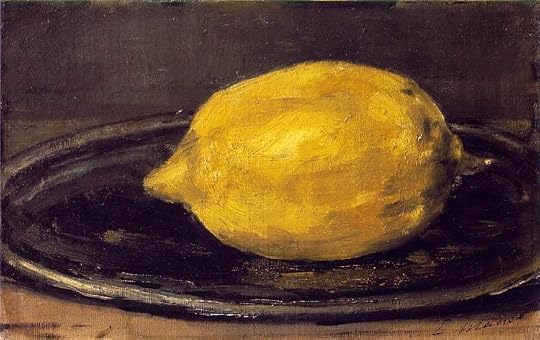
Le citron by Édouard Manet (1880). A lemon as alone as some of the characters in these stories. Source.
Chun Su, Associate Professor of English Literature at Zhejiang University, called this collection the poetics of decline. “It does not simply tell us about the indignities and anxieties of growing old; it makes us feel their narrative weight.” I found the stories in Cross Channel clever and cerebral; while entertaining, they didn’t provoke raw emotion. These packed a punch, much like eating lemon slices. The characters in these stories are all declining. They are being brought face-to-face with mortality. They don’t fit into the narrow narrative of “aging well.” Many of them have the usual denial we all do, and many of them have become stuck. “We are just horses in our stalls… There is no other life.” No one lays bare the human condition, in such a British manner, quite like Barnes.
See also
In 2021, Julian Barnes’ short play, The Lemon Table, premiered, adapted from two stories in this collection: “Vigilance” and “The Silence.” Both segments starred Ian McDiarmid as the two aging composers.
In “The Silence," cranes make multiple appearances. Jean Sibelius composed Scene with Cranes as part of the incidental music for the play Kuolema, (Death) in 1906.
Chen Su’s phrase, “the poetics of decline,” is also the title of her 2025 paper for The Gerontologist medical journal. It examines how Barnes’ text ‘challenges the commonly idealized notion of “successful aging,” which prioritizes sustained cognitive, physical, and social vitality.’ I found it interesting, if a little dry.
—“The Silence,” from The Lemon Table by Julian Barnes
The legendary Lemon Table was a gathering of wealthy gentlemen who met regularly at the À La Kämp restaurant and Kämp Bar of the Hotel Kämp in Helsinki to philosophize, to discuss politics and culture, and to see and be seen by the Finnish intelligentsia and bohemians. While I doubt composer Jean Sibelius was one of their number (or at least I couldn’t find proof he was), he was known to be one of the young artists and writers of the Symposium Circle, part of the “Young Finnish” reform movement in the 1890s, that also met at the Hotel Kämp’s restaurant. The fictional version of Sibelius in “The Silence,” the final story in this collection, is the older man, the one who has stopped producing significant works and can’t finish his Eighth Symphony. His symposium days are forever behind him. Death is around the corner. It’s far more fitting that Barnes has him joining the lemon table.
“The Silence” was a fitting closure to this collection. Where the stories in Cross Channel were united by the theme of the British in France, The Lemon Table is about aging. There are sour moments in growing old. We are presented with two judgmental (and lonely) ladies who lunch; a retired soldier who sees the same sex worker after his annual regimental dinner, but not for the reasons you think; three of the Ages of Man told through navigating trips to the barber; a man who feels justified enforcing silence at the symphonic concerts he attends in the same manner his partner tells off rude motorists from his bicycle. There’s vicious town gossip dogging unrequited love in a small, 19th century Swedish town, and the rueful conclusion between the two would-be lovers before one of them dies. There’s a grown man trying to come to terms with his parents separating in their eighties due to an affair. There’s a woman who reads recipes to her husband with dementia, who sometimes replies with stories that may be memories, and sometimes with offensive sexual vulgarities. There’s one half of a written correspondence to an author named Julian Barnes from a lively, elderly fan sequestered in an old age care home. There’s a platonic and chivalrous love between an elderly Ivan Turgenev and a young actress who revives his play, A Month in the Country. And, of course, there’s the silence following Jean Sibealus’ major works.
Le citron by Édouard Manet (1880). A lemon as alone as some of the characters in these stories. Source.
Chun Su, Associate Professor of English Literature at Zhejiang University, called this collection the poetics of decline. “It does not simply tell us about the indignities and anxieties of growing old; it makes us feel their narrative weight.” I found the stories in Cross Channel clever and cerebral; while entertaining, they didn’t provoke raw emotion. These packed a punch, much like eating lemon slices. The characters in these stories are all declining. They are being brought face-to-face with mortality. They don’t fit into the narrow narrative of “aging well.” Many of them have the usual denial we all do, and many of them have become stuck. “We are just horses in our stalls… There is no other life.” No one lays bare the human condition, in such a British manner, quite like Barnes.
See also
In 2021, Julian Barnes’ short play, The Lemon Table, premiered, adapted from two stories in this collection: “Vigilance” and “The Silence.” Both segments starred Ian McDiarmid as the two aging composers.
In “The Silence," cranes make multiple appearances. Jean Sibelius composed Scene with Cranes as part of the incidental music for the play Kuolema, (Death) in 1906.
Chen Su’s phrase, “the poetics of decline,” is also the title of her 2025 paper for The Gerontologist medical journal. It examines how Barnes’ text ‘challenges the commonly idealized notion of “successful aging,” which prioritizes sustained cognitive, physical, and social vitality.’ I found it interesting, if a little dry.

December 11, 2021
Barnes, 2021'ime damgasını vuran yazarlardan biri olarak geçsin 💫 O, kapıdan Bir Son Duygusu ile girdi ve iyi ki..
Yarattığı monolog ve diyaloglar içinde hayata dair samimi söyleşmesi ve yer yer her duygu için mizahtan beslenmesi, onun orijinal kaleminin imzası. Beklenmedik anda gelen vurucu cümleleri iyi düşünme molaları vaat ediyor
Yarattığı monolog ve diyaloglar içinde hayata dair samimi söyleşmesi ve yer yer her duygu için mizahtan beslenmesi, onun orijinal kaleminin imzası. Beklenmedik anda gelen vurucu cümleleri iyi düşünme molaları vaat ediyor

February 18, 2021
Sejam romances ou contos, como é o caso, Barnes cumpre sempre com o que espero dele.

February 2, 2013
"Geese would be beautiful if cranes did not exist."
Julian Barnes is the crane of modern writers, ruining me for all the geese out there. I can’t remember the specifics of most of the short stories in this collection, but weeks later I can tell you that Barnes’ writing held me captive throughout. My mom, who shares my love of Barnes, describes him as “slice of thought.” His ability to get inside of the way we think astonishes me.
I love his characters, starting with a boy who’s convinced that the barber is out to get him, and I adore the emotional setting in which his characters reside.
Our way of conversing was long-established: companionable, chummy, oblique; warm, yet essentially distant. English, oh yes it's English. In my family we don't do hugging and back-slapping, we don't do sentimentality. Rites of passage: we get our certificates by mail."
Aging is the theme which holds this collection together, but it doesn’t feel sad or slightly beyond my viewpoint. In fact, I forgot that most of his protagonists are much older than I am because I understood their thoughts and concerns. I identified with regret and wasted opportunities and the fear at what lies ahead. I even appreciated the darker sides of their natures.
"That was all you needed to know about the heart: where the grain lay. Then with a twist, with a gesture, you could destroy it."
If you’re looking for plot-driven stories about people you know, Barnes is not for you. But if you’re looking vignettes wrapped around thought-provoking, beautiful language, I strongly recommend The Lemon Table.
Julian Barnes is the crane of modern writers, ruining me for all the geese out there. I can’t remember the specifics of most of the short stories in this collection, but weeks later I can tell you that Barnes’ writing held me captive throughout. My mom, who shares my love of Barnes, describes him as “slice of thought.” His ability to get inside of the way we think astonishes me.
I love his characters, starting with a boy who’s convinced that the barber is out to get him, and I adore the emotional setting in which his characters reside.
Our way of conversing was long-established: companionable, chummy, oblique; warm, yet essentially distant. English, oh yes it's English. In my family we don't do hugging and back-slapping, we don't do sentimentality. Rites of passage: we get our certificates by mail."
Aging is the theme which holds this collection together, but it doesn’t feel sad or slightly beyond my viewpoint. In fact, I forgot that most of his protagonists are much older than I am because I understood their thoughts and concerns. I identified with regret and wasted opportunities and the fear at what lies ahead. I even appreciated the darker sides of their natures.
"That was all you needed to know about the heart: where the grain lay. Then with a twist, with a gesture, you could destroy it."
If you’re looking for plot-driven stories about people you know, Barnes is not for you. But if you’re looking vignettes wrapped around thought-provoking, beautiful language, I strongly recommend The Lemon Table.

June 15, 2016
Способността на този автор да се превъплащава в различни личности, принадлежащи на различни социални прослойки, живеещи в различни епохи и дори в различни възрасти (първият разказ от сборника – един и същи човек в три етапа от живота си), е феноменална. И всеки един от протагонистите на разказите му звучи с различна тоналност, виждаш как лексиката се променя, синтаксисът, понятията и как те отразяват вариращата чувствителност на героите. Барнс е автор-хамелеон – тази способност да излезеш от собственото си "аз" за мен е висшият пилотаж в художествената проза.
В този сборник има единайсет разказа. Това са единайсет вариации на една и съща тема – преходът от живота към смъртта. Разказани по съвсем различен начин, но до един пропити от носталгичната атмосфера на есента.
Преводът на Димитрина Кондева е добър. Корицата – също – жълтото на лимона и на фона не е обикновено жълто, то е жълтото на есента. Браво на Обсидиан, направили са една чудесна книга!
В този сборник има единайсет разказа. Това са единайсет вариации на една и съща тема – преходът от живота към смъртта. Разказани по съвсем различен начин, но до един пропити от носталгичната атмосфера на есента.
Преводът на Димитрина Кондева е добър. Корицата – също – жълтото на лимона и на фона не е обикновено жълто, то е жълтото на есента. Браво на Обсидиан, направили са една чудесна книга!

July 7, 2007
Bought this for my mother for her birthday the year it came out and only read it this year - um, opps...
A series of short stories based on growing old and regrets. Regrets about life and love and everything else. Perhaps one can judge the quality of a person by the quality of their regrets? Just a thought.
Wonderful stories by a magnificent writer.
A series of short stories based on growing old and regrets. Regrets about life and love and everything else. Perhaps one can judge the quality of a person by the quality of their regrets? Just a thought.
Wonderful stories by a magnificent writer.

January 4, 2016
The common topic of all stories in Julian Barnes‘ “The Lemon Table” is death and ageing. Apart from that, the settings, the narrators, the events and the tone vary. How time changes who you are or how you see yourself, how others see you, whether what is now can retroactively change what once was or whether there are various truths at various points – all that might or might not interest you per se. But that is not the point. Personally, I am very drawn to all such questions and reflections. And truth be told: you can find them in more (literary) places than not, though few authors discuss them with such a gentleness like Barnes. At their core, none of these stories is about the topic itself. It is the weaving that makes this small volume a pure gem. Each sentence, each scene is crystal-clear and lucid, downy in its delicacy and yet a gateway to an abyss of beauty and horror. Every sentence spoken or thought is the tip of an iceberg of the characters’ relations, their rights and wrongs and in-betweens, everything ever said and – even more so – concealed between them, everything that might have, ought to have or never should have been, of every opportunity missed and every chance better not taken. You know some of those marvellous actors in equally marvellous scenes, where one barely visible, blink-and-it-has-never-even-been-there, wink of the eye or a twitch in the corner of the lips tells volumes in utter silence? Well, this is its literary equivalent: an atlas of human sensibility masked as a humble, unassuming stillness.

October 29, 2021
Mühim bir gelişme: sanıyorum ki Julian Barnes yavaş yavaş benim için bir yan sanayi Javier Marias olmaktan fazlasına dönüşüyor – yani sanki kendisiyle ayrı bir ilişki devşirmeye başladık, sadece Marias’ı özleyince gittiğim biri olmanın ötesine geçiyor gibi. Ne mutlu! Limon Masası’na bayıldım. Yaşlılık ve ölümle ilgili bu küçük öyküler bana aksine yaşamak gerektiğini hatırlattılar. Yaşamak, korkmadan yaşamak. Acı çekmenin, endişenin, korkunun da insana yaşadığını hissettirebileceğini, bunlara sarılmak gerektiğini. Kitaptaki öyküler çok güzeller, çok gerçekler, çok komikler, çok hüzünlüler. İçtenlikle tavsiye ediyorum bu kitabı. “Ama bütün aşklar bir yolculuğa ihtiyaç duyar. Bütün aşklar simgesel olarak bir yolculuktur ve bu yolculukların vücut bulmaya gereksinimi vardır.”

August 2, 2021
Bu masaya oturduğunuzda yaşlanmayı, vazgeçmeyi, ölmeyi soluyorsunuz ve anlıyorsunuz.
Hangisi en güzel ayırt edemediğim birbirinden güzel hikayeler yazmış Barnes. Benim için uzun uzun camdan dışarıyı seyrettiren cümlelerle dolu güzel bir yolculuk kitabı oldu.
"İnsan hâlâ istediği şeyi bırakmaz."
Hangisi en güzel ayırt edemediğim birbirinden güzel hikayeler yazmış Barnes. Benim için uzun uzun camdan dışarıyı seyrettiren cümlelerle dolu güzel bir yolculuk kitabı oldu.
"İnsan hâlâ istediği şeyi bırakmaz."
March 4, 2026
O livro "Mesa Limão" é composto por 11 contos independentes, mas todos unidos pelo mesmo tema: o envelhecimento e a consciência da mortalidade. O próprio título aponta para isso e no livro é referido que, entre os chineses, o limão é símbolo da morte.
Barnes escreve sobre velhice sem romantizar e sem dramatizar. Há adaptação, desgaste, memória, solidão, relações longas que se transformam, demência, lares de idosos, filhos, traição tardia. Há sobretudo a consciência de que o tempo vai retirando camadas daquilo que somos.
“Uma das coisas que aprendera na vida e em que esperava poder confiar, era que uma grande dor afasta outra dor mais pequena.”
A dor reorganiza-se. Não desaparece.
“Talvez ela tivesse razão e devessem envelhecer juntos e, com o tempo, confiar no endurecimento do coração.”
O amor surge menos como ideal e mais como resistência ao tempo.
“Somos tão jovens quanto nos sentimos ou tão velhos quanto parecemos?"
A consciência interna e o corpo deixam de coincidir.
"Quando éramos crianças pensávamos que tínhamos amigos, mas de facto só tínhamos aliados - pessoas ao nosso lado, que nos acompanhavam até sermos grandes. E depois(...)afastavam-se e havia a idade adulta(...). Depois precisávamos outra vez de aliados, de pessoas que nos acompanhassem e apoiassem até ao fim.(...)Aliados que nos ajudassem a entender uma folha de impostos e a abrir pequenos boiões de compota."
A velhice surge como regresso à dependência. As relações tornam-se alianças práticas.
Envelhecimento e morte continuam a ser temas difíceis de abordar. Muitas vezes são vistos como tabu ou como algo mórbido, quando fazem simplesmente parte da vida. Ter a difícil noção de finitude ajuda a ter consciência da Vida e de como Viver. Neste livro, Barnes escreve sobre a morte com naturalidade e aceitação.
"O que cura a dor? Tempo, respondem os velhos sabichões. Mas vocês sabem. Têm a sabedoria necessária para saber que o tempo nem sempre cura a dor."
A velhice nem sempre traz sabedoria.
"Se eu lhe perguntasse "O que é a vida?", provavelmente respondia-me, com o mesmo número de palavras, que tudo não passa duma coincidência.
Por isso, fica a pergunta: Que tipo de coincidência?"
"Mesa Limão"não é um livro confortável. É um livro honesto.
Uma breve história do penteado - 4⭐
A história de Mats Israelson - 5⭐
As coisas que tu sabes - 3 ⭐
Higiene - 3⭐
Reviver - 3⭐
Vigilância - 3⭐
Casca - 4⭐
Saber Francês - 5⭐
Apetite - 5⭐
A Gaiola da Fruta - 4 ⭐
Silêncio - 4 ⭐
Muito obrigada, querida Paulinha!💖
Barnes escreve sobre velhice sem romantizar e sem dramatizar. Há adaptação, desgaste, memória, solidão, relações longas que se transformam, demência, lares de idosos, filhos, traição tardia. Há sobretudo a consciência de que o tempo vai retirando camadas daquilo que somos.
“Uma das coisas que aprendera na vida e em que esperava poder confiar, era que uma grande dor afasta outra dor mais pequena.”
A dor reorganiza-se. Não desaparece.
“Talvez ela tivesse razão e devessem envelhecer juntos e, com o tempo, confiar no endurecimento do coração.”
O amor surge menos como ideal e mais como resistência ao tempo.
“Somos tão jovens quanto nos sentimos ou tão velhos quanto parecemos?"
A consciência interna e o corpo deixam de coincidir.
"Quando éramos crianças pensávamos que tínhamos amigos, mas de facto só tínhamos aliados - pessoas ao nosso lado, que nos acompanhavam até sermos grandes. E depois(...)afastavam-se e havia a idade adulta(...). Depois precisávamos outra vez de aliados, de pessoas que nos acompanhassem e apoiassem até ao fim.(...)Aliados que nos ajudassem a entender uma folha de impostos e a abrir pequenos boiões de compota."
A velhice surge como regresso à dependência. As relações tornam-se alianças práticas.
Envelhecimento e morte continuam a ser temas difíceis de abordar. Muitas vezes são vistos como tabu ou como algo mórbido, quando fazem simplesmente parte da vida. Ter a difícil noção de finitude ajuda a ter consciência da Vida e de como Viver. Neste livro, Barnes escreve sobre a morte com naturalidade e aceitação.
"O que cura a dor? Tempo, respondem os velhos sabichões. Mas vocês sabem. Têm a sabedoria necessária para saber que o tempo nem sempre cura a dor."
A velhice nem sempre traz sabedoria.
"Se eu lhe perguntasse "O que é a vida?", provavelmente respondia-me, com o mesmo número de palavras, que tudo não passa duma coincidência.
Por isso, fica a pergunta: Que tipo de coincidência?"
"Mesa Limão"não é um livro confortável. É um livro honesto.
Uma breve história do penteado - 4⭐
A história de Mats Israelson - 5⭐
As coisas que tu sabes - 3 ⭐
Higiene - 3⭐
Reviver - 3⭐
Vigilância - 3⭐
Casca - 4⭐
Saber Francês - 5⭐
Apetite - 5⭐
A Gaiola da Fruta - 4 ⭐
Silêncio - 4 ⭐
Muito obrigada, querida Paulinha!💖

August 26, 2014
The Silence Table

That Brancusian table with its twelve seats, eleven of them duly occupied by eleven characters, each of them waiting for his lemon. The twelfth is forever empty for is forever reserved to the lemons’ distributor – Death. But before leaving with the yellow fruit in hand, each occupant has to tell his story, has to make sense of his life and to acknowledge his place in the world.
So maybe Julian Barnes’s Lemon Table is not about old age and death after all, just as Brancusi’s sculpture is not about waiting. But both are surely about the power of art to give sense to the human feelings, to human existence. Like Anders Bodén, the hero of the brilliant Story of Mats Israelson, who, for more than twenty years polishes an old story as a gift for the woman he has loved, thus rising not only the narrative but also his own feelings above the oblivion:
In fact, the main theme of the book is love, be it creative or procreative. For the retired major Jacko Jackson, who has visited his mistress Babs once a year for twenty-three years, love is a means to escape the dullness of the quotidian: “She was – what was that phrase they used nowadays? – his window of opportunity” (Hygiene) For the 81-year-old man who leaves his wife to settle with his mistress of 65, love is his mutiny against decrepitude but also against the preconception that old means already dead or waiting for dying (The Fruit Cage). Reading, even cooking recipes, is love that slows the falling into Alzheimer nothingness of the beloved one (Appetite).
And then there is love as a source of creation. In the last story, The Silence, the old, drunken and apparently embittered Sibelius, whose love for music cannot be turned into creation anymore, is well aware that it is this love that defines him:
Finally, the two kinds of Eros are harmonized in The Revival, the story of the 65 year-old Turgenev’s last love for an actress of 25. A bittersweet love which “move il sole e l’altre stele” precisely because it is unfulfilled:
Each of the eleven stories in the volume is about love in one sense or another. In each one of them, love is sought to escape time.
Each stool around Brancusi’s table has the form of an hourglass. However, there is no sand dripping the time. The occupants are gone; their voices are but vague memories, their individuality already forgotten. But the seats are there, frozen into eternity. They will continue to speak about love, and suffering, and human imperfections and of death as not the end of all things as long as someone will listen to them. Like Barnes’s book does.
That Brancusian table with its twelve seats, eleven of them duly occupied by eleven characters, each of them waiting for his lemon. The twelfth is forever empty for is forever reserved to the lemons’ distributor – Death. But before leaving with the yellow fruit in hand, each occupant has to tell his story, has to make sense of his life and to acknowledge his place in the world.
So maybe Julian Barnes’s Lemon Table is not about old age and death after all, just as Brancusi’s sculpture is not about waiting. But both are surely about the power of art to give sense to the human feelings, to human existence. Like Anders Bodén, the hero of the brilliant Story of Mats Israelson, who, for more than twenty years polishes an old story as a gift for the woman he has loved, thus rising not only the narrative but also his own feelings above the oblivion:
…he worked at the story until he had it in a form that would please her: simple, hard, true.
In fact, the main theme of the book is love, be it creative or procreative. For the retired major Jacko Jackson, who has visited his mistress Babs once a year for twenty-three years, love is a means to escape the dullness of the quotidian: “She was – what was that phrase they used nowadays? – his window of opportunity” (Hygiene) For the 81-year-old man who leaves his wife to settle with his mistress of 65, love is his mutiny against decrepitude but also against the preconception that old means already dead or waiting for dying (The Fruit Cage). Reading, even cooking recipes, is love that slows the falling into Alzheimer nothingness of the beloved one (Appetite).
And then there is love as a source of creation. In the last story, The Silence, the old, drunken and apparently embittered Sibelius, whose love for music cannot be turned into creation anymore, is well aware that it is this love that defines him:
'Certainly, I am neurotic and frequently unhappy, but that is largely the consequence of being an artist rather than the cause.'
Finally, the two kinds of Eros are harmonized in The Revival, the story of the 65 year-old Turgenev’s last love for an actress of 25. A bittersweet love which “move il sole e l’altre stele” precisely because it is unfulfilled:
Like most of his life’s writing, the paly was concerned with love. And as in his life, so in his writing, love did not work. Love might or might not provoke kindness, gratify vanity, and clear the skin, but it did not lead to happiness, there was always an inequality of feelings or intention present. Such was love’s nature.
Each of the eleven stories in the volume is about love in one sense or another. In each one of them, love is sought to escape time.
Each stool around Brancusi’s table has the form of an hourglass. However, there is no sand dripping the time. The occupants are gone; their voices are but vague memories, their individuality already forgotten. But the seats are there, frozen into eternity. They will continue to speak about love, and suffering, and human imperfections and of death as not the end of all things as long as someone will listen to them. Like Barnes’s book does.

January 26, 2015
If you want a well-done critique with synopses of each story, read Cecily's review.
Mea culpa
My reading time was fractured: I was constantly interrupted by work and then for several days I peered at the damned Kindle with its quirky formatting through blocked sinuses that made me feel stupid and sometimes a little insane. Also, this was my first Julian Barnes book, so I did not understand his references to his other books, and I am Amerkin, not British, so ditto re the Britishisms. Given my pathetic attention, clogged brain, and lack of erudition, it is a testament to Mr. Barnes that I still think he's a very good writer—plus which, lots of other smart Goodreaders have said he is, and, despite my wretched state, I know enough not to make waves from the bottom of a viscous sea.
The stories are all about getting older. (The titular lemon is a symbol of death—explained in the final story.) All are moving, honest, funny, saucy, and sophisticated. In a story called "Hygiene" a man is up on a ladder to clean the roof gutter—as he's done for 25 years:
That just about says it all.
Mea culpa
My reading time was fractured: I was constantly interrupted by work and then for several days I peered at the damned Kindle with its quirky formatting through blocked sinuses that made me feel stupid and sometimes a little insane. Also, this was my first Julian Barnes book, so I did not understand his references to his other books, and I am Amerkin, not British, so ditto re the Britishisms. Given my pathetic attention, clogged brain, and lack of erudition, it is a testament to Mr. Barnes that I still think he's a very good writer—plus which, lots of other smart Goodreaders have said he is, and, despite my wretched state, I know enough not to make waves from the bottom of a viscous sea.
The stories are all about getting older. (The titular lemon is a symbol of death—explained in the final story.) All are moving, honest, funny, saucy, and sophisticated. In a story called "Hygiene" a man is up on a ladder to clean the roof gutter—as he's done for 25 years:
. . . as he stood there, all protected, Wellington boots on his feet, windcheater around him, woolly cap on his head and rubber gloves on his hands, he would sometimes feel the tears begin and he knew it wasn't because of the wind, and then he'd get stuck, one rubber hand clamped to the guttering, the other one pretending to poke in the curve of thick plastic, and he'd be scared fartless. Of the whole damn thing."
That just about says it all.


January 4, 2016
Što je četrunovina?
Nemam pojma. A ne zna ni Google, jedina referenca je na ovu knjigu. Ova zbirka kratkih priča se u originalu zove The Lemon Table, pa otkud onda ta četrunovina?
Julian Barnes je cijenjen i popularan autor, čitao sam od njega nekoliko romana, a Engleska, Engleska mi je ostao u sjećanju kao odličan roman sa zanimljivom i originalnom pričom, iako se danas više ne mogu sjetiti nijedne pojedinosti iz njega. U zadnjem pohodu u knjižnicu sam uzeo ovaj Stol od četrunovine, jer sam htio provjeriti kako Barnes piše, ova je bila najtanja, pa ako mi se svidi posudio bih ponovno i Engleska, Engleska. Nisam znao da je ovo zbirka kratkih priča dok nisam počeo čitati.
Iako ovo što je Barnes ovdje napisao ne bih nazvao pričama, više nedovršenim skicama od kojih bi se možda uz malo truda mogle razviti i neke priče. Svaka ima neku "poruku" i sadrži autorova promišljanja o životu i smrti, odnosno o neizbježnoj prolaznosti života i starenju. No sve je to tako prozirno i pojednostavljeno. Tu su i fraze poput: "Život je tek preuranjena reakcija na smrt.” i slične. Sve bi to bilo ok da je to pozadina, odnosno da priče pričaju o nečemu. Jedina koju bi istaknuo je prva: Kratka povijest frizerskog zanata, koja na zabavan način opisuje kako su se brijači i brijačnice relativno brzo pretvorili u frizere i frizerske salone. No, također i ona bi bolje fukcionirala kao esej, jer kao i ostale ima samo privid radnje.
Uz sve napisano ocjena ipak nije jedinica, jer i sa ovako nedovršenim pričama Barnes uspjeva stvoriti neke zanimljive slike.
Nemam pojma. A ne zna ni Google, jedina referenca je na ovu knjigu. Ova zbirka kratkih priča se u originalu zove The Lemon Table, pa otkud onda ta četrunovina?
Julian Barnes je cijenjen i popularan autor, čitao sam od njega nekoliko romana, a Engleska, Engleska mi je ostao u sjećanju kao odličan roman sa zanimljivom i originalnom pričom, iako se danas više ne mogu sjetiti nijedne pojedinosti iz njega. U zadnjem pohodu u knjižnicu sam uzeo ovaj Stol od četrunovine, jer sam htio provjeriti kako Barnes piše, ova je bila najtanja, pa ako mi se svidi posudio bih ponovno i Engleska, Engleska. Nisam znao da je ovo zbirka kratkih priča dok nisam počeo čitati.
Iako ovo što je Barnes ovdje napisao ne bih nazvao pričama, više nedovršenim skicama od kojih bi se možda uz malo truda mogle razviti i neke priče. Svaka ima neku "poruku" i sadrži autorova promišljanja o životu i smrti, odnosno o neizbježnoj prolaznosti života i starenju. No sve je to tako prozirno i pojednostavljeno. Tu su i fraze poput: "Život je tek preuranjena reakcija na smrt.” i slične. Sve bi to bilo ok da je to pozadina, odnosno da priče pričaju o nečemu. Jedina koju bi istaknuo je prva: Kratka povijest frizerskog zanata, koja na zabavan način opisuje kako su se brijači i brijačnice relativno brzo pretvorili u frizere i frizerske salone. No, također i ona bi bolje fukcionirala kao esej, jer kao i ostale ima samo privid radnje.
Uz sve napisano ocjena ipak nije jedinica, jer i sa ovako nedovršenim pričama Barnes uspjeva stvoriti neke zanimljive slike.

August 6, 2022
I'm not sure I can add to anything not already said about this book. It is a collection of short stories based around the central theme of ageing in all its forms. Some of the stories are hard to listen to with themes such as physical abuse or the onset of dementia, some are amusing or merely observations on age. In general the theme seems to be that ageing is not much fun and it is more about looking back than living in the moment; it is about acceptance of your fate.
Julian Barnes writing speaks for itself. He is one of those writers you either love or hate. I love him but wouldn't recommend this book as somewhere to start reading his work if you've never read any before. If, on the other hand, you like Mr Barnes work then you'll enjoy these stories. They are clever, well observed, slightly sad and generally typical of his body of work.
I would have changed the running order round but that is personal preference.
Julian Barnes writing speaks for itself. He is one of those writers you either love or hate. I love him but wouldn't recommend this book as somewhere to start reading his work if you've never read any before. If, on the other hand, you like Mr Barnes work then you'll enjoy these stories. They are clever, well observed, slightly sad and generally typical of his body of work.
I would have changed the running order round but that is personal preference.


November 8, 2018
Not what I typically give five stars for, but so very good. An elegant, intelligent pleasure.
Displaying 1 - 30 of 412 reviews