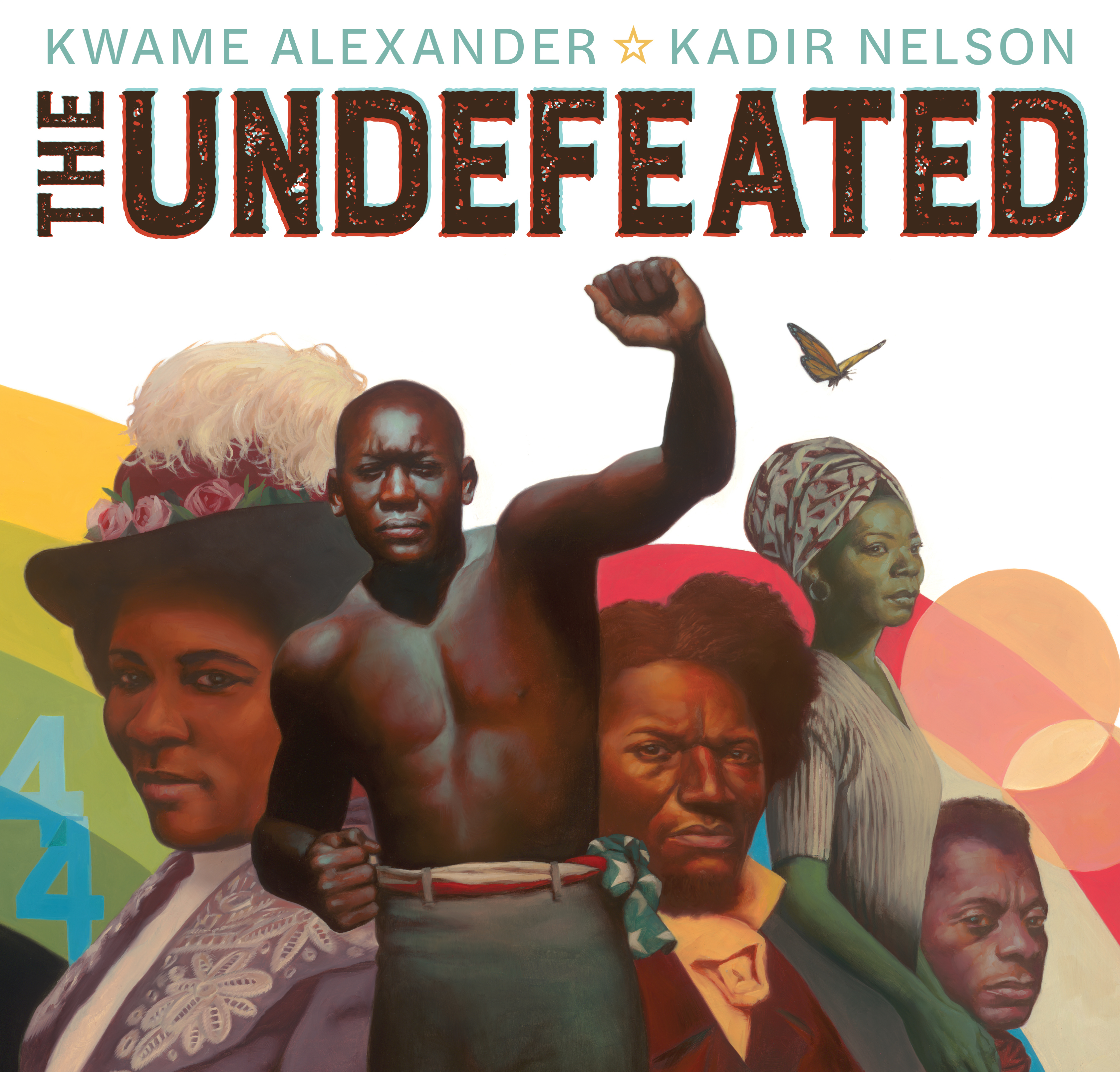
With the passing of Walter Dean Myers in 2014, a question arose: who was the heir apparent to his literary legacy? Myers wrote proudly about black America from Colonial times to twenty-first century urban New York, yet wasn't afraid to challenge its culture where needed. His sophisticated understanding of art, philosophy, history, and social dynamics infused his writing with depth, emotion, and originality. Who could fill his shoes? Some might suggest Nikki Grimes, Marilyn Nelson, Derrick Barnes, or Jacqueline Woodson stepped into the role, and there's merit in any of those answers. I'm inclined to say it was Kwame Alexander, winner of the 2015 Newbery Medal for The Crossover and a 2020 Newbery Honor for The Undefeated. After Barack Obama was elected America's first black president in 2008, Alexander wrote this poem to praise the tenacity of black America in the face of all it went through since the days of the African slave trade. Having a black man occupy the White House less than one hundred fifty years after slavery officially ended was a miracle, and The Undefeated was written to celebrate it.
Athletes and activists, politicians and pastors, adolescents and adults have contributed to black America's progress. Just surviving was hard in the days of slavery; white owners could treat their blacks however they wished. Even killing them was not out of bounds. Countless good men and women died never tasting a single day of freedom, but even back then blacks found a way to lead meaningful lives. They cared for their families and fought as Union soldiers in the Civil War, on which their future depended. Would they end up free to chart their own destiny in America? Black artists and innovators flourished in the century after the war, using their liberty to do great things in music, literature, politics, medicine, and technology, yet work remained if America's founding principles were to be realized. Martin Luther King Jr. and other civil rights crusaders of the 1960s refused to stay quiet about ongoing injustice in America; the guarantee of liberty had to extend to every race, or it was only an illusion. No country ever attains perfection, but a lot in America had changed for the better, and improvement would continue.
"This is for the unafraid.
The audacious ones
who carried the red, white, and Weary Blues
on the battlefield
to save an imperfect Union."
—from The Undefeated
Kwame Alexander's poetry is smooth and potent, like sweet jazz or classical piano, but what is the primary takeaway from The Undefeated? In my opinion, it's that black America shouldn't be seen as crippled by past injustices inflicted on it. Blacks survived being captured in Africa and sold in the New World as chattel; they survived vicious beatings and the denial of basic education, as well as legal discrimination in the era of Jim Crow, and racist lynchings that persisted into the latter half of the 1900s. Despite every nightmare foisted upon them, black America became a thriving populace whose mental elasticity and moral courage were their strongest assets. We all can take inspiration from their success: whoever you are, whatever your background, it is possible to move beyond a troubled past by focusing on creating a better future. Your dreams are waiting for you to arrive and inhabit them.
"This is for the unlimited,
unstoppable ones.
The dreamers
and doers
who swim
across The Big Sea
of our imagination
and show us
the majestic shores
of the promised land".
—from The Undefeated
I appreciate the variety of black historical figures in The Undefeated. Sprinter Jesse Owens and boxer Jack Johnson were all-time greats regardless of the stout social headwind they faced; Phillis Wheatley and Langston Hughes made valuable strides in literature, in two very different eras; John Lewis and Martin Luther King Jr. peacefully advanced the cause of racial equality in the U.S.; and Thelonious Monk, Billie Holiday, and Sarah Vaughn added texture and energy to American music by injecting a dose of the black experience. There were many whose names we'll never know: men, women, and children who perished in the era of slavery protecting loved ones or fleeing to freedom. Their legacy lives on in future generations who desire to do the right thing, who uphold core American values. The Undefeated edges into controversial territory a few times, which limits its ability to speak to everyone. A few of the cited cases of young blacks killed by police don't serve the narrative; if someone is shot while assaulting a law officer, that isn't a racist incident. However, there is value in this book if you earnestly seek it, and Kadir Nelson's artwork is beyond reproach. He is among the great illustrators in the history of children's literature. I wouldn't have given The Undefeated a Newbery Honor—I'm not even sure I'd rate it the full two stars—but I'm pleased that Kadir Nelson finally won the Caldecott Medal. If you want a provocative picture book with a social message, this might be what you're looking for. It's a memorable read.