Jump to ratings and reviews
Rate this book

The Languages of Pao

Rate this book
When the Panarch of Pao is assassinated, Beran Panasper, his son and heir, must flee to the planet Breakness where he finds the truth behind his father's death...and much more. Reprint.

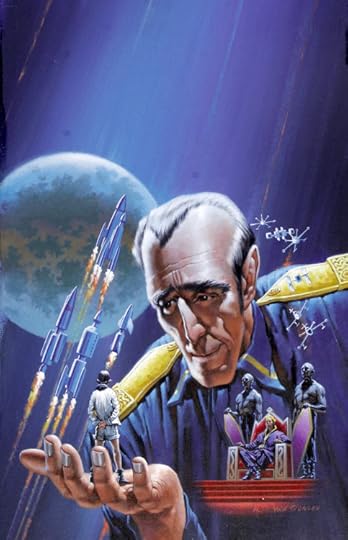
Cover Artist: Rik Binkley.

220 pages, Paperback

First published January 1, 1957

26 people are currently reading
1217 people want to read

About the author

Jack Vance

776 books1,582 followers
Aka John Holbrook Vance, Peter Held, John Holbrook, Ellery Queen, John van See, Alan Wade.

The author was born in 1916 and educated at the University of California, first as a mining engineer, then majoring in physics and finally in journalism. During the 1940s and 1950s, he contributed widely to science fiction and fantasy magazines. His first novel, The Dying Earth , was published in 1950 to great acclaim. He won both of science fiction's most coveted trophies, the Hugo and Nebula awards. He also won an Edgar Award for his mystery novel The Man in the Cage . He lived in Oakland, California in a house he designed.

Ratings & Reviews

What do you think?
Rate this book

Friends & Following

Create a free account to discover what your friends think of this book!

Community Reviews

5 stars
336 (22%)
4 stars
592 (40%)
3 stars
421 (28%)
2 stars
101 (6%)
1 star
20 (1%)
Displaying 1 - 30 of 129 reviews
Profile Image for mark monday.
1,874 reviews6,305 followers
December 28, 2018
if a world can be described in a word, then the word for Pao is passive. language has helped make the Paonese content but also ill-equipped to handle invasion and other forms of aggression.

the Sapir–Whorf hypothesis posits that "the structure of a language affects the ways in which its respective speakers conceptualize their world... or otherwise influences their cognitive processes" (thank you, Wikipedia)... linguistic relativity can mean that the way different cultures talk impacts how different cultures act. or as the character Finisterle notes: "every language impresses a certain world-view upon the mind."

this is the chilliest Jack Vance novel that I've read to date. all of the Vancean virtues are present - sly, almost subliminal wit; elegant prose; absorbing world-building; an illustration of how easily monstrous egos can blossom into actual monstrosity - but Vance seems disinterested in providing a way for the reader to connect with the story except on a purely intellectual level. I am the sort of under-evolved reader who needs an emotional connection for me to truly enjoy a work. there is much to fascinate within its pages. but the bland protagonist, the casual and vague handling of a pact that includes sex slaves to be exported, a narrative full of suspense that lacks much narrative drive, and especially a debilitating ending that illustrates the need to give in to physical force... all of that contributed to a detachment I felt throughout the experience. this is not a bad book by any means and there is much that provided food for thought. it has a cerebral quality that makes it in some ways a superior book to other, more shallow Jack Vance adventures. overall I liked it. but it is perhaps the first book by the author that I am disinclined to read a second time.
Profile Image for Karl.
3,258 reviews372 followers
June 25, 2020
Cover Artist: Rik Binkley.

Profile Image for Lyn.
2,009 reviews17.6k followers
March 27, 2016
SF Grandmaster Jack Vance first published Languages of Pao in 1957, during the Cold War and this political climate serves as a behind the scenes guide to the message Vance imparts.

Vance possesses one of the most gifted and subtle sense of dry humor amongst any group of writers, but this book made me think he is akin to Kurt Vonnegut in that regard. This novel contains Vonnegutesque humor, like a Kilgore Trout fantasy, that is almost Seussian in it’s simplicity yet pregnant with allegory and double meaning. Like Vonnegut’s The Sirens of Titan, The Languages of Pao features a power play that is unreliable as the action goes in different, non-formulaic directions.

I give high praise for originality and Vance here demonstrates his unparalleled imagination. On a planet that is a caricature of moderation, compliance and passivity, the introduction of a likewise absurdly extreme culture of individuality and solipsism presents a unique exploration of sociological and cultural elements.

I read recently that Vance was best friends with fellow speculative fiction writers Poul Anderson and Frank Herbert. This, of course, made me like him all the more. Whereas Vance fantasies like The Dying Earth and Suldrun's Garden resemble Anderson’s work, this is more like Frank Herbert. Elaborate and byzantine world building and complex, multi-layered characterization with a deep backstory are themes in which both writers excel.

A cerebral and inventive SF gem.

description
Profile Image for Phil.
2,430 reviews236 followers
May 30, 2022
A good early, but not great, Vance novel, that has many of his trademarks/world building we find in later novels. The focus of this book is the world of Pao, but it is really about language and how each one shapes the user in particular ways. Pao has been settled for 1000s of years, with a population of around 15 billion, but is largely an agrarian world based on tradition. I will not go into details, which are largely found in the footnotes, but the Pao language is rather passive which reflects the inhabitants to a tee. Early on, the uncle of the supreme ruler has the ruler killed in his grab for power. The ruler's son Beran actually did the deed under hypnotic suggestion via his uncle. The Uncle knows he has to off Beran as well, but he escapes with a 'wizard' from Breakness. Why did the Palafox the 'wizard' help Beran escape? It seems to be some sort of long range plan...

This novel could also easily be read in a cold war framework, with the Paoians somewhat communal and the people from Breakness hyperindividualists to a fault. In part, both aspects of the two cultures can be traced to the language they utilize. Without going into much more details, Palafox has a long term plan for Pao that involves the creation of new languages to help transform the population. We have one language invented for the military, one for the scientists, and one for the bureaucrats/traders. The results are amazing-- the largely pacific Paoians achieve a military force, innovative scientists and a thriving interstellar trading force.

I loved the ideas regarding language here, and of course Vance's incredible use of language-- the guy is a serious wordsmith. Yet, this felt a little flat regarding the characters and the ending was more of a fizzle than a bang. Perhaps my biggest issue concerns my lack of vestment with the various societies. Breakness is a nasty patriarchal society with no females except those kept in harems, and these are from off planet. The goal of the Breakness male is to father as many boys as possible to ensure their genetic 'gifts' for the future and they take their breeding seriously. Palafox has hundreds of sons for example. All girls born to the harem women are sent off planet, along with the 'inferior' boys and their moms when they are past prime breeding age. Vance has a unique way to build worlds, but this one did not appeal to me at the least. The Breakness breeding program does play a key role in the plot so I can see why it is here, but still, pretty creepy.

Probably not the best Vance novel for someone new to his work, but it still has that Vance flair and some nifty ideas. 3 solid stars!
Profile Image for TJ.
277 reviews8 followers
May 1, 2025
The Languages of Pao is an early, interesting novel by Jack Vance written in 1956 and first published in December 1957 in an abbreviated version in the magazine Satellite Science Fiction. Avalon Press issued it as a hardcover book in 1958. It is currently in print in a very nice, 149 page, trade paperback edition by Spatterlight Press.
For the most recent review and other Vance reviews please see:
https://vancealotjackvanceinreview.bl...

How much does our language shape our cognitions, behavior and even sensory perceptions? Can changing a language dramatically alter a society? As one of the characters in this novel states, "Language controls the mechanism of your mind. When people speak different languages, their minds work differently and they act differently." In The Languages of Pao, Vance explores such psycholinguistic and semantic issues, especially the "Sapir-Whorf hypothesis."

The people on the planet Pao are very docile and resistant to change but hard working. They are taken advantage of by inhabitants from other planets that have a strong military or experienced traders with fleets of ships. The ruler of Pao, the Panarch Aiello Panasper wants to create a military so he will not have to pay tribute to those from other planets. He also wants to develop direct trade so the Pao are not constantly cheated by the Mercantil who have all of the merchant spaceships and a monopoly on all interplanetary trade. In order to create weapons and merchant ships he needs technology, something the Pao are painfully lacking.

Panasper, makes arrangements to consults with a leader from the Breakness planet but is assassinated by his brother, Bustamonte. The son of the deceased Panarch, Beran Panasper, is next in line but must go into hiding to avoid being killed by his uncle Bustamonte. He is sheltered by Lord Palafox from the Breakness Institute on the planet Breakness. This is the same person who was contacted to be a consultant by the Panarch before he was assassinated. Bustamonte continues his brother's plan to consult with Palafox to try to change their society. Palafox informs Bustamonte that this can be done but that, "We must alter the mental framework of the Paonese people, which is most easily achieved by altering the language." Thus begins a massive social experiment that dramatically alters Pao society. In the meantime Beran remains on Breakness and studies their language and culture while hoping he will not be assassinated by Uncle Bustamonte.

Millions of Pao citizens are displaced and land is confiscated to set up three different centers, one for the military (Valiants), another for technical research and production (Technicants) and a third for trade (Cogitants). Over many years each group is taught a different language created to favor their specialty. "To the military segment, a 'successful man' will be synonymous with 'winner' of fierce contest. To the industrialist it will mean 'efficient fabricator.' To the traders, it equates with 'a person irresistibly persuasive'.” In addition to the three technical languages a mixed language called Pastiche develops.

Pao is able to develop a strong military, an industrial base and merchant trade but there are consequences so that much of the population is isolated from the three elite groups and is unhappy. Each group (Valiant, Technicant and Cogitant) speaks only its own language and not the common Paonese language or Pastiche so they need interpreters to communicate with each other and the general population. And the ordinary, displaced Pao citizen who is not one of these three elite groups seems to be left out of the picture. How can the Pao maintain most of the advantages of this tremendous social experiment while improving things for the average Paonese.

There is much more to the plot. Beran wants to topple his uncle to become the new Panarch since he is the rightful heir. Palafox develops an elaborate scheme to obtain indentured Paonese woman with whom he breeds, attempting to populate all planets with his offspring. Palafox also has very powerful weapons and abilities that are implanted in him so that he is something of a Robocop. He implants some of these in Beran whom he supports as a possible successor to Bustamonte if Bustamonte becomes too independent or uncooperative. The Brumbo warrior clan from the planet Batmarsh continues to visit Pao to demand tribute to avoid invasion and destruction. This clan also orders the Paonese to abandon their merchant fleet and trade with other planets, something that will ruin the Pao economy and increasing independence. Palafox in the meantime makes it clear that he has no sense of ethics or honor and will do whatever it takes to promote his own advantage. He outdoes Machiavelli. Beran cannot really trust him because Palafox and his group are totally self serving and have no conscience or sense of morality.

This is a novel of ideas with the plot and characters being of secondary importance. I have loved semantics ever since I began reading S.I. Hayakawa, IA Richards and others back in the 1960s and am familiar with the Sapir -Whorf hypothesis so was excited to read this book the first time I did so. But a mere 157 pages does not allow for the epic depiction of such social and psychological changes and the main ideas can only be briefly sketched. Vance gives it a good try, though, and the book is easy to read, engaging and thought provoking.

The Languages of Pao is recommended to all Vance fans and to any readers who are interested in the connection between language, behavior, cognition, perception and culture. As far as I know it is the only science fiction novel to ever focus on the Sapir-Whorf hypothesis. I've read this novel three times so far and rated it a 4 (really liked it) each time.
Profile Image for Antonio TL.
350 reviews44 followers
June 7, 2021
El planeta Pao ha sido invadido sin resistencia, debido a que el lenguaje de sus habitantes les hacen desconocer palabras como rebeldia. Para obtener la libertad, sus habitantes deberán aprender nuevos idiomas que posibiliten la comprensión y la asimilación de conceptos nuevos como la violencia, comercio y tecnologia. Pero, si cambian de lengua, ¿seguirán siendo los mismos? "Las cosas buenas vienen en paquetes pequeños": Lo mismo podría decirse de The Languages ​​of Pao de Jack Vance. Escrito en 1957, el libro es una de las primeras obras de Vance y aunque no representa la madurez de estilo que muestran los diálogos de La Tierra moribunda o la trama del Ciclo de Tschai (Planeta de la aventura). Sin embargo, se puede ver que se ha plantado semilla. La novela, aunque tiene solo 250 páginas, es inconfundiblemente Vance. Este es quizás uno de los mejores libros de ciencia ficción sobre lingüística y lenguajes construidos. Es un estudio sobre la intersección de la cultura, la política y el lenguaje en el corazón de la civilización, añadiendole una trama de con las aventuras del protagonista. Una muy buena y entretenida novela.
Profile Image for Rhys.
Author 326 books320 followers
March 29, 2022
How I love the work of Jack Vance, the lyrical language, the invented exoticism, the strange societies, the conspiracies and resolutions! His best work (in my opinion) is The Eyes of the Overworld and it remains my favourite ever fantasy novel. But anyway... what did I think of this earlier creation from the late 1950s? It is very good (is there such a thing as bad Vance?) and it comes from the same era as the excellent Big Planet when Vance was really hitting his stride. The ending is perhaps a little unsatisfying, but no matter! The central concept and the plot are original and intriguing, and the two main actors in the drama, Beran and Palafox, are suitably engaging.

The hypothesis that language absolutely controls thought and behaviour -- that different modes of verbal expression play the most vital part in shaping a culture's dynamism (or passivity) -- has apparently beeen discredited. I don't know enough about linguistics to comment on this. I met the same notion in Samuel Delany's later Babel 17 but as a science-fiction plot device I find it fascinating and refreshingly different from the usual SF conceits, which seem to rely on technology more than psychological or sociological progress.
Profile Image for Metaphorosis.
976 reviews62 followers
July 27, 2015
I first read this book a long time ago. It was my first exposure to the idea that language shapes not just how one says things, but what it is possible to say and think. I was tremendously impressed.

Vance takes that idea, and runs with it. While I wouldn't say that this is a complete examination of the concept, he does apply it with a certain amount of rigor, and the result is striking.

The setting is typically Vancian, if a bit less overt than usual, and a little more on the adventurous side. Women barely get a look in, and the one woman who does is to some extent a loose thread.

I didn't like the book as much this time around, but I've left the rating untouched because of its initial impact, and because it's one of the few examples of Vance preferring concept over mood and setting.

All that sounds a bit gloomy, but the fact is I thought this book was tremendously powerful on first read, with a concept that I thought about for years. Beyond that, it's a well-written Vancian adventure, and that's always worth reading. Recommended.

CVIE V
Profile Image for Ian Cunningham.
20 reviews
April 9, 2012
Sometimes I think Jack Vance couldn't write a truly bad story if he tried. A bog-standard 'prince is exiled, prince is raised by evil wizard, prince returns to his kingdom, and after some setback, defeats evil wizard' plot combined with a science fiction hook of "what if the Sapir-Whorf hypothesis is correct?" should not result in such a breezy, fun read. This is a three-star book if you're not a linguistics nerd nor apt to view no-to-low alien settings through a Warhammer 40,000 lens, and a two-star book if you're NOT enchanted by Vance's style, but I can't for the life of me figure out why this book has been out of print for so long. It's fun, intelligent pulp, just like the doctor ordered.
Profile Image for Joachim Boaz.
483 reviews74 followers
December 8, 2021
Full Review: https://sciencefictionruminations.com...

"Since I started my site in 2011, I’ve soured a bit on Jack Vance’s brand of planetary adventure in richly realized and exotic worlds. I doubt I’d currently rate novels like Showboat World (1975) or The Blue World (1966) as highly as I did back then. One of more appealing elements of having a single project for so long is my ability to track my evolving views on genre. That said, I’d classify Wyst: Alastor 1716 (1978) and The Languages of Pao (1958) amongst his most conceptually ambitious [..]"
Profile Image for Jordan.
689 reviews7 followers
January 24, 2025
This book kind-of felt like Jack Vance's take on Dune. His usual sardonic approach to authority is somewhat mellowed, alloyed with a philosophical, philological structure to the tale.
Profile Image for Xabi1990.
2,126 reviews1,386 followers
December 29, 2018
7/10. Media de los 30 libros leídos del autor : 7/10.

Nada menos que 30 libros leí de Vance, la mayoría de joven lector de CF en editoriales míticas: Orbis, Edhasa, Ultramar, Nova,...
De imaginación abrumadora, creaba mundos y sociedades como churros, desbordando imaginación y superando nuestra capacidad de asombro. Una media de 7/10 en tantos libros no es fácil de mantener.

Creó muchas sagas (ninguna mala o aburrida) y me quedo con la de "Tschai", que son 4 libros. Si hubiera de escoger uno que no sea saga, pues "Lámpara de Noche".

Un gran clásico.
Profile Image for Marc Nash.
Author 18 books467 followers
November 23, 2018
Not the best plotted novel in the world, - time is really ill-disciplined within the book, jumping a year in the course of a paragraph, but still lots of fascinating ideas on show here. A series of planets with variations of humans who have developed their society according to the flexibility or constrictions of their various languages. The society in focus here, Pao, is very conservative, does not embrace change, accepts its fate phlegmatically, what you'd call passive-aggressive probably. The introduction of new languages by another planet for its own benefit, leads to the development of military, technocratic and merchant classes where none existed before. Really interesting stuff.

Video review https://www.youtube.com/watch?v=q9_QJ...
Profile Image for Bria.
953 reviews81 followers
November 11, 2024
I appreciate some linguistics in my scifi, and it's kinda neat to use Sapir-Whorf as the basis for social engineering, but otherwise a somewhat unremarkable book. Could've been developed into something much more in-depth. Maybe more of a 2.5.
Profile Image for Bob Offer-Westort.
39 reviews8 followers
August 16, 2018
I have a thing for linguistics- or languages-oriented sci-fi, & my interest led me to Vance's novel—the only of his that I've yet read. The great majority of linguistic sci-fi is oriented toward a popular version of what gets called the Sapir-Whorf hypothesis, & Vance's book is—now—fairly run-of-the-mill in this regard, tho it's an early effort in this direction. Perhaps in its time the central idea would have seemed novel (tho Vance did have precursors—probably most famously 1984). But the treatment is superficial & uninformed—even given the knowledge of language available at the time—& much less interesting than any other such novel I've yet come across.

The linguistic concept at issue is this: Perhaps the lexical & grammatical structure of the language we speak has a significant impact on how we are able to perceive—& thus engage—the world.

In Vance's planet Pao, the fifteen billion residents are very nearly homogenous, & speak one language which—comprised entirely of noun phrases, void of the dynamism of verbs or the differentiation of adjectives—leads to a passive populace, content to serve a dynasty of autocrats, provided that the ruler doesn't shake things up any. (Because they're so passive, the Paonese won't revolt against an unsuitable Panarch: They'll just drag their feet.) An assassination & ensuing political intrigue lead to the introduction of four new languages to selected ranks of Paonese. Three of these languages are specially designed to change the speakers' character, such that those assigned to the new military are more competitive; those assigned to technological development are unemotional & have greater precision of thought. The fourth language, Pastiche, is a pidgin of the three artificial languages & Paonese, developed recreationally by the new class of translators as they're trained in the introduced languages.

& that's it, really. The rest of the novel is political intrigue, but in a world in which the dynamics are not sufficiently thought-thru or fleshed out to make the intrigue intriguing. It might be an exaggeration to call the characters flat, but their characterisations are weak & unmemorable.

I haven't got much else to say. This book is bad.
Profile Image for jade.
489 reviews388 followers
July 19, 2012
Generally, I quite enjoy Jack Vance’s work, but I’m afraid that I consider The Languages of Pao to be one of his lesser works. It has an interesting premise and build-up, but it never really breaks through in terms of development and execution. The characters are flat and without development, the plot too simplistic, the dialogue too banal, and the story failed to elicit a strong emotional response from me.

The basic premise of the story revolves around the Sapir-Whorf hypothesis, which basically boils down to the fact that language affects the way we act, the way we think, and the way we perceive the world around us. In The Languages of Pao, this is explored by the invention of three different languages that are introduced to three equal parts of the same population; the population of Pao, people who are generally bland, abhor violence, and show passive-aggressive behaviour. Of course, these three languages completely change the three population groups, leading to general anarchy and troubles for the main character(s) of the book.

Like I said, I think that’s an interesting premise that shows promise, but it’s simplified way too much. The three population groups change quickly, drastically, and unrealistically, and therefore I don’t really consider it to be an honest exploration of the Sapir-Whorf hypothesis.

As far as Pao, its inhabitants, and the main characters (Beran, Palafox, and an uncle of Beran’s) are concerned – everything and everyone is so terribly, terribly bland! There’s no colourful descriptions, no characterisations, no development at all. I consider this to be quite odd, since I’m used to Vance’s novels having imaginative, detailed descriptives of different alien cultures.

I would recommend this for people who are looking for an easy bit of sci-fi pulp, but, unfortunately so, expect nothing more from this story.
Profile Image for Christy.
Author 6 books462 followers
July 3, 2008
I have only two things to say about this book.

1. Vance's central contention, that language shapes culture, is a good one and worth exploring, which is what he does here. He writes, "Each language is a special tool, with a particular capability. It is more than a means of communication, it is a system of thought" (45). And he then goes on to illustrate the truth of this by showing how the political and cultural landscape of one planet, Pao, is altered by consciously and deliberately altering the language.

2. Aside from this point about language, there's little to be gained from this book. The plot is essentially Hamlet sans the introspection and the death of all the characters at the end. There is little character development, little innovation in plot, and little of stylistic interest. At least, for better or for worse, because of its familiarity and simplicity, it reads quickly.
Profile Image for Warwick Stubbs.
Author 4 books9 followers
August 27, 2025
Serving as "willingly" indentured concubines or maidens who serve drinks is the height of female involvement in this story:
Beran ordered the erection of a large tent pavilion, where women wishing to hire themselves to the cogitants might exhibit themselves. ... on the benches a scattered handful of women, a miserable group by any standards, unlovely, harassed, perhaps 30 in all. ...Palafox replied "slaughtered and buried they might make acceptable fertiliser. Other than that I see no possible use for them."
Had Vance set Palafox up as a miserable villain, then the reader could accept these horrible words, and eagerly await his comeuppance, but for the most part, Palafox is a scheming, manipulator who educates Beran, the rightful heir of a murdered father, to his own ends.

This underlying plot is actually quite good as it involves manipulations, secrets, and conquering enemies from another planet. But Vance puts little effort into detailing any part of this plot, or bringing depth to the characters, and ends up telling most of the story rather than showing or using dialogue, which in turn, robs many scenes of their potential impact. Women remain classless chattel without any autonomy, even when the one introduced female makes her own decisive decision about her future - the one rare moment of autonomous decision-making - no other female has even a voice to use as a means of rising against the wave of male dominance.

But what am I reading this story for? ...oh yeah, a science-fiction author adapting Linguistic Relativity. Great idea. Lets see how language determinism could shape a group of people to change their behaviour.

For an author adept at putting humorous and sometimes ingenious turns of phrases into his character’s mouths, one would think that a book specifically about learning a new language would be a hotspot for in-jokes, misunderstandings, and double entendre spilling out left, right, and centre of every cakehole. But no. It’s a short, but, what feels like, aloof trek through an ambiguous revenge and return of the rightful heir plot without much gravitas. No mystery, because the reader is told details as soon as they happen, and then told that the main character doesn’t know these events. So the only interest is really to discover how the main character is going to find out, and what the main character will do as the story progresses. The language aspect is merely described to be happening: students go to learn "these" different languages which have "these" different qualities, yet nowhere in the dialogue is there any suggestion of this. The characters always speak normal, plain English. No warrior class speaks in any kind of warrior idiom, no industrialist are introduced and shown to be speaking a very industrialised language; there is no attempt to make the English actually sound like what Vance has described the new language as: e.g. the absence of pronouns. The pastiche language is a great idea, but that simply can't be rendered accurately without prior knowledge of a culture's actual language habits: A pastiche of Victorianism, or Shakespearean, we could accept, but here in The Languages of Pao, there is no obvious callback to what that Pastiche language is referring to, so the idea becomes pointless, especially since it was never setup from the beginning as a way of speaking.

I don’t mind reading Vance. Based on my recent experience with Poul Anderson, I’d return to Vance over Anderson any day, but I might be more Selective in what I choose. His space adventures just seem a bit more fun. Despite writing more, if not mostly, Science Fiction, it almost looks like the best and most developed Vance books are his Fantasy literature: Tales of the Dying Earth stories (Science Fiction parading as Fantasy) and The Complete Lyonesse Trilogy (Arthurian Fantasy).

All The Languages of Pao ends up achieving is a slightly more intellectual version of pulp fiction. Which isn't saying much.
Profile Image for Johnny.
Author 10 books144 followers
November 10, 2018
Jack Vance! The more I read from him in my quest to discover this incredible author that I shamefully overlooked in my initial discovery of science-fiction, the more impressed I become. In other reviews, I have noted Vance’s incredible creativity regarding the alien cultures he described. There is an incredible sensitivity to detail and implication in these fictional cultures that seems rare, even in the speculative realms of science-fiction. The Languages of Pao is no exception. I loved the normaloids (essentially bio-enhanced eunuchs to serve as official troops) in Paonese culture and the tapestry in the capitol of one planet which had been woven from the hair of everyone born into the ruling clan (p. 131).
But that wasn’t the main course for this novel. The Languages of Pao conceives of a people who are so passive that they won’t defend themselves under any circumstances. If their government wants to punish them, they are “subaqueated” (ie. “drowned”). The thesis is that the people are passive and conceive of themselves as nothing more than corks on the surface of the ocean (p. 6) because their language only describes situations with no verbs and no adjectives of comparison (p. 6). However, through the circumstances of the novel, three new languages are formed. One language introduces the kind of activity and comparison that the Paonese language lacked. Vance describes the new language as rich in gutterals and hard vowels, helping to mold a people with a very martial attitude (p. 59). The second new language would be complex, consistent and logical to shape a technological/scientific people (p. 59). See if you can guess what the third language did from the following description: “Theirs would be a symmetrical language with emphatic number parsing, elaborate honorifics to teach hypocrisy, a vocabulary rich in homophones to facilitate ambiguity, a syntax of reflection, reinforcement and alternation to emphasize the analogous interchange of human affairs.” (p. 59) If you guessed that the third language was that of the traders and salesmen, you were correct.

The way these languages shape Paonese society into a military, technological, and economic class (and later, an academic, philosophical class) demonstrates the difficulty of legitimate social engineering and the challenge of developing an orderly society with emerging free will. The Languages of Pao is a rather relaxed story, despite the assassination attempts, betrayals, and “subaqueations” which take place. Its confrontations range from typical action-based confrontations to logic-based confrontations. Some of the events are clearly foreshadowed and some are unexpected (or unexpectedly repeated with different results). But when the culture is so efficiently engineered, what happens when the protagonist feels a "stew pot" of languages and society is better than the figurative separation of food on a plate? To me, it was fascinating!

Although it is unusual for this to happen, I found myself agreeing with the cover blurb of my DAW Books (1980 reprint of the 1958 novel) edition which closed with “…it’s also one of Jack Vance’s finest!”
Profile Image for Julio The Fox.
1,713 reviews117 followers
June 24, 2022
This unusual and gripping science fiction novel is based on a unique premise: linguistics is king. The inhabitants of the planet Pao submit easily to any and all foreign conquerors because their language, the one they invented for themselves, had the unfortunate side-effect of teaching them to be submissive. The recourse? "Rectify the lexicon", in the words of Kung-Fu-Tzu (Confucius) or "as nasty as the wanna be" (2 Live Crew). I find this intellectual adventure in the novel more stimulating and entertaining than the exploits of the hero shape-shifter. Caveat: to enjoy this novel one must reject Chomsky and his epigones who argue that language is part of the hardware of the brain and thus a new software, in this case a more aggressive language, would make little difference.
Recommended side reading: THE EMBEDDING by Ian Watson, reviewed elsewhere by me on Goodreads.
47 reviews
April 5, 2012
Here’s the short review: if you’re into sociology-porn, if the Sapir-Whorf Hypothesis is the sort of thing that gets you all hot and bothered, sure, look this one up. Otherwise, it’s probably not worth your time.

The “hero” of the tale is Beran Panasper, whose father is Panarch of Pao. The Panarch is the absolute ruler of the world, and his rule is facilitated by the culture of Pao. The people of Pao number in the billions, and all share a unified culture. The dislike change and violence, and prefer conformity and stasis. Their idea of a national sport is to gather in huge crowds and perform “drones”, chanting for hours in unison. When faced with adversity, the Paonese response is passive-aggressive. This makes it easy for the Panarch if, for instance, he has to murder a few million of his subjects in order to stave off an impending famine.

Beran’s uncle decides he’d make a better Panarch than Beran’s father, so he murders the current Panarch. The visiting techno-wizard Palafox spirits Beran away before he, too, can be murdered by his uncle, and hides him on the world of Breakness. Beran is enrolled in a course of education on Breakness while his uncle faces a passive-resistant revolt on Pao, and then invasion by a neighboring world of warriors. In desperation, he turns to Palafox for help.

The prescription suggested by Palafox is a remolding of the Paonese culture. Palafox designs a program to transform the Paonese from passive, bucolic serfs centered around changing their language. He creates three languages for Beran’s uncle, and they set about using these languages to create three new cultures on Pao. One, speaking Valiant, are warriors who are eager to die for glory. Another language is created for engineers, which inspires them to build and design and improve. Finally, a third language aimed at cogitation and planning (and based on the language of Breakness) is introduced to inspire the creation of a supervisor caste. Entire populations are uprooted and moved around as territories are marked out where only the new languages are to be spoken. It’s impossible to read about this massive social engineering program and not think of the Cultural Revolution. And, indeed, millions are displaced and hundreds of thousands die in the chaos the results. Beran hears about these horrors and, as the rightful Panarch, feels some obligation to “set things right”, which, to his mind, means returning things back to the way they were. Thus begins a three-way conflict between Beran, his uncle, and Palafox, who has his own megalomaniacal plans for the Paonese.

Now, I suppose we’re supposed to root for Beran because he’s the viewpoint character, but really, he’s extremely hard to like. The fact that he wants to be an absolute tyrant over a world of listless ciphers hardly makes him loveable. You can’t root for his uncle because, in addition to being a murderer, he’s singularly incompetent, and behaves stupidly throughout the book. And Palafox is a manipulative bastard. If the book wallowed in the wickedness of the characters, that might have been a fun read, something like a sci-fi sociology-porn version of Karl Wagner’s Dark Crusade. Unfortunately, I was never quite able to dislodge the feeling that Beran was, in fact, meant to be a hero, and not an anti-hero. Maybe I’m dense and missed the intended satire? As our three main characters clashed in their attempts at social engineering on a grand scale, the primary emotion I felt was tepid revulsion at their banally vile behavior.

So I really can’t recommend this book, unless the idea of using language as a tool in massive social-engineering projects tickles your fancy. Otherwise, there’s little here to enjoy in The Languages of Pao.
This entire review has been hidden because of spoilers.
Profile Image for Isaac.
142 reviews31 followers
June 12, 2016
This is Jack Vance for linguists.

The Languages of Pao features a whopping 7 (or maybe 8?) fictional languages. Vance goes in to great detail, and readers unfamiliar with langauge terminology will be utterly lost. "Paonese" in particular reminded me of Japanese, with it's fondness of the passive voice and subjectless sentences. However, everything is in English in the book, so there is no heavy decoding expected of the reader. The nuances of the various languages are explained in dialogue, narrative exposition, and in Terry Pratchett-esque footnotes (or should I say Vance-esque, since Vance came first?).

Admittedly, the skeleton of the plot is dissapointing. Any storyline involving a usurped prince fighting to regain his throne is going to get eyes rolling - my cliche detector went off big time!
But, the plot structure devlops in very unusual ways and is undeserving of scorn of readers.

As usual, Vance's prose is excellent, concise, dryly humerous. There are exotic locales, and vivid descriptions. The Science Fiction element is also very good. His inventiveness is brilliant and reminds me of the Dying Earth series in the magic-esque power of the technology in his future setting. In particular, I enjoyed the description of a tongue touch pad for computer inside the cheek of the mouth - something that I read was being developed for dissabled people in the New Scientist magazine! Not bad for a novel written in 1958.

In conclusion, this is early Jack Vance at it's near best. The characterisation is unsympathetic, and the plot skeleton is an overused one, but those are my only criticisms. The book is great Science Fiction.


Profile Image for Patrick Scheele.
179 reviews1 follower
June 11, 2018
It's my own fault really. I decided to give Vance another try, because a lot of people like him. I tried reading his books before, but they were just so... bland.

The only interesting bit about this book is the idea that language influences thought. So some languages create fighters, others create thinkers. An interesting premise, even though it's obviously false. That wouldn't stop me from enjoying a story that explores the idea. Too bad Vance didn't write such a story. He just assumes it is so and writes about a world where people will always be passive and docile unless they learn a different language. That's not even a caricature of reality.

The story itself is forgettable. I know, because I already forgot most of it, including the ending. The characters were hard to like. They all sounded the same. I guess I was supposed to root for the hero who was trying to... umm, I want to say he was trying to save the culture of Pao or something, but why save something to bland and useless? Maybe he just hated the other guy and wanted to stop him from making Pao a more interesting place.
Profile Image for Fantasy Literature.
3,226 reviews166 followers
May 30, 2013
Jack Vance is known as a master stylist who, at his best, has an exquisite way with the written English language, a tribute in many ways to his idols P.G. Wodehouse and the unjustly forgotten Jeffery Farnol, among others, but Vance is also a writer of thought-provoking and unique ideas. The Languages of Pao is Vance at the top of his game as far as exploring unusual concepts. The premise of the story is based on a theory known as “Linguistic Relativity” or the “Sapir–Whorf hypothesis” and in layman’s terms it basically means that the language a person speaks shapes human thought patterns and behavior, in both individuals and societies. Vance has here taken the theory to its logical extreme conclusion in a far future time, where a group of “wizards” use the method to attempt to change the mindset of an entire planet to suit their own agenda.

Young Beran Penasper is heir to... Read More:
http://www.fantasyliterature.com/revi...
1,060 reviews9 followers
February 9, 2017
At first glance, there's not a huge amount to this book.. the plot is pretty basic... displaced royal son has to learn the ways of the world to reclaim his birthright. There's alot going on underneath, though. Considering when it was written, I think you could definitely take the stoic, communal, rustic Paos as Soviet Communism taking to the extreme, and the 'wizards' (really cyborgs) of Breakness and their hyper individualists as American Capitialism to the opposite one.

That the Paoese where the good guys makes me wonder if Mr. Vance got a call from Joe McCarthy at some point. The language thing was pretty interesting, his theory being that the language of a society is part of it's nature, and is part of the brain's development, then puts that theory into practice in the story. I'm not sure I believe it, but it made sense and made for apretty interesting story.
Profile Image for Justin Howe.
Author 18 books37 followers
May 8, 2012
I can’t help but read this as “The Languages of POW!”.

Vance has fun in this novel playing with the Sapir-Whorf hypothesis, but really that’s the side attraction to the usual Vancian loopiness where everything important gets done with “punctilio”. Also present are the standard “elite of amoral supermen” that were so popular in 1950s SF. Vance deflates his supermen, making them rather silly, kind of like Gandalf by way of Hugh Hefner. (I’d posit that Hugh Hefner was a huge influence on 1950s and 60s SF.) Also short. Have I mentioned how much I miss the 50,000 word novel?
Profile Image for Johanna.
9 reviews
November 20, 2024
Explores the Sapir-Whorf hypothesis which has been debunked by modern linguists; however, it is an exceptionally good rendering of it, speaking to the ways in which humans divide and segregate themselves - this time in an intergalactic context. Vance's work is very accessible, not overly complex yet rich with imagery and symbolism. The book has some elements of pre-historic/primal culture combined with the futuristic atmosphere.
Profile Image for Jay.
11 reviews11 followers
April 2, 2012
Nice sci-fi Neo-Whorfianism. I sort of doubt the ending because they overvalue the power of language on behavior and undervalue the power of culture. But still, a fun fairly quick read.
Profile Image for Florin Pitea.
Author 41 books199 followers
June 9, 2016
I liked this one better than the series of the demon princes. Details soon to follow on my blog.
Displaying 1 - 30 of 129 reviews

Can't find what you're looking for?

Get help and learn more about the design.