Jump to ratings and reviews
Rate this book

Coventry: Essays

Rate this book
Rachel Cusk redrew the boundaries of fiction with the Outline Trilogy, three "literary masterpieces" (The Washington Post) whose narrator, Faye, perceives the world with a glinting, unsparing intelligence while remaining opaque to the reader. Lauded for the precision of her prose and the quality of her insight, Cusk is a writer of uncommon brilliance. Now, in Coventry, she gathers a selection of her nonfiction writings that both offers new insights on the themes at the heart of her fiction and forges a startling critical voice on some of our most personal, social, and artistic questions.

Coventry encompasses memoir, cultural criticism, and writing about literature, with pieces on family life, gender, and politics, and on D. H. Lawrence, Françoise Sagan, and Elena Ferrante. Named for an essay in Granta ("Every so often, for offences actual or hypothetical, my mother and father stop speaking to me. There's a funny phrase for this phenomenon in England: it's called being sent to Coventry"), this collection is pure Cusk and essential reading for our age: fearless, unrepentantly erudite, and dazzling to behold.

256 pages, Hardcover

First published August 20, 2019

415 people are currently reading
10059 people want to read

About the author

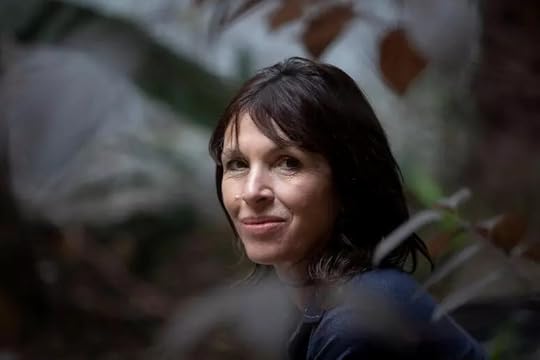
Rachel Cusk

60 books5,099 followers
Rachel Cusk was born in Canada, and spent some of her childhood in Los Angeles, before her family returned to England, in 1974, when Cusk was 8 years old. She read English at New College, Oxford.

Cusk is the Whitbread Award–winning author of two memoirs, including The Last Supper, and seven novels, including Arlington Park, Saving Agnes, The Temporary, The Country Life, and The Lucky Ones.

She has won and been shortlisted for numerous prizes: her most recent novel, Outline (2014), was shortlisted for the Folio Prize, the Goldsmith's Prize and the Bailey's prize, and longlisted for Canada's Giller Prize. In 2003, Rachel Cusk was nominated by Granta magazine as one of 20 'Best of Young British Novelists'

She lives in Brighton, England.

Ratings & Reviews

What do you think?
Rate this book

Friends & Following

Create a free account to discover what your friends think of this book!

Community Reviews

5 stars
634 (17%)
4 stars
1,601 (44%)
3 stars
1,079 (30%)
2 stars
205 (5%)
1 star
42 (1%)
Displaying 1 - 30 of 491 reviews
Profile Image for Fergus, Weaver of Autistic Webs.
1,270 reviews18.4k followers
February 13, 2025
As time progresses, I think that Rachel Cusk may, in all possibility, be remembered as one of the truly important authors of our time.

She takes the wide expanse of modern life in all its boisterous and random absurdity and then seems to effortlessly contain it - rationally and logically - within her own unique cadre of cool, objective and slow-moving linear prose.

She is a revelation. True refreshment for our rational spirits in chaotic times.

Her genius brings a sense of great astonishment and partiality to my own critical sensibility.

Why?

Because she will take a microcosm, an ordinary slice of life encounter, with larger-than-life people and situations, and turn it into a gradual, easeful meeting of minds; going from other lives that, in reality seem almost too in-your-face - in their oddly haphazard aleatorism and jarring conflicts - to a calmly accepting personal dissection of what is, after all, just another day.

The narrator is neither nonplussed nor exhausted in these encounters, but treats every incident that enters into her narrative with ever-ready impartiality.

It’s miraculous.

You know, our own LIVES could be just like Ms Cusk’s fictional ones...

The adverse circumstances, intermittent but repeatedly sustained, of our own lives needn’t immediately send us into a nosedive.

Yet we all have our breaking points.

The crosses of our lives are so often a constant companion, and themselves a buildup to anger or sudden mood swings. I know I’m like that. For years I tried to bear the slings and arrows of outrageous fortune as well as I could, but failed miserably at the task.

Smoking seemed to help, and so, at one point, did alcohol. Yet my hypertension relentlessly racheted upward, resulting in health problems.

After workplace burnout - which I pray you will skirt easily if your health is threatened due to stress - I returned to my roots, earlier abandoned in my crazy quest for the good things of life.

My roots were in my belief in an unchanging higher reality.

And that same belief can produce a more controlled, take-it-all-in-stride balance - as in a great writer like Rachel Cusk...

For just because life is constantly changing, why must we be as well?

Well, to stand resolutely astride a volcano seems no mean feat.

So we have to start REALLY SMALL and move slowly into Life’s Macrocosm.

And do it without grinding our gears, keeping calm & carrying on!

As Cusk shows, rationality and easeful, unstressed consideration of reality are possible and within our reach.
Profile Image for Orsodimondo.
2,457 reviews2,430 followers
September 10, 2025
PER METÀ SILENZIO, PER METÀ ENIGMA


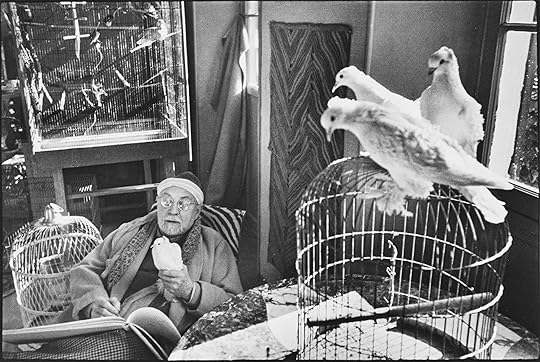
Henry Cartier Bresson: Matisse nel suo studio. Cusk parla di questa foto e io me ne sono innamorato: l’incontro di due grandi artisti, e le colombe stanno a guardare.

A volte scopriamo che la solitudine è un luogo dove possiamo sopravvivere. Non sei davvero scomparso, sei lì, tutto intero. In solitudine ho scoperto la mia consapevolezza, la mia voce, la mia individualità.

Come recita il sottotitolo è una raccolta di capitoli dedicati alla “vita, l’arte e la letteratura”.
Le parti che ho preferito sono quelle dove Cusk regala racconto di esperienza, frammenti della sua vita e momenti di quelle altrui: quelle, per così dire, più narrative. Vedi l’incontro di sua figlia col figlio coetaneo di un’amica: i due ragazzi paragonati a leoni al guinzaglio.
Altrove m’è parso si nascondesse un po’, avesse moderata voglia di trasmettere e comunicare, ma maggior intenzione di scrittura bella.
E non sempre riesce a marcare qualcosa di sfuggito al già detto, già sentito, già visto; talvolta qualche banalità le sfugge: come quelle sul traffico e i guidatori, o quelle sui pellegrini che arrivano coi torpedoni.


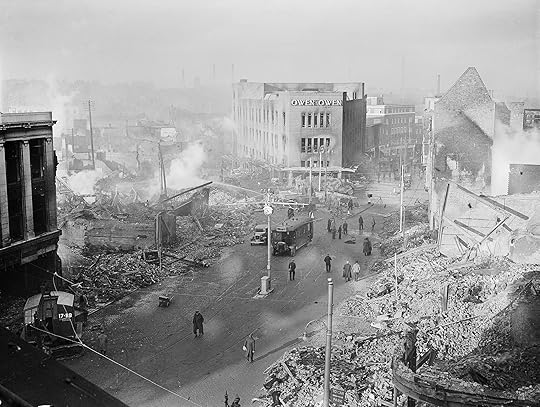
Il centro di Coventry dopo i bombardamenti.

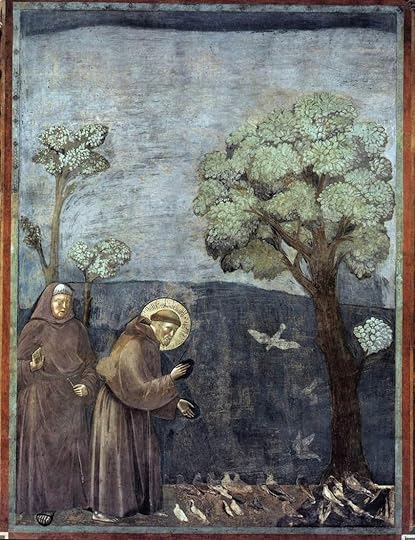
In assoluto il mio capitolo preferito è quello su san Francesco e Cimabue, col pittore quasi indicato come iniziatore dell’arte moderna. E qui, in mezzo ad altre riflessioni, c’è un pensiero, senza prove e forse senza fondamento, che però mi è piaciuto molto: gli artisti a quell’epoca – l’epoca di Cimabue e Giotto - vengono aiutati dal padre, incoraggiati, mentre fino ad allora venivano considerati “delinquentelli o idioti”:
e forse la salute psichica dell’arte del Rinascimento, la sua fiducia, la socievolezza e l’insaziabile amore per il genere umano nascono da questa fonte prosaica quanto fondamentale.


Giotto: Francesco predica agli uccelli (1295-1299)

Ma no, anche il capitolo su Coventry è speciale: sia perché introduce a un’espressione inglese poco nota, essere mandato a Coventry (è quando le persone decidono volontariamente di ignorarti), dove Coventry è la cittadina inglese devastata dalle bombe naziste, sia per riflessioni sulla sua famiglia e la sua adolescenza:
La questione di Coventry è che non ha parole: lì non ti viene spiegato nulla, chiarito nulla. È tutto simbolico. E la sola cosa che non ho mai sentito per Coventry, me ne rendo conto, è indifferenza.


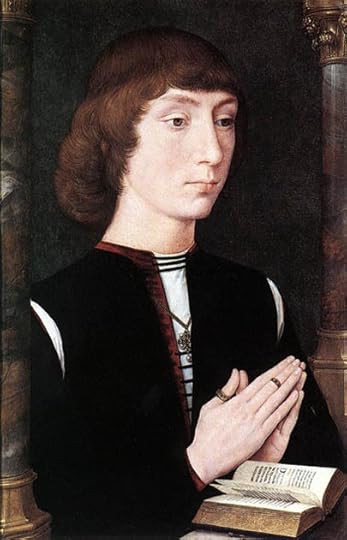
Hans Memling: Ritratto di un giovane che prega (1470 circa)

Bella, e densa, anche la parte dedicata alla scrittura femminile, con inevitabile omaggio a Virginia Woolf:
La forma e la struttura del romanzo, il suo impianto percettivo, persino la dimensione e la tipologia della frase erano strumenti forgiati dagli uomini a loro uso e consumo. La donna del futuro, dice Woolf, concepirà un proprio tipo di frase, di forma, e la userà per scrivere della propria realtà. E, per giunta, quella realtà avrà i propri valori.

Per metà silenzio, per metà enigma: le parole “scrittura femminile” non connotano semplicemente una letteratura fatta dalle donne, bensì una che emerge e prende forma in un insieme di condizioni specificamente femminili. Un libro non è un esempio di “scrittura femminile” solo perché è scritto da una donna. Può diventare “scrittura femminile” quando non avrebbe potuto essere scritto da un uomo.


Rachel Cusk fotografata a Capri nell’ottobre 2024 in occasione dell’assegnazione del Premio Malaparte.
Profile Image for Meike.
Author 1 book4,943 followers
August 26, 2019
This collection of essays combines memoir, social and literary criticism, and in a way, all of the texts are talking about storytelling: How we narrate our own lives and times is the main focus of Cusk's explorations. The author meditates about driving as a metaphor, the narrative families employ to define themselves and what happens when it is questioned by teenagers or even shattered by divorce, rudeness as a way of communication, teaching creative writing as a profession, art as way of expression, and of course she also writes about literary works, namely The Age of Innocence, The Rainbow, Bonjour tristesse, The Balkan Trilogy, Eat, Pray, Love (spoiler alert: she's not a fan :-)), Never Let Me Go and the writing of Natalia Ginzburg.

Cusk shines when she dissects conflict and complex emotions, especially when she talks about the gap between knowing what's right and feeling something that's incongruous with that knowledge. While I don't share some of her positions, e.g. when it comes to feminism ("Feminism as a cultural and political crisis comes and goes") or nature (while Cusk constantly talks about "dumb nature", I share Richard Powers' position that nature might be smarter than us), it's always interesting to follow her thought process, both because of her ideas and because of her ability to convey them in surprising and captivating ways.

I was particularly immersed in her meditations about femininity and domesticity, because frequently, I was unsure whether I would say she is right, which in itself is a narrative feat: Cusk puzzled me and made me think about how I narrate myself, my family, my society, and my time, and that's exactly what a good essay collection should do.

Some of the texts are already available online, here's a link to the title-giving essay: https://granta.com/coventry/
Profile Image for Adam Dalva.
Author 8 books2,158 followers
January 1, 2021
Cusk is absurdly brilliant, acerbic, and honest - this collection shows much of the same spark as her fiction, especially in the more autobiographical essays like "Making Home" and the title essay - I wish the whole collection had been made of these, and admit to disappointment when it pivoted to her criticism. Her criticism is great! But the first section was delicious, and I wanted more of it.
Profile Image for Vicky "phenkos".
149 reviews135 followers
July 5, 2020
I'm intrigued and perplexed by the essay form. As I was reading this offering by Rachel Cusk, I was constantly trying to trace out its boundaries with other genres that are similar to it: the academic paper; the opinion piece; the journalistic report; life writing. But none of these is an essay, strictly speaking. Academic papers usually involve a thesis or argument; opinion pieces and reports are about a single subject which they examine from various angles; life writing has an element of autobiography which the essay may not have (although it often does). So what is an essay and how is it defined? Is it a set of reflections on any subject the author may see fit (from road traffic to art)? A meditation on life and the human condition? A piece of autobiography designed to appeal to to the erudite and the learned?

Cusk's Coventry is all these and more. There is a substantial part on literature, but there are also two other parts that deal with the author's life, her relationship with her children, her ex-husband and her parents, and even a piece on 'Driving as Metaphor'. My favourite piece was 'Coventry', the essay that gives the volume its title. 'Being sent to Coventry', explains Cusk, is an expression used when someone stops talking to you, signalling a kind of social distancing that is meant as punishment. Parents often send their children to 'Coventry', but schoolchildren also perform this ritual as a way of signalling power, putting someone in their place. The piece starts with an incident when the author's parents visit; after they're gone, they indicate their displeasure but without ever explaining what it was that caused it. This is one of the rules of 'Coventry':

"The thing about Coventry is that it has no words: nothing is explained to you there, nothing made clear. it is entirely representational. And what I've never felt about it, I realise, is indifference."

The reason for being sent to Coventry can be completely trivial. In fact, one may struggle to understand what one did wrong. One can spend days wondering, as did the author and her husband after this particular incidence of 'being sent to Coventry'. This is part of how it works. Its power lies not in explaining but precisely in not saying anything, not even admitting that one is displeased. This tactic works very well with little children - and also with the children that we adults are before we manage to break the invisible bonds that tie us to our parents. 'Coventry' and the people who practice it cannot stand the light of speech, of rationalising, the exchange of arguments, giving the other the chance to fight back, state their own point of view. It suits people who are passive aggressive, especially those who are themselves unclear about what they feel and why. 'Covrenty' is a very powerful strategy but one that relies on the complicity of its victim; it only works when the punished part is too timid to defy punishment. But in reality, 'Coventry' is toothless; once the victim lifts the burden of complicity, being sent to 'Coventry' means absolutely nothing. One couldn't care less whether one is being talked to or not.

But that is not how the author's parents see it. In fact, the paradigmatic instance for 'Coventry' is war.

"That was the world my parents were born into, a world where sacred monuments could disappear between bedtime and breakfast, a world at war: it is perhaps no surprise, then, that war remains their model. War is a narrative: it might almost be said to embody the narrative principle itself. It is the attempt to create a story of life, to create agreement. [...]It never occurred to me that instead of the long siege of sending me to Coventry, my parents might simply have picked up the phone and set things right in person. That isn't how stories work."

Reading this collection of essays has made me curious about Cusk as a fiction writer. I know that her fiction has been very well received. I also know that she has a loyal following. So, I've made a start on Outline, of which more at another review.
Profile Image for Trish.
1,422 reviews2,710 followers
October 14, 2019
When I heard about a new book of essays by Rachel Cusk, I had two conflicting reactions: one was joy and one was sadness. Cusk is one of my favorite authors. She thinks deeply and can straightforwardly, analytically discuss her perceptions in involving prose but her characters can also demonstrate wildly ditzy intellectual fadeouts. I was sad to think I’d never have the quietness of mind in the current worldwide political upheaval to read her work in peace.

Then I saw a review by Clair Wills in the September 26 issue of The New York Review of Books. Cusk explained she also was experiencing a disconnection with something she is obviously attached to: writing. The review begins
“Rachel Cusk is fascinated by silence. About five years ago she announced that she had given up on fiction. A prolific writer, she had by then published seven much-praised novels and three memoirs but, she explained, she was done with both genres…Fiction now seemed to her 'fake and embarrassing. Once you have suffered sufficiently, the idea of making up John and Jane and having them do things together seems utterly ridiculous.’”
Ah. She caught me again. That’s exactly the way I feel about fiction when the world is burning.

Cusk doesn’t pander, doesn’t claim to be more than she is, and generally she stands firm on the ground she occupies but she does make tiny acknowledgements of fragility or uncertainty. Her opening essay, “Driving as a Metaphor,” starts out brassy with surety: “Where I live, there is always someone driving slowly on the road ahead.” We immediately get the impression this writer has much too many important things in her day without calculating in an extra five minutes for safety along a curvy coastline. Later in the same essay, she lets her attitude down a little and admits
“At busy or complicated junctions I find myself becoming self-conscious and nervous about reading the situation: I worry I don’t see things the way everyone else does, a quality that otherwise might be considered a strength. Sometimes, stuck on the coast road behind the slow drivers while they decide whether or not they want to turn left, it strikes me that the true danger of driving might lie in the capacity for subjectivity, and in the weapons it puts at subjectivity’s disposal.”
Ah, once again. How can one not read Cusk when she writes like this, writing whatever she claims she cannot write. We need this particular mixture of vulnerability and steeliness to reassure us we are not mad about the apocalyptic shakiness of what we’d taken as firm ground.

She displays something of this heady teenagery cocktail of self-doubt and disdain in the title essay of her collection, “Coventry.” She describes boarding school and parents who could be aloof for reasons she never really understood. Their silence towards her she calls “being sent to Coventry.” Cusk may have felt she was sent to Coventry again as an adult by the reading public after her 2012 memoir, Aftermath, in which she gave voice to resentment over her divorce. But she was not wrong to concentrate on her own feelings in that memoir. How could she possibly know or consider her husband’s feelings in the midst of the personality destruction that is divorce?

In the NYRB review, Claire Mills writes that Cusk
“is not only willing to admit to her darkest instincts; she seems to revel in the anger they produce in others. How else to interpret the fact that—seven years after the ‘creative death’ that the response to Aftermath precipitated in her, she has republished the essay on which Aftermath was based in Coventry, her new collection of essays?”
Mills’ interpretation of Cusk’s insistence on including this essay is not one I agree with. Were I to guess the reason, it would not be asserting Cusk persists in equating truth with honesty or truth as the opposite of stories. My guess would be that Cusk is asking us to think about truth and honesty, reality and fiction and see if there is much overlap. We are in the midst of a truth revolution, after all, and I feel quite sure she is just positing the question rather than supplying the answers.

This book of essays is divided into three parts, the first of which includes new work and the longish essay “Aftermath.” Part II is called A Tragic Pastime and includes a discussion of the sculptor Louise Bourgeois and a discussion on women’s writing called “Shakespeare’s Sisters,” among other things. Part III contains reprints of essays published earlier, on Olivia Manning’s work, on Natalia Ginzburg, on Kazuo Ishiguro.

Cusk knows her writing has a lashing quality sometimes. She is comfortable with that. I am, too. Hey, life is not always a basket of cherries. She has been nothing but forthright that she will write what she thinks and feels, and you should take it or leave it. She would prefer you do not slam the door on the way out, thank you very much.
Profile Image for julieta.
1,331 reviews42.3k followers
January 4, 2021
The first part of this book is wonderful. When she gets personal on family, relationships, teenagers, it is a joy to read how lucid she is. But I was very surprised about how generic she sounds when she speaks of other writers books. Still she is always a joy to read.
Profile Image for Emily B.
491 reviews536 followers
June 18, 2021
I’m not sure if Cusk was being serious when she said ‘Then again, the feminist is supposed to hate men. She scorns the physical and emotional servitude they exact. She calls them the enemy’
Profile Image for Marc Lamot.
3,461 reviews1,972 followers
July 1, 2020
While it was a very strange reading experience, I was quite impressed by Cusk's Rachel Cusk Collection: Outline, Transit and Kudos-trllogy. You could clearly see that she tried a new way of writing, sometimes with more, other times with less succes, but anyhow a bold and lucid experiment. The reading of this essay book confirms to me that Cusk does not just act on a whimp and has a clever insight into literature on the one hand and the art of life on the other.

She relentlessly puts her finger on tricky issues such as parenting, adolescent children, and especially the female (and male) identity. Her essay on female writing, for example, is a brilliant continuation of Virginia Woolf’s A Room of One's Own, and that is no small compliment. Cusk is not afraid to speak up for who she is, to show her scars, and to present her quirky but bold view of things. But at the same time, as in her fiction work, she remains elusive; she regularly changes perspective, does not finish her train of thoughts and keeps some elements in the dark. That may be frustrating, but I suspect it's her way of saying: it's not black or white, there's no overarching perspective, figure it out for yourself. This may also explain the irritation that her work evokes in many people. Anyway, this book of essays is an enticing and intriguing read!
Profile Image for Lee.
381 reviews7 followers
September 15, 2019
4.5. There are very few all-rounders as good as Cusk. Warning: will make you want to dust off copies of all books covered. (The Wharton and Lawrence essays are especially good.)
Profile Image for Maxwell.
1,441 reviews12.4k followers
November 30, 2021
Plenty of times I've heard people say, "I would read their shopping list if they published it!" And I've always sort of rolled my eyes at that statement. But after finding Rachel Cusk's writing this year, I get it. I really get it.

This collection of essays, many of which have been previously published in various magazines and newspapers, is broken into three parts: Coventry, A Tragic Pastime, and Classics & Bestsellers. In Part One, we get the more personal side of Cusk. These essays are about topics driving, homemaking, rudeness, and familial relationships, where she explores her own views and experiences with them. She makes the universal personal and the personal universal, and I truly loved these essays.

Part Two is comprised of essays about art, history, creative writing and they often are seen through the lens of modern womanhood. Cusk would take an artifact of some sort and utilize it to explore larger themes.

Finally, Part 3 is a more straightforward amalgamation of various critical reviews of books and authors that Cusk has written about over the years. These were my least favorite, simply because I didn't have any personal connection to some of these things, though like I said at the beginning of this review, Cusk could write about literally anything and I'd read it.

Would I recommend this as an introduction to Cusk? Unlikely. Not because it's bad, but I similar to Ferrante's "Frantumaglia" or "Incidental Inventions" I think the deeper appreciation in this collection is for Cusk herself than necessarily the subject matter. However, I think Part 1 alone would be a great way to see how Cusk views the world and get an insight into the way she writes about navigating the world as a woman and a writer and so many other identities, explored in the Outline trilogy and Second Place.
Profile Image for Kasa Cotugno.
2,755 reviews586 followers
July 1, 2019
The best essays make you look at things differently. This collection, comprised of material heretofore published in the likes of Granta and The Guardian, consists of fine examples of why Rachel Cusk is in such demand as a writer and as an analyst of other writers. The first two sections concern essays of introspection, autobiographical in nature. She writes of what she knows of life, with echoes of her recent trilogy: the harrowing conditions of trying to drive around her own home town, a popular seaside resort with small curved roads and distracted holiday drivers, to the challenges faced by a single mother post divorce with teenaged daughters, to observations on rudeness, to the elemental bullying of sending someone to Coventry by shutting them out and denying their existence (ghosting in today's parlance), a passage I particularly enjoyed as she wonders why the lovely city of Coventry was chosen to describe this evil practice.

There are deeper than average descriptions of travel experiences, and then the final section containing a series of studies of writers, mostly women, and what it means for a woman to forge a career as a writer and carve a distinct identity in doing so. I particularly liked the one about Olivia Manning, her Balkan and Levant Trilogies, books that have been on my "to-do list" for about five years.
Profile Image for Katia N.
710 reviews1,110 followers
November 10, 2019
It has been a long time since I wanted to read a book of essays. I’ve started with this collection, but then got into the swing of things and spent a few weeks reading just essays from different authors. I found it fascinating experience, in some ways, it is easier than reading a serious novel, but very stimulating nevertheless. I plan to do it again soon with more empathises on the literary criticism. This book was the first in the bunch. It might be that the following essays and the authors I’ve read after that has affected my impression of it, but I found it somewhat insubstantial. All of these essays has been published somewhere before. And many of them were the basis for Cusk’s more fundamental and more successful works such as “Aftermath” and her excellent “Outline” trilogy. I’ve read those works before and loved them. Therefore, it was not particularly revealing to see them here in a skeleton form.

The title essay ‘Coventry” was different though. And it is appeared to be my favourite. It dealt with the difficult relationship between her and her parents that often lead to a prolonged period of silence imposed on her. The essay was as ironic as it was revealing. It is worth noting that she is the third female writer I’ve read in a short while whose relationship with parents, especially their mum, bordered on an open conflict (another two were Rebecca Solnit and Vigdis Hjorth). It reminded me an observation by Milosz : “When a writer is born into a family that family is finished”.

The book also contains a few essays of literary criticism. She likes Edith Wharton and DH Lawrence. She admires Natalia Ginsburg and not so keen on “Never let me go”. I admired her thoughts, if only these essays were a bit less brief.

Interesting collection but definitely not my favourite book by her.
Profile Image for Ken.
Author 3 books1,238 followers
October 4, 2019
This is one of those deals where the author becomes famous enough to collect past essays from periodicals and sets them in categories within a book. It might be you can find some of them online (I haven't looked) but, conveniently grouped for you in a hardcover, you get a taste of the fiction writer's nonfiction-writing strengths, all packaged in the clothbound of convenience.

The first thing you'll learn about Rachel Cusk is that she is a capital-F Feminist. I am woman, hear me roar, as Helen "Get" Reddy said back in the day (euphemism for "the old days"). This is evident throughout, even in her choice of books to review in the final section, but especially prevalent in "Aftermath," which is the story of her divorce.

It is in that essay that she proclaims, "The children belonged to me," and then sets out to prove why. Granted, it doesn't exactly fit any ideas of fairness, especially when children are necessarily the offspring of two bodies, but Cusk does her darnedest, and a lot of it revolves around the unequal load mothers assume in most marriages.

Interesting reading? Oh, yeah. Bracing, even. I'll just say this: You wouldn't want to be Cusk's ex-husband reading this essay. In fact, it's enough to give any spouse married to a capital-W Writer pause. Could the dirty laundry become fodder (or, in this case, "mudder") for capital-A Art? God help us all. If She even exists. (That one's for you, Rachel.)

The title essay, "Coventry," is especially amusing. It involves a saying unfamiliar to me and I daresay most Americans: "being sent to Coventry." In Yank-speak, it means "getting the silent treatment." Cusk was inspired to take it on because her parents had "sent her to Coventry," but she stretched it to essay-length by examining the many uses and misuses of silent treatment we endure (or inflict) growing up. Is it immature? I'll say. But, like many immature things, oh, so satisfying!

"Lions on Leashes" is her metaphor for teenagers. I love that coinage, I must say, and I enjoyed the essay, too, although I feel as though the premise was left a bit unfulfilled. Maybe because she is one of the lucky ones who has teenagers who aren't terribly rebellious. This forced her into second-hand talk about problematic lions and their (often broken or fraying) leashes. ("Hear me roar" redux!)

The final section is, as another reviewer aptly put it, the expensive one for readers like us. These are collected reviews of writers well-known and not so well-known, including Edith Wharton (The Age of Innocence), D.H. Lawrence (The Rainbow), Françoise Sagan (Bonjour, Tristesse), Olivia Manning (The Balkan Trilogy), Elizabeth Gilbert (Eat, Pray, Love), Kazuo Ishiguro (Never Let Me Go), and Natalia Ginzburg (Family Lexicon).

Of that line-up, she most intrigued me to read The Rainbow for the first time (but not soon, as I just came out of the other side of James Joyce's Ulysses tunnel), and Ginzburg's works.

Overall, good fun. And, if you're suspicious of feminists (a loaded and emotional term by now), an edifying read.
Profile Image for luce (cry bebè's back from hiatus).
1,555 reviews5,836 followers
August 28, 2021
| | blog | tumblr | ko-fi | |

I have rather mixed thoughts about Rachel Cusk's Coventry: Essays. Maybe I'm just not the right 'reader' for her work...I previously read, and was rather underwhelmed by, Outline (a book which has won quite a few literary awards and is regarded as a modern classic).

This collection by Cusk is divided in three sections: the first consists of autobiographical essays (“Driving as Metaphor”,“Coventry”, “On Rudeness”, “Making Home”, “Lions on Leashes”, “Aftermath”) in which she makes various speculations regarding notions of motherhood, home, and agency, often using her personal history—for example with divorce—as a springing board for later suppositions. The other two sections include essays in which she mainly speaks of artists and authors (a few being “Louise Bourgeois: Suites on Fabric”, “Edith Wharton: The Age of Innocence”, “Olivia Manning: The Balkan Trilogy”, “Eat, Pray, Love”, “Never Let Me Go”, “On Natalia Ginzburg”).
I much preferred the essays included in these last two sections of this collections. Even if I didn't entirely agree with some of her readings I thought that Cusk's 'critical' essays were well articulated and interesting. Sadly, I found her autobiographical essays to be rather obnoxious.

At times I had the distinctive impression that the Cusk that emerges from these autobiographical essays seems to have undergone a processes of self-fashioning. Cusk presents herself as a sphinx-like figure, a seer of sorts, capable of discerning the universal truths from personal experiences and opinions. The weight she seems to give to her own mental meanderings seems rather unjustified.
I was also discomfited by the impassive manner in which she would methodically dissect the people around her, coldly pointing out their flaws without ever rendering with clarity a sense of their personality or their shared history with her.
This reticence to let 'us in' that manifests itself throughout her biographical essays was detrimental to my reading experience. She seems unconcerned by ideas of privacy as she speaks of very personal subject matters (her divorce for example) yet provides so little context when describing certain episodes and events in her life that made it difficult it for me to relate to her experiences or viewpoint. For example in “Coventry”, the essay which has become the title of this whole collection and therefore one might assume that it has some importance, she doesn't really make it clear to her readers why her parents “send her to coventry” or what is the exact nature of their relationship. In another essay she examines the way in which divorce has changed the reality and shape of her family in a rather metaphysical way, so that it seems almost as if she wasn't writing of her own personal experiences presenting her personal experience as some sort of universal one.
She skirts around the edges of possibly complex and fraught relationships without ever delving into the 'thick of it'
. Because of this, the comments she made about the people in her life struck me as somewhat callous and even uncalled for as I wasn't made privy to the reason behind her words.
I acknowledge that autobiographical essays are a tricky feat but there are many writers who manage to give an outline of their relationships with their family without revealing everything about them (This is the Story of a Happy Marriage). If an essay examines something that is specifically connected to a certain episode or person from its author's life one might expect a 'personal' element to supplement this exploration of this certain event/individual. For instance, in an essay in which Cusk writes of being repeatedly “send her to coventry” by her parents would, in theory, give us at least a vague impression of the dynamics between them (it doesn't).
In her philosophising Cusk shows a tendency for issuing rather banal dictums (cars=people, airports=places of transport, children=extension of their parents, homes=reflecting those who inhabit them). At times these rather predictable statements could lead into more profound observations, such as when Cusk expands her vision of airports as places of convergence or how a visit to a clothing shop leads into a discussion regarding the falsity of the customer service industry.

Cusk also demonstrated a propensity for unfortunate analogies: she is “a self-hating transvestite” because she earned the money in her household and did her share of the house-chores . She and her husband were “two transvestites, a transvestite couple” because he was a stay at home dad. She also compares her changing notions “of a woman’s beauty” to “an immigrant’s notion of home”, that is “theoretical”: “My mother may have been my place of birth, but my adopted nationality was my father’s”. This seemed a somewhat dramatic comparison...then again she goes to equate being ignored to being at war so yes, Cusk has a tendency to dramatise some of her so-called 'struggles'. After her divorce she feels that “my children and I […] we are like a Gypsy caravan parked up among the houses, itinerant, temporary” . Another clumsy comparison she makes is that of feminist to alcoholics: feminists stay away from “the kitchen, the maternity ward – like the alcoholic stays away from the bottle. Some alcoholics have a fantasy of modest social drinking: they just haven’t been through enough cycles of failure yet. The woman who thinks she can choose femininity, can toy with it like the social drinker toys with wine”.
Speaking of feminism, I didn't entirely agree, or cared to agree, with her vision of feminisms which seems to present feminism at its most radical: “ The joke is that the feminist’s pursuit of male values has led her to the threshold of female exploitation” and “what I lived as feminism were in fact the male values my parents, among others, well-meaningly bequeathed me – the cross-dressing values of my father, and the anti-feminine values of my mother ”. For Cusk a feminist “does not propitiate: she objects. She’s a woman turned inside out”. Feminists hate feminine values and notions of domesticity...and some sure do but isn't a bit of a generalisation to imply that all feminists will inadvertently fall into this trap of hating other women?
Cusk's notion of male and female values seemed outdated. In each of this autobiographical essays she seems a bit too concerned with bringing different episodes or topics back to issues of femininity vs. masculinity, definitions of womanhood and manhood which weren't as 'mind-blowing' as the author herself seemed to think. Cusk’s speculations seemed to clearly stem from the mind of someone...shall I say intellectual? Of a certain class? Because of this she seems unaware of making quite a few unfortunate analogies that made me wonder whether a reality check was needed.
Yet, in spite of my criticism towards Cusk's essays I still thought that does manage to make some interesting speculations regarding things such as rudeness and her portrayal of the polarisation in post-Brexit Britain 'hits' right on the nail as she shrewdly describes her country's current political climate.
Woven throughout Cusk's essays are a set of theories and concepts such as “suspension of disbelief” and “story vs. reality” yet, in spite of her assertion that as a writer she is values “objectivity” she shows a predilection for self-dramatisation and for conflating notions of subjectivity and objectivity.
However I also have to concede that one of the reasons why I wasn't able to relate to Cusk's autobiographical essays might be due to generational, if not cultural, differences. My mother, unlike me, seems to have appreciated most of these essays and doesn't seem to think that Cusk's speculations about feminism and domesticity are quite as obsolete as I claim they are.

Profile Image for Jennifer nyc.
353 reviews425 followers
June 8, 2022
I did love the title piece in this collection, along with one more. So, they weren’t all bad. Some might give that 3-stars, especially given that Cusk is so obviously brilliant. I made a mistake listening to the audio of this, but it was free for a finite time, and I was too curious. The narrator felt so bitter that it tipped the balance of flavors that is Rachel Cusk. My stomach would tie in knots while listening, I almost didn’t make it through. So 2 stars for having to endure the discomfort of reading this.

I’ve read 5 of her books now, and I’ve disliked both of the nonfiction. I’ve loved, or really liked her books in trilogy.
Profile Image for Chris.
612 reviews183 followers
October 1, 2019
4,5
I loved the first part Coventry: absolutely 5 stars! The rest was good and often excellent. Cusk is so analytical, precise, observant and clever. Definitely one of the best writers of this time!
Profile Image for Lyubov.
441 reviews219 followers
August 3, 2022
I think I have a new fav author.
Hello, Rachel, you rock :)
Profile Image for Troy.
270 reviews212 followers
January 17, 2022
I really enjoyed this collection, save for a few essays that were a bit dense, esoteric, or outside of my scope of understanding or interest. Her general essays at the start were the best.
Profile Image for Marcus Hobson.
722 reviews115 followers
October 21, 2019
I only started reading Rachel Cusk last year, when I read all three books in her recent trilogy; Outline, Transit and Kudos. I really enjoyed both the humour and the quirkiness of some of the situations that she created. As a result I was very keen to read this series of essays called simply ‘Coventry’.

For those that might not know, Coventry is a city in the UK which has acquired its own phrase or idiom. To be ‘sent to Coventry’ is a phrase that means to be ignored or shunned by everyone and dates back to historical events in the 1600s. In her essay Cusk talks about being sent to Coventry by her parents, but unfortunately, because she doesn’t talk to them all the time, it takes her some time to discover she has been banished there. This leads her to think about the quality of silence within relationships. Her husband’s parents, on the rare occasions that they would go out for a meal together, would often spend the whole meal in silence. This ‘signified that their intimacy was complete.’ As a result, her husband is not afraid of such silences. Cusk’s acceptance of Coventry starts to change, ‘In the following weeks, as the silence grows and expands and solidifies, I find myself becoming, if not exactly fond, increasingly accepting of it. All my life I have been terrified of Coventry, of its vastness and bleakness and loneliness, and of what it represents, which is rejection from the story. One is written out of the story of life like a minor character being written out of a soap opera.’
There are seven essays in the first part of this book, which increasingly dwell on home and family, parenthood within the context of a couple who are divorcing, and then where feminism sits within the family structure and complexity. There are some wonderful passages about children and the changes that happen to teenage girls in particular. ‘Entering a house, I often feel that I am entering a woman’s body, and that everything that I do there will be felt more intimately by her than by someone else. But in that house it is possible to forget entirely – as the passengers on the top deck of a liner can forget the blackened, bellowing engine room below…’
In the essay Making Home, Cusk describes the homes that other create: “Another friend of mine runs her home with admirable laxity, governing her large family by a set of principles that have tidiness as a footnote or a distant goal, something it would be nice to achieve one day, like retirement.’ She goes on to describe the stairs, ‘the stairs are virtually impassible with the possessions that have accumulated there, the books and clothes and toys…all precipitously stacked as if in a vertical lost property office.’ This so perfectly captures our own home, where the myth persists that if you leave children’s possessions on the stairway to their bedrooms they will pick up their things and carry them up. Long practiced but never successful, like a war of attrition until one side gives up and the adults carry them upstairs. I love the realism that Cusk has created with these observations.

Cusk also turns out to be a fine observer of the changes taking place within her daughters. In six months the circle of friends around the youngest condenses. ‘The ones that remain are more serious, more distinct. They go to art galleries and lectures together; on Saturdays they take long walks across London, visiting new areas. My daughter has become politicised; at dinner, she talks about feminism, current affairs, ethics. My oldest daughter has already made this transition, so the two of them join forces, setting the world to rights. When they argue now it is about the French headscarf ban in schools or the morality of communism. Sometimes it is like having dinner on the set of Question Time.‘ These are wonderful observations on the minutiae of everyday life.

Cusk goes on to talk about the roles of women in households and the sometimes surprising discoveries that being a mother can bring. In the two other sections Cusk works her way through a number of works of literature, reviewing and observing, pulling out the obscure or the interesting. As she talks about F Scott Fitzgerald, she notes that he caricatures the writer as being someone to whom people make suggestions for a character or a scene that might be used in a book. These days writers tend to have a tenured academic status, and you would ask them for advice rather than suggest it yourself. These are the sort of small observations that make this such an interesting collection, and well worth a read.
Profile Image for Laura Gotti.
587 reviews611 followers
May 10, 2025
Leggere la Cusk è sempre una gioia.

Questa è una raccolta di saggi su tematiche diverse, dalla vita vissuta, all'arte, alla letteratura e lo sguardo di questa scrittrice è sempre così attento lucido e puntuale da lasciarmi sempre a bocca aperta. Il saggio che dà il titolo alla raccolta è veramente illuminante e mi ha pure insegnato un. nuovo modo di dire. 'being sent to Coventry'. Significa essere fatta oggetto di silenzio: d'improvviso qualcuno non ti parla più, neanche te ne accorgi subito, ma con l'andare del tempo ti rendi conto di non sentire quella persona da un po', che non ti cerca più, che sta in silenzio. Non vi dico nemmeno cosa la Cusk ci crea intorno a sto ragionamento perché è veramente qualcosa che consiglio di leggere.
Sono tutti di altro livello? No, come tutte le raccolte e quello che mi ha deluso di più sono stati i saggi sulla letteratura ( a parte quello sulla Ginzburg che è notevole). perché delusa? Li ho trovati un po' piatti, un racconto di trama, un sacco di citazioni, la Woolf e la sua stanza tutta per sé onnipresente, forse troppo - e io venero Virginia Woolf.

È tradotto in italiano, quindi io qualcosa leggerei.
Profile Image for Domenico Fina.
291 reviews89 followers
April 4, 2024
Prose varie di una delle migliori scrittrici in circolazione; scusate la perentorietà. Lo scritto che dà il titolo alla raccolta è notevolissimo, così come altri che sono stati elaborati con la stesso occhio mobile che ha scritto la Trilogia (stiamo parlando degli stessi anni, sono saggi usciti in volume nel 2019)

Coventry è un città inglese che venne bombardata durante la seconda guerra mondiale, e per certi versi perse il suo status di città interessante, nonostante la successiva ricostruzione. Oggi esiste una curiosa espressione per indicare la cosa: «essere mandati a Coventry». Allontanare gradualmente dalla propria vita una persona, o più persone, con una sorta di indifferenza fatale per tutti. Ridimensionare e allo stesso tempo ridimensionarsi.
Tutto il saggio è un modo per spiegarne il senso, e Rachel Cusk lo fa come si deve, con la sua vita. Lei è stata mandata a Coventry dai suoi genitori, o per essere più precisi si sono reciprocamente mandati a Coventry. La temperatura tra due persone si abbassa, ma inizialmente nessuno se ne accorge, come quando la caldaia inizia a funzionare male.

Mi balza alla mente, leggendo questo splendido saggio (qui in basso riporto un passo significativo per farvi capire il tenore), che Coventry è un luogo abitato talvolta da noi tutti, abitanti adulti dei social e abitanti della vita non social, cambia poco, ché le due cose sono ‘accarnate’. Amici traslati, viviamo a nostra insaputa tutti a Coventry. Anche tra vicini, anche tra parenti, anche tra colleghi. Coventry è in agguato. Abituati a perdersi di vista un po’ e mai del tutto. Coventry è popolatissima. Se fossimo stati un po’ più giovani l’avremmo stracciata con la fantasia, Coventry (questo è De Gregori, che oggi compie 73 anni). Coventry, se non s’è capito, è l’indifferenza fatale degli adulti, sabbie mobili che i giovani non hanno ancora imparato, o subìto.

Qui in basso la bravissima Rachel Cusk che scrive dei suoi figli, di lei, e di noi:

«Le mie figlie sono un interessante ibrido fra due caratteristiche che ho sempre considerato inconciliabili, sono caparbie ma anche comprensive; ipercritiche ma capaci di gentilezza e compassione. Non capita spesso che sprechino le loro qualità migliori con gli adulti - l’amicizia è il terreno sul quale stanno costruendo la loro vita. Ma si sono preoccupate del mio stare a Coventry. Non sono abituate alla guerra come modello delle relazioni umane. Non sono abituate al fatto che le cose s’incancreniscano al punto da dover andare distrutte. Il comportamento dei miei genitori le ha fatte arrabbiare, ma sono pronte a perdonare, come un cane che insegue un coniglio: non c’è che un battito di ciglia fra accusa a clemenza. Io ho la vaga consapevolezza che vada perso qualcosa nella rapidità con cui accettano che gli errori vengano raddrizzati. Mi chiedo se il loro sarà un mondo senza liti, senza durevoli conflitti, senza Coventry, ma anche senza memoria. Dico loro di sentirsi libere di comunicare coi nonni e vederli ogni volta che credono - sono grandi abbastanza per poterlo fare - ma per quanto mi riguarda non intendo rientrare nell’arena. Non voglio lasciare Coventry. Ho deciso di restare»
Profile Image for Joachim Stoop.
950 reviews866 followers
October 1, 2019
3,5

I loved reading (the first part of) these essays -especially the one about her divorce (so 'loved' doesn't feel appropriate here).
Cusk is an exceptionally gifted writer, who can find an intersting angle about n'importe quoi, which sometimes brings her to territories of overexplaining, overthinking and farfetched analysis. She gets away with it 'cuz of her delicate play with words, but still...

Profile Image for emily.
635 reviews542 followers
November 26, 2021
First half's quite brilliant, but Cusk's writing got a bit dry afterwards (what a shame, because Cusk wrote about people/things that I was actually interested in - like Louise Bourgeois, and D. H. Lawrence). I find that Vivian Gornick's Unfinished Business: Notes of a Chronic Re-Reader is much better when it comes to writers writing about other writers. RTC.
Profile Image for Saim.
77 reviews1 follower
August 6, 2025
Har alltid tenkt det er interessant at Cusk setter bøkene sine med skrifttypen Optima, det er jo en sans-serif! Sant nok designet for å fungere som brødtekst, men den var inspirert av graveringene i gravsteiner. Skrifttypen er blant annet brukt for minnesmerkene for 9/11 og vietnamkrigen i usa, jeg har besøkt begge og tenkt at det er en interessant skrifttype. Den gir på en måte en viss tyngde til alt som blir skrevet med den, ordene får en verdi utover betydningen deres, etos som bare det. Samtidig føles det litt påtatt og cringe, hvem er du som tror ordene dine er gode nok til å hugges i stein? Beskriver vel egentlig Cusk ganske greit. Det er noen veldig flotte essay i denne samlingen, Så universaliserbare resonnementer kokt ned til enkle anekdoter at man tenker wow. Andre ganger kan det føles fake deep, som hun prøver for hardt. Men det er jo det man vil at forfatteren skal er det ikke? Være melankolsk og dramatisk, utleverende om seg selv og alle man kjenner?

Gøy å lese til tross for at litt mange av essayene handler om å være en skilt tobarnsmor.
Profile Image for Ashley.
319 reviews70 followers
February 8, 2021
Rachel Cusk is what one might call a “difficult woman,” which is one reason why I love reading her; she’s not here to make friends. Her voice is so impressive: level-headed, astute, objective, serene. She gives the impression of being a scathing critic. I can’t help but wonder what she would think about me, which of my flaws she would notice and expose. She is not the type of writer one wants to get to know in real life; I’m sure if I did know her, I would be afraid of her. But I would absolutely want to read every single piece of writing that she produces. I actually wish that she would create an infinite number of works across all forms of media; I wish she had a podcast I could subscribe to, a Youtube channel, a talk show, more novels and essay collections. I would eagerly consume all of it. I want to know her opinion on everything. As it is, the next books I buy will be Rachel Cusk’s. Perhaps I am setting myself up for disappointment, but I don’t think Cusk has the capacity to disappoint. I adore her writing, I’m in awe of how she finds truth in the most mundane topics, such as driving:

“It is often regretted that children can no longer play or move freely outside because of the dangers of traffic; inevitably, many of the people who voice these regrets are also the drivers of cars, as those same restricted children will come to be in their time. What is being mourned, it seems, is not so much the decline of an old world of freedom as the existence of comforts and conveniences the individual feels powerless to resist, and which in any case he or she could not truthfully say they wished would be abolished.”

Imagine a condensed essay that is filled with nothing but these kinds of gem-like passages; then imagine an entire book. There is nothing superfluous here. Rachel Cusk sets out to say something, and she says it without any frills.

This essay collection is so sharp, insightful, and wry — and yet also cool, collected, and peaceful. It's so intelligent that it actually makes other essayists pale in comparison. Where other writers have created opinion pieces blended with memoir and spotted with facts from their research, Rachel Cusk has dug deep into human psychology to unearth truths that were either deliberately or unknowingly buried. Coventry is not entertaining; it’s pure observation and analysis. Its purpose is to illustrate the eternal search for truth and reality, for firm footing in a subjective world. It also isn’t without its moments of humour, if you can hear the notes of sarcasm in Cusk’s unflappable style.

I was going to list my favourite essays from this collection, but found that I was just listing the entire table of contents. They were all so excellent. My copy of this book has passages underlined on almost every page, and I almost want to start reading it immediately all over again.

The essay in which she wrote about her estrangement from her parents was SO brutal, especially knowing that her parents have probably read it. It was a clear win for Cusk in her battle against them. I don’t think they’ll recover.

Some quotes I loved:

- "I was struck by the quantity and richness of his vocabulary: it was as if he had opened a vault and showed me his collection of gold bars. I felt glad he’d decided to spend them on me."

- "I say to them, the thing about time is that it can transform the landscape without improving it. It can change everything except what needs to change."

- "As one who has never been tested, who has never endured famine or war or extremism or even discrimination, and who therefore perhaps does not know whether she is true or false, brave or a coward, selfless or self-serving, righteous or misled, it would be good to have something to navigate by."

- "My daughter has this same aura of the wild about her, as though beneath a veneer of sophistication she is constantly hearing the summons of her native land, somewhere formless and free that still lives inside her and to which at any moment she might return."

- "I might explain that when I write a novel wrong, eventually it breaks down and stops and won’t be written anymore, and I have to go back and look for the flaws in its design. The problem usually lies in the relationship between the story and the truth. The story has to obey the truth, to represent it, like clothes representing the body. The closer the cut, the more pleasing the effect. Unclothed, truth can be vulnerable, ungainly, shocking. Overdressed, it becomes a lie."
Profile Image for Varsha Ravi.
487 reviews141 followers
December 16, 2019
“Every so often, for offenses actual or hypothetical, my mother and father stop speaking to me. There’s a funny phrase for this phenomenon in England: it’s called being sent to Coventry.”

In her new collection of essays, Cusk is in her glittering finest. It’s incredibly difficult to distill down the essence of these essays which are so varied in subject and scope. The collection is broken into three sections. In the first part, which was by far my favourite, Cusk explores personal topics inspired by her own life experiences. In the second she tackles literary form/structure, feminism in literature, and novel writing. The third part presents Cusk’s literary criticisms of popular works including Age of Innocence, Never Let Me Go, Natalia Ginzburg’s works, and the like. What’s interesting is that in dissecting these other works, she doesn’t necessarily review them in the traditional sense or even provide her opinion. Rather, she just breaks these works down objectively, examines the themes it explores, and the impact/influence it has on the reader. But enough said on that. For the purpose of this review, I’m going to focus on the essays from the first part, which were simply superlative and kind of stole the show for me.

The collection opens with an incredibly strong essay titled, ‘Driving as a Metaphor’. And this essay is exactly that, it explores driving as a metaphor for the nature/behaviour of people. Cusk observes, “Once inside a car it becomes permissible to comment on those outside it, to remark on their appearance or demeanour, with a brazenness absent from most social situations.” She adds: “Perhaps the soldiers of the past, in their suits of armour, felt similarly disinhibited and more capable of violence.”

In another essay, titled ‘On Rudeness’, Cusk tows the fine line between being brutally honest and being discourteous. In the essay, ‘Lions on Leashes’ she examines being a single parent to two teenage daughters, the space they inhabit and cleverly subverts the common complaint that teenagers treat their homes like hotels. She writes instead, “In fact, I quite like the idea. A hotel is a place where you can come and go autonomously and with dignity; a place where you will not be subjected to criticism, blame or guilt; a place where you can drop your towel on the floor without fear of reprisal, but where, hopefully, over time, you become aware of the person whose job it is to pick it up and instead leave it folded neatly on a chair.” In the title essay, ‘Coventry’, she examines the nature of the silent treatment, being ignored/or not spoken to as a form of ultimate disapproval.

With Cusk, subtlety is the key. Her essays do not broadcast their intention. They meander and flit around, presenting a topic from different angles, like a photographer experimenting with different views until he lands on the best shot, an alchemy of light, angle, poise and elegance. The end result is something that is brimming with artistic finesse, a pact between the photographer and his muse, the writer and her subject, revealing just enough to inspire, intrigue and enlighten.
Profile Image for Iryna Chernyshova.
620 reviews111 followers
October 13, 2024
О, це була Каск з людським обличчям, бо я відчувала себе після прочитання дурепою тільки на 1/4, а не на 2/3, як зазвичай (бо завжди знаходяться відсилки до того, що я ще не читала/не дивилася, а усі якби вже). Статті про підлітків і дім просто блискучі, буду перечитувати. Розбори книжок також прекрасні.

Подумала хто ж з наших працює в жанрі автофікшн. Прохасько, напевно. Катя Петровська, але німецькою мовою. Можливо остання Оксана Стефанівна. Мало, мені подобається цей жанр. Письменники, пишіть про ремонти і дітей, що росте у вас на городі або як ви читаєте книги інших письменників і ходите в метро в укриття.
Displaying 1 - 30 of 491 reviews

Can't find what you're looking for?

Get help and learn more about the design.