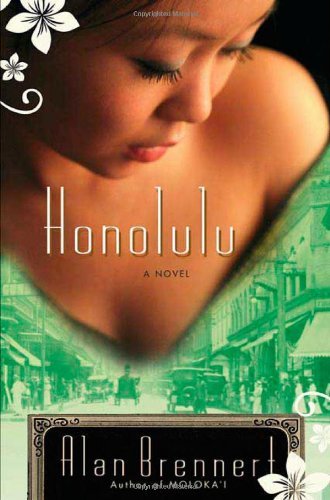
The story of a young immigrant bride in a ramshackle town that becomes a great modern city.
"In Korea in those days, newborn girls were not deemed important enough to be graced with formal names, but were instead given nicknames, which often reflected the parents; feelings on the birth of a daughter: I knew a girl named Anger, and another called Pity. As for me, my parents named me Regret."
Honolulu is the rich, unforgettable story of a young "picture bride" who journeys to Hawai'i in 1914 in search of a better life.
Instead of the affluent young husband and chance at an education that she has been promised, she is quickly married off to a poor, embittered laborer who takes his frustrations out on his new wife. Renaming herself Jin, she makes her own way in this strange land, finding both opportunity and prejudice. With the help of three of her fellow picture brides, Jin prospers along with her adopted city, now growing from a small territorial capital into the great multicultural city it is today. But paradise has its dark side, whether it's the daily struggle for survival in Honolulu's tenements, or a crime that will become the most infamous in the islands history...
With its passionate knowledge of people and places in Hawai'i far off the tourist track, Honolulu is most of all the spellbinding tale of four women in a new world, united by dreams, disappointment, sacrifices, and friendship.
Alan Brennert is the author of the historical novels Palisades Park, Honolulu (chosen one of the best books of 2009 by The Washington Post), and Moloka'i, which won the 2006 Bookies Award, sponsored by the Contra Costa Library, for the Book Club Book of the Year (and has sold over 600,000 copies since publication). It was also a 2012 One Book, One San Diego selection. He has won an Emmy Award and a People's Choice Award for his work as a writer-producer on the television series L.A. Law, and his short story "Ma Qui" was honored with a Nebula Award. His new novel, Daughter of Moloka'i, will be published by St. Martin's Press on February 19, 2019. Follow him on Facebook at https://www.facebook.com/alan.brennert.
A really good book but doesn't measure up to Molokai'. But what book does? I really enjoyed learning about the early 20th century Korean immigration as well as the history of Hawaii and it's city of Honolulu. I really liked how the author intertwined parts of true history into his book of fiction. Brennert has a way of transporting you to the island with his lush descriptions. You feel as if you are actually there. Or wish you were there. A solid book definitely worth reading.
Update... I read this years ago. It’s such a terrific story. I still remember the characters and situations. It’s a Kindle special $1.99 today.... for those looking for a very engaging historic novel.
I loved Alan Brennert’s first book SO MUCH....”Moloka'i", that I didn't think it was possible that this book could be AS GOOD..... but it was. Honolulu & Molokai are both heavenly Historical Fiction novels -- page turners--I love to give these books as gifts. They are really special.
I wasn't very impressed with Honolulu. The book's protagonist is a Korean "picture-bride" who finds herself in Oahu in the 1930s, and the book covers a period of time stretching from 1915 or so (in Korea) to just before WWII (thankfully Brennert didn't try to cover Pearl Harbor too).
The main problem I found was that Brennert simply tried to cover too much information, too many issues, and too many themes. It was utterly unbelievable that nearly every famous (or infamous) person in Honolulu during the aforementioned period would have some link to one unknown Korean woman, yet she seemed to be on intimate terms with everyone from the prostitutes of Iliwei to the famous cop Chang Apana to the beachboys of Waikiki to the principles in the Massie case. Clearly I got my history lesson, but the narrative suffered. I found myself most drawn to Jin's own story, the one of a Korean girl at the turn of the century who becomes a picture bride and then, eventually, works her way to a better life in Hawaii. THAT was the story Brennert should have stuck to. The rest just clouded the main story. Definitely a two-and-a-half-stars book for me.
From the beginning till the end, this book will surely captivate any readers by heart. It is filled with stories on how women live during the early 19th century and how they were to able to cope with every struggle they've encountered. If you like reading stories about women empowerment, then you must not miss adding this book to your to-read list.
The Publisher Says: “In Korea in those days, newborn girls were not deemed important enough to be graced with formal names, but were instead given nicknames, which often reflected the parents’ feelings on the birth of a daughter: I knew a girl named Anger, and another called Pity. As for me, my parents named me Regret.”
Honolulu is the rich, unforgettable story of a young “picture bride” who journeys to Hawai'i in 1914 in search of a better life.
Instead of the affluent young husband and chance at an education that she has been promised, she is quickly married off to a poor, embittered laborer who takes his frustrations out on his new wife. Renaming herself Jin, she makes her own way in this strange land, finding both opportunity and prejudice. With the help of three of her fellow picture brides, Jin prospers along with her adopted city, now growing from a small territorial capital into the great multicultural city it is today. But paradise has its dark side, whether it’s the daily struggle for survival in Honolulu’s tenements, or a crime that will become the most infamous in the islands’ history...
With its passionate knowledge of people and places in Hawai'i far off the tourist track, Honolulu is most of all the spellbinding tale of four women in a new world, united by dreams, disappointment, sacrifices, and friendship.
My Review: As this book wings its way off to the Bookmoocher who requested it, I felt a farewell was in order.
Farewell.
It's not like the book was bad. It wasn't particularly outstandingly excellent but it was a good way to pass some time when an unchallenging yet engaging book was just the thing called for. It's not like Brennert is a modernist icon and writing in arabesques of fiendish complexity. It's like he's making a pot of tea, putting some pastries on a plate, and bringing you your afternoon delight. The tea is Lipton's and the pastries crinkled the cellophane wrapper they came out of, but you got your value.
Descriptions are Brennert's stock in trade. When Regret gets to Hawai'i and the story really takes off, the landscape becomes the star of the show. It's clear Brennert is in love with Hawai'i and it's even clearer than Honolulu's history is what he'd use his shiny new time machine to explore. His delight in every detail is evident, but it's not the dreaded "you will not leave this page without knowing everything that I know!" It's the enthusiastic comprehensive conversation of the lover about the beloved.
I was thumbing through the pages to see if I'd left any Book Darts on some quotable quote or another. I had not. It would seem I had never marked any quotable quotes. I can't remember any lines from the book; I can't make a case for why you should read the book; I can't say I'd even remember having read it except for Regret striking me as such a cruel nickname for such a gentle lady.
This is not an insult: This is the kind of book I read instead of watching television. It requires the same level of engagement from me that TV does from most people.
Man, Alan Brennert has some gorgeous prose. I loved his first novel, Molokai, for its touching and painful look at the life of a young girl banished to a remote Hawaiian island after coming down with leprosy. And this tale of Jin, a Korean girl who travels to Honolulu as a picture bride to escape a life of occupation by the Japanese and one where she will only ever cook and clean house, first for her father, then under her mother-in-law’s thumb. Her struggles and depiction of this strange new melting pot of Hawaii with its many new cultures, even as part of her remains firmly Korean, are so elegantly and movingly rendered. This was a really beautiful read for anyone who enjoys period pieces.
Please excuse typos/name misspellings. Entered on screen reader.
This story was continuing on Berennert’s Hawai’i theme started in “Moloka’i”.
The story was very beautifully written, descriptive, and vivid. It placed you in the location that you were reading about. And if you have been to Hawai’i or in Korea before the partition, hopefully this story will bring back good memories.
The main character Jin, knew that life had more to offer, so against family tradition, she left Korea and went to Hawai’i as a picture bride.
In this story, you will see a resilience of not giving up. It has the highs and lows that family stories have. Some are more traumatic than others. Also, the author weaves current events of the time, into this family narrative.
You will want to see this story through, even if it means a night or two without sleep spent reading it.
I was born in Hawaii and spent 18 fabulous months in Korea as a missionary. When perusing books at the library, I stumbled on this little gem and loved it from the start. While in Korea in the late 1980's, I wondered at the social rules of the day. Women walked behind their husbands, men 'owned' their wives and domestic abuse was high, women did not eat meals with their husbands, rather they remained in the kitchen, young adults in love could neither hold hands, nor kiss in public, girls covered their mouths when they laughed, a woman could treat her daughter in-law horribly, and other such rules. I remember going to a home for dinner and when my companion and I sat on the floor to discuss missionary work with the male missionaries and the mission leader, he shouted at us to get in the kitchen to make food with his wife! I witnessed a man beating the crap out of a woman, his wife, girlfriend, whatever, and pounded on his car window demanding he stop (I had a blind rage that day and did not think of, or worry about, my own safety). When he saw this American screaming at him, he drove away, probably just around the corner to resume the beating. The hierarchy of men over women never sat well with me but it was interesting to learn more of the history. The Confucian ideals seem old-fashioned and very conservative, "The wife must regard her husband as heavenly; what he does is a heavenly act and she can only follow him." I knew the Chinese preferred a male child over a female, and given the social rules regarding men and women, the Koreans felt the same way, more so in previous generations. The main character of the book was, unfortunately, named 'Regrettable'.
Growing up in Hawaii during my grade-school years, I thought the world was my backyard. I never longed to leave to visit the mainland (other than to see my grandparents), and was confused when my best girlfriend moaned, "I've got to get off this rock!" I wondered what rock she was talking about and where she wanted to go. I caught a glimpse of old Hawaii and the merging of cultures as the Koreans, Chinese, Japanese, Filipinos, American military, and a hundred other nationalities descended on the islands before the first World War. I could picture many of the places in my young girls' mind, remembering the sugar cane fields my family used to drive through from Ewa (Eh-va)to get to Waipahu for church. I felt transported back to a Hawaii that was both familiar and unfamiliar, and came to understand a little more why, as a haoli child, I was so despised by the local children at my middle school.
The book was a treat for me, perhaps given my personal ties to both the Korean culture and Hawaii, but still, it was a book surely anyone could enjoy. A young girl, once destined to be the wife of a husband who would appreciate her only for her cooking, cleaning, and bearing children, specifically boys, but who would never attend school or leave the Inner Room, becomes a 'picture-bride' and travels to the unknown land called Hawaii and her path changes forever. "A road need not be paved in gold to find treasure at its end." She comes to understand that 'Hawaii is not truly the idyllic paradise of popular songs--islands of love and tranquility, where nothing bad ever happens. It was and is a place where people work and struggle, live and die, as they do the world over.'
4.5 Stars. Early twentieth century Hawaii comes to life in this descriptive historical novel depicting the life of Korean picture brides who migrated to Hawaii for a chance at a better life. While Moloka'i remains my favorite Alan Brennert novel, I was totally hooked on the life of Regret from start to finish, and the interesting character's (some real, some fictional) that she encounters in her struggles and injustices of everyday life; my favorite being the colorful prostitute May Thompson with her cat "little bastard", and the detective Chang Apana with his whip and Indiana Jones lifestyle.
Another moving and memorable read by AB for me. Definitely recommend!
When in Honolulu…….it’s never a bad idea to read Honolulu, especially when you are actually there. I really enjoyed immersing myself in this book while in Waikiki and then by the ocean on the North Shore of Oahu!
This is a “linear” (Yeah!) story which primarily takes place from 1914 to just before WWII. We meet Regret (Korean name), Jin (Hawaiian name), as she travels to Hawaii as a picture bride. Through Jin, the author takes us through some of the history of Honolulu. Most of the events did take place. Jin also meets some famous personalities. One of my “special” moments was when the author brought in the story “Rain” by Somerset Maugham. I read and loved that story last year- to find it was based on an actual encounter was surreal.
Very true of most immigrants was how hard they worked to make ends meet and to get ahead. The struggle to assimilate in your new country, the prejudices experienced, the rude awakening to marrying an unknown man were all depicted in this book.
A fine historical novel that I would definitely recommend if you want to capture some of Honolulu’s history as well as meet some strong women whose spirits will capture your hearts.
The main character, named "Regret", is born in Korea in 1897. In 1912, she goes to Hawaii as a "picture bride",to be married immediately on arrival to a Korean man. As picture brides, these young girls were brought to Honolulu by false promises. When they faced the reality of their situation, they had to either make do as best they could or strike out on their own. Regret, now calling herself Jin, leaves the plantation and goes to Honolulu. There she uses her sewing skills to begin building a new life for herself. In following her story, you meet all the immigrants and native Hawaiian people who overcome their traditional animosities to succeed together and become the "mixed plate" that made Hawaii what it is today.
Although written as one woman's life story, this is really the story of all the immigrants who went to Hawaii during its territorial period. Chinese, Japanese, Koreans, Portuguese, and Filipinos went there to escape poverty and/or political and social oppression in their native lands. When they arrived in Honolulu, they faced grueling work on the sugar plantations, brutal treatment from the white overseers, and barely livable company housing. Along with this they had to cope with huge culture shock and language barriers. Yet for many of these people, this situation was better than what they left behind in their own countries.
While not strictly historical fiction, I think Honolulu is an excellent composite representation of life in Hawaii in the early 20th century. Brennert has woven many true stories from that time period into the narrative. I learned quite a bit, and for me the history gave the story much more depth and color. Among the many historical references, he includes:
A real murder trial featuring Clarence Darrow as defense attorney.
The real woman who inspired Somerset Maugham's "Sadie Thompson" character.
A Chinese-Hawaiian cop named Chang Apana ("the real Charlie Chan"), world-famous for his remarkable skills.
A race-related riot in the notorious Iwilei prostitution compound.
Fascinating account of Honolulu in the early part of the last century, as told by Gin, a Korean “picture bride.” She left her home country, which held no opportunity for women of her class, and traveled alone to Hawaii to marry a man, sight unseen. On the trip over, she made lifelong friends in several other picture brides. Their personal trials and tribulations form the framework for the story, which weaves in the wider issues occurring in Hawaii, and several well-known personalities and historical events. I loved Molokai by this author, and this was equally engrossing.
Honolulu by Alan Brennert is a fantastic book about a Korean girl “Regret” agreeing to marry in order to get to Hawaii. She married an abusive man. This is her story. Alot of information packed into this story. I learned so much about Korean customs. This lovely novel brought in Chinese and Japanese customs as well. Racism was rampant even before the Japanese bombed Pearl Harbor. Life was hard, rough and poor. But as difficult as life was it was still easier than living in Korea.
Regret is a young Korean woman named for the disappointment of her parents because she was a female baby. She felt repressed by traditional Korean society in the early 20th Century. Regret secretly learned to read and wanted to obtain an education. She hoped the situation would be better if she signed up to be a "picture bride" of a man living in Hawaii. Her husband, a violent plantation worker with gambling and alcohol problems, was not what she expected. She renamed herself Jin, and traveled to Honolulu where she used her skills as a seamstress to survive.
Jin formed strong friendships with other "picture brides" who also had challenging lives. The population of Hawaii was very diverse--native Hawaiians, whites from America, and Asian immigrants from Korea, Japan, China, and the Philippines--which led to conflicts. Jin's life was difficult, but her courage and hard work opened the door to opportunities. "Honolulu" was a compelling story with a strong, likable main character. Many historical and cultural references are woven into the story so this book would be enjoyed by historical fiction readers.
Simply, it tried to do too much. This is not to say I hated it. I found myself laughing and in tears at some points (BTW, I also cry at Cotton commercials) but for the most part, I was kind of bored. To me, this was a weak attempt at matching Arthur Golden's "Memoirs of a Geisha" - a white male writing from the perspective of an Asian woman in a very different time. Where Golden succeeded and lured me into believing his work of fiction was more of an autobiography written by a Japanese geisha, Brennert's left me feeling like I had read more of a brief history of Hawai'i through the eyes of a not-so-believable Korean woman. Perhaps it's wrong to judge this book against MoaG, but it's hard not to... and as a result, I feel like I've read a cheap imitation.
Not quite as heart rendering as Molokai but very good all the same. Starts in Korea with Jin raised in an old school household, she wants and education more than anything but girls are not valued for their book smarts. She signs on to be a picture bride and end up in Honolulu. What follows is a very good story with plenty of the history as she arrives when American businessman have already deposed the last Hawaiian monarch, though not in the peoples minds. Well written and interesting, Brennert really gets into the culture of the island as well as the politics and struggles of the people.
A lot of research and effort went into this gem of a book and I wish I'd've realized before reading it that some of the stories were based on actual people and events. Most of it is historical fiction based on journals, books, newspaper articles and library archives. It tells the story of several Korean girls (brides) who were bought by Korean men living in Hawaii looking for wives. The descriptions of the life of Korean women in the late 1800's and early 1900's is pretty bleak. Basically, they are slaves to their fathers and then husbands. They are expected to work hard, always be submissive and obedient to virtually everyone, even their own children, especially sons. After giving birth, they are known as "The Mother of Proud Hero Son," or whatever. The main protagonist was named "Regret." What a great way to start your life with a name like that.
There were many exciting expectations as these young paid for in advance brides left Korea to be in Hawaii where the streets are paved with gold. The men they meet are a far cry from what they expected, far older, not wealthy, wrinkles, etc. The story follows these girls as they make progress and learn and live in primarily Honolulu. There is divorce, prostitution, beatings, murder, little businesses opening and closing, great success stories and the Americanization of their children. There is a lot said about the bigotries of the whites against the dark skin Asians of Hawaii (as well as bigotry from the Koreans to the Japanese and vice versa) and it is painful sometimes to see the US Government's treatment of them well into the first half of the 20th century.
I'm going to need to read Molokai soon as well. It was published before Honolulu. I loved this book because it was so down to earth, realistic and full of great information.
Brennert’s book has a lot going for it...brave characters, interesting relationships, and a Hawaiian history lesson along with a few twists here and there. All this makes for a good historical fiction read. In my opinion, the book got a bit tedious at points but a great story nonetheless. I recommend this novel if this is your genre. 3.75 stars rounded up to 4!
My grandpa grew up on a plantation in Hawaii, so I grew up listening to stories of plantation life. I always found something thrilling in the idea of picture brides: it was so adventurous, so risky, and so often disappointing.
Men from Korea, Japan, China, and Okinawa went in droves to Hawaii in the early 20th century with promises paradise and the riches to be made there. Instead, they found themselves working under very difficult conditions for very little pay on plantations. They struck up a kind of community and even created their own language (a mix of English, Hawaiian, and all of their native tongues), pidgin, which is used casually in Hawaii today. Eventually, they wanted to marry, but they wanted girls from their own countries. Girls from their native countries sent over their pictures, the men picked a bride, and the girls were sent for. There was usually deception on both sides: the girls made themselves seem prettier than they were, and the men made themselves seem richer and younger. Our main character, seeking an escape from the oppression of Korea, decides to become a picture bride and finds herself the victim of this deception.
While I liked all the tidbits about plantation life, the book at this point didn't appeal much to me. Gem (or Jin or Regret) speaks much like Chiyo (or Sayuri) in Memoirs of a Geisha. I don't know if this is just what happens when white men try to speak like Asian women, but the similarities were uncanny. Gem was also a fairly boring character. A lot of interesting things happen in her life, but she herself is not an interesting person. She's too good. She doesn't make bad decisions. She's never mean or hurtful or silly or stupid. She's a bore.
The book really picked up for me in its last third. This was about race relations in Hawaii (a touchy subject even today) and Brennert used a real story and fictionalized it. It was at this point that I became enthralled with the book. I couldn't put it down; I needed to keep going until I knew what happened. Starting in the plantations where whites were the owners and overseers and the non-whites were the workers, racial tensions were high. Whites in Hawaii were a small but powerful minority. Watching this play out was fascinating--it more than redeemed the first parts of the book.
I enjoyed reading about the place I grew up, and it was shown in a very realistic way. When a place was mentioned, I could see it. I could hear how people were talking. I loved seeing Queen Liliuokalani and Duke Kahanamoku alive and real. Parts of this book were more real to me than anything I've read in a really long time.
This is very well researched historical fiction. Rich in detail, full of fact-based events & colorful drama it tells the story of Korean ‘picture-brides’ immigrating to Hawaii. The low rating is strictly based on my failure to empathize with the main character Regret, at least for the 1st half of this book. Not the author’s fault, he did his best to explain. She embraced a Korean emotion called han. A fatalistic acceptance of defeat and suffering, a despairing resignation to one’s lot in life." Add to her character rigid self-control, also considered a virtue by Koreans. For example it’s thought inappropriate to smile at your own wedding. In one instance, he writes of a husband waiting until the moment of his death before reaching out to hold, for the 1st time, the hand of his own wife.
The 2nd half was far more enjoyable, probably because by this time she was fairly westernized. She’d grown into a strong (though never assertive) woman, learned to stand up for herself, to expect justice and some level of equality. So I finished the book feeling rather flat, like I’d just watched an interesting but overlong documentary, and annoyed at myself for not liking it more. I can only fall back on the excuse that she was just too much my polar opposite.
Most memorable: Chogak Po – A hand-stitched patchwork cloth where each colourful piece represents one of life’s milestones. Regret’s mother gives her one in which black rectangles had been sewn randomly on top of the finished design. They represented her mood on the day of the death of her own mother. She explained there was no pattern to how they were placed, as there is no sense to be made of death. One’s eye may not go to them first, but next to them the blues look bluer, the reds richer, and the golds more brilliant. Without them the cloth is pretty, but without character or contrast.
4.5 stars. Regret, a young Korean girl, renamed herself "Jin" and travelled to Hawaii as a "picture bride" to escape a desolate existence back home. What she found awaiting her was a husband who misrepresented himself and his life and took his frustrations out on her. After a severe beating that cost her her unborn child, she left him to find a new life in Honolulu. There she meets a variety of people who help her reinvent her life and make her way in the world. Interspersed in the telling of Jin's life are real life events in Hawaii's history which adds to the richness of the story. The author does not hold back when he describes the racism that the non-white citizens of Hawaii experience, even among each other.
All the characters are fully formed, with quirks and faults. Only Jin seems a bit too perfect at times. A couple of temper tantrums would have been nice, just to make her more human. One thing I enjoyed was her inability to understand idioms. As an ESL tutor, I teach idioms, and her reaction to some of the English phrases cracked me up.
The descriptions of the island were nice, but not as descriptive as they could have been. You had a good sense of place, but it just missed the mark. The descriptions of Korea were better.
Having read Moloka'i, Alan Brennert's first book, I had high expectations for this one. Although Honolulu was very good, it just missed being as good as Moloka'i. He just set the bar way too high.
Still, this is a wonderful book and a definite recommend.
I am struggling with my review here - I really wanted to love this book, but I felt completely disconnected from it. In this story of a Korean "picture bride" who travels to Hawaii for opportunities that will never be available to her in Korea, Brennert seems to be trying to inject too many themes that it ultimately leaves me not really caring about the characters. There is the girl who leaves because she will never be more than an illiterate wife and daughter in law, the girl who must overcome an abusive domestic situation, race issues between locals and ruling class, a murder, a kindly hooker, Somerset Maughm, the depression, a policeman always there when needed, and more. Thankfully he left out Pearl Harbor. It is almost as if he had a list of ideas for a novel (including some which were actual incidents) and threw them all together and tried to make it work. I kept hoping it would keep my interest, but at the end, I just was hoping it would end.
Having loved the author's novel Moloka'i, I kept hesitating at reading this one, as I was ever so afraid that it wouldn't measure up to its predecessor. Well, I finally took the plunge and was richly rewarded for doing so. As with Moloka'i, I learned about a whole segment of history of which I was completely ignorant, always a reading thrill for me. The story of the picture brides from Korea (there were also picture brides from China and Japan), and in particular that of Jin (named Regret by her parents at birth due to her female status of lack of), was truly fascinating. To leave family and all that one knows behind and face a life in a new country with an unknown spouse has to be an act of bravery beyond most of our capabilities. Following Jin and her picture bride sisters through their arrival in Honolulu in 1914 and their journeys in establishing a life in a strange land is to follow the history of Honolulu through this same time period, from 1914 to 1957. Brennert deftly weaves in some well-known names and events into the story. The WWII years are skipped over, alluded to, but not related in any detail. However, this omission, surprisingly, for me didn't alter the effectiveness of the story and its completeness. Some have had issues with the last chapter being a rather rushed summation of the lives of these women, but I was glad that at least there was a summation and somewhat closure to the lives. What strikes me most about Brennert's novels is the aspect he comments on in his "author's notes" at the end of the book. Brennert states, "If there is a common theme linking Honolulu with my previous novel, Moloka'i, it is not just the history of the Hawaiian islands but the significance of the ordinary people whose lives--many quite extraordinary--make up that history." The author is able to bring to life those "ordinary" lives in a way that creates a connective history to us all.
I really enjoyed this story of a Korean picture bride making a life for herself in Hawai'i. I don't know much about Hawai'i and this story incorporates real people and real events, so it has been a very interesting read as well.
This is a quick read, despite being longer than 400 pages. It is historical fiction, filled with interesting little details about Korean and Hawaiian life from roughly 1915-1957, and the reader gets a good fill of the "mixed plate" (author's description) that Honolulu was and is. My personal struggle with this book was the author's inability to create any multi-dimensional characters. I felt the characters were "representatives of type" rather than anything you could sink your teeth into. Also, the dialogue was superficial and stiff and I didn't experience a memorable line until one of the very last pages.
Thoroughly enjoyable bit of historical fiction about mail-order-brides who immigrate to Oahu from Korea in the 1920's. James Mitchener's Hawaii continues to be one of my favorites and this book felt like some lost chapters. I love the aloha spirit, history and great storytelling that the author captured so well. Highly recommended. I'm excited to check out Molokai by the same author.
When you finish this book you’ll remind yourself that the grass isn’t always greener on the other side. It’s your attitude in your current circumstances that largely determines the outcome.
I’d never read a book about a Korean ‘picture bride’ before and was horrified at how women were treated in the late 1800s. When the protagonist is born, she’s a disappointment to her parents who were eager for a boy, so they named her Regret. Yes, you read that correctly. When Regret reaches school age, she’s denied an education. When she reaches marrying age, she sees what could be hers and doesn’t want it. Choosing to become a picture bride, she heads to Hawaii and marries a Korean man. She suddenly learns that her outlook is no different; except this time she faces abuse. She flees the plantation life and her husband, changes her name to Jin (meaning ‘gem’) and arrives in Honolulu. There she finds a melting pot of Japanese, Korean and Filipino people who’ve also come to escape oppression. They help her reinvent herself.
This is a slow-paced book with uncanny resemblances to Memories of a Geisha. It really is a kitchen-sink, slow-paced book with a race to the finish. Unfortunately, it struggles with unrealized potential in character development. I felt like I was reading ABOUT people, not living the experience WITH them.
Despite my disappointment, Alan Brennert’s writing is wonderful. Verbose, but wonderful. I learned about Korean and Hawaiian societal/cultural norms of the time and was treated to a very vivid description of the lush and exotic Hawaiian paradise.
Though I have read approximately 1500 books since this was released, I do remember this book very positively and wanted more! Another reviewer compares this story's telling as similar to something Amy Tan would publish and I wholeheartedly agree! I say this despite the fact that I really cringe when publisher's use comparisons to sell subpar books (in my opinion) so I seldom make such comparisons.
I will say, don't expect this to be as good as Brennert's more recent works "Moloka'i" or "Daughter of Moloka'i", because those two were sensational in my opinion. On the same token, I will say you should try to put this at the top of your TBR pile. I'm not sure why Mr. Brennert doesn't get more accolades or publicity, I think he is exceptionally talented. Perhaps it is because he is not more prolific? I sure hope that he continues to create such delectable treasures that will engage his followers once again.
I loved this book as I do everything by this author. He has a way of crafting a historical tale that stays with me long after I have read it. He starts us out in Korea and takes us through the early years of the development of Hawaii and all the struggles this state went through to become what it is today. You come to think of Jin as a kindred spirit and cheer for her and her family to succeed. I encourage everyone to read this wonderfully crafted tale from a master of historical fiction.