At four-thirty one Saturday afternoon the laws of physics as we know them underwent a change. Electronic devices, cars, industries stopped. The lights went out. Any technology more complicated than a lever or pulley simply wouldn't work. A new set of rules took its place—laws that could only be called magic. Ninety-nine percent of humanity has simply vanished. Cities lie abandoned. Supernatural creatures wander the silenced achievements of a halted civilization.
Pete Garey has survived the Change and its ensuing chaos. He wanders the southeastern United States, scavenging, lying low. Learning. One day he makes an unexpected friend: a smartassed unicorn with serious attitude. Pete names her Ariel and teaches her how to talk, how to read, and how to survive in a world in which a unicorn horn has become a highly prized commodity.
When they learn that there is a price quite literally on Ariel's head, the two unlikely companions set out from Atlanta to Manhattan to confront the sorcerer who wants her horn. And so begins a haunting, epic, and surprisingly funny journey through the remnants of a halted civilization in a desolated world.
Steven R. Boyett is the author of Ariel, Elegy Beach, Mortality Bridge, Fata Morgana (with Ken Mitchroney) and numerous stories, articles, comic books, and screenplays.
As a DJ he has played clubs, conventions, parties, Burning Man, and sporting events, and produces two of the world’s most popular music podcasts: Podrunner and Groovelectric.
Steve has also been a martial arts instructor, professional paper marbler, advertising copywriter, proofreader, typesetter, writing teacher, and Website designer and editor. He also plays the didgeridoo and composes electronic music.
I absolutely loved this book as a teenager. Read it to pieces, then could never find another copy. Fortunately it has been reissued, after far too long! It holds up incredibly well -- there are a few minor Handwavium (tm) moments in the plot that I never noticed before, and I can't help laughing now at all these geeky white guys playing samurai, but everything else is perfect. The characterization, the humor, the dreamy apocalyptic beauty of this Changed world... it's all as wonderful as I remember.
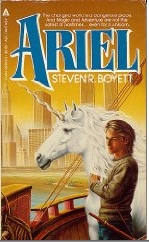
To get why this book is so beloved, you need to understand the context. This book came out in the early 80s, at the height of the "Tolkien clone" era, when fat fantasies about white farmboys getting the girl and becoming the Chosen Special King (or whatever) had begun to crowd out the Le Guins and L'Engles and Lees who had dominated fantasy throughout the Seventies. As a child I'd started to believe that "girly" fantasy was bad and therefore if I wanted good fantasy I was going to have to read only stuff written by white men and about white men and showcasing only white male power fantasies and man man man grunt grrr. So even though the edition of Ariel that I picked up had a girly unicorn on the cover, it also had a white guy on it, which was the signal in my head of what good fantasy required.
(I was 12 when this book came out. Most 12 year olds have terrible taste. I was that times internalized racism and misogyny. I read more and grew out of it.)
But lo and behold, this book had a white male protagonist... who was a virgin. He didn't want to get the girl, or at least not the human one. And yeah, he was uncomfortable with that, but he didn't allow toxic masculinity to overwhelm his sense of wonder at meeting and befriending a truly magical creature. He was kind of a Chosen One, with a Quest to undertake, but most of it was done with self-conscious tongue-in-cheek irony -- like when he gets a Special phallic object Sword and gives it the honored name of... Fred. And this book featured a very girly unicorn... who was more of a real character than many human women in the fat fantasies of the time. Helped that most of the human women in this story were also well-rounded and interesting, apart from their weird tendency to want to sleep with Pete. (Can't all be perfect.) So amid the testosterone-soaked formulaic epics of the time, this book was a breath of fresh air.
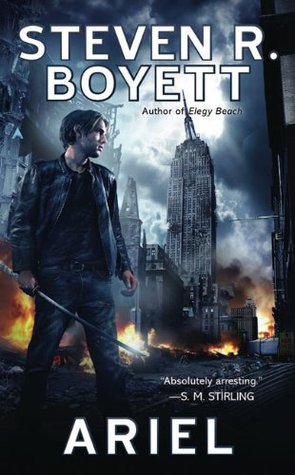
I'm not fond of the new cover (where's the title character, huh? What, was she too girly or something?), and I'm annoyed that it's only available in mass market paperback, given its thickness -- because I've cracked the spine on this copy already, which means I'm likely to read it to pieces again. But I'm happy to recommend it again, and glad it stood the test of time.
Postapocalypse with unicorn. Ok, I'll bite, especially since I've been hearing about this book from people like Cory Doctorow ever since it was reprinted earlier this year. Apparently little Cory's imagination got rocked by Ariel when he was an adolescent.
And I could see that. Written by a nineteen-year-old boy in 1983 or so, Ariel features a classic love triangle: a beautiful, accomplished, perfect untouchable blonde who for some reason hangs around with our weedy twenty-year-old protagonist; and an argumentative little brunette who - for some reason - hangs around with our weedy twenty-year-old protagonist. The blonde is a unicorn, but that sort of just makes her even more of a Dorothy Stratton figure. To put it in early 80's terms.
The action is well-scripted, and there's a lot of it. The world-building is not too excessive. Exposition is handled pretty well. The book is certainly readable all the way to the end. If there are echoes of The Stand and other post-ap fictions... well, I'm not sure you can write 400 pages of postapocalypse without hitting some of the same scenes. I just read Maurice Gee's Salt, as original a story as you'll find, and there were TONS of familiar elements in that book.
But the boyish wish fulfillment of the main character's relationship with his two women is utterly impossible to take. He treats the brunette abysmally from the moment he meets her, and yet, at the end of the book, there she is taking off her pants for him. The young man's virginity is a factor in his relationship with the unicorn, and day after his deflowerment, she rejects him and goes cantering off. But this is ok, because she has somehow lost her sparkle. The formerly spotless, noiseless, gorgeous beast is now dirty and lame as she crashes clumsily through the forest.
In an Afterword, the author says that he gets a lot of criticism for letting his main character end up with the human girl. I'm going to criticize him for letting his human girl end up with that main character. Gentlemen, I recognize that it can be something of a journey for you, finding out that under her white gown and lip gloss, Princess Leia was a cokey little drunk with body image issues. But that doesn't mean that the rest of us are lining up, just waiting for your standards to dip.
A re-read of a book read years ago and loved then despite the sad ending (no spoiler, but given the premise of a unicorn as a main character and the traditional requirement for their companions to be virgins, it won't be a big suprise). And to begin with, I did love it anew.
However this time around, some of the setting became questionable: for example, when the power goes off on the day of The Change and most modern technology stops working, not only is this rather selective - guns don't work, or bicycles, but we later discover wristwatches do - but people start to behave very extremely,
The 'gold' in the story for me happens two years later, when Pete meets a unicorn. She can communicate in baby talk, and he is able to teach her English, but she doesn't tell him how she hurt her foreleg until much later. As a virgin, Pete becomes Ariel's close companion: they are each others' Familiar, in the terminology of the post-apocalypse world where other creatures such as dragons, rocs, manticores and griffins have appeared and are sometimes bonded with humans, as are normal animals such as hawks. Since Ariel learns English from Pete she becomes a wisecracking character who swears and is generally not how you'd expect a unicorn to be, and that is one of the strongest elements in the story.
Pete and Ariel continue their aimless wandering until
On the way to New York, they meet a small boy sent on a quest to kill a dragon by his foolish father, and that part of the story is fine; the boy is charming and the working out of the physics of how dragons can both fly and breathe fire is well done. There are similarities in this section, probably deliberate, with Don Quixote by Cervantes, which Pete is reading to Ariel while they travel. However, they also meet an odd young woman called Shaugnessey who becomes a kind of fem fatale. She latches onto them, ostensibly because she is fascinated by Ariel, but soon develops a rather pathetic mooning crush on Pete.
Apart from the rashness of the journey - how can they defeat the forces against them - the story derails severely when the inevitable happens. . This occurs about halfway through and the story then drags despite some well-written action sequences, because the relationship which sustained it - Ariel and Pete - is parked. We don't see her again until almost the end when she is definitely not herself.
There is a focus throughout, and especially in the last half, on Pete's struggle against his sexual awakening (only to be expected considering he is about twenty). He has some embarrassing interludes, and it is clear when they were still together that Ariel was troubled by Shaughnessey's presence. And when they are apart, Pete behaves horribly towards Shaughnessey, coming across as self absorbed and unattractive.
I believe the book has been reissued with an afterword that explains some of the inconsistencies, including the disappearance of most of the human population and the absence of disease, but I haven't seen it. Suffice to say they stand out on this re-reading. Despite the graphic violence and sex, the book is probably more suited to the higher end of the YA age spectrum than for adult readers, which is a shame. The slump after the loss of Ariel - lectures on hang-gliding etc and guided tours of historic buildings in Washington feature - is indicative of the story's structural problems. I had good memories of it, and when I heard there was a sequel was interested to read that too, but am now not sure I would enjoy it. Hence only a 3-star rating.
Don't read too much in the number of stars I gave this novel. The fact of the matter is, having finished this almost a week ago, I'm still not quite sure what to think of it.
In fact, I'll go one step further. I could easily justify any number of stars for this book: (*mild spoilers abound, particularly in the poorer reviews*)
5 stars: A brutal, but sympathetic, look at innocence, growing up, friendship, and sex that has the good fortune to sit on top of a rollicking post-apocalyptic action-adventure novel.
4 stars: A fun, pull-out-all-the-stops swords and sorcery novel! The author is trying too hard in places to be deep (but the afterward indicates he's aware of this), and while he succeeds only rarely, one can forgive this because it features a group of samurai hang gliding from the world tradecenter in order to mount an assault on the necromancer-controlled empire state building.
3 stars: A reasonably entertaining adventure novel, with some serious momentum problems. Both times I tried to read it I got seriously bogged down in the middle, due to the disappearance or death of a few beloved characters and a lack of momentum towards the finale. I'm ultimately glad I finished it because there is much to like about the finale and ending, but the journey (particularly the second half) could have been more engaging.
2 stars: Um, unicorns aren't really my thing. I did like a lot of the characters, particularly Malachi Lee. (Although, his story arc, while well foreshadowed did not do the character justice.) Beyond that? Some good action, and the setting of the post-change east-coast is treated well, but there was a severe lack of development for some key characters (Shaunessy and the Necromancer for two...)
1 stars: What the #$%^ Stephen Boyett? I don't care *how* thoroughly you foreshadowed it, the ending is an unsatisfying mess. (and I *DON'T* mean, it should have had a happy ending, it just should have had a DIFFERENT ending.) AND Malachi Lee is one of the most poorly treated characters in the last 50 years of fiction.
So, there you have it. My attitudes about this book are complicated and poorly suited to a value-based review. Did I enjoy it? Not really...is it worth reading? Maybe. Am I glad I persevered and finished it? I suppose so yes.
Ye Original 1983 Cover, versus darker 2009 version. My, how our future visionings have changed.
Which cover is more accurate? Read it and see! (Hint: ).
SUMMARY: First published in 1983. Post-Apocalypse world with some magic. Stars a young man and a certain mythological (?) creature. Adventure, humor, sadness, sword fights, a villain, and more.
There's also a sequel, published many years later (2009): Elegy Beach
First Line: I was bathing in a lake when I saw the unicorn.
VERDICT: 3.67 stars. The world needs more sci-fi/fantasy mashups that are not completely ridiculous (and this one's less ridiculous* than most sci-fantasy attempts).
* Okay, I admit that some of the fight scenes in ARIEL were way-out completely ridiculous. I'm talking comic book level, or worse. This, along with some other minor to moderate quibbles, prevents me from awarding it the full 4 stars it may deserve.
But the rest was pretty good, if occasionally frustrating. It's the kind of book where you sometimes want to slap the protagonist, and can't decide if you want him to live or die--in a good way, I think.
I had some problems with the LACK of science here (specifically, the NON-decay of gasoline, car tires, rubber shoes, clothing etc.), but you may not give a whit about such details, because you are distracted by a unicorn with a sense of humor, and a human with an inferior one.
PS: I laughed out loud at least twice--probably at inappropriate times.
Originally published in the early 1980's, this is an overlooked gem of a novel that deserves a wider audience. I first read this as a young child, and it stuck with me through the years, despite my misplacing my copy and not being able to find a new one until years later.
I've re-read this a handful of times in the long years since, and (like a select few other books) it never fails to bring back that same sense of wonder any time I read it.
Objectively, it holds up (for the most part) pretty well to this day, despite the fact that it is firmly rooted in the 80's. There is however, one glaring plot-point (no spoilers) that some modern readers may object to, but the author addresses that in his introduction in the more modern editions.
As an aside, the author wrote one other book, (Elegy Beach), a loose follow-up to this novel ; despite my love for this book, I just could NOT get into that sequel, as it is (IMO)structurally, tonally and thematically the antithesis of this book.
Just another story of a kid and his foul-mouthed unicorn, at least these days... but when it originally came out back in 1983, Ariel was a small treasure, a groundbreaking step in the reimagining of fantasy tropes that has since become such a major industry, and I loved it. The 2009 edition has only been slightly retconned (retroactively updated for continuity); Boyett explains why that is, in a brief Author's Note and an extensive Afterword (which is, to my mind, a major selling point of this edition).
I approve of Boyett's restraint, even if he does spend some time second-guessing it later. A novel is an artifact in time that is best seen in the context of its time, not unthinkingly updated to conform to modern sensitivities which are themselves merely a snapshot of evanescent norms. (This is the kind of thing Connie Willis parodied in Remake(see also), where minimum-wage grunts digitally airbrush the cigarettes out of old movies, and it's sharply distinct from what Boyett himself is doing here when he takes ancient myths and puts his own stamp on them.) And it's no excuse to wait until after the author's dead to begin making changes, by the way; there is at least one "editor" whose new editions of deceased sf authors' works are automatically on my do-not-read list, precisely because of his propensity for such meddling.
But that's beside the point, really. Ariel is the work at hand, and it stands on its own as a thing of (rather profane) beauty, a post-apocalyptic fiction in which the apocalypse is not nuclear, not biological or nanotech, but magical... "the Change" being that singular point when Magic returned to the world, shouldering aside (most) technology without apparent effort. Guns don't work; cars don't work; electricity doesn't work... and magical creatures have returned to the world.
Pete Garey survives the Change and its anarchic aftermath well enough, but it's not until he meets Ariel that he really acquires a purpose. That purpose is quixotic, perhaps--it's no accident that the book he's reading to Ariel while on the road is Cervantes' Don Quixote--but it's of a piece with the rest of the post-Change world. For, just as James Tiptree Jr., said, "Passing in any crowd are secret people whose hidden response to beauty is the desire to tear it into bleeding meat." And there are people in Pete and Ariel's world who see unicorns as just a horse with a valuable horn.
Boyett's not the most prolific of novelists, and Ariel is not really that long a book; I recommend savoring it well, before going on to the more recent followup (I hesitate to call it a sequel), Elegy Beach. But if you've ever wanted to know why that glowing creature was standing on a tumbledown freeway overpass in your dream, here's the place to start looking.
It took me a while, but I finally finished Ariel, by Steven R. Boyett.
As the story begins, six years ago the world underwent a Change. At least, no one's said anything about the world outside the US, but since no one seems to have come along and tried to colonize the country from a stronger base the presumption is that it was a global thing. At 4:30 one afternoon, everything mechanical stopped working, from battery-operated watches to cars to telephones to guns. And for various reasons lots of people have died.
The story is told in the first person by Pete Garey, 20 (21?) years old and on his own since the Change occurred. Over a year ago Pete found a very young unicorn with a broken leg - and the book almost lost me right there when in a flashback the pretty little thing looked up at him and said, in a little girl voice, "Bwoke". Repeatedly. (I mean, what possible reason would there be for a unicorn, communicating telepathically afaik, to mispronounce something, no matter how young?) What with one thing and another, Pete was - and is as of the time of the book - able to touch the unicorn, being still a virgin, and he helped her to heal. He named her Ariel, and they have become partners over the last couple of years, traveling and surviving together. They are, in fact, Familiars, which is pretty much what the common Fantasy usage is (as opposed to Buddies, which happens when a human bonds with an animal to gain control over it). They wander the southeast without much of a goal beyond survival, until the day they discover that there is an evil sorcerer in New York City who wants her horn. Not her, necessarily – her horn.
I don't know. It's a neat idea (which is why it's been used repeatedly): suddenly the laws of nature change, and nothing mechanical works but magic does, but ... shouldn't that mean the wheel wouldn't work? I mean, guns don't fire. Wind-up wristwatches work, but guns won't fire. Guns have been around for hundreds of years, and aren't all that mechanical; my understanding is that it's more of a physics thing than anything else, especially with old weapons; there's no reason a revolver shouldn't work even if technology has been obliterated. The explanation given is that Boyett hated guns, and didn't want them in his book, and so discarded logic in favor of the explanation "It's magic. Just because. Shut up."
Also, Boyett was 19 when he originally wrote the book, which actually explains a great deal.
Something I find fascinating is that the edition I have certainly doesn't show Ariel on the cover - it comes across as a gritty urban post-apocalyptic fantasy: crumbling edifices, fire, random hub caps, and a sword. It was, I think, a good idea not to put the glowy white unicorn on the cover. That way lies Children's Book, which this certainly isn't. It is, however something of a coming-of-age story, along with the post-apocalypse semi-urban fantasy tale, and a Quest too. It's actually strangely off-putting to have a unicorn in this setting - I'm too conditioned to expect certain things when a unicorn is involved, and none of those things are present. Ariel curses like a sailor - or rather like Pete, from whom she learned to talk ... but she loves peppermint candies.
I ... just don't know. Pete's all right; he's self-absorbed, except when he's absorbed in Ariel - but if spoilers are not alarming see below for more on his self-absorption. Ariel is all right; she can be kind of bitch, which is actually funny in a unicorn. And she knows things she has no business knowing, but has no idea about other things; she doesn't know what a lighthouse is when she sees it, but she can always tell you what time it is, in the same sort of answer a person with a watch would: "It's five till ten." She doesn't know what Chesapeake Bay is, but she's able to identify a saddle on something else's back and can give accurate and detailed information on dragon physiology and how to kill one. A factor in my lack of fondness for Ariel is, I think, that Pete spends so much time telling me how wonderful she is, but I don't really see it in her actions and words. He tells me I should like her, but I'm given no reason to decide to like her. And the punning is as much fun as a hair shirt. In his afterword (so charmingly called "Taking a dump in Lothlórien" - which, by the way, he accents incorrectly), Boyett talks about how the book evenly divides people into two camps: those who loved the book and whose lives it changed, and those who flung the book against a wall and wrote him hate mail. There is, he claims, no one who falls in the middle area. I hate to break it to him, but yes, there is. *raises hand* I did not love the book. I don't think it would have changed my life even if I'd read it in my formative years. But I didn't fling it, and the urge to write a nasty email died quickly. I hated the ending, but by then I didn't care all that much; I'm not sorry I read it, but I simply won't ever reread this one.
****SPOILERS FOLLOW (not plot, but details of setting)****
I might have missed something, but I'm trying to work out what happened to the populace. Because Pete and Ariel can walk for days, on or off roads, and never meet anyone, and when they do it's nearly always just a handful of people. There were over 238 million people in the US in 1985. There were over eleven million people in Florida, where Pete and Ariel start out the book, where Pete grew up. Yes, lots of people have to have died in the cataclysm. Obviously, if you were in a plane when the Change happened you were ... in trouble (my first instinct being to say "screwed"). Hospitals obviously would be in peril; with generators useless as well as everything else, life support would be almost immediately ended. There were apparently a huge number of suicides, which is understandable, and looting and murder and general lawlessness is rampant, which is (unfortunately) human. Oh, and if you were driving along a highway and were caught going 55 in the middle of nowhere, that would be a problem. Would there have been crashes on highways if every vehicle there was just ... stopped, and if so would they have been bad enough for fatalities? Would forward motion keep people moving for a few minutes? Why wouldn't brakes work - isn't that a simple matter of depression of the brake pedal applying the brake shoe to the wheel and slowing it, power brakes being only to make the process easier? (What about elevator brakes?) And what about everyone else? (It's magic. Just because. Shut up.) I suppose people stuck far away from home - as I said, stuck with a useless car in the middle of nowhere, or at work in the middle of nowhere - could lead to starvation, death from exposure (though probably not in Florida), or various other sorts of accidents. Cities have emptied, except for the dangerous and nasty. The first thing Pete runs into the day of the Change is intruders in his house - was one of those supposed to be his brother? If so, why? Did the Change affect some people's minds? The neighbor who was a policeman seems to have gone mad - oh, and the cannibal Pete has to kill right at the beginning of the book. The loss of plumbing (did they? Lose plumbing?) and sanitation doesn't seem to have cost lives; the moment the Change hit the air and water cleared of all pollution, with an improbable immediacy - although Boyett never says if it's a self-cleaning system, as in whether it would matter if a clutch of survivors used a river as their latrine. Rampant disease is never mentioned. So ...?
Oh, right - there was apparently an immediate influx of magical beasts, many of which will happily eat human. So that might account for a decent number of people, especially in the first few unprepared days - but ... Where the heck did they come from? Did they all spring into being at the same time, the moment of the Change? Or did they always exist, and were released or emerged from hiding all at once ...? This is one of the problems with a very young writer and an equally young narrator; neither knows everything, so there are many annoying unanswered questions.
More: why hasn't Pete ever tried to find his family? He said that his mother worked a few hours away by car; why not leave some kind of message at the house - just in case - and set off toward where she would have been, even if it was a few hours' walk, or a day's, or more? It's stated she works in Miami, but not where the family lives, so it's all speculation (though they apparently live very much in the boonies, as it's several hours' walk from the high school home. I could walk to our high school in under an hour. Say she worked two hours away, which is an idiotic commute, but just say; that would be say 100 miles. Cut it down to "as the crow flies" - or as the boy walks - and call it 60 miles, though it could be a lot less. So it might take him about a day and a half; he wasn't in shape yet, so two days. Big whoop. He wandered all up the whole East Coast, for heaven's sake - a few dozen miles to find his own mother shouldn't be too much to contemplate. He might never have found her - but he's spent the last five years wandering aimlessly anyway. I would have thought if he gave half a damn about his mother he would make some effort to go and see if he could trace her. I'd imagine she would look for her children. And what about all of his other friends, and extended family if any? His brother? And what about the family of the girl he saw killed? They can just wonder for the rest of eternity?
****SPOILERS FOLLOW (this time I mean it)****
No, I won't be reading this book again. I'm still not flinging it, but … Anyone want it?
When the apocalypse comes, it will be not with a bang, but a whisper. And it will change everything...
Boyett concerns himself with the world after, and in this story, a boy and his unicorn. It is an adolescent coming-of-age story, and would read well to the 14 - 18 crowd, as its author admits.
What can I say? The ending is as inevitable here as it was in Peter Pan, and in some ways was poorly-handled. While some might suggest that the sex was graphic, having worked with teenaged boys, I can say that the fantasies of the protagonist are realistic, and they do have a place in the story. The story itself is told through a boy's eyes (he might be 20 or so in the book, but Pete's emotional age is somewhat stunted, perhaps by spending 5 years wandering around mostly by himself), and the treatment of women isn't great (we are either temptress - deliberate or unknowing - or pure. There is no in-between. I'll save my "Madonna/Whore" lecture for another time though).
The world itself is an interesting concept, though there were some niggling inconsistencies in what works and what doesn't. I'm curious to see what Boyett has done for a follow-up (something he once swore he'd never write).
Not a bad read for on the beach, train or plane. Especially good if you fit into that "adolescent male" bracket, I suspect. Girls might enjoy it... but I don't know that they'd find many characters to identify with who weren't male.
Very readable yet, ultimately, unsatisfying. Set in current times after "the change" (when virtually all but the most primitive technology stops working and magical creatures start showing up), Ariel features a dull and wimpy main character who teams up with a talking unicorn to battle an evil necromancer.
Elegy Beach, the sequel is MUCH better and definitely recommended.
Little is done to explain anything at all about The Change -- it just happened and we should get over it, apparently -- and the main character is constantly making stupid decisions -- okay if that's who he is, but in this case it seems like it's more because the author wants to move the story along than out of any desire to reveal a hero's inner weakness.
A light and easy read, the book is also uneven; short on back story and "world building", long on shallowly drawn characters and pointless explanations (I don't need a lengthy primer on how to assemble and fly a hang glider, thank you), and full of uninteresting action sequences and plot twists.
I'd heard good things about Ariel and really wanted to like this book, but it turned out to be one of those novels that had me frequently stopping to remark, "Well that's stupid."
I absolutely adored this novel when I read it back in high school and I'm reading it to my husband now and I still love it. I liked the totally unique take on the post-apocalyptic world Boyett created where magical beings emerged from the shadows and technology ceased to function. The rules had changed...and unicorns could not only talk, Ariel actually cusses! LOL! It's a wonderful story of fantasy, friendship, survival and battling the odds. In fact, I loved this book so much, it's where I got my pen name. (Arial is numerically aligned with my birth date, ergo the different spelling.)
My selection for the 'New to You Author' square in the 2021 r/Fantasy Bingo. This was a book that has been on my TBR shelves for quite a while. I bought it because the premise sounded interesting. At 4:30pm on a particular day, the world underwent a Change. There was no more electricity, complex technology no longer worked and magic and supernatural creatures appear. It's starts as your typical post-apocalypse urban story (but with those caveats mentioned above); lots of looting, killing and loner survivalists . Pete Garey is one such person until he meets a unicorn and helps her.
I'll stop there because I'll start to give away big chunks of the plot if I write any more. Suffice to say that this is a story about good vs evil; pureness and innocence vs "corruption". I'm not sure the magic system was completely explained to my satisfaction (it was certain convenient that guns no longer worked and fighters had to resort to simpler weapons -- including high-tech crossbows).
This book was originally published in 1983 and it's mostly aged well. There is a sequel that came out 26 years later (and you thought you'd been waiting a long time for GRRM or Patrick Rothfuss) that might be interesting to read, to see if any/all of the loose threads (including why the Change happened) are tied up. Some day...
(Other 2021 Bingo categories for this novel are: "First Person POV", "Revenge-Seeking Character", "Genre Mashup" and "Debut Author")
Interesting little book. It's an odd sort of dated post apocalypse (if you can call it an apocalypse) book. The "Change" took place a few years ago and the story depends on a world where libraries still have card catalogs...smoking is more common..the Trade Towers still stand and a few other things.
I found the story, "okay". It was a little disappointing with lightly drawn characters who often behave in an illogical manner . I found the protagonist weakly written and vacillating from a sort of "duh what's up" character to a Jerk.
The book is easily readable and if it weren't for the language, violence, and graphic sex it could be a YA book. At least that's the level of most of the writing, very simple and straight forward. I don't dislike the book, I simply hoped/looked for more from it. You'll get plenty of action and some magic..."wonder". The book also seems to try for a, humans are bad and impure and will dirty "stuff" motif. It's not something I found that well done, but it's there and of course you may disagree with me completely on all this.
As I said, pretty good, easy to read, lots of action, just a little weak. Enjoy.
If you like SM Stirling's Change novels, you'll probably like Ariel as it seems Stirling cribbed heavily from this book in order to come up with his own "Change".
There are just as many inconsistencies in Boyett's book about how the Change works, but it is mostly easy to ignore. What's nice is it isn't loaded with all of the remarkably favorable coincidences that appear in Stirling's Dies the Fire (and presumably his other Change books in that same series, that I refuse to read).
Boyett's book is sorta YAish and he's a little in love with adverbs and adjectives, but the book is enjoyable enough -- though you see the ending coming a mile away. And I can really do without the urban fantasy trope of SCA folks and Wiccans having the perfect skill set for the post-apocalyptic fantasy world. What fucking nonsense!
I prefer my post-apocalyptic worlds with guns and a clear event that caused the apocalypse in the first place -- NUKES, ZOMBIES, DISEASE, whatever, but these kind of fantasy books are a fun change of pace and I'll probably get around to reading the sequel eventually.
this book, wow! First, I was horrified by what was happening to us all, then Bam! I am in a love story, so hopeless it breaks your heart, then I was tossed into a quest novel, with a little action, suspense and angst! The book was a roller coaster ride, that haunted me. I re-read books until I need new copies, but I have to space re-readings of Ariel out, because it is so beautifully heartbreaking.
Hmm...once I'd suppressed my fear that the main character would try and shag the unicorn, I felt a lot better.
Things I liked: Ariel's matter of fact and direct attitude. She's a very practical unicorn for the most part. Although this was a close DNF, I'd say she saved it. Also the ending, despite everything.
Things I hated: Everything else. Being in love with a unicorn, the unicorn getting all "womanly" and jealous when another woman comes in, all the samurai bollocks, the dragon storyline that seemed pointless, treatment of women(which could be worse, I know) the fact I felt like I was reading a Stephen King book the entire time, the fucking hanggliding - YAWN - etc etc. Sodding off to Washington and pissing about. anyway, the past is another country. Old fantasy and science fiction loves to remind you of that.
I'd recommend this book for mature-ish 15/16 year old boys. It's gory and sex-filled. However, it reads better if you think of Pete as a 16 year old boy rather than a 20 year old. It doesn't quite qualify as Young Adult, but it comes close. Pete is a good Young Adult hero, what doesn't make it Young Adult is the length, sex and gore. The writing style even puts it at borderline Young Adult.
I'm pretty sure I just read a 400 page metaphor for a boy going through puberty; either that or it's a 400 page metaphor for a boy losing his virginity. Five or six years is a really long time to go through the worst of puberty. The lights, cars, and guns stopping working is even called The Change!
The fact that guns stopped working was pretty damned arbitrary, by the way.
When The Change happened, Pete was 14 or 15, just a normal nerdy teenage boy. He went to his debate event and even when the lights went out, at 4:30, they opened a window shade and kept going. He walked his girlfriend home in the dark, and when her folks weren't home, they walked to his place with the plan to go back the next day. They'd spend opposite nights in each others' houses until one set of parents made it home. Surprisingly enough, that plan didn't work, and that night Pete headed out on his own.
Two years after The Change, Pete was bathing in a clean stream musing on how quickly the waters cleaned up after technology stopped working. When he looked up, there was a unicorn standing amongst his clothing. When he got out of the stream, Pete could tell that the creature had a broken leg, and it spoke! After the Change, mythological creatures started cropping up everywhere. Unicorns, however, only show themselves and allow them to befriend the purest, the virgins. Pete names it Ariel.
The sex thing in this novel is so weird. Pete is so afraid of his own sexuality. He is so afraid of his sex dreams and when he masturbates in his sleep he really bugs out. I know he's afraid of losing Ariel, but dear Gods, he's supposed to be 20 or so. I know the world is different, but it's not so different that men and boys stop physically maturing. Even though it may have been weird having no one to talk him through puberty, he clearly knows what sex is from the way he describes his dreams. But he's so goddamned afraid of it and every time someone comes onto him or admits to have had sex, he gets nasty.
Five or six years after The Change is when the bulk of the novel takes place. (In the novel it says six years, but on the blurb, it says five. Consistency fail.) Ariel and Pete have been wandering from town to town, when they meet men on the road who will do anything to posses Ariel, especially her horn. These men are led by an evil necromancer, who lives in New York City. They go on a quest, to defeat him, walk to New York where Ariel is taken. Making a few friends along the way, Pete is able to free Ariel, but only after it is too late for his innocence.
Oh, he wants to kill us with his powerful magics? We should walk right into his lair! HERP DERP!
Also, what is it with these characters crying all the fucking time? After The Perks of Being a Wallflower, I thought I was done with the sobbing main male characters for a while. I picked up a post apocalyptic book, for Godssake. But no, Pete cries at everything. Come on! Every time he's over tired, scared, confused, angry, etc. etc. etc. He's been living in this world for 5 or six years, by himself. Why hasn't he grown up a little more? At the end of the book Pete finally grows up. There's an event that forces Ariel to turn away from him. He couldn't stay a child forever. Thank Gods.
Two and a half stars because, regardless of how weird and unsettling and arbitrary the sex, gore, and world was, it was actually a fun read.
I thought this book was horrible. The ending is pretty good but everything up to the last 20 pages is awful. The main character makes bad choice after bad choice.
I'm not into the apocolyptic everyone that survives is evil thing anyway. Every civilization started some where but they all became civilizations not anarchies.
Just exactly why had the residents of his little neighborhood become marauding bandits within 4 hours of a power outage anyway? Mabye in the author's mind he explained this but in the reader's mind, there was a lot left out. America has 4 hour power outages all the time without entire populations disappearing or turning into murderers.
Why would you wander through a town carefully explaining to everyone that you meet that the beast at your side is a UNICORN when you know there is a price on her head? Sounds like a good time to decide to keep the beast out of the town...
And finally, the population would have had to be cut hugely drastically for the stores to have anything left in them after 6 years. The products in the stores today is enough to last until next week with the current population! The kid runs around telling everyone that nothing has changed since the change except that there is no power but he's still using all the goods that were produced before the change. What would he even know about it? He doesn't know how to knit a sock or grow a vegetable. And if there is no electricity, why is there water in the faucets? Municipal water comes from pumping stations that use electricty. This is not Rome. We are not on a gravity flow aquaduct system.
Read the "restored" reissue (2009) edition. I found the protagonist, Pete, a compelling character -- a 20-year-old loner wandering post-apocolyptic America-- an honest and original young man finding his way in the big, strange world of adults and serious consequences. (He cries alot, oddly. But that touch of anti-machismo perfectly suits him. So rarely do male authors let their male lead characters just have a good, honest cry!) This should be unsurprising, considering the author wrote this at 19.
The author's youth and first-novel inexperience are readily apparent in the impatient writing. He rarely takes the time to fully sketch out the necessary details that give a narrative depth and richness. (The main reason for the 2 stars, instead of the 4, that I would have loved to award this book.)
With the title character, Ariel, however, the limitations of the author's age become apparent. The unicorn represents (appropriately enough) a true and pure love. And, not surprisingly, this ends up being the weakest character in the book-- not anywhere near as "real" as the others. But, hey, coming from a 19-year-old, damn well done! (I was haunted for days by a little voice saying, "Bwoke.")
All in all a worthy read, flaws and all. A fresh, unadorned look at how a man's first true love molds his heart for life. Oh, and killer swordplay.
Ariel... Oh how I love this book! I picked this book up off of a display at the book store because I liked the cover. I had never heard of it or Steven Boyett. I read what it was about and was interested right away.
Because I usually do not purchase books, I spend about a week trying to find it at our local libraries. I couldn’t wait to read it.
Unicorns are real?!?! WHAT! and magic really exists! I am hooked already. I love the badassness the main character brings. Wielding a Samurai sword, fighting mythological creatures (that are real!) and trying to save a friend from a brutal death. Oh, it was so good. Then the world that they live in... it was magical. Not just because magic exists. Can you imagine not having any technology? No phones, computer, GPS, cars, trains, TV's. The world would be a much quieter and simpler place.
You get sucked in from the first page. If you don’t read it, you are missing out on something great!
There is a re-release of the original Inglorious Basterds with an extra feature tacked on where Quentin Terantino (suspiciously jittery and coked up looking,) unwittingly insults the polite old Italian man who directed the original by listing all of the things that sucked so gloriously about the Italian movie.
My review of this book would go something like that.
I love this brilliantly imagined, 70's kung fu disaster of a book precisely because of its unselfconscious suckery.
Don't dig too deep. Don't try to justify. Just love it for what it is; and maybe skip the afterword, (which is full of deep digging and justifications.)
I fucking hate unicorns, turns out, so this book was a bit of a challenge. Though if you ignore the unicorn, it is a smooth/fun enough read, the world-building is missing a few important details. Ah well. This book is important to post-apocalyptic lit for two other reasons: it was an inspiration for SM Stirling's Change/Emberverse series, and it is one of the very few magical apocalypses out there.
cool concept and there's some great stuff here but i just couldn't get beyond the fact that this was basically a coming of age tale about a dude who wants to have sex with a unicorn
"...nobody becomes a hero by setting out to do it. Circumstances make heroes. Some people just end up being in the right place at the right time and they do something they think is perfectly natural for them to do, and suddenly they're heroes." (p. 140)
A mash-up post-apocalypse/fantasy story. This takes place in our world but "the Change" wiped out all technology, guns no longer work, the water is purified and magical creatures roam the landscape. Society has crumbled, with the majority of people dying. The survivors have turned into roving bandits, with some even resorting to cannibalism.
It's a tough world to survive in, but our main character, 20-year-old Pete is doing his best. He's on his own when he meets the beautiful unicorn, Ariel. The two form a partnership and go on an epic adventure across the "Changed" world. They meet colourful characters, including the samurai Malachai Lee and his faithful chow Faust, the young would-be dragonslayer George, and others.
A group of bad guys want to capture Ariel for the properties in her magic horn. It's great - an action-packed adventure with memorable characters. A lot of fun.
This story of a young man and his unicorn Familiar starts out unevenly and at times feels disjointed or episodic. The treatment of the female characters is clearly wish fulfillment but far from the worst I've read in a fantasy novel. The ending was predictable, if abrupt and not really fitting the characterizations and actions that came before. I would have liked to see more about the Change and some deconstruction about virginity as purity (while they're killing people left and right no less--consensual sex is a no-no but killing is not), but I understand as a coming of age sort of novel by a young male writer that probably wasn't going to be on the agenda. Nonetheless, it's a simple and fairly fun read if you suspend some disbelief and don't think too hard about it. I think I would have enjoyed this book a lot more if I'd found it when I was younger.
I enjoyed this dystopian fantasy. Despite the author’s afterthoughts, set out beautifully in a long postscript, it is an entertaining read with unicorns, dragons and a griffin in world where mechanical things no longer work, but magic does. Lots of clever ideas, some sections a bit clunky, but a series of interesting characters (including the unicorn) enliven a relatively predictable plot. I loved the choice of quotations beginning every chapter and enjoyed the afterword.
This book looked really interesting and I have read good things about it so I decided to give it a go. It was an enjoyable read, although there are a few things in the book which irked me a bit. This book was originally released in the early 80's and this is a re-release of it.
This story takes place in the post-Change world of the United States. The Change happened one day and suddenly all electricity/technology stopped working and magical creatures began roaming the earth. Humanity was left to survive in any manner possible in this post-apocalyptic type of world. Pete is living day to day when he stumbles upon a unicorn with a broken leg. He takes the time to fix her leg and dubs her Ariel. A year later Pete and Ariel are still traveling together; only someone is after Ariel's power and Pete and Ariel only have one choice...to destroy the necromancer that wants to hold Ariel captive.
This book moves at a fairly brisk pace and kept my interest. The relationship Pete and Ariel have, as well as the relationship of other characters with their familiars, is very interesting and much of the story pays attention to this. I also found it interesting that there is so much focus on Pete struggling with keeping his virginity, if he loses it then him and Ariel can no longer be companions. Enter a young woman (Saughnessy) who tempts Pete more than she should.
While Pete and Ariel are very well-developed characters, the characters surrounding them could use some work. The evil necromancer is fairly faceless and we never get to learn his thoughts on anything. Even the young woman that travels with Pete is rather 2-dimensional; you never get to understand her or hear why she wants to travel with Pete or Ariel.
There is a lot of unfettered violence and a lot of action in this book. Those with a weak stomach might want to skip it; to be fair I don't think that the violence was made unreasonably gory...Boyett tries to stay true to what the resulting gore would actually be given that people's limbs are removed with swords quite often. I enjoyed the inclusion of the Japanese mentality to fighting with all the samurai sword action, those scenes were a lot of fun.
The ending of the book left me disappointed. I thought the choices that Pete made were kind of sudden and un-called for; but I will not mention any more to prevent spoilers.
There were a few things that bothered me about this book. The first was Pete's use of a blowgun to drop enemies immediately; it just isn't very realistic. In the Afterward Boyett says that he now realizes this. The second thing that bothered me was the lack of people. Pete travels through vast quantities of land without barely seeing anyone, which could happen. But then he goes through big cities without seeing many people. I realize if electricity/technology stopped some people would be killed in car accidents, plane crashes, etc...but a vast majority of humanity would probably be okay. I am wondering where they all went. Also since it has been six years since the Change, wouldn't you think humanity would be re-forming organizations and communities? There is a small community (300 people) talked about in New York, but other than that there doesn't seem to be much organization at all. I just found these aspects to very unbelievable and this lowered my opinion of the story, because it was so fundamental to the story.
Overall I enjoyed the story. It is a bit long and some parts are hard to find believable, but it is well written with some awesome action scenes. Boyett's idea of a post-apocalyptic world forced by a fundamental change in the laws of physics is interesting, but flawed at points. Will I be reading "Elergy Beach", the sequel to Ariel? Probably not. I just didn't love the world enough to continue reading about it.
One Saturday, at 4:30, everything stopped. Cars, planes, electricity, batteries. Just stopped. And magical creatures appeared. The Change, as it became known, altered everything. Pete was sixteen at the time and although he made it home, his mother and brother did not. After a short while, he packed a bag and left.
Ariel, first published in1983, is the story of Pete's experiences after The Change, especially after he meets Ariel, a unicorn. As Boyett tells it, only the pure - ie virginal - can touch a unicorn. This isn't a problem for Pete. Ariel and Pete wander, mostly in the Southeast US / FL, but circumstances take them into Atlanta, and then north on their quest. Their story ends in NY.
The story is classic fantasy that commences with world building and focuses on a quest, with lots of action-packed battle scenes as the good guys fight the bad. I found the WTC scenes difficult to read - but of course, in 1983, Boyett could not have known what was to come 18y later. Fun fact: he was 19 when he wrote this. Really enjoyed the character of Ariel, the unicorn. It was a really interesting was to write about a fantasy creature.
I enjoyed this, and though I can't remember how I heard about it or why I put it on my to-read list, it was worth it. I might even reread it with my son!
The Premise: Pete is a high school student in Florida when suddenly technology stops. Planes fall out of the sky, cars and electricity stop working. Riots begin, and Pete is cut off from his parents who work too far away from his home or school to easily walk. Civilization tumbles into its lowest form - pure chaos and everyone for themselves. Mythical creatures begin to appear, such as Ariel, a unicorn who befriends Pete. To survive Pete and Ariel journey from town to town, and living off the land for food and shelter.
My Thoughts: The narrator of the book is Pete, but the title of the book is Ariel. This is significant, because the relationship between the two of them is the driving force behind the book. In the first part of the book we see how they met and then how the two of them learn how to live off the land by going to libraries and reading. At first things are fine, but Pete is human and fallible. He wants to show off about Ariel. While there are other relationships between man and mystical beast, it isn't at the same level where they are equals. So things change when other people learn of their relationship, which a now self-serving society wants to exploit.
Pete has to grow up in order to protect himself and Ariel. But he's also growing up in other ways, which affect Ariel. I found him an imperfect character, not always saying or doing the smart or right thing. Sometimes he was meaner than he needed to be. This went along with the sometimes harsh nature of the book. There's violence, bad people, terrible things happen. But good things happen too. Ariel is a good thing. There are also people willing to help them out, and Pete makes a few friends and learns some self defense and other skills from them.
One thing I wanted to note is that the writing is really well done. One of those authors where you just forget you're reading, you're so caught up in the story that you don't even notice the words, you're too busy watching what's going on in your mind's eye. I had visions of endless walking and desolation but with the company of friends. Even Ilona Andrews (who has her own version of our world without technology in the Kate Daniels series) is a fan.
Overall: The book really leaves an impact, even a year later I feel a bit haunted. It's not really young adult although Pete starts off as a teen when the book begins; there are some violent and sad things that happen here which are described rather matter-of-factly. There's a mixture of both hope and loss after reading Ariel. I plan to read Elegy which is the sequel to Ariel, thirty years later. Elegy comes out November 3rd.