Jump to ratings and reviews
Rate this book

Ru

Rate this book
Une femme voyage à travers le désordre des souvenirs : l'enfance dans sa cage d'or à Saigon, l'arrivée du communisme dans le Sud-Vietnam apeuré, la fuite dans le ventre d'un bateau au large du golfe de Siam, l'internement dans un camp de réfugiés en Malaisie, les premiers frissons dans le froid du Québec. Récit entre la guerre et la paix, ru dit le vide et le trop-plein, l'égarement et la beauté. De ce tumulte, des incidents tragi-comiques, des objets ordinaires émergent comme autant de repères d'un parcours.

145 pages, Paperback

First published October 1, 2009

687 people are currently reading
15851 people want to read

About the author

Kim Thúy

39 books882 followers
Kim Thúy arrived in Canada in 1979, at the age of ten. She has worked as a seamstress, interpreter, lawyer and restaurant owner. She currently lives in Montreal where she devotes herself to writing.

Her debut novel Ru won the Governor General's Award for French language fiction at the 2010 Governor General's Awards. An English edition, translated by Sheila Fischman, was published in 2012 and was a shortlisted nominee for the 2012 Scotiabank Giller Prize.

Thúy spent her early childhood in Vietnam before fleeing with her parents as boat people and settling in the Montreal suburb of Longueuil. She has degrees in law, linguistics and translation from the Université de Montréal.

Ratings & Reviews

What do you think?
Rate this book

Friends & Following

Create a free account to discover what your friends think of this book!

Community Reviews

5 stars
6,193 (24%)
4 stars
10,525 (41%)
3 stars
6,801 (26%)
2 stars
1,505 (5%)
1 star
366 (1%)
Displaying 1 - 30 of 2,509 reviews
Profile Image for Ilse.
551 reviews4,435 followers
January 16, 2023
Lands of hope and dreams

"My parents often remind my brothers and me that they won’t have any money for us to inherit, but I think they’ve already passed on to us the wealth of their memories, allowing us to grasp the beauty of a flowering wisteria, the delicacy of a word, the power of wonder. Even more, they’ve given us feet for walking to our dreams, to infinity. Which may be enough baggage to continue our journey on our own. Otherwise, we would pointlessly clutter our path with possessions to transport, to insure, to take care of."

daf6bea2c6565e4e2480c3d90afdfa8c


Ru might read like but is not conceived as an autobiography as it is told by a fictional narrator. As the author spent her early childhood in Vietnam before fleeing with her parents as ‘boat people’ and settling in Canada, the parallels with Kim Thúy’s own life are undeniable.

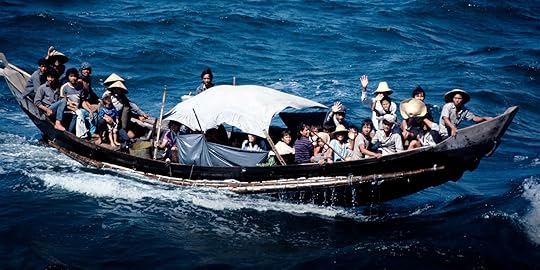
In short auto-fictional vignettes which resemble impressionistic miniatures, the narrator, a woman born in Saigon in 1968, switches backwards and forwards between the different stages in her life and the places connected to it, her life in Vietnam as a child, a refugee camp in Malaysia, building a new life in Canada with her parents and siblings and as an adult renewing the bonds with Vietnam when visiting it for her job, moving from country to country as if it were an anchor, or the memory of dropping the first anchor. Haunting scenes of war, communist ‘re-education’, living in fear, the escape on the boats, the horrific endurances in the refugee camp, capturing the experiences and life perspective of people having to leave everything behind, including language and identity alternate with moments of tenderness, reflections on motherhood, family anecdotes on numerous uncles and aunts (numbered instead of named), the narrator’s mentors and her education. In an understated but powerful way she illustrates the impact of trauma and loss on her parents having left their once privileged life behind for the future of their children, the estrangement and muteness she experiences while acquiring a new identity, a new language, settling in a different climate, breathing different air.

Concatenating fragments by association instead of narrative the narrator grapples with finding the right tone, the necessary distance in conveying her family’s experiences to others, catching herself recounting bits of my past as if they were anecdotes or comedy routines or amusing tales from far-off lands featuring exotic landscapes, odd sounds effects and exaggerated characterisations.

Because of her experiences aware of the fragility of life, the narrator movingly words her vulnerability as well as her joy through the love for her children:

"I should have chosen the moment before the arrival of my children, for since then I’ve lost the option of dying. The sharp smell of their sun-baked hair, the smell of sweat on their backs when they wake from a nightmare, the dusty smell of their hands when they leave a classroom, meant that I have to live, to be dazzled by the shadow of their eyelashes, moved by a snowflake, bowled over by a tear on their cheek. My children have given me the exclusive power to blow on a wound to make the pain disappear, to understand words unpronounced, to possess the universal truth, to be a fairy. A fairy smitten with the way they smell."

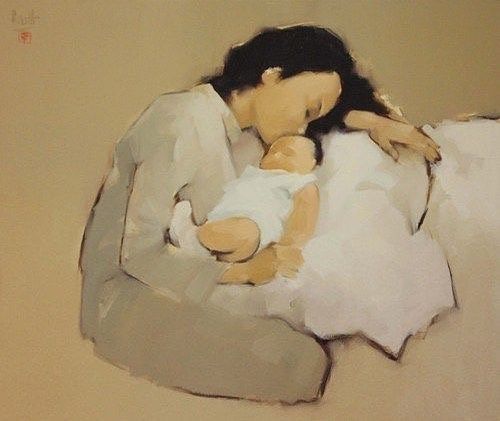
The-Mother-80x95drie

Reading Kim Thúy’s book shortly after another thinly veiled autobiographical novel which also focusses on a family of Vietnamese emigrants, Ocean Vuong’s raw and bleak novel, On Earth We're Briefly Gorgeous, the contrasts between both books are striking, which perhaps illustrates how much in life simply depends on luck. I couldn’t but wonder how Thúy’s life would have looked like if she and her family just like Ocean Vuong’s family wouldn’t have migrated to Canada, but to the USA, lucky fact of which she seems well aware when she describes witnessing the pitiful situation of one of the Vietnamese children fathered by a GI homeless and lost in New York. Without recoiling for the ambivalent feelings not unfamiliar to a person who is at the receiving side of help, in several pieces she makes clear how much her family owed to the generosity of the Canadian volunteers who welcomed the family upon their arrival in Canada – which is in stark contrast to the hopelessness of the characters living on the margins of society in On Earth We're Briefly Gorgeous where intergenerational war trauma’s and mental issues uncared for result in child abuse making a life in dignity impossible.

bc2fed403c2105bc4e246e065a494a3b

Kim Thúy’s alter ego narrator carries her wounds with grace and expresses profound appreciation for the people who she has met along the journey and who enabled her to be who and where she is now. As a rendition of the refugee experience Thùy’s poetic prose bestows heart and colour to her poignant account of the resilience and good fortune of the survivor. Timely and relevant as long as wars and oppressive regimes continue to tear the lives of people apart so they have to flee their war-torn country for fear for their lives or freedom, this is a moving and heartening read that lyrically evokes what it means to be a refugee from within.

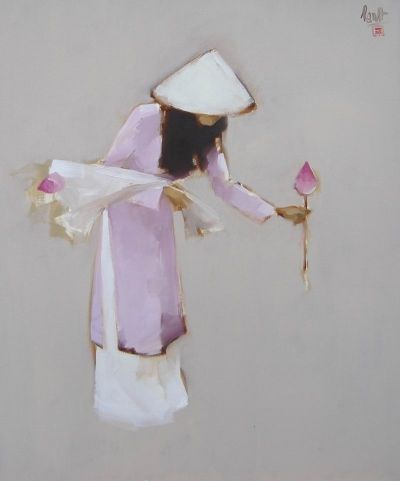
“After the old lady died, I would go every Sunday to a lotus pond in a suburb of Hanoi where there were always two or three women with bent backs and trembling hands, sitting in a small round boat, using a stick to move across the water and drop tea leaves into open lotus blossoms. They would come back the next day to collect them one by one before the petals faded, after the captive tea leaves had absorbed the scent of the pistils during the night. They told me that every one of those tea leaves preserved the soul of the short-lived flowers.”

(paintings by Nguyen Thanh Binh)
Profile Image for Brina.
1,238 reviews4 followers
March 7, 2017
I read Ru by Kim Thuy as part of my Women's History Month lineup in 2017. Thuy is a Vietnamese immigrant to Canada who has worked as a seamstress and lawyer. Ru is an autobiographical fictional account about a Vietnamese girl's experiences before and and after immigrating to Canada. This slim novel won the Governor's Award for best French literature in 2010 and is Thuy's first novel.

Growing up in the United States, one learns of the many sides of the Vietnam war. One side students do not learn much about is the fate of Vietnam's people. Thuy writes how a well to do family has their wealth taken from them by the new communist government inspectors. These agents move into the family's compound and track their every move until this once proud family is forced to leave the country when it is no longer safe. Leaving an extended family behind with hopes that they may one day be reunited in safety, the family flees on a rickety boat to Malaysia on their way to Quebec.

Ru signifies lullaby in Vietnamese and a small stream of memory in French. Thuy links the two in her beautiful prose as she describes Vietnam before the war. As a member of the upper class, her protagonist and family enjoyed the same wealth associated with the well to do in Europe. This luxurious lifestyle ended with the communist takeover, and Thuy's parents ended up working menial labor jobs outside of Montreal so that their children could enjoy a better life than the one they were forced to flee. Once Thuy has her protagonist find her new voice in French, she becomes a product of the North American dream.

A short novel of vignettes, I found Thuy's words to be captivating. Reading of the contrast of prewar Saigon, the detention center in Malaysia, and the new conditions in Quebec are chilling. Living a life of upheaval, Thuy through her protagonist admits, that she does not know how to love until she had her own children. As a mother, she learned the language of love as only she was privileged to give a child some of the unconditional love that she was denied growing up in a prewar, divided country and then later as an outsider. Her children then enjoyed the fruits of her parents labor, and the intergenerational interactions become the most touching scenes of the novel.

Although Kim Thuy is not originally an author by profession, her words along with Shiela Fischman's translation, are stunning. Whether it was in describing the imagery off prewar Saigon or a snowfall in Montreal, Thuy's use of prose reeled me in from the first pages. Despite being short in length, Ru is powerful in its message in describing the Vietnamese immigrant experience and then striving to achieve the American dream. I hope that Kim Thuy chooses to write more because this debut was beautiful, and I rate it 4 sparkling stars.
Profile Image for Canadian Jen.
661 reviews2,805 followers
August 30, 2016
RU translated in Vietnamese means lullaby. This was a poetic and beautiful short narrative with some very sad moments in the life of Ru, a young girl, who immigrated from Vietnam to Canada. The hardships that were taken to get here was a cost itself, but shedding the Vietnamese cloak of culture which defined her people, truly was a stripping of one's identity.
The heartache of leaving what you know, however twisted and sadistic it was, and being turned around in different directions trying to recalibrate oneself with this new reality.
I'm stunned by the beauty of this prose and saddened by the life she had to live before she got to a place reflective of that gentle sway. 5*
Profile Image for Baba.
4,067 reviews1,511 followers
August 27, 2023
Translated from French (originally Canadian published), Kim Thuy creates a semi-fictional biography broken down into vignettes, covering war-torn Vietnam, being 'boat people' and resettling in the West (Canada and America). A powerful, poignant, wonderful and sad look at the life and times of the 'boat-people' that left Communist ruled Vietnam in the 70s. 8 out of 12, informative Four Star read.

2012 read
Profile Image for Jaline.
444 reviews1,900 followers
December 23, 2017
This book was originally published in French in 2009, the English translation by Sheila Fischman was published in 2012, and it received the Governor General’s Literary Award 2010. Ru was also shortlisted for the Scotiabank Giller Prize in 2012, it received the Governor General’s Award for French to English translation in 2012, and the 2013 Amazon.ca First Novel Award. In addition, it won the CBC ‘Canada Reads’ competition in 2015.

The word “ru” holds a wealth of meaning in both French and Vietnamese. In French “ru” means stream or flow of money, tears or blood. In Vietnamese “ru” means cradle or lullaby. The essence of this book lies within those meanings.

This book is tiny yet it flows with deep meaning and many things to ponder - like a haiku in prose. It is also very visual – like a miniature painting it holds everything within that is supposed to be there, yet one does have to look very carefully at first, and then take a step back in order to appreciate all of it.

This is an immigrant story so there is suffering in this book. However, there is also great humour in places, and an array of other human emotions throughout its many little vignettes. It moves through time and place – Vietnam, Malaysia, and Canada – with brief mentions of other countries, too.

I found this story to be very interesting, and I was fascinated most of all by its flowing format and how the structure held everything together, like a cradle. Although this book is very small, it isn’t one to pick up and “knock off” for a “quick read”. If it is approached that way, there is a lot that will be missed. I do recommend this for readers who are interested in spending time not only reading about, but reflecting on the experiences this family lived through.
Profile Image for Christmas Carol ꧁꧂ .
963 reviews834 followers
July 1, 2017
I loved everything about this book except for the content. I liked the cover design and the gorgeous hand cut feel of it. I even liked the font. Ru by Kim Thúy But as you can see this cover states; Ru a novel by Kim Thuy. For me the ideal novel has development, a plot and conclusion. This slim volume doesn't. These are literary fragments beautifully written and no doubt at least partly autobiographical but they are still fragments. My interest was high at the start but went downhill faster than an Olympic gold medal skier.

I appreciate the author's talent but this style isn't for me.
Profile Image for Sue.
1,438 reviews650 followers
August 8, 2017
Kim Thuy has created a very different fictionalized memoir based in her past growing up in Saigon , living a life of privilege until that city's fall. Then the story changes to deprivation, re-education, escape, the new, cold world of Canada. She has chosen an unusual format for this book, a series of one and two page vignettes from her life, not in order of occurrence but some order that is internally important to the author and protagonist.

The writing is wonderful (my over-used, fall back word, I know) but the subjects described vary widely from the beautiful to the extremely brutal and ugly. Many years pass and the girl becomes a woman. I very strongly recommend Ru as a different form of memoir, an emmigrant experience, a picture of Vietnamese-Canadian life.

Addendum: Upon second and third thoughts, I'm raising the rating to 5. I really can't think of a reason this wouldn't be considered "amazing" in concept and completion.
Profile Image for Friederike Knabe.
400 reviews188 followers
January 1, 2013
Finished it in one go. A totally absorbing memoir/reflection on life in Vietnam, escape with the boat people, finding something like a home but not really in Quebec... Unusual in structure, rich in imagery, the interconnected vignettes paint a portrait of the heroine, her family, her country and what it means to be connected and uprooted at the same time.

Towards the end of the book, looking back on her earlier life, the narrator muses "...after only thirty years I already recognize our old selves only through fragments, through scars, through glimmers of light." It is these fragments, the scars and the glimmers of light that Kim Thuy has made the central theme of her book.

Like the workings of memory in our brains, nothing is told chronologically; much is only hinted at and, on superficial reading, not developed in depth. Connections between vignettes often hinge on one thought, one colour, one expression... Yet, taken together and letting the short fragments hold our attention for more than a moment or two, the reader is taken on a deeply moving voyage not only into the past of the heroine and her family, but also into the inner struggles of an individual displaced and disconnected from her roots, into her anxieties and fears to accept new ties that can bind...
Profile Image for Julie G.
1,010 reviews3,924 followers
March 14, 2021
This is less of a novel and more of a . . . mood? A stream-of-consciousness recalling of memories? It's the debut novel for the writer, Kim Thuy (2009), and it's obvious she's a gifted imagist and has a strong knack for summarizing an event using very few words.

I'd like to read more from her, but this particular little novel didn't have quite enough meat on its bones for me.
Profile Image for Angela M .
1,456 reviews2,115 followers
November 10, 2013
A small book with a big impact . The story of a Vietnamese immigrant told in short journal like entries . It moves from past to present and back again as the narrator tells of how she and her extended family lose their life of comfort and find refuge in Canada . The stories are moving , heartbreaking at times but ultimately an uplifting story of family and love. Beautifully written!
Profile Image for Magrat Ajostiernos.
724 reviews4,876 followers
March 10, 2023
Me ha encantado. Esta manera de escribir, entre recuerdos, breves anécdotas e historias más grandes, encaja conmigo a la perfección. Es una historia evocadora y sutil sobre Vietnam, sobre lo que significa ser refugiado, inmigrante y pasar de tenerlo todo a no tener nada.
Breve y de lectura rápida pero que es mejor alargar, y al final consigue permanecer contigo.
Profile Image for Repellent Boy.
634 reviews657 followers
February 6, 2021
"Ru" es una pequeña novelita muy especial donde la autora nos va a contar la historia de su vida. De una manera muy dispersa y desordenada nos va a ir narrando momentos de su vida referentes a diferentes etapas: como pasó de vivir en una familia adinerada en Saigón, a huir junto a esta de Vietnam; el tiempo que vivió en un campo de refugiados de Malasia; su vida en Quebec años después; las relaciones con los diferentes miembros de su familia; la educación de sus hijos; la relación con su estricta madre o el choque cultural entre oriente y occidente.

Lo primero que destaca es la narración de la historia. Me ha encantado lo precioso que se sentía todo por como estaba escrito, aunque te estuviera narrando hechos muy duros. La pluma de la autora es espectacular y siento que consigue transmitirte muy bien muchos sentimientos a la vez y transportarte a todos los momentos que te narra. Y lo consigue pese a lo breve que son estos trozos de su vida.

Lo que más me ha gustado son esas sensaciones bonitas que me ha trasmitido. Como pese a todo, pese a las mayores desgracias, las personas tienen esa voluntad de seguir adelante, buscando ser felices. Esa capacidad de reponerse, ese punto esperanzador me gusta mucho encontrarlo en los libros. Sobre todo en libros con una carga dramática considerable. En este libro se narran mucho hechos horribles, pero se siente ese contrapunto de superación. Me ha gustado eso.

Esta manera desordenada de ir narrando los hechos, como si la autora fuera escribiendo fragmentos sueltos de su memoria, me ha dejado una sensación agridulce. Y es que aunque he disfrutado mucho la novela por lo bien contada que está y por las reflexiones de la autora, por otra parte pensaba que esta forma dispersa limitaba la historia. Quizás si la historia fuera más larga y estuviera contada de forma cronológica, hubiera sido perfecta para mí. Aún así cuatro estrellas no está nada mal. Pienso repetir con la autora pronto.
Profile Image for luce (cry bebè's back from hiatus).
1,555 reviews5,836 followers
May 25, 2022
blogthestorygraphletterboxd tumblrko-fi

Ru is a short read that blurs the line between fiction and autobiography (autofiction..i guess?) and is comprised of very short chapters, most of them consisting of a couple of short paragraphs. These chapters, which often barely last a page, capture an instant or impression experienced by our Vietnamese-Canadian narrator. The feelings, thoughts, images, and anecdotes, that appear on these pages have a snapshot quality, both because the author is able to capture these in a concise yet hauntingly evocative prose. The narrator is now married with two children, one of whom is neurodivergent. While we do gain an understanding of her life in the present, the narrative is mainly preoccupied with her past. The narrator’s recollections of her ‘disrupted’ childhood are unsparingly unsentimental. She remembers her experiences at a refugee camp in Malaysia, the difficulties of trying to assimilate into a culture that sees you as ‘other’, her early years in Vietnam, her beloved Uncle Two, while also reflecting on the limitations of language and of memory, on history and alternate histories, on trauma, and on cultural dissonance.

The vignettes her reminiscences present to us have a fragmented quality, so that much of the narrator’s personal life and past remains shrouded in ambiguity. There is also an aloofness to her narration that made much of what she was recounting feel remote, intentionally so I believe. By distancing herself from her past the narrator is able to approach it with, curiously enough, far more clarity. There is a neutrality to her inner monologue that could easily lead one to believe that she too is like us merely a ‘witness’ as opposed to the person to who these things have happened to. I liked the stark imagery, the narrator’s cool tone, and the ideas and issues weaving her ‘retrospective’.
If you like proses that are so sharp you are liable to cut yourself or have a preference for non-linear narratives composed of a character’s past and present impressions (be it autofiction such as All Men Want to Know and On Earth We're Briefly Gorgeous, or literary fiction like as Gbost Forest) you should definitely add Ru to your tbr pile.

While I understood that many of the things the narrator divulges to ‘us’ are meant to elicit feelings of discomfort and unease, the way she sees her son’s autism gave me pause (she is “waging war against autism, even if I know already that it’s invincible”). While I understand too well that many countries still have a negative view of autism here it struck me that the narrator was creating an unfortunate parallel between her son’s autism and the Vietnam war that rubbed me the wrong way. I’m sure other readers will not be as ‘bothered’ by this but to be perfectly honest this aspect of the narrative detracted from my overall reading experience. Nevertheless I will definitely read more by Thúy.
Profile Image for Sharon Metcalf.
754 reviews202 followers
May 8, 2018
Ru is a fictionalised memoir based upon the real life experiences of author Kim Thuy. Told in brief passages, sometimes no longer than a sentence, her words were carefully selected and they packed a powerful punch. Her reflections and memories painted vivid pictures. Collectively they became an exhibition of her life experiences from a young girl in war torn Vietnam, her family's escape by sea, their time in a Malaysian refugee camp, their introduction to life in Quebec, learning to assimilate and to grasping the American dream. Her gift with words is remarkable. Somehow she managed to incorporate all the senses and evoked an array of emotions. She infused colour and substance and shared her insights and perspectives on motherhood, on love and family.

No matter how many words I write I will fail to convey just how powerful, how impactful this short work is. My best recommendation is to invest a few short hours of your time and read this very special, award winning book yourself.

Footnote: I read this rapidly and then enjoyed it all over again as I discussed it at length with my GR friend Celia. So much to discuss considering the brevity of the book. Thanks for the buddy read Celia, it was an absolute delight.
Profile Image for Barbara .
1,840 reviews1,513 followers
September 21, 2017
“Ru” is a heartfelt novel about a young Vietnamese immigrant whose family eventually ends up in Canada. This remarkable novel won the Canada’s Governor General Literary Award and was a “Canada Reads 2015” winner. It is stunning, one of my favorite reads in years.

This is an autobiographical novel telling author Kim Thuy’s story of the boat people and of her family who fled Saigon. Told in short vignettes, the narrator is protagonist Nguyen An Tinh who tells her story in lyrical detail, each vignette linked by subject and not time. Reading the story is akin to listening to a friend describe in detail facets of her life experiences. The gift the reader receives is incredible imagery of wrenching experiences of people who had no promise of safety. Although it was published in 2015, it is an amazing study of immigration and the importance of helping fellow mankind.

I highly recommend this to all American’s as a read that will open your heart to refugees.
Profile Image for Cheryl.
524 reviews844 followers
October 3, 2016
"Ru. In Vietnamese, it means lullaby; in French it is a small stream, but also signifies a flow--of tears, blood, money." Memory is universal, as is the disenchantment of exile. Try to explain the psychological disentanglement of oneself from the exiled land and culture, and there will still be some confusion. In order to survive, one must not glance back too often, otherwise one risks turning into a pillar of salt. Yet this part is not televised, this psychological inhibition not seen in too many scholarship from the experts. We know how to help current victims, how to raise awareness of travesty, but what about the survivors who live it daily?
I like the red leather of the sofa in the cigar lounge where I dare to strip naked in front of friends and sometimes strangers, without their knowledge. I recount bits of my past as if they were anecdotes or comedy routines or amusing tales from far-off lands featuring exotic landscapes, odd sound effects and exaggerated characterizations.

How does one record those many painful memories that form themselves in flashes across the mind's mirror? If Thúy had tried to publish these fragmented portraits as memoir, I suppose she would have had quite a few rejections. I can also speculate that she had quite a few rejections before this novel was published; as I will suspect there will be many readers who will not be able to grasp the importance of her writing from such a psychological distance, with such lyrical adeptness that the pages are each chapters or standalone poems. It takes grace and adroitness to concur such a feat, to produce heartbreaking lyrics that combine present and past life in captured moments; style that produces harrowing yet dazzling canvases of the individual strength and endurance of people of war. This is antithetical to the structured narrative and plot we're familiar with, and yet it is unique and captivating art.
Absolutely no one will know the true story of the pink bracelet once the acrylic has decomposed into dust, once the years have accumulated in the thousands, in hundreds of strata, because after only thirty years I already recognize our old selves only through fragments, through scars, through glimmers of light.
Profile Image for Elyse Walters.
4,010 reviews11.9k followers
October 27, 2020
“In French, ru means a small stream, figuratively, a flow, a discharge—of tears, of blood, of money.
In Vietnamese, ru means a lullaby, to lull”

Written in vignettes: 113 chapters. 114 pages long.

Kim Thuy’s short snippets- stream of consciousness- type writing....
is beautifully written...almost poetic prose.
Her Vietnamese diaspora experiences — from childhood to motherhood.... (life altering, affecting memories),
had me thinking about the 545 children separated at the border that cannot be found.
With the election in America, only a week away - and all the horrors we keep learning in 2020...
The question that continued to sit with me while reading ‘Ru’...
was...
“What’s wrong with our world - why so much corruption? why so heartless? Why so evil?”

In “Ru” we first meet
Nguyen An Tinh when she was ten years of age.
Nguyen was born in Saigon. Being from a wealthy family with servants and cooks— their lifestyle changed dramatically when they were forced to flee their country during the communist takeover. Such a frightening transitional unsettling time for this family - and many families.
We learn about the horrors of traveling by boat - the horrors of mistreatment.
...Then more horrors as a refugee in Malaysia...
...Then ( yet again), more challenges to face after
arriving in Quebec in 1979.

Assimilate... assimilate...assimilate!

In no chronological order... we get glimpses from past and present days.....
from when the communists entered Saigon and the family had to hand over their property...
to daily experiences shared in a Quebec:
....going to the movies, ice skating, McDonald’s with a friend, furnishing their home in Quebec from flea market vendors.....
and many lessons learned - in the eyes of a child—from observations. ( from parents, teachers, relatives, friends, strangers, languages, and cultures).

“As a child, I thought that war and peace were the opposites. Yet I lived in peace when Vietnam was in flames and I didn’t experience war until Vietnam had laid down its weapons. I believe that war and peace are actually friends, who mock us”.

“For a long time, I thought my mother enjoyed constantly pushing me right to the edge. When I had my own children, I finally understood”.

“Finally understood”....
is such a powerful universal theme.
The reader can pause ....ask ourselves, “what do we understand ‘now’ that our parents taught us?”
“And what do our children ‘finally understand’? Anything? Ha... we can hope!

Back to this story (really wonderful)....
When in Saigon...
Nguyen’s mother was preparing her brothers to become musicians, scientists, politicians, athletes, artists and polyglots, all at the same time.
At the same time, every day, Nguyen’s mother made her children wash ‘four’ tiles on the floor and clean ‘twenty’ sprouted beans by removing their roots one by one. She was preparing her children for the collapse.
Their mother was right to do so, because very soon they no longer had a floor beneath their feet.
Families had to slept right on the dirt when in those refugee camps.
Horrible conditions!

As an adult, Nguyen had two children: Pascal and Henri.
Nguyen says:
“I didn’t cry out and I didn’t weep when I was told that my son Henri was a prisoner in his own world, when it was confirmed that he is one of those children who don’t hear us, even though they’re neither death nor mute. He is also one of those children we must love from a distance, neither touching, nor kissing, nor smiling at them because everyone of their senses would be assaulted by the odour of our skin, by the intensity of our voices, the texture of our hair, the throbbing of our hearts. probably he’ll never call me maman lovingly, even if he can pronounce the word poire with all the roundness and sensuality of the oi sound. He will never understand why I cried when he smiled for the first time. He won’t know that, thanks to him, every spark of joy has become a blessing and that I will keep waging war against autism, even if I know already that it’s invincible”.
“Already, I am defeated, stripped bare, beaten down”.

Nguyen’s family felt blessed to be among the two thousand refugees in a camp that was intended for two hundred.
She says.....
“throughout my early childhood, my cousin Sao Mai always spoke on my behalf because I was her shadow: the same age, the same class, the same sex, but her face was on the bright side and mine on the side of darkness, shadow, silence”.

Nguyen’s mother wanted her to learn French as fast as possible, English too.
When they were in Quebec, her mother sent her to a military garrison of anglophone cadets— because learning English was free ( but came with an emotional price).
The first conversation Ru had in English was with a boy at her school — it ended with Nguyen saying: “Bye, Asshole”.

The ‘sharing’ type writing in “Ru”...created an intimate-connection between the reader and the narrator.
I am left with a sweetness in my heart for the author —
and can’t imagine any reader that wouldn’t be.

THIS IS SUCH A LOVELY ENJOYABLE BOOK.

About the author:
Kim Thuy has worked as a seamstress, interpreter, lawyer and restaurant owner. “Ru”, her first book, has been published in 15 countries and received several awards, including the Governor General’s Literary Award. Kim Thuy currently lives in Montreal, where she devotes herself to writing.


Profile Image for Connie  G.
2,143 reviews708 followers
October 11, 2022
"I first saw the light of day in Saigon, where firecrackers, fragmented into a thousand shreds, coloured the ground red like the petals of cherry blossoms or like the blood of two million soldiers deployed and scattered throughout the villages and cities of a Vietnam that had been ripped in two."

Vietnamese-born Canadian novelist Kim Thúy wrote a semi-autobiographical novel about a wealthy family in Saigon that needs to escape as the Vietnam War was winding down. Instead of a chronological plot, the book was written using quick impressions and fragmented descriptions in a series of vignettes that go back and forth in time.

The family escaped by boat and spent time in a refuge camp in Malaysia. They immigrated to the town of Granby in Quebec, Canada. Kim Thúy's story is not a political history, but a personal story about immigration and survival, learning new languages, the American Dream, motherhood, and identity. She felt that she was in a "hybrid state: half this, half that, nothing at all and everything at once."

The author writes about the burdens that the frail women of Vietnam carry. The old women are hunched over from working in the fields, many young women are emotionally changed from working as prostitutes to survive, and the women vendors carry soup and other foods, bowls, and portable coal stoves on long bamboo poles balanced on their shoulders.

Kim Thúy has prospered in Canada and has now written several books in French. Her poetic prose is a delight, and the vignettes in Ru are opportunities for reflection.
Profile Image for Cathrine ☯️ .
812 reviews420 followers
April 13, 2018
4+★
“Stories to keep alive the memory of a slice of history that will never be taught in any school.”

Ru is a fictionalized version of the authors own experience as a Vietnamese émigré and it just might be the best of its kind that I’ve read. It is told via a small collection of journal-like entries that weave back and forth between Saigon, a refugee camp in Malaysia, and the final destination of Québec with beautiful and unsentimental prose. Much was communicated in very few words and none of them wasted.
Profile Image for Alan (on December semi-hiatus) Teder.
2,705 reviews251 followers
September 19, 2023
September 19, 2023 Update Added a review for the 2023 film adaptation of Ru under Trivia and Links below. Also a NOTE: The pronunciation of Thúy sounds like "Thwee" (soft on the t sound). It means "water" in Vietnamese. Don't pronounce it "Too-ee" (hard t sound), which means "stinky/rotten" in Vietnamese. 😂

Re-read for TIFF 2023
Review of the Random House Kindle eBook (2012) translated by Sheila Fischman from the French language original Ru (2009).

I had completely forgotten that gesture, which I’d performed a thousand times when I was small. I’d forgotten that love comes from the head and not the heart. Of the entire body, only the head matters. Merely touching the head of a Vietnamese person insults not just him but his entire family tree.
...
When I meet young girls in Montreal or elsewhere who injure their bodies intentionally, deliberately, who want permanent scars to be drawn on their skin, I can’t help secretly wishing they could meet other young girls whose permanent scars are so deep they’re invisible to the naked eye.
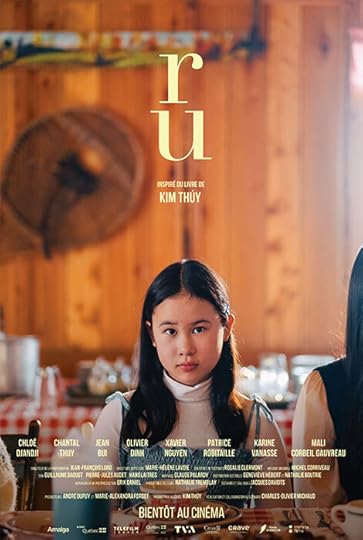

I first read Ru, which means "Lullaby" in Vietnamese, several years ago in my pre-reviewing days at Goodreads. It was 5 stars for me at the time, and it still felt like 5-stars on this re-read, which I did in advance of seeing the film adaptation next week at the upcoming Toronto International Film Festival (TIFF).

It does seem from the film trailer that the movie will concentrate on the family's arrival in Quebec, Canada after escaping as boat people from Communist Vietnam in the 1970s. The novel is far more sweeping and is disorienting as it is told in non-chronological vignettes that range from the lead character Tinh's childhood in Vietnam, thru the Communist victory in the war, the family's escape and eventual emigration to Canada and then further into the future when Tinh herself is grown with a family of 2 children and makes periodic visits back to Vietnam in the present day.


Promotional poster for the 2023 film adaptation of "Ru". Image sourced from TIFF.

I found Ru to be just as engaging on second reading with its beautiful evocations of childhood memories, the trauma of war and refugee escape and the 'fish out of water' settlement into a new country and culture while still hanging on to your roots.

Trivia and Links
Ru has been adapted as a Canadian French/Vietnamese language film with director Charles-Olivier Michaud and the author Kim Thúy as producer. The film will World Premiere at the 2023 Toronto International Film Festival in September 2023 and will have a general Canadian release on November 24, 2023. Read the TIFF background to the film here and watch an English language subtitled trailer here.

I gave the 2023 film adaptation a 5-star rating in my review on Facebook. Photographs of author & film producer Kim Thúy, film director Charles-Olivier Michaud and the main cast can be seen at Journal de Montreal (Note: French language article, turn on web translator). The film will have a November 24, 2023 general release in Canada. Foreign and/or streaming distribution is unknown to me at the present time.
Profile Image for Lisa.
101 reviews210 followers
November 30, 2015
Refugees. It's a word we hear so often these days, amidst massive geopolitical tremors that conceal countless very personal tales of dislocation and desperation. How many refugees should we let in? 200? 25,000? 1,000,000? Infinity?

Nguyễn An Tịnh is a refugee. One. She recalls small kindnesses, gestures from neighbours and attempts at communication, simple things from those first moments. This whole book is a series of fragments lifted from Vietnam, Quebec, and elsewhere, strung together piecemeal in a way that unsettles. We all rub shoulders in the metro as if we are all going about our daily lives in the same way, but really we have no idea. Which children spend their afternoons sewing in the garage to help make ends meet, their weekends picking berries. Which children have made a treacherous passage by boat, sitting in their own shit and vomit, with fear as a constant drumbeat. This novel/memoir is a lyrical reminder to approach one another with compassion and understanding. At least, that's what it was for me.
Profile Image for Peiman.
652 reviews201 followers
March 14, 2022
لالایی... شاید واقعا شبیه لالایی بود، یا روایت های کوتاه یکی دو صفحه‌ای که قبل از خواب برای بچه هات تعریف میکنی، روایت ها و داستان های کوتاهی از گذشته‌ی سخت، از اجبار به ترک خونه و زندگی، از آواره شدن، از کشوری که بهش مهاجرت کردی، از اطرافیانت و آروزهات. داستان هایی که نه به هم پیوسته هستند و تشکیل یک داستان میدن و نه جدا از هم...
Profile Image for Kim.
426 reviews540 followers
July 12, 2013

Until I was more than halfway through this book, I thought I was reading a memoir. That's my fault, because the blurb on the back and the information about the book on the Goodreads book page makes it clear that it's fiction, albeit autobiographical fiction. This fact slipped my mind at some point between acquiring the book and starting to read.

Like the author, the narrator of the work is a Canadian woman of Vietnamese origin, whose family settled in Canada as refugees. I particularly like the structure of the work - a series of short scenes, linked to each other by by threads created by a thought, an emotion, a place, an event or a character. The structure poetically depicts the way in which thinking about the past works, as each memory triggers another. I also like the way the narrative moves back and forward in time and place, with the adult narrator recalling particular events of her childhood and adulthood in Vietnam and Canada, not in chronological order, but as part of the tapestry of her life woven from memories colliding and coalescing. Another thing I like a lot about the work is the prose, which in French is poetic, yet simple and accessible.

However, for some reason, I liked the work more when I thought I was reading a memoir than I did when I realised that it's fiction. I'm not quite sure why, but I think my reaction is connected to the direction in which the narrative moves towards the end of the novel. Suddenly, seemingly out of nowhere, there are scenes which have little to do with the refugee experience and the themes of memory, dislocation and belonging which are central to the first part of the work. Those scenes feel forced, rather than organically connected to what happened previously.

Still, this was an interesting book to read, all the more so because I'm currently reading another autobiographical novel, far removed in place, time and themes - George Orwell's Down and Out in Paris and London. It's probably a 3-1/2 star read.

Merci à mon amie Jeanne, qui m'a proposé ce livre et qui l'a lu avec moi.
Profile Image for Matt Quann.
819 reviews450 followers
March 31, 2017
CANADA READS 2015 WINNER

The acclaimed novella Ru by Kim Thúy is my first read from the CANADA READS 2015 finalists, and its brevity, language, and themes make for a powerful read. Blurring the line between fiction and nonfiction, Ru is the story of one woman's life as she leaves Vietnam with her family, survives the harrowing experiences of a refugee camp, and finally immigrates to Montreal.

What sets this book apart from the typical immigrant story is the format, which sees the story bouncing back and forth in time, each chapter (I loosely use the term) ranging from a single sentence on a page to three pages. For the first few "chapters" I was frustrated, but soon enough the themes started to click with me and the nonlinear flow of the tale made a great deal more sense. The prose is lyrical, filled with metaphor, and unique turns of phrase. In some ways it almost feels like jazz: experimental, moving to and fro between times, interlacing experiences in ways that stay true to the main theme.

This is a story about a woman who is showing her path to her multi-cultural identity and the experience of the immigrant. Rather than being Canadian or Vietnamese, is she some hybrid of the two, or does the immigration experience somehow affect how her cultural identity was shaped in some entirely new way? These questions are asked of the reader implicitly, and the answers are left up to the interpretation of said reader. What's more, Thúy touches on peripheral characters who had radically different experiences, or immigrants she meets in Canada, sharing a connection to them through their shared displacement. These moments, in their shortened form, breathe life into a whole group of people who have settled in Canada to build a life that is impossible in their home countries.

This year's selection of CANADA READS books are competing for the title of the book that "can break barriers in Canada." Highlighting such a diverse group of cultures, and melding cultural identities, that make up the Canadian populace makes this a worthy book for the title. This book frames the way in which immigration is looked at and, despite not being tenable for a longer novel, the truncated sections work very well to compliment the multifaceted nature of the Vietnamese immigrants who touched down in Montreal. My only complaint is that this is not a typical novel, and is more experimental than I had originally anticipated. Nothing wrong with this of course, but it lacks cohesion as a normal narrative, but has such thematic consistency that it almost doesn't matter. Definitely a book that is worth the short time it takes to finish, and highly recommended to any Canadian!
Profile Image for EMMA.
255 reviews396 followers
November 1, 2018
اولين كتابي بود راحب ويتانام ميخوندم،تا يه حد كمي تونست اطلاعاتي بهم بده راحب جنگ ويتنام ولي خب كم بود.بنظرم معمولي بود زيادي ديگه سعي كرده بود هنري طور كتابشو بنويسه
Profile Image for Maciek.
573 reviews3,836 followers
November 19, 2013
Kim Thúy's Ru was originally published in French in Canada in 2010, where it won the Governor's General award for fiction among others, and secured publication rights in 15 additional countries. The English translation by Sheila Fischman (a specialist in translating French-Canadian literature) was published in 2012, and was shortlisted for Canada's prestigious Giller Prize. It's quite a feat - considering that Ru is Kim Thúy's debut novel, which she published at the age of 41.

Despite its short length, Ru must have taken a long time to be composed and written down - years, possibly even decades. Although the novel is a work of fiction, it obviously draws heavily from Thúy;s own experiences. Like her narrator, An Tinh, she was born to prosperity in Vietnam during the year of the monkey, but also the year of the Tet Offensive, which tore the country apart. Thúy and her family fled South Vietnam in boats with thousand other refugees, taking shelter in refugee camps in Malaysia before arriving thousands of miles away, in Quebec, and settling in the suburbs of Montreal. Because they spoke French, many Vietnamese refugees chose to settle in Quebec - which became one of the most populous destinations for Vietnamese immigrants coming to Canada during that time, second only to Ontario.

In Vietnamese, Ru means 'lullaby'; in French, it represents a small stream, but also signifies a flow. The duality of the title represents the novel very well - The flow of hundreds of thousands of Vietnamese refugees across the oceans to many various destinations, a flow of the stream of life towards the new world. This story - repeated so many times, but unique with each single one - can be a lullaby of sorts for their descendants, who grew up in the safety and prosperity that most of their parents never had.

Thúy's book is particularly interesting since she and her family came to Canada, instead of the United States - which, despite the close proximity of and the long relatiosnhip between the two countries made her life entirely different. Although separated by half of the globr and having completely different identities, in a way both Vietnam and Canada share the same conflict. Like Vietnam, divided into North and South, Canada is also a divided society - in a large part of it people speak French instead of English, and many view themselves as an entirely different society, and twice tried to transform their province into a new, sovereign country. This divide - linguistic, cultural, historical and ideological - combined with the experience of a young immigrant from a completely different society to both Canada and Quebec - could prove for fascinating reading.

Sadly, Ru never reaches that potential. The book is composed of vignettes, most no longer than a couple sentence - and can be easily read in one sitting. The whole book has a deeply personal feel to it - as if it was a personal journal kept by the author without any intention for publication (which I guess might just be the case). These vignettes are not arranged chronologically, and touch on the subjects important to Thúy - her upbringing in Vietnam, the escape on a boat and arrival in the refugee camp in Malaysia, later arrival in Quebec and the effort at assimilation there - and the unavoidable feeling of lost identity, hanging neither there or there. There is a scene in which An Tinh returns to Vietnam as an adult, and the waiter at a restuarant does not recognize her as a Vietnamese person - he says that she has adopted "American" sensibilities and lost the Vietnamese ones. How does that must feel - return to the place which was your home and find that it is no longer there? Or maybe even worse - it is there and always has been, but you can no longer enter it as a person that used to live there?

Each of the vignettes contains a nugget of an idea, a sliver of a theme and a touch of depth, but on the whole the novel feels unfinished - still very much a work in progress. It has the intimacy of a memoir, but the unmistakable look of being framed like a work of fiction. This is another divide present in the book - and just as in her life, I believe that it is an ongoing process which perhaps might never be finsihed, but which is one with which she will deal on her own terms and in her own time.

You can watch Kim Thúy speak about Ru and her immigrant experience in a video interview (in English) by clicking here.
Profile Image for Claire.
811 reviews367 followers
July 13, 2015
Reading Ru by Kim Thúy is like taking a long overland journey while looking up regularly to witness what passes in front of our eyes. Sometimes the view is stunning, sometimes it elicits sadness, it can be moving, nostalgic, perhaps an odour transports us back to a scene from childhood, a person reminds us of someone we once knew.

Reading it in French imbues it with a drifting, lyrical resonance, sometimes I drifted off as the excess of descriptive words were beyond my reach and I was too lazy to look them up, not wanting to interrupt the flow. Until another day, when I would read with the two dictionaries beside me and remember how much more fulfilling it is to venture further into unknown linguistic territory, enriching one's vocabularly in another language.

Many of the pages are like short vignettes, experiences that provoke a memory, the man at the petrol station who sees a scar and recognises a childhood vaccination from Vietnam, his own hidden beneath a tattoo of of a blue dragon, he shares a few memories, he touches her scar and places her finger in the middle of the blue dragon.

Reflections of time passed, the journey of a woman with her family leaving the south of Vietnam for Canada via a refugee camp in Malaysia, she is a woman connected with another culture and the past, who intends to embrace 'the dream', whose own children will grow up in that modern culture with different references.
Profile Image for Diane S ☔.
4,901 reviews14.6k followers
December 20, 2012
This was a book of short connecting vignettes, all pertaining to Ru's life past and present. The detail in these stories and the wonderful prose kept me reading. The story goes back and forth, from Vietnam, to a Malaysian refuge camp and than on to Quebec. She comes to understand more things about her mother when she has children of her own. The war in Vietnam, to the struggle to acclimate in a foreign country and than her struggle with her autistic child are all related. In fact it is amazing how much we come to know about Ru and her family in thes3e short vignettes. The writing certainly deserves a 4, but this type of structure, plus the going back and forth did not allow me to form an emotional bind with any of the characters. I found out much information about them but the connection was not there. Will definitely read this novelists next novel because I do admire her prose.
Profile Image for Effie Saxioni.
724 reviews137 followers
May 22, 2021
Ψήγματα αναμνήσεων,με ωραία ροή,χωρίς να βαραίνουν με φρικιαστικές περιγραφές,αφήνει τη φρίκη του πολέμου,του ξεριζωμού και της μετανάστευσης να μπουν κάτω από το δέρμα του αναγνώστη,με την αθωότητα των περιγραφών ενός παιδιού. Πανέμορφο!
5⭐
Profile Image for Celia.
1,437 reviews246 followers
October 28, 2020
The reading of Ru is to experience life from the horrible to the sublime.

Ru is a fictionalized version of the author’s own experience as a Vietnamese émigré. We meet so many people and experience so many events along the way as we travel with the narrator from Vietnam to Malaysia to Quebec, Canada.

The afterword in the book clearly provides a timeline of what has happened and I have copied some of it to share:

The narrator is ten when her family is forced to flee their home and luxurious lifestyle in Saigon because of the Communists. In vignettes that move between the past and present, the narrator tells of the Communist child inspectors who take up residence in their home and how her family flees in the dead of night by boat, taking only what is necessary with them and smuggling diamonds in vessels like shirt collars and pink plastic bracelets. They arrive in Malaysia, where her family is accepted into an overcrowded refugee camp.

Eventually, the family is able to settle in Quebec, where sponsors help them furnish their house, find clothes at the flea market, and acquire mattresses with actual fleas. It is only in Canada that the narrator, who spoke very little during her childhood, begins to open up, learning from teachers and friends the joy of language and song; it is these encounters that help the narrator realize she wishes to become a writer.

She is affected by:
Her mother, who wants her to learn English and frequently exhibits 'tough' love
Her father, who has only ever lived in the present and wants her to forget the past
Her cousin Sao Mai, whom she shadows throughout their childhood
Her paternal grandfather, who had stopped speaking after his stroke

Great book to read and share with a friend.

4 stars (some of the descriptions are pretty ugly and painful to read)
Displaying 1 - 30 of 2,509 reviews

Can't find what you're looking for?

Get help and learn more about the design.